Showing posts with label creator: james robinson. Show all posts

20 July 2022

JSA, Book One by Geoff Johns, David Goyer, Stephen Sadowski, Michael Bair, et al.

JSA by Geoff Johns, Book One

Collection published: 2017
Contents published: 1999-2000
Read: April 2022

Writers: Geoff Johns, David Goyer, James Robinson
Artists: Stephen Sadowski, Michael Bair, Buzz, Scott Benefiel, Derek Aucoin, Marcos Martin, Keith Champagne
Colorist: John Kalisz
Letterer: Ken Lopez

In this series of posts, I've been tracking an impending Justice Society renaissance. After the brief flurry of JSA-related material from 1991 to 1993 or so, the JSA was largely left behind... and then it exploded in 1999. That all culminated in JSA, a new ongoing series, the Justice Society's first in six years, and also its longest; it lasted eighty-seven issues, beating out the original All Star Comics run's fifty-seven. Plus, as we'll see going forward, it led to any number of spin-offs and tie-ins.

It seems weird to me that this series of reprints is branded "JSA by Geoff Johns," as he works on just ten of this collection's fifteen issues, and the five he doesn't work on are the first five, which set up what this new team is and how it works. David Goyer is the only one of this volume's contributors who works on every issue. But, I guess if you're Chief Creative Officer and President of DC Comics, you can make sure your name is displayed prominently wherever you like.

I felt like this series was pushing a Dinah/Jack thing. Am I reading in too much? Kind of weird, if so, because their parents had an affair!
from JSA #12 (script by David Goyer & Geoff Johns, art by Buzz)

Basically, this volume sees the reestablishment of the JSA, and like Paul Levitz and Gerry Conway's 1976-79 revival, it makes it into a multigenerational team, leaning into the idea of heroic legacy that Roy Thomas laid the foundations of over in Infinity, Inc. By now, though, we are up to three generations of heroes: we have members of the original team like Alan Scott (formerly Green Lantern, but still ghettoized as "Sentinel" here), Wildcat, and the Flash (Jay Garrick); immediate descendants and sidekicks like Atom-Smasher (formerly Nuklon of Infinity, Inc.), Sand (formerly Sandy the Golden Boy, sidekick to the Sandman), Doctor Fate (Hector Hall, formerly the Sandman, formerly formerly the Silver Scarab of Infinity, Inc.), and Black Canary (Dinah Lance, daughter of the original, Dinah Drake); and then brand-new heroes like the new Starman (Jack Knight), Stargirl (Courtney Whitmore), and the new Hawkgirl (Kendra Saunders). Plus there's a new new Hourman who is some kind of android, and a new new Doctor Mid-Nite who is a white dude.* It's a neat idea, a team composed of mentors and mentees... but I found the book didn't actually do very much with it.

Always up for a Director Bones appearance, but this was a pretty pro forma one.
from JSA #11 (script by David Goyer & Geoff Johns, art by Michael Bair & Buzz)

Overall, this is an approach to team superheroics that wasn't very much to my liking. The book moves from apocalyptic event to apocalyptic event with no time to breathe; I would have very little sense of any of these people as characters if it wasn't for the fact I know them from other books. There are a lot of shock events—deaths and people going evil and people being plunged into terrible universes—but there is little sense that any of it matters, and I found it difficult to care. Geoff Johns always gets a lot of praise for his handling of history and continuity, but I feel like this is only true if you are a character Johns is nostalgic for from his youth. Obsidian from Infinity, Inc., for example, makes a comeback here just to become a villain so that his father, Alan Scott, can angst about its for a few panels. Hector Hall is resurrected... but I'm not really sure why, as once he comes back to life, he exhibits as much personality as a lamp-post. We do hear a lot from Sand... and I would quite frankly like to never do so again. What a poorly conceived, uninteresting character. Has any Golden-Age-kid-sidekick-turned-lead ever worked out except for Robin?

You can tell me he is connected to much more interesting characters... but you can't make me care.
from JSA #1 (script by James Robinson & David Goyer, art by Stephen Sadowski & Michael Bair)

I recently reread my very first post in this series, where I wrote, "I'm not going into the Geoff Johns era because, really, a little bit of Geoff Johns goes much too far in my experience." Over two years later, I actually don't remember thinking that, nor do I remember when I changed my mind and added all the Geoff Johns stuff to my list. There is quite a lot of it: seventy-two more issues of JSA, the spin-off JSA Classified, and the soft reboot of JSA as Justice Society of America vol. 3, plus myriad miniseries. I feel committed at this point—how can I follow the JSA from 1977 to 1999, but not the one more decade it would take to get me up to the end of the "original" JSA with Flashpoint?—but I can't claim to exactly be excited about it all based on reading this.

* Roy Thomas introduced a new Wildcat and a new Doctor Midnight, both women of color, during Infinity, Inc., but I see they were both killed off to prove the situation was serious in an issue of Eclipso back in 1993, paving the way for white dudes to reclaim the mantles. Of course.
 
This post is twenty-ninth in a series about the Justice Society and Earth-Two. The next installment covers Wonder Woman: The 18th Letter: A Love Story. Previous installments are listed below:
  1. All Star Comics: Only Legends Live Forever (1976-79)
  2. The Huntress: Origins (1977-82)
  3. All-Star Squadron (1981-87)
  4. Infinity, Inc.: The Generations Saga, Volume One (1983-84)
  5. Infinity, Inc.: The Generations Saga, Volume Two (1984-85)
  6. Showcase Presents... Power Girl (1978)
  7. America vs. the Justice Society (1985)
  8. Jonni Thunder, a.k.a. Thunderbolt (1985)
  9. Crisis on Multiple Earths, Volume 7 (1983-85)
  10. Infinity, Inc. #11-53 (1985-88) [reading order]
  11. Last Days of the Justice Society of America (1986-88)
  12. All-Star Comics 80-Page Giant (1999)
  13. Steel, the Indestructible Man (1978)
  14. Superman vs. Wonder Woman: An Untold Epic of World War Two (1977)
  15. Secret Origins of the Golden Age (1986-89)
  16. The Young All-Stars (1987-89)
  17. Gladiator (1930) ["Man-God!" (1976)]
  18. The Crimson Avenger: The Dark Cross Conspiracy (1981-88)
  19. The Immortal Doctor Fate (1940-82)
  20. Justice Society of America: The Demise of Justice (1951-91)
  21. Armageddon: Inferno (1992)
  22. Justice Society of America vol. 2 (1992-93)
  23. The Adventures of Alan Scott--Green Lantern (1992-93)
  24. Damage (1994-96)
  25. The Justice Society Returns! (1999-2001)
  26. Chase (1998-2002)
  27. Stargirl by Geoff Johns (1999-2003)
  28. The Sandman Presents: The Furies (2002)

04 July 2022

Stargirl by Geoff Johns, Lee Moder, Scott Kolins, Dan Davis, et al.

Stargirl by Geoff Johns

Collection published: 2020
Contents originally published: 1999-2003
Read: March 2022

Writers: Geoff Johns, James Robinson, David S. Goyer
Artists: Lee Moder, Scott Kolins, Dan Davis, Chris Weston, John Stokes, Mike McKone, Wayne Faucher
Colorists: Tom McCraw, Carla Feeny, John Kalisz
Letterers: Bill Oakley, Kurt Hathaway

This volume collects the entirety of Stars and S.T.R.I.P.E., a modernized take on the Star-Spangled Kid that began slightly before and ran alongside the Robinson/Goyer/John JSA revival of 1999. Our main character is Courtney Whitmore, a teenager who has recently relocated to Blue Valley, Nebraska because her mother has remarried, to Pat Dugan, who back during World War II was Stripesy, sidekick to the Star-Spangled Kid. She ends up becoming the new Star-Spangled Kid, eventually dubbing herself "Stars" and then "Stargirl," while Pat operates as her sidekick in  a robotic suit called S.T.R.I.P.E. (As the cover of my edition indicates, it eventually became the basis for the CW tv series Stargirl starring Brec Bassinger.)

As a concept, it's great. Definitely a good storytelling engine: you have high school stuff, secret identity stuff, interpersonal stuff, legacy stuff. Courtney is ultimately the inheritor of the Star-Spangled Kid mantle and the Starman mantle. But I ended up feeling like Geoff Johns might not have been the writer to successfully pull off his own idea. The idea here is that Courtney becomes a superhero to annoy her stepfather, and then sort of grows into it... but I felt like this is an idea that we were told more than we actually saw on the page. The interpersonal dynamics were often crowded out by the superhero plots and the crossover storylines; some of Courtney's development as a hero was seemingly happening over in JSA, not here. I never really got a feel for her and Pat's relationship in a meaningful way.... but of course this is Geoff Johns. Great idea, but hand the execution over to, say, a John Rogers or a G. Willow Wilson, and I think this would have soared.

Heck of a kick for a brand-new superhero.
from Stars and S.T.R.I.P.E. #1 (script by Geoff Johns, art by Lee Moder & Dan Davis)

Still, it's entertaining stuff. Johns picks up on the kind of "legacy" work Roy Thomas was doing in Infinity, Inc., and the result is strong. I liked the story about Courtney interacting with Starman, for example, paralleled with a flashback adventure about how the original Star-Spangled Kid became Skyman, and also tying in how Star-Spangled Kid got the cosmic converter belt way back in the very first story I reviewed for this project, Only Legends Live Forever. I don't know if this kind of storytelling is meaningful to people who haven't been reading JSA comics nonstop for over two years now, but I dug it.

Of course I am always up for an Infinc flashback!
from Stars and S.T.R.I.P.E. #4 (script by Geoff Johns, art by Lee Moder & Dan Davis)

The Teen Titan appearances were fun. The story delving into the post-Crisis version of the JLA/JSA/Seven Soldiers of Victory crossover that brought the Star-Spangled Kid and Stripesy into the present day was fun... almost certainly better than the original story, actually! (Although, since when was the Crimson Avenger's sidekick, Wing, a kid? In the Roy Thomas version, he was the chauffeur!) I liked the occasional conversations between Pat and the original Starman, Ted. The villain being an evil cheerleader was good. The only "legacy" element I disliked was learning that Danette Reilly, Firebrand in All-Star Squadron, was fridged off-panel sometime in the decades since WWII in order to give the Shining Knight some angst. She is too good a character to deserve that, but apparently has made no post-A-SS appearances except in the All-Star Comics 80-Page Giant.

Poor Danette.
from Stars and S.T.R.I.P.E. #13 (script by Geoff Johns, art by Lee Moder & Dan Davis)

Overall, this is fun, and I look forward to seeing Courtney shine in JSA. But I can't help feel that somewhere in the multiverse there's a version of this comic that rivals G. Willow Wilson's Ms. Marvel!

This post is twenty-seventh in a series about the Justice Society and Earth-Two. The next installment covers The Sandman Presents: The Furies. Previous installments are listed below:
  1. All Star Comics: Only Legends Live Forever (1976-79)
  2. The Huntress: Origins (1977-82)
  3. All-Star Squadron (1981-87)
  4. Infinity, Inc.: The Generations Saga, Volume One (1983-84)
  5. Infinity, Inc.: The Generations Saga, Volume Two (1984-85)
  6. Showcase Presents... Power Girl (1978)
  7. America vs. the Justice Society (1985)
  8. Jonni Thunder, a.k.a. Thunderbolt (1985)
  9. Crisis on Multiple Earths, Volume 7 (1983-85)
  10. Infinity, Inc. #11-53 (1985-88) [reading order]
  11. Last Days of the Justice Society of America (1986-88)
  12. All-Star Comics 80-Page Giant (1999)
  13. Steel, the Indestructible Man (1978)
  14. Superman vs. Wonder Woman: An Untold Epic of World War Two (1977)
  15. Secret Origins of the Golden Age (1986-89)
  16. The Young All-Stars (1987-89)
  17. Gladiator (1930) ["Man-God!" (1976)]
  18. The Crimson Avenger: The Dark Cross Conspiracy (1981-88)
  19. The Immortal Doctor Fate (1940-82)
  20. Justice Society of America: The Demise of Justice (1951-91)
  21. Armageddon: Inferno (1992)
  22. Justice Society of America vol. 2 (1992-93)
  23. The Adventures of Alan Scott--Green Lantern (1992-93)
  24. Damage (1994-96)
  25. The Justice Society Returns! (1999-2001)
  26. Chase (1998-2002)

15 June 2022

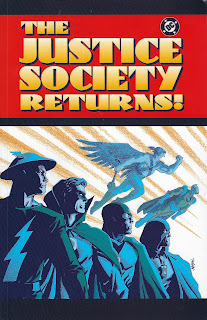
The Justice Society Returns! by David Goyer, James Robinson, et al.

 The Justice Society Returns!

Collection published: 2003
Contents originally published: 1999-2001
Acquired and read: February 2022

Writers: David Goyer, James Robinson, Chuck Dixon, Geoff Johns, Ron Marz, Tom Peyer, Mark Waid
Pencillers: Michael Lark, William Rosado, Eduardo Barreto, Scott Benefiel, Russ Heath, Aaron Lopresti, Stephen Sadowski, Peter Snejbjerg, Chris Weston, Peter Grau
Inkers: Michael Bair, Eduardo Barreto, Keith Champagne, John Dell, Wade Von Grawbadger, Doug Hazlewood, Russ Heath, Ray Kryssing, Aaron Lopresti, Mark Propst, Claude St. Aubin, Christ Weston
Colorists: John Kalisz, Carla Feeny, Noelle Giddings, Tom McCraw
Letterers: Ken Lopez, Kurth Hathaway, Bill Oakley, John Costanza, Janice Chiang

I'm coming up on the return of the JSA to an ongoing comic, but before then, I'm reading four collected editions with JSA connections, of which this is the first.

The title of this volume would seem to indicate that it's about a triumphant return of the Justice Society of America. This is only kind of true. This isn't a "return" in the narrative; the JSA (which had disbanded in Zero Hour) was still moribund in the present-day of the DC Universe (though that was about to change), it was a return out of the narrative, in that 1999 gave us a JSA title for the first time since the end of its short-lived only ongoing back in 1993. But if you were to look at my list of titles below, it's slightly deceptive: it would imply no JSA-adjacent titles from the end of Damage in 1996 until now. But in fact one had been steadily chugging along since 1994: James Robinson's Starman. This was about the most recent inheritor of the Starman mantle, but it had played a lot with the history of the character, including his JSA ties. That title was primarily written by James Robinson, often co-plotted by David Goyer, and it's those two that primarily guide this storyline.

Did people in 1945 know this? I guess probably.
from All Star Comics vol. 2 #1 (script by James Robinson & David Goyer, art by Michael Lark and Wade Von Grawbadger & Doug Hazlewood)

The Justice Society Returns! is set in 1945, as it seems World War II is coming to an end, and one could imagine it as a story arc in All-Star Squadron if the series had made it that far along; like that series, it weaves the superheroics in and out of real war to good effect. It is structured like a typical Golden Age JSA storyline: the characters as a group discover some issue, then they split up into groups to handle different aspects of it, then they come back together as a group to finish it off. Except, instead of having just a single issue to do all of this, JSA Returns takes nine issues, two of which are double-sized!

This turns out to really work. I usually dislike the typical JSA structure because everything is rushed and you don't get much genuine character interaction—which is surely what you want out of a team book! But with one issue apiece for each pair of heroes, you can really dig into them. The individual stories, like All-Star Squadron did, do neat stuff by placing these superheroes in wartime, exploring what makes them tick, and delving into the war itself at the same time. Goyer and Robinson write the two framing issues (All Star Comics vol. 2 #1-2, more on them later), while a variety of writers pen the ones in between; each issue has its own artist.

Good use of the silent panel, here.
from All-American Comics vol. 2 #1 (script by Ron Marz, art by Eduardo Barreto)

Highlights included "Cold Heart" (All-American Comics vol. 2 #1), which is about Green Lantern and Johnny Thunder protecting the Yalta Conference, but is mostly told from the perspective of an ordinary American soldier trying to do the same without superpowers: a strong sense of tone, time, and character make this an effective tale. It might be the best Ron Marz script I've ever read, and Eduardo Barreto is a great penciller who I am surprised not to know more of given this quality of work.

Go little guy, go!
from Adventure Comics vol. 2 #1 (script by James Robinson & David Goyer, art by Peter Snejbjerg & Keith Champagne)

I also really liked "Stars and Atoms" (Adventure Comics vol. 2 #1), which sends Starman and the Atom to Los Alamos to protect the atom bomb test site. Robinson and Goyer themselves provide a great focus on one of my favorite JSAers, the eternal underdog the Atom, and Peter Snejbjerg (is he an underrated talent? I always like him but can't remember seeing him get much high-profile stuff) also turns in some atmospheric pencils, backed up by great coloring from John Kalisz. The debt that this whole series owes to A-SS is most clear here, as it picks up on some stuff Roy Thomas established about how the Atom developed superpowers and changed costumes (though I think that "really" didn't happen until 1948).

I don't think I've ever read a comic really focused on Mr. Terrific, but I usually enjoy him when he pops up.
from National Comics vol. 2 #1 (script by Mark Waid, art by Aaron Lopresti)

It would probably surprise no one to know that Mark Waid's story is also one of the collection's greats. "Fair Play" (National Comics vol. 2 #1) is set in Dresden during the Dresden bombing, focusing on the Flash and Mr. Terrific. The story is narrated by the Flash, but focuses on Mr. Terrific, whose sense of fair play is undermined by the horrific events he witnesses... perpetrated by his own side! The ending is a little pat, though, as the story kind of punts responsibility for the bombing onto war itself rather than, you know, the people who make these decisions.

Gotta get our gratuitous shots into those comics about women, amirite?
from Sensation Comics vol. 2 #1 (script by James Robinson & David Goyer, art by Scott Benefiel & Mark Propst)

Probably the only misfire is "Womanly Deeds & Manly Words" (Sensation Comics vol. 2 #1). The writing here from Robinson & Goyer is fine, teaming up Wonder Woman and Hawkgirl, but it is pretty typical superhero comics that clearly someone involved went, "Well, why would people read a comic about two women unless it had a lot of panels with gratuitous focuses on tits, asses, and panties in it?" I don't know this Scott Benefiel guy, and I am not encouraged to do so. The Wonder Woman here is Diana's mother, Queen Hippolyta, having travelled back in time (I think this happened in John Byrne's Wonder Woman comics, which I haven't read), but the story mostly shies away from that; aside from Johnny Thunder calling her "Polly" in one issue, I don't think there's a reference. (Roy Thomas established back in All-Star Squadron/Secret Origins that Miss America filled Wonder Woman's role in the JSA in the post-Crisis timeline, but later writers don't seem to have been very interested in that idea.)

I have never really been convinced I want to read a Johnny Thunder series or something, but I have come to see him as a delightful bit of color in JSA stories.
from All Star Comics vol. 2 #1 (script by James Robinson & David Goyer, art by Michael Lark and Wade Von Grawbadger & Doug Hazlewood)

I also was not very taken by the wrap-up issue, "Time's Arrow" (All Star Comics vol. 2 #2), which becomes a confusing muddle involving time travel for no evident reason. It felt like the writers ran out of space... but they only ran out of space because they added a bunch of unnecessary stuff! But the first issue, "Time's Keeper" (All Star Comics vol. 2 #1), was a strong one; it's essentially two one-issue stories combined: first an Hourman solo story, then a big JSA fight. I can't claim to love Hourman (I would be very happen to never read another ham-fisted Miraclo addiction storyline), but he can work well in some cases, and this is one of them. Michael Lark, better known for his work on Gotham Central, is just as adept with traditional superheroics.

(There are also two short stories that pad out the volume, one about class snobbery in the JSA from Golden Age Secret Files and Origins #1, and one about Stargirl from JSA Secret Files and Origins #1. The former was fun, but the latter did not make me like Stargirl very much. I am curious to see her in her original solo series, which I should do soon.)

Overall, this is great, doing what the "retroactive continuity"–based JSA comics have done at their best since the days of All-Star Squadron, and I am glad I spent the money to track down a physical copy. Soon I'll be reunited with the JSA in the present (there is a veritable explosion of JSA content in the early 2000s) but this is a great teaser for things to come, a great return to the glory days.

This post is twenty-fifth in a series about the Justice Society and Earth-Two. The next installment covers Chase. Previous installments are listed below:
  1. All Star Comics: Only Legends Live Forever (1976-79)
  2. The Huntress: Origins (1977-82)
  3. All-Star Squadron (1981-87)
  4. Infinity, Inc.: The Generations Saga, Volume One (1983-84)
  5. Infinity, Inc.: The Generations Saga, Volume Two (1984-85)
  6. Showcase Presents... Power Girl (1978)
  7. America vs. the Justice Society (1985)
  8. Jonni Thunder, a.k.a. Thunderbolt (1985)
  9. Crisis on Multiple Earths, Volume 7 (1983-85)
  10. Infinity, Inc. #11-53 (1985-88) [reading order]
  11. Last Days of the Justice Society of America (1986-88)
  12. All-Star Comics 80-Page Giant (1999)
  13. Steel, the Indestructible Man (1978)
  14. Superman vs. Wonder Woman: An Untold Epic of World War Two (1977)
  15. Secret Origins of the Golden Age (1986-89)
  16. The Young All-Stars (1987-89)
  17. Gladiator (1930) ["Man-God!" (1976)]
  18. The Crimson Avenger: The Dark Cross Conspiracy (1981-88)
  19. The Immortal Doctor Fate (1940-82)
  20. Justice Society of America: The Demise of Justice (1951-91)
  21. Armageddon: Inferno (1992)
  22. Justice Society of America vol. 2 (1992-93)
  23. The Adventures of Alan Scott--Green Lantern (1992-93)
  24. Damage (1994-96)

14 December 2016

Faster than a DC Bullet: Project Crisis!, Part LV: The World of Flashpoint featuring Wonder Woman

My three days of Doctor Who reviews comes to an end with the best Fourth Doctor Adventure so far this series, Gallery of Ghouls.

Comic trade paperback, n.pag.
Published 2012 (contents: 2011)
Borrowed from the library
Read July 2016
The World of Flashpoint featuring Wonder Woman

Writers: Dan Abnett & Andy Lanning, Tony Bedard, James Robinson
Pencillers: Agustin Padilla, Scott Clark, Vicente Cifuentes, Ardian Syaf, Eddie Nunez, Gianluca Gugliotta, Christian Duce, Javi Fernandez
Inkers: Jose Aviles, Dave Beaty, Vicente Cifuentes, Diana Egea, Don Ho, Gianluca Gugliotta, Walden Wong, Javi Fernandez
Colorists: Nei Ruffino, Val Staples, Andrew Dalhouse, Kyle Ritter, The Hories
Letterers: Travis Lanham, Jared K. Fletcher, Dave Sharpe, John J. Hill

I'm not sure where I got my reading order for the Flashpoint collections from, but so far, it seems to make sense to read the Wonder Woman World of Flashpoint collection first. The first two stories in here, "Wonder Woman and the Furies" and "Emperor Aquaman," lay out the status quo of this new timeline we're suddenly in, from different perspectives. The Wonder Woman tale spans the history of the Flashpoint universe, showing us Princess Diana first encounter with Man's World, which results in an engagement to Aquaman. Reactionary elements in both the Amazon and Atlantean societies think merging the cultures is a Very Bad Idea, and manipulate events to kick off a war that wrecks much of the Earth, with Great Britain becoming an Amazon fortress and much of Europe devastated by an Atlantean geo-weapon.

That's Angela Merkel, right? It always amuses me when actual heads of state turn up in superhero comics. Though, in one of the stories in The World of Flashpoint featuring Superman, Germany is represented by an actual Nazi, so how does that track with this?
from Flashpoint: Emperor Aquaman #1 (script by Tony Bedard, art by Ardian Syaf & Vicente Cifuentes)

As a story, to be honest, the Wonder Woman one doesn't have a whole lot to recommend it, from either a writing or artistic perspective; the writing moves too quickly for us to get attached to this version of Diana, and the art is weird, either plasticky under one illustrator, or kind of flat under another. But the story's real purpose seems to be exposition: read this, and you'll know the background for every subsequent World of Flashpoint tale. As a result, "Emperor Aquaman" seems to have more room to breathe, giving more personal focus to Arthur Curry in this mad world, showing his youth (he spent much less time on the surface world than his Prime equivalent, to his morality's detriment) and how the attacks detailed in the Wonder Woman tale affected him on a personal level. It's not particularly amazing, but it works.

I'm not sure what I like less, plastic-face on the left, or giant-eye on the right.
from Flashpoint: Wonder Woman and the Furies #1 (script by Dan Abnett & Andy Lanning, art by Scott Clark & Dave Beaty) and #2 (script by Dan Abnett & Andy Lanning, art by Agustin Padilla & Jose Aviles)

If there's anything to like about these tales so far, it's how they all interlock to create a larger tapestry. "Lois Lane and the Resistance" shows us the backstory of some key events of "Wonder Woman and the Furies": like, we learn how come Lois is broadcasting a distress signal to the world from Great Britain, and how Diana figures out that her aunt has set her up. Other than that and some once again goofy art (the outfits Eddie Nunez puts Lois into are ridiculous, though I thought the issue illustrated by Christian Duce showed some real design sense) and a team up between Etrigan the Demon and Grifter, there's not much going on here.

At first I was gonna scan some of the art I didn't like, but then I was like, 'c'mon, self, accentuate the positive.' Looking at it again, I think it's the inking that really makes it work: Walden Wong is pretty reliable.
from Flashpoint: Lois Lane and the Resistance #3 (script by Dan Abnett & Andy Lanning, art by Christian Duce & Walden Wong)

The book closes out with "The Outsider," about an asshole criminal from India. This story isn't very strongly linked to the other three and probably could have gone in a different volume. James Robinson has written some good magnificent bastards before, but the Outsider isn't one of them: there's little to care about here, and fewer familiar characters and concepts from the DC universe appear, either. I found this one sort of joyless and grim in an uninvolving way.

Next Week: Okay, but what about Superman? Time to find out what happened to the Man of Steel in The World of Flashpoint!

03 January 2014

Review: The Golden Age: A Different Look at a Different Era by James Robinson and Paul Martin Smith

Comic trade paperback, 200 pages
Published 1995 (contents: 1993-94)
Acquired October 2013
Read December 2013
The Golden Age: A Different Look at a Different Era

Writer: James Robinson
Artist: Paul Martin Smith
Color Artist: Richard Ory
Letterer: John Costanza

Despite the fact that this story is labeled "Elseworlds," I'm not sure why it wouldn't work as a prequel to the DC universe as seen in Robinson's Starman series; in fact, it has a number of elements in common with it. This follows DC's World War II superheroes as they adapt back to life post-war, in a world that seems to be leaving them behind. Like the best of superhero stories, it thus becomes universal, telling a story about how anyone would adjust to life in what the 1950s brought. With a sprawling cast that's sometimes hard to keep straight, it feels big, and the conspiracy at the story's heart unravels audaciously.

Paul Martin Smith's artwork is good, but Richard Ory's colors bring them to life; this book wouldn't be half so good without the additional subtleties and tones they deliver.

02 January 2014

Review: The Shade by James Robinson

Comic trade paperback, n.pag.
Published 2013 (contents: 2011-12)
Acquired October 2013
Read December 2013
The Shade

Writer: James Robinson
Artists: Cully Hamner, Javier Pulido, Frazer Irving, Darwyn Cooke, J. Bone, Jill Thompson, Gene Ha
Colorists: Dave McCaig, Hilary Sycamore, Frazer Irving, Dave Stewart, Trish Mulvihill, Art Lyon
Letterer: Todd Klein

After ten years away, James Robinson returns to Opal City and his greatest "creation"-- now clearly(?) set within the confines of the "New 52." Mikaal Thomas is Starman (again), and the series references the events of Cry for Justice but studiously avoids doing anything to indicate that superpowered beings existed in America prior to Superman. But it doesn't say they didn't, either, so you can interpret this story as taking place in the New 52 or the old continuity just fine. Now there's a masterclass. Anyway, speaking of Cry for Justice, I think it's awesome how all the cover blurbs basically boil down to "Maybe James Robinson still is a good writer."

Anyway, this is indeed pretty good. I think the post-reform Shade loses some of his spark, but Robinson otherwise delivers with a globe-trotting adventure, and that's what's cool here: we get to see Australia, Spain, and London, among other places, and I especially liked Robinson's invented superheroes of Spain, as well as the way this story draws into a perfect conclusion. The bits of backstory Robinson sprinkles in also work very well, as did his "Times Past" back in the Starman days.

The biggest kudos must go to Robinson's artistic collaborators. Darwyn Cooke, Jill Thompson, and Gene Ha each do a single issue, and each is great, of course, but Cully Hamner, Javier Pulido, and Frazer Irving each tackle a third of the main story, each taking a distinctive slice. Pulido takes the three issues in Spain, and his art is the definite highlight of the book, with thin lines, wonderful character design, and some cool layouts. Frazer Irving's use of lighting and color in the final part is perfect for a story so much about darkness and light, too. I wasn't familiar with the work of these three before, but I hope to see more in the future.

01 January 2014

Review: The Starman Omnibus, Volume Six by James Robinson with David S. Goyer

Comic hardcover, n.pag.
Published 2011 (contents: 2000-10)
Acquired January 2011
Read December 2013
The Starman Omnibus, Volume Six

Writer: James Robinson
Artist: Peter Snejbjerg
Colorist: Gregory Wright
Letterer: Bill Oakley
Co-Story on "1951": David S. Goyer
Additional Artists: Paul Smith, Russ Heath, Fernando Dagnino & Bill Sienkiewicz
Additional Colorist: Matt Hollingsworth
Additional Letterer: John J. Hill

Typing out the list of credits, one immediately notices that this is the most artistically consistent volume of Starman thus far. I liked Tony Harris, but there's something to be said for a unified artistic vision-- only three fill-ins! Peter Snejbjerg is on fine form, too; now that he's inking himself, his artwork looks utterly magnificent. There's a real darkness to it that's utterly perfect for Opal City and the story's climax.

And what a climax. I've said it before, but the thing that will always make the "comic book" superior to the "graphic novel" is its ability to weave a number of number of smaller stories into one huge one. It's the reason why Preludes and Nocturnes and The Doll's House were okay but Brief Lives and The Kindly Ones are magnificent; they build on what has gone before. So too does this volume, as almost all of the various heroes we've seen throughout the series come together against the worst threat that Opal City has ever seen-- apparently the Shade gone evil. It's absolutely perfect in every way. I initially felt a little disappointed that at times Jack seems like a bystander in his own story, but emotionally, he's always the center of this, especially that heartrending, amazing climax. What a way to go.

The "1951" story that follows this up is necessary, but less effective; I felt that learning who the Starman of 1951 had been would have been better if it had been the same person all along, not one person most of time and another for just a month. But seeing the young, distraught Ted Knight is touching and fitting.

Starman has been an interesting journey, with highs and lows. You can see its creators grow across it-- compare Robinson's deft plotting here to the jumpiness of Volume One-- and its characters, too. It has the occasional misstep, but it's a rewarding read through and through.

31 December 2013

Review: The Starman Omnibus, Volume Five by James Robinson with David S. Goyer and Geoff Johns

Comic hardcover, n.pag.
Published 2010 (contents: 1998-2003)
Acquired October 2010
Read November 2013
The Starman Omnibus, Volume Five

Writer: James Robinson
Co-Story on "Stars My Destination": David S. Goyer
Penciller: Peter Snejbjerg
Inker: Keith Champagne
Co-writer on Stars & S.T.R.I.P.E. #0: Geoff Johns
Additional Pencillers: Steve Yeowell, Craig Hamilton, Chris Weston, Lee Moder, Steve Sadowski, David Ross, Tony Harris, John McCrea
Additional Inkers: Wade von Grawbadger, Steve Yeowell, Ray Snyder, Dan Davis, John Stokes, Andrew Hennessy, Tony Harris, Chris Weston, John McCrea
Colorists: Gregory Wright, John Kalisz, Craig Hamilton, Tom McCraw, Carla Feeny, Tony Harris
Letterers: Bill Oakley, Craig Hamilton, Kurt Hathaway, Ken Lopez

Volume Five returns the narrative energy to Starman; having launched into space, it's one zippy adventure after another. It's a very different tone to previous Starman stories: despite now being set in space, it's a much lighter set of stories, especially at first, as Robinson and Goyer use the new setup to revisit a neverending series of classic DC space characters. Which I love, of course, as the only thing better than sci-fi or superheroes is sci-fi and superheroes. I love Jack and Mikaal's visit to the future, and especially the three tales of Starman related by the Space Cabbie and his buddies, each of them more ludicrous than the last.

I also really enjoyed the final story arc, set on Throneworld and tying together a number of diffuse strands of the Starman mythos into a single story: Prince Gavyn, Will Payton, Mikaal, and Jack, all together in one story. (Gavyn returns in Rann-Thanagar Holy War and Strange Adventures, but I don't think those acknowledged his dual identity as Will.) Jack's complicity but attempt to abstain from revolutionary violence makes for an interest subcurrent in what might otherwise be a fairly simple space opera.

Meanwhile, on Earth, there are some interesting goings-on with the Starman of the 853rd century, not to mention an appearance by one of my favorites, the Elongated Man! A pleasant surprise, to be sure. (As was the appearance of the Dee Tyler Phantom Lady; I didn't realize she'd ever appeared again after her debut in Action Comics Weekly.)

Peter Snejbjerg didn't click for me at first as the artist in this volume, but as it went on, he got better, I think. His dark illustrations for the Throneworld issues in particular really shine. This isn't the best of the Starman volumes, but I think it succeeds perfectly at what it sets out to do.

30 December 2013

Review: The Starman Omnibus, Volume Four by James Robinson with Jerry Ordway

Comic hardcover, n.pag.
Published 2010 (contents: 1998-99)
Acquired February 2010
Read October 2013
The Starman Omnibus, Volume Four

Writers: James Robinson, Jerry Ordway
Pencillers: Tony Harris, Mike Mignola, Pete Krause, John Lucas, Mike Mayhew, Gary Erskine, Matt Smith, Gene Ha, Steve Sadowski, Wade von Grawbadger, Dusty Abell, Tim Burgand
Inkers: Wade von Grawbadger, Mike Mignola, Dick Giordano, Gary Erskine, Richard Case, Gene Ha, John Lucas, Mike Mayhew, Tom Nguyen, Drew Geraci, Tim Burgand, Ray Snyder
Colorists: Gregory Wright, Carla Feeny, Matt Hollingsworth, Glenn Whitmore, Pat Garrahy, Gene Ha
Letterers: Bill Oakley, Kurt Hathaway, Willie Schubert, John Costanza

Volume Four is maybe the weakest part of Starman. A lot of it feels like biding time. At the end of Volume Three, Sadie asks Jack if he will go into space to look for her brother, because (susprise!), she is secretly the brother of a previous Starman. But that doesn't happen in this book, and indeed, there's no emotional fallout from the fact that Sadie has basically been lying to/manipulating Jack their entire relationship. I get that she grew to love him, but there should be something to deal with it.

Also: the crossover with Captain Marvel doesn't quite work, though I don't have a good feeling as to why. I don't think the worlds are incommensurable, but the fight is forced, and the contrasts aren't hit quite the way one would hope.

While the book bides its time, it does have its highlights: a "Time Past" story of Ted Knight and the ever-lovable Etrigan, the cleverly constructed 80-page giant anthology (especially the appearance of "Those Li'l O'Dares (and Patrolman Clarence)"), and the story of the Mist's "team-up" with Mary Marvel, the exploration of the relationship between Ted and his cousin Sandra (the Phantom Lady) all stand out to me as some of the more memorable standalone Starman stories. Mike Mayhew's art on the latter is especially superb.

Also featuring superb artwork: issue #45, where Jack finally leaves for space. Tony Harris pulls out all the stops for his last issue on the title. The two-page spread of Jack and Mikaal boarding the rocket, saying goodbye to friends and family, is superb, and a worthy final effort from Harris, whose talents visibly grew over the course of the series. The rocket's launch is also magnificent.

Finally, I don't know why someone out there thought that Batman/Hellboy/Starman was a must-have crossover, but I could look at that beautiful Mike Mignola artwork all day. Combined with Matt Hollingsworth's colors, it's a stunning use of light and dark.

22 November 2013

Review: The Starman Omnibus, Volume Three by James Robinson

Comic hardcover, n.pag.
Published 2009 (contents: 1997-98)
Acquired June 2009
Read October 2013
The Starman Omnibus, Volume Three

Writer: James Robinson
Penciller: Tony Harris
Inker: Wade von Grawbadger
Colorist: Gregory Wright
Letterer: Bill Oakley
Additional Pencillers: Steve Yeowell, Gene Ha, Mitch Byrd, J. H. Williams III, Bret Blevins, Michael Zulli, Richard Pace, Dusty Abell, Mark Buckingham, Phil Jimenez, Lee Weeks, Stefano Gaudiano
Additional Inkers: Drew Geraci, Gene Ha, Bret Blevins, Michael Zulli, Dexter Vines, Norman Lee, Phil Jimenez, Robert Campanella, Steve Yeowell, Stefano Gaudiano, Ray Snyder, Wayne Faucher
Additional Colorists: Pat Garrahy, Dave Hornung, Gene Ha, Trish Mulvihill, John Kalisz, Noelle Giddings, Lee Loughridge
Additional Letterers: Chris Eliopoulos, John Babcock

Volume Three was the weakest installment of Starman for me thus far. Not that it's bad or anything, but that I felt there was a little too much Shade, not quite enough Starman. Throughout the series, I've felt that maybe James Robinson likes this character more than I do-- he strikes me as someone best used in small doses, but we lead off with a large one: four issues of "The Shade" miniseries, plus some diary excerpts, plus the Shade intervenes (yet again) at the end of a story in order to resolve it when it gets out of Jack's control. All of this is a shame, though, because "The Shade" miniseries, about the Shade's recurring rivalry with an English family, is actually very, very well done, especially the issue with the Flash. It's just that when you bundle the whole Starman series together, "The Shade" feels like a mistimed digression.

The first actual Starman story, "Infernal Devices," is only okay, which exacerbates the problem. The stuff with Solomon Grudy is fine, and I loved the appearances of Batman and Alan Scott, but there didn't feel like there was enough of a personal connection for Jack. (I did really like the Woody Allen movie metaphor, even if, unlike Batman, I have actually never seen a Woody Allen movie.)

Thankfully, a number of the one-shots are strong. "Stars in My Eyes!", where Jack tells his girlfriend three tales of superhero romance, was excellent: I liked the story of Scalphunter, but as a big Black Canary II fan, I was really pleased to see her mother's relationship with Jack's father fleshed out and expanded on, following on from two Silver Age tales where the characters team up. It's an oddly bittersweet story about fidelity and trust and truth. This year's "Talking with David," where Jack has dinner with the dead members of the Justice Society, was good too.

On the other hand, the issue where the Mist kills off Justice League Europe just to prove how badass she is is the most crass, cynical kind of superhero storytelling. "Oh, these characters are in limbo-- let's brutally murder them!" I expected better of Robinson (though maybe I shouldn't have, given he'd go on to kill kids to prove the situation was serious in the awful Cry for Justice).

Thankfully, that bad taste is leavened by the final story, the parallel "Talking with Ted..." and "...Talking with Jack...", where Ted tells Jack's girlfriend about Ted while Jack tells his tattoo artist about his dad. If Starman has an emotional core, it's the father-son relationship between these two, all the respect they can't bring themselves to say, and the parallel narratives here develop that beautifully. Jack might struggle with his father's superheroic identity, but we all struggle with our parents' identities. The final page, especially, got me right in the heart. Brilliant stuff, even if the volume as a whole seemed to tread water a bit.

20 November 2013

Review: The Starman Omnibus, Volume Two by James Robinson

Comic hardcover, n.pag.
Published 2009 (contents: 1996-97)
Acquired March 2009
Read October 2013
The Starman Omnibus, Volume Two

Writer: James Robinson
Penciller: Tony Harris
Inker: Wade von Grawbadger
Colorist: Gregory Wright
Letterer: Bill Oakley
Additional Artists: Craig Hamilton & Ray Snyder, John Watkiss, Steve Yeowell, Matt Smith, J. H. Williams III & Mick Gray, Bret Blevins, Guy Davis, Wade von Grawbadger, Chris Sprouse, Gary Erskine
Additional Colorists: Kevin Somers, Pat Garrahy, Melissa Edwards, Debbie McKeever, Trish Mulvihill, Dave Hornung
Additional Letterer: Chris Eliopoulos

This book collects a couple storylines of Starman; the first big one is "Sand and Stars," which see Jack Knight traveling to New York City to check in on Wesley Dodds and Dian Belmont for a case he's working on. As someone who loved Sandman Mystery Theatre, I really appreciated this storyline-- it's awesome seeing Wes and Dian sixty years on, older but still recognizably themselves. The story even ends with Wes and Dian heading off on a final globetrotting journey, which will lead into their final appearances in Sleep of Reason and Justice Be Done. The plot here is kinda so-so, but who cares? I especially liked the fact that Jack primarily geeks out over Dian, not Wesley. Nice to see that she got that writing career off the ground!

It is a little weird to see a story that very much uses the Sandman Mystery Theatre version of the Sandman but also acknowledges the Sandman's participation in the Justice Society, something very much against the tone and feel of SMT itself. What's really awesome, though, is a flashback drawn by Guy Davis, the main and best of the SMT artists-- it really adds to the whole feel of the story as authentically rooted in the other series (which takes place way in the past, but was then-ongoing, I believe).

From there, we segue into "Hell and Back," where Jack and the O'Dares must figure out how to activate a poster that's a portal into hell, inside which the Shade and and one of the O'Dares has been trapped. It's a good story, with nice insights into our characters, but I really loved Tony Harris's decorative borders for the pages. I don't know what it adds, specifically, but it really adds something.

My favorite story in this volume, though, is definitely "Christmas Knight," a simply, sappy, Christmas story, where as characters roll into the O'Dare house for Christmas, Jack helps a mall Santa Claus get his life back together. Yes, I did get a little misty-eyed. Christmas is awesome, and so are superheroes.

18 November 2013

Review: The Starman Omnibus, Volume One by James Robinson

Comic hardcover, n.pag.
Published 2008 (contents: 1994-95)
Acquired June 2008
Read October 2013
The Starman Omnibus, Volume One

Writer: James Robinson
Penciller: Tony Harris
Inker: Wade von Grawbadger
Colorists: Gregory Wright, Ted McKeever
Letterers: John Workman, Bill Oakley, Gaspar Saladino
Additional Pencillers: Teddy H. Kristiansen, Matt Smith, Tommy Lee Edwards, Stuart Immonen, Chris Sprouse, Andrew Robinson, Gary Erskine, Amanda Conner
Additional Inker: Matt Smith, Christian Hojgaard, Bjarne Hansen, Kim Hagen, Gary Erskine
Additional Letterers: Bob Pinaha, Ken Bruzenak

I've owned the first volume of Starman for five years now(!), but my desire to read it goes back even further than that-- I remember reading about it in Scott Tipton's Comics 101 column, which rated it as one of the very best comic books ever. Thankfully, that turned out to be exactly that. Starman tells the tale of Jack Knight, son of the original Starman, Ted Knight, and a young man who never wanted to be a superhero... but found himself forced to be one by circumstances... and found himself starting to like it.

That "liking" is a key part of what I find appealing about this book. Starman goes to dark places, both narratively and visually, but it's often enjoyable, often fun. This isn't a series about a grim antihero, but one about someone who likes being a hero. There's a sense of joy, of enthusiasm, of heroism to the events that happen here. This book doesn't ask, "Do we really need heroes?", it just gets on with the business of having them. But it's not a Golden-Age froth fest; this is a story about terrible things happening to good people... just thank goodness that sometimes the good people can stop those terrible things. This is the ethos I like from my superhero comics.

This was writer James Robinson's first real big break, I think, and it shows-- in a good way. This book bursts with new ideas and reworkings of old ideas: the O'Dares, the Shade, the Mist, Mikaal, the "Conversations with David" segments (where Jack talks to his dead brother), the evil poster, the evil circus, the mysterious Hawai'ian shirt. There's a lot going on, and little of it is generic superhero vs. supervillain theatrics. I like how Starman has a third-person narrator, one with a distinct voice and tone. I think this was Tony Harris's first big break, too, but he also shines here, with art that's purposefully a little rough, and perfectly suited to the task.

Like a lot of DC's Modern Age work, this retcons levels of personality and depth onto Golden Age characters that, quite frankly, was not there to begin with, just like in Sandman Mystery Theatre. Most blatant in this regard is "13 Years Ago: Five Friends," a bleak story of how a few members of the Justice Society reunited to take out a killer cult-leader. The JSA stories in Crisis on Multiple Earths were never like this! But of course, I like this, and I like this mode of going about; this is the kind of thing I think the best modern comics do: respect the past, use it as a foundation to build on, but not be overly beholden to it.

10 July 2012

Faster than a DC Bullet: The End of Green Arrow, Part II: Justice League: Cry for Justice

Comic hardcover, n.pag.
Published 2010 (contents: 2006-10)
Borrowed from the library
Read June 2012
Justice League: Cry for Justice

Writers: James Robinson / Sterling Gates / Len Wein / Mark Waid
Art: Mauro Cascioli / Scott Clark / Federico Dallocchio
Additional Art: Ibraim Roberson / Sergio Carrera
Additional Pencils: Mark Bagley / Don Kramer / Ardian Syaf / Scott McDaniel / Ivan Reis
Additional Inks: David Beatty / John Dell / Michael Babinski / Andy Owens / Oclair Albert / Vicente Cifuentes
Colorsts: Mauro Cascioli / Siya Oum / Giovani Kososki / Federico Dallocchio / Pete Pantazis / Alex Sinclair / Ulises Arreola
Letterers: Steve Wands / Sal Cipriano / Travis Lanham / Ken Lopez / Rob Clark Jr.

At the end of Green Arrow and Black Canary: Five Stages, Hal Jordan summons Oliver Queen and Dinah Lance up to the Justice League headquarters for an important meeting; Cry for Justice opens with that meeting. Hal's point is that too many heroes have died recently and what he needs is some JUSTICE.  JUSTICE apparently being a more proactive approach, where the League hunts down criminals before the commit crimes.  Notwithstanding that the characters in the first chapter use the word JUSTICE at an implausibly high rate, I'm not sure this premise makes sense.

(Can we talk about the hilarious panel where the Atom shouts "Yeah... JUSTICE!", which makes him sound like a member of the Tiny Titans, which I somehow doubt was Robinson's intention?)

Are you telling me that the League knows where (for example) the Toyman is, and just sits around doing nothing? Even if he's not currently up to criminal mischief, he's a wanted man, surely? To imply that superheroes just sit around waiting for crimes to happen makes them seem like incompetent chumps most of the time.  Anyway, Hal Jordan says he's gonna form his own JUSTICE League, and even though moments before they beamed up, Oliver and Dinah renewed their commitment to one another, Oliver takes no time at all to leave with Hal for completely nonsensical reasons.

So, even if the premise did make sense, it gets abandoned after about 22 pages.  Hal and Oliver go proactive in Gotham (why? isn't it kind of mean of GA to leave Speedy protecting Star City all by herself?), teaming up with the Atom, who is apparently a giant asshole, and soon discover that the villain Prometheus has a plot to destroy the world which they need to stop.  Okay, so just like every other Justice League title, then.  What was the point of this special team?

Oh, right! It's the torture. This is done in the heavy-handed way that every superhero comic handles torture, which is to say that the characters do a lot of it, then one of them shouts, "My God! We've gone too far!" for no readily apparent reason. If this comic actually examined the seductive aspects of torture, that would be one thing, but it just has a lot of it up until the point where it doesn't.

It's also the violence. This is famously the story that kills off a five-year-old girl to prove the situation is serious. Charming.  Also, Star City gets blown up. Again, for those of you who remember Winick's five-years-ago run on Green Arrow.  Oh geeze.

The worst part of this book is, of course, Prometheus. Seriously, has a worse supposedly-awesome-but-actually-lame villain ever existed? His power is that he has a power to stop any superhero's power. Does that even make sense? Some of his powers are so powerful that he should just use them all the time. He can chop off Arsenal's arms-- why doesn't he do that to everyone? Or he has bullets forged by Mercury to use on Supergirl-- surely that would kill anyone he came across? And for some reason the Justice League fights him one at a time. I am pretty sure that if anyone was jumped by Supergirl, Hawkman, Hawkgirl, Stargirl, Black Canary, the Atom, Wonder Girl, Starfire, Green Lantern, Doctor Light, Starman, Plastic Man, Zatanna, and the freaking Flash all at once, there's no way he could be fast enough to win.  He was lame when he first appeared in Grant Morrison's JLA, and he's lame here.

There's also the art, which starts out nice, if stiff-- Mauro Cascioli does some good sub-Alex-Ross painted stuff. But time goes on, he gets rushed, and we get bad fill-ins and a never-ending stream of butt and boob shots.  Both at once if we're lucky!  The storytelling, too, is lacking.

Is there anything to like about this book?  Even the humor's B-grade sexist stuff. So apparently not.  Poor Green Arrow-- why'd you have to get sucked into this crap?