Showing posts with label creator: peter snejbjerg. Show all posts

05 October 2022

JSA, Book Four by Geoff Johns, David S. Goyer, Leonard Kirk, Keith Champagne, et al.

JSA by Geoff Johns, Book Four

Collection published: 2020
Contents published: 2002-03
Read: July 2022

Writers: Geoff Johns, David S. Goyer
Pencillers: Leonard Kirk, Peter Snejbjerg, Keith Giffen, Stephen Sadowski, Patrick Gleason
Inkers: Keith Champagne, Peter Snejbjerg, Al Milgrom, Andrew Pepoy, Christian Alamy
Colorist: John Kalisz
Letterer: Ken Lopez

The fourth (and final) volume of JSA by Geoff Johns finally catches events up to what was collected back in book two; in that book, Captain Marvel and the Rick Tyler Hourman were members of the team, and we finally see them join here! If you're making a definitive series of collections, I feel like you could make a much better effort at getting the order right.

Collecting issues aside, the series finally hit its groove for me in this collection. I've struggled with it up until now, but I enjoyed most every storyline in this volume. It opens with "Stealing Thunder," where the Ultra-Humanite has put his brain into Johnny Thunder's body in order to access the power of the Thunderbolt. First there's a pretty decent character-focused prologue (which nicely wrongfoots you about what has happened to Johnny), and the story itself does a good job of focusing on the personalities of individual JSA members. It jumps ahead several months, to when the Earth is an Ultra-Humanite-controlled dystopia, and a small group of heroes remains free of his control. So we follow the members of this group, and it's all handled pretty well. We even get an issue that focuses on former Injustice Society member Icicle, a villain who's immune to the Ultra-Humanite's control and becomes an uneasy ally of the JSA. It's nice to see Rick Tyler (formerly of Infinity, Inc.) again, and the thing about him being able to spend one last hour with his dad, the original Hourman, is pretty neat.

I appreciate all the Infinc callbacks, of course... especially since I actually forgot about this one!
from JSA #34 (art by Leonard Kirk & Keith Champagne)

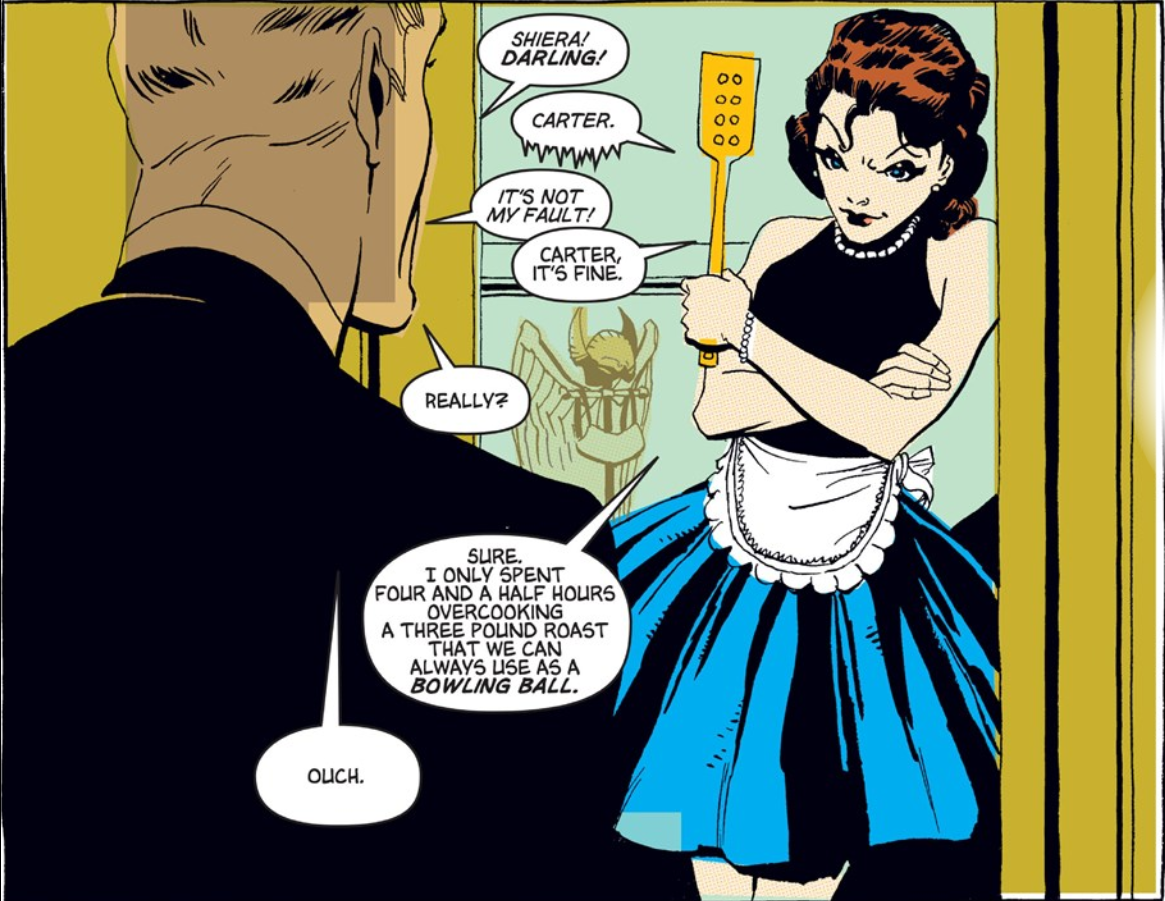
After this, we get some character-focused one-offs. A Father's Day story parallels Rick meeting with his father, and Jakeem Thunder trying to track down his. I enjoyed this one. Then there's a story about a villain lusting after Power Girl, and it's as bad as all Geoff Johns–penned Power Girl stories. But then there's a decent story about an old Dr. Mid-Nite villain getting his grandson to commit crimes, and the JSA working together to stop him.

Don't trust him!
from JSA #32 (art by Peter Snejbjerg)

Finally, there's a multi-part story about time travel. Some characters go back to the 1940s and meet the original Mr. Terrific; this I really liked, especially the way Mr. Terrific immediately cottoned on to what was happening. Some other characters end up in Ancient Egypt with the original Hawkman and Black Adam, and this I found much less interesting. It does seem like the series is moving back in the direction of having Hawkgirl hook up with Hawkman, which I find profoundly dull and kind of creepy. The stuff about Black Adam's tortured past I don't really care for, because I know it goes pretty unpleasant places in stories like World War III.

Poor Johnny Thunder... or maybe not?
from JSA #36 (art by Leonard Kirk & Keith Champagne)

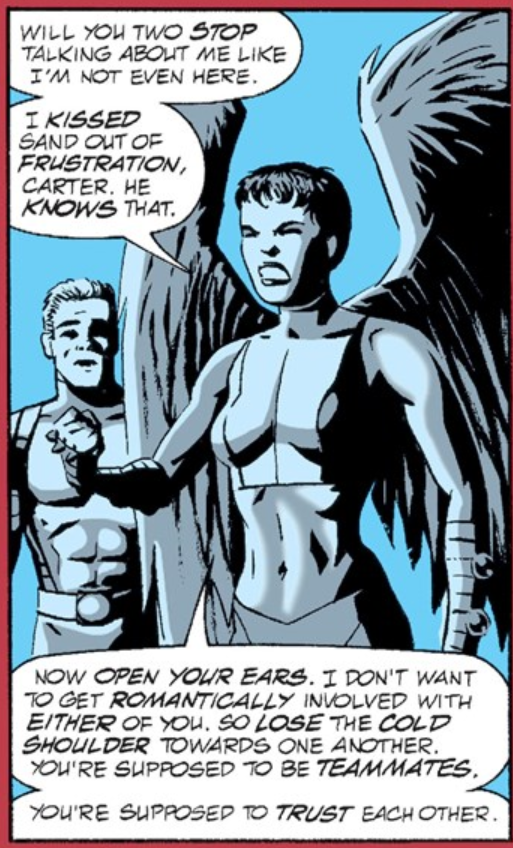
Also the Hector-Hall-looking-for-Lyta subplot continues to be dead dull. It's a succession of plot beats, not a story about characters.

Ouch.
from JSA #38 (art by Stephen Sadowski & Andrew Pepoy)

But overall, this is an effective team comic at this point. It helps that Leonard Kirk is an absolutely solid artist. Not "flashy," but good personality and good storytelling and good action, the exact kind of artist a nuts-and-bolts team title like this needs. I've liked him ever since his Captain Britain and MI13 days for Marvel. The real shame is that this series of collections ended with this volume; even though DC did collect all of JSA and Justice Society of America vol. 3 in a set of three JSA by Geoff Johns Omnibuses, their "re-cutting" of the run as a series of trade paperbacks ended here, only partway through the contents of what had been JSA by Geoff Johns Omnibus, Volume Two. So having read issues #1-45 of this series via Hoopla, I am going to need to track down #46-87 some other way! (Also it seems clearly criminal that this series was called JSA by Geoff Johns when in the end, David Goyer wrote as many of the collected issues as Johns did... if not more!)

This post is thirty-fifth in a series about the Justice Society and Earth-Two. The next installment covers JSA Presents Green Lantern. Previous installments are listed below:
  1. All Star Comics: Only Legends Live Forever (1976-79)
  2. The Huntress: Origins (1977-82)
  3. All-Star Squadron (1981-87)
  4. Infinity, Inc.: The Generations Saga, Volume One (1983-84)
  5. Infinity, Inc.: The Generations Saga, Volume Two (1984-85)
  6. Showcase Presents... Power Girl (1978)
  7. America vs. the Justice Society (1985)
  8. Jonni Thunder, a.k.a. Thunderbolt (1985)
  9. Crisis on Multiple Earths, Volume 7 (1983-85)
  10. Infinity, Inc. #11-53 (1985-88) [reading order]
  11. Last Days of the Justice Society of America (1986-88)
  12. All-Star Comics 80-Page Giant (1999)
  13. Steel, the Indestructible Man (1978)
  14. Superman vs. Wonder Woman: An Untold Epic of World War Two (1977)
  15. Secret Origins of the Golden Age (1986-89)
  16. The Young All-Stars (1987-89)
  17. Gladiator (1930) ["Man-God!" (1976)]
  18. The Crimson Avenger: The Dark Cross Conspiracy (1981-88)
  19. The Immortal Doctor Fate (1940-82)
  20. Justice Society of America: The Demise of Justice (1951-91)
  21. Armageddon: Inferno (1992)
  22. Justice Society of America vol. 2 (1992-93)
  23. The Adventures of Alan Scott--Green Lantern (1992-93)
  24. Damage (1994-96)
  25. The Justice Society Returns! (1999-2001)
  26. Chase (1998-2002)
  27. Stargirl by Geoff Johns (1999-2003)
  28. The Sandman Presents: The Furies (2002)
  29. JSA by Geoff Johns, Book One (1999-2000)
  30. Wonder Woman: The 18th Letter: A Love Story (2000)
  31. Two Thousand (2000)
  32. JSA by Geoff Johns, Book Two (1999-2003)
  33. Golden Age Secret Files & Origins (2001)
  34. JSA by Geoff Johns, Book Three (1999-2003)

26 September 2022

JSA, Book Three: The Power of Legacy! by Geoff Johns, David S. Goyer, Stephen Sadowski, Rags Morales, Peter Snejbjerg, et al.

JSA by Geoff Johns, Book Three

Collection published: 2019
Contents published: 1999-2003
Read: July 2022

Writers: Geoff Johns, David S. Goyer, Michael Chabon, Dan Curtis Johnson, James Robinson, J. H. Williams III, Brian Azzarello, Howard Chaykin, Darwyn Cooke, Jeph Loeb, Ron Marz
Pencillers: Stephen Sadowski, Rags Morales, Peter Snejbjerg, Sal Velluto, Buzz, Javier Saltares, Adam DeKraker, Barry Kitson, Michael Lark, Mike McKone, Dave Ross, Phil Winslade, Uriel Caton, Derec Aucoin, Rick Burchett, Tony Harris, Howard Chaykin, Darwyn Cooke, Eduardo Risso, Tim Sale, Chris Weston
Inkers: Bob Almond, Michael Bair, Peter Snejbjerg, Wade Von Grawbadger, Jim Royal, Ray Kryssing, Keith Champagne, Wayne Faucher, Barry Kitson, Michael Lark, Prentis Rollins, Phil Winslade, Anibal Rodriguez, Christian Alamy, Dave Meikis, Derec Aucoin, Rick Burchett, Howard Chaykin, Darwyn Cooke, Eduardo Risso, Tim Sale, Chris Weston
Colorists: John Kalisz, Tom McCraw, Carla Feeny, Mark Chiarello, Tony Harris
Letterers: Ken Lopez, Kurt Hathaway, Michael Lark, Patricia Prentice, Richard Starkings, Darwyn Cooke, Janice Chiang

I complained when reading book two of this series that it seemed like the stories were being collected out of order; book three (called The Power of Legacy! on the cover but subtitle-free on the title page) makes that particularly clear, with later issues collected here introducing things that had already happened in book two, like the transfer of the JSA chairship to Mr. Terrific. But anyway: let's take this part by part as it's presented.

Women, amirite?
from JSA All Stars vol. 1 #2 (script by Jeph Loeb, art by Tim Sale)

The book begins with JSA All Stars vol. 1, an eight-issue miniseries about the various "legacy" characters in the JSA, those who are successors to older heroes: Hawkgirl, Dr. Fate, Stargirl, Hourman, Dr. Mid-Nite, and Mr. Terrific. The middle six issues all follow the same format. First, there's a sixteen-page story about the modern hero written by Geoff Johns and David Goyer, usually delving into character points for them, like Hourman's addiction (this is the Rick Tyler version from Infinity, Inc.) or Stargirl's relationship with her biological father. Then, there's a six-page story about their Golden Age predecessor, written and drawn by high-profile guest artists, like Howard Chaykin, James Robinson and Tony Harris, or Darwyn Cooke. Overall, I enjoyed these; the present-day stories actually give us some solid character work, especially for characters who haven't really had much meaningful focus in the present-day stories, like Hourman, Dr. Mid-Nite, and Mr. Terrific. The flashback stories are good fun stuff: if you take a great writer and artist (or writer/artist) and tell them to do what they want in a six-page Golden Age adventure, they will deliver.

Learning that the new Dr. Mid-Nite also did a residency with the original makes me wonder even more what happened to Beth Chapel. Ah, well, gotta replace those black legacy characters with white ones.
from JSA All Stars vol. 1 #6 (story by David S. Goyer & Geoff Johns, script by Geoff Johns, art by Stephen Sadowski & Wade Von Grawbadger)

The only thing I didn't like was the frame, which I have a sneaking suspicion was added after the middle six issues were completed, because of it how it contorts to not be mentioned in them. A villain turns up, but disguises himself as the Spectre and tells the characters to take time off to think about their histories but also that they shouldn't think about the events of the frame. It's pretty pointless, to be honest, and the six issues would have stood up on their own just fine. But overall, JSA All Stars is my favorite thing I've read thus far in this title... though technically, it's not part of it!

I often find Dr. Fate thaumababble tedious, but I would have read the hell out of a Darwyn Cooke Fate ongoing.
from JSA All Stars vol. 1 #3 (script & art by Darwyn Cooke)

Then come three stories about a character named Nemesis, two from JSA Annual #1 and JSA Secret Files & Origins #2. She's raised by the Council (the same organization responsible for some of DC's various Manhunters), and I felt like a lot of time was spent on her for reasons that weren't clear to me. But maybe this will come in during book four more? The Ultra-Humanite seems to be part of the Council storyline, and he's in book four. (There are some other stories from that Secret Files issue, too; one I already read in the Chase collection, and the other is to foreshadow an upcoming storyline.)

I will never care about Sand, especially his self-doubt, but this was a neat moment.
from JSA Secret Files & Origins #2 (story by Geoff Johns & David S. Goyer, script by Geoff Johns, art by Javier Saltares & Ray Kryssing)

After this, we finally get back to the main JSA series. First we have one of those standalone stories where nothing in particular is going on and we check in on various character that team books like to do—and that I like them to do. After the icky stuff in book two where everyone was expecting teenage Hawkgirl to hook up with octagenarian Hawkman because it was her "destiny," this volume thankfully pushes back against that, with her telling everyone she's going to do what she wants to do. I hope the series sticks to this, and that it's not a set-up for her coming around and getting together with Hawkman anyway. We also have some interrogation of the idea that Black Adam can be part of the team; I liked that Captain Marvel turned up, though was Atom Smasher (then called Nuklon) this hot-headed back in Infinc? Thankfully Sand, the team's most boring nonentity of a character, finally steps down as team leader.

My favorite part of this is that like two panels later, Captain Marvel goes on to use the word "legit." Such grace!
from JSA #27 (script by Geoff Johns, art by Rags Morales & Michael Bair)

This book also introduces Alex, a new character who was a cousin to Yolanda Montez, the Wildcat of Infinity, Inc. He was inspired by her JSA enthusiasm, and now he manages the JSA museum in the JSA's HQ. Fun idea... but he never actually appeared in Infinc! Didn't Yolanda have a younger brother? Why not use him? 

This lady's power is to always pose like a man is watching her.
from JSA #28 (script by Geoff Johns, art by Stephen Sadowski and Christian Alamy & Dave Meikis)

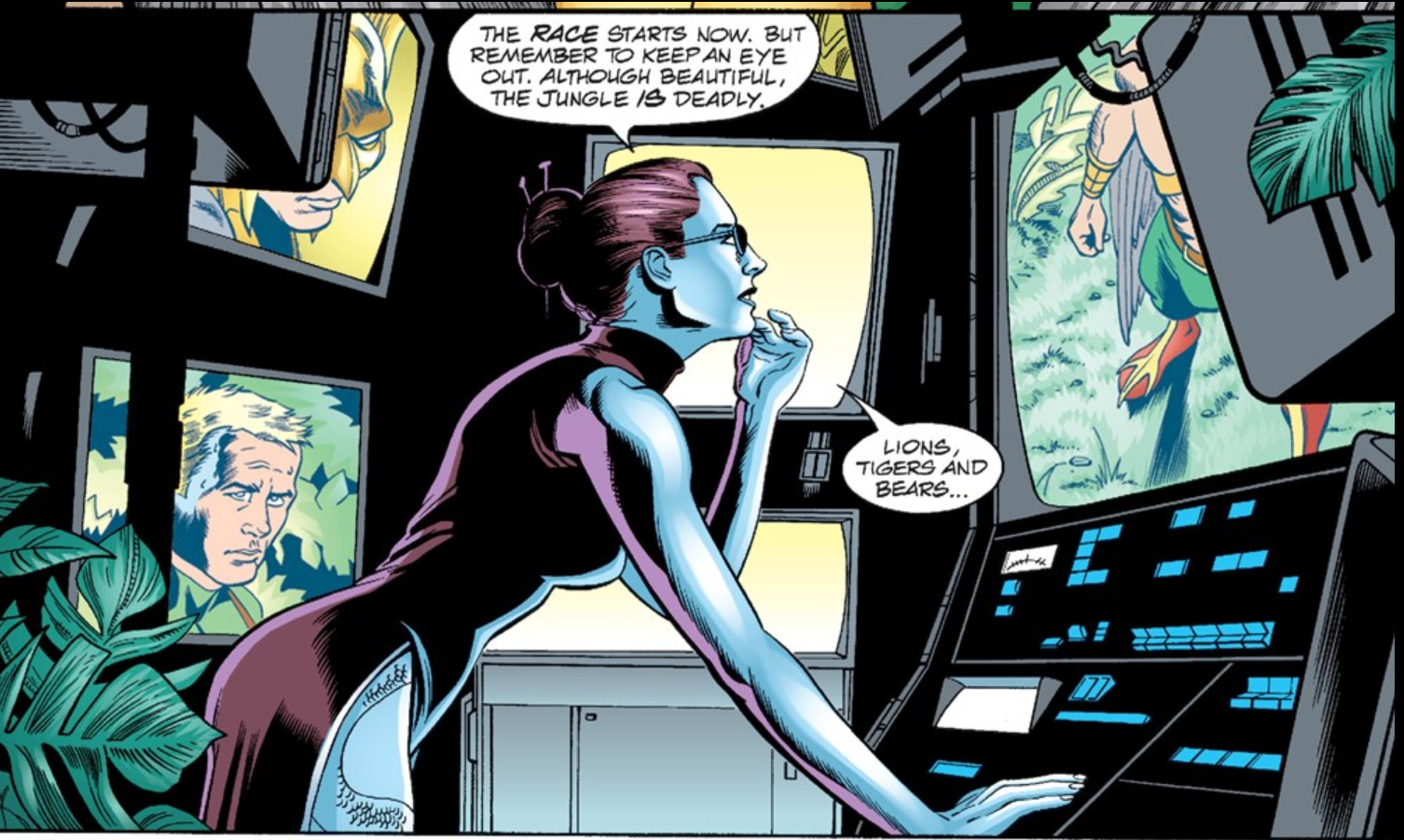
Lastly, we have a storyline where villains kidnap a number of JSA members and force them to fight each other as part of a gambling operation. This I thought was pretty good, probably the best actual storyline thus far, with lots of good moments of characterization, something sorely lacking from the series up to this point. I've been complaining about Geoff Johns, but this is actually the first story not co-written with David Goyer, so maybe it's him who's the problem. My favorite issue here was one where Stargirl and Jakeem Thunder (modern-day inheritor of Johnny Thunder's Thunderbolt) are the only two heroes left in HQ during the events of the Joker: Last Laugh crossover and have to protect New York City from a Joker-venom infected Solomon Grundy. Just two principal characters gives the characterization and the action time to shine, aided by some excellent moody art from Peter Snejbjerg. There's also a decent story about the JSA working with Batman. So... after three 400-page books things are finally looking up?

Finally!
from JSA #31 (script by Geoff Johns, art by Peter Snejbjerg)

The last story in the collection is "History 101," which the back cover proudly declares has never before been reprinted... but in fact it was already reprinted in The Justice Society Returns! way back in 2003! There are also lots of profiles and such from various issues of Secret Files & Origins, which is nice to have if you like that kind of thing; I did enjoy the diagram of JSA HQ.

This post is thirty-fourth in a series about the Justice Society and Earth-Two. The next installment covers JSA by Geoff Johns, Book Four. Previous installments are listed below:
  1. All Star Comics: Only Legends Live Forever (1976-79)
  2. The Huntress: Origins (1977-82)
  3. All-Star Squadron (1981-87)
  4. Infinity, Inc.: The Generations Saga, Volume One (1983-84)
  5. Infinity, Inc.: The Generations Saga, Volume Two (1984-85)
  6. Showcase Presents... Power Girl (1978)
  7. America vs. the Justice Society (1985)
  8. Jonni Thunder, a.k.a. Thunderbolt (1985)
  9. Crisis on Multiple Earths, Volume 7 (1983-85)
  10. Infinity, Inc. #11-53 (1985-88) [reading order]
  11. Last Days of the Justice Society of America (1986-88)
  12. All-Star Comics 80-Page Giant (1999)
  13. Steel, the Indestructible Man (1978)
  14. Superman vs. Wonder Woman: An Untold Epic of World War Two (1977)
  15. Secret Origins of the Golden Age (1986-89)
  16. The Young All-Stars (1987-89)
  17. Gladiator (1930) ["Man-God!" (1976)]
  18. The Crimson Avenger: The Dark Cross Conspiracy (1981-88)
  19. The Immortal Doctor Fate (1940-82)
  20. Justice Society of America: The Demise of Justice (1951-91)
  21. Armageddon: Inferno (1992)
  22. Justice Society of America vol. 2 (1992-93)
  23. The Adventures of Alan Scott--Green Lantern (1992-93)
  24. Damage (1994-96)
  25. The Justice Society Returns! (1999-2001)
  26. Chase (1998-2002)
  27. Stargirl by Geoff Johns (1999-2003)
  28. The Sandman Presents: The Furies (2002)
  29. JSA by Geoff Johns, Book One (1999-2000)
  30. Wonder Woman: The 18th Letter: A Love Story (2000)
  31. Two Thousand (2000)
  32. JSA by Geoff Johns, Book Two (1999-2003)
  33. Golden Age Secret Files & Origins (2001)

14 September 2016

Faster than a DC Bullet: The Sandman Spin-Offs, Part XXXI: Free Country: A Tale of the Children's Crusade

Comic hardcover, n.pag.
Published 2015 (contents: 1993-2015)
Borrowed from the library
Read March 2016
Free Country: A Tale of the Children's Crusade

Writers: Neil Gaiman, Toby Litt, Rachel Pollack, Alisa Kwitney & Jamie Delano
Artists: Chris Bachalo, Mike Barreiro, Peter Gross, Al Davison & Peter Snejbjerg
Colorists: Daniel Vozzo & Jeanne McGee
Letterers: John Costanza & Todd Klein

It's probably impossible to discuss this book without discussing its means of production. Though it would be interesting to discuss it as a purely standalone book, its strange genesis will always influence anything you can write about. The Children's Crusade was a 1993-94 "annual" crossover, by which I mean a crossover through annuals of ongoing series (like Eclipso: The Darkness Within or Armageddon 2001), not a crossover that took place annually. It was Vertigo's first and last attempt at such a thing, spanning Black Orchid, The Books of Magic, Swamp Thing, Animal Man, and Doom Patrol. In addition to those five issues, it was bookended by issues featuring Charles Rowland and Edwin Paine, the so-called "Dead Boy Detectives" from The Sandman, which were (mostly) written by Neil Gaiman. The crossover has never been collected, I guess because the middle parts didn't make a lot of sense on their own, and didn't connect into the last issue in the way they were supposed to. But because printing Neil Gaiman is like printing money, DC has finally collected the bookends he wrote, commissioning a new middle chapter by writer Toby Litt and artist Peter Gross to bridge the gap between the two Gaiman-penned issues, covering all the ground needed to get you from The Children's Crusade issue #1 to issue #2. Litt and Gross also add extra pages to the closing issue, I guess to clarify or expand rushed aspects of it.

I actually meant to scan a different sequence of panels on the facing page, but I messed up and I'm too lazy to redo it, so this'll have to do.
from The Children's Crusade #1 (script by Neil Gaiman, art by Chris Bachalo & Mike Barreiro)

The opening issue is Neil Gaiman at his most typical and his best, aided by Chris Bachalo and Mark Barreiro on art. Charles and Edwin, the two boarding-school ghosts who eluded Death in Season of Mists, have set up a detective agency, finally answering a long-standing point of bafflement for me. Their first case is brought to them by a girl whose brother has vanished, along with every other child in their village, plus a huge number of children the world over. In typical Gaiman fashion, though, their investigations (such as they are; they're delightfully poor detectives) are interspersed with tales of lost or missing children from throughout history: a chronicle of the Children's Crusade, a boy telling the Victorian poet Robert Browning about the Pied Piper's visit to the town of St. Cecile, and a very grim story of how a group of children trapped in a pit managed to escape.

24 March 2014

Faster than a DC Bullet: The Houses of Mystery and Secrets, Part XVI: House of Mystery: Desolation

Comic trade paperback, n.pag.
Published 2012 (contents: 2011)
Borrowed from the library
Read February 2014
House of Mystery: Desolation

Writer: Matthew Sturges
Penciller: Luca Rossi
Inker: José Marzán, Jr.
Colorists: Lee Loughridge, Dave Stewart, Eva de la Cruz
Letterer: Todd Klein
Short Story Writers: Bill Wilingham, Steven T. Seagle
Short Story Artists: Darwyn Cooke, Aaron Campbell, David Lapham, Peter Snejbjerg, Annie Wu, Tony Akins, Teddy Kristiansen, Inaki Miranda

One feels like the final volume of a series should start laying on some answers, but Desolation just piles on the complications, and boring ones at that. Why this whole divergence with Lotus Blossom? Why add a whole mess of sorcerer characters only for them to do nothing? Why ruin the character of Goldie that way?

Eh, who cares. House of Mystery was a great vehicle for stories, but its own story was never particularly interesting, and this volume confirms that. The best part is the final issue, where three travelers tell the tale of the House, but even that seems a little tame and lackluster.

01 January 2014

Review: The Starman Omnibus, Volume Six by James Robinson with David S. Goyer

Comic hardcover, n.pag.
Published 2011 (contents: 2000-10)
Acquired January 2011
Read December 2013
The Starman Omnibus, Volume Six

Writer: James Robinson
Artist: Peter Snejbjerg
Colorist: Gregory Wright
Letterer: Bill Oakley
Co-Story on "1951": David S. Goyer
Additional Artists: Paul Smith, Russ Heath, Fernando Dagnino & Bill Sienkiewicz
Additional Colorist: Matt Hollingsworth
Additional Letterer: John J. Hill

Typing out the list of credits, one immediately notices that this is the most artistically consistent volume of Starman thus far. I liked Tony Harris, but there's something to be said for a unified artistic vision-- only three fill-ins! Peter Snejbjerg is on fine form, too; now that he's inking himself, his artwork looks utterly magnificent. There's a real darkness to it that's utterly perfect for Opal City and the story's climax.

And what a climax. I've said it before, but the thing that will always make the "comic book" superior to the "graphic novel" is its ability to weave a number of number of smaller stories into one huge one. It's the reason why Preludes and Nocturnes and The Doll's House were okay but Brief Lives and The Kindly Ones are magnificent; they build on what has gone before. So too does this volume, as almost all of the various heroes we've seen throughout the series come together against the worst threat that Opal City has ever seen-- apparently the Shade gone evil. It's absolutely perfect in every way. I initially felt a little disappointed that at times Jack seems like a bystander in his own story, but emotionally, he's always the center of this, especially that heartrending, amazing climax. What a way to go.

The "1951" story that follows this up is necessary, but less effective; I felt that learning who the Starman of 1951 had been would have been better if it had been the same person all along, not one person most of time and another for just a month. But seeing the young, distraught Ted Knight is touching and fitting.

Starman has been an interesting journey, with highs and lows. You can see its creators grow across it-- compare Robinson's deft plotting here to the jumpiness of Volume One-- and its characters, too. It has the occasional misstep, but it's a rewarding read through and through.

31 December 2013

Review: The Starman Omnibus, Volume Five by James Robinson with David S. Goyer and Geoff Johns

Comic hardcover, n.pag.
Published 2010 (contents: 1998-2003)
Acquired October 2010
Read November 2013
The Starman Omnibus, Volume Five

Writer: James Robinson
Co-Story on "Stars My Destination": David S. Goyer
Penciller: Peter Snejbjerg
Inker: Keith Champagne
Co-writer on Stars & S.T.R.I.P.E. #0: Geoff Johns
Additional Pencillers: Steve Yeowell, Craig Hamilton, Chris Weston, Lee Moder, Steve Sadowski, David Ross, Tony Harris, John McCrea
Additional Inkers: Wade von Grawbadger, Steve Yeowell, Ray Snyder, Dan Davis, John Stokes, Andrew Hennessy, Tony Harris, Chris Weston, John McCrea
Colorists: Gregory Wright, John Kalisz, Craig Hamilton, Tom McCraw, Carla Feeny, Tony Harris
Letterers: Bill Oakley, Craig Hamilton, Kurt Hathaway, Ken Lopez

Volume Five returns the narrative energy to Starman; having launched into space, it's one zippy adventure after another. It's a very different tone to previous Starman stories: despite now being set in space, it's a much lighter set of stories, especially at first, as Robinson and Goyer use the new setup to revisit a neverending series of classic DC space characters. Which I love, of course, as the only thing better than sci-fi or superheroes is sci-fi and superheroes. I love Jack and Mikaal's visit to the future, and especially the three tales of Starman related by the Space Cabbie and his buddies, each of them more ludicrous than the last.

I also really enjoyed the final story arc, set on Throneworld and tying together a number of diffuse strands of the Starman mythos into a single story: Prince Gavyn, Will Payton, Mikaal, and Jack, all together in one story. (Gavyn returns in Rann-Thanagar Holy War and Strange Adventures, but I don't think those acknowledged his dual identity as Will.) Jack's complicity but attempt to abstain from revolutionary violence makes for an interest subcurrent in what might otherwise be a fairly simple space opera.

Meanwhile, on Earth, there are some interesting goings-on with the Starman of the 853rd century, not to mention an appearance by one of my favorites, the Elongated Man! A pleasant surprise, to be sure. (As was the appearance of the Dee Tyler Phantom Lady; I didn't realize she'd ever appeared again after her debut in Action Comics Weekly.)

Peter Snejbjerg didn't click for me at first as the artist in this volume, but as it went on, he got better, I think. His dark illustrations for the Throneworld issues in particular really shine. This isn't the best of the Starman volumes, but I think it succeeds perfectly at what it sets out to do.

06 August 2011

Faster than a DC Bullet: The Sandman Spin-Offs, Part VIII: The Dreaming: Beyond the Shores of Night

Comic trade paperback, 208 pages
Published 1998 (contents: 1996-97)

Borrowed from the library
Read July 2011
The Dreaming: Beyond the Shores of Night

Writers: Terry LaBan, Peter Hogan, Alisa Kwitney
Artists: Peter Snejbjerg, Steve Parkhouse, Michael Zulli, Dick Giordano
Colorist & Separator: Daniel Vozzo
Letterers: Todd Klein, Steve Parkhouse, Annie Parkhouse

The Dreaming was the second of the three ongoings to spin out of The Sandman (the others being Sandman Mystery Theatre and Lucifer). Unlike the other two, it's largely uncollected; there are only two trades, which collect a scattered seventeen issues of the sixty-issue series. Maybe this is because it had a sort of anthology format, moving between different characters and concepts from the Dreaming, the realm ruled over by Gaiman's character-- there's not really an ongoing character narrative.

This first volume collects three different stories, the first of which is Terry LaBan and Peter Snejbjerg's "The Goldie Factor." This concerns a couple of my favorite characters from the Dreaming, Cain and Abel, the brothers were one is an eternal murderer and the other is an eternal victim. They set off after Abel's pet gargoyle, Goldie, who is being misled by "the Great Tempto," the snake from the Garden of Eden. Gaiman's Eve, Matthew the Raven, and Lucien also appear. It's a decent quest story, mostly worth it for the way that LaBan nails the personalities of all the different Sandman characters; I like the interplay between the feuding brothers especially. On the other hand, LaBan and Snejbjerg's Dreaming feels too much like a pedestrian fantasy world, not a place you might inadvertently wander into on the fringes of consciousness.

The second story is Peter Hogan and Steve Parkhouse's "The Lost Boy," is about an architect from 1956 who wanders into 1996 and finds a world he doesn't understand. Unfortunately, the man-out-of-time story has been done better than here, and though I think the architect is supposed to be a likeable average guy, he's more just boring. This undercuts an ending which I think would have been sweet had it been written better. The best part of this over-long story (it is by no means a four-issue concept) is the return of Mad Hettie, the vagrant who popped up from time to time in both The Sandman and Death. I honestly never paid a lot of attention to her before, but amidst these dull characters, she delights with her matter-of-fact weirdness, as she speaks plainly about mystical happenings to humans and fairies alike. I really liked Steve Parkhouse's artwork, though.

Last is Alisa Kwitney and Michael Zulli's short "His Brother's Keeper," which follows up on a mention of Cain and Abel's brother Seth from "The Goldie Factor," but then tells a story that has nothing to do with that concept at all. Baffling and dull.

03 July 2011

Faster than a DC Bullet: The Sandman Spin-Offs, Part V: WitchCraft

Comic trade paperback, 133 pages
Published 1996 (contents: 1994)

Borrowed from the library
Read June 2011
WitchCraft

Writer: James Robinson
Artists: Teddy Kristiansen, Peter Snejbjerg, Michael Zulli, Steve Yeowell
Colors: Daniel Vozzo
Lettering: Richard Starkings

This isn't the first Sandman spin-off-- it's predated by the launch of Sandman Mystery Theatre and the first Death miniseries-- but it's kinda the first standalone one. (I say "kinda" because it did garner a sequel, but said sequel was never collected in trade paperback.) Its subject is a little odd, though; I refused to believe that any Sandman fans were clamoring for a return of the Three Fates or the Three Witches or the Three Goddesses or whatever they were. (I mean, they don't even have clear names.) They would just pop up sporadically and be cryptic; I think they had a role in the finale, but maybe the Three Furies were something separate? I don't know and I don't really care.

The story opens with a Pict barbarian coming to Londinium and raping a Roman woman. She's a priestess of the Triple Goddess, though, and lets off a prayer as she dies. Too late to save herself, but the Triple Goddess decide that she will get her revenge: when she and her killer are next reincarnated in the London area, her killer will die. This takes over a millennium, but finally a young maiden is due to marry a guy who turns out to be a rapist. She's secretly a witch, and so is he, and though the Triple Goddess try their best, it doesn't quite come together, everyone dies, and no revenge is had. At this point, I wasn't really into the story either way-- didn't hate it, didn't love it. Did kinda wonder what the point was. (Except that the introduction had told me, but I'll come back to that later.)

So they're left to try again in 1842, where for some reason the priestess has been reincarnated as a man-- and not just any man, but Sir Richard F. Burton (though he's no "sir" yet). What? This just seemed bizarre to me. The killer is actually his mother's lover, and willingly so. Richard Burton is chastised by her for not allowing her her sexual freedom. But he chases the lover anyway and, whoops, the lover rapes Burton. I guess because he's just so evil? Then Burton meets up with gypsies, who teach him sex magic or something (you know gypsies) and then he finds the lover, but doesn't kill him, and goes on to be imperialist bastard we all know and love. And who wrote awful, dull travelogues.

The last bit brings us to the 1990s, when the priestess is now an old lady, and the barbarian is her baby-raping, wife-mind-controlling, priest-killing warlock son-in-law. Because he just wasn't evil enough? It's starting to get over the top at this point. Anyway, the grandma wins, and the Triple Goddess sentences him to be reincarnated throughout the past as the victim of every sex crime ever. Leaving aside the fact that "sex crime" sounds a bit too 20th-century in the mouth of a pagan goddess, it's just what!? I don't even understand what this is supposed to mean. Does it make rape into an empowering act for women? Or is it poetic justice (because raping men is funny maybe)? Or something? God, how bizarre. The book tries to pull back from it by having one of the Goddesses say "I actually started wondering if the matter deserved all the fuss we'd given it," but you know, that ending still exists!

Like Black Orchid (it must be a Vertigo thing), this collection contains a fawning introduction from someone I've never heard of, but I think is supposed to be famous maybe, Penelope Spheeris. Spheeris describes the book as creating "a comic-book world for those who are evolved enough to know that ultimately there is justice in the world." There's nothing evolved about this book! It depicts men as eternal rapists and women as eternal victims, whose best outcome for "justice" is that the men can secretly be the victims of the rapes they commit. She also claims that it shows the power of women as "immeasurably strong and immeasurably subtle," though I feel like being victimized through the millennia is pretty much neither. And lastly, she's quick to claim that men will like this book too even if it is all about female power (really?) because the stories "are sexually titillating without being sexist. They are sometimes erotic, but in an artful, beautiful way... and in a way that allows the WitchCraft women to keep their power and their moral strength." WHAT!? Did we read the same book? Because in the book I read, every sex act bar two is coerced. This book is not remotely titillating-- sex is nasty, brutish, and short, a means to an end for one or both parties in every case. None of the participants are ever drawn attractively. And let's not even talk about the assumption that "boys and men alike" need sex on display to enjoy a story about women anyway...

I freely admit that Penelope Spheeris's introduction is not James Robinson's fault. But it does show the same warped, unpleasant set of values that seems to underly this entire book. Ugh.