Showing posts with label topic: hugos 2021. Show all posts

16 February 2024

How Often Do I Agree with the Hugo Electorate?

In my recent post comparing my final ballot to the winners of the 2023 Hugo Awards, I noted that my first place choice and the actual final winner were the same in four of the nine categories in which I vote. I then speculated, "I think this is a record."

But was it a record? Good question! I trawled backward through my old posts to see how often the broader Hugo electorate had made the right choice (i.e., my choice).

Here's how many categories my first-place choice and the voters' has coincided in each year:

  • 2017: 4 (Novelette / Short Story / Related Work / Dramatic Long)
  • 2018: 1 (Short Story)
  • 2019: 1 (Dramatic Long)
  • 2020: 1 (Novel)
  • 2021: 4 (Short Story / Related Work / Dramatic Short / Lodestar)
  • 2022: 1 (Lodestar)
  • 2023: 4 (Novel / Short Story / Related Work / Dramatic Long)

Far from being a record, four matches is my second most common result! I had not realized that my distribution was so sharply bimodal; either I agree in one category or four. Never zero, two, or three!

I then wondered how I did more broadly. To figure this out, I looked at whatever I ranked first and then averaged where it ranked in the final results. That is to say, if my picks for first came in fifth, sixth, first, first, sixth, first, first, and second, that would average out to 2.9. A lower score is better; thus on this graph, I've flipped things around.


You'll see that 2023 actually is a record at 2.3; I've never been so consistently in agreement with the other voters. My low point was 2019; I don't know what was wrong with everyone else. 

I am not sure what we can infer from this: it may be that in years where I match up well, there's a weak finalist pool and thus only one obvious winner for me and everyone else.

Having compiled this data, it was then easy to also figure out what was the category where my tastes are most often aligned with the broader electorate's:

I didn't find anything too surprising here. Dramatic Long usually has one very good choice and a bunch of Marvel movies, so I am not surprised to see I usually line up well here. I have picked the eventual first-place winner three out of seven times.

Two categories do much worse on a regular basis. I have never picked a first-place winner in Graphic Story; indeed, one time my first-place pick finished in second, and all other times fourth or sixth. But it is a category usually made up of a bad set of finalists (in my opinion), and one where my tastes clearly do not line up with others' at all. Novella fares even worse, with my first-place pick coming in fifth on average. I have never picked the winner, and my pick for the winner has come in sixth three times and in seventh once! (In 2019, I liked the set of finalists so little that I voted No Award in first.) Though apparently me and the voters do pretty well for Short Story,* when it comes to novella-length fiction, we just do not get on.

Which is to say, the electorate loves Tordotcom novellas and I do not.

* My first-place choice has come in first four out of seven times, actually, which is my best result for any category, but this is counterbalanced by my first-place choices coming in fourth, seventh, and fifth in the three other years.

07 January 2022

The 2021 Hugo Awards: "No Award" Statistics

Last year, I did a post analyzing various statistics in the Hugo Awards voting data, mostly relating to the use of "No Award."* I want to do that again this year, especially as this year's Hugo team provided us with more data than is usual about the use of No Award.

But first, here's all the categories ranked in terms of how many ballots were received: (Note that this does not include ballots where "No Award" was the first preference.)

As is, I believe, almost always the case (it would be interesting to go back and verify), the prose fiction categories typically do the best, and the fan endeavor categories the worst. Interestingly, Best Novel (won by Network Effect) and Best Series (won by The Muderbot Diaries) were the top two, even though those are the two categories that require the most work for a conscientious voter. This year's special category, Best Video Game (won by Hades), come in a little bit below average. I have no sense if the Business Meeting will make this one permanent going forward. (I have no interest in it myself, but I am not philosophically opposed to as I am some other categories.)

Last year, the bottom category was a third of the top one, but this year it is only a quarter. One should note that as per the World Science Fiction Society Constitution, "'No Award' shall be given whenever the total number of valid ballots cast for a specific category (excluding those cast for 'No Award' in first place) is less than twenty-five percent (25%) of the total number of final Award ballots received" (3.2.12). Best Fancast came very close this year, with just 26.8%.

Next, here are all the categories ranked by how many ballots placed No Award as first preference:

You'll note that here, it's mostly the inverse of the other graph. Best Editor (Long Form) (won by Diana M. Pho) is the highest. As I said last year, this could mean two things: "First, it could mean that you find the concept of the category invalid. Every year, I vote No Award for Best Series, Best Editor, and a couple other categories, for example, and leave the rest of my ballot blank. I have some fundamental disagreements with the premises of those categories, and do not think they should be awarded. (Very few Hugo voters agree with me, though, clearly.) It could also mean that you just found everything in that category subpar [in which case you might rank finalists below that point anyway]." The other thing to note, I think, is that Best Video Game is a little higher than we might expect by its placement on the first graph.

One interesting piece of information given on the results is how many ballots ranked No Award above the eventual winner. This could mean 1) the ballot just No Awarded the entire category, or it could mean that 2) on that voter's ballot, No Award was placed higher than the winner. (This is reported because if more ballots place No Award above the winner than placed the winner above No Award, No Award wins, even if it doesn't on the normal counting method. I don't think this has ever actually come to pass, and I think it would require an incredibly polarizing winner for it to do so. This is called the "run-off.")

So here are all the categories ranked in terms of how many ballots had No Award ranked above the eventual winner:

This lets us identify particularly controversial winners.This year, though, it's not too different from the other above graphs.

We can highlight controversial winners even more by subtracting the number of people who ranked No Award first from the number of people who ranked it above the winner. So this shows how many ballots had No Award in 2nd place or lower, but above the winner:

What this reveals, I would argue, is how many voters believed a category had some basic level of validity (so they didn't put No Award first for whatever reason), but didn't like what actually ended up winning. There's nothing as standout as last year's Best Related Work win, but Best Fanzine (won by Nerds of a Feather, Flock Together) comes out on top, and this year's Best Related Work (won by Beowulf: A New Translation) comes in next. On the other hand, there were just two people who placed No Award above Sara Felix in Best Fan Artist!

Last year I posited the existence of what I've come to think of as the "No Award Curve," an inverse relationship from the total number of ballots cast in a category and the number of first-preference No Award votes. I asked, "Does it indicate that the bigger categories are bigger for a reason, i.e., people view them as more legitimate?" It seems to hold up this year:

As I did last year, what I find most interesting about it are the categories that are off the curve, where more people voted No Award than you would expect given the size of the category. In the past, Best Series has been an outlier, but this year it's right where it should be. Everyone sure does love Murderbot, I guess! The most noticeable outlier is Best Video Game: there is a sizeable contingent of Hugo voters who do not believe this category should exist. Not as big of outliers are Best Related Work and Best Dramatic Presentation (Long Form). It's nice to have validated my belief that The Old Guard did not deserve a Hugo.

Last year, this is where I wrapped up, but this year's Hugo team provided us with extra data: they ran the run-off test when determining every place, not just first. So we know not only how many people placed No Award above the first place winner of each category, but the second, and the third, and so on. So this year, we can identify not just particularly controversial winners, but controversial finalists.

I experimented with a number of ways of showing this, but ultimately settled on plotting the number of ballots ranking a finalist above No Award against the number of ballots ranking No Award above a finalist:


You'll see that in 95.0% of cases, no more than 150 ballots ranked No Award above a finalist. Indeed, 92.4% were within one standard deviation of the mean. The outliers were:

Category Finalist Ballots with No Award above Finalist
Video Game Last of Us pt. 2 136
Semiprozine
Strange Horizons 139
Novelette
"Helicopter Story" 148
Dramatic (Long) Tenet 166
Dramatic (Long) Eurovision Song Contest 200
Related Work Last Bronycon 211
Related Work FIYAHCON 257
Related Work CoNZealand Fringe 265
Related Work "GRRM Can Fuck Off into the Sun" 358

So these are this year's controversial finalists. I can't comment to all, but in most, the reasoning seems pretty obvious. "Helicopter Story," as I have said, was pretty controversial; one notes that it got the most first-place preferences in Best Novelette and the most placing No Award above it. I guess people really did not care for Tenet or Eurovision Song Contest; the latter does not surprise me but the former kind of does.

What is particularly notable is how high all the Best Related Work finalist land... and indeed, all of these except The Last Bronycon I placed below No Award myself. A significant contingent of Hugo voters were clearly displeased with what Hugo nominators got onto the ballot in this category, even though "George R.R. Martin Can Fuck Off into the Sun" came in fourth, a full 24.2% of voters in this category ranked No Award above it.

I think, though, there are more variables here than I can account for as an amateur with a spreadsheet! I'd be curious to see things like, "what finalist got more No Award votes than we would expect based on its rank and number of ballots cast?" But that is pretty far beyond me!

* In the process of making this post, I realized I made an error in last year's: what is listed on the official Hugo voting statistics as "Cast Ballots" for each category excludes ballots cast that listed No Award in first place. This year I added those back in when calculating percentages.

24 December 2021

The 2021 Hugo Awards: Thoughts on the Final Results

I could have watched this year's ceremony... except my wife and I were folding laundry, and for some reason she refused to watch an 120-minute award ceremony for a bunch of books she hadn't read! So we watched a James Bond movie instead (I guess she really does love me), and whenever she left the room to nurse our sick baby, I watched a little bit of the ceremony livestream. I liked what I saw, especially the commentary about the winners that was read as they walked up to the podium; I don't remember this from previous Hugo ceremonies, and it was a nice feature. Of the bits I saw, I did really like Martha Wells's speech for Best Series, and I also thought the Best Fan Writer winner (Elsa Sjunneson) had some good stuff to say. I am sorry to have missed Ursula Vernon's bits, by all accounts.

So what did I think of the results, and how did they compare to my own votes? Just some brief thoughts here:

Category What Won Where I Ranked It What I Ranked #1 Where It Placed
Best Novel Network Effect
4th Piranesi 3rd
I am disappointed but not at all surprised by this outcome. It is, after all, the much beloved Murderbot. I wrote in my prediction post, "Clarke's book is good, but I think not quite in the core sensibility of the Hugo voter. So I will guess either Kowal or Wells." So I was right on that... thought Kowal's Relentless Moon was down in fifth, so I wasn't that accurate a predictor! Jemisin came in second, which kind of surprised me, but maybe shouldn't have. I had hoped Robinson's Ministry for the Future would make the ballot so I would have an excuse to read it, but looking at the nomination stats, it was down in ninth, and quite a ways off. Thankfully, we were spared Scalzi (down in eleventh). Novik's A Deadly Education (a finalist for the Lodestar) was twelfth for nominations in this category as well. In theory, a book can be a Lodestar finalist and a Hugo finalist, but it hasn't yet happened. Overall, I think it was kind of a weak year for Best Novel.

Best Novella The Empress of Salt and Fortune
3rd Riot Baby
6th
I wrote I would happy see Empress win, even though I had it in third, so this was a satisfactory result... but my preferred novella was all the way down in sixth! It figures that the finalist that most feels like an actual sf novella would be the one not to the taste of Hugo voters. Looking at the nomination data, it looks like Tor.com novellas dominate the long list, taking not only the top six slots, but also seventh, tenth, twelfth, thirteenth, and fifteenth. None of the sixteen top finalists are from magazines (print or web) this year; they were all published as standalone books.

Best Novelette "Two Truths and a Lie"
4th "Helicopter Story"
5th
This was a strong category this year, so no complaints about the winner... except that the fate of "Helicopter Story" is a great example of instant runoff voting... unfortunately. It had more first-place votes than any other finalist, but as lower-ranked items were eliminated from the ballot, their votes went to pretty much anything other than "Helicopter Story" until "Two Truths" achieved a majority. This was repeated in every round of voting until the fifth, indicating the presence of both a strong pro-"Helicopter Story" bloc and a strong anti-"Helicopter Story" bloc. Alas. Looking at the nominations data, though, it shouldn't be too much of a surprise, as it was sixth for nominations, and only made it onto the ballot by ~4 votes. Good thing I nominated it!

Best Short Story "Metal Like Blood in the Dark" 1st "Metal Like Blood in the Dark"
1st
Happy with this outcome, of course! Also I wrote, "I would say that the Hugo electorate 1) always loves T. Kingfisher (justifiably) and 2) always loves self-serving stories about how great it is to be a fan (less justifiably). So I would guess either 'Metal Like Blood' or 'Little Free Library.'" And indeed, "Little Free Library" came in second.

Best Related Work Beowulf: A New Translation
1st Beowulf: A New Translation
1st
Whoo, two in a row! This category had three things I ranked below No Award: FIYAHCON (a convention), Natalie Luhrs's vitriolic blog entry about last year's Hugo ceremony, and the "CoNZealand Fringe" (supplemental programming to last year's Worldcon). FIYAHCON placed in third, but 257 voters ranked it below No Award; Luhrs placed in fourth (even though she had almost as many first-round votes as Beowulf), with 358 voters ranking it below No Award; and CoNZealand Fringe placed in sixth, with 265 voters ranking it below No Award. By contrast, fifth-place finisher The Last Bronycon had 211 voters rank No Award higher. This will have to wait until I do my No Award analysis for this year, but at first glance, it's probably the best showing for "Noah Ward" across all the categories.

As I complained, there was only one book about science fiction finalist in the category, which is what I think the category ought to be for. Looking at the long list, there were some more of these, including Una McCormack's edited collection about Bujold (seventh, only ten nominations away from making the ballot), a book about Pratchett (eighth), and a book about disability in sf&f (twelfth). On the other hand, the long list also includes a facebook group and a spreadsheet. Let's just change this category back to "Best Nonfiction Book," please.

Best Graphic Story or Comic Octavia E. Butler's Parable of the Sower: A Graphic Novel Adaptation
4th Ghost-Spider: Dog Days Are Over
2nd
I never feel strongly about this category, so whatever. Ghost-Spider had the most first-round first-place votes, but fell to second on transfers: that reliable Seanan McGuire voting bloc always at it, but not quite making it here. Questionable Content was down in eleventh on the long list; I live in dread of it making the ballot someday.

Best Dramatic Presentation (Long Form) The Old Guard
6th Eurovision Song Contest: The Story of Fire Saga
5th
The hell!?

Best Dramatic Presentation (Short Form) The Good Place: "Whenever You're Ready"
1st The Good Place: "Whenever You're Ready" 1st
Up to three categories where my top choice matched the voters'. I predicted Good Place would pick up its fourth (and, presumably, final) Hugo this year, and I was correct.

The long list this year has a pretty good showing from Star Trek; the Picard episode "Nepenthe" was just two nominations away from making the final ballot, and there were also Discovery episodes in ninth and tenth, and another Picard episode in fifteenth. But where's Lower Decks?

Lodestar Award for Best Young Adult Book A Wizard's Guide to Defensive Baking
1st A Wizard's Guide to Defensive Baking 1st
And now, four of my first place picks actually won, which is a good success rate for me, not achieved since 2017. (In 2018, 2019, and 2020, only one of my picks won.) As I wrote, "Kingfisher/Vernon has been a finalist in this category before, but I think it's her year to win it. If she doesn't, it'll be Novik." And, indeed, Novik's book came in second.

Looking at the long list, thankfully we were spared Seanan McGuire's Victorian fairy tale pastiche, Over the Woodward Wall, languishing down in twelfth, thank goodness.

This was, of course, a pretty odd year for Hugo reading; with Worldcon postponed to December, I had six months instead of three... yet my reading was down to the wire more than I can remember ever happening before. I was just too leisurely early one, especially once the fall semester hit. Usually I don't read almost anything but Hugo finalists, but with the extra time, I also worked on my usual reading list. The other downside here is that I've only just finished... and in a couple months, it will be time to think about the 2022 Hugos!

This year was overall a weaker year, I think; not as many new, unexpected, interesting voices in Best Novel especially (everyone here was a repeat finalist), and the short fiction was its usual mixed bag. I think I need to be more selective with the Lodestar, and give up on books quicker that are not to my tastes. But as always I had fun, in what has turned out to be my fifth year of this!


20 December 2021

Hugos 2021: Piranesi by Susanna Clarke

Originally published: 2020
Acquired: September 2021
Read: October 2021

Piranesi by Susanna Clarke

I do like books where the world itself is a mystery, and Piranesi is a great one. I also like books where both characters and reader have to piece together events from documents, and Piranesi does a lot of that, too. This was right up my alley, and I hugely enjoyed it, from Clarke's strange otherworld to her guileless narrator trying to see his way out of a trap to the glimpses of a strange, off-putting film project. I did want a little more out of it—the origin of the otherworld doesn't really matter in the end—but on the whole, this was a great little tale, well told.

(I did spend a lot of the book wondering if Clarke was a Doctor Who fan because I feel like the novel's villain was "played" by Roger Delgado... and then it turned out a character had published an academic paper on Steven Moffat!)

17 December 2021

2021 Hugo Award for Best Novel Ballot

And here it is, my take on the best novels of the year. I did not nominate anything in this category, but then, I am very rarely that up to date on my sf novels. (As always, the links go to full write-ups of the novels, though at the time this is posted, not all of those will have gone up yet.)


6. Harrow the Ninth by Tamsyn Muir

I didn't care much for the first "Locked Tomb Trilogy" book (like so many of these things, it's now going to be four books) when it was a finalist last year, and as a result, I found it difficult to get into the sequel, which rather seemed to assume I remembered more about the first book than I actually did. Up until the last fifty pages or so, I was prepared to rank it above City We Became, since it seemed to me that Muir was trying to do something of more interest than Jemisin, but the last fifty pages are a huge number of speeches where characters explain to other characters their complicated plans, and I found it intensely amateurish and dull.


5. The City We Became by N. K. Jemisin

As I said in my review, I was pretty dissatisfied by this novel, especially given the quality of Jemisin's other Hugo finalist novels. Surprisingly simple, and surprisingly little happens given it's a 400-page novel.

4. Network Effect by Martha Wells

I always struggle with where to rank things in the middle. I definitely enjoyed reading this more than The City We Became... did I like it more than Black Sun, though? They are both novels that began decently but didn't stick the landing for me. I eventually decided that I was engaged with the events of Black Sun throughout even though I think it made some weird character choices that lost me, but as always in Murderbot stories, I checked out when the action shifted into gear, so that gives a slight edge to Black Sun.

3. Black Sun by Rebecca Roanhorse

I was also not very much into this. But I ranked it above The City We Became for two reasons, one of which I think has merit, and one which perhaps does not. The first is that though by the end of this novel, it had lost me, it did have me at the beginning, which is more than one can say for The City We Became, which never really had me. The other is that Jemisin has won three times before, and I think is more likely to win than Roanhorse, so I am being a bit strategic in putting Roanhorse above her.

2. The Relentless Moon by Mary Robinette Kowal

This was the only one of these I read on my own initiative, prior to it becoming a Hugo finalist, and it is still one of the best. Like I said when I reviewed it, at first I struggled with it a bit, and I still have some plotting quibbles, but by the end I found it the best Lady Astronaut book thus far, gripping and moving in turn. I think a more focused plot has let Kowal say more with less than in the Elma-focused installments, and I would happily see her win again for this.

1. Piranesi by Susanna Clarke

I think you can tell that this isn't one of my favorite sets of Hugo finalists, as we only reach the "I would happily see it win" level with my second-ranked finalist. So I do wonder if Clarke's novel—which is quite good—would be my top choice in a year with a stronger set of finalists. It's highly enjoyable and well written and clearly by someone with a mastery of their craft... but does it represent the heart and the future of the genre in the way I think a Hugo Award winner ought to? That I'm less sure of. But it is the best of what we have here, and, as I said, I would gladly see it win.


Overall Thoughts

As I said above, I think this is a somewhat weaker set of Best Novel finalists that we have had in other years. But as the Hugos are my way of staying on top of the genre, I can't point you toward a more deserving finalist!

I don't have a good sense of what will win this year. I don't think it will be Harrow, which I think has something of a vocal minority behind it; I also don't think it will be Black Sun. Jemisin, Kowal, and Clarke would all be repeat winners for this category, and we know the Hugos love those... that said, I don't think City We Became has been having the impact the Broken Earth trilogy did, so it's not going to be that, either. Wells has won Best Novella for Murderbot, too. Clarke's book is good, but I think not quite in the core sensibility of the Hugo voter. So I will guess either Kowal or Wells.

(I wonder how wrong I am going to be here!)

15 December 2021

Hugos 2021: Harrow the Ninth by Tamsyn Muir

Originally published: 2020
Acquired: November 2021
Read: December 2021

Harrow the Ninth by Tamsyn Muir

I didn't care much for Gideon the Ninth, so I wasn't expecting much here... and I didn't get much, either. This is one of those books where the words seemed to roll over me. Who were all these characters? What were they trying to do? I couldn't tell you. I know from reading other reviews that this is one of those books designed to be confusing... but I was so lost, I wasn't even confused about the things I was supposed to be confused about; I didn't even remember the first book well enough to know that this book was deliberately contradicting that one.

Then at the end, there's like fifty pages where characters explain the plot to each other, which was sheer tedium. I really hope no more installments of this series get nominated for Best Novel.

13 December 2021

Hugos 2021: Network Effect by Martha Wells

Originally published: 2020
Acquired: August 2021
Read: September 2021

Network Effect: A Murderbot Novel
by Martha Wells

Having caught up on my Murderbot novellas, it was finally time for me to dive into what was in publication order book 5, and in chronological order book 6, but the first novel in the series. Really, it shares all the strengths and weaknesses of the novellas. At first, when it's Murderbot straining against the strictures of people in authority, it's pretty enjoyable, and there are some good flashbacks showing Murderbot settling into its life on Preservation. I also liked the hook of how Asshole Research Transport returned; indeed, I liked it so much that I think I will steal it for the Star Trek RPG I am DMing. But as is almost always the case with this series, once it switched into action mode, I got bored, and unfortunately, the novel length means there is much more of this than there is in a novella. On the other hand, the action stuff is a bit more character-focused than in was in books 2 and 3 in particular, and Murderbot's character arc has some good moments... it's just that, thanks to the previous books, I'd kind of checked out of Murderbot's character arc by this point, and I find it hard to care again. I can see that if you are already a big fan of the series/character, you will surely love this one too, but if you are not, this one will not win you over.

I was quite pleased, though, that a worldbuilding thing I complained about as regards book 4 actually turns out to have a clever, character-based explanation. I don't know if this was a long-term plan or a clever retcon, but either way, well played, Martha Wells. Still too much damn CamelCase, though.

10 December 2021

2021 Lodestar Award for Best Young Adult Book Ballot

The Lodestar Award is the redheaded stepchild of the Hugos: like a Hugo, but not of them. What did I think of the best of YA sf&f? (I did not nominate anything in this category.)


6. Cemetery Boys by Aiden Thomas

I acknowledge that a high school romance novel is very much Not For Me, but even allowing for that, I didn't enjoy that much. The central idea—about the secret brujx who can communicate with the dead, and the main character, a trans boy whose family won't let him be a brujo—is a good one, but this book just rambles with no purpose for a long time. Basically, the main character rescues a hot ghost who also goes (went, I guess) to his high school, and they are supposedly working together to figure out how he died, but they learn literally nothing of use after chapters and chapters of investigations. And then after that slow build-up, the murderer just reveals himself, and the action is over in a single chapter. Most of the focus is on the developing relationship, which is eminently predictable.

5. Legendborn by Tracy Deonn

This started okay but didn't work for me. There are just a lot of elements jockeying for attention, and they ultimately don't cohere. The main character is a sixteen-year-old in an Early College program at UNC-Chapel Hill shortly after the death of her mother; she stumbles into a hidden world of Arthurian mythos. Only, it never felt very Arthurian, it just had Arthurian names grafted onto it. That she's sixteen feels like something the writer forgets about at times, and I'm not sure why it's there, except to make this squarely YA. Supposedly she's trying to undergo trials to join this secret order to figure out how they were involved in the death of her mother, but the trials feel like an afterthought, as does the fact that this all takes place at a college. Oh, and there's one of those generic YA romances: there's a hot dude she's into, but this other dude who's dark and seems to hate her but she gets this electric thrill whenever they touch... On top of all that, there's a ton of exposition; I felt like the second quarter of the novel was entirely people explaining things to Bree, much of which washed right over me; I never grokked the magic system, or what the difference between a Page and Vassal and a Scion and a Merlin and a Onceborn was. When another character tells Bree that no, there's an entirely different magic system out there, I sighed a bit, and wished she was learning some of this instead of being told it all. I think this novel is trying to do interesting things, but I did not find them interesting much of the time (things do pick up a bit here and there in the second half), and the thematic elements don't come off in the execution. So I can see why other people might like this, but it did not work for me. Marginally less interesting than Raybearer, really; I could have gone the other way, too.

4. Raybearer by Jordan Ifueko

This secondary-world fantasy (one of only two this year, alas) was interesting, but never fully engaged me. I am not quite sure why. The main character is part of the council of the heir to the throne, who gains invincibility by bonding mentally with his councilors (one form of invulnerability per councilor); there's also some complicated stuff about a curse that the emperor can push off with his councilors' bloodlines. Only she's been raised by her mother to kill the heir apparent, and that command is buried deep within here. It felt to me like there was a lot going on, much of interesting, but in a way that didn't entirely cohere. There's a good story about memory (the main characters has the power to access and erase others' memories) and a good story about parenting here, but I think they struggle against the not terribly convincing geopolitical strand. I do like that the book takes place in an African-derived fantasy world, and unlike Children of Blood and Bone, that actually feels meaningful to the worldbuilding; it's not just Avatar: The Last Airbender with different names. I feel like the book, despite being told in the first person, is not quite reflective enough for the character stuff to land. So, definitely more interesting to me than Cemetery Boys, but not as successful as A Deadly Education.

3. A Deadly Education by Naomi Novik

This didn't seem to entirely delver on its potential; it felt like it ended when it was just getting underway. I think there's a 500-page version of this story that is better than Elatsoe; it's more ambitious and well put together. But I felt Elatsoe better accomplished what it set out to do than did A Deadly Education.

2. Elatsoe by Darcie Little Badger

Like Cemetery Boys, this is about a high schooler who can talk to the dead investigating a murder with the aid of the murdered. Beyond that, though, it's very different, and much better. Though I am not entirely certain the worldbuilding hangs together in every detail, I really enjoyed all the ideas Little Badger worked in here, and some of them intersect in interesting ways, such as the use of vampires. I found the ghost dog pretty great, and the main character was a delight. The main thing that held me up was it felt like the writer's idea of her relationship with her best friend had changed during revisions and not been implemented consistently; there were things they didn't know about each other that didn't really make sense! But this is fun, and exactly the kind of thing I am glad the Lodestar Award exists to introduce me to.

1. A Wizard's Guide to Defensive Baking by T. Kingfisher

Full write-up at the link, of course, but this was a blast. Neat concepts and lots of heart; everything I want out of a YA fantasy novel in general, and T. Kingfisher novel in particular. Even though I liked a lot of what I read for the Lodestar, this is the one I loved.

Final Thoughts

The thing about the YA category is it's a really mixed bag. When I like something in it, I tend to really like it... but when I don't like something, it becomes tedious in a way that's not true of a piece of adult fiction not to my taste. I think I just don't find the current generic conventions very interesting as a 36-year-old male adult. The thing is, if the point of reading for these awards is to expose me to stuff I don't know already but might like, a lot of the time, my favorite stuff in the YA category is something I already know: I already like Urusula Vernon (a.k.a. T. Kingfisher). Usually, there is one totally-new-to-me book and author that really does it for me, and justifies the whole endeavour: Riverland in 2020, Tess of the Road in 2019, In Other Lands in 2018. This year, alas, Elatsoe was pretty good but not great, and then there were three books I found vaguely sloggish. So then I wonder if I should stop voting in this category, but I'd scarcely like to live in a world where I never discovered Riverland or In Other Lands.

Kingfisher/Vernon has been a finalist in this category before, but I think it's her year to win it. If she doesn't, it'll be Novik. The other books, I think, skew toward the tastes of YA Twitter, I think, not the stereotypical Hugo voter.

08 December 2021

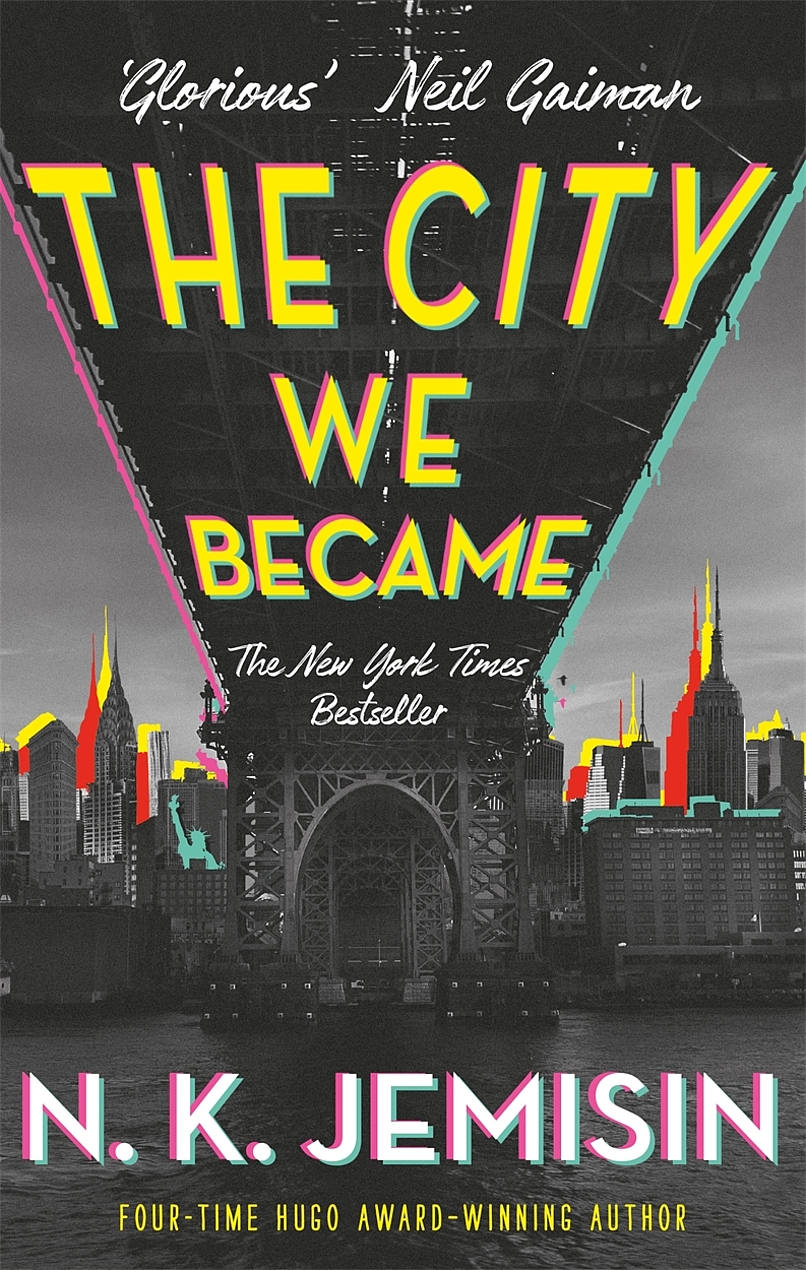
Hugos 2021: The City We Became by N. K. Jemisin

Published: 2020
Acquired and read: August 2021

The Great Cities Trilogy, Book One: The City We Became
by N. K. Jemisin

I enjoyed Jemisin's previous fantasy trilogy, The Broken Earth, a lot, particularly its first volume. Despite being fantasy, I felt it had the doubling effect that for me makes the best science fiction: it had a rigorously extrapolated secondary world, but it was also a metaphor for our world. This new novel is, as far as I know, the first book by Jemisin that falls into the Mendlesohn category of "intrusion fantasy" rather than "immersive fantasy," and perhaps for that reason, I found the commentary much less interesting. The basic premise is that when they reach certain levels of complexity, cities are "born" and acquire living avatars, but there are dark forces out there willing to destroy cities to stop this from happening. New York City is undergoing that process during the course of this novel, but because it has multiple boroughs, it has multiple avatars, who must find each other and learn to work together.

I had a number of problems with the book. It drags. As a friend of mine also pointed out, the reader understands what its going on by the end of the prologue, but it takes the characters over four hundred pages to figure it out for themselves, and to undertake the pretty mundane task of finding one another. And while the orogenes in The Broken Earth were potent metaphors for various aspects of chattel slavery, I felt like The City We Became didn't really engage with the potential complexities of its premise. The city avatars are basically all good, and the city is coming to life is a good thing, and they are a charming team of ethnically diverse heroes; the bad guys are all evil racists. But surely cities—and here my thoughts are influenced by James Scott's Seeing Like a State—are born of the push and pull between complexity and simplification. Cities are diverse places, but they are also always trying to contain and stamp out and systematize their own diversity in order to make it legible and therefore controllable. Without this, I would argue, you have no city. A city planner wants things in neat grids, and is willing to smash those who gets in their way; an American city in particular, is born of stolen land. I feel like some of this is touched on vaguely, but not really dealt with. I feel like there's another version of this book that's about cities coming to life in all their mess just being a thing that is, rather than a thing that's good, and I think that book is probably more interesting than this one.

This is made worse by the fact that the social commentary in The City We Became ranges from the obvious to the banal. It felt to me like it was written by Twitter: the villain is clearly a Karen, and there are definite echoes of the Chris Cooper birdwatching incident (though that actually happened after the book was written). Jemisin's book doesn't have anything new or interesting to say about those topics; it's pretty much all the exact same way you would get people snarkily commenting on it online. There's a particularly risible subplot about evil bro fascist racist progressive artists which completely failed to convince me that its villains were real people; again, it felt like an online stereotype of a category of person I'm not completely convinced actually exists. On top of that, this subplot is resolved stupidly easy; basically someone tweets "help out our art gallery," and it's all taken care of in a couple paragraphs.

Anyway, overall I found this pretty disappointing considering the strength of Jemisin's other work, and I imagine I will only read future installments if "forced" to do so by them being Hugo finalists in future years.

06 December 2021

Hugos 2021: A Deadly Education by Naomi Novik

Originally published: 2020
Acquired and read: June 2021

A Deadly Education: Lesson One of The Scholomance
by Naomi Novik

This reads like Naomi Novik started with Harry Potter and worked backward to justify it: why would you send your child to a magic school where it seems like immensely dangerous things are always happening? Then she worked forward from those justifications and built up a world and story around them. I found that quite clever. The main character is fun, and so is her place in the world; Novik does some great worldbuilding here. I'm sure she is a Harry Potter fan, but it does feel a bit like "Harry Potter done right."

One hundred and fifty pages in, though, and I felt like we were just getting started, still building the world, and what this book was actually about was unclear to me. I didn't feel like a central conflict had been introduced that this book would resolve; we just had the general premise of the whole series. Then, suddenly, it was, and the book quickly ran to its ending. I get that it's meant to be sudden in the narrative, too, but the only previous Novik I've read is Spinning Silver, which was over double the length of this book, and used its length highly effectively. Without having actually read the next book yet, it felt like this one had been arbitrarily cut off for reasons I don't really understand, when really this book should have kept on developing for some time. (If it's because of length and genre—unlike Novik's other work, this seems to be marketed as YA, albeit half-heartedly—then why is literally every Lodestar finalist longer?)

So as a 500-page book, I think this could have been great, but it resolves at the point it ought to have been complicating.

03 December 2021

2021 Hugo Awards for Best Dramatic Presentation Ballots

Best Dramatic Presentation is technically two categories, but I will write up both Long Form and Short Form in a single post.

Things I Nominated

I nominated one thing in each category this year. I decided to nominate a Big Finish audio drama, so I looked back over the 2020 releases that I had actually listened to in 2020 (I range from a little behind to a lot behind with my Big Finish at the best of times) and ended up picking Torchwood Soho: Parasite, which covers shenanigans at Torchwood in the 1950s, fronted by the delightful Norton Folgate, and also featuring good old PC Andy, plucked out of time. (As it's six half-hour episodes, I nominated it under long form.) My guess is that no Big Finish release will ever be a Hugo finalist, though; even if there are a lot of Hugo nominators listening to Big Finish (which I doubt), they put out so much content, it's hard to imagine any single release getting enough nominations to make the ballot.

The only 2020 tv I watched during 2020 was Doctor Who series 12, Star Trek: Picard season 1, (some of) Star Trek: Lower Decks season 1, and (some of) Star Trek: Discovery season 3. I didn't like Picard season 1 or Discovery season 3 much, and none of the episodes of Lower Decks that I saw in time spoke much to me. (I could see myself nominating "Crisis Point," but I got to it too late.)

So I ended up nominating what I thought was a pretty decent episode of a pretty dull series of Doctor Who, "Can You Hear Me?", which was probably the only episode both trying to do something interesting and almost pulling it off. It did not make the ballot, however, though a different episode did, and that one wasn't bad either.


6. The Old Guard, directed by Gina Prince-Bythewood, written by Greg Rucka

This movie is about a group of four immortals who get in a lot of fight scenes. I fell asleep about halfway through; I don't think this is entirely the film's fault (I was very tired) but what is the film's fault is that I was at no point motivated to resume watching it.

5. Birds of Prey and the Fantabulous Emancipation of One Harley Quinn, directed by Cathy Yan, written by Christina Hodson

This wasn't very to my taste. I love the Birds of Prey comics, but this isn't really a Birds of Prey film, it's a Harley Quinn film... though as my wife pointed out, it's probably the most enjoyable a Harley Quinn film could be. I did laugh couple times. I liked the performances of the actors playing both Black Canary and Huntress, so maybe I will like them better in some other, Harley-free, film. Plus... this isn't really sf&f, is it? One scene of Dinah using her sonic scream doesn't really count.

4. Tenet, written and directed by Christopher Nolan

At first, this felt to me like Nolan's take on James Bond, plus some sf elements. Our protagonist travels to exotic locations, each with a suitable set piece; what stopped it from being fully Bondian is that Bond would have slept with Elizabeth Debicki's character. The central idea is pretty neat, and the story does some cool stuff with it; by the climax, though, I will admit that I was confused. Robert Pattinson was a delightful surprise, and I also thought Debicki and Kenneth Branagh did great work. It felt to me like something Steven Moffat would have done... but once I realized that, I also realized that he would have put in more jokes! And of course I have to take points off for that. This movie takes itself very seriously... and also I'm not really sure what it was about beyond the sfnal idea; it's very sterile.

3. Soul; directed by Peter Docter; written by Peter Docter, Mike Jones, and Kemp Powers 

I feel like I always understimate Pixar. I'm like, "oh yeah they're pretty good movies," but then I watch a Pixar film and realize they always have a heft and a design sense to them that is pretty much unparalleled in contemporary animation. Things here move and live and breathe and shine. I enjoyed this a lot. I think it's not groundbreaking (it's very It's a Wonderful Life, isn't it?) but I don't know that that matters: good jokes, good performances, good score by Reznor and Ross, and great visuals. I particularly loved the way the afterlife creatures moved through the real world, and the climax with Joe and 22 plunging to Earth was glorious.

2. Palm Springs, directed by Max Barbakow, written by Andy Siara

I would have vacillated a lot on where to place this, but I watched it the day ballots were due, so I didn't have the time to dither a whole lot. Give me twenty-four hours to reflect and I might have placed it on top, who knows. This is a time loop film; I must be a sucker for these things, because in 2020 and 2018, I gave top spots to a time loop story. The time loop is a genre of its own these days, and we're surely in its decadent phase (as Joanna Russ would say) and all the better for it. This is a comedy that opens with a guy already trapped in the time loop for so long he can't remember; he inadvertently brings a woman into it alongside him. You'll know some beats from other time loop stories, but it's very original in other ways and has a good emotional core. Some great laughs, but also some really strong, thoughtful character stuff.

1. Eurovision Song Contest: The Story of Fire Saga, directed by David Dobkin, written by Will Ferrell & Andrew Steele

I really debated on where to place this. It's about an Icelandic duo with middling talent trying to make it in Eurovision; Will Ferrell and Rachel McAdams feature, and Pierce Brosnan plays Will Ferrell's dad. They have to overcome parental doubt, evil bankers, and Dan Stevens's obviously gay Russian in order to persevere and fulfill their childhood dreams. I had a blast watching this: it has fun music and a keen sense of the ridiculous that plays straight into my sensibilities. You have to take this movie intensely seriously and not at all seriously at the same time. I laughed a lot. But, you know, the sfnal content probably amounts to about 120 seconds of run time! Is it consistent of me to ding Birds of Prey but place this so high? So I was prepared to place it below Soul; Soul would be meaningless without its sf&fnal conceit, but Story of Fire Saga would honestly work just fine. But then I was like, "what would I be more excited to see win?" And it's not like Pixar films lack for acclaim. And though I think Soul is good, this was a blast. So here it is.


6. The Expanse 5x04: "Gaugamela", written by Dan Nowak, directed by Nick Gomez

I have stalled out somewhere back in season 3 of The Expanse, but I have read all the books, and this one is adapted from book five, Nemesis Games, so I had enough context to follow. In isolation, though, it comes across as one of those episodes that's more noteworthy for what happens than how. Big events, but outside of that, there was little that grabbed me here other than the chance to see one of my less-favorite books in one of my favorite series on screen.

5. Star Wars: The Mandalorian, chapter 13: "The Jedi", written and directed by Dave Filoni

I am sure this is quite exciting if you've been following both The Mandalorian in particular and Star Wars on tv more broadly: we learn key information about baby Yoda, and a character from the Clone Wars cartoon appeares in live action. I've been doing none of these things, so it's all kind of wasted on me. Still, it works well enough as a piece of standalone tv, just without the bigger emotional/dramatic hook one might want. I do quite like Ludwig Göransson's score.

4. She-Ra and the Princesses of Power 5x12/13: "Heart", written by Josie Campbell and Noelle Stevenson, directed by Jen Bennett and Kiki Manrique

This is the series finale to a five-season show. It seems like the kind of show I would like very much, along the lines of some of the favorites of my youth (and adulthood): big battles of good and evil, colorful characters, angsty side-switching, epic confrontations. But watching the series finale on its own is difficult to appreciate. I feel as though I am watching something that could be quite interesting, but I don't have the ability to appreciate it.

3. Star Wars: The Mandalorian, chapter 16: "The Rescue", written by Jon Favreau, directed by Peyton Reed

Despite this being only my third episode of The Mandalorian, I was quickly able to grasp the mechanics of what was going on here and why I should care. Despite me knowing what the big surprise was going to be, I still got chills. I did have to pause at one point and look up who all the returning characters were at the beginning, but on the other hand, the emotion of the ending succeeded entirely on its own terms. Maybe someday I will watch this show, but I have been enjoying these dribs and drabs of it.

2. Doctor Who 12x05: "Fugitive of the Judoon", written by Vinay Patel and Chris Chibnall, directed by Nida Manzoor

This wasn't the episode I nominated, but it was one of the better episodes of series 12 of Doctor Who, with some dramatic reveals, cracking direction, and sharp scenes featuring Jodie Whittaker's Doctor and the mysterious Ruth. (What brings it down for me are the weirdly shot and pointless scenes with Captain Jack; one assumes they couldn't get Barrowman on the same day as any of the rest of the cast.) This has an impact, but it's also an enjoyable and entertaining episode on top of that.

1. The Good Place: The Final Chapter: "Whenever You're Ready", written and directed by Michael Schur

At last our long national nightmare is over. In honor of that, I give The Good Place my vote.

In all seriousness... I really liked this? My only previous episodes of The Good Place have been those five nominated as Hugo finalists, which long-time readers know I have found more miss than hit, but this seemed to me—based on that weird sampling anyway—to be a charming, effective, and occasionally moving finale. All the characters get good final moments... plus lots of great jokes (of course I was a sucker for the Radiolab one) and a cameo from Nick Offerman playing Nick Offerman teaching someone how to make a chair. This gave me the purest enjoyment of anything on this list.


Overall Thoughts

Long Form was a more interesting category than usual this year; I suspect this is down to the pandemic delaying any blockbuster originally scheduled for March 2020 or later to 2021. No Marvel movies; the closest we get to a big franchise film is Birds of Prey. This allows for some more offbeat stuff to rise to the top, which is one of the things I like about this category. Seems unlike I ever would have even heard of Palm Springs without the Hugos, much less seen it.

Short Form is tougher than normal. It usually has a few things that work reasonably well as standalones, but this year literally every finalist is a pivotal moment in an ongoing story! This makes them hard to assess as an outsider; I feel like if I'd seen any other She-Ra, for example, I might have ranked "Heart" at the top, but I'll never know. I am loathe to add more Hugo categories, but I do wonder if Short Form and Long Form need to be split yet again: I don't know what I would call the categories, but with spans of something like 0-90 minutes, 90-180, and 180+, so you get individual episodes, films, and seasons each evaluated on their own terms. Though, if all of these seasons make it into the 180+ category, will there be anything left for the 0-90 one given how serialized televised sf&f is at the moment?

I feel fairly comfortable in saying that The Good Place will take home its fourth and final Hugo. The long-form category is much less obvious to me. None of them strike me as having the "it factor" that will win over (after a number of rounds) the majority of Hugo voters. I don't think it will be The Story of Fire Saga—too weird—nor Tenet—not good enough—nor Birds of Prey—too over-the-top—nor Old Guard—too boring—nor Palm Springs—too comedic. Which I guess means Soul? Pixar films have won twice before, The Incredibles and WALL-E, though both of those seem closer to the sf fan's sensibilities. So who knows.

I might be unsure about this year, but I will go out on a limb and tell you right now that the 2022 Hugo Award for Best Dramatic Presentation (Long Form) is going to go to Dune.

19 November 2021

2021 Hugo Awards for Best Novella and Novelette Ballots

Best Novella has become sort of a pain point for me; my first couple years, I was impressed by the Tor.com novella program, but as it has taken over the ballot (all six finalists are from it this year), it seems to me that it's mostly ossified in ways I don't like. We always get a "Wayward Children" story, a Murderbot story (thankfully, we got a reprieve this year), and then a bunch of set-ups for other ongoing series.

Things I Nominated

Time to be excited, because I nominated something that actually made the ballot, Isabel Fall's "I Sexually Identify as an Attack Helicopter" under Best Novelette. I wonder if I would have thought to do so without the controversy? But in any case, it's a great story.


7. Come Tumbling Down by Seanan McGuire

“Have you noticed that the doors come for us when we’re young enough to believe we know everything, and toss us out again as soon as we’re old enough to have doubts?”
This is the fifth "Wayward Children" novella, and the fifth to make the Best Novella ballot... I think I could pretty charitably describe myself as being over them. This one isn't as twee and affected as some of the others, but I never cared about any of these people and what they did. I didn't have a strong opinion about whether it was better or worse than FINNA, so I broke my tie by deciding that Come Tumbling Down was more likely to win, and thus it would make more use of an anti-vote.

6. FINNA by Nino Cipri

“You don’t need written instructions, the diagrams are made to be universally understandable.”

The premise of this book is fun: an assemble-it-yourself-furniture-chain-store-that-is-clearly-IKEA is so confusing and twisty to navigate that occasionally you can wander into a different universe; as a result, the staff have a device they can put together to follow, find, and retrieve customers who get lost. But once the basic premise is communicated, the corporate satire vanishes and it becomes a pretty dull adventure story; plus it contained several leaps that I found pretty unlikely.

5. Upright Women Wanted by Sarah Gailey

“People like us, we draw the bad in. There’s no good end, not for us. We knew better, we read all the stories—read them too much, probably.”

This is the fifth Sarah Gailey Hugo finalist I have read, and the third I have ranked below No Award. I am starting to think that I just do not get on with what they are doing. (I did really like "STET," though.) In this one, it's after the apocalypse, and women librarians travel the West, enforcing moral hygiene. A young lesbian seeks refuge with them—only it turns out the librarians are the locus of the resistance. A good idea here that failed in execution, I think. The protagonist's desire to "fix" herself vs. her fascination with the librarians wasn't very well handled (I didn't really have a good sense of what she was after), and the book never really reckoned with how the librarians reconciled distributing homophobic and misogynistic material with being in the resistance. Like a lot of Tor.com novellas, it feels more like the pilot for a streaming television show than a piece of prose fiction. But I didn't skim it as aggressively as I did the lower ranked items on this list.

4. No Award

You could best, as you might have worked out, describe my take on the Tor.com dominance of the Best Novella category as grumpy. They clearly do good work, but I don't think the approach of their work is sufficiently diverse to justify them claiming the top six spots. If some of the finalists came from other publishers, I probably wouldn't feel compelled to put No Award here. But I felt there was a pretty sharp demarcation between Tor.com novellas that were doing things I found interesting, and ones that were not; between ones that actually felt like prose novellas and ones that did not.

3. The Empress of Salt and Fortune by Nghi Vo

Chih tilted their head to one side.
     “Are you going to ask me if I understand? I am still not sure if I do.”
     “Well, something like this, you understand or you won't.”

This was the last novella finalist I read, and I probably read it faster than it deserved, because I was bit surprised when it ended, and not certain I followed it completely. But it was an interesting story: a young cleric hears the testimony of a former servant of an empress, so we get a series of vignettes about the empress. But they were good vignettes, and there were some good lines. I see it has a sequel, but it doesn't feel like a set-up for a series, so I won't hold that against it. I would gladly reread it someday, and gladly see it win.

2. Ring Shout, or Hunting Ku Kluxes in the End Times by P. Djèlí Clark

In the Shout, you got to move the way the spirit tell you and can't stop until it let you go. And don't call it no dance! Not unless you want Uncle Will to set you down and learn your proper. See, the Shout ain't really the song, it's the movement. He says the Shouts like this one got the most power: about surviving slavery times, praying for freedom, and calling on God to end that wickedness.

At least there is one good novella finalist this year. This is set in an alternate 1910s in Georgia, where there are both human Klansmen and alien "Ku Kluxes," horrific creatures that stoke human racism; the narrator is a black woman who hunts them down. A strong sense of voice is what carried me through it, playing to the strengths of the genre more than most Tor.com novellas. I didn't think it quite stuck the landing, though; the motivations of the aliens felt a bit too Doctor Who, and undercut the book's engagement with themes of racial hate. (Why did I not learn that Clark was a history professor at UConn until now? I could have met him!)

1. Riot Baby by Tochi Onyebuchi

[A] dozen more shootings produce a dozen more weeping families that have to struggle stoically through their black grief or that can stand behind microphones and declare their black anger, and the bodies pile higher and higher and higher, and so does the frustration with the impunity “because,” says the district attorney in St. Louis in Kansas City in Staten Island in Dayton in Gary in Albuquerque in Oakland, “you can't indict an algorithm.”

I was beginning to despair. Yes, there was one good novella finalist, but was just one and just good the best we could do? Then, squeezed in at the end, I read my second-last one. And I was like, wow, it's actually a novella! It's not a pilot for a series filled with Buffy characters, it's a standalone sf story with incredible power. This follows a girl with fantastic powers and her younger brother, who was born during the Rodney King riots, as America grows worse and worse. Onyebuchi's writing is confusing, beautiful, and dark, and I was going to say that I liked the weaving in of commentary, except that it's less commentary and more a rant. There are some intense scenes, but also some weird ones. Clear and above one of the best, and I guess maybe the Tor.com novella program might be worth it after all. 


6. "The Inaccessibility of Heaven" by Aliette de Bodard

“Will you come?” he asked, again, and it wasn’t an invitation after all—at least, not the kind you could refuse.

Sort of a mystery involving a bunch of fallen angels. I was very surprised to learn this wasn't a tie-in to a novel series or a sequel to another story, as it very much felt like a story that was covering backstory very hurriedly because it had already been told in some other stories. There were a lot of relationships that I didn't care about because I felt like the story didn't make me care about them; some turns in the plot upset things the narrator thought they knew... but since I didn't know them, it was hard to care. There also really aren't any suspects, or a meaningful motive.

 5. "Monster" by Naomi Kritzer

Mao is a lot less popular in China than he once was, but he’s still on the money. I suppose this is also true of George Washington in the US. 

I was a bit surprised this was nominated, to be honest; it was well told, but I didn't feel like much was going on, story-, character-, or theme-wise; a genetics professor goes in search of, and recounts her history with, a creepy guy she knew in high school who, like her, was bullied a lot. That's basically it. Kritzer has written better.

4. "Two Truths and a Lie" by Sarah Pinsker
“And did he say ‘rhizome’? Who says ‘rhizome’ to seven-year-olds?”

I do like me some Sarah Pinsker, and I enjoyed this story, which is about someone who compulsively makes things up discovering that a local kids' tv she made it may have some reality to it after all. Like Pinsker's last piece of horror fiction to make the ballot, though, it wasn't quite to my taste as much as her work usually is.

3. "Burn or The Episodic Life of Sam Wells as a Super" by A. T. Greenblatt

Watch Sam burn and hate himself for it.

Neat story about an accountant who gains superpowers he can't control; he joins a super-team in the hopes that he can use his powers for good... but they just need an accountant, too. Some of the beats will be familiar if you've read a lot of superhero comics, but Greenblatt tells the story engagingly; good structure and good prose. The repeated refrain of "Watch Sam burn" hits very effectively. I will have to look out for more by her. Didn't strike me as innovative or compelling as "The Pill," but highly enjoyable.

2. "The Pill" by Meg Elison
It was a “trade secret,” they said on the news. They also said “miracle” and “breakthrough” and “historic.” The miracle of shitting out skin just looked like blood and collagen and rotten meat, it turns out.

A pill is released that allows people to become skinny easily... it's just that they have a ten percent chance of dying... and people rush to do it, because they'd rather be dead than fat. I had never even heard of Meg Elison before, but I found this very arresting and disturbing and tantalizing, about the lengths people will go to to remold their bodies, and what society will do to people with bodies that different from the norm.

1. "Helicopter Story" [formerly known as "I Sexually Identify as an Attack Helicopter"] by Isabell Fall
The Apache is my body now, and like most bodies it is sensual. Fabric armor that stiffens beneath my probing fingers. Stub wings clustered with ordnance. Rotors so light and strong they do not even droop: as artificial-looking, to an older pilot, as breast implants.

This story was the center of some controversy, in that its trans author was harassed on Twitter for supposedly being transphobic to the point of the story being removed from the Internet; this Vox article lays it out pretty well. It's a shame, because I read the story when it was published (someone posted it on r/printSF, and I was intrigued by how the title was reclaiming a transphobic meme), and I thought it was brilliant. It has some fascinating stuff to say about gender identity; what I particularly liked was how it depicts the state co-opting people's identities for the purpose of violence. All that and great prose too. An easy top place for me.


Overall Thoughts

As alluded to many times above, I don't find the Tor.com dominance of Best Novella in recent years very compelling. They do good work, but surely so are others. Though many finalist come from Tor.com, usually other publishers sneak in a couple; this is the first year since 1996 where all six novella finalists come from one source. I don't have a solution for this, though; not even E Pluribus Hugo seems to be making a difference! (I will be curious to see the nomination stats.) On the other hand, I've said before that I kind of think of novelettes as not real (they're really either long short stories or short novellas) but that's belied by the quality of these stories. The past couple years, Best Novelette has had more strong stories than either Best Short Story or Best Novella. Any of the top four here are very solid pieces of work even when they're not to my taste.

A Wayward Children novella gets nominated every year for Best Novella, but has only actually won once. Among the other finalists, I don't have a strong sense of who will win; I haven't followed much short fiction discussion this year, to be honest, so I don't know who has "buzz." Eh, it probably will be McGuire, yeah? I have a suspicion it will be "Helicopter Story" for Best Novelette. Maybe Pinsker if not. None of the stories are twee tales about robots and/or fandom, so what will appeal to the electorate's taste isn't obvious.