Showing posts with label creator: john ross. Show all posts

31 May 2023

Mistress of Chaos (From Stockbridge to Segonus: A Doctor Who Magazine Comics Marathon, Part 47)

Mistress of Chaos: Collected comic strips from the pages of Doctor Who Magazine
by Scott Gray, John Ross, Mike Collins, and David A Roach

Collection published: 2020
Contents originally published: 2018-20
Acquired: January 2021
Read: March 2023

And here it is: I come, at long long last, to the end. I began way back in November 2020; two years and four months later, thirty-one collections later, five hundred and forty-eight strips later,* I am finally done! It's been quite a journey, but that's probably content for a separate post. First, we have to talk about this volume in particular.

The Warmonger, from Doctor Who Magazine #531-34 (Dec. 2018–Feb. 2019)
story by Scott Gray, art by John Ross, colours by James Offredi, lettering by Roger Langridge
So the caveat to everything I am going to discuss here is that I am not really a fan of the Jodie Whittaker era on screen, as the writing and direction make what are—to me at least—frequently baffling choices that eliminate the possibility of drama and character development. I struggled with Titan's Thirteenth Doctor comics, which I felt emulated the parent show very well... by being sort of boring and aimless and not knowing how to handle having three companions.

Which is to say, that I like what Scott Gray does here and in the volume's subsequent stories, which is tell the same kind of entertaining strip stories he always tells, just with a new set of characters. I always liked the potential of the thirteenth Doctor, Yaz, Graham, and Ryan, but the show rarely delivered on it. Gray, though, is always good at incorporating strong character beats into his writing, and as ever, we get that here, as the TARDIS delivers the four of them into a warzone. Yaz is strong-willed and idealistic; there's a great scene where she stares down some looters. Graham and Ryan are well-meaning but a bit comic; they get some fun material here when they're separate from the Doctor, especially when Ryan flirts with a robot news reporter. (Gray is good at splitting the fam up into different combinations across these stories.) The Doctor is impish, impulsive, steely, and radically compassionate. There was this idea nascent in early thirteenth Doctor stuff that she would be compassionate to the point of being dangerous but I'm not sure it always worked on screen; I actually reckon that aside from Gray, the two stories to capture the thirteenth Doctor best are Paul Cornell's lockdown tales "The Shadow Passes" and "The Shadow in the Mirror." In the latter, the Doctor extends a very dangerous but ultimately successful forgiveness, and we see something like that in her solution to this story's crisis.
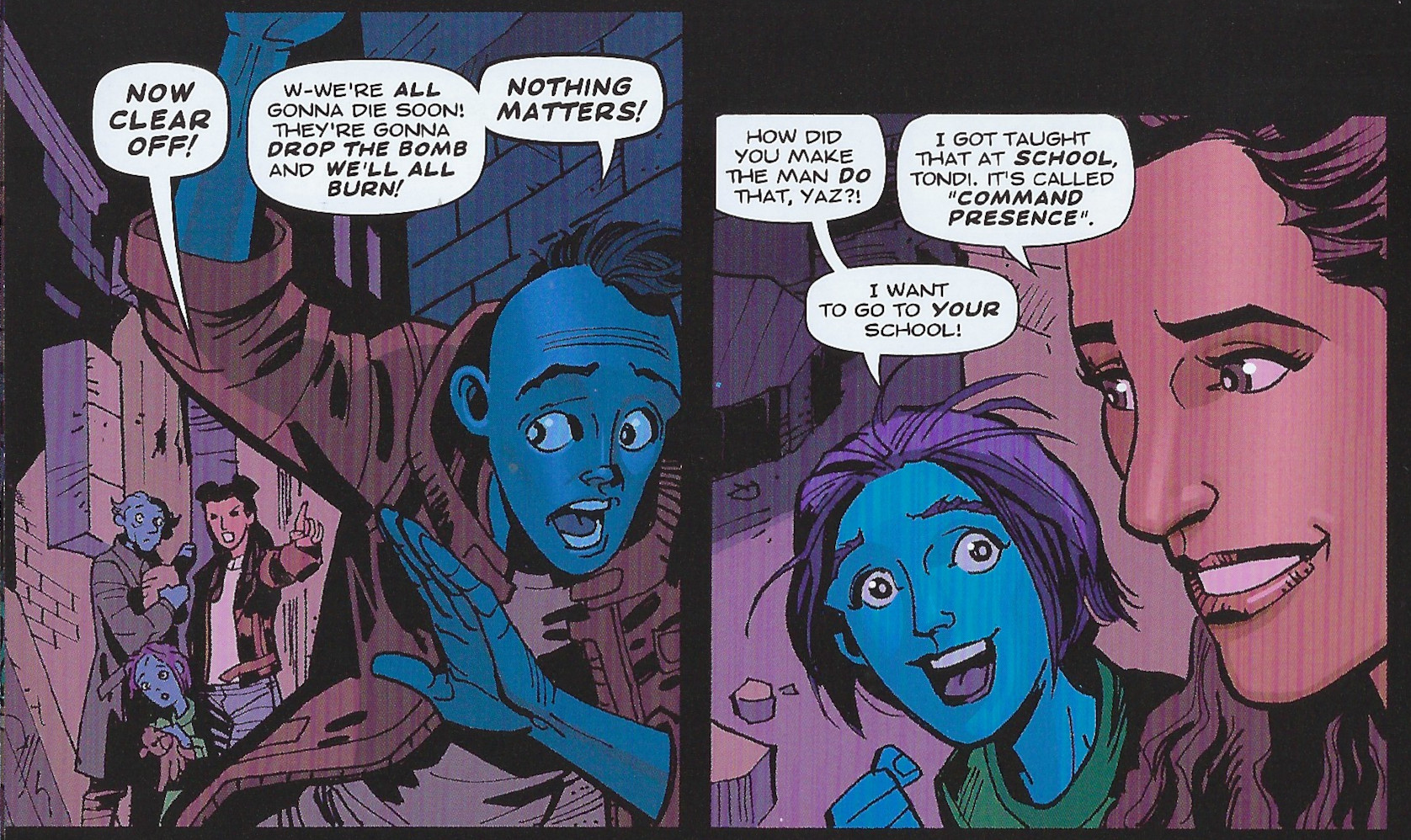
from Doctor Who Magazine #533
The place where this story clearly diverges from its screen counterpart is in its use of a returning villain. While series 11 very much eschewed any returning elements at all, this brings back Berakka Dogbolter. While she only appeared for the first time back in The Stockbridge Showdown in #500, she's the daughter of long-running foe Josiah W. Dogbolter, taking us all the way back to DWM's 1980s "golden age." It's a nice move, I think: the Doctor may be different, the set-up may be different, the screen version may have a very different style, but the reader of the DWM comic knows that it's still the same story that began with The Iron Legion.

Of the new series Doctor, three were introduced by Mike Collins and a fourth by Martin Geraghty, both of whom have a very realistic style. Here, we get the dynamic John Ross on art, and he very much nails it: his likenesses are less direct but also very strong. He juggles a lot of elements in this story, and the reader is kept on top of all of them. I've liked his stuff all long, but his material in this volume is surely him at the top of his game.

So yeah, like a lot of Scott Gray's stories, there's not something I can point to that makes it a work of genius, but it is a well-executed piece of strong Doctor Who. Good characterization, neat worldbuilding, dynamic ideas.
from Doctor Who Magazine #535
Herald of Madness, from Doctor Who Magazine #535-39 (Mar.-July 2019)
story by Scott Gray, pencil art by Mike Collins, inks by David A Roach, colours by James Offredi, lettering by Roger Langridge
This is a fun historical story about the Doctor and fam crashing a gathering of astronomers and such, focusing on Tycho Brahe and Johannes Kepler. I don't have a lot to say about it that I didn't about the previous story, but again, Gray does a great job of putting together an interesting story with good reversals that splits up the regulars to strong effect. Yaz gets a good bit, where she pretends to steal someone's soul with her phone, but really they all across strongly.

Mike Collins is always good, but after reading this I kind of wondered if they didn't give him Jodie's debut because his likenesses for women are not quite as good as his ones for me (he always kind of struggled with Amy in particular), and now the lead character is a woman.
from Doctor Who Magazine #540
The Power of the Mobox, from Doctor Who Magazine #540-42 (Aug.-Oct. 2019)
story & art by Scott Gray, colours by James Offredi, lettering by Roger Langridge
Scott Gray takes on his first multi-part story as an artist. The Mobox have appeared in a few previous DWM stories, most notably Ophidius and Uroboros, but they've never looked better than they look here, as somewhat Kirbyesque creations... but one of their strengths is they're not monsters, they're people; I came to really like R'Takk, the grumpy but well-meaning Mobox captain the fam encounters. The Kirby tone for all tech here really works; honestly, more Doctor Who artists should do this, because it's a good fit for the sensibilities of Doctor Who.

There's a great cliffhanger where it looks like the Mobox disintegrated Graham and Yaz, but long-time DWM readers will remember that Mobox store what they de-materialize inside them and can bring it back. When I first read this story in DWM in 2019, I did not remember that fact from the earlier Mobox stories almost two decades prior, but this time I did (having read the relevant stories less than a year ago), so nicely done, Scott. As always, each character gets a moment to shine, and Gray puts them in a different combination every time.
from Doctor Who Magazine #544
Mistress of Chaos, from Doctor Who Magazine #543-48 (Nov. 2019–Mar. 2020)
story by Scott Gray, art by John Ross, colours by James Offredi, lettering by Roger Langridge
The finale to this set of stories brings back Berakka from The Warmonger and the Herald of Madness from, well, you know... and finally brings us to the planet Segonus that gives this series of posts its alliterative title! The Doctor discovers that the Herald of Madness wasn't a reflection of her... but actually her.

Again, filled with strong moments; I like Gray's steely thirteenth Doctor, who goes after Berakka when she realizes Berakka is trying to ruin her reputation. There are creepy baddies and a good role for Graham and excellent art from John Ross once more. Clever stuff as always, and James Offredi is on fire here as a colourist. Of course, the realms of logic and chaos are distinguished from each other, but they're also very distinct from the real world too.

My main issue is that "evil Doctor" stories are always tricky: the bad Doctor has to convince as the Doctor, and this doesn't always happen. Gray gets closer than most, but one never really feels like the chaos Doctor and the logic Doctor are possible future Doctors. The idea that they reflect different key aspects of the Doctor's personality comes through better in the commentary than in the actual story, where it feels more abstract. I did really like the resolution, though, and the story's closing moments—a montage of people highlighting the good the Doctor does, complete with Sharon cameo—is a fitting one for this particular Doctor, who is often positioned as a source of hope in the darkness.
Like I said above, this set-up for Doctor Who never worked for me on screen, but Gray reveals the potential that was there all along and really makes it sing.

Stray Observations:
  • If you're the kind of person who cares about these things, note that The Warmonger, The Power of the Mobox, and Mistress of Chaos all take place during the same time period, which must be what Ahistory calls "the mazuma era," around the time of Dogbolter and Death's Head in the 82nd century. I don't think there was ever any kind of even loose dating given for Ophidius and Uroboros, but the presence of the Mobox empire here would seem to place them in the same era as well.
  • Surely it ought to have been The Power of the Mobox!, right?
  • Three different versions of Jodie Whittaker in a series finale? Whatever the tv show can come up with, Scott Gray always gets there first!
  • Three of the four stories feature a mysterious "Mother G," who knows the TARDIS; she tells the Doctor what the "G" stands for in Mistress of Chaos, but we don't get to hear that answer ourselves... and the Doctor doesn't believe it. Well, I look forward to seeing where Scott Gray goes with this in what will surely be a key thread to his long run on the thirteenth Doctor's comics for the next two-and-a-half years!
  • "JUST A TRACER" WATCH: David A Roach Appreciation Society triumphant! That's right, he finally garners cover credit for a volume where he is a "mere" inker. We did it!
Okay, Panini, where's my The Everlasting Summer collection? #549-52, 559-72, 574-77, and 578-83 would add up to about the right amount of content for a graphic novel. And then I think Monstrous Beauty would go well with Liberation of the Daleks.

* Well, kind of.

This post is the forty-seventh in a series about the Doctor Who Magazine comic strip and Marvel UK. The next installment covers issues #215–18, 223–27, and 235–54 of Transformers UK. Previous installments are listed below:

  1. The Iron Legion
  2. Dragon's Claw 
  3. The Transformers Classics UK, Volume One
  4. The Tides of Time
  5. The Transformers Classics UK, Volume Two
  6. Voyager
  7. The Transformers Classics UK, Volume Three
  8. The World Shapers
  9. The Transformers Classics UK, Volume Four
  10. The Age of Chaos
  11. The Transformers Classics UK, Volume Five
  12. A Cold Day in Hell!
  13. Death's Head: Freelance Peacekeeping Agent (part 1)
  14. Nemesis of the Daleks
  15. Death's Head: Freelance Peacekeeping Agent (part 2)
  16. The Good Soldier
  17. The Incomplete Death's Head
  18. Evening's Empire
  19. The Daleks
  20. Emperor of the Daleks
  21. The Sleeze Brothers File
  22. The Age of Chaos
  23. Land of the Blind
  24. Ground Zero
  25. End Game
  26. The Glorious Dead
  27. Oblivion
  28. Transformers: Time Wars and Other Stories
  29. The Flood
  30. The Cruel Sea 
  31. The Betrothal of Sontar
  32. The Widow's Curse
  33. The Crimson Hand
  34. The Child of Time
  35. The Chains of Olympus
  36. Hunters of the Burning Stone
  37. The Blood of Azrael
  38. The Eye of Torment
  39. The Highgate Horror
  40. Doorway to Hell
  41. Daleks: The Ultimate Comic Strip Collection, Volume 1
  42. The Phantom Piper
  43. Daleks: The Ultimate Comic Strip Collection, Volume 2
  44. The Clockwise War
  45. Death's Head: Clone Drive / Revolutionary War
  46. Skywatch-7

08 May 2023

The Clockwise War (From Stockbridge to Segonus: A Doctor Who Magazine Comics Marathon, Part 44)

The Clockwise War: Collected Comic Strips from the pages of Doctor Who Magazine
by Scott Gray, John Ross, Alan Barnes, Adrian Salmon, Charlie Adlard, et al.

Collection published: 2019
Contents originally published: 1994-2018
Acquired: December 2019
Read: December 2022

The twelfth Doctor's run comes to an end with this somewhat odd collection, which includes just one twelfth Doctor story as well as a number of outstanding uncollected color stories from various sources, basically everything color that was left except for a few strips that made their way into The Age of Chaos.

Anyway, for obvious reasons I didn't follow my usual principle of reading each collection in original publication order: it just wouldn't make sense to go from The Phantom Piper to a bunch of other stuff to The Clockwise War, when The Clockwise War picks up right from The Phantom Piper.

The Clockwise War, from Doctor Who Magazine #524-30 (May-Nov. 2018)
story by Scott Gray, art by John Ross, colours by James Offredi, lettering by Roger Langridge

This story caps off the twelfth Doctor era with a story that pits the Doctor and Bill against erstwhile companion Fey, who's out for revenge against the Time Lords after suffering through the horrors of the Time War. I think there's a lot to like about this story but it didn't totally work for me. I like the return of Fey, I like the installment told from the perspective of the War Doctor, I like the reveal about Shayde, I like the return of Jodafra and the use of his death to prove the situation is serious, I like the stuff with Wonderland and especially Annabel Lake. John Ross probably turns in his best-ever DWM work here, it's propulsive and beautiful to look at. On the other hand, the black-and-white monsters are too similar to what we just saw in The Phantom Piper, and while it's nice to see some of the supporting characters from The Parliament of Fear return... I'm not actually sure why they're there! Ultimately I think it's at least partially a victim of the sudden page cut: there's little room to breathe, and just like in the last story, Bill feels a bit forgotten in the middle of it all. This is her last story, but she doesn't get the kind of moments or send-off that Rose, Donna, Amy, and Clara got in theirs. Lots of moments of love but I didn't love it altogether.
from Doctor Who Yearbook 1994
A Religious Experience, from Doctor Who Yearbook 1994
story by Tim Quinn, art by John Ridgway, letters by Janey Rutter, colours by Chrissie McCormack
In this first Doctor story, he and Ian watch a religious ritual on an alien planet. I didn't care for this at all: overly talky and nihilistic, I felt. Plus, John Ridgway's art usually doesn't benefit from being colored, especially coloring this crude.
Rest & Re-Creation / The Naked Flame, from Doctor Who Yearbooks 1994 & 1995
scripts by Warwick Gray, art by Charlie Adlard, colours by Helen Nally and Steve Whitaker, letters by Janey Rutter and Jane Smale
These are both fourth Doctor stories where he re-meets old monsters: the Zygons in the first and the Menoptera in the second. They're by a young pre-"Scott" Scott Gray, and I found both kind of boring and confusing.
Blood Invocation, from Doctor Who Yearbook 1995
story by Paul Cornell, art by John Ridgway, colour by Paul Vyse, letters by Jane Smale
The fifth Doctor, Tegan, and Nyssa take on Time Lord vampires in this story that's almost but not quite a prequel to the Missing Adventure Goth Opera; in the extras, Paul Cornell explains that he doesn't know why they aren't consistent. I didn't find much to enjoy here; again, I think I'd be more into John Ridgway drawing vampires if it was all in black and white.
from Doctor Who Magazine #223
The Cybermen, from Doctor Who Magazine #215-38 & 504 (Aug. 1994–May 1996, Nov. 2016)
by Alan Barnes & Adrian Salmon, lettering by Peri Godbold
This was a series of one-page strips published in the magazine across about two years; even before reading the commentary it was obvious to me that it was based on the old Daleks strips: it focuses on the Cybermen on Mondas in the old days, encountering weird threats, where we're usually meant to identify with the monsters, not the people trying to stop them. Like those old strips, they're kinetic and weird and fascinating, and I kind of felt like reading them all in a row wasn't doing them justice. They're very visual stories, and I often didn't know what exactly had happened, and felt I ought to have spent the time working through the art of the (as always) brilliant Adrian Salmon, but instead I went on to the next. But still: where else can you get Cybermen battling dinosaurs, Cybermen with blimps, Cybermen battling Cthuluoid menaces. The use of stuff like the Silurians could be overly fannish, but Barnes and Salmon make it work; I don't know how this actually fits with previous Cybermen stories, not even The Tenth Planet, but I don't really care.
from Doctor Who Yearbook 1996
Star Beast II / Junk-Yard Demon II, from Doctor Who Yearbook 1996
stories by Gary Gillat and Alan Barnes, art by Martin Geraghty and Adrian Salmon, colours by Paul Vyse, letters by Elitta Fell and Peri Godbold
It would be easy to attack to self-consuming nature of DWM pre-TVM: the best it could come up was two sequels to Steve Parkhouse strips? But actually these were my favorites of the various yearbook stories collected here. Fun, straightforward stories with good artwork. Beep the Meep is always good fun, of course, and it's nice to see Fudge again. I don't know that Junk-Yard Demon demanded a sequel, but if it had to get one, this one is suitably grotesque.
from Doctor Who Magazine #526
Stray Observations:
  • Branding this collection "Collected Multi-Doctor Comic Strips – Volume 2" is one of those things that's technically correct but seems a bit confusing. Far better to brand it as the fifth and final of the "Collected Twelfth Doctor Comic Strips," since that's the series it actually ties into.
  • I liked the return of Jodafra, but on the other hand I didn't remember who Gol Clutha was at all even though she appeared much more recently, in Hunters of the Burning Stone and The Stockbridge Showdown!
  • I know the name came from Moffat (it debuted in this comic, but Scott Gray e-mailed Moffat to find out if the character had a name), but I find "Kenossium" as a name for Ken Bones/T'Nia Miller's General character really really stupid.
  • In the extras, Tim Quinn complains that editor John Freeman added a reference to the planet Quinnis from Inside the Spaceship to A Religious Experience. He seems to think the name "Quinnis" is intrinsically dumb-sounding but I'm not sure why.
  • These are Charlie Adlard's only Doctor Who contributions, and he seems faintly bemused by the whole things in the notes. He also did a lot of Vertigo work in the 1990s, but most notably went on to be the penciller on 187 issues of The Walking Dead, making him the person in this volume with the biggest non–Doctor Who comics career.
  • Star Beast II picks up from the end of The Star Beast; when Big Finish eventually did its own Beep the Meep story (2002's The Ratings War), it would actually pick up right from the end of Star Beast II, with Beep escaping Lassie.

This post is the forty-fourth in a series about the Doctor Who Magazine comic strip and Marvel UK. The next installment covers Death's Head: Clone Drive and Revolutionary War. Previous installments are listed below:

  1. The Iron Legion
  2. Dragon's Claw 
  3. The Transformers Classics UK, Volume One
  4. The Tides of Time
  5. The Transformers Classics UK, Volume Two
  6. Voyager
  7. The Transformers Classics UK, Volume Three
  8. The World Shapers
  9. The Transformers Classics UK, Volume Four
  10. The Age of Chaos
  11. The Transformers Classics UK, Volume Five
  12. A Cold Day in Hell!
  13. Death's Head: Freelance Peacekeeping Agent (part 1)
  14. Nemesis of the Daleks
  15. Death's Head: Freelance Peacekeeping Agent (part 2)
  16. The Good Soldier
  17. The Incomplete Death's Head
  18. Evening's Empire
  19. The Daleks
  20. Emperor of the Daleks
  21. The Sleeze Brothers File
  22. The Age of Chaos
  23. Land of the Blind
  24. Ground Zero
  25. End Game
  26. The Glorious Dead
  27. Oblivion
  28. Transformers: Time Wars and Other Stories
  29. The Flood
  30. The Cruel Sea 
  31. The Betrothal of Sontar
  32. The Widow's Curse
  33. The Crimson Hand
  34. The Child of Time
  35. The Chains of Olympus
  36. Hunters of the Burning Stone
  37. The Blood of Azrael
  38. The Eye of Torment
  39. The Highgate Horror
  40. Doorway to Hell
  41. Daleks: The Ultimate Comic Strip Collection, Volume 1
  42. The Phantom Piper
  43. Daleks: The Ultimate Comic Strip Collection, Volume 2

29 March 2023

Doorway to Hell (From Stockbridge to Segonus: A Doctor Who Magazine Comics Marathon, Part 40)

Doorway to Hell: Collected Comic Strips from the pages of Doctor Who Magazine
by Mark Wright, Staz Johnson, Mike Collins, David A Roach, and John Ross

Collection published: 2017
Contents originally published: 2016-17
Acquired: December 2017
Read: December 2022

The twelfth Doctor has settled down for a time, stuck in one time and place. His new companion is a young, college-age black woman, to whom he acts as a bit of a teacher. Plus, his oldest enemy is trapped with him.

No, it's not series ten... it's DWM issues #501 to 511! It is a bit amazing how much this is like what would be done on screen a year later. "Great minds," one supposes, but it's a set-up that really works in both cases.

Reading the comic, I have come to look forward to those periods where the television programme is off screen for protracted runs. Even though the comic is usually solid when the show is on, the energy of a complete run with its own connections and themes makes it greater than the sum of its parts—and it's most often these sequences that reward rereading in collected form.

The Pestilent Heart, from Doctor Who Magazine #501-03 (Aug.-Oct. 2016)
story by Mark Wright, pencils by Mike Collins, inks by David A Roach, colour by James Offredi, letters by Roger Langridge
This is the story that has to reunite the twelfth Doctor with Jess Collins from The Highgate Horror, strand the Doctor in the 1970s, and establish a new status quo. Its strength is definitely its first installment, where Jess goes after the enigmatic Doctor she remembers from Highgate Cemetary; the later-era Peter Capaldi Doctor is perfectly presented here, funny and acerbic. Once the plot gets underway I found it all a bit less interesting, to be honest, and when the bird creatures appeared in a grave, I was a bit confused until I realized they were totally different bird creatures to the ones in a grave from Jess's first story!
from Doctor Who Magazine #504
Moving In, from Doctor Who Magazine #504 (Nov. 2016)
story by Mark Wright, art by John Ross, colour by James Offredi, lettering by Roger Langridge
Now this is where this run and its premise begins to sing. This is told in the form of four three-page vignettes, as the Doctor interacts with each member of the Collins household: father Lloyd, mother Devina, son Maxwell, and of course Jess. They're all nicely executed bits of characterization, but the best of all is the Doctor arguing about superheroes with Max. "Detectives aren't clever! What's clever about solving crimes after they happen? 'Ooh, look at my amazing powers of hindsight!'" John Ross is usually tapped as DWM's action man (see last volume for a prime example), but he's amazingly deft with the character work here: good facial expressions, really captures Capaldi's performance and brings the whole family to life. This is the kind of thing only the strip could do, and all the better for it.
from Doctor Who Magazine #506
Bloodsport, from Doctor Who Magazine #505-06 (Dec. 2016–Winter 2016/17)
story by Mark Wright, art by Staz Johnson, inks by David A Roach, colours by James Offredi, lettering by Roger Langridge
This is a fine story. Solid but unspectacular... alien hunters come to London, the Doctor must persuade them to depart. It's the exact kind of thing that benefits from the overarching set-up, because Jess and Max and the blundering cop are what make the story work, as real people around the Doctor trying to get out.
from Doctor Who Magazine #507
Be Forgot, from Doctor Who Magazine #507 (Jan. 2017)
story by Mark Wright, layouts & inks by David A Roach, pencil art by Mike Collins, colour by James Offredi, letteting by Roger Langridge
I like that Christmas strips have become a thing, but not too regular of a thing so that they don't feel repetitive when the graphic novels are read in quick succession. I am, however, not sure what I think of this one. You think the Collinses' neighbor is being controlled by a monster, but it turns out to be a hallucination brought on by grief. It's trying to say something important... but is this how grief and mental illness work? Feels a bit cheap. But I did like the last page a lot, where Devina throws a Christmas party for the whole street.
Doorway to Hell, from Doctor Who Magazine #508-11 (Feb.-May 2017)
story by Mark Wright, art by Staz Johnson, colours by James Offredi, lettering by Roger Langridge
It all comes to a (premature, I would claim; more on that soon) end with this story, a nice little epic where the Roger Delgado Master goes after the twelfth Doctor, mistaking him for a new incarnation after the third. There are two great cliffhangers, good character moments, nice dialogue, impressive hellish art from Staz Johnson, and a nice coda. It's all very well done, and DWM makes one of its rare bids for depicting a key tv-continuity moment with the regeneration of the Master. I liked it, and like all the stories, it's better because of its context.
from Doctor Who Magazine #509
I said above that this run is a lot like series ten. There's another way it's like series ten: its set-up feels like it could have been a storytelling engine for a lot longer than it was. I always think we needed a second series of the Doctor and Bill at St. Luke's; I would have liked to have had at least one more story of the Doctor with the Collinses. It very much seems like there ought to have been at least one more "regular" adventure at least between Be Forgot and Doorway to Hell.

Stray Observations:
  • Sometimes Roger Langridge is credited with "lettering," other times with "letters." This must not bother him, as he's the one who has to write it each time, so if it did, he could fix it! (Similarly, sometimes James Offredi is credited with "colour" and other times with "colours.")
  • Jess remembers the Doctor used to travel with Clara, of course, but as per "Hell Bent," he does not. So when she brings it up, he's confused... but oddly not curious. I guess in some way, he knows it's something he's better off not knowing, but it does read a bit off. That said, there wouldn't be a way to bring Jess back without this bit of awkwardness.
  • Staz Johnson is the first new artist to debut in DWM in quite some time, the first since Paul Grist way back in #414, ninety-one issues prior. This is the longest gap between new artists in DWM history, beating out the previous record when Tim Perkins debuted in issue #130, the first new artist since John Ridgway forty-two issues earlier. He is, on the other hand, the first DWM artist not to contribute to the commentaries that I can remember! (At least, since the detailed commentaries were introduced.) He's done some work for DC and such, but I know him best as one of the primary artists of the later, black-and-white years of the Transformers UK comic strip.
  • Don't confuse Be Forgot the Christmas comic strip written by Mark Wright with with "...Be Forgot," the Christmas short story co-written by Mark Wright. I guess if you have a good title, you can't afford to turn it down even if you've used it before!
  • Wright talks about suggesting era-appropriate actors to Staz Johnson to model characters on; Katya, the Master's henchlady in Doorway to Hell, is clearly Jacqueline Pearce!
  • "JUST A TRACER" WATCH: The rare DWM graphic novel where everyone who worked on it gets cover credit!

This post is the fortieth in a series about the Doctor Who Magazine comic strip and Marvel UK. The next installment covers Daleks: The Ultimate Comic Strip Collection, Volume 1. Previous installments are listed below:

  1. The Iron Legion
  2. Dragon's Claw 
  3. The Transformers Classics UK, Volume One
  4. The Tides of Time
  5. The Transformers Classics UK, Volume Two
  6. Voyager
  7. The Transformers Classics UK, Volume Three
  8. The World Shapers
  9. The Transformers Classics UK, Volume Four
  10. The Age of Chaos
  11. The Transformers Classics UK, Volume Five
  12. A Cold Day in Hell!
  13. Death's Head: Freelance Peacekeeping Agent (part 1)
  14. Nemesis of the Daleks
  15. Death's Head: Freelance Peacekeeping Agent (part 2)
  16. The Good Soldier
  17. The Incomplete Death's Head
  18. Evening's Empire
  19. The Daleks
  20. Emperor of the Daleks
  21. The Sleeze Brothers File
  22. The Age of Chaos
  23. Land of the Blind
  24. Ground Zero
  25. End Game
  26. The Glorious Dead
  27. Oblivion
  28. Transformers: Time Wars and Other Stories
  29. The Flood
  30. The Cruel Sea 
  31. The Betrothal of Sontar
  32. The Widow's Curse
  33. The Crimson Hand
  34. The Child of Time
  35. The Chains of Olympus
  36. Hunters of the Burning Stone
  37. The Blood of Azrael
  38. The Eye of Torment
  39. The Highgate Horror

22 March 2023

The Highgate Horror (From Stockbridge to Segonus: A Doctor Who Magazine Comics Marathon, Part 39)

The Highgate Horror: Collected Comic Strips from the pages of Doctor Who Magazine
by Mark Wright, David A Roach, Mike Collins, Jacqueline Rayner, Martin Geraghty, et al.

Collection published: 2016
Contents originally published: 2015-16
Acquired: January 2017
Read: December 2022

The strip continues its use of rotating creative teams throughout the twelfth Doctor and Clara era. Since The Crimson Hand, the strip has always tried to do an ongoing strand when the show is off the air for protracted periods of time, but it is less consistent about if it tries to do this when the show is on. Yes, ongoing stories for the Eleven/Amy and Eleven/Clara runs, no ongoing stories for the Twelve/Clara run. I wonder what determines this? Well, presumably Scott Gray knows how to make the magic...

Space Invaders! / Spirits of the Jungle, from Doctor Who Magazine #484 & 489-91 (Apr., Sept.-Nov. 2015)
stories by Mark Wright and Jonathan Morris, art by Mike Collins & David A Roach and John Ross, colour by James Offredi, lettering by Roger Langridge
These two stories perhaps exemplify the fault with the rotating creative team approach. This isn't to say that the stories are awful or anything—I feel a bit bad picking on them, to be honest—but they are also not up to much. Space Invaders! has a fun premise of the Doctor and Clara being in a gigantic space storage facility, but I don't feel like it does anything fun with it, as it basically becomes a fight between them and a giant monster. Similarly, Spirits of the Jungle is crammed with ideas and action, but the ideas are mostly just there; the story doesn't really do anything of note with the idea of a living jungle, or Clara encountering a Danny Pink simulation, or what have you. The fakeout ending is all too obvious: this is an area where the regular page length of a DWM strips lets the twist down. Clearly the story isn't going to wrap up on page three! It would be more effective to trick the reader into thinking it's a two-parter, and then having a cliffhanger at the end of part two.
from Doctor Who Magazine #492
The Highgate Horror, from Doctor Who Magazine #492-93 (Dec. 2015–Winter 2015/16)
story by Mark Wright, art by David A Roach with Mike Collins, colour by James Offredi, lettering by Roger Langridge
This is a solid enough story. Lots of atmosphere as the Doctor and Clara battle vampires in a spooky cemetery, aided by future companion Jess. But the ending—as I feel like is often the case with these two-part stories by inexperienced comics writers—seems to come out of nowhere. Like, it's ten pages of solid horror, and then the Doctor's like, "oh this previously unmentioned time thingummy can fix all out problems." But David A Roach really nails it, of course.
The Dragon Lord, from Doctor Who Magazine #494-95 (Jan.-Feb. 2016)
story by Steve Lyons, art & colour by Adrian Salmon, lettering by Roger Langridge
"Adrian Salmon, draw dragons." Well, of course it looks great. But to be honest I found the story a bit of a muddle, and got lost, especially as the Doctor seemed very angry for reasons that I never really grasped.
from Doctor Who Magazine #496
Theatre of the Mind, from Doctor Who Magazine #496 (Mar. 2016)
master of ceremonies: Roger Langridge, lighting by James Offredi
Roger Langridge has been a recurring artist on DWM since Happy Deathday in 1998, and the main letterer of the strip since TV Action! in 1999. But Langridge is also an accomplished writer of comics, something I know from his short, lamented, but very good 2010-11 run on Thor. Here for the first time in seventeen years at DWM, he writes as well as draws... and the the result is excellent, the first strong strip in what was shaping up to be a bit of a lackluster volume. The Doctor meets old friend Harry Houdini... and of course battles aliens. Langridge has a great grasp of character voice, some good gags and imagery, and real economy of storytelling. Everything here shines in both writing and art. His caricatured style is good for capturing Peter Capaldi, of course, but I was also surprised to realize that he probably does the best Jenna Coleman of all the DWM artists?
Witch Hunt, from Doctor Who Magazine #497-99 (Apr.-June 2016)
story by Jacqueline Rayner, pencil art by Martin Geraghty, inks by David A Roach, colours by James Offredi, lettering by Roger Langridge
This story I had a dim memory of reading as it came out (which was not true for the other stories here, most of which I had completely forgotten)... and I was surprised to find Clara's last DWM adventure an absolute delight. A Halloween-themed fundraiser at Coal Hill School goes horribly wrong when Clara—dressed as a witch—is sent back to the era of the witch hunts and hunted by the real Witchfinder General! It looks great of course (Clara in a simple black witch outfit is perfect) and is packed with lots of great moments: "curses" start working... but the Doctor is able to use that to his advantage by picking up a penny and giving himself luck. Clara in prison is a tour-de-force of illustration from Martin Geraghty and David Roach. There's lots of whimsy here mixed with real peril, especially when the Doctor must face down Miss Chief, a seemingly omnipotent entity who just really really gets on his nerves, the kind of enemy that Peter Capaldi's Doctor sparkles facing down. Lots of good gags, strong character moments. Jac Rayner is rapidly emerging as a new talent on the DWM strip.
from Doctor Who Magazine #500
The Stockbridge Showdown, from Doctor Who Magazine #500 (July 2016)
story by Scott Gray; art by Dave Gibbons, Roger Langridge, Adrian Salmon, Dan McDaid, John Ross, and John Ridgway; pencil art by Mike Collins and Martin Geraghty; art & inks by David A Roach; colours by James Offredi; lettering by Dave Gibbons and Roger Langridge
Five hundred issues of DWM... commemorated by a twenty-page strip featuring Sharon, Max Edison, Izzy, Frobisher, Destrii, Majenta Pryce, (kind of) Chiyoko, Dogbolter, and Hob! With art by all the most prominent current members of the DWM art team, but also bringing back Dave Gibbons and John Ridgway! Like, what can you say against or even for such a celebratory jam? It also gets in references to DWM's two dead companions, Sir Justin and Gus... and the Gus moment is the emotional heart of the strip. "No one ever remembers Gus. Except me." This is what I think elevates it, not just using the strip's history as a source of continuity, but delivering a surprise character moment. "You see, I'm not on your list, Dogbolter... you were on mine." Finally, 413 issues later, the Doctor brings Dogbolter to justice.
from Doctor Who Magazine #500
It's got lots of nice moments beyond that. It's great to see a sure-of-herself Izzy, and the bit where she points out that of course she's reconciled with her parents is great; it's nice to see her and Destrii getting along; it's good to see Destrii at all (though we don't know what she's been up to) and Majenta Pryce using her powers for good. Max gets his moment in the spotlight, and we even get to visit DWM's other mainstay of a setting, Cornucopia. The way each artist is assigned their own two-page spread is very well done; we finally get to see Dan McDaid draw Majenta again, for example.

A well-earned and well-done celebration of five hundred issues. I mean, c'mon... they got Dave Gibbons to come back!
Stray Observations:
  • I think I'm getting good at pegging when David Roach is collaborating with Mike Collins and when he's not. Their styles are very sympathetic, but there's some slight differences when Roach isn't inking over Collins's pencils.
  • from Doctor Who Magazine #497
  • At thirty-eight issues, Clara has the third-longest run of any comic strip companion, behind only Izzy and Frobisher, and just edging out Amy. Not sure I would have guessed she had the longest run of any tv companion! But it kind of makes sense; there were some big hiatuses in Clara's tv tenure. (Note that this doesn't mean she appeared in all thirty-eight issues of the era, just that she was the companion for that period.)
  • Scott Gray totally ignores the fact that Dogbolter was seemingly killed off in Death's Head #8. Look, I know, but it was written and illustrated by Dogbolter's creator! And he ignores that Hob became a vengeful killing machine in The Incomplete Death's Head #6-12. I can't imagine why!
  • Maybe it would have been overegging the pudding, but I could have done with a couple more cameos at the last-page celebration of Max's birthday on Cornucopia. C'mon, throw in Horatio Lynk and Amy Johnson!
  • Okay, it feels a bit churlish to complain about this, but whenever the strip celebrates its own history, it feels to me like what it celebrates is not the entirety of that history, but just 1979-87 and 1996-present. Sure, 1987-95 was not the best era of the strip, but it often seems like Ground Zero didn't just erase the New Adventures strips, but everything involving Sylvester McCoy's Doctor at all. I'm not saying that Olla the Heat Vampire needed to pop up here... but, I dunno, give us a Muriel Frost or House on Allen Road appearance? The strip continued to introduce original characters and concepts during that run, and surely someone out there is nostalgic for them! And it's not like this period is one Scott Gray is unfamiliar with... he debuted on DWM then!
  • from Doctor Who Magazine #500
  • Say it again. Dave Gibbons! John Ridgway! Wow! They both have still got it.
  • "JUST A TRACER" WATCH: Second billing! Of course, he's not "just a tracer" in this one...

This post is the thirty-ninth in a series about the Doctor Who Magazine comic strip and Marvel UK. The next installment covers Doorway to Hell. Previous installments are listed below:

  1. The Iron Legion
  2. Dragon's Claw 
  3. The Transformers Classics UK, Volume One
  4. The Tides of Time
  5. The Transformers Classics UK, Volume Two
  6. Voyager
  7. The Transformers Classics UK, Volume Three
  8. The World Shapers
  9. The Transformers Classics UK, Volume Four
  10. The Age of Chaos
  11. The Transformers Classics UK, Volume Five
  12. A Cold Day in Hell!
  13. Death's Head: Freelance Peacekeeping Agent (part 1)
  14. Nemesis of the Daleks
  15. Death's Head: Freelance Peacekeeping Agent (part 2)
  16. The Good Soldier
  17. The Incomplete Death's Head
  18. Evening's Empire
  19. The Daleks
  20. Emperor of the Daleks
  21. The Sleeze Brothers File
  22. The Age of Chaos
  23. Land of the Blind
  24. Ground Zero
  25. End Game
  26. The Glorious Dead
  27. Oblivion
  28. Transformers: Time Wars and Other Stories
  29. The Flood
  30. The Cruel Sea 
  31. The Betrothal of Sontar
  32. The Widow's Curse
  33. The Crimson Hand
  34. The Child of Time
  35. The Chains of Olympus
  36. Hunters of the Burning Stone
  37. The Blood of Azrael
  38. The Eye of Torment

09 January 2023

The Widow's Curse (From Stockbridge to Segonus: A Doctor Who Magazine Comics Marathon, Part 32)

The Widow's Curse: Collected Comic Strips from the Pages of Doctor Who Magazine
by Rob Davis, John Ross, Jonathan Morris, Martin Geraghty, Dan McDaid, Roger Langridge, Ian Edginton, Mike Collins, Adrian Salmon, et al.

Collection published: 2009
Contents originally published: 2007-08
Acquired: January 2010
Previously read: April 2010
Reread: October 2022

This is my era! In spring 2007, I took a three-week trip to the United Kingdom. I was excited to get to see Doctor Who on the tv as it aired... but the person I was staying with didn't have a tv! I had to torrent it just like I was back home in the States.

But the thing I could do was pick up Doctor Who Magazine in any old shop. The three weeks overlapped with the on-sale periods of #382 and 383, if I remember correctly, and I picked up both in the bookstore while I was there. Once I was back home, I realized my local Borders carried the magazine, so I just kept going with it. Soon, I would switch to getting it through my local comic book shop, and I have continued to get the magazine ever since. (I am not sure where my first year's worth of issues actually is, though; the earliest one in my DWM boxes is #397. Did I... gasp... throw them away!?) For me, this was a real high period for the magazine. The covers from 2007 are fantastic; great publicity photos well used (#386 is iconic, I reckon), and I very much miss the in-depth set reports and episode features of this era. And Russell T Davies's "Production Notes" were so good!

This means I would have joined the strip as a regular reader with part two of The Woman Who Sold the World. I was probably very confused! To be honest, though I love reading the strip in collected editions, I often struggle with it in the actual magazine. I find it hard to invest in a story that I read in ten-page segments stretched out across months. Still, I do remember some of the stories of this era from my first read, particularly, Time of My Life from #399. (I also have negative memories of Universal Monsters in the actual magazine, but I enjoyed it both the previous time I read this collection and this time. Maybe I was just not yet an Adrian Salmon devotee?)

It was kind of weird to read this right after watching The Power of the Doctor and seeing the 60th anniversary teaser trailer... Tennant and Tate nostalgia rules the land!

from Doctor Who Magazine #382

The Woman Who Sold the World, from Doctor Who Magazine #381-84 (May-July 2007)
script by Rob Davis, pencils by Mike Collins, inks by David A. Roach, colours by James Offredi, letters by Roger Langridge

This I found a bit tough to get into at first. It's one of those weird Doctor Who stories where at first there's a bunch of disparate elements and it's not clear how they relate to each other; you're sort of relentlessly thrown from bit to bit. I particularly found it hard to track how I was supposed to feel about Sugarpea and Sweetleaf, the old couple in the flying chair. But by the end of the story I had come around and was totally into it: great characters, so many great concepts packed in here, good jokes, and a real emotional ending like something that might have been done on tv at the time. Only this is so much madder and more expansive! In the notes, editor Clay Hickman says they were trying to get the strip to be like the Mills & Wagner days, and I can totally see it: it has that non-stop breakneck feeling, only with more of a genuine character focus. Only thing that doesn't work for me is the kid who accidentally kills his dad. Felt a bit too gruesome and dark.
from Doctor Who Magazine #385
Bus Stop!, from Doctor Who Magazine #385 (Aug. 2007)
script by Rob Davis, pencils by John Ross, inks by David A. Roach, colours by James Offredi, letters by Roger Langridge
A one-off gag strip, but a decent one. The Doctor tries to preserve the timeline from rogue time travellers by riding on a bus with a soup made from the Mayor of London, but it's all (mostly) told from the perspective of a passenger (we do have a couple cuts to what Martha is doing on Mars). The narration of the passenger sometimes lays it on a bit thick but overall it's an enjoyable conceit, well executed.
The First, from Doctor Who Magazine #386-89 (Sept.-Dec. 2007)
script by Dan McDaid, pencils by Martin Geraghty, inks by David A. Roach, colours by James Offredi, letters by Roger Langridge
The Doctor and Martha meet Shackleton... and of course aliens made of ice. This is solid: it didn't wow me, but it felt like a reasonably good pastiche of an RTD-era "celebrity historical." I found the ending a bit confusing and rushed, but I enjoyed the experience overall. Nice as always to see Martin Geraghty on the main strip.
Sun Screen, from Doctor Who Storybook 2008
script by Jonathan Morris, pencils by Martin Geraghty, inks by David A. Roach, colours by James Offredi, letters by Roger Langridge
This story made me realize that I'm not sure one strip is really a good length for a Doctor Who comic if it's attempting to do the "traditional" Doctor Who story of the Doctor showing up somewhere, finding a bad thing, and fixing it. You can do a comedy story, you can do a character study, but eight pages for this kind of thing is so compressed that there's no interesting characters, no plot complications that aren't instantly resolved. Morris's other one-offs in this volume show better ways of handling it, though I guess a one-off adventure is what the context of the Doctor Who Storybook pretty much calls for.
from Doctor Who Magazine #390
Death to the Doctor!, from Doctor Who Magazine #390 (Jan. 2008)
script by Jonathan Morris, art and letters by Roger Langridge, colours by James Offredi
Indeed, here we go. This one is fun: a bunch of old but rubbish foes of the Doctor get together, and are undermined by their own incompetence. Probably my favorite gag was the Mentor, totally not a knock-off of the Master.
from Doctor Who Magazine #392
Universal Monsters, from Doctor Who Magazine #391-93 (Feb.-Apr. 2008)
story by Ian Edginton, art by Adrian Salmon, letters by Roger Langridge
Again, if not a great story, a very solid one. I like how the story plays into all the horror tropes in parts one and two, and then undoes them all in part three, but does so without feeling gratuitous or contrived. And of course giving this story to Adrian Salmon is a stroke of genius, one of the best-ever artists ever associated with Doctor Who, and this  plays perfectly into his wheelhouse.

One thing I do love about this story is how different it is in terms of tone. Since The Green-Eyed Monster in #377, I feel like the strip is reembracing that it is, well, a comic strip more. Though the two Rose volumes had some good and even great stories, I think the ones from #377 are more playful in tone and format in the way that only a comic strip can be. I don't think tv could do something like the shift from Death to the Doctor! to Universal Monsters to The Widow's Curse. Sure, you can shoot each episode like its own film (as the Moffat era did to good effect), but here you can even change how the characters look... but it's somehow all the same thing anyway.
from Doctor Who Magazine #398
The Widow's Curse, from Doctor Who Magazine #395-98 (May-Aug. 2008)
story by Rob Davis, pencils by Martin Geraghty, inks by David A. Roach, colours by James Offredi
How good is this? Definitely the standout of this volume, except for maybe The Time of My Life. Great visuals, great concepts, great capturing of character. Westminster Abbey on a Caribbean island! Donna flying a Boeing 747! This is the stuff comics were born to do. On top of that, it's populated with a genuine cast of guest characters. This is actually something the strip doesn't do a lot, or doesn't do effectively; most stories I feel like just have one or two people in them who are fully developed. But we have a whole group of tourists and more here, each of which who gets a genuinely great moment. The way the title comes into play at the end is excellent. It's kind of weird to see DWM do such a close sequel to a screen story, but overall it works incredibly well. If Donna only got one multi-part story, I'm glad it was this one.
The Immortal Emperor, from Doctor Who Storybook 2009
script by Jonathan Morris, art by Rob Davis, colours by Rob Davis & Geraint Ford, letters by Roger Langridge
Like Sun Screen, this is pretty breakneck. It works a bit better, in that I love the stylized art of Rob Davis, and a bit worse, in that I'm a bit skeptical of the fact that in one of Doctor Who's rare forays into the history of a non-UK country, every significant character other than the Doctor and Donna is evil.
from Doctor Who Magazine #399
The Time of My Life, from Doctor Who Magazine #399 (Sept. 2008)
script by Jonathan Morris, art by Rob Davis, colours by Geraint Ford, letters by Roger Langridge
Again, how good is this? I love this style of storytelling, a number of quick one-page excerpts from unseen adventures that show off the Doctor and Donna at their best. Lots of great jokes and great concepts and beautiful moments. The page where they just have fun seeing the Beatles is probably the best, but they're all great. On top of that you get the amazing art and layouts of Rob Davis, which adds so much to each page.

In the past I kind of thought the early new series–era comics weren't very good... on this reread I haven't felt that way—they're good on the whole even if they're not great—but since #377 they've been on a definite upward trajectory, and I can't wait to see what happens next...
Other Notes:

  • Mike Collins's design for the space bank here (a giant space pyramid) is basically identical to his design for the Redeemer spaceships in the Star Trek comic New Frontier: Double Time.
  • My hypothetical "only-knows-Doctor-Who-from-the-strip" reader must have been very confused reading Death to the Doctor! "Who the heck is this lady in white? Where's Sharon!?" But it is nice to see Frobisher and Izzy again. I think this is the strip's first post-2005 reference to its pre-2005 history, right? Am I forgetting something? And then a few stories later we get the freakin' zyglots! Only thing that could have been better would be making the Dan Abnett–style space marines in Time of My Life the actual Foreign Hazard Duty.
  • Here we're back to a run with neither a consistent writer (there are four different ones across nine stories) nor a consistent penciller (six different ones). But unlike past instances of this, the strip still feels coherent. I think this probably comes down to 1) strong editorial work from Clay Hickman/Tom Spilsbury and especially Scott Gray, and 2) strong capturing of the voices of the regulars, especially David Tennant. All these various creators seem to be on the same page despite their varied styles, unlike, say, the early McCoy-era strips collected in A Cold Day in Hell!
  • Universal Monsters is Ian Edginton's only contribution to Doctor Who Magazine. He has, however, written a mediocre Big Finish audio drama, Shield of the Jötunn. Outside of the world of Doctor Who, he is a prolific comics writer: I know him best from his Star Trek work (an excellent run for Marvel on the Captain Pike series Early Voyages, plus an IDW one-off), but his best-known work is probably Scarlet Traces, a series of The War of the Worlds sequels.
  • This collection skips over Hotel Historia from #394, because it makes more sense to collect it in the next volume, The Crimson Hand, as we'll see. I guess because of when it was published, I always think of that story as featuring Martha... but it totally does not!
  • I usually read the strips in these collections in order publication order; this means I should have moved The Immortal Emperor to the end. (It would actually properly go between strips in the next volume by publication order.) But it was clearly sequenced here based on reading flow, and in this case, I made an exception and bowed to book's position, which was the right choice.
  • from Doctor Who Magazine #386
  • Both Martha and Donna had been written out of the tv show by the time their first comic story came to an end. At five strips, Donna has one of the shortest runs of any multi-story companion, tying Olla the Heat Vampire (#130-34). This is exacerbated by the fact that, as a tv companion, she just blips into existence... though she actually does kind of get written out.
  • Two of the writers here would go on to become the "main" writer of the strip in the future. Dan McDaid, writer of The First, would do the tenth Doctor and Majenta Pryce run (#400-20), while Jonathan Morris would do the eleventh Doctor and Amy run (#421-41). No offense to either writer, though, who have both turned out strong work, but the surprising thing to me—based purely on the quality of work in this collection—is that Rob Davis never got a run. Two excellent stories as a writer in this collection, one excellent story as an artist, and some other solid work as well. Able to do big stories and little stories in a variety of styles; knows how to crash weird things together in the best DWM tradition.
  • "YOU'RE JUST A TRACER" WATCH: This collection has ten writers and artists. Nine of them get cover credit. The only one who doesn't? Inker David A. Roach, who works on thirteen of the nineteen strips. John Ross draws just one and still manages to snag cover credit. Indeed, he gets second billing!

This post is the thirty-second in a series about the Doctor Who Magazine comic strip and Marvel UK. The next installment covers The Crimson Hand. Previous installments are listed below:

  1. The Iron Legion
  2. Dragon's Claw 
  3. The Transformers Classics UK, Volume One
  4. The Tides of Time
  5. The Transformers Classics UK, Volume Two
  6. Voyager
  7. The Transformers Classics UK, Volume Three
  8. The World Shapers
  9. The Transformers Classics UK, Volume Four
  10. The Age of Chaos
  11. The Transformers Classics UK, Volume Five
  12. A Cold Day in Hell!
  13. Death's Head: Freelance Peacekeeping Agent (part 1)
  14. Nemesis of the Daleks
  15. Death's Head: Freelance Peacekeeping Agent (part 2)
  16. The Good Soldier
  17. The Incomplete Death's Head
  18. Evening's Empire
  19. The Daleks
  20. Emperor of the Daleks
  21. The Sleeze Brothers File
  22. The Age of Chaos
  23. Land of the Blind
  24. Ground Zero
  25. End Game
  26. The Glorious Dead
  27. Oblivion
  28. Transformers: Time Wars and Other Stories
  29. The Flood
  30. The Cruel Sea 
  31. The Betrothal of Sontar