Showing posts with label creator: roger langridge. Show all posts

23 January 2023

The Child of Time (From Stockbridge to Segonus: A Doctor Who Magazine Comics Marathon, Part 34)

The Child of Time: Collected Comic Strips from the pages of Doctor Who Magazine
by Jonathan Morris, Martin Geraghty, Dan McDaid, et al.

Collection published: 2012
Contents originally published: 2010-11
Acquired: December 2013
Read: November 2022

So, Doctor Who is back on screen. David Tennant regenerated into Matt Smith on New Year's Day, and the show once again has regular episodes and a regular companion; the strips reprinted here span from "The Eleventh Hour" to "The Doctor, the Widow and the Wardrobe," the entirety of series 5 and 6.

You might expect the strip to return to its pre–Crimson Hand format, which was well honed by the time of The Widow's Curse: unconnected stories featuring the tv TARDIS team, by a rotating group of writers and artists. But, surprisingly, the strip opts to go for the Crimson Hand format again: a single writer and linked stories. It seems to be that off the back of the success of The Crimson Hand, they must have wanted to try that approach again.

But it's not exactly the same. The strip using a single writer with continuing story threads hadn't been done while the tv show was on since Steve Parkhouse's run (#53-99, June 1981–Apr. 1985)!* As writer Jonathan Morris notes, this did cause some issues: when Rory became a regular companion during series 6, the strip couldn't accommodate this, as the entire run was set during series 5 when Rory had been erased from time. (Steve Parkhouse, of course, solved this kind of problem by pretending there were no such people as "Adric," "Tegan," "Nyssa," "Turlough," or "Peri.")

So while The Crimson Hand was a success, the run of strips collected in The Child of Time is a bit hamstrung in a way its predecessor was not.

from Doctor Who Magazine #423
Supernature, from Doctor Who Magazine #421-23 (May-July 2010)
story by Jonathan Morris, pencil art by Mike Collins, inks by David A Roach, colours by James Offredi, letters by Roger Langridge

Indeed, it gets off to a rocky start. I remember this one from its original appearance in DWM... and I remember not liking it. The usually strong Mike Collins once again pencils the DWM debut of a new Doctor, but he seems to struggle with the faces of Matt Smith and Karen Gillian in a way that wasn't true of Eccleston, Piper, Tennant, and Agyeman. On top of that, while the introductory stories for all the previous new series companions do a good job of highlighting them, this sidelines Amy quite a lot, complete with a very Colin Baker–era transformation into a hideous creature. The story never really engaged me, and neither did the side characters.

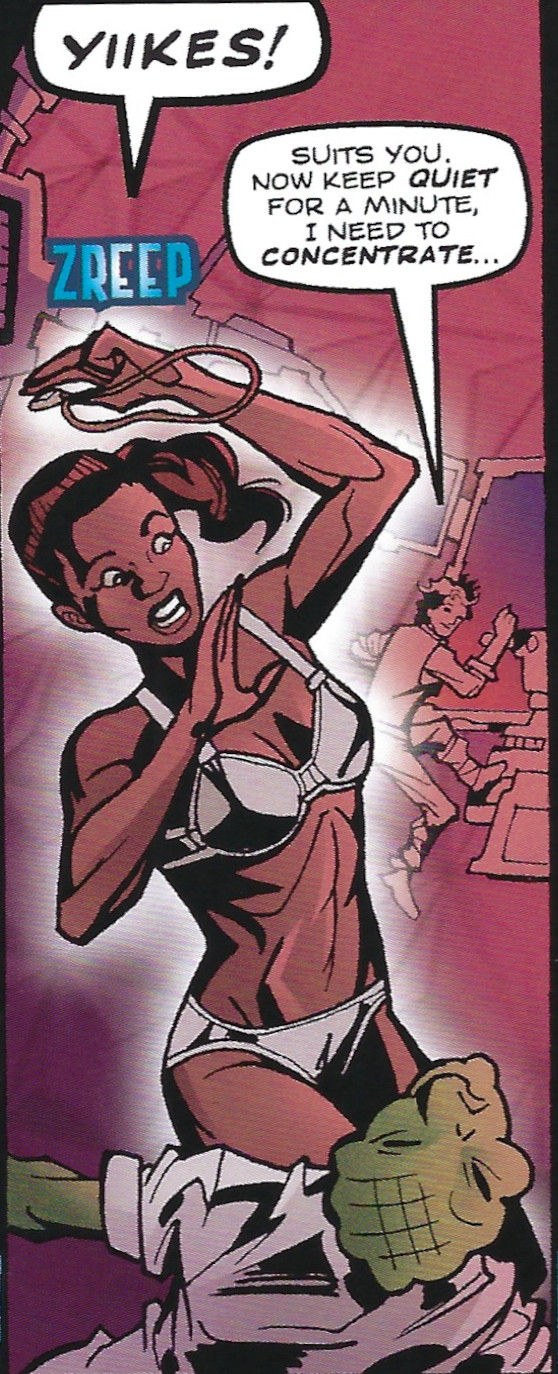
Props, though, to the excellent joke about the gun held together with screws, that made me laugh, and Morris does a good Moffat pastiche in the recurrent glimpses of the colony's emergency message. (Oh, and in the gratuitous Amy nudity.)
Planet Bollywood!, from Doctor Who Magazine #424 (Aug. 2010)
story by Jonathan Morris, art by Roger Langridge, colours by James Offredi
Somewhat surprisingly, I would argue, screen Doctor Who has never given us a musical episode. Morris delivers a fantastic one here: the lyrics are good fun to read, the technobabble excuse for it all is actually convincing (enough), and of course Roger Langridge was born to draw it. (His stylized art is also the perfect fit for Matt Smith's chin.) I particularly liked the "Technobabble" song but they're all good. Might be the best story in this volume, except for the next couple.
from Doctor Who Magazine #426
The Golden Ones, from Doctor Who Magazine #425-28 (Sept.-Dec. 2010)
story by Jonathan Morris, pencil art by Martin Geraghty, inks by David A Roach, colours by James Offredi, letters by Roger Langridge
Sometimes the strip very much tries to pastiche the kind of thing Moffat was doing on screen (see: Do Not Go Gentle into that Good Night). At other times, though, it does its own thing: this is a fast-paced contemporary sci-fi thriller, the kind of thing Moffat wasn't interested in, but Russell T Davies gave us on screen in Aliens of London/World War Three or The Sontaran Stratagem/The Poison Sky. Or, to put it in DWM referents, it's like The Flood or The Age of Ice. It's very well put together, and I really enjoyed it. Good twists, quick jokes (you can tell Morris has got the hang of the Eleventh Doctor), nice moments for Amy, amazing visuals. The whole thing looks excellent; Martin Geraghty just ups his game every time he comes back. It's neat seeing the eleventh Doctor and Amy in a slightly different genre, and this is a good example of it.
from Doctor Who Magazine #429
The Professor, the Queen and the Bookshop, from Doctor Who Magazine #429 (Jan. 2011)
story by Jonathan Morris, art by Rob Davis, colours by Geraint Ford, letters by Roger Langridge
This is, I think, the first comic strip you might call a Christmas special, but there will be more to come over the years. It's a good tradition to start, and who could draw it better than Rob Davis? There's not much of a story, to be honest: C. S. Lewis tells the Doctor and Amy a story about two kids meeting a man with a bookshop that leads to another world, with lots of references to Narnia and other children's fantasy stories; the story is a bit simple, though it has a pretty clever resolution. But it looks brilliant and feels evocative, and well, this is a comic strip after all. Davis's bookshop interior is in particular amazing, and the thing is shot through with the chilliness of winter.
from Doctor Who Magazine #431
The Screams of Death, from Doctor Who Magazine #430-31 (Feb.-Mar. 2011)
story by Jonathan Morris, art by Dan McDaid, colours by James Offredi, letters by Roger Langridge
Dan McDaid is back! And what a story for him. Again, it oozes with creepy atmosphere; it's like a better version of The Vampires of Venice. The villain's plan is convolutedly great in a way that makes perfect sense. Well, except for the bit where he uses flying hypnotized opera singers in their nightclothes as his minions! But all the time travel lark is a well-thought-through twist on a common trope.
from Doctor Who Magazine #432
Do Not Go Gentle into that Good Night, from Doctor Who Magazine #432 (Apr. 2011)
story by Jonathan Morris, art by David A Roach, colours by James Offredi, letters by Roger Langridge
If I was feeling a bit mean, I might say that as a writer, Morris can sometimes be better as pastiching other's styles than having his own. But again, this is one of those stories that feels like it could have been on tv: it's straight out of the show that gave us, say, Night Terrors to have creepy ghosts in a retirement home. It's got some good stuff, but it all wrapped up a bit too easy: basically the Doctor and Amy find out what's up, and then the story is over.

Long-time DWM inker David A Roach (by the time this came out, he had inked 85 strips) makes his pencilling debut here. He's good at likenesses, and it's interesting to note that I think he uses finer lines on his own work than others'. I did sometimes find the action less fluid.
from Doctor Who Magazine #433
Forever Dreaming, from Doctor Who Magazine #433-34 (May-June 2011)
story by Jonathan Morris, art by Adrian Salmon, lettering by Roger Langridge
I don't have much to say about this one, except that Adrian Salmon does great both by Amy in a 1960s minidress and probably the creepiest-looking villains I can ever remember from DWM. The story is a bit of a confusing jumble of mental states; feels like it needed one more draft to sort it out.
from Doctor Who Magazine #435
Apotheosis, from Doctor Who Magazine #435-37 (June-Aug. 2011)
story by Jonathan Morris, art by Dan McDaid, colours by James Offredi, letters by Roger Langridge
And here, the plot arc all comes to a head.

Plot arc? Indeed, I haven't mentioned any plot arc because there's not really a plot arc. In some individual stories, people would disappear between panels when touching the TARDIS: the TARDIS had been infected by the spores from the planet Basingstoke way back in Supernature. I don't think I noticed at the time, and I wouldn't have noticed now without the hints in the commentaries. This might be what you want with the show on the air: a viewer who picks up a random issue because they liked "Closing Time" doesn't want to be confused by a Glorious Deadesque epic, or even something like Uroboros or Mortal Beloved. So I would say there's not much of a plot arc to grab on to here, but I'm not sure there should be one.

As for its reveal in the story, it's done very well. It reminded me of that way that "Flesh and Stone" wrong-foots the viewer halfway through. You know, as a viewer of the revival's first four series, that series-long plot arcs never matter until the twelfth episode, so when the crack in time suddenly starts mattering, it really throws you for a loop. Similarly, you know that there's no plot arc at all in the strip when the programme is on tv, so the reveal about the TARDIS itself being the cause of problems is a great twist. What a cliffhanger! And the story has a lot of other stuff to like, both courtesy of Dan McDaid and Jonathan Morris. The nun warriors are well-handled: very Moffat but good fun.
from Doctor Who Magazine #439
The Child of Time, from Doctor Who Magazine #438-41 (Sept.-Dec. 2011)
story by Jonathan Morris, pencil art by Martin Geraghty, inks by David A Roach, colours by James Offredi, letters by Roger Langridge
The problem with the arc, however, is that it's not really about anything. By which I mean, there's a bunch of events that have happened, but they don't really matter to the characters. This was very much not true of Majenta in The Crimson Hand, or Izzy and the Doctor in Oblivion. That means this story, aside from the fact that its villain Chiyoko had appeared before, is pretty much like any other one. Nothing is at stake here for the Doctor and Amy... even though the story arc means that the Doctor has been inadvertently responsible for a number of deaths! The story ends with an emotional climax, as the Doctor convinces Chiyoko to stand down... I wish we had seen more of her as a person throughout the arc, because I found this kind of unconvincing on its own. It felt like a lost opportunity to do something more.

That said, this is a pretty fun story on its own terms. The cliffhanger ending to part one is amazing, as is its resolution. (On the other hand, the resolution to part two is rubbish.) Alan Turing is a good temporary companion, and the Doctor flirting with him is great. The take on the Brontës is pretty delightful. I like that the backstory to Apotheosis is picked up and explained here, deepening the DWM universe. The Back to the Future shenanigans are fun. Overall, fun, but I am not sure it feels like the climax to a run of twenty in the same way Crimson Hand did.
Stray Observations:

  • I'm not being mean, but as I said when I reviewed The Widow's Curse, I'm a bit surprised Jonathan Morris was picked. Morris had done some solid strips, but they had all been one-offs, with the exception of a single two-parter. It seems a big leap from that to twenty!
  • Mike Collins draws the colonists in Supernature wearing jumpsuits pretty similar to the one Rose wore in The Cruel Sea
  • It probably wouldn't have been to the story's benefit, to be honest, but it might have been nice to work the UNIT crew from The Age of Ice into The Golden Ones.
  • In the extras, Morris talks a lot of rejected concepts. One of his ideas for Apotheosis was a story where the Doctor and Amy find frozen versions of what they assume to be their future selves, but are in fact their past selves. Editor Scott Gray rejected it for being a bit too like Morris's audio drama Cobwebs, but Morris would reuse the idea as the central twist of his audio drama Cortex Ice anyway.
  • The typeface used in the Apotheosis logo is the one used the covers of all collections since The Crimson Hand.
  • Apotheosis is, alas, Rob Davis's last DWM contribution. I don't know what he's up to these days, but it seems a crime he never got a run of his own, or at least more stories. Like Dan McDaid, a great writer-illustrator double threat.
  • "YOU'RE JUST A TRACER" WATCH: Aside from making his pencilling debut for DWM, David A Roach works on eleven strips as inker, more than the two artists featured on the cover, Martin Geraghty (8) and Dan McDaid (5).
* I almost wrote Alan McKenzie, but in fact his run (#100-10, May 1985–Mar. 1986) entirely fits into the hiatus between Revelation of the Daleks Part Two and The Trial of a Time Lord Part One.

This post is the thirty-fourth in a series about the Doctor Who Magazine comic strip and Marvel UK. The next installment covers The Chains of Olympus. Previous installments are listed below:

  1. The Iron Legion
  2. Dragon's Claw 
  3. The Transformers Classics UK, Volume One
  4. The Tides of Time
  5. The Transformers Classics UK, Volume Two
  6. Voyager
  7. The Transformers Classics UK, Volume Three
  8. The World Shapers
  9. The Transformers Classics UK, Volume Four
  10. The Age of Chaos
  11. The Transformers Classics UK, Volume Five
  12. A Cold Day in Hell!
  13. Death's Head: Freelance Peacekeeping Agent (part 1)
  14. Nemesis of the Daleks
  15. Death's Head: Freelance Peacekeeping Agent (part 2)
  16. The Good Soldier
  17. The Incomplete Death's Head
  18. Evening's Empire
  19. The Daleks
  20. Emperor of the Daleks
  21. The Sleeze Brothers File
  22. The Age of Chaos
  23. Land of the Blind
  24. Ground Zero
  25. End Game
  26. The Glorious Dead
  27. Oblivion
  28. Transformers: Time Wars and Other Stories
  29. The Flood
  30. The Cruel Sea 
  31. The Betrothal of Sontar
  32. The Widow's Curse
  33. The Crimson Hand
09 January 2023

The Widow's Curse (From Stockbridge to Segonus: A Doctor Who Magazine Comics Marathon, Part 32)

The Widow's Curse: Collected Comic Strips from the Pages of Doctor Who Magazine
by Rob Davis, John Ross, Jonathan Morris, Martin Geraghty, Dan McDaid, Roger Langridge, Ian Edginton, Mike Collins, Adrian Salmon, et al.

Collection published: 2009
Contents originally published: 2007-08
Acquired: January 2010
Previously read: April 2010
Reread: October 2022

This is my era! In spring 2007, I took a three-week trip to the United Kingdom. I was excited to get to see Doctor Who on the tv as it aired... but the person I was staying with didn't have a tv! I had to torrent it just like I was back home in the States.

But the thing I could do was pick up Doctor Who Magazine in any old shop. The three weeks overlapped with the on-sale periods of #382 and 383, if I remember correctly, and I picked up both in the bookstore while I was there. Once I was back home, I realized my local Borders carried the magazine, so I just kept going with it. Soon, I would switch to getting it through my local comic book shop, and I have continued to get the magazine ever since. (I am not sure where my first year's worth of issues actually is, though; the earliest one in my DWM boxes is #397. Did I... gasp... throw them away!?) For me, this was a real high period for the magazine. The covers from 2007 are fantastic; great publicity photos well used (#386 is iconic, I reckon), and I very much miss the in-depth set reports and episode features of this era. And Russell T Davies's "Production Notes" were so good!

This means I would have joined the strip as a regular reader with part two of The Woman Who Sold the World. I was probably very confused! To be honest, though I love reading the strip in collected editions, I often struggle with it in the actual magazine. I find it hard to invest in a story that I read in ten-page segments stretched out across months. Still, I do remember some of the stories of this era from my first read, particularly, Time of My Life from #399. (I also have negative memories of Universal Monsters in the actual magazine, but I enjoyed it both the previous time I read this collection and this time. Maybe I was just not yet an Adrian Salmon devotee?)

It was kind of weird to read this right after watching The Power of the Doctor and seeing the 60th anniversary teaser trailer... Tennant and Tate nostalgia rules the land!

from Doctor Who Magazine #382

The Woman Who Sold the World, from Doctor Who Magazine #381-84 (May-July 2007)
script by Rob Davis, pencils by Mike Collins, inks by David A. Roach, colours by James Offredi, letters by Roger Langridge

This I found a bit tough to get into at first. It's one of those weird Doctor Who stories where at first there's a bunch of disparate elements and it's not clear how they relate to each other; you're sort of relentlessly thrown from bit to bit. I particularly found it hard to track how I was supposed to feel about Sugarpea and Sweetleaf, the old couple in the flying chair. But by the end of the story I had come around and was totally into it: great characters, so many great concepts packed in here, good jokes, and a real emotional ending like something that might have been done on tv at the time. Only this is so much madder and more expansive! In the notes, editor Clay Hickman says they were trying to get the strip to be like the Mills & Wagner days, and I can totally see it: it has that non-stop breakneck feeling, only with more of a genuine character focus. Only thing that doesn't work for me is the kid who accidentally kills his dad. Felt a bit too gruesome and dark.
from Doctor Who Magazine #385
Bus Stop!, from Doctor Who Magazine #385 (Aug. 2007)
script by Rob Davis, pencils by John Ross, inks by David A. Roach, colours by James Offredi, letters by Roger Langridge
A one-off gag strip, but a decent one. The Doctor tries to preserve the timeline from rogue time travellers by riding on a bus with a soup made from the Mayor of London, but it's all (mostly) told from the perspective of a passenger (we do have a couple cuts to what Martha is doing on Mars). The narration of the passenger sometimes lays it on a bit thick but overall it's an enjoyable conceit, well executed.
The First, from Doctor Who Magazine #386-89 (Sept.-Dec. 2007)
script by Dan McDaid, pencils by Martin Geraghty, inks by David A. Roach, colours by James Offredi, letters by Roger Langridge
The Doctor and Martha meet Shackleton... and of course aliens made of ice. This is solid: it didn't wow me, but it felt like a reasonably good pastiche of an RTD-era "celebrity historical." I found the ending a bit confusing and rushed, but I enjoyed the experience overall. Nice as always to see Martin Geraghty on the main strip.
Sun Screen, from Doctor Who Storybook 2008
script by Jonathan Morris, pencils by Martin Geraghty, inks by David A. Roach, colours by James Offredi, letters by Roger Langridge
This story made me realize that I'm not sure one strip is really a good length for a Doctor Who comic if it's attempting to do the "traditional" Doctor Who story of the Doctor showing up somewhere, finding a bad thing, and fixing it. You can do a comedy story, you can do a character study, but eight pages for this kind of thing is so compressed that there's no interesting characters, no plot complications that aren't instantly resolved. Morris's other one-offs in this volume show better ways of handling it, though I guess a one-off adventure is what the context of the Doctor Who Storybook pretty much calls for.
from Doctor Who Magazine #390
Death to the Doctor!, from Doctor Who Magazine #390 (Jan. 2008)
script by Jonathan Morris, art and letters by Roger Langridge, colours by James Offredi
Indeed, here we go. This one is fun: a bunch of old but rubbish foes of the Doctor get together, and are undermined by their own incompetence. Probably my favorite gag was the Mentor, totally not a knock-off of the Master.
from Doctor Who Magazine #392
Universal Monsters, from Doctor Who Magazine #391-93 (Feb.-Apr. 2008)
story by Ian Edginton, art by Adrian Salmon, letters by Roger Langridge
Again, if not a great story, a very solid one. I like how the story plays into all the horror tropes in parts one and two, and then undoes them all in part three, but does so without feeling gratuitous or contrived. And of course giving this story to Adrian Salmon is a stroke of genius, one of the best-ever artists ever associated with Doctor Who, and this  plays perfectly into his wheelhouse.

One thing I do love about this story is how different it is in terms of tone. Since The Green-Eyed Monster in #377, I feel like the strip is reembracing that it is, well, a comic strip more. Though the two Rose volumes had some good and even great stories, I think the ones from #377 are more playful in tone and format in the way that only a comic strip can be. I don't think tv could do something like the shift from Death to the Doctor! to Universal Monsters to The Widow's Curse. Sure, you can shoot each episode like its own film (as the Moffat era did to good effect), but here you can even change how the characters look... but it's somehow all the same thing anyway.
from Doctor Who Magazine #398
The Widow's Curse, from Doctor Who Magazine #395-98 (May-Aug. 2008)
story by Rob Davis, pencils by Martin Geraghty, inks by David A. Roach, colours by James Offredi
How good is this? Definitely the standout of this volume, except for maybe The Time of My Life. Great visuals, great concepts, great capturing of character. Westminster Abbey on a Caribbean island! Donna flying a Boeing 747! This is the stuff comics were born to do. On top of that, it's populated with a genuine cast of guest characters. This is actually something the strip doesn't do a lot, or doesn't do effectively; most stories I feel like just have one or two people in them who are fully developed. But we have a whole group of tourists and more here, each of which who gets a genuinely great moment. The way the title comes into play at the end is excellent. It's kind of weird to see DWM do such a close sequel to a screen story, but overall it works incredibly well. If Donna only got one multi-part story, I'm glad it was this one.
The Immortal Emperor, from Doctor Who Storybook 2009
script by Jonathan Morris, art by Rob Davis, colours by Rob Davis & Geraint Ford, letters by Roger Langridge
Like Sun Screen, this is pretty breakneck. It works a bit better, in that I love the stylized art of Rob Davis, and a bit worse, in that I'm a bit skeptical of the fact that in one of Doctor Who's rare forays into the history of a non-UK country, every significant character other than the Doctor and Donna is evil.
from Doctor Who Magazine #399
The Time of My Life, from Doctor Who Magazine #399 (Sept. 2008)
script by Jonathan Morris, art by Rob Davis, colours by Geraint Ford, letters by Roger Langridge
Again, how good is this? I love this style of storytelling, a number of quick one-page excerpts from unseen adventures that show off the Doctor and Donna at their best. Lots of great jokes and great concepts and beautiful moments. The page where they just have fun seeing the Beatles is probably the best, but they're all great. On top of that you get the amazing art and layouts of Rob Davis, which adds so much to each page.

In the past I kind of thought the early new series–era comics weren't very good... on this reread I haven't felt that way—they're good on the whole even if they're not great—but since #377 they've been on a definite upward trajectory, and I can't wait to see what happens next...
Other Notes:

  • Mike Collins's design for the space bank here (a giant space pyramid) is basically identical to his design for the Redeemer spaceships in the Star Trek comic New Frontier: Double Time.
  • My hypothetical "only-knows-Doctor-Who-from-the-strip" reader must have been very confused reading Death to the Doctor! "Who the heck is this lady in white? Where's Sharon!?" But it is nice to see Frobisher and Izzy again. I think this is the strip's first post-2005 reference to its pre-2005 history, right? Am I forgetting something? And then a few stories later we get the freakin' zyglots! Only thing that could have been better would be making the Dan Abnett–style space marines in Time of My Life the actual Foreign Hazard Duty.
  • Here we're back to a run with neither a consistent writer (there are four different ones across nine stories) nor a consistent penciller (six different ones). But unlike past instances of this, the strip still feels coherent. I think this probably comes down to 1) strong editorial work from Clay Hickman/Tom Spilsbury and especially Scott Gray, and 2) strong capturing of the voices of the regulars, especially David Tennant. All these various creators seem to be on the same page despite their varied styles, unlike, say, the early McCoy-era strips collected in A Cold Day in Hell!
  • Universal Monsters is Ian Edginton's only contribution to Doctor Who Magazine. He has, however, written a mediocre Big Finish audio drama, Shield of the Jötunn. Outside of the world of Doctor Who, he is a prolific comics writer: I know him best from his Star Trek work (an excellent run for Marvel on the Captain Pike series Early Voyages, plus an IDW one-off), but his best-known work is probably Scarlet Traces, a series of The War of the Worlds sequels.
  • This collection skips over Hotel Historia from #394, because it makes more sense to collect it in the next volume, The Crimson Hand, as we'll see. I guess because of when it was published, I always think of that story as featuring Martha... but it totally does not!
  • I usually read the strips in these collections in order publication order; this means I should have moved The Immortal Emperor to the end. (It would actually properly go between strips in the next volume by publication order.) But it was clearly sequenced here based on reading flow, and in this case, I made an exception and bowed to book's position, which was the right choice.
  • from Doctor Who Magazine #386
  • Both Martha and Donna had been written out of the tv show by the time their first comic story came to an end. At five strips, Donna has one of the shortest runs of any multi-story companion, tying Olla the Heat Vampire (#130-34). This is exacerbated by the fact that, as a tv companion, she just blips into existence... though she actually does kind of get written out.
  • Two of the writers here would go on to become the "main" writer of the strip in the future. Dan McDaid, writer of The First, would do the tenth Doctor and Majenta Pryce run (#400-20), while Jonathan Morris would do the eleventh Doctor and Amy run (#421-41). No offense to either writer, though, who have both turned out strong work, but the surprising thing to me—based purely on the quality of work in this collection—is that Rob Davis never got a run. Two excellent stories as a writer in this collection, one excellent story as an artist, and some other solid work as well. Able to do big stories and little stories in a variety of styles; knows how to crash weird things together in the best DWM tradition.
  • "YOU'RE JUST A TRACER" WATCH: This collection has ten writers and artists. Nine of them get cover credit. The only one who doesn't? Inker David A. Roach, who works on thirteen of the nineteen strips. John Ross draws just one and still manages to snag cover credit. Indeed, he gets second billing!

This post is the thirty-second in a series about the Doctor Who Magazine comic strip and Marvel UK. The next installment covers The Crimson Hand. Previous installments are listed below:

  1. The Iron Legion
  2. Dragon's Claw 
  3. The Transformers Classics UK, Volume One
  4. The Tides of Time
  5. The Transformers Classics UK, Volume Two
  6. Voyager
  7. The Transformers Classics UK, Volume Three
  8. The World Shapers
  9. The Transformers Classics UK, Volume Four
  10. The Age of Chaos
  11. The Transformers Classics UK, Volume Five
  12. A Cold Day in Hell!
  13. Death's Head: Freelance Peacekeeping Agent (part 1)
  14. Nemesis of the Daleks
  15. Death's Head: Freelance Peacekeeping Agent (part 2)
  16. The Good Soldier
  17. The Incomplete Death's Head
  18. Evening's Empire
  19. The Daleks
  20. Emperor of the Daleks
  21. The Sleeze Brothers File
  22. The Age of Chaos
  23. Land of the Blind
  24. Ground Zero
  25. End Game
  26. The Glorious Dead
  27. Oblivion
  28. Transformers: Time Wars and Other Stories
  29. The Flood
  30. The Cruel Sea 
  31. The Betrothal of Sontar

02 January 2023

The Betrothal of Sontar (From Stockbridge to Segonus: A Doctor Who Magazine Comics Marathon, Part 31)

The Betrothal of Sontar: Collected Comic Strips from the Pages of Doctor Who Magazine
by Mike Collins, Gareth Roberts, Tony Lee, John Tomlinson & Nick Abadzis, Roger Langridge, Martin Geraghty, Jonathan Morris, et al.

Collection published: 2008
Contents originally published: 2006-07
Acquired: November 2008
Previously read: December 2008
Reread: October 2022

This collection spans the entirety of the tenth Doctor and Rose era of DWM, which initiated when "The Christmas Invasion" aired and ran all the way to "The Runaway Bride," and it also includes a (kind of) companion-free storyline from between "The Runaway Bride" and "Smith and Jones," making for a nice sizeable chunk of DWM. Like the comics collected in The Cruel Sea, these are definitely trying to ape the storytelling of the Russell T Davies era on screen, but I also felt there was a more concerted effort to play to the strengths of comics here: more stories that do things so big that they could never have been afforded on screen, or stories with lots of different locations. Overall, it's a pretty pleasing package.

I've read this collection before, way back in 2008 when it came out. This is (part of) what I wrote at the time:
I was curious to see how much my impressions of some of these stories shifted this time around!

from Doctor Who Magazine #365
The Betrothal of Sontar, from Doctor Who Magazine #365-67 (Feb.-Mar. 2006)
story by John Tomlinson & Nick Abadzis, pencils by Mike Collins, inks by David A. Roach, colours by James Offredi, letters by Roger Langridge
This sees the first appearance of the Sontarans in the DWM strip since 1993's Pureblood (and even reuses that story's title term); it's about a group of low-quality Sontarans who run a mining rig instead of getting glorious soldiering duty, a neat look into a different dimension of Sontaran society than we've ever seen on screen. The cosmic maguffin wasn't super interesting, but I liked the two principal Sontaran characters. I'm not sure why in my review above I called this story's resolution "highly disappointing." Like, rereading it I have no idea what my beef was at all.
from Doctor Who Magazine #368
The Lodger, from Doctor Who Magazine #368 (Apr. 2006)
story by Gareth Roberts, pencils by Mike Collins, inks by David A. Roach, colours by James Offredi, letters by Roger Langridge
This was fun; you can see why Moffat picked it up to make it into a tv episode, and though being a 45-minute story gave it more room to breathe, this version has the benefit of pairing the Doctor with a familiar character—and not having to work in an alien threat of some kind. More of a series of vignettes than a story, but a very solid series of them, and the kind of thing that (somewhat ironically) only DWM could do, I think.
from Doctor Who Magazine #370
F.A.Q., from Doctor Who Magazine #369-71 (May-July 2006)
story by Tony Lee, pencils by Mike Collins, inks by David A. Roach, colours by James Offredi, letters by Roger Langridge
I was dreading this one going in. I remembered my negative review from last time around, and having since suffered through Tony Lee's run on IDW's Doctor Who comic book, my opinions of Lee as a comic writer have only diminished. But... I actually kind of liked this? I wouldn't say it's a work of genius or anything—the stories on either side of it are better—but it's fun enough. It has the grounded sensibility of the RTD era, focusing on an ordinary family affected by alien powers, shades of "Fear Her" (a story that I really like). Rose gets some good spotlight moments. The main thing I don't like is the reveal about the teacher who didn't really exist, which seemed kind of pointless. Like, it's spooky, but it doesn't really seem to make a character or thematic point.
from Doctor Who Magazine #373
The Futurists, from Doctor Who Magazine #372-74 (Aug.-Oct. 2006)
story & art by Mike Collins, inks by David A. Roach, colours by James Offredi, letters by Roger Langridge
I really don't know what I was thinking when I wrote my above review, because this story was on fire. Good ideas, great visuals, neat contrasts (black Romans in Britain vs. a fascist Italian state), fast pace—four different key locations in three installments!—nice themes, and above all, good characterization for Rose and some genuine laugh-out-loud jokes. Loved gags about the Silurians, how many people were in the resistance, the use of the resistance, and especially the clever use of the psychic paper. "But Darius... you can't read..." "Oh." I can imagine it playing out perfectly on screen. Rose leading the captured Silurian women in revolt is great, and her voice is captured very well. Exactly the kind of story the strip ought to be doing when the tv show is leading, and the volume's highlight. I don't know how I got it so wrong fourteen years ago.

(Wait... fourteen years ago!?)
from Doctor Who Magazine #375
Interstellar Overdrive, from Doctor Who Magazine #375-76 (Nov.-Dec. 2006)
story by Jonathan Morris, pencils by Mike Collins, inks by David A. Roach, colours by James Offredi, letters by Roger Langridge
I do love time loop stories. They're one of my favorite sf subgenres. TNG's "Cause and Effect," Groundhog Day, SG-1's "Window of Opportunity," Discovery's "Magic to Make the Sanest Man Go Mad," Russian Doll season one, Palm Springs, I love them all. I am a total sucker for them. I even love the chronic hysteresis bit in Meglos.

Um, except this one. I think it's a noble attempt. But it has two things going against it, I reckon. One is that the repetition just isn't as interesting when it's solely visual. Here the scenes are all shown from a different angle, but that means you don't really get that uncanny echo that makes these kind of things work on screen. The second is that since it's only two parts, the loop only repeats once, and so it's less a time loop story, and more a story where something happens once, and then the characters get a do-over. It feels cheap, I guess, if it's that easy to get out of the loop. Seeing the iterations is what makes these kind of things fun!

But there are some good jokes and the part one cliffhanger is a good one.
from Doctor Who Storybook 2007
Opera of Doom!, from Doctor Who Storybook 2007
story by Jonathan Morris, pencils by Martin Geraghty, inks by David A. Roach, colours by James Offredi, letters by Roger Langridge
This story is a delight. Quick, fun, good gags. A little too quick, maybe—the fact that people were disappearing into the alien opera house maybe should have been set up better—but I really enjoyed it. The really terrible musician who becomes amazing is a fun character with lots of good jokes.
The Green-Eyed Monster, from Doctor Who Magazine #377 (Jan. 2007)
story by Nev Fountain, art & letters by Roger Langridge, colours by James Offredi
Rose's last appearance in the strip is a good one, bringing Mickey back again and also marking Jackie's only strip appearance. It's a kind of contrived story about an alien jealousy monster and a talk show, but it's all worth it for the incredible sequence where Rose thinks that the Doctor has settled down with her mother. The ending gag of Jackie wanting a second kiss is delightful.
The Warkeeper's Crown, from Doctor Who Magazine #378-80 (Jan.-Mar. 2007)
story by Alan Barnes, pencils by Martin Geraghty, inks by David A. Roach, colours by James Offredi, letters by Roger Langridge
Rose of course stopped appearing on screen way back in July 2006, but DWM seems to have considered "The Runaway Bride" her official cut-off point as the current companion—the first episode without her as a lead, I guess. So here we get a companion-less story to bridge the gap before Martha, and DWM brings back the Brigadier to serve as a temporary companion. Though the Brigadier appeared in the "past Doctor" early of the early 1990s, I think this is his first present-day appearance since The Mark of Mandragora.
from Doctor Who Magazine #380
It's okay. I liked the first part all right, which pulls the Doctor, the Brigadier, and the wrong Mike Yates together; I liked the last part, where the wrong Mike Yates tries to remake Britain. The middle part, though, lost me in the complicated exposition about the relations on the alien planet, and the whole story suffered as a consequence. I didn't really get the ending, for example. It seemed like things ought to have been simplified. The idea of the Doctor meeting the Brigadier for the first time after he himself fought in a war seemed squandered in a single panel. (Shades of Big Finish's own attempt to do this story, Way of the Burryman, which I read Warkeeper's Crown in the middle of, coincidentally.)
Other Notes:

  • #367 is one of the rare issues from this era I actually do own; I picked it up to get the free Big Finish CD that came with it. I have no memory of reading The Betrothal of Sontar part three on its own, but I have to imagine it made no sense.
  • John Tomlinson previously wrote for DWM way back in 1989, scripting Nemesis of the Dalek. (He also wrote two Who strips for The Incredible Hulk Presents and a prose story from the collection Abslom Daak: Dalek Killer.) At 210 issues, that's the longest gap between contributions for any DWM writer/artist as of 2014's strips. His cowriter here, Nick Abadzis, would go on to the primary writer of Titan's The Tenth Doctor comic.
  • From #363 to 368, we have three stories, two of which were by Gareth Roberts and got adapted for television! Plus The Love Invasion inspires a scene in "The Unicorn and the Wasp" on screen. Quite a hit rate for him. The Lodger is, however, his last contribution to the DWM strip.
  • I was all prepared to admit I was too hard on Tony Lee as a writer, and then I read his behind-the-scenes I comments. I don't know how one manages to write a bad creator's commentary, but somehow he does. Lots of very belabored jokes, with the kind of self-deprecating humour that comes across as false modesty.
  • Jonathan Morris gives an incredible amount of detail in his creator's commentaries, down to entire lost scenes from both his stories. I can't think of another DWM graphic novel with this level of detail. Though I enjoyed Opera of Doom! the lost joke about the very slow gondola chase would have been amazing.
  • from Doctor Who Magazine #377
  • The Green-Eyed Monster opens with a caption reading "Quite a while ago...", which confused me at first, but I guess it's meant to indicate that this goes between "The Girl in the Fireplace" and "Rise of the Cybermen," which was broadcast many months prior. Placement notes aren't really the kind of thing DWM typically goes in for, and it didn't even occur to me we weren't going in chronological order prior to that, since I think every strip here could comfortably fit between "Tooth and Claw" and "School Reunion."
  • At the time I read this volume, The Warkeeper's Crown was seemingly Alan Barnes's last contribution to the strip, but he is the writer of the current fourteenth Doctor strip, Liberation of the Daleks, that began in issue #584. In between these points, he wrote one million Doctor Who audio dramas for Big Finish and script-edited ten million.
  • David A. Roach works on literally every story in this volume except for one ten-page strip, more than any other writer or artist... and somehow does not deserve cover billing!

This post is the thirty-first in a series about the Doctor Who Magazine comic strip and Marvel UK. The next installment covers The Widow's Curse. Previous installments are listed below:

  1. The Iron Legion
  2. Dragon's Claw 
  3. The Transformers Classics UK, Volume One
  4. The Tides of Time
  5. The Transformers Classics UK, Volume Two
  6. Voyager
  7. The Transformers Classics UK, Volume Three
  8. The World Shapers
  9. The Transformers Classics UK, Volume Four
  10. The Age of Chaos
  11. The Transformers Classics UK, Volume Five
  12. A Cold Day in Hell!
  13. Death's Head: Freelance Peacekeeping Agent (part 1)
  14. Nemesis of the Daleks
  15. Death's Head: Freelance Peacekeeping Agent (part 2)
  16. The Good Soldier
  17. The Incomplete Death's Head
  18. Evening's Empire
  19. The Daleks
  20. Emperor of the Daleks
  21. The Sleeze Brothers File
  22. The Age of Chaos
  23. Land of the Blind
  24. Ground Zero
  25. End Game
  26. The Glorious Dead
  27. Oblivion
  28. Transformers: Time Wars and Other Stories
  29. The Flood
  30. The Cruel Sea

07 December 2022

The Flood (From Stockbridge to Segonus: A Doctor Who Magazine Comics Marathon, Part 29)

The Flood: Collected Comic Strips from the Pages of Doctor Who Magazine
by Scott Gray, Martin Geraghty, Mike Collins, John Ross, et al.

Collection published: 2007
Contents originally published: 2003-05
Previously read: August 2008
Reread: September 2022

And here we come to the end. Not just the eighth Doctor, but the end of an unprecedented era in Doctor Who Magazine history.

Something I've tracked in this project is for how long the strip functions as a self-contained narrative. For example, you can read from #1-60 and it all makes sense... but then the Doctor changes appearance between #60 and 61! Peri spontaneously disappears between #129 and 130. Benny appears suddenly in #193, and Ace disappears; Ace reappears in #203; and then Ace and Benny disappear after #210. The tv programme and other external factors prevent the strip from working as a totally self-contained story, even if it almost gets away with it at times. (The Shape-Shifter picks right up from The Moderator even though the Doctor changed his appearance!)

But from #244 to 353, we have a continuous story (side-strips like The Last Word or Character Assassin aside): over a hundred strips, not quite ten years' worth, that you can read without interruption. The characters, the themes, the ideas, develop from story to story. It had never been done before in Doctor Who Magazine history—no one prior to Alan Barnes, Martin Geraghty, Scott Gray, and company had ever had such a canvas to work on, and thus far, no one has ever had one again. Even more amazingly, it's clear this could have kept on going. This volume introduces Destrii as a new companion, only to immediately wrap up the narrative of her and the eighth Doctor. The universe where Doctor Who didn't come back to tv is probably a darker one overall, but its DWM strip could have kept going for another five years at least, I bet.

from Doctor Who Magazine #329
Where Nobody Knows Your Name, from Doctor Who Magazine #329 (Apr. 2003)
story by Scott Gray; pencils, colours & lettering by Roger Langridge, inks by David A. Roach
The eighth Doctor, a bit mopey after the events of the Ophidius/Oblivion arc, ends up in a bar that is—unbeknownst to him—run by Frobisher—who doesn't recognize the Doctor either. It's a great one-off, with some good character moments and strong comedy and heartfelt writing. The idea that they don't recognize each other is good; as Gray says in the end notes, "it avoided becoming a cosy, nostalgic reunion then and made it a bit more poignant." Not to spend my time here complaining about Big Finish, but compare this to the obnoxious sentimentality of something like the eighth Doctor meeting the Brigadier again in Stranded: UNIT Dating.
from Doctor Who Magazine #334
The Nightmare Game / The Power of Thoeuris! / The Curious Tale of Spring-Heeled Jack, from Doctor Who Magazine #330-36 (May-Nov. 2003)
stories by Gareth Roberts and Scott Gray; art by Mike Collins & Robin Smith, Adrian Salmon, and Anthony Williams & David A. Roach; colours by Dylan Teague and Adrian Salmon; lettering by Roger Langridge
For me, the DWM strip is always a bit less interesting when it becomes continuity-light. These aren't quite a series of one-offs, but they are pretty close to it. We have a story of the Doctor involved in a goofy plot involving aliens and football, one about Osirians in ancient Egypt, and one about an alien acting as Spring-Heeled Jack in nineteenth-century London. The Nightmare Game didn't work for me; I think it wants to be The Star Beast, but it doesn't have the energy or inventiveness of that story, and Gareth Roberts's Doctor's voice doesn't feel like Scott Gray's—too stiff and old-fashioned. Even the usually reliable Mike Collins seems to be having a bad day. The Power of Thoueris! is fun if slight—hard to go wrong with Adrian Salmon—but Curious Tale is again kind of a plod.

The first and third stories here both try to fake you into thinking you're meeting a new companion. I guess, anyway; Roberts claims in the end notes it was his intention to make readers think the pointless kid character was going to be a companion? Goodness knows why he wanted to do that, or why anyone fell for it. Gray pulls off a similar twist to much better effect in Curious Tale.

I do like the recurring gag across #330 to #338 about the Doctor turning up everywhere in a new, often ludicrous hat.
from Doctor Who Magazine #337
The Land of Happy Endings, from Doctor Who Magazine #337 (Dec. 2003)
story by Scott Gray, pencils by Martin Geraghty, inks by Faz Choudhury and David A. Roach, colours by Daryl Joyce and Adrian Salmon, lettering by Roger Langridge
Has anyone had to come up with more "celebratory" strip concepts than Scott Gray? He certainly had to do it a lot of times, and in the end notes to these collections, he sometimes comes across as increasingly desperate. Here it's Doctor Who's fortieth anniversary, and he would still be doing it ten years later for the fiftieth! This is surely one of the better ones, a tribute to the pre-DWM comics framed as a dream of the depressed eighth Doctor. The actual story is bonkers and charming, the coloring is beautiful, and the end is poignant.
from Doctor Who Magazine #344
Bad Blood / Sins of the Fathers, from Doctor Who Magazine #338-45 (Jan.-July 2004)
stories by Scott Gray, art by Martin Geraghty & David A. Roach and John Ross, colours by Adrian Salmon, lettering by Roger Langridge
And suddenly, the ongoing story is back. Bad Blood is the return of Destrii—who becomes a companion—and her uncle Jadafra—who becomes a villain. I remember this not sitting well with me the previous time I read this collection; way back in January 2008, I wrote, "I feel the return of Jodafra was bungled; the one-dimensional villain here is nothing like the enjoyable fop from Oblivion." Fourteen years later (!) I think I was wrong: Jodafra is an enjoyable fop if he thinks he can use you, but an awful bastard otherwise, and Bad Blood does a great job drawing that out, and establishing what makes him distinct from Destrii. A strong story with lots of great characters and concepts; after a minor slump, the strip is once again firing on all cylinders. This continues into Sins of the Fathers, which mostly is there to set up Destrii as a companion, especially the logistics of her holo-disguise, but is another solid story. Like the late Moffat/Smith era, Gray and his artists make it feel like a new movie every time.
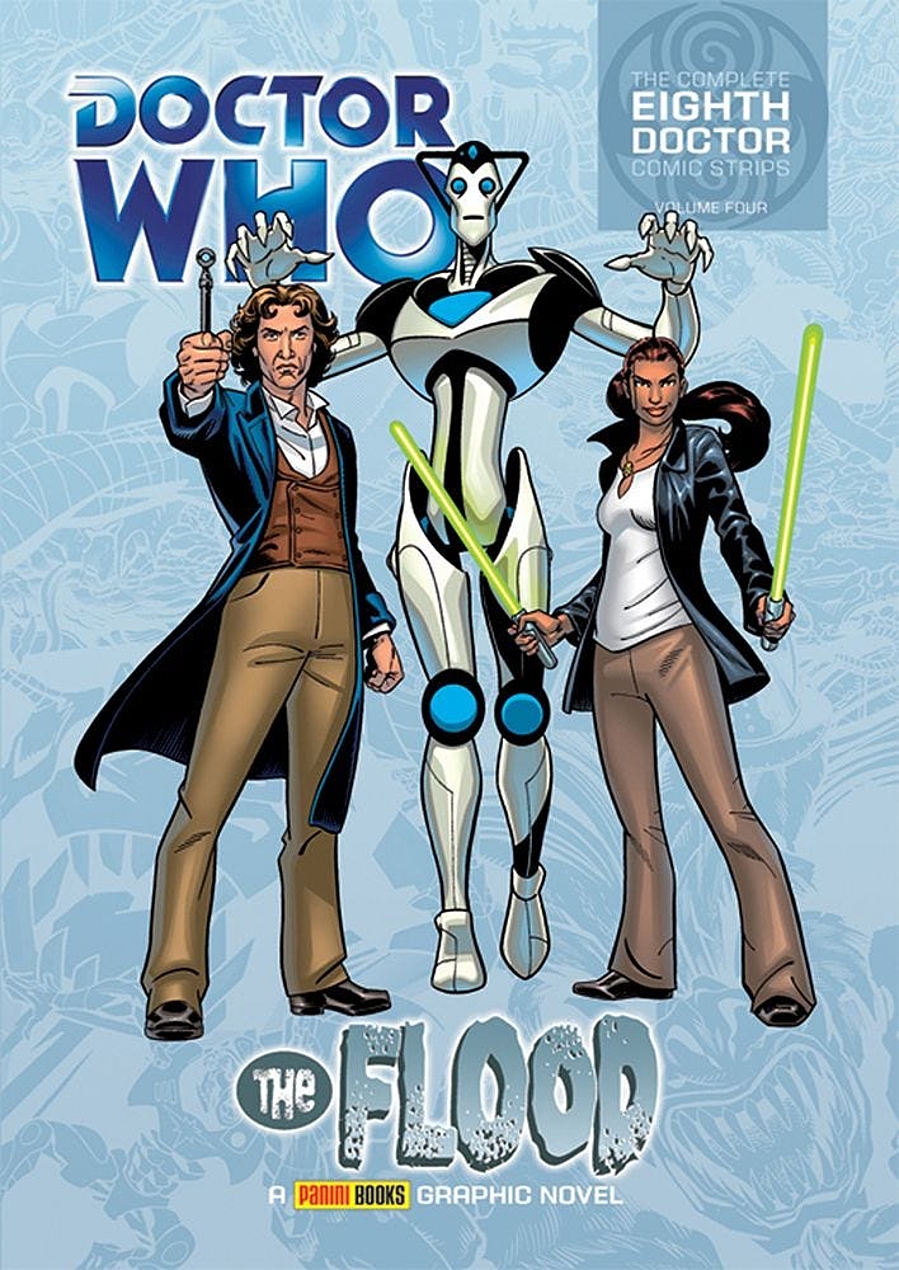
The Flood, from Doctor Who Magazine #346-53 (Aug. 2004–Mar. 2005)
story by Scott Gray, pencils by Martin Geraghty, inks by David A. Roach, colours by Adrian Salmon, lettering by Roger Langridge
from Doctor Who Magazine #350
The end of the eighth Doctor's comic run is surely also one of its best stories. An amazing setting, a great use of the Cybermen, some real meaningful, human stuff from both the Doctor and Destrii, perfect artwork. So good that Russell T Davies cribbed from it two different times (the Doctor absorbing the Time Vortex in The Parting of the Ways, the Cybermen as ghosts in Army of Ghosts), but of course he did, because this is operating right in the same ethos as him, my preferred ethos for Doctor Who, where the fantastic crashes right into the ordinary. The Cyberman plan—to make people want to by Cybermen by making their emotions unbearable—has never been bettered. The Doctor's increasingly desperate plans and ploys are done amazingly well. The new Cyberman design is fantastic. Martin Geraghty is on fire as much as the Doctor is during the climax. The narration by Izzy is the icing on the cake, and the cameos from her, Maxwell Edison, and Grace are well-placed. The ending isn't a regeneration, but it could have been, and it works either way.

Even the coda with the cows is great. I'm sad it had to end, but it couldn't have ended better than this.
from Doctor Who Magazine #353
Stray Observations:
  • There's never been much sign that DWM cares about the Big Finish uses of their concepts; the woman Frobisher is married to here is seemingly not the one he settled down with when he left the Doctor in The Maltese Penguin.
  • #337 was, fact fans, the very first issue of Doctor Who Magazine I ever picked up, meaning The Land of Happy Endings was my first-ever DWM strip. I picked up that issue so I could get ahold of its exclusive Big Finish audio drama, Living Legend, written by Scott Gray himself! It would be a few years before I would become a regular purchaser of DWM... I own The Coup / Silver Living, which came free with #351, but the cover to that one doesn't strike a chord; I think I might have just bought the CD on its own on eBay in that case.
  • Normally I think Gray does a great job capturing the Doctor in general and Paul McGann specifically, but I don't care for a Doctor who makes scalping jokes and thinks Native Americans went around saying "How!" and calls them "Red Indians." Ugh.
  • One thing I don't like about The Flood: the bit where Destrii is inadvertently racist. It's just not what I want to read about a companion doing? I think the story might get away with it if Destrii or anyone else acknowledged it, but all the only reaction comes from someone who's been emotionally compromised by the Cybermen. Similarly, I don't quite buy that you could watch as much Earth tv as Destrii has and not know about money!
  • Can I just say, Martin Geraghty has always drawn Paul McGann as kind of tall... but in reality, McGann's only a couple inches taller than the "short" Sylvester McCoy. I feel like this is surely because of those TVM promo photos where McCoy hands McGann the TARDIS key, where McGann is clearly way taller. Supposedly McGann was standing on a box! Can we assume that even if McGann is average height, the character of the eighth Doctor is tall, and thus Martin Geraghty draws him correctly?
  • The "Flood Barriers" behind-the-scenes here, about how DWM almost got to do the regeneration, and their pitch of Ninth Doctor: Year One, is really fascinating to read. I totally see the reason neither panned out, but it does seem a bummer that DWM could be offered something so titanic yet not get to do it, and I bet Scott Gray and Martin Geraghty would have made The Ninth Doctor: Year One something special. But they made the right call—especially once Night/Day of the Doctor came along!

This post is the twenty-ninth in a series about the Doctor Who Magazine comic strip and Marvel UK. The next installment covers The Cruel Sea. Previous installments are listed below:

  1. The Iron Legion
  2. Dragon's Claw 
  3. The Transformers Classics UK, Volume One
  4. The Tides of Time
  5. The Transformers Classics UK, Volume Two
  6. Voyager
  7. The Transformers Classics UK, Volume Three
  8. The World Shapers
  9. The Transformers Classics UK, Volume Four
  10. The Age of Chaos
  11. The Transformers Classics UK, Volume Five
  12. A Cold Day in Hell!
  13. Death's Head: Freelance Peacekeeping Agent (part 1)
  14. Nemesis of the Daleks
  15. Death's Head: Freelance Peacekeeping Agent (part 2)
  16. The Good Soldier
  17. The Incomplete Death's Head
  18. Evening's Empire
  19. The Daleks
  20. Emperor of the Daleks
  21. The Sleeze Brothers File
  22. The Age of Chaos
  23. Land of the Blind
  24. Ground Zero
  25. End Game
  26. The Glorious Dead
  27. Oblivion
  28. Transformers: Time Wars and Other Stories