Showing posts with label topic: film. Show all posts

10 January 2025

Beyond A Christmas Story: Watching the "Parker Family Saga"

Though it's a Christmas staple for many, A Christmas Story (1983) isn't a movie I grew up with. I think if you're from Cleveland, it's mandatory viewing because it was filmed there, but I of course am from Cincinnati. I am pretty sure I never saw it until after I began dating Hayley. Early in our relationship (winter break 2007/08, I think), we took a tour of "emerging Cleveland," and one of the places the tour went was Tremont, where the Christmas Story house resides; now it's a museum devoted to the movie, but that was still in development then. Many houses in the neighborhood, though, had the famous "leg lamp" in the window, and from that, I believe, Hayley realized I'd never seen it. I don't know if we watched it right then, but if not, I'm sure it was soon thereafter.

Famously, the movie is run in a twenty-four-hour marathon on cable on Christmas Eve; Hayley's stepmother always tunes into this, so whenever we'd stay with her dad's family over Christmas, I'd catch at least pieces of it.

The movie is adapted from the semiautobiographical stories of Jean Shepherd (1921-99); what many people don't know, I think, is that before A Christmas Story, his memoirs formed the basis of two tv movies aired on PBS. After A Christmas Story, there were two more PBS tv movies in the late '80s, plus the (long-term) success of A Christmas Story itself resulted in a number of follow-ups: a second theatrical movie (1994), a direct-to-DVD sequel (2012), and an HBO Max original (2022). There's very few overlapping cast members between all these movies, aside from a couple of the PBS ones; Peter Billingsley, who plays Ralphie in A Christmas Story, for example, doesn't pop up again until the 2022 movie. The one constant is writer Jean Shepherd himself, who narrates as the adult Ralphie in all the movies that were produced during his lifetime.

I don't know when I learned this fact; it's perfectly possible to watch A Christmas Story ignorant of it. Now the lede of the A Christmas Story article on Wikipedia notes it's part of the "Parker Family Saga," but the article on the "saga" was only added in 2020, so it probably wasn't so prominently noted back then. In our lore-obsessed era, people even wonder if it's possible to watch A Christmas Story without seeing the "first" two movies... even though those movies are set later, and made by an entirely different group of people!

What is a bit surprising is that you can find a lot of people who note that A Christmas Story is part of an overall "series"... but seemingly no one who has actually watched their way through all its constituent movies! But if you read my blog, you know I love excuses for complicated marathons (I am, after all, the person who nonsensically watched (most of) the James Bond movies in book publication order), and this Christmas when watching the marathon at Hayley's aunt's house during the family Christmas party, I was reading about the "Parker Family Saga" on Wikipedia on my phone, and I discovered that there's actually a DVD set you can get from Amazon (out of stock now). So I took advantage of an Amazon gift card I had got in my stocking, and placed an order.

(I should say I have some doubts about the provenance of this set... but hey, it sure is convenient, and there's no other way to get the PBS ones on home media as far as I know.)

My plan: to watch the movies in internal chronological order and blog my way through them over the next couple months. (This means I will somewhat unseasonably end up watching A Christmas Story Christmas in March, but given others of the movies take place on the Fourth of July and Thanksgiving, there's not really a way to marathon them that doesn't include some amount of unseasonability.)


Hayley and I began this process this past weekend with the first movie chronologically: A Christmas Story itself. Released in 1983 (so third in production order), the movie is set in (approximately) 1940, when Ralphie is nine years old. As I said, I've seen it once all the way through before, and many times in bits and pieces during the cable marathon. 

I don't have much to say about it, to be honest, except that I really enjoy it. I'm sure there are people who don't like this movie, but it seems to me that if you're sympathetic to what the movie is trying to do, you must like it, because it's one of those stories that is so completely itself. Is it "great art"? I don't know, but it does accomplish exactly what it sets out to do perfectly. If you want a set of anecdotes about childhood that are nostalgic without being saccharine, that capture the perspective of a child but with the knowledge of adulthood, I don't know that you could do better. I've always liked the parents, and this my first time really watching the movie since becoming one myself, and the moments of parenthood ring true, both the dad's eternal exasperation and the mother's alternation between punishment and support.

That the movie succeeds as well as it does is surely a testament to the casting. It would be possible to look at the smarmy picture of Ralphie's grinning face on the merchandise and dismiss Peter Billingsley, but he's actually a pretty gifted comic performer, doing a lot with his face. Ian Petrella as his little brother Randy is hilarious. The standouts for me, though, are the parents, Darren McGavin and Melinda Dillon, who I think just embody their characters. Were they really 1940s parents? No they were not, but I believe it when I watch the movie. McGavin gets lots of great bits throughout, but I think it would be easy to overlook the skill of Dillon, who also gets a lot of nice moments, particularly the hilarious bit with the soap.

The movie is set in northern Indiana, and mostly filmed in Toronto, but the house exteriors and department store scenes were filmed in Cleveland. The department store, Higbee's, was a real place... but in Cleveland. Despite this, it appears as itself in the film, apparently as part of the deal to allow filming. Higbee's was an eleven-story behemoth; my wife's mother likes to talk about her Christmas trips to Higbee's, and it sounds like a magical place. Alas, it became a Dillard's in 1992, and now the building is a casino.

Having established the foundation of the "Parker Family Saga" movie that everyone knows and likes, I am curious to see where things go from here!

This is the first in a series of posts about the "Parker Family Saga." The next installment covers My Summer Story.

17 August 2022

"Oh, baby, wasn't I the one who made you want to stay?": Licence to Kill

Now that I've seen all the James Bond movies based on books, it's time to go through the remaining ones, which I'll be doing in release order. There's just seven of them (as I've determined it), of which Licence to Kill is the first. On the other hand, this is actually the last James Bond movie I've never seen, as I rented all the Pierce Brosnan ones on VHS back when I was a kid, and saw all the Daniel Craig ones in the theatre.

This might have been the first Bond film without a book title, but on watching it, it actually did turn out to be based on some books. Like a lot of the 1980s Bond films did, it went back and mined bits from earlier Bond books that had never been used on screen: specifically, this film takes the maiming of Bond's CIA counterpart Felix Leiter via shark from Live and Let Die and the character of Milton Krest, a supposed biological researcher up to no good on his yacht the Wavekrest, from the short story "The Hildebrand Rarity." What it does with them, though, is pretty original.

The movie has a great pre-titles sequence. Bond is best man at Felix's wedding in the Florida Keys, but the wedding is interrupted by some DEA agents showing up to tell Felix they have the opportunity to take out Sanchez, a Central American drug lord who's come to the United States to chase a fleeing girlfriend. Felix goes to help—and of course, so does Bond. There are some good hijinks like Bond jumping from the DEA helicopter to Sanchez's plane and tying a cable around it, and then Bond and Felix parachute right in front of the church to make the wedding. Good stuff.

If you want to make it up to your bride for being late, arrive via parachute.

Only, Sanchez escapes custody and then goes out for revenge; on Felix's wedding night, he kills his wife, and (as I said before) maims Felix via shark. So the movie follows Bond as he goes rogue in pursuit of revenge, deciding to bring down Sanchez's drug empire single-handedly when M revokes his licence to kill. The movie is one of the grimmer and darker Bond films, a lot more in line with a Daniel Craig story than anything the Bond films had done up until that point; Timothy Dalton's only other outing as Bond, had been a bit lighter, and films' previous attempt at an off-the-books Bond, For Your Eyes Only, wasn't quite this brutal. There are a lot of shocking cold deaths by both Bond and villains.

Overall, I liked it. The plot is complicated enough to be interesting, but not so complicated as to be confusing (as has been the case with a few recent Bonds, e.g., Octopussy, Quantum of Solace). The film might be a bit grim, but it still has some good moments of Bondian levity. We particularly enjoyed the sham religious leader who works for Sanchez, who shouts "bless your heart!" every time he gets outwitted, and much of the climactic battle is sublimely ridiculous, such as when Bond pops a wheelie in a gasoline tanker truck.


There are only two "Bond girls" here, and Bond doesn't seem very interested in one of them. There's Lupe Lamora, Sanchez's girlfriend. She sees Bond as a way out of her situation, and helps him so he can help her. She melodramatically and unconvincingly declares she loves him; she's not a very good actress.

This sets up a pretty great moment where Bouvier downs Bond's "shaken, not stirred" martini herself and makes a face.

The main Bond girl is Pam Bouvier, a former U.S. Army pilot, who ended up running drugs for Sanchez, but then decided to go straight by turning informant. Bond goes to her for information, but then hires her to fly him to Isthmus (the thinly veiled Panama analogue where Sanchez is based); she pretends to be his "executive secretary" while he infiltrates Sanchez's organization, and ends up helping in a variety of ways up to and including the climax. Bond and Bouvier are given a bit of a mutual-animosity-turns-to-passion thing: they make love on a boat in the middle of the ocean when it runs out of gas. Bouvier is in the line of Melina in For Your Eyes Only: she's not a secret agent, but she has her own competencies, and the film doesn't undermine them, presenting her as closer to an equal than most Bond women.

She's clearly meant to resent Bond's dominance, but also resent when Bond doesn't pay her enough attention—if there's a bit of commentary in here, it's that these short-haired independent women aren't as independent as they imagine! What I found fascinating, though, was the scene at the very end. Lupe is flirting with Bond, Bouvier is once again jealous—and Bond, recognizing this, pushes Lupe off on another guy, and then goes after Bouvier! Like, he is clearly concerned about her feelings, and wants to make it up to her. Would Sean Connery act like this?

In The Living Daylights, Dalton was a bit more emotionally sensitive than your average James Bond; here, on the other hand, he's out for revenge. This actually plays quite a bit on Bond's history: as happened to Bond himself, Felix's wife is killed on their wedding day. The film alludes to this very indirectly, and it actually took me a while to remember how close the parallels were, as they are never explicitly named. It seems a bit off, if I am honest, for your protagonist's emotional arc to depend on something that happened ten films prior, twenty years ago, and three actors before! I wish it had been discussed more directly.

It was interesting watching this in close proximity to Quantum of Solace, which is a very similar film: it pursuit of revenge, Bond defies M and has to flee his own people. Both movies focus on Central/South America, and in both, one of the Bond women is even a villain's girlfriend who gets abused! Quantum is all about whether or not Bond has gone too far; his emotional arc centers on this question. In Licence to Kill, neither Bond nor the film itself really engages in any introspection about Bond's choices. He just does it. M revokes Bond's licence to kill... but the end of the film doesn't even mention this! No one chews Bond out or welcomes him back into the service or anything. In Living Daylights, Dalton was effective at alternating between hardened killer and sensitive soul; here, he's all hardened killer, and I wish we'd seen more introspection, because I know he could have done it based on Living Daylights. I don't know that it needed to go all angst as the Craig films often do, but there was room for more emotion than we got.

When I wrote up Living Daylights, I said, "People say License to Kill is Dalton's good one, so I look forward to getting to see it," but I would pretty much place them on par with one another. Still, what a hit rate! If you only make two Bond films, I guess odds are neither of them will be clunkers.

Other Notes:

  • David Hedison was only actor to play Felix Leiter more than once prior to Geoffrey Wright showing up in Quantum of Solace. I gather that since the film depended on Bond's relationship with Felix for its emotional core, they wanted an actor that had actually been seen on screen with Bond before. It's a bit odd, though, in that it's a different Felix to the one from the immediately previous film (John Terry); in fact, Hedison had previously appeared sixteen years prior, opposite Roger Moore! Still, he's pretty likable, though I found the ending scene where he's goofing with Bond about getting his golf swing back pretty odd. I wonder if the producers didn't kill him off in case they wanted to use him again, but the Pierce Brosnan films would go on to introduce a different American counterpart for Bond.
  • I felt this was one of Desmond Llewellyn's better turns as Q, who sneaks off from MI6 to help Bond. On the other hand, Caroline Bliss puts in a pretty fleeting appearance as Moneypenny, her last.
  • Bond infiltrating the villains and taking them down from within by sowing distrust was pretty nicely done, and felt more in line with the early Fleming Bond than what we often see on screen.
  • I spent the movie suffering from a sense of vague recognition for both villains, Sanchez and his subordinate Krest. Upon looking it up later, it turned out that Robert Davi (Sanchez) played a recurring villain in Stargate Atlantis and Anthony Zerbe (Krest) was one of the principal villains in Star Trek: Insurrection.
  • There's a scene at Hemingway House, complete with all the cats. This lets Bond make a real groaner of a literary pun about A Farewell to Arms.

Film Rankings (So Far):

  1. Casino Royale
  2. Dr. No
  3. From Russia with Love
  4. For Your Eyes Only 
  5. On Her Majesty's Secret Service
  6. Thunderball 
  7. The Living Daylights
  8. Licence to Kill
  9. Spectre
  10. You Only Live Twice
  11. Goldfinger
  12. Quantum of Solace
  13. The Spy Who Loved Me
  14. Moonraker
  15. The Man with the Golden Gun
  16. Octopussy
  17. Never Say Never Again
  18. A View to a Kill
  19. Live and Let Die 
  20. Diamonds Are Forever

12 August 2022

Hugos 2022: Ballots for Graphic Story and Dramatic Presentation

And here is my last Hugo ballot post! We have my nominations and votes in the "visual" categories: comics, tv, and film. I should note that I was done with the comics back in June... and didn't finish the film/tv stuff until two days before the deadline. I find it easier to organize my reading than my watching, I guess. (I have linked the titles if I have written a review elsewhere, or if the work is freely available on the Internet.)

Things I Nominated

I don't read many comics right as they come out, so my ability to nominate things for Best Graphic Story is always pretty limited. This year I nominated the same thing I did last year... a My Little Pony / Transformers crossover comic! Seemed unlikely to me that The Magic of Cybertron would make the ballot, but I did my bit...

I nominated two tv episodes in Best Dramatic Presentation (Short Form), both episodes of Star Trek: Lower Decks season 2 that I enjoyed immensely: "wej Duj" (Klingonese for "Three Ships"), where the lower-decks crew of the USS Cerritos are paralleled by lower-decks escapades on Klingon and Vulcan ships, and "First First Contact", the delightfully triumphant season finale. To my surprise and delight, "wej Duj" actually made the final ballot! It's the first Star Trek installment to make it since an episode of Discovery in 2018.

I also nominated some random Big Finish stuff I enjoyed, though I have no expectations that any of it will ever make the ballot. Two Torchwood audio dramas (The Five People You Kill in Middlesbrough and Madam I'm) in Short Form, and one Doctor Who audio drama (Shadow of the Daleks) in Long Form.


Best Graphic Story or Comic

6. Monstress: The Vow, script by Marjorie Liu, art by Sana Takeda 

Below, I said I was only really interested in the backmatter in Die. Well, at least Die has interesting backmatter...
 
5. Die: Bleed, script by Kieron Gillen, art by Stephanie Hans

The first volume of this series was a finalist in 2020, the second in 2021. This is the fourth and final; I didn't enjoy those previous volumes enough to feel motivated to read the third before this, so I just skipped it. (It's about people trapped in a TTRPG, and each volume focuses on a different writer who influenced RPGs. The first did Tolkien, the second the Brontës, and this one Lovecraft; it turns out the one I skipped did Wells, so maybe I ought to go back.) I found this hard to follow—too many characters, and even though it came out as twenty issues across three years, it's clearly meant to be read in one go. It seems to be trying to say something interesting about queerness and RPGs, but I couldn't follow the story enough to tell you what. The most interesting part was definitely the backmatter, where Kieron Gillen interviews people about the evolution of RPGs.

4. Lore Olympus, Volume One by Rachel Smythe

This is a webcomic, now released in print, that retells the story of Hades and Persephone with modern trappings. The comics language here uses a lot of manga conventions, and manga tropes dominate the romance story, too. Overall I enjoyed it well enough. Some good jokes, nice art, but sometimes I struggled to keep the characters straight, and the emotions are a little overwrought. This is clearly the beginning of a long story (this volumes collects episodes 1-25 of a serial that has run 200 thus far), and I am not sure it is really aimed at me, though the end promises a darker turn that I would be curious to see the repercussions of.

3. Once & Future: The Parliament of Magpies, script by Kieron Gillen, art by Dan Mora

This is volume three of a series about the Arthurian mythos rising up again in modern Britain; I read volume one when it was a finalist last year. (I didn't intentionally skip volume two; I didn't realize I'd skipped an installment until there were a bunch of references to Beowulf in this one.) It's pretty fun stuff, with strong characters, good art, and occasional moments of genius... but like all the original Kieron Gillen comics I've read, I have this sort of vibe that he's almost but not quite as good as Brian K. Vaughan. Unfair but there you go.

2. Far Sector, script by N. K. Jemisin, art by Jamal Campbell

In some ways I enjoyed this more than Once & Future: as a somewhat erudite superhero comic, it's just more my jam than the non-stop-high-concept kind of thing Kieron Gillen tends to write. On the other hand, this is a good superhero comic but not a great one, and Once & Future is definitely up to more. On the whole, I would say my enjoyment of the two is pretty comparable, so I gave the edge to Far Sector on two bases: I do like superhero comics a lot, and it's also a complete story as opposed to a fragment.

1. Strange Adventures, script by Tom King, art by Mitch Gerads & Evan "Doc" Shaner

As soon as I finished this, it was clearly the best of the four Graphic Story finalists I had read thus far. Beautiful art, thematic complexity. There are snatches of greatness in, say, Once & Future, but this is the kind of thing this category ought to be rewarding.


Best Dramatic Presentation (Long Form)

6. Encanto; directed by Jared Bush & Byron Howard; script by Charise Castro Smith & Jared Bush

This is (if you need to be told) an animated musical about a Colombian family who lives in a magical house, where each resident of the house has a magical power... except one. I really enjoyed this; it's a solid film with some great songs and interesting thematic beats. I really liked "Surface Pressure," about one sister's need to never stop doing what the family needs, and "Waiting on a Miracle," about the protagonist's desire to do something to help the family. It's a good depiction of the complexity of family dynamics, about how people want to contribute to a system that has disappointed them. I think it deserves awards, but I'm not convinced it deserves this award. Sure, it's got magic, but is it really in dialogue with the genre of science fiction and fantasy? Or is it more a contribution to the genre of children's animation? (if that makes sense) This is to say, don't let its low ranking leave you thinking I didn't like it. I just don't think it's in the core sensibility of what I seek to reward with a Hugo.

5. Dune, Part One; directed by Denis Villeneuve; written by Jon Spaihts, Denis Villeneuve, and Eric Roth

I have never been a Dune partisan. I largely bounced off the book as a teenager (though I probably would find it more digestible now), I have seen the Lynch film a couple times, and I remember enjoying the Sci-Fi Channel original miniseries. This adaptation is probably the best one you could imagine, with room to breathe due to the increased running time but also the budget not afforded the Sci-Fi Channel mini. It's impeccably cast, and like all Villeneuve films I've seen, it looks great. But I felt... somehow unmoved by it all. Magisterial, but I didn't feel invited into either the world or the characters' emotional lives. It's like you're at a remove the whole time.

4. Shang-Chi and the Legend of the Ten Rings; directed by Destin Daniel Cretton; script by Dave Callaham, Destin Daniel Cretton, and Andrew Lanham

Last year, my wife and caught up on Marvel films (at the time, Spider-Man: Far from Home was the most recent), and I felt like that was it: following Avengers: Endgame, there was nothing more I wanted out of them, and I was ready to move on. I haven't seen one since, though I guess I ought to go see Thor 4 in theatres given I saw the other three in theatres. All this is to say that I was actually quite charmed by this, which follows the Marvel origin story formula, but is a reasonably strong execution of it. It has a real sense of style and flair, a good soundtrack, some great set pieces, the best villain I can remember in a Marvel film for a long long time, and a totally gratuitous but excellent comic relief character.* On the other hand, I thought star Simu Liu was charismatic and likeable, but his emotional arc didn't really seem to be present, writing-wise. I really struggled with ranking this. Is it a better movie than Dune? I don't know. Certainly it is less ambitious, and do the Hugos need to award (what is by my count) the eighth Marvel origin movie? Anyway, as it often is, my tiebreaker was the question, "What am I more likely to rewatch?" And the answer to that question is definitely Shang-Chi.

3. WandaVision, created by Jac Schaeffer, directed by Matt Shakman

Thankfully, this was the only complete-season finalist this year. I found this pretty fun at first: the sitcom pastiches are excellently done, and the language of television is abused to disconcerting effect. Moments where the camera angle suddenly shifts out of the sitcom standard, or the credits roll and things keep on going, or the crossing over of the better Quicksilver, are wonderful. Elizabeth Olson and Paul Bettany get to show off more here than in every Avengers film put together. Plus the episodes that are basically just sitcoms are very well done ones! I found this less interesting the further away it got from that basic set-up, however. There are a lot of characters who ultimately don't serve very important functions, narratively or thematically, and by the final episode, the show has abandoned its interesting meta play in favor of a somewhat-above-average Marvel punch-up. The sitcom stuff was ultimately a puzzle to be solved, not an idea to be explored. The idea that someone who lost her real family life and found solace in sitcom families might try to make her own sitcom family seems ripe with possibilities for saying something about family, but the finale doesn't go there, and it has none of the playfulness that characterized the rest of the series. Still, we have a number of episodes of really enjoyable stuff prior to that point, and I was definitely more involved than in Dune, and I would happily see this win.

2. 승리호, directed by Jo Sung-hee, script by Jo Sung-hee & Mocan

Space Sweepers is a Korean space film, about space scavengers who end up in over their heads when they discover a robot with a hydrogen bomb inside it aboard a derelict spaceships... a robot in the form of a human child. Okay, look, it's not a great movie. The villain (played by Richard Armitage!) has no real motivation, and a couple of the characters' backstories feel tacked on, and I found bits of it confusing and/or clumsy. But, you know, group-of-underdogs-in-a-spaceship unite to do great things has basically been my favorite genre of sf film since Star Wars, and this is a charming example of it with a lot of heart. A special shout-out to the character of Bubs, who at first seems to be a quippy murderous robot, but is soon revealed to have extra dimensions. Is it really the second-best thing on this list? Probably not; I think on any objective measure of "good film" it goes below Dune. But would I be excited for it to win a Hugo? More than anything else on this list.

1. Sir Gawain and the Green Knight: A Filmed Adaptation of the Chivalric Romance by Anonymous, written and directed by David Lowery

I didn't know much about this going in beyond that it was based on an Arthurian medieval text (one with which I am unfamiliar) and that it was controversially received. Well, I really enjoyed it: it reminds me of the kind of 1980s pre-Lord of the Rings fantasy film I might have randomly plucked off the shelf at Blockbuster as a kid, and been weirded out but entranced by, before the fantasy genre of film became codified as massive epics. Well, that crossed with a Tarkovsky movie! Beautiful, jarring, potent. Exactly the kind of thing I like the Hugos to expose me to (doubt I would have bothered otherwise), and the kind of thing I like to reward.


Best Dramatic Presentation (Short Form) 

6. The Wheel of Time 1x06: "The Flame of Tar Valon", written by Justine Juel Gillmer, directed by Salli Richardson-Whitfeld

This seems like a perfectly acceptable piece of epic fantasy, if you're into that kind of thing. The mean thing to say is that I liked it better when it was called The Lord of the Rings.
5. Arcane: League of Legends 1x09: "The Monster You Created", written by Christian Linke & Alex Yee, directed by Pascal Charrue & Arnaud Delord

This is a 3D-animated cartoon on Netflix set in the world of the League of Legends videogame, and the only thing on the short-form ballot I hadn't even heard of before it became a finalist. I don't have anything against this, but it was the final episode of a nine-episode serialized story that made absolutely no concessions for anyone; there wasn't even a "previously on..." at the beginning. Which I get, no one but me is watching this show this way, but I had no ability to assess it really. It looks nice when it's still, but I found the way people moved a bit off, like it was, well, a videogame. Some very dramatic moments that had me curious about context... but also very gruesome in places, which doesn't appeal. I was going to put this below Wheel of Time but then I realized at least I was never bored watching this (though I didn't find the fights very interesting). 
 
4. Loki 1x04: "The Nexus Event", written by Eric Martin, directed by Kate Herron

I'm sure this was quite exciting to people who had been watching Loki, and indeed, there was some fun stuff in it: I liked Loki getting punched by Sif again and again. But, like, what is a "nexus event"? Maybe someday I will watch all of Loki, but until then, this didn't quite work on its own. My friend Christiana hates it when I evaluate tv this way, but I need some kind of limit. If I am obligated to watch the previous three episodes of Loki, am I not also obligated to watch the previous nineteen episodes of For All Mankind? And that's not happening.

3. The Expanse 5x10: "Nemesis Games", written by Daniel Abraham & Ty Franck and Naren Shankar, directed by Breck Eisner

As I always say, I stopped watching The Expanse during season 3 (not the show's fault), but since I read the books, I was mostly able to follow this out of context. It's another perfectly competent episode whose emotional beats might have landed better had I seen the previous nine episodes of the season, but landed well enough regardless, especially the bits with Naomi. The Expanse has made the ballot five out of the last six times, and this was the best Expanse finalist since "Leviathan Wakes."

2. For All Mankind 2x10: "The Grey", written by Matt Wolpert & Ben Nedivi, directed by Sergio Mimica-Gezzan

This did work on its own, to my surprise. For All Mankind is an alternative history show where the Space Race continued unabated after the 1960s. This episode is set in the 1980s, and America has a base on the Moon, Apollo-Soyuz is going ahead, there are missile platforms in space, and so on. I am a sucker for shows about competent people working together to solve difficult problems, and this is one of them. (I particularly liked Wrenn Schmidt as Margo Madison, director of Mission Control.) There are lots of good moments in this, a show about how even in dark times we can work together, and it very much made me want to go back and watch the first two seasons. Except, you know, it's on Apple TV+ (surely one of the less necessary streaming services; I signed up for a week-long free trial to watch this).

1. Star Trek: Lower Decks 2x09: "wej Duj", written by Kathryn Lyn, directed by Bob Suarez

Like I said above, I nominated this. This was a great episode of the overall strong second season of Lower Decks, with the story of the lower-decks Cerritos crew paralleled with their counterparts on Klingon and Vulcan ships, all coming together in a satisfying way. The character of T'Lyn, the Vulcan prone to "outbursts," was particularly fun, as was security chief Shaxs doing pottery. It's Lower Decks at its best, and you bet that if a show I actually watch gets a Hugo nomination, I am going to rank it highly.


Overall Thoughts

This is one of the better Best Graphic Story ballots I've seen; even if I never enjoy Kieron Gillen comics all that much, there's no denying he's one of the medium's most acclaimed writers. There are no finalists this year that stick out as mediocre-but-nominated-for-some-other-reason. Monstress won for its first three volumes but hasn't won since; my guess is based on past voting patterns, N. K. Jemisin will win yet another Hugo.

Similarly, this is a strong long-form Dramatic Presentation ballot, with all six movies being fundamentally enjoyable. (I did not fall asleep during any of them, unlike last year.) I stand by the prediction I made last year before this year's ballot was even out: Dune will win.

I find the state of short form annoying... but what can you do about it when serialized shows dominate the sf&f television market? Now that The Good Place is no longer in contention, I have no idea what Hugo voters actually like.

* After the Mandarin reference, I reminded my wife of the events of Iron Man 3, which we saw some time ago. I figure that was it: we explain how this move relates to the other one for the continuity nerds in the audience, then move on. Little did I expect that five minutes later Ben Kingsley would turn up! If you told me that as originally filmed, his character left them before they went through the portal, I would believe it; I don't think he interacted with a main character again after they crossed over, so you could have totally beefed up his role in reshoots.

01 June 2022

"Another tricky little gun giving solace to the one / That will never see the sunshine": Quantum of Solace

This is it! My last James Bond film in my novel-order marathon. "Quantum of Solace" was a short story collected in For Your Eyes Only, but when this movie came out, all the James Bond short stories were repackaged into a single volume called Quantum of Solace as a tie-in, so I watched it after reading it. It's all kind of pointless, of course, in that the film has literally nothing to do with the short story except for the title. The short story is an interesting but weird little thing where Bond only appears in the frame, as he is told a story about a degenerating marriage where once the couple's marriage no longer contains even the smallest possible amount (i.e., a quantum) of solace, they turn on each other. Bond is in it mostly to serve as a contrast: "Suddenly the violent dramatics of his own life seemed very hollow." 

In the film, "Quantum" is revealed as the name of the evil organization that was responsible for the events of Casino Royale, but also the film is about Bond chasing "solace" for the death of Vesper in that film. It isn't spelled out, but one presumes he manages to find the smallest possible amount of it.

As I think I said back when I reviewed Spectre, I've seen all the Daniel Craig films in the theater. Thus, I have two contexts to think about each of them: how they fit into the other Daniel Craig films, and how they fit into the Bond films more broadly. I wasn't a big fan of Spectre as a Craig film when it originally came out, for example, but as a Bond film, I found it good fun on rewatching. I feel like the opposite happened here. I know this is a minority view, but I remember really enjoying Quantum of Solace when I saw it in the theater; on rewatching, I found it interesting how it played with Bond tropes but also it feels less like a Bond film and more like a generic action film of the Bourne era.


Okay, as a Craig film first. The movie opens literally an hour after the events of Casino Royale; the guy Bond went to confront at the end of Casino Royale, Mr. White, is stuffed into Bond's trunk when this film begins. Bond spends the film trying to get to grips with the plans of Quantum, who were behind Casino Royale, and spends the film trying to come to terms with the death of Vesper. This all worked for me when Casino Royale was indeed my previous Bond film, and I had seen it just a couple years prior, but in this sequence, Casino Royale was over seven years ago, nineteen Bond films back! I think some of it still lands okay, but it does feel like the movie is trading off your memory of the first one for your emotional investment here. Thank God for composer Daniel Arnold's occasional invocation of his beautiful "Vesper" theme. The one part that really didn't work for me was the return appearance of Mathis; Mathis has no real reason to go with Bond, so he clearly only does it because he's a familiar character who can die to prove the situation is serious, as in this new continuity, Bond doesn't really have any old friends.

On the other hand, it's pretty interesting how this one plays with tropes and expectations of Bond films, which is something I hadn't clocked watching it in its original context. Bond is pretty charmless for the first half, and also not particularly clever; as M points out repeatedly, he keeps killing his leads. There's a bit where he hijacks a boat driven by Olga Kurylenko's agent Camille so that he save her life. In a Roger Moore or Sean Connery film, she would get mad at him, but then they would flirt, he would save her life, and then they would sleep together. (This is basically what does happen in a very similar scene in Licence to Kill.) Here, she gets winged during the gun battle and falls unconscious, and he just ditches her! (We actually thought she was dead at first, but we may not have been watching too closely, as we were also folding laundry; she pops up again thirty minutes later, evidently fine.) This is "not your father's Bond," made very plain in a pretty clever way.

(The Goldfingeresque death of Agent Fields comes across as pretty gratuitous, though, and not really in character.)

On the other hand, I struggled with the action. Casino Royale had some big extravagant action sequences in its first sixty minutes, before the casino plot actually kicks in, but then the main body of the film is much more restrained than the old Bond films. But I felt like Quantum of Solace, having removed the over-the-top goofy action of a Roger Moore film and also lacking the intensity of Casino Royale, didn't know what to replace it with, so there were a lot of just pretty generic action sequences that could come from any 2000s action flick. There's no humor and no intensity. It did improve for me with the final sequence—the villain lair is visually striking—but even that lacked the climactic oomph it needed.


In trying to figure out what a non–Cold War, non-SPECTRE villain might want, Quantum of Solace comes up with a pretty clever answer. Mr. Greene, this film's Quantum representative, is supposedly an environmentalist, but secretly he's after oil... but that's another cover, and he's really after capturing water and then selling it back to impoverished countries at high premiums. This is clever... but it's also a bit too complicated, or at the very least, under-explained. It also means that the stakes don't really escalate. I mean, giving thirsty people their water back is noble, but it's not saving the West from Communism, you know? I do think the next film overreacted in its course correction, but it's little wonder that Quantum isn't even mentioned in Skyfall.

I feel like the filmmakers really missed a trick. Any movie where Bond discovers the villains have built a dam for nefarious purposes really ought to end with the dam exploding! That would have given us a great climax.

Craig himself does a good job with what he can, of course, but though we know he can be charming, there's little evidence of it here, even when he charms Gemma Arteron's Agent Fields and sleeps with her. She's the only woman he sleeps with; his relationship with Camille is very different, and probably the strongest part of the film, as he genuinely wants her to be a better person than he is... but he also wants her to get that same "quantum of solace" he's after.

So all in all, it's okay stuff. Probably the worst Daniel Craig film, but Craig had an above-average run. Better than Moonraker—there's your pull quote.  

Other Notes:

  • In this part of my review, I often comment on all the recurring character actors, but at this point in the Daniel Craig chronology, there's no Moneypenny yet and no Q! Judi Dench does a good job with generic material as M; I did really like the moment where she lets him get on with the job because she knows that if Bond's seemingly gone rogue, he has a good reason for it. Rory Kinnear puts in his first appearance as M's chief of staff, Bill Tanner, and ohmigosh, he looks like such a baby. (Actually, so does Daniel Craig. Somehow this movie came out thirteen years ago!)
  • It's not exactly a competition to be "best Felix," but Jeffrey Deaver wins it by a country mile.
  • The bit where Bond goes to the opera isn't much of an action sequence per se, but it does have good modern vibe to it, and is visually interesting.
  • The theme song is not the worst one, but it is much less memorable than this delightful fake one I have always loved:
    "The Suantum of Qolace. Is that how it goes?"
  • Of course, this isn't the end of my film Bond-a-thon. Even if the books have come to an end, I will go through all the movies not based on books in release order. That means next up is the second Timothy Dalton film, License to Kill; then all the Pierce Brosnan ones; and then finally a couple other Daniel Craig ones, Skyfall and No Time to Die. (If you've seen No Time to Die, you know that I could have slotted it in as a second You Only Live Twice adaptation, but it didn't exist back when I read that book in early 2020.) So only seven to go!
 Film Rankings (So Far):
  1. Casino Royale
  2. Dr. No
  3. From Russia with Love
  4. For Your Eyes Only 
  5. On Her Majesty's Secret Service
  6. Thunderball 
  7. The Living Daylights
  8. Spectre
  9. You Only Live Twice
  10. Goldfinger
  11. Quantum of Solace
  12. The Spy Who Loved Me
  13. Moonraker
  14. The Man with the Golden Gun
  15. Octopussy
  16. Never Say Never Again
  17. A View to a Kill
  18. Live and Let Die 
  19. Diamonds Are Forever

13 April 2022

"His eye may be on you or me, who will he bang? We shall see": The Man with the Golden Gun

The Man with the Golden Gun was Roger Moore's second film as Bond, but in our weird, book-based sequence, it's his last, not to mention the second-last film to use a book as its basis... at least hypothetically, anyway. This is one of those Bond films that uses very little from its literary antecedent: the idea that there's an assassin out there with a golden gun is basically all the comes over. Which makes sense, because the book is pretty small-stakes, even for a Bond novel. Bond just shuts down a money laundering operation on Jamaica.

The film makes Francisco Scaramanga into an international assassin, and shifts the action to Lebanon, Hong Kong, and China, as Scaramanga works with an evil Chinese corporation to exploit the energy crisis by monopolizing the ability to use solar power.

It doesn't hang together entirely. At the beginning, it seems as though we're watching a personal conflict between Bond and Scaramanga; Scaramanga has seemingly dared Bond to come and get him, and M pulls Bond off the the energy crisis because he doesn't want the increased liability of someone coming after Bond when he's on his missions. So Bond goes after Scaramanga on his own, without authorization. This is the kind of move a lot of later Bond films would make, but I think this is its first use. Roger Moore doesn't really pull it off here; he doesn't seem like he's off the books, pursuing his own agenda, he's just Roger Moore-ing it up like usual. He does have the range to do it because he does it in For Your Eyes Only, but maybe he didn't know how to stretch the character yet on what was only his second outing.

Then, halfway through the film, we learn Scaramanga does have a connection to the whole energy crisis thing, but because we only heard about the energy crisis thing in one tossed-off line over an hour ago, it's like, "wait, what?" and suddenly we're watching a different movie and having to absorb a lot of exposition. It's not a very effective transition.

I think this film's problem is that it's frequently dull; the serious stuff isn't serious enough to care about, the goofy stuff (often the strength of the Moore films) isn't goofy enough to be truly enjoyable. The climax especially is not very interesting. The duel between Bond and Scaramanga isn't very intense, and the threat of the giant solar beam and the energy complex being in danger of exploding is blatantly tacked on.

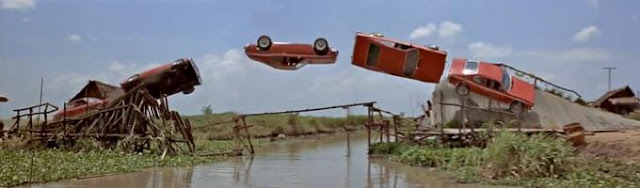
Still, when it leans into the ridiculousness it gets it right. The best part of the film is probably the chase sequence where Bond contrivedly bumps into the yokel sheriff from Live and Let Die, who accompanies him on an extended chase sequence that culminates in Bond's car doing a corkscrew jump across a river and Scaramanga converting his car into an airplane in a secret hangar. Why is the sheriff guy in the movie? I don't know but I came to love it.


Really, its biggest fault is the waste of its villain and its title character. Scaramanga is played by Christopher Lee, and Christopher Lee ought to play a delectable Bond villain... but why cast someone with such an amazing voice and then have him barely speak? Scaramanga is a silent thug for most of the film, and when he finally does get some good dialogue sequences, it's too little, too late.

Other Notes:

  • This film introduces an MI6 agent named Mary Goodnight. (This is the name of Bond's secretary in the books, but she's never appeared before in the films, what she does usually being merged into Moneypenny.) The film never seems to be able to decide if she's a competent agent or, you know, a woman. She gets trapped in a car trunk trying to bug it; she accidentally triggers the self-destruct of the solar energy facility; she almost kills Bond by bumping a switch with her butt. The Roger Moore films would do somewhat better with women agents in The Spy Who Loved Me and (especially) For Your Eyes Only.
  • Other genius moments:
    • Bond tries to get a golden bullet turned into a piece of jewelry out of a woman's navel with his teeth, and inadvertently swallows it, meaning the scene ends with him rushing off to the pharmacy. Can't believe they never got Daniel Craig to do something like that!
    • Bond is about to sleep with Mary Goodnight when Scaramanga's girlfriend turns up, and Bond needs to sleep with her to get information. So first Goodnight has to pretend to be pillows under the sheets, and then Goodnight must hide in a cupboard for hours while Bond and the woman have sex!
    • MI6 turns the wreck of the Queen Elizabeth liner in Hong Kong harbor into a base, so a bunch of scenes take place on an askew ship.
    • For reasons that aren't clear, Bond is at one point dropped into a martial arts school by the villains. What does work is a sequence where two schoolgirls beat up all the martial artists while Bond mostly just stands there.
  • There is a lot of delightful technical nonsense about the solar energy facility that we got a big kick out of.
  • Apparently Lee was suggested by Ian Fleming as a candidate to play the villain in Dr. No. How good would that have been!
 Film Rankings (So Far):
  1. Casino Royale
  2. Dr. No
  3. From Russia with Love
  4. For Your Eyes Only 
  5. On Her Majesty's Secret Service
  6. Thunderball 
  7. The Living Daylights
  8. Spectre
  9. You Only Live Twice
  10. Goldfinger
  11. The Spy Who Loved Me
  12. Moonraker
  13. The Man with the Golden Gun
  14. Octopussy
  15. Never Say Never Again
  16. A View to a Kill
  17. Live and Let Die 
  18. Diamonds Are Forever

03 December 2021

2021 Hugo Awards for Best Dramatic Presentation Ballots

Best Dramatic Presentation is technically two categories, but I will write up both Long Form and Short Form in a single post.

Things I Nominated

I nominated one thing in each category this year. I decided to nominate a Big Finish audio drama, so I looked back over the 2020 releases that I had actually listened to in 2020 (I range from a little behind to a lot behind with my Big Finish at the best of times) and ended up picking Torchwood Soho: Parasite, which covers shenanigans at Torchwood in the 1950s, fronted by the delightful Norton Folgate, and also featuring good old PC Andy, plucked out of time. (As it's six half-hour episodes, I nominated it under long form.) My guess is that no Big Finish release will ever be a Hugo finalist, though; even if there are a lot of Hugo nominators listening to Big Finish (which I doubt), they put out so much content, it's hard to imagine any single release getting enough nominations to make the ballot.

The only 2020 tv I watched during 2020 was Doctor Who series 12, Star Trek: Picard season 1, (some of) Star Trek: Lower Decks season 1, and (some of) Star Trek: Discovery season 3. I didn't like Picard season 1 or Discovery season 3 much, and none of the episodes of Lower Decks that I saw in time spoke much to me. (I could see myself nominating "Crisis Point," but I got to it too late.)

So I ended up nominating what I thought was a pretty decent episode of a pretty dull series of Doctor Who, "Can You Hear Me?", which was probably the only episode both trying to do something interesting and almost pulling it off. It did not make the ballot, however, though a different episode did, and that one wasn't bad either.


6. The Old Guard, directed by Gina Prince-Bythewood, written by Greg Rucka

This movie is about a group of four immortals who get in a lot of fight scenes. I fell asleep about halfway through; I don't think this is entirely the film's fault (I was very tired) but what is the film's fault is that I was at no point motivated to resume watching it.

5. Birds of Prey and the Fantabulous Emancipation of One Harley Quinn, directed by Cathy Yan, written by Christina Hodson

This wasn't very to my taste. I love the Birds of Prey comics, but this isn't really a Birds of Prey film, it's a Harley Quinn film... though as my wife pointed out, it's probably the most enjoyable a Harley Quinn film could be. I did laugh couple times. I liked the performances of the actors playing both Black Canary and Huntress, so maybe I will like them better in some other, Harley-free, film. Plus... this isn't really sf&f, is it? One scene of Dinah using her sonic scream doesn't really count.

4. Tenet, written and directed by Christopher Nolan

At first, this felt to me like Nolan's take on James Bond, plus some sf elements. Our protagonist travels to exotic locations, each with a suitable set piece; what stopped it from being fully Bondian is that Bond would have slept with Elizabeth Debicki's character. The central idea is pretty neat, and the story does some cool stuff with it; by the climax, though, I will admit that I was confused. Robert Pattinson was a delightful surprise, and I also thought Debicki and Kenneth Branagh did great work. It felt to me like something Steven Moffat would have done... but once I realized that, I also realized that he would have put in more jokes! And of course I have to take points off for that. This movie takes itself very seriously... and also I'm not really sure what it was about beyond the sfnal idea; it's very sterile.

3. Soul; directed by Peter Docter; written by Peter Docter, Mike Jones, and Kemp Powers 

I feel like I always understimate Pixar. I'm like, "oh yeah they're pretty good movies," but then I watch a Pixar film and realize they always have a heft and a design sense to them that is pretty much unparalleled in contemporary animation. Things here move and live and breathe and shine. I enjoyed this a lot. I think it's not groundbreaking (it's very It's a Wonderful Life, isn't it?) but I don't know that that matters: good jokes, good performances, good score by Reznor and Ross, and great visuals. I particularly loved the way the afterlife creatures moved through the real world, and the climax with Joe and 22 plunging to Earth was glorious.

2. Palm Springs, directed by Max Barbakow, written by Andy Siara

I would have vacillated a lot on where to place this, but I watched it the day ballots were due, so I didn't have the time to dither a whole lot. Give me twenty-four hours to reflect and I might have placed it on top, who knows. This is a time loop film; I must be a sucker for these things, because in 2020 and 2018, I gave top spots to a time loop story. The time loop is a genre of its own these days, and we're surely in its decadent phase (as Joanna Russ would say) and all the better for it. This is a comedy that opens with a guy already trapped in the time loop for so long he can't remember; he inadvertently brings a woman into it alongside him. You'll know some beats from other time loop stories, but it's very original in other ways and has a good emotional core. Some great laughs, but also some really strong, thoughtful character stuff.

1. Eurovision Song Contest: The Story of Fire Saga, directed by David Dobkin, written by Will Ferrell & Andrew Steele

I really debated on where to place this. It's about an Icelandic duo with middling talent trying to make it in Eurovision; Will Ferrell and Rachel McAdams feature, and Pierce Brosnan plays Will Ferrell's dad. They have to overcome parental doubt, evil bankers, and Dan Stevens's obviously gay Russian in order to persevere and fulfill their childhood dreams. I had a blast watching this: it has fun music and a keen sense of the ridiculous that plays straight into my sensibilities. You have to take this movie intensely seriously and not at all seriously at the same time. I laughed a lot. But, you know, the sfnal content probably amounts to about 120 seconds of run time! Is it consistent of me to ding Birds of Prey but place this so high? So I was prepared to place it below Soul; Soul would be meaningless without its sf&fnal conceit, but Story of Fire Saga would honestly work just fine. But then I was like, "what would I be more excited to see win?" And it's not like Pixar films lack for acclaim. And though I think Soul is good, this was a blast. So here it is.


6. The Expanse 5x04: "Gaugamela", written by Dan Nowak, directed by Nick Gomez

I have stalled out somewhere back in season 3 of The Expanse, but I have read all the books, and this one is adapted from book five, Nemesis Games, so I had enough context to follow. In isolation, though, it comes across as one of those episodes that's more noteworthy for what happens than how. Big events, but outside of that, there was little that grabbed me here other than the chance to see one of my less-favorite books in one of my favorite series on screen.

5. Star Wars: The Mandalorian, chapter 13: "The Jedi", written and directed by Dave Filoni

I am sure this is quite exciting if you've been following both The Mandalorian in particular and Star Wars on tv more broadly: we learn key information about baby Yoda, and a character from the Clone Wars cartoon appeares in live action. I've been doing none of these things, so it's all kind of wasted on me. Still, it works well enough as a piece of standalone tv, just without the bigger emotional/dramatic hook one might want. I do quite like Ludwig Göransson's score.

4. She-Ra and the Princesses of Power 5x12/13: "Heart", written by Josie Campbell and Noelle Stevenson, directed by Jen Bennett and Kiki Manrique

This is the series finale to a five-season show. It seems like the kind of show I would like very much, along the lines of some of the favorites of my youth (and adulthood): big battles of good and evil, colorful characters, angsty side-switching, epic confrontations. But watching the series finale on its own is difficult to appreciate. I feel as though I am watching something that could be quite interesting, but I don't have the ability to appreciate it.

3. Star Wars: The Mandalorian, chapter 16: "The Rescue", written by Jon Favreau, directed by Peyton Reed

Despite this being only my third episode of The Mandalorian, I was quickly able to grasp the mechanics of what was going on here and why I should care. Despite me knowing what the big surprise was going to be, I still got chills. I did have to pause at one point and look up who all the returning characters were at the beginning, but on the other hand, the emotion of the ending succeeded entirely on its own terms. Maybe someday I will watch this show, but I have been enjoying these dribs and drabs of it.

2. Doctor Who 12x05: "Fugitive of the Judoon", written by Vinay Patel and Chris Chibnall, directed by Nida Manzoor

This wasn't the episode I nominated, but it was one of the better episodes of series 12 of Doctor Who, with some dramatic reveals, cracking direction, and sharp scenes featuring Jodie Whittaker's Doctor and the mysterious Ruth. (What brings it down for me are the weirdly shot and pointless scenes with Captain Jack; one assumes they couldn't get Barrowman on the same day as any of the rest of the cast.) This has an impact, but it's also an enjoyable and entertaining episode on top of that.

1. The Good Place: The Final Chapter: "Whenever You're Ready", written and directed by Michael Schur

At last our long national nightmare is over. In honor of that, I give The Good Place my vote.

In all seriousness... I really liked this? My only previous episodes of The Good Place have been those five nominated as Hugo finalists, which long-time readers know I have found more miss than hit, but this seemed to me—based on that weird sampling anyway—to be a charming, effective, and occasionally moving finale. All the characters get good final moments... plus lots of great jokes (of course I was a sucker for the Radiolab one) and a cameo from Nick Offerman playing Nick Offerman teaching someone how to make a chair. This gave me the purest enjoyment of anything on this list.


Overall Thoughts

Long Form was a more interesting category than usual this year; I suspect this is down to the pandemic delaying any blockbuster originally scheduled for March 2020 or later to 2021. No Marvel movies; the closest we get to a big franchise film is Birds of Prey. This allows for some more offbeat stuff to rise to the top, which is one of the things I like about this category. Seems unlike I ever would have even heard of Palm Springs without the Hugos, much less seen it.

Short Form is tougher than normal. It usually has a few things that work reasonably well as standalones, but this year literally every finalist is a pivotal moment in an ongoing story! This makes them hard to assess as an outsider; I feel like if I'd seen any other She-Ra, for example, I might have ranked "Heart" at the top, but I'll never know. I am loathe to add more Hugo categories, but I do wonder if Short Form and Long Form need to be split yet again: I don't know what I would call the categories, but with spans of something like 0-90 minutes, 90-180, and 180+, so you get individual episodes, films, and seasons each evaluated on their own terms. Though, if all of these seasons make it into the 180+ category, will there be anything left for the 0-90 one given how serialized televised sf&f is at the moment?

I feel fairly comfortable in saying that The Good Place will take home its fourth and final Hugo. The long-form category is much less obvious to me. None of them strike me as having the "it factor" that will win over (after a number of rounds) the majority of Hugo voters. I don't think it will be The Story of Fire Saga—too weird—nor Tenet—not good enough—nor Birds of Prey—too over-the-top—nor Old Guard—too boring—nor Palm Springs—too comedic. Which I guess means Soul? Pixar films have won twice before, The Incredibles and WALL-E, though both of those seem closer to the sf fan's sensibilities. So who knows.

I might be unsure about this year, but I will go out on a limb and tell you right now that the 2022 Hugo Award for Best Dramatic Presentation (Long Form) is going to go to Dune.