Showing posts with label creator: w. w. denslow. Show all posts

10 July 2026

Reading Issue #3 of Oz-story Aloud to My Kids

As previously discussed here on this blog, I've been rereading some of the early L. Frank Baum Oz books aloud to my kids. So far, we've done The Wonderful Wizard of Oz and Marvelous Land. But in between these, we've been working in some later "apocryphal" Oz books based on when they take place. So, for example, we read Donald Abbott's Speckled Rose between the first two because that's when it's set. In between Marvelous Land and Ozma, we read issue #3 of Oz-story Magazine because it contains the story "Ozma Sees Herself" by Edward Einhorn, which is set during that span; I also read the kids a couple other stories from the book I thought they would be interested in, and then read the rest of the book to myself.

Oz-story Magazine, Number Three
edited by David Maxine
 with Eric Shanower

Anthology published: 1997
Contents originally published: 1901-97
Acquired: May 
2026
Read: May–July 2026

"Ozma Sees Herself" is set shortly after Marvelous Land, and concerns something L. Frank Baum himself was resolutely uninterested in: the psychological ramifications of Tip's transformation back into Ozma. It's pretty short, but like all of Einhorn's Oz work, well done. It also introduces Ozma to the Hungry Tiger; I was a bit surprised that Einhorn had the Tiger and the Cowardly Lion know each other from before Dorothy met the Lion, because I personally am a fan of the interpretation that the Tiger we see in Wonderful Wizard when the animals beg the Lion to kill the giant spider is the Hungry Tiger. But that's a quibble: the idea that Ozma sees a beautiful nymph and comes to recognize it as herself is a clever one.

The book also contains three installments from W. W. Denslow's newspaper strip that featured the Scarecrow and the Tin Woodman. (Denslow and Baum shared copyright on the first book, and each made their own attempts to capitalize on the success of the stageplay adaptation of it; for Baum, that was Marvelous Land and its own stageplay adaptation, while for Denslow, it was a series of short stories he wrote and illustrated himself.) Denslow is an amazing illustrator, of course, but his writing does not really hit the tone of an Oz story. His work actually reminds me a lot of the next Oz-illustrator-turned-writer, John R. Neill—basically anything can happen if it gives Denslow an excuse to draw something interesting. For example, in these stories, the Scarecrow and the Tin Woodman can casually travel to America! Overall, they're pretty harmless and forgettable. If you care about timelines, they probably take place between Wonderful Wizard and Marvelous Land, except for the first one, which includes Dorothy. This is about her being sad because it's Christmas and she's away from her family; my understanding is that Oz timeline aficionados place it during Wonderful Wizard, in the segment after the Wizard has left Oz in his balloon, before the characters get the idea to go see Glinda for help. (Hungry Tiger Press later collected all of Denslow's stories in a book called The Scarecrow and the Tin-Man of Oz, which I own but have not read. Maybe someday I'll read it to the kids.)

This volume didn't contain as much kid-friendly material as some other installments of Oz-story; the only other thing I read aloud to the kids was "Spots in Oz" by Rachel Cosgrove Payes, which features the leopard with changing spots named Spots from The Hidden Valley of Oz. It was two years ago that we read this book, and it is honestly pretty forgettable, so Kid One has only a vague memory of Spots, and Kid Two doesn't know it at all. This story isn't much cop either, but it's fine. It also features the Hungry Tiger, so that lined up nicely with "Ozma Sees Herself" and our imminent rereading of Ozma of Oz.

There's some original comics material here, all written by Eric Shanower, with various illustrators (including himself); I particularly enjoyed "Poppies," a one-page conversation between Ozma and Dorothy about the poppies Ozma wears in her hair, with beautiful artwork by Ramona Fradon.

In terms of prose, ones I read to myself included "Buffalo Dream" by Jane Mailander, which was a reprint from an anthology of original sf&f. This is about a strange thing that happened to Oscar Diggs—the man later known as the Wizard—during his time as an itinerant circus performer in Nebraska. It's very different from an Oz story, but I really enjoyed it: a melancholy story about the last of the buffalo, told in the first person. "It was very long ago... and far stranger things have since happened to me." Reading it in this context, it's immediately obvious who the main character is, but it would have been fun to encounter it in the wild. 

There are a couple Baum reprints; the one of "The Glass Dog" from Animal Fairy Tales is fine. This issue's full-length novel is his The Flying Girl, originally published under the pseudonym Edith Van Dyne in 1911. The novel is about a brother and sister; she's seventeen and working as a secretary to help the family make ends meet, he's a recent engineering grad from Cornell who can only find employment in an automobile repair shop, but soon gets swept up in the mania for flying. He develops his own airplane, and the two must navigate the skullduggery of potential investors to support their invention... as you might guess from the title, she ends up being the one to fly it!

I found it a quick and charming read. I was surprised by some of the turns some of the characters take; Baum actually does a decent job avoiding what initially seem like some obvious directions. While Baum's main talent was surely in his fantasies, he was able to turn his hand to other genres quite successfully. In fact, though, I would say the book is clearly science fiction! It is about a new technology, one that's not real at the time the story was written, and the ramifications of it. If this isn't sf, then I don't know what it. 

I should also point out that while there is some surprise at the idea of a "flying girl," there no resistance. I bet if someone remade this book now, there'd be a bunch of misogynists going, "NO FE-MALE IS SUITABLE FOR FLYING!" In fact, we get the exact opposite from one of the characters: "The most successful aviators of the future... are bound to be women. As a rule they are lighter than men, more supple and active, quick of perception and less liable to lose their heads in emergencies. The operation of an aeroplane is, it seems to me, especially fitted to women."

Though, the same character goes on to make this prediction: "The airship of the future will not be a passenger affair... but an individual machine for personal use. They’ll be cheaper than automobiles, and more useful, for they can go direct to their destination in a straight 'airline.' Men will use them to go to business, women to visit town on shopping expeditions or to take an airing for pleasure; but I’m sure they will be built for but one person." Whoops!

Two other things of note. First, there's some discussion of mental illness and domestic abuse that really does not past muster in 2026, and made me very glad I did not elect to read the book aloud to my kids:

"He says that—that you abused his sister," doubtfully remarked the girl.
     "Well, I did," said Cumberford, calmly. "I pounded her two or three times. Once I choked her until it’s a wonder she ever revived."
     "Oh, how dreadful!" exclaimed Orissa, shrinking back.
     "Isn’t it?" he agreed, lighting a cigarette. "Only a brute would lift his hand against a woman. But Burthon's sister—my wife—had a fiendish temper, and her tantrums aroused all the evil in my nature—there's plenty there, I assure you. It was the time I choked her that Burthon had me arrested for cruelty. She had put poison in my coffee and I took the fluid into court with me. Burthon said I was lying and I asked him to drink the coffee to establish his sister’s innocence. But he wouldn’t. Pity, wasn’t it? The judge begged my pardon and said I ought to have choked her a moment longer. But no; I’m glad I didn’t, for she died naturally in the end. My dear daughter, whom I sincerely love, is like her lamented mother, except that I can trust her not to poison me."

Egads, I don't even know what to say about all that.

On the other hand, the "daughter" referred to in that passage, Sybil, very much reads as autistic to my 2026 eyes. Here's her first appearance:

As they went up the path Orissa, anxious to be sociable and to put the stranger at her ease, said brightly: "Don't you think the ride out here is beautiful?"
     "Yes," responded Sybil.
     "The orange groves are so attractive, just now," continued Orissa.
     There was no response.
     "I hope you enjoyed it, so you will be tempted to come again," resumed the little hostess.
     Miss Cumberford said nothing. Her father, a step in advance, remarked over his shoulder: "My daughter seldom wastes words. If you wish her to speak you must address to her a direct question; then she will answer it or not, as she pleases. It's her way, and you'll have to overlook it."

As the father of an autistic kid, this could be describing their approach to social interaction to a T!

Anyway, I was pretty into this. The sequel, The Flying Girl and Her Chum, was reprinted on its own by Hungry Tiger Press, so I'll probably end up picking it up at some point. (I gather the first book had minimal illustrations; it's been reillustrated here by Eric Shanower.) 

22 May 2026

(re)Reading The Wonderful Wizard of Oz Aloud to My Kids

As I have been reading all these apocryphal Oz books aloud to my kids, my wife keeps commenting that instead of reading them all these mediocre latter-day books, what I really ought to be doing is rereading some of the original ones. Kid Two, after all, was not even born yet when I read the original Baum novels, and even for Kid One, it was so long ago, they barely remember them. I felt like this had some merit—do I really want someone to remember, say, The Patchwork Bride of Oz moreso than Patchwork Girl?

I've been picking the apocryphal Oz books at random from a list I assembled; most recently, that lead me to The Speckled Rose of Oz by Donald Abbott, which takes place during the gap between Wonderful Wizard and Marvelous Land, when the Scarecrow rules the Emerald City. Well, this seemed like a clear enough reason to go back at last: reading a book set in a gap neither of my children recollected seemed pretty pointless! So I decided we'd reread Wonderful Wizard, then do Speckled Rose, then continue on into Marvelous Land.

Even though Kid One had Wonderful Wizard read aloud to them five years ago, they are still fairly familiar with its contents: they've heard the audiobook a couple times, read the Shanower/Young adaptation at least twice, and seen the MGM film. And Kid Two has seen the MGM film as well.

The Wonderful Wizard of Oz by L. Frank Baum
illustrated by W. W. Denslow

Originally published: 1900
Acquired: January 2011
Previously read: umpteen times
Read aloud: 
March–April 2026
It was well worth rereading. First off, it's just very good. The book has been often imitated, even (especially?) by Baum himself, but rarely bettered. Maybe it's the nostalgia, but I think the book has a sort of joy and a pleasure in it that has very rarely been captured by other Oz books. The Scarecrow, the Tin Woodman, the Cowardly Lion are all at the most themselves: each possessing a singular virtue that they don't believe themselves to possess. Oz itself is a land of wonders and marvels, full of unknown dangers and extraordinary beauties. The characters' problem-solving skills are at their most important, because the landscape they move through is full of mysteries, and there are no convenient Magic Belts or wishing pills that can save them. To a degree, anything can happen. But also problems can be solved through the rational application of thought; I think Baum very much gets the pleasure of what China MiĆ©ville calls "rationalized alienation": this world works different from ours, but you can figure it out. Things don't differ arbitrarily; if you accept his starting premises of how a living scarecrow or man of tin would work, then what follows on them those ideas makes sense. So there is pleasure to, say, the Scarecrow and company working out how to get the Cowardly Lion out of the deadly poppy field. And this would be hard to get back to in a later book, where these characters are all "celebrities" and have very powerful friends.

Partially, though, I don't think the other books ever could capture what made this one work so well. I am thinking of what Brian W. Aldiss says in The Trillion Year Spree about the difference between the original Dune and its sequels, a difference he said was "perhaps true of most series novels in SF. The first novel derives much of its power from our delight in and discovery of a new environment. The pleasure of future volumes is different in kind. Familiarity and complexity replace the higher satisfaction of revelation" (398).

It was also worth doing because of the increased age of the kids. Unlike on previous reads, I think they got that the Scarecrow, Tin Woodman, and Cowardly Lion are intelligent, kind, and brave even before they see the Wizard... though also Kid One insisted that the Wizard must not be a humbug because he did give the threesome what they wanted, so I don't think they totally got how (at least as I think the first book makes clear, though later ones seemingly walked this back a bit) the gifts were nothing more than placebos. What Kid One did grok on this reading was the fact that much of what appears in the Emerald City is not actually green, and that the Wizard is just tricking everyone through the use of the green spectacles.

And of course the illustrations of this one are so good. We usually read a chapter or two before bedtime, and the kids listen in their beds, with me coming to show them any pictures. But the original book (which we of course read in its Books of Wonder facsimile edition) has pictures on almost every page, so I let the kids sit next to me as I read it. 

It was interesting reading the book shortly after the two Ages of Oz books by Gabriel Gale and Lisa Fiedler. Those are prequels to the original series, so I could see some of the connections a bit better... though also the account given by the Winged Monkeys of their history does not agree with what Gale and Fiedler added in in their books!

27 August 2021

Reading The Wizard of Oz Aloud to My Son

Published: 2000
Annotated edition originally published: 1973
Acquired: November 2011
Previously read: April 2013
Read aloud: July 2021

The Annotated Wizard of Oz: Centennial Edition
by L. Frank Baum, pictures by W. W. Denslow, annotated by Michael Patrick Hearn

My eldest son has long been interested in The Wizard of Oz; one of the books a friend gave us when he was born was the improbably titled Little Master Baum: The Wonderful Wizard of Oz: A Colors Primer: A BabyLit Book, which rearranges the story into a set of color-coded two-page spreads of objects. At some point—I don't remember how these days—he discovered my actual copy of The Wonderful Wizard of Oz and I must have "read" it to him a million time by just summarizing the story with reference to the pictures. (I have a nice Books of Wonder facsimile edition of the original 1900 edition.) He was into it enough that my mother bought him a set of Wizard of Oz dolls for Christmas. I began to wonder if he might want to read the actual novel, word by word, but an article I read suggested age 3 was more likely. As we neared his third birthday, I realized he was sitting through whole issues of My Little Pony in one sitting (something he hadn't been able to do a couple months prior), and he was also down for some long, text-dense picture books. So I offered to read him the whole thing in its entirety and he agreed.

At first I think he was a bit baffled—Dorothy used to get out of Kansas in thirty seconds, now it took ten minutes!—but he quickly became an enthusiastic devotee. We would do one chapter a day, often two or more, though I quickly worked out that more than two chapters in one sitting was not compatible with his attention span. Knowing the outline of the whole story from having read it in summary form before definitely helped him keep track of things, and fit with the advice that article gave me.

It's a fun book to read aloud, with lots of room for good voices. For Dorothy I just used my normal voice. For the Munchkins and Emerald City residents, I did my normal voice, but pitched upward at the end of sentences; I matched this with the Scarecrow but made it a bit hoarse. I was surprised by how the Tin Woodman ended up with an English accent, but it seemed to fit the character perfectly. The Cowardly Lion was of course very deep. One criticism people lob at the book is that it's episodic, but when you are reading it out loud a chapter at a time, that kind of thing doesn't really register—the Dainty China Country's is today's episode, rather than an irrelevant diversion. (Though I suspect it's one he won't really remember.)

On this reread—who knows how many times I've read it now—I was struck by how the Scarecrow, Tin Woodman, and Cowardly Lion already possess their desire qualities before they are gifted by the Wizard (something lost from the MGM film): the Scarecrow comes up with the best plans, the Woodman always acts with compassion, the Lion is always brave. But also that they actually kind of lose them once they receive them; they are kind of stupid and uncompassionate when visiting the Dainty China Country, and the Lion's means of killing the giant spider isn't exactly an act of bravery. I'm curious to see how this plays out going forward.

The novel's violence was also interesting, and somewhat jarring compared to modern children's literature sensibilities. But surely a child of 1900 would have much more contact with death than my own son—and the book is always so matter of fact about it that it cannot disturb.

I couldn't find my Books of Wonder facsimile, so I had to read him my Norton annotated edition. This has the complete text and illustrations, though the color plates are all in one spot, so every chapter we had to check there for any relevant pictures. The main problem it represented is that I would often get distracted from reading aloud by reading footnotes!

When I was in high school, I babysat a couple of kids—I think they would have been around six and seven at the time?—and at the suggestion my English teacher, I read them the Harry Potter books aloud, a chapter at a time. I think the first three were out when we started, and the fourth came out while I was babysitting them still. They loved it, and I loved it, and ever since them I've wanted to read something aloud to my own children someday. I am glad to finally have the opportunity. He's liked it enough that at the time I write this we've already plowed on through Marvelous Land and we are a few chapters away from finishing Ozma of Oz. Baum's original fourteen or fifteen will keep us some time... and then I guess there's always the rest of the Famous Forty!

30 January 2018

Return to Oz: The Wonderful Wizard of Oz by L. Frank Baum and W. W. Denslow

Hardcover, 267 pages
Published 1987 (originally
1900)
Acquired January 2011

Reread December 2016
The Wonderful Wizard of Oz by L. Frank Baum
pictures by W. W. Denslow

I've been an Oz fan as long as I can remember, but the copy of the first book I had as a kid was kind of rubbish. A 1958 edition from Scholastic, it had new illustrations by Paul Granger obviously designed to remind you of the MGM film versions of the characters-- and even leaving that aside, they weren't very good. So after reading about it (Michael O. Riley discusses it in Oz and Beyond) and hearing about (Anne Philips presented on it at a conference I attended), I knew I needed to pick up a facsimile of the original book, and thankfully I found this 1987 Books of Wonder edition a few years later.

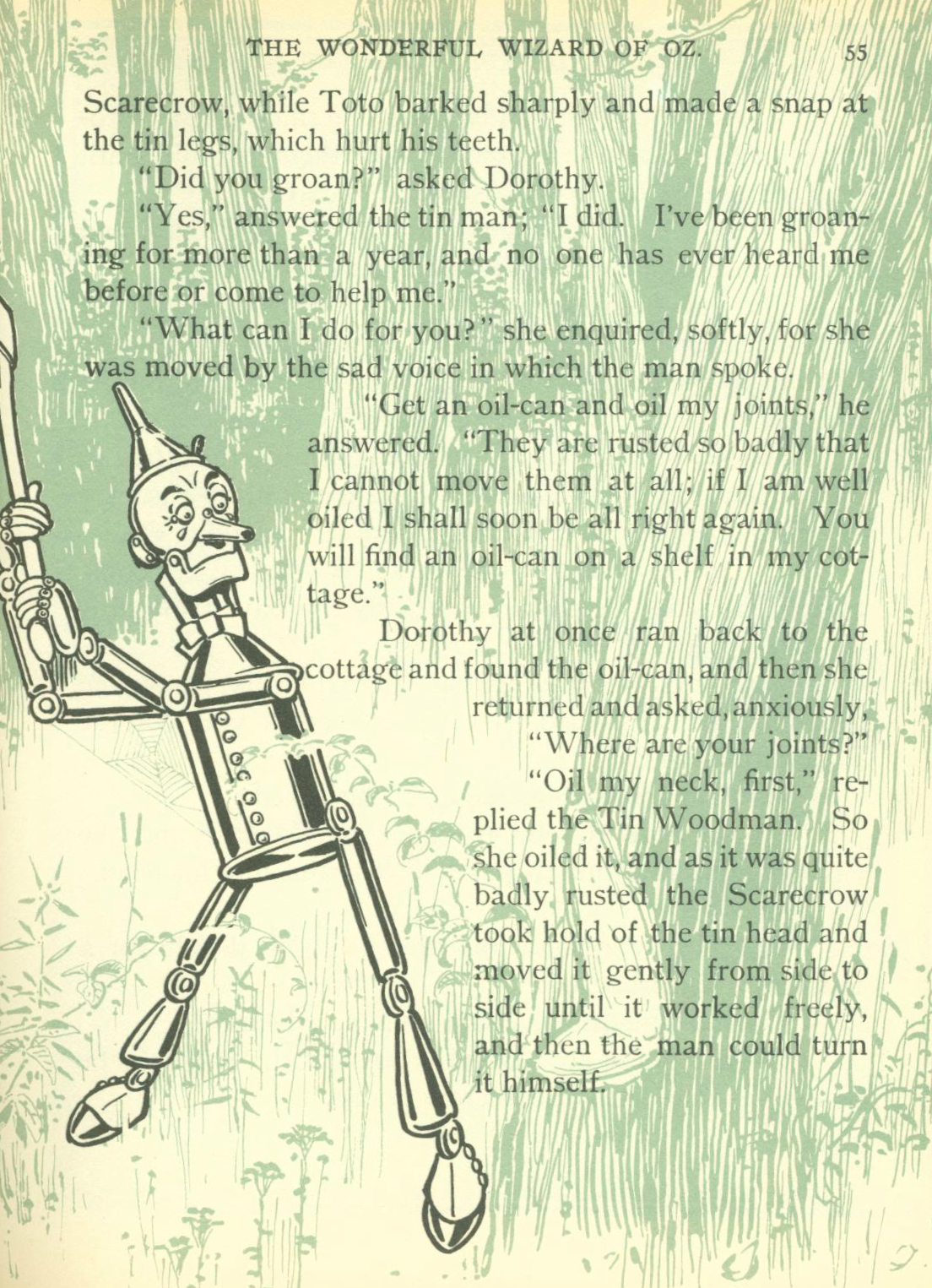
The original book is as much W. W. Denslow's as it is L. Frank Baum's I would argue (and indeed, Denslow and Baum split the copyright, whereas Baum was the sole owner of the later novels illustrated by John R. Neill). The original is an very visual experience. Far from just having pictures occasionally opposite or next to the text like my old Scholastic edition, in the original Denslow's pictures interact with the text. Take for example this illustration from when Dorothy and the Scarecrow find the Tin Woodman in the forest:
Baum & Denslow (1900), p. 55

As you can see, the Munchkin forest doesn't just surround the Tin Man, but it also surrounds the very words of the story itself-- the story is in the woods as much as the characters are. Like a lot of Oz books, the book features both a number of color plates and also black-and-white illustrations on the text pages, but uniquely, the black-and-white illustrations almost all have some kind of color accent. This color shifts throughout the story. You get the dark green above when the characters are in the Munchkin Country (I'm not sure why it's not in blue, though). This becomes light green in and near the environs of the Emerald City:
Baum & Denslow (1900), p. 116

Earlier in the book, in Kansas, a dismal brown was the accent color:
Baum & Denslow (1900), p. 5

And, appropriately, it keeps changing as the novel goes on: a sort of dark yellow as they travel into the Land of the Winkies, brown for the forests of south Oz, and orange-red in the Quadling Country (this color is also used during the poppy field incident). It's a cool touch, and one that as far as I know, the Oz books never made use of again. But this was a lavish edition, intended for gifting, and Denslow's star was arguably bigger than Baum's at the time.

The color plates are great, too. This one of the Cowardly Lion to dinner at a random house on the road is pretty nice, for example:
Baum & Denslow (1900), opp. p. 114

And the green wash Denslow covers the illustrations from the Emerald City chapters with nicely reproduces the effect of the green glasses everyone wears in the book:
Baum & Denslow (1900), opp. p. 196

Denslow's style works to keep Oz safe. As I've discussed before, Baum occasionally describes horrific violence: a lot of creatures fall victim to the Tin Man's axe, and a pair of Kalidahs-- themselves described as "monstrous" (79)-- are even "dashed to pieces" on rocks at the bottom of a chasm (81). Or there's the story the Tin Woodman tells of his own mutilation. But, Denslow never renders this violence directly. The plunging Kalidahs are almost comic:
Baum & Denslow (1900), opp. p. 80

And this is all the illustration we get of the Tin Man killing an army of forty wolves in a nighttime battle:
Baum & Denslow (1900), p. 142

I also like Denslow's cartoony, round-headed people. Almost everyone looks like a little kid in Oz, which seems appropriate. Glinda might be a young woman, but she's one of the only human beings in the book who is actually taller than Dorothy:
Baum & Denslow (1900), p. 253

The witches end up being the only characters with, well, stature, which seems appropriate for the way their capabilities tower across the plot of this novel. I know this draws on the way the Oz characters are described in the text of Wonderful Wizard, but I don't think Baum and Neill maintained these height distinctions in the later Oz novels, and I assume it was one of the inspirations behind casting people with dwarfism as the Munchkins in the MGM film. (Though, why are the Scarecrow and the Tin Man as tall as average human beings when they're both modeled on Munchkin men?)

Each chapter even gets both an illustration with its first word (as with the opening to Chapter XXIII immediately above) and a cool title page of its own, setting the atmosphere for the chapter ahead, like this one:
Baum & Denslow (1900), p. 85

In short, Baum's original text has always been great, but pair it with Denslow's illustrations, and you have a journey into the fantastic that no one will ever be able to surpass. This is the definitive version of The Wizard of Oz and all others pale in comparison.

Next Week: I resume an old reading project, The New Doctor Who Adventures, picking up with the Doctor vs. Hitler in Timewyrm: Exodus!

15 October 2013

Review: The Annotated Wizard of Oz: Centennial Edition

Hardcover, 396 pages
Published 2000 (originally 1973)

Acquired November 2011
Read April 2013
The Annotated Wizard of Oz: Centennial Edition
by L. Frank Baum
edited by Michael Patrick Hearn

Though it's not my favorite Oz book, The Wonderful Wizard of Oz is a brilliant start to a brilliant series. Hearn's annotated edition is a thing of beauty, not to mention highly informative.