Showing posts with label subseries: green lantern. Show all posts

24 June 2026

Alan Scott: The Green Lantern by Tim Sheridan, Cian Tormey, et al.

Alan Scott: The Green Lantern

Collection published: 2024
Contents originally published: 2023-24
Acquired: January 2026
Read: February 2026
Writer: Tim Sheridan
Penciller: Cian Tormey
Inkers: Cian Tormey, Jordi Tarragona, Raúl Fernandez, John Livesay
Colorists: Matt Herms, Chris Sotomayor
Letterer: Lucas Gattoni

Part of the whole point of my long, long comics reading projects like this one is to see how a concept changes over time as the world changes around it. When the Justice Society originally debuted, it was of course set in the present; it was set during World War II because WWII was happening. When the JSA was revived in the 1960s and '70s, it became a vestige of the past: the debuts of the JSA heroes were kept rooted in WWII. This meant the JSA heroes could age and grow, unlike the new heroes of the Silver Age, who would always have their origins updated as time marched on. Roy Thomas exploited this to good effect in the 1980s, giving us both JSA as period piece (in All-Star Squadron; see item #3 in the list below) and JSA as a saga that had evolved in a way the JLA never could (in Infinity, Inc.; see items #4, 5, and 10). But as time went on, this became—if you were literal-minded—increasingly untenable. The JSA went from being the generation before the JLA to two generations before to even more. By the 2010s, did it make any sense that people who'd fought in World War II could still be active superheroes?

This is one of the reasons, I suspect, that in the "New 52," DC totally retooled the JSA, setting the series in the present but on an alternate Earth. They took the opportunity to update many of the characters; in particular relevance to this post, they made Alan Scott, the original Green Lantern, into a gay man. Later, this updating of the JSA got undone. I don't know the details of this (I largely stopped reading DC Comics after Convergence), but the JSA is back on the same Earth as the JLA and back to originating during World War II. But DC did not undo changes like making Alan Scott gay, so now the original Green Lantern was a gay man during a time where society was much less accepting of homosexuality. My understanding is that this was tackled briefly in a couple one-shots I haven't read yet, but the first full exploration of this is in Alan Scott: The Green Lantern, one of three "Dawn of DC" miniseries focusing on JSA members (see also #55 below). Framed by Alan talking to his son Todd (himself gay), the story delves into Alan's origin, but also the tale of his first love, including a stay in an asylum where Alan is subjected to conversion therapy.

We're here, we're queer?
from Alan Scott: The Green Lantern #6 (art by Cian Tormey)
Overall, I found this really effectively done; I don't know if writer Tim Sheridan is gay, but the details of what it would be like for Alan in this time overall rang true to me. The conversion therapy stuff is harrowing, the emphasis on learning to live as you are works well. I don't know if I like the idea the whole JSA was immediately accepting of Alan (seems anachronistic), but I suppose DC would never want to tackle making some of its heroes homophobic in a mainstream book in the 2020s. I found Cian Tormey's art strong overall, and the story has some good twists and turns. Although... why are the bad guys in this World War II story Russians, given they were our allies? Not that Russians couldn't have been up to some skulduggery, but literally no one even comments on the fact that they're supposed to all be on the same side! Not quite as strong as the nostalgic glow I got from Wesley Dodds: The Sandman, but it still shows off the strength and continuing relevance of these characters.

This post is the fifty-sixth in an improbably long series about the Justice Society and Earth-Two. The next installment covers Jay Garrick: The Flash. Previous installments are listed below:

16 June 2025

Showcase Presents Wildcat by Eddie Berganza, Nick Gnazzo, and Ray Kryssing / Green Lantern / The Flash: Faster Friends by Ron Marz, Val Semeiks, Chip Wallace, et al.

From June 2020 to December 2023, I chronicled the history of the Justice Society in fifty installments. And then, at last, I was done!

Or was I? The nature of these projects I undertake is you can always discover there was some relevant comic you didn't know about at the time. Such was the case when a friendly commenter named Drew popped up to tell me that, after I'd bemoaned Geoff Johns forgetting about the brother of Yolanda "Wildcat" Montez, the character made an appearance in an issue of Showcase '94. Well, it looks like I have more comics to read, so this series is (much like the JSA itself) called back into action again after a long gap. Since December 2023, I've discovered a few different JSA-adjacent comics, so this will be the first of, I think, three new installments.

So, the second Wildcat, Yolanda, was created by Roy and Dann Thomas in Infinity, Inc. (see item #10 below), but like a lot of DC's legacy characters, basically went into limbo once the series was over. And then was brutally killed off to prove the situation was serious... in an issue of freakin' Eclipso! Gotta put that old white guy back into his rightful position, of course. 

from Showcase '94 #8
But as Drew told me, there was a follow-up to all this in an issue of Showcase, DC's anthology series. In this story, Ted Grant, the original Wildcat, goes to Yolanda's funeral... only to find out that her parents, desperate with mourning, have hired a witch doctor to bring their daughter back to life! It's a pretty simple story: you might not be surprised to find out that Yolanda comes back as a mindless monster, and Ted defeats it. It is, after all, just ten pages. I didn't much care for the art, but it was nice to see that Roy and Dann Thomas's original conception of Yolanda wasn't totally forgotten; her brother is in the story. (For some reason, Geoff Johns later makes up a cousin for Yolanda rather than just use the brother during his JSA run; see item #34 below.)

from Green Lantern/Flash: Faster Friends #1
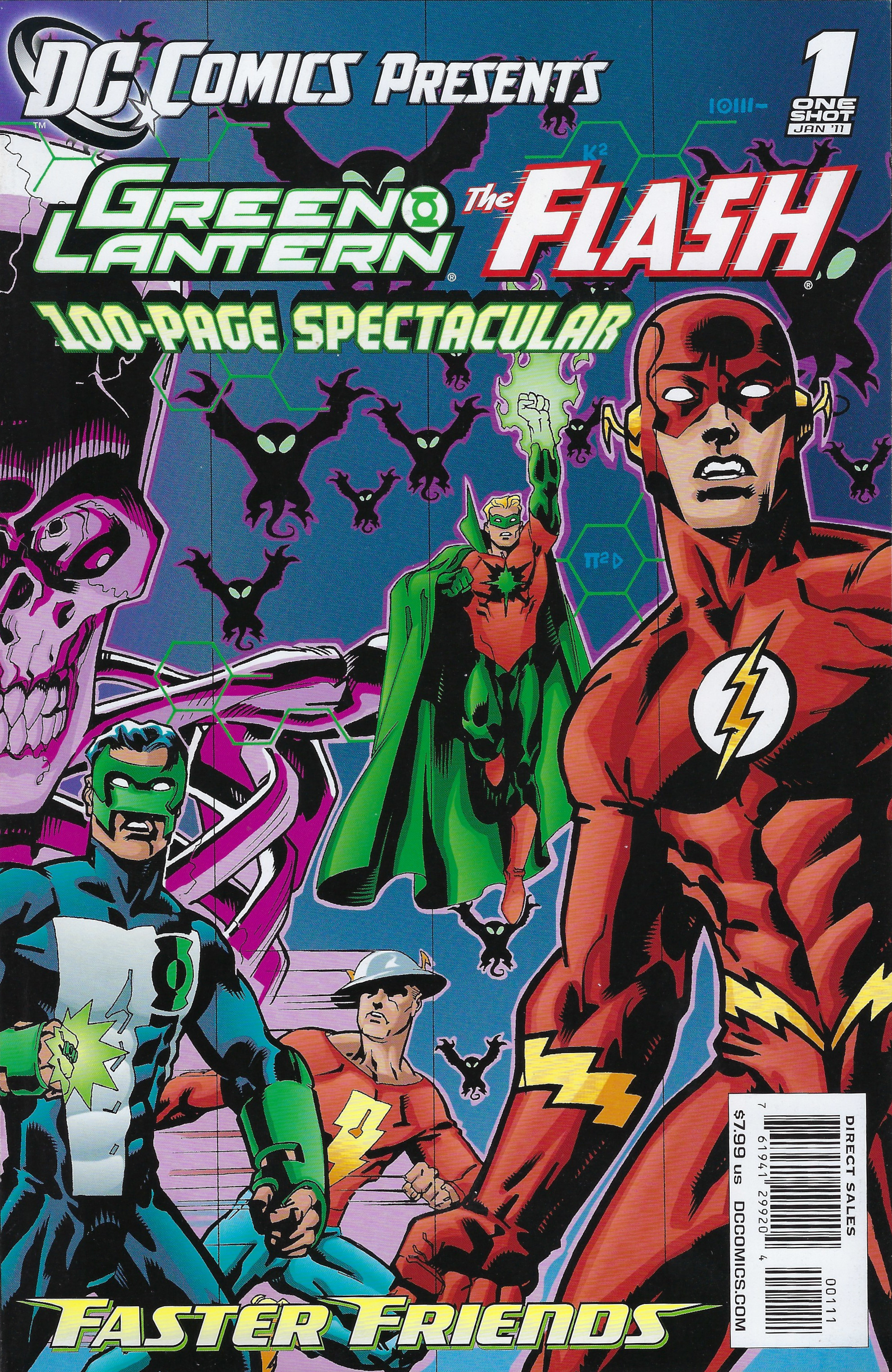
I also read Faster Friends, a two-issue miniseries from 1997 about Green Lantern (then Kyle Rayner) teaming up with the Flash (then Wally West) in order to deal with the consequences of an early adventure of a different Green Lantern (then Alan Scott) and Flash (then Jay Garrick). We get some flashbacks to that original adventure, the first time Green Lantern and Flash ever teamed up, back in 1940, as the present-day characters work alongside their namesakes and each other.

I think the idea here is good but I also think there's too much going on for the story's ninety-six pages... or maybe there's too much action, which pushes out the stuff it seems to me the story should actually be about! The first issue in particular is a bit of a nothingburger; we have a flashback of Jay and Alan teaming up but it goes so quickly it doesn't really give us any insight into their personalities. In the present, I think we're supposed to see a sort of rivalry between Wally and Kyle, but it's more like something we're told happened in other stories than something we actually see in this one.

from Flash/Green Lantern: Faster Friends #2
The second issue has more potential but again is trying to do too much: Jay is terminally ill, and Kyle and Wally go through a teleporter that mixes them up a bit. But Jay's impending death is a bit too much to deal with in a story like this, and of course it's all resolved by the end of the story (albeit in a clever way). One might think that Wally and Kyle being scrambled up would yield some good drama or character insight, but basically all it means is that each is wearing the wrong costume and seems to know stuff the other should, and then it gets fixed. There's no meaningful character arc: one expects more from Mark Waid, to be honest.

As far as this project goes, it's always fun to see Jay and Alan... but this is from the period (see #23 below) when Alan was deaged and went by "Sentinel." Such things happen in superhero comics, I suppose, but one doesn't have to like them. Bad creative decision, though again, Waid and Augustyn do an interesting thing with it, at least. 

(I read the story collected in a DC Comics Presents issue from 2011, but I think it will end up being collected whenever DC does The Flash by Mark Waid Omnibus, Volume Three, which I will buy when it comes out, so that may have been pointless.) 

Wildcat: "Brujas Y Gatos" originally appeared in issue #8 of Showcase '94 (July 1994). The story was written by Eddie Berganza, pencilled by Nick Gnazzo, inked by Ray Kryssing, colored by Suzanne Bourdages, lettered by Bill Oakley, and edited by Neal Ponzer.  
 
Green Lantern/Flash: Faster Friends #1 and Flash/Green Lantern: Faster Friends #2 originally appeared in 1997. The story was written by Ron Marz (#1) and Mark Waid & Brian Augustyn (#2); pencilled by Bart Sears, Andy Smith, Jeff Johnson, Ron Lim, & Tom Grindberg (#1) and Val Semeiks (#2); inked by Mark Pennington & Bill Anderson (#1) and Chip Wallace (#2); colored by John Kalisz (#1) and Ian Laughlin (#2); lettered by Chris Eliopoulos (#1) and Albert DeGuzman (#2); and edited by Kevin Dooley (#1) and Paul Kupperberg (#2). It was reprinted in DC Comics Presents: Green Lantern / The Flash: Faster Friends #1 (Jan. 2011).
 
This post is the fifty-first in an improbably long series about the Justice Society and Earth-Two. The next installment covers Impulse: Bart Saves the Universe. Previous installments are listed below:

14 November 2022

JSA Presents Green Lantern by Steven T. Seagle, Tony Bedard, Junior Thomas, John K. Snyder III, Dennis Calero, Staz Johnson, et al.

JSA Presents Green Lantern

Collection published: 2008
Contents published: 2002-08
Acquired and read: August 2022

Writers: Steven T. Seagle, Tony Bedard, Junior Thomas
Artists: John K. Snyder III, Dennis Calero, Staz Johnson/Mike Norton, Rodney Ramos/Jack Purcell, Allen Passalaqua
Letterers: Todd Klein, Travis Lanham, Jared K. Fletcher, Rob Leigh

This slim collection contains three stories (four issues originally, one double-sized) about Alan Scott, the original Green Lantern. One is a "retro" story, set in 1944; the other two feature him in the present day, a bit ahead of where I am at with my reading otherwise, with the events of Infinite Crisis and 52 coming in between. (I left off with JSA #45, published April 2003; the first present-day issue collected here was published June 2007.) It seems many developments await Alan Scott, but most noticeably he became director of and then quit the government black-ops organization Checkmate, and his daughter Jennie-Lynn "Jade" Hayden has died.

The first story is "Brightest Day, Blackest Night," which tells the story of Alan's first run-in with Solomon Grundy in the Slaughter Swamp outside Gotham City. Nazi agents crash a passenger airplane in the swamp to get their hands on an inventor aboard it, as well as his invention, but run afoul of an angry Grundy. Green Lantern comes to the rescue, aided by his romantic interest, reporter Irene Miller, and taxi-driving sidekick Doiby Dickles. The story seems designed to show off the painted art of John K. Snyder III, which is brimming with atmosphere, and captures well both the brutality of Grundy and the majesty of the Green Lantern. Unfortunately, the art isn't consistently great at storytelling: though I thought on the one hand, the body language of Irene really brought her to life, on the other hand, there were times it was just completely unclear to me what was happening. That the scientist had a niece also on the plane who also survived the crash was something the illustrations only seemed to intermittently depict, for example.

The art does a good job of capturing the light/darkness interaction.
from Green Lantern: Brightest Day, Blackest Night (script by Steven T. Seagle, art by John K. Snyder III)

The second story, "Johnny Mimic," is the best in the volume. Johnny Mimic is a criminal with an uncanny ability to recreate heists; Alan apprehended him back during the Golden Age, but let him go if he promised to be good—and he did. But decades later, the Super Human Advanced Defense Executive want Johnny to help them figure out a heist, and if Alan can't convince him nicely, S.H.A.D.E. will do it by force. The three-way tension between Alan, Johnny, and Father Time (leader of S.H.A.D.E.) is well done, and the story is genuinely surprising in terms of both what had happened and what goes on to happen. Johnny is not an actual preexisting character, but feels like one. The story does a strong job of playing Alan's optimism off the more cynical tone of contemporary comics. This is a solid, perfectly executed done-in-one comic with good moments of charm. Unsurprisingly, it's written by Tony Bedard who's good at this kind of thing in general, and Dennis Calero handles the art well.

Like Johnny Mimic's wife, I am always up for a bit of Green Lantern charm.
from JSA Classified #25 (script by Tony Bedard, art by Dennis Calero)

The final story is "Giving Thanks"/"Ghosts of Christmas Past"—you might not be surprised to realize it takes place across the holiday season, going from Thanksgiving to Christmas. Alan battles perennial JSA villain Vandal Savage, who taunts him by seemingly bringing Jade back to life. It's a bit plodding at times (the battle went on too long with the same character beats repeated again and again), but the final ten pages or so really shined, as Alan must make a tough decision, and then we follow the emotional fallout of it. I get that she wasn't really there, but Jade felt very generic here, not the well-rounded character that Roy and Dann Thomas created in Infinity, Inc. Anyway, it's fine. I remember not liking how Jade was killed off in the Infinite Crisis Companion; I'm curious to find out if she has any kind of meaningful role in JSA before that point, or if she's brought back just to be killed as so often happens with minor female superheroes.

This post is thirty-sixth in a series about the Justice Society and Earth-Two. The next installment covers issues #46-87 of JSA. Previous installments are listed below:
  1. All Star Comics: Only Legends Live Forever (1976-79)
  2. The Huntress: Origins (1977-82)
  3. All-Star Squadron (1981-87)
  4. Infinity, Inc.: The Generations Saga, Volume One (1983-84)
  5. Infinity, Inc.: The Generations Saga, Volume Two (1984-85)
  6. Showcase Presents... Power Girl (1978)
  7. America vs. the Justice Society (1985)
  8. Jonni Thunder, a.k.a. Thunderbolt (1985)
  9. Crisis on Multiple Earths, Volume 7 (1983-85)
  10. Infinity, Inc. #11-53 (1985-88) [reading order]
  11. Last Days of the Justice Society of America (1986-88)
  12. All-Star Comics 80-Page Giant (1999)
  13. Steel, the Indestructible Man (1978)
  14. Superman vs. Wonder Woman: An Untold Epic of World War Two (1977)
  15. Secret Origins of the Golden Age (1986-89)
  16. The Young All-Stars (1987-89)
  17. Gladiator (1930) ["Man-God!" (1976)]
  18. The Crimson Avenger: The Dark Cross Conspiracy (1981-88)
  19. The Immortal Doctor Fate (1940-82)
  20. Justice Society of America: The Demise of Justice (1951-91)
  21. Armageddon: Inferno (1992)
  22. Justice Society of America vol. 2 (1992-93)
  23. The Adventures of Alan Scott--Green Lantern (1992-93)
  24. Damage (1994-96)
  25. The Justice Society Returns! (1999-2001)
  26. Chase (1998-2002)
  27. Stargirl by Geoff Johns (1999-2003)
  28. The Sandman Presents: The Furies (2002)
  29. JSA by Geoff Johns, Book One (1999-2000)
  30. Wonder Woman: The 18th Letter: A Love Story (2000)
  31. Two Thousand (2000)
  32. JSA by Geoff Johns, Book Two (1999-2003)
  33. Golden Age Secret Files & Origins (2001)
  34. JSA by Geoff Johns, Book Three (1999-2003)
  35. JSA by Geoff Johns, Book Four (2002-03)

23 February 2022

The Adventures of Alan Scott--Green Lantern by Roger Stern, Ron Marz, Dusty Abell, Jim Balent, Andrew Pepoy, et al.

While reading Justice Society of America vol. 2, I learned from the lettercol that at the same time, Alan Scott had his own feature in the short-lived Green Lantern Corps Quarterly series. I don't necessarily track down every solo appearance of every JSA member, but these seemed to have some focus on Alan's family life, which meant appearances by Jade and Obsidian of Infinity, Inc., plus Alan's marriage to the original Harlquin, also an Infinc concept. So I went ahead and tracked it down. (I skipped the final issue, #8; it featured Lobo, so it goes for $20 at least these days. No thanks.)

GLC Quarterly was an ongoing anthology comic about various members of the Green Lantern Corps; each issue had 54 story pages. Typically, there was a short frame story, an eighteen-page lead story about a new Green Lantern character, a twelve-page Alan Scott story, a twelve-page G'nort story, and a short story either about a preexisting character ("Whatever Happened to...?") or a previously unknown Earth Green Lantern ("The History of Sector 2814"). Issue #7 switches things up somewhat, and features two Alan Scott tales. (In issue #8, the Alan Scott story is actually a flashback tale, so I feel justified in excluding it.)

from Green Lantern Corps Quarterly #3
(script by Roger Stern, art by Dusty Abell & Mark McKenna)
The first four stories are written by Roger Stern, and mostly feature art by Dusty Abell and Steve Mitchell. Roger Stern is one of those comics writers who I wouldn't call "great" but you can depend upon to turn in a satisfactory story, in my experience, and that's exactly what he does here. Across his four tales, we get an origin recap, a family reunion, a visit to the grave of Dinah Drake Lance (the original Black Canary), a battle with Solomon Grundy, and a visit to Doiby Dickle's adoptive home planet.

This is solid stuff. I always like seeing a superhero's family, and though twelve pages don't leave a ton of room for it, we get a good sense of the affection Alan has for his found family. The best story was, to my surprise, the Doiby Dickles one, which treats this goofy character with enough affection that I found myself charmed: Alan and Molly visit his new planet, and discover that he's remade it into a tribute to the place and time he's left behind. Dusty Abell is an artist I don't have much experience with—I do remember a solid turn on the "Five Years Later" Legion of Super-Heroes—but he proves himself well-suited to the classic heroism of a Golden Age character. All in all, enjoyable stuff. I was pleased also to see the whole JSA paying tribute to Dinah, who died while they were in limbo; it's a nice touch that keeps these characters feeling real.

from Green Lantern Corps Quarterly #7 (script by Ron Marz,
art by Mark Tenney & Wade Von Grawbadger)
With issue #4, though, Jim Balent and Andrew Pepoy take over the art, and with issue #5, Ron Marz takes over the writing. The result is an immediate, jarring change in style and tone: overwrought, angsty, verging on the 1990s "xtreme" aesthetic stuff. There's a new Harlequin taunting Alan; later, Alan is de-aged, and in issue #7, we learn this is because of the power of the Starheart, the ejected magic core of the Power Batter on Oa that gave Alan his powers. Alan becomes the new "Sentinel," abandoning his Green Lantern identity. It was all rather rushed and under-explained, even though issue #7 gives us two Alan Scott stories, and makes his story the frame narrative.

This is all because, I think, of the impending Emerald Twilight storyline, the end goal of which was to make Kyle Rayner the only Green Lantern in the universe; if Alan was to go on, he needed a new superhero identity. I am not a fan, but I guess I'm glad he wasn't killed off. However, this material doesn't feel rooted in the life and history of Alan Scott like Stern's; it's much more generic action-adventure with a dose of darkness that feels gratuitous.

I thought the Harlequin here was the same new one who bedevilled Infinity, Inc. back in the day, Marcie Cooper, but the DC wiki tells me that she's a new character who only appeared in two more issues a few years later (Underworld Unleashed #1 and Green Lantern vol. 3 #71), and who we never really learn anything about. It seems to me it would make more sense for her to be Marcie, based on what she knows about Alan's personal life.

This could make a nice little trade if anyone was ever so motivated, but I doubt anyone ever will be. Still, the first four issues are worth picking up if you are into the JSA legacy elements, and I assume the last three will be important for understanding future Alan Scott stories if nothing else.

(It's not my focus here, but I did read all the stories in this title. Some were quite good! There's a charming Mark Waid/Ty Templeton collaboration in issue #2, I really liked the story of the woman who turned down the Guardians in issue #4, Elliot S! Maggin has a neat one-off about an alien GL in issue #5, and so help me, I even liked the G'nort feature at times.)

The Adventures of Alan Scott--Green Lantern were originally published in issues #1-7 of Green Lantern Corps Quarterly (Summer 1992–Winter 1993). The stories were written by Roger Stern (#1-4) and Ron Marz (#5-7); pencilled by Dusty Abell (#1-3), Jim Balent (#4-6), Darryl Banks (#7), and Mark Tenney (#7); inked by Steve Mitchell (#1-2), Mark McKenna (#3), Andrew Pepoy (#4-6), Terry Austin (#7), and Wade Von Grawbadger (#7); lettered by Bob Lappan (#1-3), Bob Pinaha (#4-5, 7), and Albert DeGuzman (#6); colored by Anthony Tollin (#1), Matt Webb (#2-5, 7), and Stuart Chaifetz (#6); and edited by Kevin Dooley (#1-7) and Eddie Berganza (#6-7).
 
This post is twenty-third in a series about the Justice Society and Earth-Two. The next installment covers Damage. Previous installments are listed below:
  1. All Star Comics: Only Legends Live Forever (1976-79)
  2. The Huntress: Origins (1977-82)
  3. All-Star Squadron (1981-87)
  4. Infinity, Inc.: The Generations Saga, Volume One (1983-84)
  5. Infinity, Inc.: The Generations Saga, Volume Two (1984-85)
  6. Showcase Presents... Power Girl (1978)
  7. America vs. the Justice Society (1985)
  8. Jonni Thunder, a.k.a. Thunderbolt (1985)
  9. Crisis on Multiple Earths, Volume 7 (1983-85)
  10. Infinity, Inc. #11-53 (1985-88) [reading order]
  11. Last Days of the Justice Society of America (1986-88)
  12. All-Star Comics 80-Page Giant (1999)
  13. Steel, the Indestructible Man (1978)
  14. Superman vs. Wonder Woman: An Untold Epic of World War Two (1977)
  15. Secret Origins of the Golden Age (1986-89)
  16. The Young All-Stars (1987-89)
  17. Gladiator (1930) ["Man-God!" (1976)]
  18. The Crimson Avenger: The Dark Cross Conspiracy (1981-88)
  19. The Immortal Doctor Fate (1940-82)
  20. Justice Society of America: The Demise of Justice (1951-91)
  21. Armageddon: Inferno (1992)
  22. Justice Society of America vol. 2 (1992-93)

15 March 2019

The Making of a Black Man: Green Lantern: Mosaic

Mosaic, the four-part Green Lantern storyline by Gerard Jones, M. D. Bright, and Romeo Tanghal (vol. 3 #14-17), was followed by Green Lantern: Mosaic, an ongoing series about Green Lantern John Stewart trying to integrate the various cities plucked out of space and deposited on Oa to form "the mosaic world." Gerard Jones continued on as writer; the series's main penciller was Cully Hamner, who I know from his work over a decade later on the new Jaime Reyes Blue Beetle book. The series lasted eighteen issues, cancelled as part of a general deck-clearing in preparation for the massive reshuffling of Green Lantern that happened with Emerald Twilight.

In an early lettercol (in issue #5), Gerard Jones says he was unhappy with how the original Mosaic story went (he agrees with a writer who calls it "deadly dull") and wanted to do something different with the premise when it became an ongoing. I don't think you'd need to read the lettercol to know that, because the transition between Green Lantern #17 and Mosaic #1 is obvious and sharp. I think it's best summed up by the aliens. The aliens inhabiting the mosaic in the original miniseries are Star Trek aliens. In the ongoing, they're Farscape aliens. Everything gets weird and dark and twisted and far less human.

Which really sums up the whole approach, because it's not just the mosaic that's changed: John Stewart is weird and dark and twisted and far less human now, too. John Stewart is a man pushed beyond endurance, trying to reconcile the dozens of conflicting peoples of the mosaic, but as the story goes to great pains to point out, that's life as a man of color. His very identity is a mosaic, one that is assembled in a rickety way but must withstand the pressure of American racism. In one sense, John is going crazy because of this sci-fi scenario he's been plunged into, but in another, the story surfaces the problems John Stewart has had all along.

It reminds me of a Vertigo series in style, but it could never be a Vertigo series because of its more "mainstream" content. In fact, I wonder if it lucked out in being born in 1992, that era where DC was publishing the comics that would become Vertigo comics when the imprint was formed in 1993. You wouldn't put this alongside The Sandman, Hellblazer, and Animal Man, it has too many ties to other superhero comics, but it's pretty much like no contemporary DC comic I've read, either. Post-Vertigo, it would have no clear place in DC's line-up, but before March 1993 divides the DC world in Vertigo and not-Vertigo, it's just one of a number of boundary-pushing comics DC published in the early 1990s. Surely, as I often say, one of the publisher's most fertile periods.

One Vertigoesque attribute is it doesn't really feel like a setup for an ongoing set of stories, more like one big story in many chapters. Jones's run was curtailed, and that shows, but I'm doubtful it's the kind of series that could run one hundred or even fifty-plus issues and still remain fresh.

That said, what's here is excellent. The opening issue is fantastic, a strange tour of the mosaic that lets you into John Stewart's mind at the same time: "This is my world... '...and welcome to it.' James Thurber." The second issue is bizarre and dark, the notorious death of Ch'p, the squirrel Green Lantern, but what made it more noteworthy to me is the way Jones and Hamner make Ch'p into something alien himself, not just a comedy alien Green Lantern.

Issue #4 is one of the series's occasional forays into life in the mosaic: the inhabitants of the American town have largely given up hope, and express their despair by watching reruns of classic television ad nauseam, not to mention days-long binge-drinking sex orgies. The issue is told from the perspective of their children who see the mosaic as an opportunity; the don't want to wallow in tv nostalgia, but to push forward into the new, no matter how dangerous. The series didn't often do this kind of thing, but it was usually worthwhile when done. Who would have thought that Green Lantern: Mosaic, of all series, could support a special Christmas issue!? Yet #9 was super-weird and super-fascinating.

The best issue is probably #5, "The Child-Man and the Great White Hero." Hal Jordan comes to confront John over how he's been handling the mosaic, and we get a great, dark insight into John and the way he thinks about Hal Jordan, about how he envies Hal's casual heroism, his whiteness. As John says to Hal, "You fight to prove your rightness, you score your total victories, and you stride out as you entered. I never score a total victory!" The book even gives Hal some casual (or perhaps more than casual) racism: he doesn't like that his old romantic interest Rose is now with John... but he can't quite vocalize why.

There is the occasional misstep; seeing John step outside the mosaic in #6 and into a more clichéd Green Lantern narrative wasn't particularly interesting. The one with the music aliens (#7) wasn't as good as it ought to have been.

The last few issues push John in an interesting direction, as we (spoiler) find out that it wasn't the mad old Guardian who brought all these cities to Oa, but John itself. Yet this idea feels squandered as one of many introduced as the series wraps up; it would have been nice for the series to have the room to actually explore it. The implications of this don't really get the time they deserve. In the final issue, John becomes a Guardian of the Universe himself, or maybe something else: "What's man in me. What's American in me. And what's black in me... I'll nurture every day... as I become a new kind of being."

Yet this would never be explored; John Stewart next appeared in Darkstars, no longer a Guardian or even a Green Lantern, recruited as the head of NEMO (the organization that supports the Darkstars), with no sign of the baggage or characterization introduced here.  

Mosaic is, like so many comic book premises, a great idea cut short by the constraints of the medium. Or, perhaps we might say, cobbled together from disparate parts in crazy ad hockery to make something worth viewing from a distance, even if each individual piece might not shine on its own. That is to say, of course, a mosaic.

08 March 2019

Review: Green Lantern: Mosaic by Gerard Jones, M. D. Bright, and Romeo Tanghal

Green Lantern: Mosaic is one of those cult classic comics runs-- I don't think it was successful in its time, and it's never been collected, but people who have read it speak highly of it, and I was sufficiently intrigued to break my rule of only picking up those space-based DC comics that do not feature Green Lantern. But before Green Lantern: Mosaic, the ongoing series, there was Mosaic, the four-part Green Lantern story. (That's not confusing at all.)

There was obviously even some set-up before this, but it works on its own well-enough; in fact, despite having been originally published in 1991, it reads like something optimized for the trade paperback era. The background is pretty easy to work out: one Guardian of the Universe, the so-called "Old Timer" (the same one who traveled America with Hal Jordan and Oliver Queen) went mad and died, but not before using his power to bring one settlement each from a number of planets to Oa, clustering them together into a sort of a "mosaic" world. While Hal Jordan cruises the universe re-establishing the Green Lantern Corps (I'm not sure why it needs re-establishment to be honest, it seems like the Corps is always being un- and re-founded), John Stewart has been assigned to watch over the settlements on Oa.

Gerard Jones seems to me to be a perennially underrated writer. I know his career is over now, but it seems to me that in the early 1990s he was putting out quality stuff on a regular basis but he never made it big like some of his contemporaries did. In addition to a redefining run on Green Lantern and various spin-offs, he also wrote or co-wrote much of Justice League Europe (issues #14-50), and he was responsible for the only Elongated Man series ever published, Europe '92. The more I read of him, the more I see what a versatile writer he was. Mosaic is not just the story of people having to learn to co-exist on an alien planet (and failing), it's a deep dive into the traumas and history of John Stewart.

The main plot of Mosaic is the conflict between the various way of thinking on the mosaic world, some of which are quite alien; the whole thing kicks off when an alien race with an irrepressible desire to expand at all costs kills a couple innocent humans. Armed conflict between the two species quickly escalates, despite the best efforts of both John Stewart and a woman named Rose Hardin. John can't come up with any solutions other than brute force: giant walls between settlements that his ring needs his force of will to maintain. But things keep getting worse. There's some pointed commentary on race, especially as humans start finding allies among the aliens-- allies in a desire to tear down the walls so that the fighting can resume.

But the real story of the book is the mind of John Stewart. Jones's script brings together a number of incidents from John's past to give us a broken man: his history as an architect, his perennial outsider status, the death of Katma Tui in Action Comics Weekly, the destruction of Xanshi in Cosmic Odyssey. Jones does a great job of uniting these disparate threads into a picture of a desperate man, suffering from tragedy (he even deftly justifies John's poor judgement in Cosmic Odyssey as a consequence of him overcompensating for the powerlessness he felt after Katma Tui died), who his whole life has tried to build structures that turned out to be more like strictures-- and now he has to try his hand at sculptures for the first time if he's going to save the planet and save himself.

I mostly knew Jones for comedy with a tinge of character in JLE and Elongated Man, and for more straightforward cosmic adventures in the other bits of his Green Lantern I'd read. Oh, and for whatever the heck Batman: Fortunate Son was meant to be. But here he shows himself to be capable of complicated psychological tragedy. I look forward to seeing where the mosaic world and John Stewart go when Jones and I return to it in the Green Lantern: Mosaic ongoing series that began eight months after this storyline came to an end.

Perhaps unjustly, I haven't said much about it here, but I enjoyed the artwork of M. D. Bright and Romeo Tanghal here. Bright was one of the, ahem, bright spots of the otherwise dismal run of Green Lantern in Action Comics Weekly, especially his out-there space adventure stuff in the story in Green Lantern Special #2 that tied up the whole storyline. He's just as good here, handling Jones's human drama and far-out space plots with equal skill. The kind of artist I wish I saw more of. As for Romeo Tanghal, the man was basically ubiquitous as an inker at DC from the early 1980s to the late 1990s, and he's never disappointed me. It's just a shame neither man really returns for the Mosaic ongoing, but hopefully its actual artists will be quality ones as well.

Mosaic originally appeared in issues #14-17 of Green Lantern vol. 3 (July-Oct. 1991). The story was written by Gerard Jones, pencilled by M. D. Bright, inked by Romeo Tanghal, colored by Anthony Tollin (#14-16) and Matt Hollingsworth (#17), lettered by Albert DeGuzman, and edited by Andy Helfer.

02 March 2018

The Prehistory of the Omega Men

I didn't know when I began reading DC's The Omega Men that it was a spin-off of previous comics, mostly those by Marv Wolfman; I was actually surprised when I realized that Teen Titans's Starfire was from the Vega system that is the setting for The Omega Men. So now, as part of my dive back into 1970s-80s DC space comics, I'm reading a collection of random stuff that tied into The Omega Men in some way. Two enemies of the Omega Men, the Citadel and the Spider Guild, both appeared in Green Lantern originally (issues #136 and 167, respectively), for example. The Omega Men appeared in a number of stories across Green Lantern, Action Comics, and The New Teen Titans before they got their own ongoing, and it's those I want to talk about today.

* * * 


In addition to the issues of Green Lantern cited below, I also read #136-39, 164, 167, 172, and 180-90. I was in general impressed by what I read of writer Marv Wolfman's run (which in full goes from #133 to 153); Wolfman is very adept as balancing ongoing plots with standalone stories in the way that I feel is ideal, and even though I was plunged right into the middle of several ongoing stories, I never failed to understand what was going on. Those old comics where the characters spend a page thinking about what's happened to them recently might look a little silly to us now, but that conceit sure is helpful!

The Omega-Men Saga! actually gives very terrestrial roots to what would become quite a cosmic concept. Carol Ferris has been deposed as head of Ferris Aircraft by her father, so Carol and Hal Jordan-- who have only recently rekindled their relationship-- go on a trip to Newfoundland to get away from it all. Writer Wolfman implies a lot of tent sex. Because Hal Jordan is dumb, they run out of gas in the middle of nowhere, and when he uses his ring to get to the nearest town, they discover the whole thing is an illusion created by... the Omega Men! They're a group of resistance fighters from the Vega star system, who are masking themselves from the hunters of the Citadel, the evil empire that dominates their home system. Of course Green Lantern fights them, but when the Gordanian hunters arrive, they unite against their enemy. (Green Lantern previously fought the Gordanians in the 22nd and 58th centuries in Green Lantern #136-37.)

It's an okay story. With eight different Omega Men to incorporate (Primus, Kalista, Tigorr, Broot, Nimbus, Harpis, Demonia, and Auron) into what's really just two issues, none of them make much of an impression. Primus is the boss one, Kalista is the girl one, Demonia is the evil one, Auron is the god one, and that's basically it. And can I just say that Wolfman's naming is incredibly unimaginative? Primus is the leader, Tigorr is a tiger, Broot is a brute, Nimbus is a cloud, Harpis is a harpy, Demonia is a demon, and Auron is a light. Anyway, Joe Staton draws some good fights, the Gordanians are sent packing, and the Omega Men will stop hiding on Earth and go back into space to fight the Citadel.

* * * 


If this story (hardly a saga) had been their only appearance, I doubt anyone would remember them, but Marv Wolfman brought them back a year later, by which time he and Joe Staton were writing and drawing Action Comics. The end of The Omega-Men Saga! implied that the Omega Men were heading off into space, but apparently they actually didn't because they still had stuff to do. They need Green Lantern's help to finish fueling up their ship, only he's in space, so here they go ask Superman instead. However, we'vre right in the middle of an ongoing plot for Superman, where he's been split into two different people, each of which only has some of his powers, and one of which is lost in the medieval era. Just another Tuesday for Superman. So the Omega Men end up helping him and Lois (Wolfman is good at giving the female love interests stuff to do) fight some underground people who want to auction him off.

Not all of the Omega Men appear in this story, but the beginning of The Starfire Saga is also perfunctory. Some fighting, blah blah blah. Like with the holographic village in Green Lantern, the Omega Men seem to have a level of power not really consistent with what we see in the later ongoing Omega Men series by Roger Slifer and company; here, Kalista can use sorcery to summon someone on the opposite side of the Earth! It's hard to imagine the Omega Men leaving Vega at all, actually, based on the ongoing. (There definitely were some retcons when the Omega Men were made into their own thing.) The Superman stuff here was honestly more interesting than the Omega Men stuff. Which I guess makes sense; it's Superman's series after all!

However, at the end of its second issue, Superman takes the Omega Men to the Justice League satellite, where he provides them with the fuel they seek... only to be interrupted by the New Teen Titans barely reaching the satellite, as they nearly asphyxiate in space. The Starfire Saga continues from there in the pages of The New Teen Titans, which fill in how they ended up in this predicament: they were trying to rescue Starfire from being kidnapped by her sister Blackfire, who works for the Citadel. (Starfire and Blackfire's backstory was depicted by the recent Tales of the New Teen Titans #4, where we got our first glimpse of the key Vegan world of Okaara.)

The Omega Men have to go to Vega anyway, and hate the Citadel already, so they let the Titans accompany them in what leads to a series of pitched battles, as the Citadel tries to steal the Vegan god X'Hal. Some of the Titans stay on Okaara to defend the planet, while others go to the Citadel itself to rescue Starfire.

It's all exciting stuff. Marv Wolfman and George Pérez were at the top of their game in the 1980s. These are cosmic battles and personal foibles as only they can tell it, and even though I've scarcely read any of The New Teen Titans, they made me want to start collecting some expensive omnibus volumes. The Omega Men are still kind of just there, except for Demonia who is so evil that it seems improbable the rest would put up with her.

These stories do succeed in making you want the Omega Men get their own series, though, because of the worldbuilding. We see several planets in the Vega system, each with some kind of cool cosmic imagery, like the crystal interior of Okaara, or the asteroid fortress moons of the Citadel. You finish the story wanting to see more of this incredible world, and the best stories from the Omega Men ongoing would do just that. The only thing not to like is that the gorilla-like Citadelians are written as so stupid it beggars belief they could manage an interplanetary empire. (And Marv Wolfman doesn't seem to know the difference between a solar system, a galaxy, and a universe.)

* * * 


The last Omega Men story before they got their own spin-off was a two-issue return to Green Lantern. It's a simple story: Green Lantern is captured by some old enemies, the Headmen, who have really big heads. Listen, not every concept can be a winner. The Headmen seek to demonstrate their fitness to join the Citadel Empire by executing a Lantern. (The Citadel is much more expansionist in these precursor stories than it would be in the actual Omega Men series; I don't remember them ever trying to expand beyond Vega in those.) The Omega Men intercept the transmission between the Headmen and the Citadel, and go and rescue Green Lantern to repay their old debt. That's basically it, though it's a decent story; like Staton and Pérez, Pollard is a strong artist.

Its final issue came out in Feb. 1983, and The Omega Men began in Apr. 1983, so it seems likely this story was intended to directly set up the ongoing; it clarifies what would become a key part of the Omega Men mythos, that the Green Lanterns are forbidden by treaty from interfering with the Vega system. I found it weird, though, that the book doesn't actually mention that the Omega Men are about to get their own series. Shouldn't the new book get some explicit advertising?

* * * 


A collected edition of much of this material was solicited by DC a few years ago, but never released. I'm glad, then, that I tracked these issues down, and I look forward to someday rereading The Omega Men with this context in mind.

The Omega-Men Saga! originally appeared in issues #141-44 of Green Lantern vol. 2 (June-Sept. 1981). The story was written by Marv Wolfman, illustrated by Joe Staton, lettered by John Costanza (#141) and Ben Oda (#142-44), colored by Carl Gafford (#141-43) and A. Tollin (#144), and edited by Len Wein (#141-42) and Cary Burkett (#143-44).

The Starfire Saga originally appeared in Action Comics vol. 1 #535-36 (Sept.-Oct. 1982), The New Teen Titans vol. 1 #23-25 (Sept.-Nov. 1982), and The New Teen Titans Annual  vol.  1 #1 (1982). The story was plotted by Marv Wolfman (#535-36, #23-25, Annual #1) and George Pérez (#23-25, Annual #1); scripted by Marv Wolfman (#535, #23-25, Annual #1) and Paul Kupperberg (#536); illustrated/pencilled by Joe Staton (#535-36) and George Pérez (#23-25, Annual #1); embellished/inked by Pablo Marcos (#535), Sal Trapani (#536), and Romeo Tanghal (#23-25, Annual #1); lettered by Todd Klein (#535, #24) and Ben Oda (#536, #23, 25, Annual #1); colored by Gene D'Angelo (#535-36) and Carl Gafford (#23-25, Annual #1); and edited by Julius Schwartz (#535-36) and Len Wein (#23-25, Annual #1).

"Head Trip!" and "…And They Shall Crush the Headmen!" originally appeared in issues #160-61 of Green Lantern vol. 2 (Jan.-Feb. 1983). The story was written by Mike W. Barr, pencilled by Keith Pollard, embellished by Sam de la Rosa (#160) and Pablo Marcos (#161), lettered by Todd Klein (#160) and Ben Oda (#161), colored by Tom Ziuko (#160) and Anthony Tollin (#161), and edited by Ernie Colón. 

The first two of these titles are not quite official. The cover of Green Lantern #143 calls the issue "THE SHATTERING CONCLUSION OF THE OMEGA-MEN SAGA!" while the lettercol of New Teen Titans refers to the story begun in Action Comics as "the Starfire saga" on occasion. There is no overarching title given to Green Lantern #160-61.

04 January 2017

Faster than a DC Bullet: Project Crisis!, Part LVIII: The World of Flashpoint featuring Green Lantern

Comic trade paperback, n.pag.
Published 2012 (contents: 2011)
Borrowed from the library
Read August 2016
The World of Flashpoint featuring Green Lantern

Writers: Adam Schlagman, Jeff Lemire, Pornsak Pichetshote
Artists: Felipe Massafera, Robson Rocha, Joe Prado, Ibraim Roberson, Alex Massacci, Andy Smith, Keith Champagne, Ig Guara, Marco Castiello, Ruy José, Vincenzo Acunzo, Cliff Richards, Ben Oliver
Colorists: Rod Reis, Pete Pantazis, Stefani Rennee, Allen Passalaqua
Letterers: Dave Sharpe, Pat Brosseau, Travis Lanham, Carlos M. Mangual, Wes Abbott

Like I said when talking about the Batman World of Flashpoint volume, despite thinking these books were kind of dumb at first, I'm coming to enjoy them. The World of Flashpoint featuring Green Lantern is another solidly enjoyable volume-- I liked all four stories here. The key ones are definitely the first and last stories, both written by Adam Schlagman: "Abin Sur: The Green Lantern" and "Hal Jordan." These stories essentially run in parallel, depicting the lives of their two main characters. In this timeline, Abin Sur still crashlands on Earth and is found by hotshot test pilot Hal Jordan, but Abin doesn't die, meaning he doesn't pass his Green Lantern ring on to Hal.

Why are the Guardians of the Universe jerks in every timeline?
from Flashpoint: Abin Sur: The Green Lantern #1 (script by Adam Schlagman, art by Felipe Massafera)

Abin's story is about him holding onto the Green Lantern determination to protect life in a universe increasingly hostile to it. We see his youth, we see his friendship with fellow Green Lantern Thaal Sinestro (I had no idea Sinestro had a first name), we see Sinestro's turn to evil when he's told their timeline is an aberration and can be rewritten, and we see Abin sent on a mission to Earth by the Guardians of Oa, who want him to recover the White Entity, the essence of life, from its hiding place. Only once Abin finds out about the Amazon-Atlantis war consuming Earth, he wants to stop that instead. This isn't anything deep, but it is a solid, enjoyable tale, with larger-than-life characters doing big things and making tough choices. The art of Felipe Massafera and his collaborators (Robson Rocha and Joe Prado) is some of the best art on a World of Flashpoint story I've seen yet, communicating character and strength. There's some real tragedy, and real emotion here. As always, I'm curious to see if these events will play into the main Flashpoint title. It seems like they ought to, but Flashpoint is only five issues long and so many things have been set up in The World of Flashpoint by this point!

19 June 2011

Faster than a DC Bullet: The Sandman Spin-Offs, Part III: Green Lantern/Superman: Legend of the Green Flame

Perfect-bound comic, 38 pages
Published 2000

Borrowed from the library
Read June 2011
Green Lantern/Superman: Legend of the Green Flame

Written by Neil Gaiman
Artwork by Michael D. Allred & Terry Austin, Mark Buckingham, John Totleben, Matt Wagner, Eric Shanower & Arthur Adams, Jim Aparo, Kevin Nowlan, Jason Little
Colored by Matt Hollingsworth
Lettered by Todd Klein

Action Comics Weekly sounds like the kind of thing I'd've liked, given my enjoyment of Wednesday Comics: an anthology title that came out weekly, with several stories advancing slowly issue to issue. But it was apparently a nightmare to pull together, and so it didn't even last a year. Legend of the Green Flame is the finale it never got, as Gaiman's script was dumped for someone else's, finally being illustrated and published some twelve years later. The story unites all of the characters-- the Blackhawk Squadron, the Green Lantern, Superman, Catwoman, the Phantom Stranger, Deadman, and a demon who totally isn't Etrigan, honest-- from Action Comics Weekly into one big story.

In this tale, Hal Jordan and Clark Kent find an old green lantern, originally found in some rubble in 1949, in a museum exhibit. When Hal uses it to charge his ring, the two of them end up flung into Hell itself. It's short, only a little longer than your typical single issue, so not a whole lot actually happens. What does happen is fun enough, I suppose, though I suspect it would have been funner had it actually been read as the conclusion to all of these characters' stories in Action Comics Weekly. I think my favorite random appearance was Deadman, who gets some funny material. I don't get why the Blackhawks find dead members of the Justice Society (including the Sandman, natch) in 1949, though.

As it is, it's nice to see Clark Kent and Hal Jordan hang out together. I don't know why Hal Jordan is so mopey here, or why the events of this story make him get over it, but Gaiman write a nice Clark/Superman. There's a fun bit where in the middle of a conversation, Clark flies off and gets a cat out of a tree, and the best scene in the book is probably when, upon their arrival in Hell, Superman is incapacitated by being able to hear the torment of every single being in Hell at once. Sometimes it sucks being Superman.

The resolution is a bit too easy, given all the buildup it gets, but that's a done-in-one story for you, I suppose. There are a number of different artists for some reason, but it's not as jarring as you might think, since each of them does a different chapter, and each chapter takes the story some place completely different. Oh, and the ending joke is fun, though it wasn't until just now that I finally got it. "The place is all yours," indeed, Neil.

06 June 2010

Faster than a DC Bullet: Project Star City, Part XXIII: Green Lantern: Emerald Allies

This is it! With Green Lantern: Emerald Allies, I have officially and finally read every single trade paperback to feature Green Arrow, a voyage I began exactly a year ago in May 2009, taking me through twenty Green Arrow comics, plus a few related stories.

Comic trade paperback, 206 pages
Published 2000 (contents: 1996-97)

Borrowed from the library
Read May 2010
Green Lantern: Emerald Allies

Writers: Chuck Dixon, Ron Marz
Pencillers: Rodolfo Damaggio, Dougie Braithwaite, Paul Pelletier, Darryl Banks, Will Rosado
Inkers: Robert Campanella, Robin Riggs, Romeo Tanghal, Terry Austin
Colorists: Lee Loughridge, Pam Rambo, Rob Schwager
Letterers: John Costanza, Albert De Guzman, Chris Elioupoulos

The only part of Connor Hawke's time in the title role of volume 2 of Green Arrow is collected in this volume, labeled as part of the Green Lantern series despite the fact that five of its eight issues were originally Green Arrow releases. They all feature team-ups between Connor and Kyle Rayner, the then-Green Lantern of Earth, both young men unexpectedly thrust into a long-running superhero mantle. The material that works with this is probably the best stuff here.

The first story is "Bad Blood," a one-issue first meeting for the two heroes that is decent, but not spectacular. The largest section of the book is "Hard-Traveling Heroes: The Next Generation," which apes the GL/GA team-ups of old by having the two of them travel the United States looking for Kyle's father. Denny O'Neill's early team-ups were known for their over-earnest social commentary, and there's some of that here, but it fits oddly. The story is okay, but let down by a villain plan that doesn't make a whole lot of sense. The best story in the book is the last one, "Hate Crimes," which sees New York City pulled apart by racial rhetoric from both white and black commentators, and gets some nice material in as a result, as well as showing us both heroes in their element.

I liked this brief chance to get to know both Connor and Kyle; it some ways it's a shame that both had to be replaced in their roles by the returns of their predecessors. It's not long after this story that Oliver Queen is resurrected, bringing us to Quiver, back where I began all that time ago.