Showing posts with label creator: mark waid. Show all posts

03 February 2026

Justice League International Year Eight, Part II: Judgment Day (JLA #89-92 / JLI #65-68 / JLTF #13-16)

Finally, at last, we come to the end of the Justice League's pre-Zero Hour run... and thus the end of my continuous reading; from here I'll be jumping ahead a bit. Here we have the final issues of Justice League International and Justice League Quarterly, as both series were cancelled with Zero Hour. (The JLI lettercol indicates more issues of JLQ were planned, though; it mentions an all–Tasmanian Devil issue by David De Vries and Kiki Chansamone which never happened.)

The Justice League did continue from this point, with JLI-era characters in its roster still like Booster Gold and Fire... but nothing I've seen or read of this era is even remotely appealing. As far as I can tell, Justice League America continued to lean  further into the "extreme" 1990s aesthetic, and of course, it was paired with Extreme Justice, which was surely even moreso. I could barely stomach the last year or so of JLA; I don't need more of this.

(Christopher Priest did take over on Justice League Task Force, which seems interesting, but I'll save reading that for another time.) 

Reading this era in order is pretty straightforward. Mostly the three series rotate between each other, one issue leading into the next. The only time there's not a direct continuation is between JLA #91 and JLI #15, so that's where I recommend reading the last two issues of JLQ.

from Justice League Task Force #14
Judgment Day / "Heroes Passage", from Justice League America #89-90, Justice League Task Force #13-14, & Justice League International vol. 2 #65-66 (June-July 1994) and Justice League America #91 (Aug. 1994), reprinted in Wonder Woman and Justice League America, Volume 2 (2017)
written by Dan Vado, Mark Waid, and Gerard Jones; pencils by Marc Campos, Sal Velluto, and Chuck Wojtkiewicz; inks by Ken Branch, Jeff Albrecht, and Bob Dvorak (with Robert Jones & Rich Rankin); letters by Clem Robins, Bob Pinaha, and Kevin Cunningham; colors by Gene D'Angelo and Glenn Whitmore

Judgment Day was a six-part story that rotated through all three Justice League monthlies: the American branch, international branch, and Task Force all teamed up to deal with a world-threatening menace. This is the Overmaster. Unsurprisingly, this story has all the negatives of all the recent stories from all three titles: bad art, especially by Marc Campos, over-the-top melodrama, incoherent plotting. Much of the story is never really explained. What is the connection between this Overmaster and the one that threatened the Detroit-era League? How did he cause all the disasters around the Earth before he even got there? Why was he going around empowering random people? Why doesn't he just destroy the Earth right away instead of imposing this countdown?

There are some nuggets of a good concept here. I liked the idea that Booster encountered a situation where he knew things were going to turn out fine in the future... but then the events of Zero Hour meant that his future knowledge actually wasn't right. But all the stuff about Booster being dead and not dead was painted with way too broad a brush. I did like the stuff between Booster and Beetle, though; I feel like their friendship was largely not utilized during Dan Vado's run so it was good to see it in play here. The idea no one was being born or dying is creepy.

On the other hand, we once again get an ineffectual Wonder Woman up against a rash Captain Atom when it comes to command of the League. I don't know why we needed to see this play out three stories in a row; it's insulting to both characters. (And when and how did Atom even become a League member again?) This time we get the added layer of a UN-threatened League shutdown from Maxwell Lord. I'm not sure why Max was kept on as a lead character after Breakdowns when he has done so very little of interest except occasionally be the face of UN interference.

The big aspect of this story is the death of Ice. It comes across as a bit of a Chewbacca moment: "kill the family dog." That is to say, kill the nicest character because it will garner the most sympathy. In execution, it doesn't work very well. Ice had been absent from the League for a long time, and since her return, hasn't even really felt like Ice in any meaningful sense. She spends most of Judgment Day under the Overmaster's mind control, which is not really an interesting way for a character to spend their final appearance. Surely an effective character death should remind you of why you liked someone before they get killed off, but there's none of that here.

The one thing I did like about the death of Ice was the actual issue in which it happened, JLTF #14, certainly the best issue of the whole crossover. As the League acts to stop the Overmaster, we keep cutting to T. O. Morrow and a couple other villains; every time the League does something, we see Morrow cross it off of a list of things he knows are going to happen. The culminates in him crossing Ice's death off the list. It's a surprisingly effective mechanic from writer Mark Waid, giving the death of Ice some impact.

Lastly, Dan Vado and Marc Campos's run finishes out with a coda issue about how the death of Ice affected the team. The characters snarl and posture a lot; the potential drama of Fire dealing with this is of course squandered by bad writing and worse art.

from Justice League Quarterly #16
"Visions of Glory" / "The Heart of Darkness" / "The Sleeper Awakens" / "Guardian Angel", from Justice League Quarterly #16-17 (Fall-Winter 1994)
written by Paul Kupperberg, Charlie Bracey, and Andy Mangels; pencilled by Vince Giarrano, Rick Stasi, Curt Swan, Khato, Danny Rodriguez, Carlos Franco, and Phil Jimenez; inked by Vince Giarrano, Dick Ayers, Jose Marzan, Khato, Andrew Pepoy, Richard Space, Rich Rankin, and John Stokes; lettered by Albert De Guzman, Gaspar, Agnes Pinaha, Chris Eliopoulos, Bob Pinaha, and Clem Robins; colored by Patricia MulvihillJerry NicholasPhil AllenGreg RosewallRobbie BuschScott Ballman, and Greg Wright

The first of the last two issues of Justice League Quarterly seems pretty random: it's an all–General Glory issue. In the monthlies, General Glory last did something other than appear in a crowd shot back during Breakdowns, so around three years ago. I'm not sure why editorial decided he needed a whole book devoted to him!

But I'm not going to complain because this is pretty good stuff. There's a frame story set after Judgment Day; after its events, General Glory reverted to his Joe Jones form—and had a heart attack. He's been hospitalized alongside a paralyzed hero cop, and Jones spend their time together telling the cop stories from the General Glory comic books published after the General disappeared. This provides a frame story for four "flashback" stories—though we know none of them happened. The first is a Kirby monster comic pastiche, with pitch-perfect art from Rick Stasi and Dick Ayers; the second a bit of a Batman pastiche. These were both really good pastiche... but I didn't really see the point. Writer Paul Kupperberg did something similar in an earlier issue of JLQ (see item #9 in the list below), but there to comedic effect.

There is good comedy in the other two stories. The Dark Knight Returns parody is hilarious: "The rest of the world merely visits, never getting deeper into my heart and soul than the foyer of my life. Me, I live down in the cellar, alone, the dry-rot of my discontent eating away at the timbers of my emotional support." Amazing! The Image parody isn't quite as funny, but it has its moments still. (It is a bit grating that here in JLQ, Kupperberg is making fun of the Image aesthetic while over in JLA, they're just ripping it off. Either it's good or it's not, folks, pick a lane!) The frame story is surprisingly good, too, aided by some strong art from Vince Giarrino. It ends with the debut of a new General Glory. Unfortunately, I think this guy never appeared again for two decades until Geoff Johns (of course, it's always Geoff Johns) brutally killed him to prove a situation was serious.

The very last issue of JLQ has a Global Guardians lead feature; I thought we'd finally gotten past these guys but I guess not. Like too many of them, it's more about setting up a new status quo than actually telling an interesting story. Plus this one is a lot about something happening in some kind of series called... "Primal Force"? What even is that? Did the Global Guardians ever get an ongoing feature? I doubt it, and I'm not sure why JLQ spent so much time trying to position them for one. The other two stories here focus on Captain Atom and Maxima. The Captain Atom one is fine; it's nice to see a post-resurrection story where he's not a dumb jarhead but though the idea here is decent the execution didn't grab me. The Maxima one is surprisingly good, as Maxima struggles to help a young teenage runaway forced to work as a prostitute. It's a bit on-the-nose but I liked it a lot. It's too bad we didn't spend more of Maxima's time in the League delving into her complexities like this. Some great art by the great Phil Jimenez.

from Justice League International vol. 2 #67
"Silver Ages" / "Family Troubles", from Justice League Task Force #15 and Justice League International vol. 2 #67 (Aug. 1994)
stories by Mark Waid and Gerard Jones, pencils by Sal Velluto and Anthony Williams, inks by Jeff Albrecht and Luke McDonnell, letters by Bob Pinaha and Clem Robins, colors by Phil Allen and Gene D'Angelo 

This linked pair of issues has the League continuing to deal with the fallout of Ice's death. A tabloid outfit tries to get details on her; the League agrees to not speak to the press, but Blue Beetle breaks the silence, both to get the truth out there, and to use the money to pay Booster's medical bills. It has its moments, but there's too much melodramatic posing and snarling. Clearly a lot of these issues are devoted to shuffling off the board the characters who won't play a role in the post-Zero Hour League, like Doctor Light and Power Girl. (Did the Power Girl pregnancy storyline ever get resolved anywhere? Honestly, I kind of hope not.)

from Justice League Task Force #16
Return of the Hero!, from Justice League America #92, Justice League Task Force #16, and Justice League International vol. 2 #68 (Sept. 1994)
written by Christopher Priest; pencilled by Luke Ross, Greg LaRocque, and Phil Jimenez; inked by Cramer, Banning, Faucher, & Marzan Jr., Rich Rankin, and John Stokes; colored by Gene D'Angelo and Dave Grafe; letters by Clem RobinsBob Pinaha, and Kevin Cunningham

Lastly, we finish out with a three-part story called Return of the Hero! The premise of this one is interesting: it turns out the Justice League had a sixth founding member we didn't know about, Triumph, who accidentally eliminated himself and the enemy the League was fighting from time. Triumph is brought back amid the timeline fluctuations of Zero Hour, along with the aliens he was fighting. But how can he get the League to help him when 1) they're in mourning for Ice, and 2) they don't remember he ever existed? This is by Priest, so it has a lot of good moments: Triumph's original story, the League needing to take a taxi to defeat the aliens in D.C., Ralph's self-realization about his role in the League, the Tasmanian Devil finally revealing his origin, L-RON in Despero's body. 

But it is brought down a bit by the repetitive over-the-top arguments and fights. I get that the League is under strain here but it feels like everyone says the same thing five times. And Triumph's own emotional throughline seems a bit muddled. I'm not totally sure what point is being made with him here.

This ends with the League in tatters... yet again. But like I said, that's enough for me for now! On to the returns of the original JLI team. 

This is the fifteenth in a series of posts about Justice League International. The next covers Formerly Known as the Justice League and I Can't Believe It's Not the Justice League. Previous installments are listed below:

  1. Justice League #1-6 / Justice League International #7-12 (May 1987–Apr. 1988)
  2. Justice League International #13-21 (May 1988–Dec. 1988)
  3. Justice League International #22-25 / Justice League America #26-30 / Justice League Europe #1-6 (Jan. 1989–Sept. 1989) 
  4. Justice League America #31-36 / Justice League Europe #7-12 (Oct. 1989–Mar. 1990)
  5. Justice League America #37 / Justice League Europe #13-21 (Apr. 1990–Dec. 1990)
  6. Justice League America #38-50 / Justice League Europe #22 (May 1990–May 1991)
  7. Justice League America #51-52 / Justice League Europe #23-28 (Feb. 1991–July 1991) 
  8. Justice League America #53-60 / Justice League Europe #29-36 (Aug. 1991–Mar. 1992) 
  9. Justice League America #61-65 / Justice League Europe #37-42 (Apr. 1992–Sept. 1992)
  10. Justice League America #66-69 / Justice League Europe #43-50 (Sept. 1992–May 1993) 
  11. Justice League America #70-77 / Justice League Task Force #1-3 (Jan. 1993–Aug. 1993) 
  12. Justice League America #78-83 / Justice League International #51-52 / Justice League Task Force #4-8 (June 1993–Jan. 1994)
  13. Justice League America #84-85 / Justice League International #53-57 / Justice League Task Force #9 (Aug. 1993–Feb. 1994) 
  14. Justice League America #86-88 / Justice League International #58-64 / Justice League Task Force #10-12 (Nov. 1993–May 1994) 

16 December 2025

Justice League International Year Six, Part II: Red Winter (JLA #66-69 / JLE #43-50)

One of the defining comics events of the 1990s was of course The Death of Superman. Here we have the run of JLA and JLE stories that lead up to and overlapped with it. There are also a lot of Justice League Quarterly issues set during this span, presumably because they wanted to avoiding overlapping with the more complicated events of Death and its immediate aftermath.

from Justice League Europe #43
"'Round and 'Round and 'Round It Goes..." / "With a Little Bit of Luck", from Justice League Europe #43-44 (Oct.-Nov. 1992)
written by Gerard Jones, drawn by Ron Randall, inked by Randy Elliott, lettered by Willie Schubert, colored by Matt Hollingsworth and Gene D'Angelo

These two issues of JLE have the JLE checking into a hotel, as the events of the Deconstructo storyline saw them kicked out of their previous HQ; in this story, Sue finds them a castle to use as a headquarters. While the castle is made ready, though, they investigate a series of improbable disaster near gambling site. As in many stories in both JLI titles recently, the villain turns out to be an old League foe, though one unfamiliar to me other than this story: Amos Fortune, who can manipulate probabilities. When he makes good luck for himself, bad luck results for everyone else.

This isn't a great story, but it is another strong installment of a good run for JLE. Gerard Jones, Ron Randall, and Randy Elliott have really made the title work at this point. Fun, offbeat concepts and good character interactions elevate what could easily be an also-ran title into an enjoyable one. If you include the upcoming Red Winter storyline, this fourteen-issue run of JLE is the most consistent the title has been since its birth. I enjoyed a lot of the Giffen/DeMatteis/Sears run of course, but it's really clicked with this team.

from Justice League America Annual #6
"Maximum Eclipse", from Justice League America Annual #6 (1992), reprinted in Superman and Justice League America, Volume 2 (2016)
plot by Dan Jurgens, written by Dan Mishkin, penciled by Dave Cockrum, inked by José Marzan, Jr., lettered by Clem Robins, colored by Gene D'Angelo

Eclipso: The Darkness Within was a big crossover where the villain Eclipso began taking over superheroes from a fortress on the Moon. I actually collected and read all of its installments many years ago, so this was a reread for me. The JLA installment is collected in volume 2 of Superman and Justice League America, but the status of Guy Gardner means it clearly belongs with the stories in volume 1.

What I learned from collecting all those Darkness Within installments is that I actually don't enjoy Eclipso stories very much. Oh no, a hero has turned evil! It doesn't really generate much of interest. To the extent that this one works, it's the story's focus on Blue Beetle, who must outwit Eclipso with technical wizardry and sleight of hand; I have mixed thoughts on Dan Jurgens's JLA run, but he typically does well by Blue Beetle. 

"Eclipso over London" / "Brilliant Men", from Justice League Europe Annual #3 (1992) and Eclipso: The Darkness Within #2 (Oct. 1992)
plots by Gerard Jones and Keith Giffen & Robert Loren Fleming; breakdowns by Keith Giffen; dialogue by Will Jacobs and Robert Loren Fleming; pencils by Tim Hamilton and Bart Sears; inks by Romeo Tanghal and Mark Pennington, Randy Elliott & Raymond Kryssing; colors by Gene D'Angelo and Tom McCraw; letters by Ken Holewczynski and Gaspar

The Darkness Within continues with a JLE installment; it's fine but mostly forgettable. For completion's sake, I did actually reread the last part of the whole storyline, since it features a number of JLA and JLE characters, but I needn't have bothered, since they mostly just fill out crowd scenes. The whole thing is surprisingly jumpy at times considering Keith Giffen did breakdowns.

"Double Trouble!" / "It's...It's...a Ballroom Blitz! (or, The Rook's a Crook!)" / "Yesterday's News" / "The Real Return of... The Global Guardians!", from Justice League Quarterly #8 (Autumn 1992)
stories by Mark Waid, Mike Collins, Elliot S! Maggin, and Kevin Dooley; pencils by Rod Whigham, Mike Collins, Tim Hamilton, and Andy Smith; inks by Romeo Tanghal, Jose Marzan Jr., Trevor Scott, and Smitty; letters by Bob Pinaha, Albert DeGuzman, and Clem Robins; colors by Gene D'AngeloMatt HollingsworthJohn Cebollero, and Tom McCraw

from Justice League Quarterly #8
This installment of JLQ's lead story is about Max and his ex-wife Claire setting up a rematch between the JLI and Conglomerate; Max uses his business connections to get all of Conglomerate's members to quit for better gigs, sabotaging her. In desperation, Claire ends up using heroes from another universe... not realizing they are members of the Crime Syndicate from the antimatter universe! The League must work together to overcome evil alternates of themselves. It's okay; the best part is probably all the lame heroes who audition for Conglomerate. There's also a story about Power Girl and Wally West stopping a robbery, which is obviously an excuse for them to meet Peter Cannon, Thunderbolt, star of a then-forthcoming new series (Thunderbolt also cameoed in JLE #41, so DC was definitely trying to hype this guy)... but I do of course like getting to seem some Mike Collins artwork. Plus there's a good joke about what "Wally" means in the UK.

The best story in the issue surprised me by being the one by Elliot S. Maggin, who though I enjoy a lot, I feel is a bit of an old-fashioned writer. But his low-key story about the JLA discovering the identity of Max Lord's first ex-wife is surprisingly moving and charmingly contemplative and very character driven. The JLA (especially Fire) investigating in the present is paralleled against short scenes from Max and Sylvia's relationship. It's very well done, and one of my favorite stories about this incarnation of the League.

Once again, but thankfully for the last time, there's a Global Guardians story. 

from Justice League America #68
"Together Again" / "Transitions, Transmissions and Transactions" / "Actions, Admissions & Acquisitions", from Justice League America #66-68 (Sept.-Nov. 1992), reprinted in Superman and Justice League America, Volume 1 (2016)
story and layouts by Dan Jurgens, finishes by Rick Burchett and Jose Marzan, Jr., letters by Willie Schubert, colors by Gene D'Angelo and John Cebollero

The last three pre-Death of Superman issues of JLA have a lot of Guy Gardner in them. In the first, Superman battles Guy—freshly tossed out of the Green Lantern Corps—for leadership, and wins through his refusal to fight; meanwhile, the Atom turns up just to shit on the new League. To be honest, I feel like Jurgens is always shitting on the League in this incarnation; the characters are constantly being show as inferior power-wise and bad at working together. If he's trying to hit some kind of "underdogs make good" vibe, it's not coming off; you more feel like the writer doesn't like the group of character's he's been stuck with... even when he is good at writing them!

The other two issues make a story about an alien coming to the Earth because he thinks he owns it; as normal for Jurgens, it's very action-heavy and thus not very interesting to me... except for the ending, which is a good trick and has a great joke. Fire getting a new new costume so quickly is surely an admission that Dan Jurgens screwed up.

from Justice League Quarterly #10
"Frenzy" / "Cherchez L'Homme" / "You Bet Your Life" / "Tomorrow Belongs to Geralyn" / "Time and Chance!" / "Half an Inch" / "Contested Friendship" / "When Titans Date", from Justice League Quarterly #9-10 (Winter 1992–Spring 1993)
stories by Mark Waid, Kevin Dooley, Paul Kupperberg, Elliot S! Maggin, and William Messner-Loebs; pencils by Rod Whigham, Andy SmithDusty AbelDave CockrumPatrick ZircherScott Benefiel, and Ty Templeton; inks by Mike DeCarlo, Bob Wiacek, Jose Marzan Jr., John Lowe, Mike Sellers, and Karl Kesel; letters by Bob Pinaha, Albert De Guzman, Todd Klein, Clem Robins, Tim Harkins, and Bob Lappan; colors by Gene D'AngeloDan JeromeTom McCrawMatt HollingsworthJordan B. Gorfinkel, and Steve Mattsson

I wouldn't have guessed it to be honest, but I actually think that of the three post-Breakdowns JLI ongoings... JLQ might be my favorite!? These are two really strong issues on the whole, with just one misstep, and lots of stories that focus on a group of characters I've come to be quite fond of.

Standouts include "Frenzy", where six member of the JLI are exposed to a virus with a one-sixth chance of turning you into a homicidal maniac. Tensions rise as they try to figure out who it will be and if they can protect themselves; again, Mark Waid does well by the personalities of this version of the League, and Blue Beetle gets to show off his skill. I also enjoyed "You Bet Your Life," where Wally bets Karen that she can't keep her calm for an entire day... the same day Battlecat--protector of the environment begins prowling the streets of London. Fun stuff.

Elliot Maggin pops up again with another really well done story, "Tomorrow Belongs to Geralyn," this one about Booster meeting a young girl he knows will go on to be famous and help make the world a better place... but who also has a tragedy in her life. I think it's easy to write Booster as a shallow gloryhound, so I like these stories that delve into his earnest side. Like I said, I wouldn't have guessed Maggin would be such a good fit for the JLI; I hope there's more from him in future JLQ issues.

We get more good Booster in "Time and Chance!", which delves into Booster's dark past with gambling when he gets a chance to take down the crime family that ruined his life centuries before it happened. There's a really great scene between Booster and Beetle about what a good hero Booster actually is.

My favorite in these two issues, though, is "When Titans Date," a slice-of-life story about Fire, Wally, and Booster spying on Ted while he goes on a really terrible blind date. It's fun, it's cozy, it's everything I love about this group of characters. It's such a shame most of these JLQ stories have never been reprinted, because they really maintain what worked about this team so well in the Giffen/DeMatteis run, but in a slightly different way.

The only real misfire in these two issues is the kind of stupid one about Fire and Ice. It has its moments, but you sort of have the feeling that William Messner-Loebs thought that because it was "funny" he could just do whatever, whether it made sense or not. I don't think Fire and Ice act very believably at key points. But the bit about world peace was great! 

from Justice League America #69
"Down for the Count", from Justice League America #69 (Dec. 1992), reprinted in Superman and Justice League America, Volume 2 (2016)
story and art by Dan Jurgens, finished art by Rick Burchett, letters by Willie Schubert, colors by Gene D'Angelo

Oddly, Superman is only in one regular issue collected in Superman and Justice League America, Volume 2. This issue is part of The Death of Superman; while Superman gives an interview in Metropolis, Doomsday (named by Booster Gold, fact fans!) beats up on the rest of the JLA. It's an all-action issue again, but I think it works better than most thanks to the level of desperation here. Still, I think it would have worked even more if so many of the preceding issues of the title weren't also action-heavy ones about the JLA being outclassed by superior opponents.

(I just reread my review of when I originally read this issue some eighteen years ago: "These aren't exactly heavy hitters. Guy, as much as I love him, is in one of the periods where he's been kicked out of the Green Lantern Corps, so he's dressed even worse than usual, and I'm pretty sure I could take out Blue Beetle. And I've never even heard of Bloodwynd or Maxima. This comic doesn't exactly inspire me to want to know more about them, either. I'm pretty sure Maxima's power is being stupid. And having an invincible midriff." God, I sucked.)

from Justice League Europe #50
Red Winter, from Justice League Europe #45-50 (Dec. 1992–May 1993)
written by Gerard Jones, pencilled by Ron Randall & Mike Parobeck, inked by Randy Elliott, lettered by Willie Schubert, colored by Gene D'Angelo

The last story of this very long chuck of comics (twelve regular issues, three double-sized issues, three quadruple-sized issues!) is the six-issue Red Winter, where the Rocket Red Brigade takes over post-Soviet Russia... and Elongated Man foe Sonar has taken over the Rocket Reds... and soon, all of Europe!

I remembered this as being epic, and I was, thankfully, right. Jones is just a master of this kind of thing at this point; these six issues cover a lot of ground, with characters splitting off into a bunch of different configurations throughout, and with everyone getting a good moment: everyone contributes to the resolution of the problem at some point. Once again, there's great moments between Ralph and Sue, and some good stuff with the Crimson Fox, and an excellent ending. Is it great art? I guess not, but it is exactly what I want out of a superhero team book.

The only thing to not like, in my opinion, is that the appearances of the JSA and the JLI reserves seems kind of random, as do the huge crowd of villains Sonar dredges up. (Why are the Global Guardians and Injustice League working for him?) But we get a new character, Chandi the incarnation of Shiva, and also the stuff with the ghost in the JLE's castle is amazing. As I said above, Jones and Randall's JLE run from post-Breakdowns to here is exactly what I want from superhero team comics.

(If you're trying to read precisely chronologically, that's not easy with Red Winter, as its events overlap those in The Death of Superman, and the stories aren't very clear on how that might work; no matter what you choose, there are going to be some inconsistencies. In these posts, I've rendered it how I actually did it as I read, but in retrospect, I would have chosen a different sequence I'll describe later.)

This is the tenth in a series of posts about Justice League International. The next covers issues #70-77 of JLA and #1-3 of JLTF. Previous installments are listed below:

  1. Justice League #1-6 / Justice League International #7-12 (May 1987–Apr. 1988)
  2. Justice League International #13-21 (May 1988–Dec. 1988)
  3. Justice League International #22-25 / Justice League America #26-30 / Justice League Europe #1-6 (Jan. 1989–Sept. 1989) 
  4. Justice League America #31-36 / Justice League Europe #7-12 (Oct. 1989–Mar. 1990)
  5. Justice League America #37 / Justice League Europe #13-21 (Apr. 1990–Dec. 1990)
  6. Justice League America #38-50 / Justice League Europe #22 (May 1990–May 1991)
  7. Justice League America #51-52 / Justice League Europe #23-28 (Feb. 1991–July 1991) 
  8. Justice League America #53-60 / Justice League Europe #29-36 (Aug. 1991–Mar. 1992) 
  9. Justice League America #61-65 / Justice League Europe #37-42 (Apr. 1992–Sept. 1992)

18 August 2025

JLA: Year One by Mark Waid, Brian Augustyn, Barry Kitson, et al.

JLA: Year One: The Deluxe Edition

Collection published: 2017
Contents originally published: 1998-99
Acquired and read: July 2025
Writers: Mark Waid & Brian Augustyn
Penciller: Barry Kitson
Inkers: Michael Bair, Barry Kitson, Mark Propst, John Stokes
Colorist: Pat Garrahy
Letterers: Ken Lopez

Like the previous installment of this series (see below), this one covers a story that is arguably pretty tangential to the Blackhawks. But I couldn't see how I wouldn't like this book, so I really wanted an excuse to buy it and read it sooner rather than later.

This book comes from a (somewhat odd, in retrospect) period of DC history where Batman, Superman, and Wonder Woman were not founding members of the Justice League, thanks to various changes in continuity introduced following Crisis on Infinite Earths. Thus, the main characters are the Flash (Barry Allen), Green Lantern (Hal Jordan), Black Canary (Dinah Laurel Lance), Aquaman, and the Martian Manhunter. The story chronicles the first year of the JLA, picking up from them fighting off an alien invasion. They organize as a group, face various crises, discover that the alien invasion they fought off is not quite over, try (and fail) to recruit Superman, and learn about each other and themselves and how to work as a team.

I loved it. This is, as far as I am concerned, perfect superhero comics. This should be of little surprise to anyone familiar with the other work of the creative team; Mark Waid is, in my opinion, one of the all-time greats, able to unite continuity with characterization in really compelling ways. I haven't read much by his frequent collaborator Brian Augustyn, but Waid sings his praises in the intro, so clearly they are simpatico. Definitely also simpatico is Barry Kitson; Kitson came out of the UK comics scene (specifically, of course, Transformers), but really won himself over to me with his amazing five-year run on L.E.G.I.O.N., where he went from pencilling the title to plotting it and then scripting it. That was, I believe, where he first worked with Waid, who scripted the title for a year. After JLA: Year One, the two would work together on the excellent Legion of Super-Heroes "threeboot".

I understand why Batman and Wonder Woman couldn't be founding members of the JLA in the post-Crisis continuity—Batman was supposedly an "urban legend" in the post–Batman: Year One comics, which would hardly be true if he was giving Justice League press conferences, and George Pérez's Wonder Woman reboot moved her origins up to the present day—and I can also see why the editors of the Superman titles might not want him in the JLA in the present day—presumably they didn't want his actions in that book to constrain what they were doing in theirs—but it's not clear to me why Superman couldn't have been a past member of the JLA. But I guess it worked out; I don't think this story would have been anywhere near as good if these five characters were outclassed by a hero of Superman's power and narrative significance.
from JLA: Year One #7 (art by Barry Kitson & Michael Bair)

When I was a young comics fan, I used to make fun of Aquaman. This book made me feel bad for that.
from JLA: Year One #3 (art by Barry Kitson)
All of this is to say, I think this creative team was entirely on the same page, and what was on that page is beautiful. I like my superhero comics to be character-driven and fun, and this is undoubtedly both. One of the benefits of this odd team is that they have a lot of good hooks for characterization, especially early in their superheroic careers. Aquaman is trying to adjust to living on the surface world, where he feels like an alien of sorts; I liked the idea that he mumbles compared to people from the surface because of how sound propagates more loudly underwater. 

I think Hal is probably the one who gets the fewest character moments, actually, but he's fine, even if the playboy thing is laid on a bit thick. (I do, however, think the decision to call Tom Kalmaku "Pie" was not really any better than "Pieface" surely.)

Black Canary is a real highlight of the book, which as a Dinah Laurel Lance stan I very much appreciated. Post-Crisis, Black Canary was split into two characters: Dinah Drake (later Dinah Drake Lance), who was the Justice Society's Black Canary, and Dinah Laurel Lance, her daughter. But in most of the comics I've read, this is a fact of backstory, not something dealt with in the narrative; one of the benefits of going back to Black Canary's origin is actually seeing how she relates to her mother. The elder Dinah wants to mold the younger into her own image, but the younger Dinah must find her own path. There is a lot of good JSA stuff in the book; Dinah is often comparing her new colleagues to the heroes she grew up alongside, but also she discovers that those heroes weren't so perfect, as Waid and Augustyn make good use of the revelation from Starman that the elder Dinah had an affair with Ted Knight, the original Starman.

Honestly, I was a bit skeptical about going back over this ground, but the story did a great job with it.
from JLA: Year One #4 (art by Barry Kitson & Michael Bair)

I think Barry Allen's thread is less involved than either Black Canary's or Martian Manhunter's, but Waid and Augustyn and Kitson do well by him. (Which I guess makes sense, as they cowrote an acclaimed and long run on The Flash, even if it was about Wally West.)

Reading this book made me think I really must get around to reading some actual Martian Manhunter comics someday.
from JLA: Year One #1 (art by Barry Kitson)

The other real highlight is Martian Manhunter, even more of an outsider than Aquaman, but also able to pass thanks to his shapeshifting and telepathy. His discomfort at seeing the way his teammates treat the aliens they fight, his need to better understand them that goes places that violate their privacy, his belief that they and humanity can do better, they're all very well done.

What really makes the characterization sing, though, is the interactions. There are lots of moments between them all: John and Aquaman, Hal and Barry, Barry and Dinah, and so on, all the permutations you can think of, perfectly rendered. This is a team of people, in their highs and their lows; you understand why the team (briefly) turns on Martian Manhunter, but the moment where he needs to tune himself telepathically into an alien device, and the whole team comes together to help him do it is a genuine punch-the-air moment, I loved it.

Awww...
from JLA: Year One #12 (art by Barry Kitson & Michael Bair)

Beyond that, the book is just fun and inventive, taking those old Silver Age stories and filtering them through a modern perspective without being either overly nostalgic or cynical. (Weird to think, actually, that this book is now thirty years old, which is about how old the original Justice League stuff was when this was written.) We see Vandal Savage, we see the Doom Patrol, we see Snapper Carr, we get cameos from Oliver Queen and Maxwell Lord. At the end of the book, the invading aliens trap every superhero on Earth in a prison, which gives the JLA its chance to shine—but also means that once the JLA liberates the others, we get glimpses of all the superheroes of the Earth at this time. (In some cases, I suspect the continuity timing doesn't add up, but who cares.) I found that each issue of this series just flew by, perfect superhero comics. 

Lots of characters in this image who should be dead!
from JLA: Year One #2 (art by Barry Kitson)
As for the Blackhawks? Well, I'm saving a discussion of their post-Crisis continuity for a future post, but this story very much doesn't seem to care about it, nor does it even sit very well with their Silver Age continuity. Their role in the story is small but significant. In an early issue, we see them in their 1970s red-and-green uniforms, and Blackhawk suggests they need to update with the times. But then in a later issue, they're all in their superhero gear from the "Junk-Heap Heroes" era (see item #6 in the list below), and they decide they all look ridiculous and go back to how they were. Additionally, Blackhawk Island is the site of the prison where the aliens put the Earth's superheroes.

You might see this as massaging how their superheroic career could fit into their new post-Crisis history... except that all the characters who got killed off during the Rick Burchett run (see #10 and 11) are there! Additionally, so is Lady Blackhawk, but we were told in Guy Gardner (see #12) that she was plucked out of time at some point in the past and brought to the present thanks to the Crisis in Time. But this isn't a complaint or anything, just observations. The joke about how they look terrible as superheroes is probably worth everything else! (It is shooting fish in a barrel, though.)

Chuck's face just screams, "Blackhawk, you promised me this outfit looked cool."
from JLA: Year One #8 (art by Barry Kitson & Michael Bair)

This is the thirteenth in a series of posts about the Blackhawks. The next installment covers Guns of the Dragon. Previous installments are listed below:

  1. The Blackhawk Archives, Volume 1 (1941-42)
  2. Military Comics #18-43 / Modern Comics #44-46 / Blackhawk #9 & 50 (1943-52)
  3. Showcase Presents Blackhawk, Volume One (1957-58) 
  4. Blackhawk vol. 1 #151-95 (1960-64) 
  5. Blackhawk vol. 1 #196-227 (1964-66)
  6. Blackhawk vol. 1 #228-43 (1967-68)
  7. Blackhawk vol. 1 #244-50 / The Brave and the Bold #167 (1976-80)
  8. Blackhawk (1982) 
  9. Blackhawk vol. 1 #251-73 / DC Comics Presents #69 (1982-84) 
  10. Blackhawk: Blood & Iron (1987-89)
  11. Blackhawk vol. 3 (1989-92) 
  12. Guy Gardner: Warrior #24, 29, 36, 38-43 / Annual #1 (1994-96)

16 June 2025

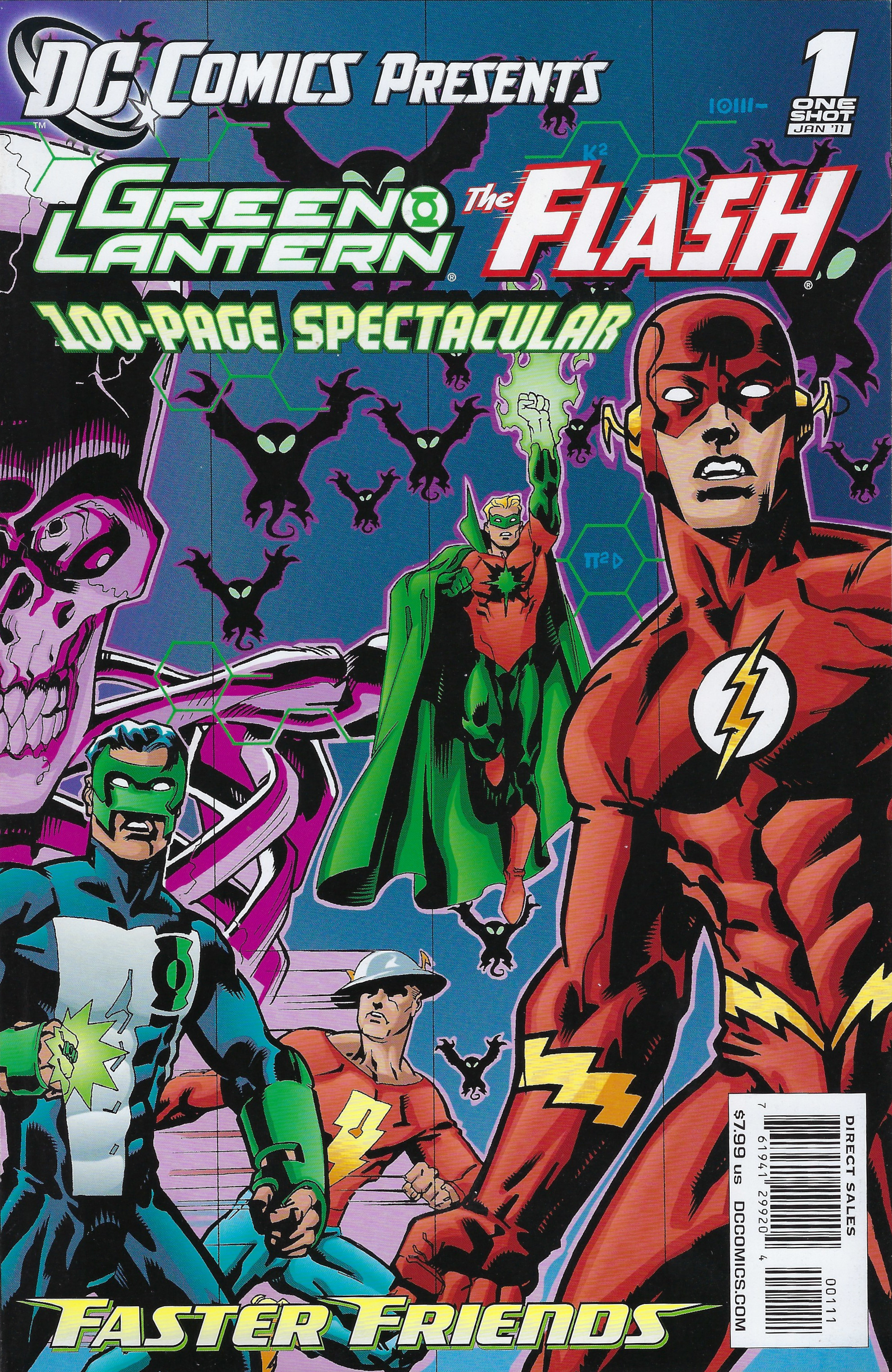
Showcase Presents Wildcat by Eddie Berganza, Nick Gnazzo, and Ray Kryssing / Green Lantern / The Flash: Faster Friends by Ron Marz, Val Semeiks, Chip Wallace, et al.

From June 2020 to December 2023, I chronicled the history of the Justice Society in fifty installments. And then, at last, I was done!

Or was I? The nature of these projects I undertake is you can always discover there was some relevant comic you didn't know about at the time. Such was the case when a friendly commenter named Drew popped up to tell me that, after I'd bemoaned Geoff Johns forgetting about the brother of Yolanda "Wildcat" Montez, the character made an appearance in an issue of Showcase '94. Well, it looks like I have more comics to read, so this series is (much like the JSA itself) called back into action again after a long gap. Since December 2023, I've discovered a few different JSA-adjacent comics, so this will be the first of, I think, three new installments.

So, the second Wildcat, Yolanda, was created by Roy and Dann Thomas in Infinity, Inc. (see item #10 below), but like a lot of DC's legacy characters, basically went into limbo once the series was over. And then was brutally killed off to prove the situation was serious... in an issue of freakin' Eclipso! Gotta put that old white guy back into his rightful position, of course. 

from Showcase '94 #8
But as Drew told me, there was a follow-up to all this in an issue of Showcase, DC's anthology series. In this story, Ted Grant, the original Wildcat, goes to Yolanda's funeral... only to find out that her parents, desperate with mourning, have hired a witch doctor to bring their daughter back to life! It's a pretty simple story: you might not be surprised to find out that Yolanda comes back as a mindless monster, and Ted defeats it. It is, after all, just ten pages. I didn't much care for the art, but it was nice to see that Roy and Dann Thomas's original conception of Yolanda wasn't totally forgotten; her brother is in the story. (For some reason, Geoff Johns later makes up a cousin for Yolanda rather than just use the brother during his JSA run; see item #34 below.)

from Green Lantern/Flash: Faster Friends #1
I also read Faster Friends, a two-issue miniseries from 1997 about Green Lantern (then Kyle Rayner) teaming up with the Flash (then Wally West) in order to deal with the consequences of an early adventure of a different Green Lantern (then Alan Scott) and Flash (then Jay Garrick). We get some flashbacks to that original adventure, the first time Green Lantern and Flash ever teamed up, back in 1940, as the present-day characters work alongside their namesakes and each other.

I think the idea here is good but I also think there's too much going on for the story's ninety-six pages... or maybe there's too much action, which pushes out the stuff it seems to me the story should actually be about! The first issue in particular is a bit of a nothingburger; we have a flashback of Jay and Alan teaming up but it goes so quickly it doesn't really give us any insight into their personalities. In the present, I think we're supposed to see a sort of rivalry between Wally and Kyle, but it's more like something we're told happened in other stories than something we actually see in this one.

from Flash/Green Lantern: Faster Friends #2
The second issue has more potential but again is trying to do too much: Jay is terminally ill, and Kyle and Wally go through a teleporter that mixes them up a bit. But Jay's impending death is a bit too much to deal with in a story like this, and of course it's all resolved by the end of the story (albeit in a clever way). One might think that Wally and Kyle being scrambled up would yield some good drama or character insight, but basically all it means is that each is wearing the wrong costume and seems to know stuff the other should, and then it gets fixed. There's no meaningful character arc: one expects more from Mark Waid, to be honest.

As far as this project goes, it's always fun to see Jay and Alan... but this is from the period (see #23 below) when Alan was deaged and went by "Sentinel." Such things happen in superhero comics, I suppose, but one doesn't have to like them. Bad creative decision, though again, Waid and Augustyn do an interesting thing with it, at least. 

(I read the story collected in a DC Comics Presents issue from 2011, but I think it will end up being collected whenever DC does The Flash by Mark Waid Omnibus, Volume Three, which I will buy when it comes out, so that may have been pointless.) 

Wildcat: "Brujas Y Gatos" originally appeared in issue #8 of Showcase '94 (July 1994). The story was written by Eddie Berganza, pencilled by Nick Gnazzo, inked by Ray Kryssing, colored by Suzanne Bourdages, lettered by Bill Oakley, and edited by Neal Ponzer.  
 
Green Lantern/Flash: Faster Friends #1 and Flash/Green Lantern: Faster Friends #2 originally appeared in 1997. The story was written by Ron Marz (#1) and Mark Waid & Brian Augustyn (#2); pencilled by Bart Sears, Andy Smith, Jeff Johnson, Ron Lim, & Tom Grindberg (#1) and Val Semeiks (#2); inked by Mark Pennington & Bill Anderson (#1) and Chip Wallace (#2); colored by John Kalisz (#1) and Ian Laughlin (#2); lettered by Chris Eliopoulos (#1) and Albert DeGuzman (#2); and edited by Kevin Dooley (#1) and Paul Kupperberg (#2). It was reprinted in DC Comics Presents: Green Lantern / The Flash: Faster Friends #1 (Jan. 2011).
 
This post is the fifty-first in an improbably long series about the Justice Society and Earth-Two. The next installment covers Impulse: Bart Saves the Universe. Previous installments are listed below:

09 November 2020

Review: All-Star Comics 80-Page Giant

In 1999, All-Star Comics had two momentary revivals. All Star Comics vol. 2 was part of the Justice Society Returns! storyline, so I'll cover it when I get to that, but there was also the All-Star Comics 80-Page Giant. Like most of the 1990s/2000s 80-page giants, it contains several original short tales on a central topic. I meant to read it with All-Star Squadron, as the latest All-Star ongoing, but ended up not getting it until later and thus read it after Infinity, Inc. I wish I had read it with All-Star Squadron, though, because despite not being published until over a decade later, it really feels like it ties in with Roy Thomas's work on that series.

Partially the reason for that is obvious. One of the stories in here is explicitly an All-Star Squadron tale, and Roy Thomas writes it. I haven't got to Young All-Stars yet, but I understand it takes the All-Star Squadron story from April 1942 up to June; "Thunderstruck" reads like it could thus be the very next issue after Young All-Stars #31, picking up on June 27, 1942 with the adventures of Green Lantern, Doctor Fate, Firebrand, and the Shining Knight; there's even appearance by those perennial All-Star Squadron favorites, FDR and Churchill. It's a fun story that reignites the oft-deferred romance between Firebrand and the Shining Knight. (I know many threads from Thomas's 1940s series were picked up in the present day in later JSA revivals, so I hope I will see what become of these two.)

script by Roy Thomas, art by Kevin Sharpe & J. Baumgartner
But outside of that explicit All-Star Squadron branding, several of the other, stories feel more like tributes to the Thomas version of the JSA rather than the Golden Age itself. "The Way of the Amazon" by Eric Luke, Chris Jones, and Keith Champagne is billed as a Wonder Woman tale. While Crisis on Infinite Earths wrote the Earth-Two Wonder Woman out of history, and Roy Thomas's work on Infinity, Inc., Young All-Stars, and Secret Origins substituted Miss America and Fury into her place in history, John Byrne's run on Wonder Woman in the late 1990s later featured Diana's mother, Queen Hippolyta, traveling back in time to the 1940s and acting as Wonder Woman during World War II, giving a different/new explanation of who took the Earth-Two Wonder Woman's role in so many Golden Age stories. Set in June 1943, "The Way of the Amazon" folds that retcon in with Thomas's All-Star Squadron milieu, featuring Hippolyta hanging out with the Phantom Lady and Liberty Belle in the Perisphere. It's another fun story, as the trio of women take down a Nazi air fortress and discover the original Red Tornado.

script by Eric Luke, art by Chris Jones & Keith Champagne
The other stories here don't draw as heavily on Roy Thomas retcons, but many still feel like they could have slotted in as issues of All-Star Squadron had the series made it further than April 1942. The Sandman, Wonder Woman, and Hawkman team up in "Waking Nightmare" (November 1942); the Atom has to be steered into pacifism by the rest of the JSA in "Steam Engine" (December 1942); Starman has to talk the Spectre into believing in hope again in "P.O.V.—a Fable" (January 1945). Of these one, my favorite was "Steam Engine," a charming tale of how the Atom lets the way bigger people mock him get him down-- no surprise that it comes from the pen of Mark Waid. The story of "Waking Nightmare" was hard to understand, to be honest, but the evocative art of Dennis Cowan and John Floyd makes up for it. (They draw the wrong Sandman costume, as continuity pedants love to note, but the gasmask one is way better than the yellow-and-purple one, so who cares?) On the other hand, I found "P.O.V." pretty unconvincing; why was it Starman who needed to help the Spectre regain his connection to humanity? Why would seeing someone in an internment camp make a paper airplane even help? (If the Spectre really feels so bad, why wouldn't he just close the camp himself?)

script by John Ostrander, art by Dennis Cowan & John Floyd
Just two stories seem to go outside of the All-Star Squadron-verse. "The 90-Minute Man" by Tom Peyer, Peter Pachoumis, and Wade Von Grawbadger is a pre-war, straight Hourman tale, where the guy who has superpowers last only sixty minutes has to figure out how to take down someone with one-and-a-half times the duration! I've read a lot of stories with Hourman in them, but this is probably the first where I've actually got something out of his gimmick. There's just one of these not set during the Golden Age, "The Ropes" by David Goyer & James Robinson, David Ross, and Andrew Hennessy, where the Jack Knight Starman spars with Wildcat and talks courage. It's okay. (It's the only one of these stories to be collected, in The Starman Omnibus, Volume Five. I feel like it probably reads better in that context than this one.)

script by Joe Kelly, art by Duncan Rouleau & Aaron Sowd
Overall, it seems like 1999 was the time of JSA revivals. It was the year after Hippolyta was retconned into the JSA, and the year that we got The Justice Society Returns!, the debut of the Geoff Johns Stargirl, and the return of a JSA ongoing comic. It will be some time before I get to all that, but All-Star Comics 80-Page Giant is a good tribute to the ongoing vitality of DC's original superheroes. If anyone ever bothers to make an All-Star Squadron/Young All-Stars collection (unlikely), they could do a lot worse than chucking a few of these in at the end.

All-Star Comics 80-Page Giant was originally published in one issue (Sept. 1999). The stories were written by Mark Waid, Joe Kelly, Eric Luke, Tom Peyer, Roy Thomas, John Ostrander, and David Goyer & James Robinson; pencilled by Adam DeKraker, Duncan Rouleau, Chris Jones, Peter Pachoumis, Kevin Sharpe, Dennis Cowan, and David Ross; inked by Mark Propst, Aaron Sowd, Keith Champagne, Wade Von Grawbadger, J. Baumgartner, John Floyd, and Andrew Hennessy; lettered by Ken Lopez, Ken Bruzenak, Kurt Hathaway, Rick Parker, and John Costanza; colored by Gloria Vasquez, John Kalisz, Noelle Giddings, and Carla Feeny; and edited by Dan Raspler with Tony Bedard.

This post is the twelfth in a series about the Justice Society and Earth-Two. The next installment covers Steel, the Indestructible Man. Previous installments are listed below:
  1. All Star Comics: Only Legends Live Forever (1976-79)
  2. The Huntress: Origins (1977-82)
  3. All-Star Squadron (1981-87)
  4. Infinity, Inc.: The Generations Saga, Volume One (1983-84)
  5. Infinity, Inc.: The Generations Saga, Volume Two (1984-85)
  6. Showcase Presents... Power Girl (1978)
  7. America vs. the Justice Society (1985)
  8. Jonni Thunder, a.k.a. Thunderbolt (1985)
  9. Crisis on Multiple Earths, Volume 7 (1983-85)
  10. Infinity, Inc. #11-53 (1985-88) [reading order]
  11. Last Days of the Justice Society of America (1986-88)

08 August 2016

Revolutionary Reading: An Examination of the Legion of Super-Heroes Threeboot, Final Part: Dominator War

I had two reviews posted at Unreality SF last week: one of last year's Doctor Who audio trilogy with the seventh Doctor and Mel, and one of Series Four of Survivors. Posting this notice before this review makes me think there should be a Doctor Who comics by Mark Waid and Barry Kitson. They would be good at it. But then, I think they would be good at almost any comic.

Comic trade paperback, 124 pages
Published 2007 (contents: 2007) 

Acquired February 2016
Read May 2016
Supergirl and the Legion of Super-Heroes: Dominator War

Writer: Mark Waid with Tony Bedard
Pencils: Barry Kitson with Kevin Sharpe
Inks: Mick Gray with Jimmy Palmiotti, Mark McKenna, Jack Purcell
Colors: Nathan Eyring
Letters: Travis Lanham, Jared K. Fletcher, Pat Brosseau, Phil Balsman

This is the final volume of Mark Waid and Barry Kitson's run on Legion of Super-Heroes, which means it will be my last post in this short-lived series of posts (though I do plan on eventually picking up what Tony Bedard and Jim Shooter did with this version of the Legion later on). In my review of Teenage Revolution, I set up the idea that a lot of fiction about revolutions deals with idea of "shrugging": how a character justifies the deaths that are needed to bring about utopia. Though Waid and Kitson's Legion of Super-Heroes has largely shied from depicting violence by the Legion against the state, this volume does have a pretty big example of justified violence, albeit in the context of warfare.

The last couple volumes have included among their many subplots the simmering threat of the Dominators; in this one, it finally comes to the fore. The Dominators are genetically engineered zealots. Each one believes in the genetic superiority of their species, and things are getting worse, as a Dominator scientist has introduced new genetic code that will propagate through the species, making every Dominator superpowered within a few generations. This means a conventional military defeat is insufficient; the Legion must commit genocide in order to win. If they just confine the Dominators to their homeworld, within a few generations, the Dominators will be unstoppable.

Cosmic Boy, still leader of the Legion, debates if he has the right to commit genocide:
from Supergirl and the Legion of Super-Heroes #30 (script by Mark Waid, art by Barry Kitson and Mick Gray & Jimmy Palmiotti)

Thus we have Cos assuming a sort of Ozymandias-like posture: this is a burden he must take, only he is capable of doing so. He's the only person advanced enough to sanction mass murder to save universe.

So the Dominator homeworld is destroyed by Mon-El:
from Supergirl and the Legion of Super-Heroes #30 (script by Mark Waid, art by Barry Kitson and Mick Gray & Jimmy Palmiotti)

I think this cops out on the series's confrontation with revolutionary violence in a few ways. The first is that the violence is all directed outwards; the Legion has never had to use lethal force against, for example, the Science Police during the course of the series. No one from the Legion's own society suffers as a result of their actions. The second is that the Dominators are basically genetically engineered to be evil. Obviously this can't happen in the real world, but it is often used to make genocide palatable in science fiction, like with the Daleks in Doctor Who. If every Dalek is an evil soldier, killing them is just what you must do during wartime, and the same applies here to the Dominators. There are no "innocent" Dominators, and thus Cosmic Boy is merely a general ordering the deaths of enemy soldiers. The third is that no genocide actually happens:
from Supergirl and the Legion of Super-Heroes #30 (script by Mark Waid, art by Barry Kitson and Mick Gray & Jimmy Palmiotti)

Both Mon-El and the Dominators are not actually dead, but shunted into another dimension. Everyone thinks Cosmic Boy committed genocide, but he actually did not, though the continued existence of the Dominators needs to be kept a secret for various plot reasons. Now I'm not complaining that I don't get to read a comic book about teenagers committing genocide per se, but there are a lot of ethical complexities to revolution, and since this book framed itself as being about one, I wish it had delved into them a little bit more. If it doesn't, it doesn't take sufficient advantage of its unique premise, and becomes just another superhero team comic.

But I think that's what DC wanted. In my discussion of Adult Education, I talked about how Waid and Kitson modeled the reading practices they wanted their readers to follow. But it wasn't working, at least so the sales indicated. Soon after Waid and Kitson left the book, they were replaced by Jim Shooter, who had written the Legion back in the 1970s. The metatextual message here seems pretty clear to me: here is the Legion you knew and loved in the past. If DC Comics had been trying to cultivate a new, younger readership with the "threeboot," they had given up and were now chasing after the older die-hards who had read the Legion as children. I haven't read Shooter's run yet, but I understand that under him, the idea of the Legion as a youth movement was diminished, and it became a more traditional superhero team book.

In an interview a couple of years ago, Waid reflected on the difficulties DC had with his and Kitson's run:
I thought we had a home run on our hands. I really did. The reader response to it was really good. In-house, people loved it. At DC. I felt like we were hitting it out of the park. But we were right at that point where the marketplace was deciding whether or not fresh takes on old things or whether it wanted what it read in the 1980s. "Why can't comics be good the way they were when Mommy was still alive?" And we lost that bet. It felt to me that we did exactly the right thing, which was, "Look, I’m going to treat this beloved franchise as if it’s been a moribund, dead property for 15 years and we’re dusting it off and give you a whole new spin on it." There was an appetite for it at first, it seemed like, but then it just... people love their Legion comics the way they were in 1985. I can’t fault them, but I thought that would have been over the fence.
Either ironically or inevitably, the very nostalgic reading practices they had used the comic to argue against proved its undoing. Not even Jim Shooter could save the "threeboot" Legion, however; in 2009, just two years after Waid and Kitson left, DC cancelled the book, and it was replaced by the "deboot" Legion, which restored the status quo to what it had been in 1986, ignoring everything that had come in the intervening 23 years.

Nostalgia had defeated the revolution.