Showing posts with label subseries: justice society. Show all posts

13 December 2023

Justice Society of America: A Celebration of 75 Years

Justice Society of America: A Celebration of 75 Years

Collection published: 2015
Contents originally published: 1941-2012
Acquired: December 2019
Read: December 2019–September 2023

Writers: Gardner Fox, Robert Kanigher, John Broome, Dennis O'Neil, Paul Levitz, Roy Thomas, Len Strazewski, James Robinson, David Goyer, Geoff Johns & Alex Ross
Artists: Everett E. Hibbard, Martin Nodell, Bernard Baily, Howard Sherman, Chad Grothkopf, Sheldon Moldoff, Ben Flinton, Irwin Hasen, Joe Kubert, Alex Toth, Carmine Infantino, John Belfi, Frank Giacoia, Arthur F. Peddy, Bernard Sachs, Mike Sekowsky, Sid Greene, Dick Dillin, Joe Giella, Joe Staton, Rich Buckler, Jerry Ordway, Arvell Jones, Tony DeZuniga, Mike Parobeck, Mike Machlan, William Rosado, John Dell, Ray Kryssing, Stephen Sadowski, Michael Bair, Dave Meikis, Paul Neary, Rob Leigh, Alex Ross, Dale Eaglesham, Ruy Jose, Drew Geraci, Nicola Scott & Trevor Scott

When I began my JSA journey way back in December 2019, this 2015 volume had been put on sale on Comixology, so I picked it up; it contains a sampling of stories from across seventy-five years of the Justice Society, ranging from the first original story of the team in All Star Comics vol. 1 #4 (Mar./Apr. 1941) up to its then most recent incarnation in Earth 2 #6 (Jan. 2013). Some of it was redundant with material I was going to read anyway, but it was a good source for stories I would not have otherwise have read, and I sprinkled those among the other tales of my four-year Justice Society marathon. I'll review those ones here, but also point out where you can find my comments on the other inclusions.

All Star Comics vol. 1 #4, 37, & 55 (Mar./Apr. 1941–Oct./Nov. 1950)
These are three classic JSA stories. All Star #4 wasn't their first adventure—but it was their first adventure as a team. The first three issues of All Star had the JSA regaling each other with tales of solo adventures; this one has them all working together, though though do the traditional thing of splitting up to handle their own aspects of the case, and the individual parts are even drawn by each character's usual artist. All three are Golden Age comics: more interesting for what they do than the crude way in which they do it. But I did enjoy the sprawling nature of All Star #4 in particular; it's a whopping sixty pages!

from Justice League of America vol. 1 #82
(script by Denny O'Neil, art by Dick Dillin & Joe Giella)
Justice League of America vol. 1 #21-22, 30, 47, & 82-83 (Aug. 1963–Sept. 1970)
Of course, you couldn't have a Justice Society history collection without JLA #21-22, the story that reintroduced them as denizens of Earth-2 during the Silver Age. But I don't really get what the other ones are doing here; I didn't really enjoy them when I originally read them in the various Crisis on Multiple Earths volumes, and I didn't enjoy them here. It would have been better to use some of the stories that tap into the idea that the JSA has its own history where characters can really grow and change, like JLA #171-72.

Adventure Comics vol. 1 #466 (Nov./Dec. 1979)
This is the Silver Age version of the JSA's disbanding, which I already reviewed as part of All Star Comics: Only Legends Live Forever, and which was also included in Justice Society of America: The Demise of Justice.

from Justice League of America vol. 1 #193
(script by Roy Thomas, art by Rich Buckler & Jeremiah Ordway)
Justice League of America vol. 1 #193 (Aug. 1981)
This fourteen-page backup serves as a prelude to All-Star Squadron. It probably reads weirdly on its own, to be honest, but if you're going to read All-Star Squadron afterward (and I did), it provides excellent context for issue #1. If A-SS is ever collected, I imagine this will be included, but there's no sign of that thus far.

All-Star Squadron #67 (Mar. 1987)
The post-Crisis origin of the JSA, which I already reviewed as part of All-Star Squadron. I would have preferred to see an actual A-SS story, but this is fine.

Justice Society of America vol. 2 #10 (May 1993) / All Star Comics vol. 2 #2 (May 1999) / JSA #25 (Aug. 2001) / Justice Society of America vol. 3 #10 (Dec. 2007)
A number of modern age revivals and/or flashbacks that I've already reviewed: the 1990s one, an installment of The Justice Society Returns!, an issue of JSA (included in JSA by Geoff Johns, Book Two), and an issue of Geoff Johns's second Justice Society revival. For every single one of these series, I would have picked something else. I was glad to see the 1990s revival here, because it's often overlooked... but surely the first issue would make more sense than the last. The installment of The Justice Society Returns! included here doesn't even make sense in context, much less out of it; literally any other issue of the event would have been better. The JSA issue is part of a tedious crossover with Hawkman; there surely must have been a better option. And the last inclusion here is from another big event, Thy Kingdom Come; I would have picked Johns's last issue on the series, "Happy Birthday Stargirl!"

from Earth 2 #6
(script by James Robinson, art by Nicola Scott & Trevor Scott)
Earth 2 #6 (Jan. 2013)
I mean, I guess they had to include some issue of Earth 2 here, and someone must like it, but this just confirmed to me that everything I suspected about the series was true. This has character names from the JSA, but making them contemporary characters battling the apocalypse means they lose everything that makes the JSA interesting and enjoyable.

Overall, a pretty mixed bag, to be honest. Some necessary inclusions, but some pretty questionable ones, too.

This post is the penultimate in an improbably long series about the Justice Society and Earth-Two. The next installment covers Power Girl Returns. Previous installments are listed below:

06 December 2023

"Maybe you were too tough for the JUSTICE SOCIETY... but, mister, now you've got to fight the SUPER SQUAD!": JSA All-Stars

During Justice Society of America vol. 3 (see item #44 below), a particularly stupid subplot saw the JSA breaking up into two distinct teams: the original JSA relocated to Happy Harbor to keep doing their thing, while a group of offshoots led by Power Girl but instigated by Magog formed the "All-Stars," which were supposed to be proactive and militaristic. The result was an eighteen-issue spin-off series called JSA All-Stars published from 2010 to 2011,* written by Lilah Sturges (then known as Matthew) and mostly illustrated by Freddie Williams II. (Flashpoint and the New 52 would kill it off.)

Like... why? If the twenty-first century JSA has worked at all, it's worked when it's been about the team's long history, its "legacy." The All-Stars undermine this by siphoning the legacy characters away from the original ones; the team mostly consists of younger heroes like Power Girl, Hourman, Cyclone, King Chimera, Wildcat II, Damage, and Stargirl. These characters are mostly interesting when contrasted against the older heroes. On top of that, the whole instigating incident is quickly rendered pointless when in Justice Society of America Annual vol. 3 #2, set between issues #3 and 4 of JSA All-Stars, Magog leaves the team! Thus the new proactive, militaristic JSA groups loses the person who makes them proactive and militaristic. So why did they split exactly? (Power Girl herself actually lampshades this with a conversation in the Power Trip collection.)

Once you move beyond that supposedly-unique-but-pointless team set-up... there's not much to this. There are three big story arcs, plus a couple smaller stories, and all of them left me cold. A lot of "big" action—gods returning, people jumping timelines, journeys into other dimensions—but nothing that ever seems clever or interesting, nothing that elevates the title above fairly generic superhero punch-ups. There are good characters on this team... but who is Stargirl when she's not part of the real JSA? Who is the Rick Tyler Hourman away from his wife? (More on him later.) This overlaps with Amanda Conner's Power Girl, and the character here has basically nothing to do with the character there other than costume. At one point a sorceress joins the team, and no one ever even bothers to explain who she is or where she is from. (I think Victorian England? Would have been nice to know.)

The one good issue is probably the Blackest Night epilogue, where everyone mourns the death of Damage. Unfortunately, it makes you realize more was done with him in one issue after he died than in six issues where he was alive.

Freddie Williams is a competent artist, and I seem to remember enjoying other work by him, but nothing from this title sticks out positively in my memory. There is a funny bit where a villain is using what is clearly the TARDIS console and control room from Doctor Who... and Williams (coincidentally, one assumes) draws the villain looking like Jodie Whittaker!

from JSA All-Stars vol. 2 #9
(script by Jen Van Meter, art by Travis Moore & Dan Green)
The one thing that does kind of work is the Liberty Belle and Hourman back-up, The Inheritance. Set before the team split up, this covers the adventures of the married couple as they travel around the world to track down a powerful artifact, competing against but sometimes working with Icicle and Tigress. It appears in ten-page installments from issues #2 to #11. It's kind of hard to follow at times—one has the feeling no one involved knows how to tell a story in ten-page chunks—but it's fun. I like Jen Van Meter's work on JSA Classified a lot, and it's good to see her writing these two villains again, and she does great by the superpowered power couple as well. Travis Moore acquits himself well on pencils, and it's always great to see the dependable Dan Green on inks. I don't know if these were collected, but it probably would have made a nice 100-page collection (maybe throw in the Liberty Belle/Hourman stories from the Justice Society of America 80-Page Giants), but I suspect no one other than me would buy it, alas.

This post is forty-eighth in an almost concluded series about the Justice Society and Earth-Two. The next installment covers Justice Society of America: A Celebration of 75 Years. Previous installments are listed below:

20 October 2023

Justice Society of America (2007–11) Reading Order

Volume 3 of DC's Justice Society of America comic (the one that began after 52 and came to an end with Flashpoint and the "New 52") is one of those titles that keeps getting sucked into crossovers and events, and thus what order you should read it in is not totally obvious. Thus, here I am to straighten it out for you.

Crossover/event titles are noted in bold.

  • Justice Society of America vol. 3 #1-4
  • The Lightning Saga
    • Justice League of America vol. 2 #8
    • Justice Society of America vol. 3 #5
    • Justice League of America vol. 2 #9
    • Justice Society of America vol. 3 #6
    • Justice League of America vol. 2 #10
  • Justice Society of America vol. 3 #7-8
  • Thy Kingdom Come
    • Justice Society of America vol. 3 #9-17
    • Justice Society of America Annual #1
    • Justice Society of America vol. 3 #18-20
    • Justice Society of America: Kingdom Come Special: Superman #1
    • Justice Society of America: Kingdom Come Special: Magog #1
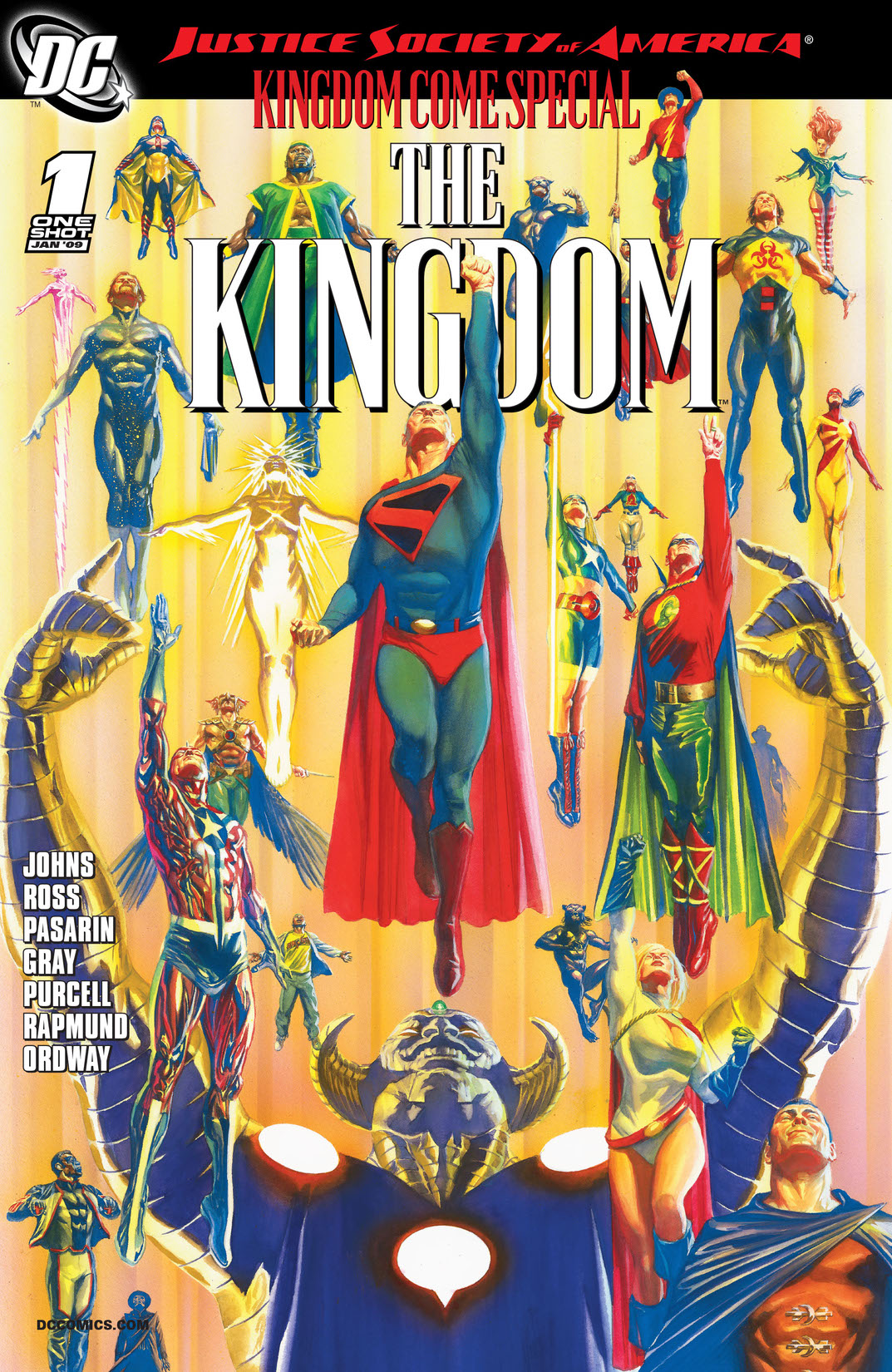
    • Justice Society of America: Kingdom Come Special: The Kingdom #1
    • Justice Society of America vol. 3 #21-22
  • Justice Society of America vol. 3 #23-28
  • Justice Society of America 80-Page Giant #1 
  • Justice Society of America vol. 3 #29-40
  • The Dark Things
    • Justice League of America vol. 2 #44-46
    • Justice Society of America vol. 3 #41
    • Justice League of America vol. 2 #47
    • Justice Society of America vol. 3 #42
    • Justice League of America vol. 2 #48
    • Justice Society of America vol. 3 #43
  • Justice Society of America 80-Page Giant 2010 #1
  • Justice Society of America vol. 3 #44-50
  • Justice Society of America 80-Page Giant 2011 #1
  • Justice Society of America vol. 3 #51-54

Note that there were two books that seem like they ought to be part of this reading order, but I omitted. Justice Society of America Annual #2 ties into JSA All-Stars vol. 2, and is best read after #3 of that title; Justice Society of America Special #1 concludes a three-part storyline that began in Magog #11 and 12; there is no best place to read it because no one will ever trick me into reading Magog.

This post is a supplement to an ever-expanding series about the Justice Society and Earth-Two. The next installment covers Power Girl: Power Trip Terra. Previous installments are listed below:

16 October 2023

Justice Society of America 80-Page Giants by Jesus Merino, Jesse Delperdang, Freddie Williams II, Scott Hampton, Victor Ibàñez, et al.

Alongside Justice Society of America vol. 3, DC published three "80-Page Giants," collections of seven ten-page stories (the other ten pages are ads). I have a lot of time for the 80-page giant format (see entry #11 in this series below, for example); usually these kind of collections will have a couple stories by big name writers and artist to anchor them, and then work by newer writers and artists to develop talent. I think the format works particularly well here, as a companion to an ongoing series, as it lets the creators spotlight characters from the main series in different situations, with a variety of voices and styles.

The first has a framing narrative, set between Jerry Ordway's and Bill Willingham's runs on the parent title. In the frame, the JSA brownstone becomes subject to dream logic, as characters move through time and appear and disappear at random. I kind of suspect this was picked to smooth over discontinuities between stories, but I didn't care because I thought it worked really well. It has a good dreamlike feeling to it, as characters disappear between page transitions and the logic is a bit hard to follow but also not totally random.

from Justice Society of America 80-Page Giant #1
(script by Zander Cannon, art by Scott Hampton)
Not all of the stories are great, of course, but I found enough to be worth reading. I liked "Heart of Steel" (Felicia D. Henderson, Renato Guedes, and José Wilson Magalhaes), which gives some much-needed pathos to Citizen Steel, "Mother's Little Secret" (Jerry Ordway), which explores the history of the new Wildcat, and "Spin Cycle" (Jen Van Meter, Jesus Merino, and Jesse Delperdang), which is a cute meeting between Cyclone and Power Girl while doing laundry. Particularly nightmarish is "Damage" (Zander Cannon and Scott Hampton), a bizarre story about Doctor Mid-Nite surgically removing people from Damage's insides, which I can't imagine working in any other format; good use of the frame, and a great collision of writing and art.

The other two collections have no frame; they're just collections of seven stories apiece. Typically, a few stories take place at the "now" of when the issue was released, and then a few must take place earlier on in the run of Justice Society vol. 3 based on what characters are present. These I liked for their spotlights on characters who may have been present in the main title, but were often unfocused on as it jerked from big event to big event. For example, one of my complaints about the parent title would be how Obsidian was either demoted to a disembodied presence or turned into an egg or going nuts again, so I appreciated "...the Not-So-Secret Origin of Obsidian!" (Marc Andreyko, Mike Norton, and Bill Sienkiewicz), which gave some unity to his disparate appearances and connected to what was being done with the character in Manhunter at the same time.

Liberty Belle/Jesse Quick quickly established herself as a favorite in Justice Society vol. 3 even though I felt like she didn't actually get much to do, so I enjoyed "Unstoppable" (Robert T. Jeschonek and Victor Ibàñez) where she takes on abusers, and "Guiding the Gifted" (Drew Ford, Andy Smith, and Keith Champagne), where she protects a kid with new powers. They both had a good domestic focus, but also a clear indication of how she doesn't take any crap. (Should I expand this ever-lengthening project to track down her appearances in Titans?) And again, there was a good Citizen Steel story in "The Tin Man" (Matthew Cody and Tim Seeley), where he falls in love with a patient he can never touch. I never really liked Steel much in the main series, so I was grateful for the positive focus these issues gave him.

from Justice Society of America 80-Page Giant 2011 #1
(script by Adam Beechen, art by Howard Chaykin)
I also appreciated this series following up on dropped plot points from the main one; for example, during James Robinson's run, Green Lantern became the guardian of a magic city on the moon, but Marc Guggenheim did little with this; here, we get "City of Light & Magic" (Matt Kindt and Victor Ibàñez), which actually looks into this. There's also one historical story, "Duty, Honor, Country" (Adam Beechen and Howard Chaykin), which is told from the perspective of the guy designated to serve papers to the Justice Society for their congressional hearing back in the 1950s. A neat angle on a story the comics have revisited a lot.

Overall, I was often disappointed with how Justice Society vol. 3 was jerked from big event to big event, eschewing the character focus that makes team books so appealing to me. These three anthologies did a lot to rectify that, and I was glad I incorporated them into my reading experience. Alas, the stories are not collected so far as I know, and the issues are not available on DC Universe Infinite, so if you want to follow my lead, you'll need to track them down on the secondary market.

Justice Society of America 80-Page Giant (Jan. 2010), Justice Society of America 80-Page Giant 2010 (Dec. 2010), and Justice Society of American 80-Page Giant 2011 (Aug. 2011) were each originally published in one issue. The stories were written by James Robinson, Felicia D. Henderson, Kevin Grevioux, Jerry Ordway, Jen Van Meter, Zander Cannon, Lilah Sturges, Marc Andreyko, Robert T. Jeschonek, Justin Peniston, Christina Weir & Nunzio DeFilippis, Jason Starr, Freddie Williams II, Brandon Jerwa, Steve Niles, B. Clay Moore, Matt Kindt, Matthew Cody, Drew Ford, Ivan Brandon, and Adam Beechen. They were pencilled by Neil Edwards, Renato Guedes, Roberto Castro, Jerry Ordway, Jesus Merino, Scott Hampton, Freddie Williams II, Mike Norton, Victor Ibàñez, Tonci Zonjic, Jesse Delperdang, Leandro Fernandez, Mateus Santolouco, Josh Adams, Tim Seeley, Andy Smith, Nic Klein, and Howard Chaykin, and they were inked by Wayne Faucher, José Wilson Magalhaes, John Floyd, Jerry Ordway, Jesse Delperdang, Scott Hampton, Freddie Williams II, Bill Sienkiewicz, Victor Ibàñez, Tonci Zonjic, Jesus Merino, Leandro Fernandez, Mateus Santolouco, Bob McLeod, Tim Seeley, Keith Champagne, Nic Klein, and Howard Chaykin. Colors were provided by Mike Thomas, David Curiel, Allan Passalaqua, Danny Vozzo, the Hories, Zac Atkinson, Tonci Zonjic, Alex Bleyaert, Chris Beckett, Mateus Santolouco, Thomas Chu, Nic Klein, and Jesus Aburtov, and letters by Rob Leigh, John J. Hill, and Swands. The stories were edited by Chris Conroy, Rachel Gluckstern, Mike Carlin, and Joey Cavalieri.

This post is forty-fifth in an ever-expanding series about the Justice Society and Earth-Two. The next installment is a supplement covering a reading order for Justice Society of America volume 3. Previous installments are listed below:

09 October 2023

"During the days of World War II, a group of costumed mystery men gathered to form the first and greatest super-hero team of all time: THE JUSTICE SOCIETY OF AMERICA! Now, fighting side-by-side with the surviving original members, a new generation of heroes has been born, promising to uphold the legacy their predecessors created--while inspiring today's heroes the world over. The J.S.A. lives again!"

The end of the 1999-2006 JSA ongoing was not the end of the JSA. A few months after that title's cancellation, it was reborn as Justice Society of America (the third comic of that title from DC). Geoff Johns returned as writer to launch the new comic, alongside artists like Ruy José, Fernando Pasarin, Rodney Ramos, and Dew Geraci. The new Justice Society embraced the "legacy" stylings of its predecessor very explicitly; the JSA was reformed in order to find and mentor new heroes, especially new heroes with some kind of Golden Age link. While original-era members like the Flash, Green Lantern, and Wildcat stayed on, as did preexisting legacy members like Stargirl, Power Girl, and Hourman, they were also joined by a mix of preexisting legacy characters that hadn't already been JSA members like Liberty Belle, Damage, and the Starman of the Legion, and totally new legacy characters like a new Mr. America, a new Amazing-Man, Cyclone (carrying on the legacy of the original Red Tornado), and even a guy who is descended from President Franklin D. Roosevelt (not a member of the JSA but arguably its founder).

This seems like a good premise, but it's difficult to tell, and to the extent that I can tell, it didn't work for me under Johns. Geoff Johns writes (or cowrites) most of the series's first twenty-six issues, plus some specials and annuals. One big problem is that there are simply too many characters, and the series never stops adding new ones; it just gets exhausting, and you never get to know any of the new characters because new new ones are constantly being added. I like the idea of mentoring, but we rarely get to see it in action in a meaningful way.

The other problem is that Johns's run is mostly in service of a couple big events after the opening arc, which prevents us from actually seeing the status quo in action. The opening arc (issues #1-4) is typical Geoff Johns, in all the worst ways: not much meaningful character stuff, lots of gratuitous violence, just unpleasant to read. Lots of references to old comics without understanding what actually made those old comics enjoyable to read. I would have very happily found out what, for example, Len Strazewski (writer of volumes 1 and 2 of Justice Society) might have done with such a premise, for example.

Once this comes to an end we plunge into The Lightning Saga (issues #5-6), a crossover with Justice League of America which is pretty bad: basically the JSA and JLA wander around aimlessly for five issues while the Legion of Super-Heroes carries out an overcomplicated plan that they don't explain for any readily apparent reason. We then get a small breather, which contains one of the two good issues of Johns's run, #8, where we see what married couple Liberty Belle and Hourman (their whole romance happened between JSA and this book unless I missed something) get up on a day-to-day basis.

But after this the comic becomes virtually unreadable, as it becomes tied up in a storyline of eighteen issues! No idea is worth taking over a comic book for eighteen issues, and this one certainly isn't. The basic premise is a decent idea: a sequel to Kingdom Come. The book posits that the events of Kingdom Come (which I have read, but evidently did not write up on this blog) came about because they took place in a world with no JSA to mentor the new heroes. The Superman of Kingdom Come arrives on the JSA's Earth and in the JSA's time, and has to watch as what happens on his Earth happens all over again... can the JSA head it off? A cracker of a premise, but it totally falls flat in execution.

There are two main problems. One is that instead of a gradual moral deterioration of heroes, what we mostly get is a big giant being (supposedly a god) being discovered in Africa and walking around doing nice things. There's no sense of threat, and of course he turns out to be bad, and of course he gets stomped down. Using the myth of Gog and Magog tries to make this apocalyptic, but it does not come across as high-stakes at all.

The other is that the JSA divides into two groups over this: ones who support Gog, and ones more skeptical of him. This is repeated from the Black Adam story in JSA, and moreover, Johns repeats one of that story's principal weaknesses: the only characters who support Gog are new characters who are clearly in the wrong. Wow, we have Green Lantern, the Flash, and Stargirl on one side... and the new Wildcat, the new Amazing-Man, Citizen Steel, and Mr. America on the other? Gosh, who could be the group who is in the right? It's all so obvious and dull. Its main saving grace is a one-issue special written and illustrated by Alex Ross about the Kingdom Come Superman; on the other hand, a brief story about Power Girl going to Earth-Two and meeting the pre-Crisis Infinity, Inc. is terrible despite Infinity, Inc. penciller Jerry Ordway on art.

Johns's other good story is a cute Stargirl tale (#26) about her birthday party. If he wrote more stuff like this, and less stuff like Thy Kingdom Come, I would have enjoyed his run a lot more.

Once Johns leaves, the series never settles into a new regular writer for very long. We get runs by Jerry Ordway (#27-28), Bill Willingham and Lilah Sturges (#29-33), Bill Willingham alone (#34-40), James Robinson (#41-43), and Marc Guggenheim (#44-54), taking us right up to Flashpoint and the obliteration of the JSA from DC history. (Well, until whenever they bring it back... they probably already have.) Ordway's story is decent, but for me the only one of these to actually be successful was Willingham's.

In its phase being cowritten with Sturges, it's dragged down by having to set up a very stupid split of the JSA into two different ongoings. This comes right after a story about the JSA almost splitting, so it feels repetitive, and it all seems vaguely misogynist, in that no sooner does the JSA get its first female leader in Power Girl than it falls apart. (Meanwhile, over in JLA, it also got its first female leader in Black Canary, and it also falls apart!) But aside from that (obviously editorially imposed), Willingham's run is quite fun. Good character focus, good jokes, clever storytelling. If only it had lasted longer; I particularly enjoyed his two-part Doctor Fate story, and I liked how he actually made something of the relationship between Green Lantern and Obsidian, which most JSA writers have mangled and/or ignored. Unfortunately, he left the book rather than have to write a JLA crossover... and indeed, James Robinson's JLA/JSA crossover The Dark Things is so uninteresting I can't even be arsed to explain why. (But why does Liberty Belle revert to her Jesse Quick identity?)

There's some potential in Guggenheim's run, but unfortunately 1) it sees yet another status quo change, with the JSA moving yet again (they previously moved from New York to Happy Harbor in Willingham's run), to Monument Point, a DC suburb, and 2) things start changing a lot, with the members who left during the split returning with no explanation, and a bunch of random new people joining the team, like the Blue Devil. Plus, the story clearly got wrapped up quickly to make way for thew New 52, and it doesn't really follow up on anything set up by Willingham or Robinson. (Also why does the original Liberty Belle suddenly show up?)

And that was it! Then the "New 52" came along, and the new continuity—where Superman the first superhero had debuted five years ago—had no place for the JSA. DC erased one of its most distinctive features. But that's not it for me, I have a few more things to read before I'm finally done with the Justice Society...

This post is forty-fourth in an ever-expanding series about the Justice Society and Earth-Two. The next installment covers the Justice Society of America 80-Page Giants. Previous installments are listed below:

05 April 2023

JSA: Ragnarok by Paul Kupperberg

JSA: Ragnarok
by Paul Kupperberg

Ragnarok is a prose novel originally intended for publication in early 2006, supposed to be the first part of a JSA trilogy from iBooks. However, the owner of iBooks died in a car crash and his company limped on for a bit before going into bankruptcy. The manuscript was due to go to the printers when everything came to a halt. Fourteen years later, the author, Paul Kupperberg (writer of many DC comics, but most relevant to this project, a couple issues of All-Star Squadron) was able to finally get the book released through indie publisher Crazy 8 Press. I bought the book when it was released, and decided that I would read it as part of my JSA marathon around the time it would have been released. Early 2006 would put it after JSA, during the run of JSA Classified, and before volume 3 of Justice Society of America, so I read it following JSA Classified.

Published: 2020
Acquired: December 2020
Read: February 2023

It is actually set during JSA, a bit before the events of Infinite Crisis (more on that later, though), and it features the JSA line-up of that time: Green Lantern, the Flash, Mr. Terrific, Power Girl, Jakeem Thunder, Sand, Wildcat, Stargirl, and so on. The book chronicles an encounter between the Justice Society and the Injustice Society, here led by the Wizard. The Injustice Society is trying to hunt down the Spear of Destiny and release a Norse god; the Spear of Destiny is of course the artifact Hitler used to keep American superheroes out of Nazi-occupied Europe according to All-Star Squadron, and there's an extended flashback in the middle of the book chronicling what happened to the Spear after the end of the war. It also ties into Last Days of the Justice Society of America, as part of the Wizard's plan is to send the JSA back into Ragnarok.

Kupperberg is primarily, I believe, a comics writer, and overall a solid one, the kind of comics writer who is not distinctive enough to be a favorite, but who typically turns in work that, well, works. I do have fond memories of his Starfleet Corps of Engineers novella Sargasso Sector, which would have been written around this same time, but I didn't find the book very gripping.

Superheroes in prose is a very tricky thing, and I've found that few have managed it well (basically just Elliot S. Maggin and Marv Wolfman, to be honest). Overall, basically, the book is fine. Many of the characters have little moments of development, but they are pretty generic and don't really feel like they arise out of the plot and themes of the novel, nor does it feel like much is ever at stake for them. The story is a bit slow considering how long it is, and the action doesn't jump off the page. This isn't to say it's terrible or anything; I found it a diverting way to spend a couple days. But it did feel to me like the promise of a JSA novel is a bit more than what we got here: these are characters with more depth and history than your average DC superhero, and I would have liked to have seen that explored in a more novelistic way, while what we have here feels more like a comic on the page, not really playing to the strengths of the medium.

I did enjoy, though perhaps it was a bit too long, a flashback to the JSA after V-E Day, drawing a lot on retcons established in All-Star Squadron and other post-Crisis stories. (For example, the Hippolyta Wonder Woman turns up, and her affair with Ted Grant is mentioned.) That period stuff is always a win for me. There's another flashback that didn't work for me, though, which is to the events of Last Days. Near the end of the novel, the Wizard tries to send the JSA back into Ragnarok, so we get a flashback showing us the original events of that story. Specifically, the flashback tries to emphasize why Alan Scott would really really not want to go into this. But a flashback only a couple chapters before the climax of your novel really disrupts the pacing, and the groundwork it lays would have been better laid earlier, in more detail. A good idea, but needed more to support it.

The book as a book is clearly small press, and could have used some better typesetting and proofreading: some em-dashes are left as two hyphens, for example, and sometimes the book shifts into the present tense for a single paragraph.

I do, of course, have some continuity issues. The book has to take place after JSA #50, because Power Girl knows that her Atlantean backstory is false, which is something she learns in that issue. It has to take place before JSA #59, because that's the issue where Captain Marvel leaves the team. However, from issue #50 to #64, Sand isn't present in the JSA because he's been turned into actual sand—so there's no actual time where the line-up present in this book all exists.

Kupperberg also does some retconning for the post-Crisis history of the JSA. The events of Last Days took place after the Crisis on the Infinite Earths; the story begins with the JSA at the funeral for the Earth-Two Huntress and Dick Grayson, who both died in the Crisis. But of course they couldn't exist at all post-Crisis, and so when Kupperberg retells those events, he makes it the funeral of the original Mr. Terrific, who died in the 1979 JLA/JSA team-up. At the funeral, Green Lantern thinks about how the JSA is stepping down and Infinity, Inc. is kind of supplanting it, so Kupperberg has moved the death of Mr. Terrific (Year Nine on my timeline) later or the founding of Infinity, Inc. earlier (Year Ten on my timeline). It's reinforced when in that flashback, Alan Scott thinks about his daughter Jade, but he didn't know she was his daughter until Infinity, Inc. Annual #1 (Year Eleven on my timeline). (And, weirdly, he doesn't think about his son Todd at all. I get why Todd isn't mentioned in the present-day stuff, as he's evil from the time of JSA #1 to #52, but why doesn't Alan think of him fondly in the flashbacks?) Most of this isn't an issue, but I just found it interesting.

This post is fortieth in an ever-expanding series about the Justice Society and Earth-Two. The next installment covers Catwoman: Her Sister's Keeper. Previous installments are listed below:

30 January 2023

The Stories between the Stories: JSA Classified

In 2005, the Justice Society reached a new milestone: two ongoing series at once. JSA Classified lasted thirty-nine issues, from Sept. 2005 to Aug. 2008, which means it overlapped with both JSA (which ended Sept. 2006) and Justice Society of America vol. 3 (which began Feb. 2007).

Those other ongoings were clearly the "main" ones. JSA Classified featured rotating creative teams on shorter stories that focused on one or two or occasionally a couple more JSA members at a time. There are two four-part stories; the rest are usually two- or three-parters, with the occasional one-off. No writer or artist works on more than one storyline, with the exception of Alex Sanchez (who illustrates two stories for a total of five issues) and Jimmy Palmiotti (who inks two stories for a total of eight issues, making him the series's most prolific contributor).

Very little of the series has been collected. Issues #1-4, a Power Girl story by Geoff Johns and Amanda Conner, have been collected a few times; I previously read them in The Sequential Art of Amanda Conner. #5-9 were collected as Honor Among Thieves, the only JSA Classified–branded trade. A couple more issues have been chucked into collections here and there: #21-22, by Walter Simonson, were included in Hawkgirl: Hawkman Returns and #25 and 32-33 were part of JSA Presents Green Lantern. Rather than track down the floppies, I decided to read the whole series on DC Universe Infinite, except I skipped the issues in JSA Presents Green Lantern, since I had just read that trade.

As you might expect for an anthology series, some stories are better than others. I'm not going to go blow by blow, but I will give you some highlights.

When I first read Power Trip (#1-4, by Geoff Johns, Amanda Conner, and Jimmy Palmiotti), I didn't like it; rereading it made it even worse. It's a story focused on continuity with nothing to say about character... except it doesn't even really say anything about continuity, either, as the story is just a series of fakeouts about things that are not Power Girl's origin. Amanda Conner's art is brilliant, though, and it made me decide to incorporate her Power Girl ongoing into this project.

On the other hand, I was pleasantly surprised by Honor Among Thieves (#5-7, by Jen Van Meter, Patrick Olliffe, et al.). This is about the Injustice Society planning a heist in JSA headquarters, and I have found most modern takes on the Injustice Society, from Roy Thomas on, gratuitously violent. But Jen Van Meter produces a charming story about underdogs who have to work together to do something that's, well, if not the right thing, not the worst thing either. I liked it a lot, and I'm excited to see that Van Meter returns to some of these characters in a backup she writes for Justice Society vol. 3.

Another villain-focused story did have the problems of gratuitous violence: "The Fall & Rise of Vandal Savage" (#10-13, by Stuart Moore, Paul Gulacy, and Jimmy Palmiotti) just went on and on and on, and had little of interest. Similarly, I didn't like the two Doctor Mid-Nite stories, "Skin Trade" (#19-20, by Scott Beatty, Rags Morales, and Michael Bair) and "Nightfall" (#23-24, by J. T. Krul, Alex Sanchez, and Jack Purcell). Both had lots of squicky stuff. Worse, "Skin Trade" mutilates some minor characters from other series just to prove the situation is serious, one of my least favorite superhero tropes. (On the other hand, it did pick up an interesting loose end from Ultra-Humanite's backstory.)

But when the series is great, it's really great. One thing I didn't like about Geoff Johns's JSA run is that the actual people of the JSA often seemed lost in the way the series lurched from massive event to massive event. Here, we get a lot of nice character-focused stories about the people who make the world's first superhero team also its best. I am not a Scott McDaniel fan, nor a Bane one, so I was pleasantly surprised by "The Venom Connection" (#17-18, by Tony Bedard, Scott McDaniel, and Andy Owens), where Bane comes to Hourman and his son Hourman, seeking help with Venom... which it turns out might be related to the drug that gives them their powers, Miraclo. It's a great focus on the younger Hourman, Rick Tyler, and also Bane himself, with some good (if comic-book-level) discussion of addiction.

I often feel like Wildcat gets a bit flanderized: ooh, he talks funny and he gives Power Girl crap and he drinks beer. So again, I was pleasantly surprised when I ended up enjoying all three of JSA Classified's Wildcat stories: "Fight Game" (#26-27, by Frank Tieri, Jerome Moore, et al.), "Forward through the Past" (#35-37, by B. Clay Moore and Ramon Perez), and "Body and Soul" (#38-39, by Mike W. Barr and Shawn Martinbrough). Each story does a good job focusing on his history, and tying into his interest in wrestling without making it contrived. He uproots a gambling ring, takes on criminals using his old gyms in Gotham, and stops people from stealing the mental patterns of retired wrestlers. Each story is solid, but I particularly enjoyed "Forward through the Past," which has some great character-focused writing and, especially, great art. I don't know that I've ever really registered either B. Clay Moore or Ramon Perez before, but I will look out for more by them. Their depiction of the relationship between Wildcat and Catwoman intrigued me, so now I plan to circle back and read a couple stories about that as well.

The only other stories I found particularly bad were the Justice League Detroit one, "Double or Nothing" (#14-16, by Steve Englehart, Tom Derenick, et al.), and the Mr. Terrific one, "Mr. Horrific" (#29-31, by Arvid Nelson and Alex Sanchez). The former was confusing and poorly explained—and also I'm totally over stories where villains force heroes to fight each other for gambling purposes. Maybe I'll like it more when I reread it in the Justice League Detroit omnibus? But I kind of doubt it. "Mr. Horrific" was just awful: nonsensical leaps in the writing, ugly impenetrable artwork.

Beyond that, you have a number of solid, enjoyable stories. If I have an overall complaint, it's that I wish we'd seen more JSA members. Some more focus on the younger members would have been good; Stargirl's only story was the terrible "Double or Nothing," and Jakeem Thunder just gets a one-parter (#28, by Fabian Nicieza and Steve Uy). Or, it would be nice to open the series up some more so it's not so focused on the present-day JSA: give me a good Atom story, or a good World War II–era one, or whatever.

But on the whole I liked it a lot, more than I expected. I kind of though it was a series to burn off bad fill-ins by mediocre creative teams, but it was nothing like that at all. To be honest, I wish the regular JSA series had been more like this: nothing overdramatic, just good character-focused stories drawing on these people's long histories.

This post is thirty-ninth in a series about the Justice Society and Earth-Two. The next installment covers JSA: Ragnarok. Previous installments are listed below:
  1. All Star Comics: Only Legends Live Forever (1976-79)
  2. The Huntress: Origins (1977-82)
  3. All-Star Squadron (1981-87)
  4. Infinity, Inc.: The Generations Saga, Volume One (1983-84)
  5. Infinity, Inc.: The Generations Saga, Volume Two (1984-85)
  6. Showcase Presents... Power Girl (1978)
  7. America vs. the Justice Society (1985)
  8. Jonni Thunder, a.k.a. Thunderbolt (1985)
  9. Crisis on Multiple Earths, Volume 7 (1983-85)
  10. Infinity, Inc. #11-53 (1985-88) [reading order]
  11. Last Days of the Justice Society of America (1986-88)
  12. All-Star Comics 80-Page Giant (1999)
  13. Steel, the Indestructible Man (1978)
  14. Superman vs. Wonder Woman: An Untold Epic of World War Two (1977)
  15. Secret Origins of the Golden Age (1986-89)
  16. The Young All-Stars (1987-89)
  17. Gladiator (1930) ["Man-God!" (1976)]
  18. The Crimson Avenger: The Dark Cross Conspiracy (1981-88)
  19. The Immortal Doctor Fate (1940-82)
  20. Justice Society of America: The Demise of Justice (1951-91)
  21. Armageddon: Inferno (1992)
  22. Justice Society of America vol. 2 (1992-93)
  23. The Adventures of Alan Scott--Green Lantern (1992-93)
  24. Damage (1994-96)
  25. The Justice Society Returns! (1999-2001)
  26. Chase (1998-2002)
  27. Stargirl by Geoff Johns (1999-2003)
  28. The Sandman Presents: The Furies (2002)
  29. JSA by Geoff Johns, Book One (1999-2000)
  30. Wonder Woman: The 18th Letter: A Love Story (2000)
  31. Two Thousand (2000)
  32. JSA by Geoff Johns, Book Two (1999-2003)
  33. Golden Age Secret Files & Origins (2001)
  34. JSA by Geoff Johns, Book Three (1999-2003)
  35. JSA by Geoff Johns, Book Four (2002-03)
  36. JSA Presents Green Lantern (2002-08)
  37. JSA #46-87 (2003-06)
  38. JSA: Strange Adventures (2004-05)

04 January 2023

JSA: Strange Adventures by Kevin J. Anderson, Barry Kitson, and Gary Erskine

JSA: Strange Adventures

Collection published: 2010
Contents published: 2004-05
Acquired and read: December 2022

Writer: Kevin J. Anderson
Penciller/Breakdowns: Barry Kitson
Inker/Finishes: Gary Erskine
Letterer: Rob Leigh

I think this might be the last "continuity insert" storyline of my Justice Society reading: that is to say, the last story set entirely in the "past" of the DC Universe relative to when it was published. Like Superman vs. Wonder Woman, Steel, the Indestructible Man, All-Star Squadron, The Young All-Stars, The Crimson Avenger, The Demise of Justice, The Justice Society Returns!, and All-Star Comics 80-Page Giant, this is entirely set during World War II, fleshing out the Golden Age in a modern style—which to me has become one of my favorite types of JSA story.

Unfortunately it is not very good. It is a a long miniseries, at six 30-page issues, but less seems to happen in it than in many minis of four 20-page issues. Before I picked this up, I was reading Don McGregor's Jungle Action run, and it took me longer to read a 17-page issue of Jungle Action than a 30-page issue of this. Like, there are lots of boring fights and boring meetings; the characters have long conversations about things that aren't interesting and don't matter.

This story seems to think the Star-Spangled Kid was a JSA member for some reason.
from JSA: Strange Adventures #5
The characters themselves are fairly generic. In "continuity insert" stories like The Demise of Justice and The Justice Society Returns!, the writers and artists were able to express the depths and personality of these Golden Age characters, but there's barely any of that here. It wants to be a Johnny Thunder story, about his desire to be a writer, but this doesn't go anywhere interesting. Johnny befriends the real Golden Age science fiction writer Jack Williamson, and this could be fun and meta, but unfortunately, it makes for long boring scenes. I don't rate Kevin J. Anderson very much as a writer, so I was not surprised by any of this... I was however disappointed, because I was hopeful anyway. I did kind of think the usually excellent Barry Kitson might be able to save it, but if there's nothing interesting to draw, it doesn't matter how well you draw it.

This post is thirty-eighth in a series about the Justice Society and Earth-Two. The next installment covers JSA Classified. Previous installments are listed below:
  1. All Star Comics: Only Legends Live Forever (1976-79)
  2. The Huntress: Origins (1977-82)
  3. All-Star Squadron (1981-87)
  4. Infinity, Inc.: The Generations Saga, Volume One (1983-84)
  5. Infinity, Inc.: The Generations Saga, Volume Two (1984-85)
  6. Showcase Presents... Power Girl (1978)
  7. America vs. the Justice Society (1985)
  8. Jonni Thunder, a.k.a. Thunderbolt (1985)
  9. Crisis on Multiple Earths, Volume 7 (1983-85)
  10. Infinity, Inc. #11-53 (1985-88) [reading order]
  11. Last Days of the Justice Society of America (1986-88)
  12. All-Star Comics 80-Page Giant (1999)
  13. Steel, the Indestructible Man (1978)
  14. Superman vs. Wonder Woman: An Untold Epic of World War Two (1977)
  15. Secret Origins of the Golden Age (1986-89)
  16. The Young All-Stars (1987-89)
  17. Gladiator (1930) ["Man-God!" (1976)]
  18. The Crimson Avenger: The Dark Cross Conspiracy (1981-88)
  19. The Immortal Doctor Fate (1940-82)
  20. Justice Society of America: The Demise of Justice (1951-91)
  21. Armageddon: Inferno (1992)
  22. Justice Society of America vol. 2 (1992-93)
  23. The Adventures of Alan Scott--Green Lantern (1992-93)
  24. Damage (1994-96)
  25. The Justice Society Returns! (1999-2001)
  26. Chase (1998-2002)
  27. Stargirl by Geoff Johns (1999-2003)
  28. The Sandman Presents: The Furies (2002)
  29. JSA by Geoff Johns, Book One (1999-2000)
  30. Wonder Woman: The 18th Letter: A Love Story (2000)
  31. Two Thousand (2000)
  32. JSA by Geoff Johns, Book Two (1999-2003)
  33. Golden Age Secret Files & Origins (2001)
  34. JSA by Geoff Johns, Book Three (1999-2003)
  35. JSA by Geoff Johns, Book Four (2002-03)
  36. JSA Presents Green Lantern (2002-08)
  37. JSA #46-87 (2003-06)

14 December 2022

“During the days of World War II, a group of costumed mystery men gathered together to form the first and greatest super-hero team of all time. Now, fighting alongside the surviving original members, a new generation of heroes has been born.... Today, the JUSTICE SOCIETY OF AMERICA lives again!”

DC's JSA by Geoff Johns collections stalled out after four volumes, going up to issue #45. But JSA ran for another forty-two issues beyond that. I ended up deciding the best way to read issues #46-87 (May 2003–Sept. 2006) was through DC's digital comic service, DC Universe Infinite, where for a monthly fee you can access a vast collection of back issues. It doesn't have a Kindle app, but it worked perfectly fine in the browser on my tablet. Some of this run I had read before; specifically, I had read #56-67 and 76-81 as part of my Sandman spin-offs project, as those issues had significant developments for Lyta Hall, mother of the second Dream.

I think there are clearly two big influences on this run of JSA, which is mostly, but not entirely, written by Geoff Johns. (David Goyer departs after five issues; Keith Champagne writes some fill-ins around the time of Infinite Crisis; the series is closed out in a five-issue arc by Paul Levitz.) The first is Paul Levitz's All-Star Comics, which was the first ongoing run to do the thing Johns does here (as signalled in the first-page blurb I've used in my post title): mix original JSA heroes with a new generation. Levitz's series co-starred WWII-era JSA members like Wildcat and Green Lantern with descendants and legatees like Huntress and Power Girl. Johns very much takes that approach; Jay Garrick co-exists with Jakeem Thunder. The other influence is Roy Thomas's Infinity, Inc. That comic wasn't a JSA one, but focused on the JSA's legacy. Thomas's comic evolved the status quo of many JSA characters, giving them children and marriages and new life developments. Put both of these approaches together and, I would argue, you have the major influences on Geoff Johns's approach to JSA.

JSA even features a variety of one-time Infinc stars: Al "Nuklon" Rothstein is now the JSA's Atom-Smasher. Rick Tyler, son of the original Hourman, is one of three different Hourmen to serve during this run. Alan Scott's daughter Jade puts in a few appearances, his son Obsidian does so as well. Hector "Silver Scarab" Hall is the new Doctor Fate, and his wife Lyta "Fury" Hall is brought out of the Vertigo universe. Northwind and Brainwave Jr. show up, as well, and though Yolanda "Wildcat" Martinez is dead, her cousin is a recurring character. Power Girl wasn't a big Infinc player outside of its opening arc, but she's here too. The Star-Spangled Kid is dead, but of course JSA member Stargirl inherits his legacy, and his sidekick. Basically the only Infinity, Inc. members to not show up or influence JSA are Helena "Huntress" Wayne, who was eradicated from continuity, and Beth "Doctor Midnight" Chapel, who was dead (and is never even mentioned because she was replaced by a white man).

But if you are an Infinity, Inc. fan there is little to enjoy in the callbacks. Of the original Infinity, Inc. members, Atom-Smasher, Obsidian, Northwind, and Brainwave all become villains during JSA. So does Wildcat's cousin. One or two could be interesting, but when it happens to four-or-five of them, it begins to feel repetitive and obnoxious. Part of the joy of superhero comic universes is to see characters you like again and again... but it brings me no joy for Northwind to be reduced to a snarling animal without any dialogue and turn evil for no readily apparent reason. (And let's not linger on the optics of this happening to a character coded as Native American.) Same goes for Obsidian, for Brainwave, for Atom-Smasher. I liked these characters in Infinity, Inc.; my reward for that is to see Brainwave assaulting people. Rick Tyler is killed off so his father can be brought back. Hector and Lyta do okay, at least.

As an undergraduate, I read a little bit of—or, to be honest, maybe just about—the "anxiety of influence" in a class on performativity in Victorian drama. That was twenty years ago, so I cannot claim to be au fait with the ideas of Harold Bloom. But I seem to recall that the later writer is anxious about the influence of the earlier writer, and thus in many cases seeks to destroy or undermine him. Does Geoff Johns destroy Roy Thomas's characters as a way of attempting to eradicate Roy Thomas's influence on him? I don't know enough about Bloom to say... but it was a pretty obnoxious pattern to see play out in this title again and again.

When JSA isn't involved in multi-part storylines about mass murder, which is unfortunately most of the time, it's a pretty good comic book. I usually liked the done-in-ones the best; there's a fun Thanksgiving issue, and a great Christmas issue about the JSA protecting Santa Claus. There's a nice Stargirl story about what she's up to during Infinite Crisis. But I found much of this run an unappealing slog, with little of the sense of fun or brightness or character that makes me enjoy a superhero comic. The basic premise here is good—a multigenerational superhero team where the characters can evolve and change—but little about the execution was ever enjoyable.

This post is thirty-seventh in a series about the Justice Society and Earth-Two. The next installment covers JSA: Strange Adventures. Previous installments are listed below:
  1. All Star Comics: Only Legends Live Forever (1976-79)
  2. The Huntress: Origins (1977-82)
  3. All-Star Squadron (1981-87)
  4. Infinity, Inc.: The Generations Saga, Volume One (1983-84)
  5. Infinity, Inc.: The Generations Saga, Volume Two (1984-85)
  6. Showcase Presents... Power Girl (1978)
  7. America vs. the Justice Society (1985)
  8. Jonni Thunder, a.k.a. Thunderbolt (1985)
  9. Crisis on Multiple Earths, Volume 7 (1983-85)
  10. Infinity, Inc. #11-53 (1985-88) [reading order]
  11. Last Days of the Justice Society of America (1986-88)
  12. All-Star Comics 80-Page Giant (1999)
  13. Steel, the Indestructible Man (1978)
  14. Superman vs. Wonder Woman: An Untold Epic of World War Two (1977)
  15. Secret Origins of the Golden Age (1986-89)
  16. The Young All-Stars (1987-89)
  17. Gladiator (1930) ["Man-God!" (1976)]
  18. The Crimson Avenger: The Dark Cross Conspiracy (1981-88)
  19. The Immortal Doctor Fate (1940-82)
  20. Justice Society of America: The Demise of Justice (1951-91)
  21. Armageddon: Inferno (1992)
  22. Justice Society of America vol. 2 (1992-93)
  23. The Adventures of Alan Scott--Green Lantern (1992-93)
  24. Damage (1994-96)
  25. The Justice Society Returns! (1999-2001)
  26. Chase (1998-2002)
  27. Stargirl by Geoff Johns (1999-2003)
  28. The Sandman Presents: The Furies (2002)
  29. JSA by Geoff Johns, Book One (1999-2000)
  30. Wonder Woman: The 18th Letter: A Love Story (2000)
  31. Two Thousand (2000)
  32. JSA by Geoff Johns, Book Two (1999-2003)
  33. Golden Age Secret Files & Origins (2001)
  34. JSA by Geoff Johns, Book Three (1999-2003)
  35. JSA by Geoff Johns, Book Four (2002-03)
  36. JSA Presents Green Lantern (2002-08)