Showing posts with label series: radiolab. Show all posts

20 February 2026

Talking about Generations

I recently listened to an episode of Radiolab, "Time Is Honey." The exact topic of the episode (bees and the Internet) is not really relevant to the point I am going to make here, what is relevant is that co-host Latif Nasser is trying to find an example of an overloaded website to use in a story he's telling the other co-host, Lulu Miller, like when too many people all get on the same site at one time and that overloads it and no one can access it, or at least, it loads at an agonizing crawl.

The example Latif ends up giving is the Hamster Dance becoming really popular.

And Lulu Miller doesn't know what the Hamster Dance is!

Now, I don't expect everyone to know what the Hamster Dance is. I'm sure my parents don't; I'm sure some younger Gen Xers don't know what it is either. On the other end of the spectrum, I certainly wouldn't expect my Gen Z students to know it, or even younger Millennials. The Interner has gone on to feature much more interesting things. 

But surely if you are a Millennial of a certain age, you must know what the Hamster Dance is. I don't know exactly when Lulu Miller was born, but from Wikipedia, I can tell she was in college in 2005, as was I, so she can't be too far off my own age. Are there really people born c. 1985 who don't know what the Hamster Dance is, who never saw it?

I asked my wife this, and she said that when she has dementia, and can't remember her own name, she'll probably still be able to sing the song. I just don't believe that people my age wouldn't know the Hamster Dance! What strange planet did Lulu Miller grow up on?

This isn't a serious criticism, by the way. I'm sure there are lots of people who didn't know the Hamster Dance. But it kind of boggles my mind to imagine them. I'm sure things like this happen all the time, I'm sure there are things other people perceive as ubiquitous in their own era that some people never actually experienced. I wouldn't say the Hamster Dance is a generation-defining experience (I'm sure Lulu Miller does remember exactly where she was on 9/11)... but it is emblematic of the old weird Internet that used to exist and has largely passed, and that I do feel like was a generation-defining experience.

I hope at least Lulu Miller knows Trogdor.

09 May 2025

Teaching the Medical Humanities: General Course Design

This is the first in a series of (probably) two posts about a class I taught last semester and this. This one covers my general approach to the course.

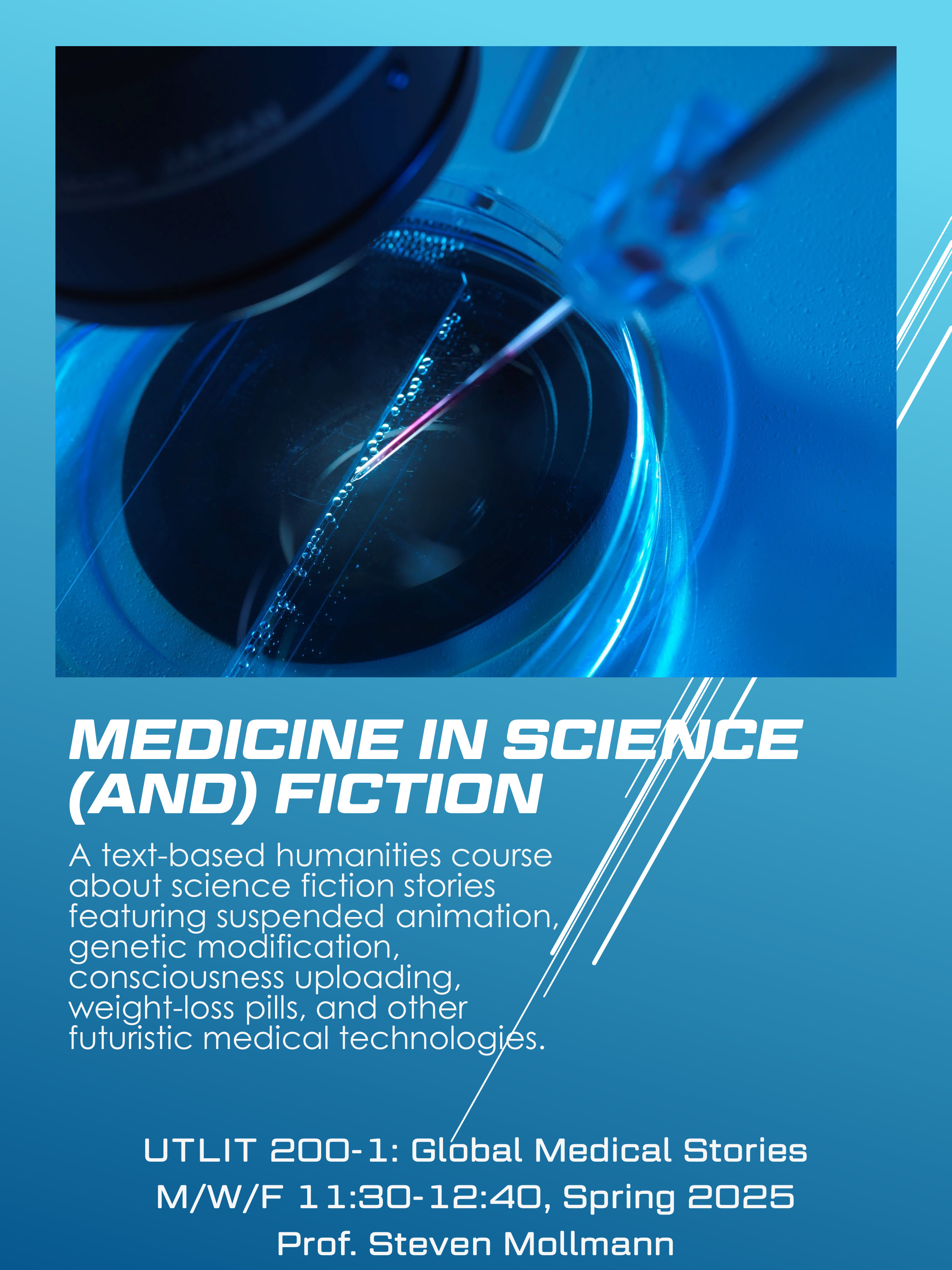
My university has recently implemented a new general education program; faculty members design and propose courses in various areas that students can take to fulfill distribution requirements. For obvious reasons, here in the Department of English and Writing, we offer a lot of courses that fulfill the "text-based humanities" requirement. My colleague Claire proposed one called "Global Medical Stories," where the idea was that students would read different kinds of medical narratives, engaging in the "medical humanities." Classes in our gen ed program have to be able to be taught by a variety of faculty—they can't be classes just one person can teach—so I was asked if I was interested in the class when it was under development, and my name put down on the application. This mean that when a section came open in Fall 2024, I was asked if I wanted to teach it, and I said sure; I then taught another section in Spring 2025. 

Going in I was a bit worried. I'd said "yes" on the basis that a lot of my scholarship ends up discussing medical issues, particularly my work on vivisection, public health, and biocracy. But was I going to teach Wilkie Collins's Heart and Science or Charles Kingsley's Two Years Ago or Fergus Hume's The Year of Miracle in a 200-level gen-ed class? It seemed unlikely. So what would I teach?

Eventually I decided I could probably find a bunch of medical science fiction. That would allow me to discuss interesting issues but also play to my strengths. I will always have plenty to say in a class on sf!

I plotted out a bunch of short stories (more on that in post #2), but felt like I was coming up short of enough to fill up a whole semester; in an act of desperation, I asked the bookstore to order Sinclair Lewis's Arrowsmith. I'd taught it a decade ago and it had worked well, and now, post-COVID, it was even more relevant.

Arrowsmith got me thinking about some episodes of Radiolab I had enjoyed, particularly "Every Day Is Ignaz Semmelweis Day" and "The Great Vaccinator," both of which I thought really explicated some issues the novel raised in a more nonfictional way. When I looked at my colleagues' syllabus, she had a lot of nonfiction about medical topics, but that's not an era I know a lot about... but Radiolab podcasts... now there I'm an expert! (And podcasts are obviously not fiction, but they are stories about medicine, so they fit the class anyway.) I decided to pair a number of course texts with podcasts as a way of showing that the issues in the science fiction stories were issues in the real world as well. Some I was able to come up with myself; a request for suggestions on r/Radiolab also jogged some others in my memory.

Here are the podcasts I ended up doing, organized by what unit I used them in:

  1. Public Health
  2. Disability
    • "Unfit": people with low IQs and sterilization
  3. Genetic Engineering
    • "CRISPR": what CRISPR is and how it works
    • "Seeking Patterns": how a medication changed someone's whole identity
  4. Life Extension
    • "The Bitter End": what lengths doctors would not go to to save their own lives

So, I had a class. Open with Arrowsmith, taking breaks for podcasts, and then do sf in the second half of the course, also with some podcasts. I think the first semester went pretty well, but I refined my approach for the second semester, which I think went even better.

The class requires three "Signature Assignments": two papers and a presentation. It was pretty obvious to make the first paper about Arrowsmith and the second about the sf. The first time, I had the students do video presentations about the topic of their second paper. I don't really enjoy watching video presentations, to be honest, and this seemed to add a lot of work for both me and the students in the last couple weeks of the course. 

Inspired by what my colleague Nicole was doing for presentations in her text-based humanities course, the biggest change I made going into the second semester was to the presentations. This time, I had them pick a podcast I hadn't assigned (Radiolab episodes I hadn't taught, but also some others I knew as well as suggestions solicited on Facebook). I had students present on whatever one they chose, providing a summary of key points and a connection to a text from the class. (Students were allowed to present on ones not on the list as long as they got preapproval from me, but no one did.) I don't know what the students though, but I found them fun and interesting, though I think my prompt needs some slight refinement.

Like many classes, I think the first time went okay and the second time went quite well; I think the exams and papers reflect much more this time out that students are thinking about the kind of things I want them to think. But more when I wrap up my thoughts next time!

18 November 2024

Teaching Notes: Public Health in Sinclair Lewis's Arrowsmith

I'm currently teaching a general education course here at UT, one focused on the medical humanities. That course and its design will probably merit its own post at some point (maybe not until next semester, though, after I reteach it), but for now I want to discuss the novel I assigned.

Arrowsmith by Sinclair Lewis

Originally published: 1924
First read: January 2013
Acquired: June 2014
Previously taught: September 2014
Retaught: September 2024

Originally my thought was to play to my strengths by doing short science fiction about medicine. But as things were getting down to the wire, I wasn't sure if I would have enough short stories to teach without having to do a lot of research to prep the class... research I honestly didn't have time to do. But then I cast my mind back and remembered Sinclair Lewis's Arrowsmith, a novel I taught a decade ago in a class on the novel post-1900. A whole 450-page novel about a doctor trying to find his way in the world! What could be better for using up a month of course time? But also giving us a lot of very relevant things to discuss.

So I put in my book order, and when the semester rolled around, I taught the book. In my link above, you can get a sense of the kind of things I was interested in last time around, and I did do some of that this time, too: Arrowsmith as bildungsroman, Arrowsmith as exemplar for the realist project.

But the big change in the world since the last time I taught Arrowsmith (other than the fact that college students can't cope with a 450-page book anymore, even across three weeks) is, of course, that we have all lived through a major public health crisis... and Arrowsmith is all about public health. Martin Arrowsmith spends a lot of time working in a public health department, trying to convince people to behave rationally in the face of scientific evidence... a struggle we have all now witnessed firsthand. 

I remember making jokes to my class in 2014 about the inanity of the songs Martin's boss at the public health department comes up with to communicate public health messages. At the time, these seemed like goofy 1920s nonsense. But in the 2020s, we did all this! Martin's struggle to get people to put aside their petty prejudices in favor of collective action is something we all saw in real time. I realize now, of course, that Lewis must have been thinking (at least in part) of the Spanish flu, and a student pointed out to me that he was probably also inspired by "Typhoid Mary."

So there was a lot of fruitful material for discussion here. I paired a lot of our course texts with episodes of Radiolab as a way of letting my class get to interesting issues in detail without forcing me to assign a bunch of other reading. I paired Arrowsmith with three:

  • "The Great Vaccinator" (3 Dec. 2020). This episode is about Maurice Hilleman and the creation of the mumps vaccine, the quickest created vaccine prior to COVID, as well as seven others routinely given to children today. I thought of Arrowsmith as soon as I first heard this episode back when it came out because it discusses some of the ethical issues of double-blind testing. When Hilleman did polio vaccine testing, he had to do so in the knowledge that he was letting some kids suffer who might have not suffered if they hadn't been given the placebo—the exact dilemma Martin faces at the climax of Arrowsmith when he can only give half the inhabitants of St. Hubert the bacteriophage that will save them from the plague.
  • "Every Day Is Ignaz Semmelweis Day" (1 Apr. 2020). This episode is about Ignaz Semmelweis, who invented handwashing in a maternity ward in nineteenth-century Vienna. It's a neat episode about the development of something so commonplace now that most people know little about. Semmelweis reminds me a lot of Martin, in that I would argue the personality attributes that make him good at science are also the same attributes that made him bad at convincing other people to use his discoveries. Semmelweis alienated a lot of people when he tried to get them to adopt handwashing... but if he hadn't had that drive and arrogance, could he have discovered it to begin with?
  • "Playing God" (21 Aug. 2016). This episode is about triage, going through three main stories: 1) the way triage decisions were made in a New Orleans hospital during Katrina, 2) an attempt to devise triage guidelines using citizen input, and 3) a medical reporter's failure to adhere to the guidelines. Arrowsmith isn't really about triage per se, but both triage and medical testing on humans (I would argue) come down to something Robert Krulwich says at the end of the episode: "what you've hit upon here is an impossible piece of human business. Rationing, triage, whatever you call it, is an inhuman act which humans are trying to do, but the fact of their humanity makes it impossible. We have a God role and nobody fits it." Arrowsmith is all about Martin's attempt to deny his humanity so he can fit that God role. This is both necessary to providing medical care (as "Playing God" highlights)... and utterly impossible.

I don't know that my students loved Arrowsmith, but I think it teaches very well in that it's got a lot of great medical issues in it that are very teachable. I don't know that I would teach the book every time I teach this class (I am toying with an alternative), but I definitely will reteach it when I teach the class again next semester at least.