Showing posts with label creator: clifford d. simak. Show all posts

21 June 2023

Hugos Side-Step: City by Clifford D. Simak

City by Clifford D. Simak

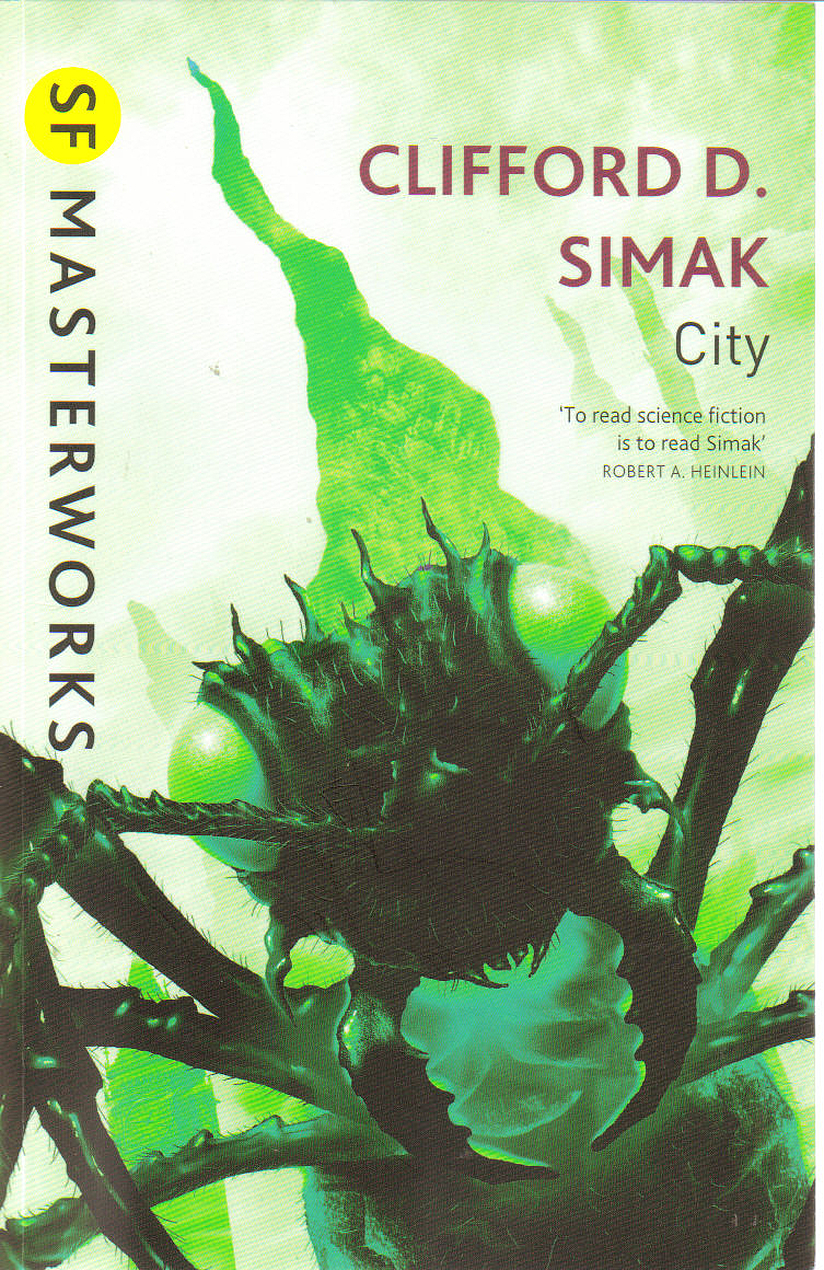
As I read through the Hugo Award for Best Novel winners, I often supplement by reading significant books that were written by winning authors, but did not win themselves. So, after enjoying Way Station by Clifford Simak, I decided to pick up his City. City is a fix-up: it was originally published as a series of short stories chronicling a future history, mostly in Astounding, from 1944 to 1951. In 1952, Simak collected them in a book, adding introductions to each story written by some scholar from the far far future, making it into a work that exists in the future history. Simak wrote one extra City story in 1973, which was incorporated into editions of the book published in 1981 onward, including my 2011 Gollancz edition.

Collection originally published: 1952
Contents originally published: 1944-73
Acquired and read: October 2022

It's certainly of its era: I feel like a lot of sf writers in this period wrote series of short stories covering vast swathes of human history. In that sense, City reminded me of Isaac Asimov, Robert Heinlein, and especially Cordwainer Smith. But what is different than those other future histories is the scope of City: while Asimov, Heinlein, and even Smith chronicle the history of humanity, Simak considers what comes after humanity... and then what comes after that. The only person who really matches Simak for scope is Wells. This is a series of vignettes, linked by some common characters and some related ones, that take us from the abandonment of the cities to the abandonment of the planet Earth itself.

Simak's futurism isn't always right, but the futurism isn't the point, so it doesn't matter. There's a lot to like here, but my favorite was "Hobbies," which I've already written about here. The story focuses on the dogs and robots left on Earth by humanity. Both were created to serve humanity; even though dogs have been raised to sapience, that's still what a dog is. There are also a last few humans. But all of these beings have no work to do—there is nothing left but the "hobbies" of the title. Simak is often praised for his pastoral style, and this thoughtful story is it at its moving best. The last couple stories point toward the fact that things never stop developing. Watch out for the ants!

I also really enjoyed the introductions to each story, written by the dog scholars of the far future attempting to put each story into its original context... but they are from so far in the future that they are not convinced any such creature as man actually existed. Surely he is just part of a creation myth? I'm often a sucker for this kind of faux apparatus, and this is a good example of it, extending the distance between the world of the text and ours.

I read an old winner of the Hugo Award for Best Novel every year, plus other Hugo-related books that interest me. Next up in sequence: The Collected Short Stories of Philip K. Dick, Volume One

28 November 2022

Hugos 1964: Way Station by Clifford D. Simak

American Science Fiction: Four Classic Novels 1960-1966: The High Crusade by Poul Anderson / Way Station by Clifford D. Simak / Flowers for Algernon by Daniel Keyes / ...And Call Me Conrad [This Immortal] by Roger Zelazny
edited by Gary K. Wolfe

Every year, after I vote in the Hugo Awards, I then read the oldest book to win the Hugo Award for Best Novel I haven't previously read. In 1964, the award was given to Clifford Simak's Way Station. Simak is an author I haven't read much of; last year, I read his 1967 novel Why Call Them Back from Heaven?, but other than that it's just pieces of scattered short fiction in anthologies like The Science Fiction Hall of Fame. (I do remember liking his story "Immigrant" in Galactic Empires, Volume I.)

Collection published: 2019
Novel originally published: 1963
Acquired: February 2022
Read: September 2022

Way Station is an odd book: after the American Civil War, a Union soldier named Enoch returns home to Wisconsin and is recruited to operate a "way station" for Galactic Central, a place where aliens can materialize and rest on their way to destinations further out in the spiral arm. For this, he is essentially granted immortality. At the time the book takes place (much of it is told in flashback), four things converge: the CIA discovers and takes an interest in this immortal man, a political faction in Galactic Central wants to close the way station on Earth by any means necessary, Enoch takes a woman into his home when she's abused by her father, causing the locals to end their longstanding policy of ignoring him, and an important peace conference is breaking down, meaning the Cold War may be about to turn hot.

Like Fritz Lieber's The Big Time (1958), also a Hugo winner from this era, it has big ideas, but takes a subdued, personal, perhaps even slow approach to them. That said, many like to point to Simak's style as "pastoral sf." (Searching "pastoral, science fiction" as a tagmash on LibraryThing brings up sixty-nine works, though only the top dozen would really seem to count. Simak is its top practitioner with his 1965 novel All Flesh Is Grass, and Way Station itself comes in sixth.) It's a defense I buy: I imagine that even in 1963, this felt like a story from another era. Simak's style captures the emotions Enoch must feel as a man out of his own time and the tone really communicates his isolation without slipping into being maudlin. The flashbacks we go into about Enoch's life over the years, encounters he's had with various aliens especially, are effective and Simak manages to evoke a world that is beyond Enoch's comprehension (and ours) but tantalizing and promising. Probably one of the most admirable parts of the novel is the way Simak communicates Enoch's orientation toward the universe, one of wonder and hope.

Given that even good contemporary sf often seems to want to emulate streaming television programs rather than play to the strengths of prose, I appreciated how different this book was. (Oddly, a Netflix film adaptation of this book was announced in 2019, though nothing has been heard since.) That said, I occasionally found myself wanting to skim—the pacing is a bit too languid from time to time!

There is, in the end, a lot going on here, and at the novel's conclusion, all those things kind of collide. Simak handles this very effectively, as elements of different plots and strands cross with one another in unexpected ways. But there's not just a unity of plot but also one of theme. People these days like to talk about "hopepunk" (thanks, I hate it), but sf has always provided us with hope. In Way Station, hope comes from caring: Enoch cares of course, but so does the woman Enoch rescues, and so do many of the various aliens Enoch meets, and so does Enoch's postman, and even the CIA agent assigned to shadow Enoch does, and without all of these people caring about things, the ending would have gone much differently. Near the end, Enoch thinks this:

A million years ago there had been no river here and in a million years to come there might be no river—but in a million years from now there would be, if not Man, at least a caring thing. And that was the secret of the universe, Enoch told himself—a thing that went on caring.

It's a sentiment worth awarding.

(I read this in a Library of America edition, collected with three other early 1960s sf novels, all of which were Hugo finalists, and one other of which also won. More on that in the next post in this sequence.)

I read an old winner of the Hugo Award for Best Novel every year, plus other Hugo-related books that interest me. Next up in sequence: The High Crusade by Poul Anderson

11 November 2022

Five Very Good Short Stories I've Read Recently

This (possibly) marks the start of an irregular feature around here. (God knows I need more of these, but actually, having things I do regularly makes it easy for me to come up with ideas for posts!) Obviously I write up all my reading of "books," but what of short stories? Either they're buried in an anthology review, or I read them on their own and I never mention them at all. So, here they are, complete with links where you can read them too. (I definitely read some good stuff for the Hugos, but I didn't write it up here because I always write those stories up in detail already.)

"An Important Failure" by Rebecca Campbell

Then he fitted it, and it hid so perfectly in his violin, maybe no one would know the terrible thing he had done, the secret history he had stolen like all the other secret histories that constituted his violin.

I read this in The Best Science Fiction of the Year, Volume 6; it was originally published in Clarkesworld in 2020. It's about a kid who's an apprentice violin maker in the near future, when the trees are burning away and dying off, and he hears a beautiful violin performance that makes him want to present the performer with the perfect violin. But making such a thing is a series of difficulties, especially if the world's going to pot. After a somewhat confusing start (I always read my BSFY stories over lunch after teaching, which usually means I am not in a very focused mindset), it quickly grabbed me. I often hate writing about music, but like Sarah Pinsker, Rebecca Campbell has the gift of making the beauty of the sound come alive in prose. Genuinely moving without being maudlin, and the way it keeps coming back to various "failures" is the kind of thing that resonates with me at thirty-six years old. Things are going to hell and the world wasn't meant to be like this, but there's some beauty to find in all of it anyway.

"AirBody" by Sameem Siddiqui

“You’re not gonna soak the dal first?”
     “Oh so now you’re such a refined cook?”
     “I can make dal.”
     “Then tell me, why soak the dal? What difference does it make, aside from wasting two hours of our lives?”
     “Well it’s just, what . . . it’s just what you do.”

Like the Campbell, I read this in Clarke's Best SF of the Year, and like the Campbell, it was originally published in Clarke's own Clarkesworld Magazine in 2020. It's set in a future where people can temporarily "rent" the bodies of other people in different locations; like, you might live in San Francisco, but rent someone's body in New York so you can go to a meeting in person without traveling. The main character is a young Pakistani man in the D.C. area who rents his body to an "aunty" back home. It's very cute, has some great worldbuilding, and good jokes—a satisfying tale of missed opportunities.

"Your Boyfriend Experience" by James Patrick Kelly 

Was I aroused? I was. Was I that twisted? Maybe.

I read this in Clarke's Best SF of the Year, but it originally was published in an MIT Press sf anthology called Entanglements: Tomorrow's Lovers, Families, and Friends (2020). The above link will only work if you have access to the MIT Press Direct database of ebooks. (My university, for example, does not subscribe to it.) It's a kind of disturbing story about a couple where one partner is very interested in food, but the other, a developer, has never been able to share his interest. The developer is working on a project to make a male robot companion for gay men, and he tests it out on his partner. Pretty emotionally intense, very strong. I was left somewhat uncertain by the ending, in the best possible way.

"Exile's End" by Carolyn Ives Gilman

The story enthralled the public. It was better than finding a species given up for extinct. It was a chance at redemption, a chance to save what was lost, to reverse injustice, to make everything right.
     The reality of the Atoka faded into inconsequence.

Like all the above stories, I read this in Clarke's Best SF; it was originally published on the Tor.com blog in, yes, 2020. It's told from the perspective of an museum curator on a human colony planet—her museum's pride and joy is a native artwork depicting a native woman who plays a key role in her planet's founding myth, someone who bridged the gap between human and colonizer. (Like a more significant Pocahantas.) Those natives are all dead now, so the artifacts in her museum are all that's left... until someone turns up, claiming that there's a small population of them still alive on a distant colony world, and they want their stuff back. It's a striking story, beautifully told, about what art is: how it derives its meaning from what we attach to it, not what it actually looks like, and how different people and different cultures can attach different meanings to the same physical artifact, and thus see it in completely different ways. There's no easy answers here and no sanctimony, just a strong tale of the conflict of cultures.

"Hobbies" by Clifford D. Simak

The pups were bringing in the cows for the evening milking.

Here's the exception. This story was originally published in Astounding way back in 1946; it was later incorporated into Clifford Simak's fix-up novel City, which is where I read it. (My link above goes to a scan of the issue of Astounding in which it originally appeared.) City spans several thousand years of future history in eight short stories; "Hobbies" is the sixth one. I read it in context, of course, but I think it would work on its own. In the future, humanity has largely abandoned the Earth, and those humans that are left have all their needs provided for. In Simak's future, dogs have been raised to sentience, and there are also robots left behind by humankind. The end result of all this is purposelessness: dogs and robots were made to serve humans, but there are none. Even humans themselves don't know what to do. Humanity no longer strives forward, no longer strives to survive. City is my third Simak in the last year, and "Hobbies" is pretty typical of him: atmospheric, detailed, contemplative. But "Hobbies" is also that style at its best. There's something very moving about all these people and things and animals drifting through the world, trying to find reasons to be.
19 September 2022

Why Call Them Back from Heaven? by Clifford D. Simak

Why Call Them Back from Heaven? by Clifford D. Simak

I read this as part of my ongoing investigation of life extension in science fiction. In this book's future, everyone is frozen upon death; the society hasn't figured out resurrection yet, but they're sure that bit is coming.

Published: 1967
Acquired: October 2021
Read: November 2021

What really works are the novel's various ideas about how society would change around such a development. People live very frugally, saving all their money for the second life; preventing someone from being frozen, even inadvertently, is a crime because you're essentially killing them; investors buy swampland because they know the Earth will need tons of room for all these people upon resurrection so even worthless land ought to have value.

It's very 1950s/60s sf: kind of off-kilter, a dose of spiritualism, a lot of discussion of marketing, an ending that doesn't quite come together. We follow a group of parallel characters in this future society, but I felt like their stories petered out in the end. Simak had great worldbuilding, but I am not entirely convinced he really knew what the book was about thematically.

It is short, and probably would be pretty fun to teach in my putative course, but hasn't been in print since 1988! There's an ebook from Gollancz, but you can only get it in the UK.