Showing posts with label subseries: flash. Show all posts

16 June 2025

Showcase Presents Wildcat by Eddie Berganza, Nick Gnazzo, and Ray Kryssing / Green Lantern / The Flash: Faster Friends by Ron Marz, Val Semeiks, Chip Wallace, et al.

From June 2020 to December 2023, I chronicled the history of the Justice Society in fifty installments. And then, at last, I was done!

Or was I? The nature of these projects I undertake is you can always discover there was some relevant comic you didn't know about at the time. Such was the case when a friendly commenter named Drew popped up to tell me that, after I'd bemoaned Geoff Johns forgetting about the brother of Yolanda "Wildcat" Montez, the character made an appearance in an issue of Showcase '94. Well, it looks like I have more comics to read, so this series is (much like the JSA itself) called back into action again after a long gap. Since December 2023, I've discovered a few different JSA-adjacent comics, so this will be the first of, I think, three new installments.

So, the second Wildcat, Yolanda, was created by Roy and Dann Thomas in Infinity, Inc. (see item #10 below), but like a lot of DC's legacy characters, basically went into limbo once the series was over. And then was brutally killed off to prove the situation was serious... in an issue of freakin' Eclipso! Gotta put that old white guy back into his rightful position, of course. 

from Showcase '94 #8
But as Drew told me, there was a follow-up to all this in an issue of Showcase, DC's anthology series. In this story, Ted Grant, the original Wildcat, goes to Yolanda's funeral... only to find out that her parents, desperate with mourning, have hired a witch doctor to bring their daughter back to life! It's a pretty simple story: you might not be surprised to find out that Yolanda comes back as a mindless monster, and Ted defeats it. It is, after all, just ten pages. I didn't much care for the art, but it was nice to see that Roy and Dann Thomas's original conception of Yolanda wasn't totally forgotten; her brother is in the story. (For some reason, Geoff Johns later makes up a cousin for Yolanda rather than just use the brother during his JSA run; see item #34 below.)

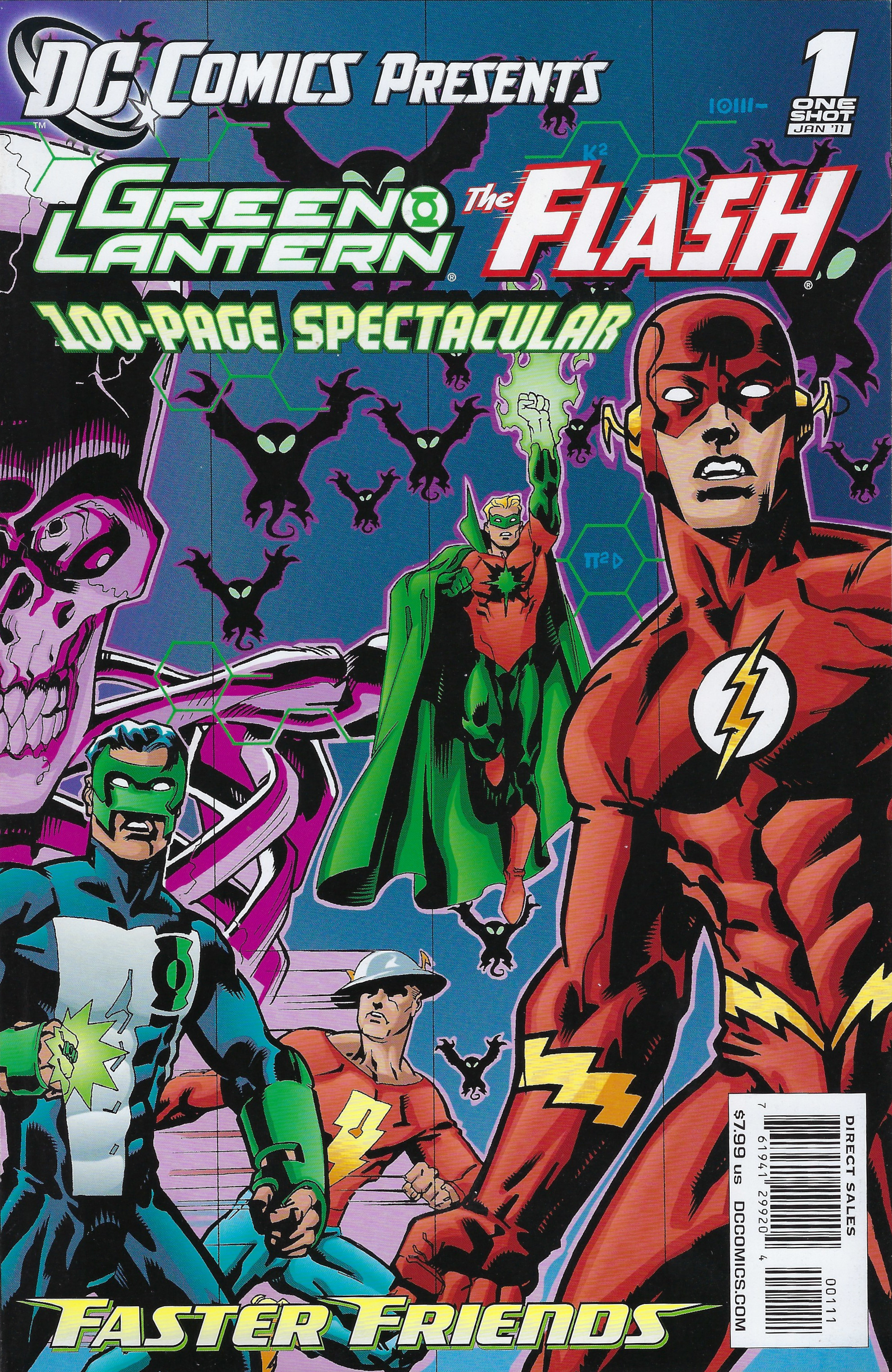
from Green Lantern/Flash: Faster Friends #1
I also read Faster Friends, a two-issue miniseries from 1997 about Green Lantern (then Kyle Rayner) teaming up with the Flash (then Wally West) in order to deal with the consequences of an early adventure of a different Green Lantern (then Alan Scott) and Flash (then Jay Garrick). We get some flashbacks to that original adventure, the first time Green Lantern and Flash ever teamed up, back in 1940, as the present-day characters work alongside their namesakes and each other.

I think the idea here is good but I also think there's too much going on for the story's ninety-six pages... or maybe there's too much action, which pushes out the stuff it seems to me the story should actually be about! The first issue in particular is a bit of a nothingburger; we have a flashback of Jay and Alan teaming up but it goes so quickly it doesn't really give us any insight into their personalities. In the present, I think we're supposed to see a sort of rivalry between Wally and Kyle, but it's more like something we're told happened in other stories than something we actually see in this one.

from Flash/Green Lantern: Faster Friends #2
The second issue has more potential but again is trying to do too much: Jay is terminally ill, and Kyle and Wally go through a teleporter that mixes them up a bit. But Jay's impending death is a bit too much to deal with in a story like this, and of course it's all resolved by the end of the story (albeit in a clever way). One might think that Wally and Kyle being scrambled up would yield some good drama or character insight, but basically all it means is that each is wearing the wrong costume and seems to know stuff the other should, and then it gets fixed. There's no meaningful character arc: one expects more from Mark Waid, to be honest.

As far as this project goes, it's always fun to see Jay and Alan... but this is from the period (see #23 below) when Alan was deaged and went by "Sentinel." Such things happen in superhero comics, I suppose, but one doesn't have to like them. Bad creative decision, though again, Waid and Augustyn do an interesting thing with it, at least. 

(I read the story collected in a DC Comics Presents issue from 2011, but I think it will end up being collected whenever DC does The Flash by Mark Waid Omnibus, Volume Three, which I will buy when it comes out, so that may have been pointless.) 

Wildcat: "Brujas Y Gatos" originally appeared in issue #8 of Showcase '94 (July 1994). The story was written by Eddie Berganza, pencilled by Nick Gnazzo, inked by Ray Kryssing, colored by Suzanne Bourdages, lettered by Bill Oakley, and edited by Neal Ponzer.  
 
Green Lantern/Flash: Faster Friends #1 and Flash/Green Lantern: Faster Friends #2 originally appeared in 1997. The story was written by Ron Marz (#1) and Mark Waid & Brian Augustyn (#2); pencilled by Bart Sears, Andy Smith, Jeff Johnson, Ron Lim, & Tom Grindberg (#1) and Val Semeiks (#2); inked by Mark Pennington & Bill Anderson (#1) and Chip Wallace (#2); colored by John Kalisz (#1) and Ian Laughlin (#2); lettered by Chris Eliopoulos (#1) and Albert DeGuzman (#2); and edited by Kevin Dooley (#1) and Paul Kupperberg (#2). It was reprinted in DC Comics Presents: Green Lantern / The Flash: Faster Friends #1 (Jan. 2011).
 
This post is the fifty-first in an improbably long series about the Justice Society and Earth-Two. The next installment covers Impulse: Bart Saves the Universe. Previous installments are listed below:

11 January 2017

Faster than a DC Bullet: Project Crisis!, Part LIX: The World of Flashpoint featuring the Flash

Comic trade paperback, n.pag.
Published 2012 (contents: 2011)
Borrowed from the library
Read September 2016
The World of Flashpoint featuring the Flash

Writers: Scott Kolins, Adam Glass, Sean Ryan, Sterling Gates
Artists: Joel Gomez, Scott Kolins, Rodney Buchemi & José Marzán Jr., Ig Guara & Ruy José, Oliver Nome & Trevor Scott
Colorists: Brian Buccellato, Mike Atiyeh, Artur Fujita, Stefani Rennee
Letterers: Sal Cipriano, Dave Sharpe, Carlos M. Mangual, Dezi Sienty

It seemed to me that the volume of The World of Flashpoint featuring the Flash would have the most to do with Flashpoint proper given that it features the Flash, which I think is why I read it last. Actually, it doesn't really shed that much light on Flashpoint. (I don't think so, anyway-- keep in mind I actually haven't read Flashpoint yet!) There's a short "Reverse Flash" story written by Scott Kolins (a longtime collaborator with Geoff Johns on The Flash) which seems to be laying some groundwork for what will come in Flashpoint, but also is somewhat redundant with the Reverse Flash story contained in The Road to Flashpoint (which was illustrated by Kolins). I'm not well-versed enough in Flash lore to know how much of what is contained here-- the Reverse Flash manipulates the Flash's childhood a little bit-- is new information, and how much is a reminder of old information. I did quite like Joel Gomez's artwork, however; it reminds me of Kolins, as well as other frequent Johns collaborator Francis Manapul, and the stuff featuring kid Barry Allen is especially cute.

You can't change history. Not one line! Except when you can.
from Flashpoint: Reverse Flash #1 (script by Scott Kolins, art by Joel Gomez)

The other story that seems to be directly tying into Flashpoint proper is "Kid Flash Lost," about young Bart Allen winding up in a dystopian future ruled by Brainiac alongside Hot Pursuit, who in Road to Flashpoint was an alternate-Earth Barry Allen, but whose equipment and identity has been taken by Patty Spivot, a forensic scientist who also appeared in Road to Flashpoint. This story doesn't take place in the world of Flashpoint like most other World of Flashpoint stories, but rather has Bart jumping through time, trying to find Barry Allen and help him put time back together. It's nothing incredible, but Sterling Gates writes a decent little story of an optimistic little kid maintaining his outlook in the face of a pessimistic universe and doing what he has to do to help his idol put things right, complete with Crisis on Infinite Earths throwback. I assume this will tie into Flashpoint in some way, like Bart shows up at the climax and tosses Barry some speed force. This seems to also be an ending point of Bart Allen, a character I don't know much about, but do know was sorely mishandled in the period between Infinite Crisis and Flashpoint.

By the time I write this caption, I have read Flashpoint. This has nothing to do with anything. I guess it happens between panels.
from Flashpoint: Kid Flash Lost #3 (script by Sterling Gates, art by Oliver Nome & Trevor Scott)

The other three stories here are mostly just more glimpses of the alternate world of Flashpoint, and I didn't find any of them terribly interesting. "Citizen Cold" shows us that in a world without the Flash, Captain Cold is instead "Citizen Cold," hero of Central City, but despite some quality Scott Kolins art (he also writes the story), the story doesn't really say anything interesting: the alternate Cold is still an asshole who is cruel to women.

The Hero of Central City.
from Flashpoint: Citizen Cold #1 (script & art by Scott Kolins)

Even more unpleasant to read is "Legion of Doom," one of those World of Flashpoint stories that's basically just about how cruel people are in the world of Flashpoint. Like, do I really need three issues of this gross shit? It is nice to get a glimpse at how heroic Cyborg is in this world (he's been a side character in tons of these stories, but this is the closest he gets to the spotlight), but other than that this tale produces little of value.

The same goes for "Grodd of War," where we learn Grodd's gorillas control all of Africa in the Flashpoint timeline. It's most more gratuitous, uninteresting violence.

So, in the end, the balance of this collection is a little odd: two stories (four issues) that might or might not add something to our understanding of Flashpoint, three stories (seven issues) that seemingly don't, and none of them are really standouts. At this point, though, I just want to get to the real deal!

Next Week: Finally! The main event is upon us! A race against time to solve the mystery of the Flashpoint!

07 December 2016

Faster than a DC Bullet: Project Crisis!, Part LIV: The Flash: The Road to Flashpoint

Comic hardcover, n.pag.
Published 2011 (contents: 2011)
Borrowed from the library
Read July 2016
The Flash: The Road to Flashpoint

Writer: Geoff Johns
Artists: Scott Kolins, Francis Manapul
Colorists: Brian Buccellato, Michael Atiyeh
Letterer: Sal Cipriano

You might have expected Final Crisis to be the end of my reviews of DC's Crisis books. It was, after all, about the Final Crisis, and thus far, DC has actually kept to that claim. But there have been a couple events since that seem to be Crises in all but name, so I'll be tackling those next, starting with Flashpoint.

This is the lead-in to Flashpoint, featuring the Flash. The Barry Allen version, recently returned from beyond the grave during the Final Crisis, and slipping back into his old life. The book opens with a standalone story about Professor Zoom, a.k.a. the Reverse-Flash, and for me, this was the most effective part of the book, a creepy tale of an obsessed man rewriting his timeline to make himself the man he was, removing any obstacle to his goals. I don't think I've read anything substantive with the Reverse-Flash before (he did turn up in some of the Infinite Crisis tie-ins, I think), but I enjoyed this.

That said, that's not how professorships work, Geoff Johns.
from The Flash vol. 3 #8 (art by Scott Kolins)

The rest of the book is less focused. Barry is having trouble settling back into his old life now that's he's undead. (Former sidekick Bart is also undead, thanks to the events of Legion of 3 Worlds. I think Wally West is also resurrected? Didn't he die during the Infinite Crisis?) In the meantime, a Barry Allen from one of the other 51 Earths has appeared in Central City, riding a motorcycle around, plus there are some murders. To be honest, the contours of all this were a bit vague. I wasn't sure what Barry was doing that was so bad it required an intervention, and the book's superhero plot was pretty simple. Guess what: the mysterious newcomer in town is the murderer. Then at the end, Zoom turns up, there's a lot of shouting, and a mysterious lightning bolt indicates the coming of Flashpoint.

C'mon, Barry, you were the first person to ever breach the vibrational barrier. Aren't you used to this by now?
from The Flash vol. 3 #10 (art by Francis Manapul)

I hope that when I read Flashpoint, the point of much of this will be more apparent. I must say, I did really like the artwork from Scott Kolins and Francis Manapul, which was human and dynamic, and the coloring is above average as well.
Good use of white space. (Yeah, that might sound sarcastic, but I mean it.)
from The Flash vol. 3 #11 (art by Scott Kolins)

Next Week: Meanwhile, in another universe: we step into The World of Flashpoint featuring Wonder Woman!