Showing posts with label creator: gareth roberts. Show all posts

02 December 2024

Monstrous Beauty (From Stockbridge to Beyond Segonus: A Doctor Who Magazine Comics Marathon, Part 55)

Monstrous Beauty: Collected comic strips from the pages of Doctor Who Magazine
by Dan Abnett, Colin Andrew, Martin Geraghty, Scott Gray, Russ Leach, Paul Peart, Jacqueline Rayner, Gareth Roberts, John Ross, and Brian Williamson

Collection published: 2024
Contents originally published: 1991-2022
Acquired and read: November 2024

Like the final Peter Capaldi volume, the final Jodie Whittaker one is a weird catch-all one that has the "Collected Multi-Doctor Comic Strips" branding, with its Doctor's last two stories combined with a miscellany of material from previous Doctors: the first, third, fourth, seventh, and ninth, plus Dr. Who. As I usually do, I read the book's stories in original publication order, not internal order.

This book is a landmark volume, though! In plugging in the two gaps of uncollected strips (one during The White Dragon, the other between The White Dragon and Liberation of the Daleks), it means that every Doctor Who Magazine strip from issue #1 to issue #597, from 1979 to 2023, has been collected! In a mere thirty-four volumes! What an achievement—but more on that in a future post.

The Man in the Ion Mask, from Doctor Who Magazine Winter Special 1991
script by Dan Abnett, art by Brian Williamson, letters by Helen Stone

This is a slight-but-charming story of the Doctor visiting the Master in prison after the events of The Dæmons; the Master claims to have reformed, but the Doctor of course is wary, and rightly so. There's not much action (in a good way), and artist Brian Williamson is quite good at handling the dialogue and characterization the story requires.
Are You Listening? / Younger & Wiser, from Doctor Who Magazine Summer Special 1994
written by Warwick Gray, art by Colin Andrew, lettered by Amer Anwar
A linked first Doctor story and seventh Doctor story; the first visits a mysterious city with Vicki and Steven and runs off, while the seventh returns with Benny, finally understanding what's going on. They have their moments, but there's not a lot of conflict in Younger & Wiser, which is basically the Doctor and Benny just chatting.
from Doctor Who Magazine Winter Special 1994
Plastic Millennium / The Seventh Segment, from Doctor Who Magazine Winter Special 1994 & Summer Special 1995
stories by Gareth Roberts, art by Martin Geraghty and Paul Peart, letters by Elitta Fell
The first of these is fun, a stylish Martin Geraghty–drawn story about the seventh Doctor and Mel (in her DWM debut, I think) taking down some Autons. It's not very complicated, but the art really sells it. The second is also carried by the art—or rather, the art is the best part, because I found this noir pastiche featuring the fourth Doctor and the first Romana utterly impenetrable.
from Doctor Who Magazine #557
Monstrous Beauty, from Doctor Who Magazine #556-58 (Nov.-Winter 2020)
story by Scott Gray, artwork by John Ross, colouring by James Offredi, lettering by Roger Langridge
This Time Lord Victorious tie-in brings back the ninth Doctor and Rose, and plunges them into the "Dark Times" of the ancient Time Lords' war against the vampires (see State of Decay). Scott Gray is usually good value, and John Ross a strong artist, for sure, but something about this didn't sing. I think the stakes are ultimately too abstract. There's not a lot of sympathetic characters here, so ultimately it's kind of hard to care about any of this. Looks great, though (Ross does very well by Christopher Eccleston; actually, so does Gray), and I appreciated the very obscure (but footnoted!) callback to Tooth and Claw from the End Game collection. The DWM universe gets its tentacles everywhere!
Dr. Who & the Mechonoids, from Doctor Who Magazine #578 (July 2022)
story by Jacqueline Rayner, art by Russ Leach, colour by Mike Summers, lettering by Roger Langridge
Maybe this would have been funny if I had more than a dim memory of one Cushing film, or if I got the reference to the actor "cast" as the one-off male companion here. But I didn't and it wasn't.
from Doctor Who Magazine #579
Fear of the Future / The Everlasting Summer, from Doctor Who Magazine #579-83 (Summer-Nov. 2022)
story by Jacqueline Rayner, art by Russ Leach, colour by Mike Summers, lettering by Roger Langridge
Unfortunately, I don't think Jac Rayner (or, perhaps, her editors) ever got to grips with the format of the six-page DWM strip, especially with the reduced panel count. The first story here is too slight even at six pages: Dan sees vaguely bad things, the Doctor realizes why, the end. The second story, on the other hand, like Rayner's last attempt at a thirteenth Doctor epic (Hydra's Gate), attempts to squeeze in too much and thus is basically impossible to follow. Which is a shame, because all the thematic ideas she gives in the backmatter sound great... but what's on the page is a confusing jumble of ideas, too many of them. Russ Leach will never go down as one of the DWM greats, with a strong tendency toward confusing panel transitions and weak storytelling skills. I get that COVID was at fault in very real ways, but #570-83 is surely the weakest run of the strip in the history of the mag since... well, I was going to say the early McCoy strips, but skimming back over my reviews, those were at least inconsistently enjoyable, whereas these are consistently unenjoyable. Maybe since the mid–Colin Baker run (#100-19)? But even those had John Ridgway!
Stray Observations:
  • Alas, the original idea Scott Gray recounts in the notes for Are You Listening? and Younger & Wiser, that they'd be told in different orders from the perspective of the Doctor and the alien city Xenith, is better than what we got. Similarly, it's hard to read the notes on Monstrous Beauty and not wish that Scott Gray had got to write the eighth Doctor and Destrii story he'd originally pitched.
  • Reading Plastic Millennium only a day or two after Business as Usual, I couldn't help but thinking the Auton and plastic factory here ought to have been the same one as in that story.
  • I've charted the DWM strip's influence on Russell T Davies in the past; the line from Plastic Millennium to "Rose" seems pretty obvious!

This post is the fifty-fifth in a series about the Doctor Who Magazine comic strip and Marvel UK. The next installment covers statistics about the history of the strip. Previous installments are listed below:

02 January 2023

The Betrothal of Sontar (From Stockbridge to Segonus: A Doctor Who Magazine Comics Marathon, Part 31)

The Betrothal of Sontar: Collected Comic Strips from the Pages of Doctor Who Magazine
by Mike Collins, Gareth Roberts, Tony Lee, John Tomlinson & Nick Abadzis, Roger Langridge, Martin Geraghty, Jonathan Morris, et al.

Collection published: 2008
Contents originally published: 2006-07
Acquired: November 2008
Previously read: December 2008
Reread: October 2022

This collection spans the entirety of the tenth Doctor and Rose era of DWM, which initiated when "The Christmas Invasion" aired and ran all the way to "The Runaway Bride," and it also includes a (kind of) companion-free storyline from between "The Runaway Bride" and "Smith and Jones," making for a nice sizeable chunk of DWM. Like the comics collected in The Cruel Sea, these are definitely trying to ape the storytelling of the Russell T Davies era on screen, but I also felt there was a more concerted effort to play to the strengths of comics here: more stories that do things so big that they could never have been afforded on screen, or stories with lots of different locations. Overall, it's a pretty pleasing package.

I've read this collection before, way back in 2008 when it came out. This is (part of) what I wrote at the time:
I was curious to see how much my impressions of some of these stories shifted this time around!

from Doctor Who Magazine #365
The Betrothal of Sontar, from Doctor Who Magazine #365-67 (Feb.-Mar. 2006)
story by John Tomlinson & Nick Abadzis, pencils by Mike Collins, inks by David A. Roach, colours by James Offredi, letters by Roger Langridge
This sees the first appearance of the Sontarans in the DWM strip since 1993's Pureblood (and even reuses that story's title term); it's about a group of low-quality Sontarans who run a mining rig instead of getting glorious soldiering duty, a neat look into a different dimension of Sontaran society than we've ever seen on screen. The cosmic maguffin wasn't super interesting, but I liked the two principal Sontaran characters. I'm not sure why in my review above I called this story's resolution "highly disappointing." Like, rereading it I have no idea what my beef was at all.
from Doctor Who Magazine #368
The Lodger, from Doctor Who Magazine #368 (Apr. 2006)
story by Gareth Roberts, pencils by Mike Collins, inks by David A. Roach, colours by James Offredi, letters by Roger Langridge
This was fun; you can see why Moffat picked it up to make it into a tv episode, and though being a 45-minute story gave it more room to breathe, this version has the benefit of pairing the Doctor with a familiar character—and not having to work in an alien threat of some kind. More of a series of vignettes than a story, but a very solid series of them, and the kind of thing that (somewhat ironically) only DWM could do, I think.
from Doctor Who Magazine #370
F.A.Q., from Doctor Who Magazine #369-71 (May-July 2006)
story by Tony Lee, pencils by Mike Collins, inks by David A. Roach, colours by James Offredi, letters by Roger Langridge
I was dreading this one going in. I remembered my negative review from last time around, and having since suffered through Tony Lee's run on IDW's Doctor Who comic book, my opinions of Lee as a comic writer have only diminished. But... I actually kind of liked this? I wouldn't say it's a work of genius or anything—the stories on either side of it are better—but it's fun enough. It has the grounded sensibility of the RTD era, focusing on an ordinary family affected by alien powers, shades of "Fear Her" (a story that I really like). Rose gets some good spotlight moments. The main thing I don't like is the reveal about the teacher who didn't really exist, which seemed kind of pointless. Like, it's spooky, but it doesn't really seem to make a character or thematic point.
from Doctor Who Magazine #373
The Futurists, from Doctor Who Magazine #372-74 (Aug.-Oct. 2006)
story & art by Mike Collins, inks by David A. Roach, colours by James Offredi, letters by Roger Langridge
I really don't know what I was thinking when I wrote my above review, because this story was on fire. Good ideas, great visuals, neat contrasts (black Romans in Britain vs. a fascist Italian state), fast pace—four different key locations in three installments!—nice themes, and above all, good characterization for Rose and some genuine laugh-out-loud jokes. Loved gags about the Silurians, how many people were in the resistance, the use of the resistance, and especially the clever use of the psychic paper. "But Darius... you can't read..." "Oh." I can imagine it playing out perfectly on screen. Rose leading the captured Silurian women in revolt is great, and her voice is captured very well. Exactly the kind of story the strip ought to be doing when the tv show is leading, and the volume's highlight. I don't know how I got it so wrong fourteen years ago.

(Wait... fourteen years ago!?)
from Doctor Who Magazine #375
Interstellar Overdrive, from Doctor Who Magazine #375-76 (Nov.-Dec. 2006)
story by Jonathan Morris, pencils by Mike Collins, inks by David A. Roach, colours by James Offredi, letters by Roger Langridge
I do love time loop stories. They're one of my favorite sf subgenres. TNG's "Cause and Effect," Groundhog Day, SG-1's "Window of Opportunity," Discovery's "Magic to Make the Sanest Man Go Mad," Russian Doll season one, Palm Springs, I love them all. I am a total sucker for them. I even love the chronic hysteresis bit in Meglos.

Um, except this one. I think it's a noble attempt. But it has two things going against it, I reckon. One is that the repetition just isn't as interesting when it's solely visual. Here the scenes are all shown from a different angle, but that means you don't really get that uncanny echo that makes these kind of things work on screen. The second is that since it's only two parts, the loop only repeats once, and so it's less a time loop story, and more a story where something happens once, and then the characters get a do-over. It feels cheap, I guess, if it's that easy to get out of the loop. Seeing the iterations is what makes these kind of things fun!

But there are some good jokes and the part one cliffhanger is a good one.
from Doctor Who Storybook 2007
Opera of Doom!, from Doctor Who Storybook 2007
story by Jonathan Morris, pencils by Martin Geraghty, inks by David A. Roach, colours by James Offredi, letters by Roger Langridge
This story is a delight. Quick, fun, good gags. A little too quick, maybe—the fact that people were disappearing into the alien opera house maybe should have been set up better—but I really enjoyed it. The really terrible musician who becomes amazing is a fun character with lots of good jokes.
The Green-Eyed Monster, from Doctor Who Magazine #377 (Jan. 2007)
story by Nev Fountain, art & letters by Roger Langridge, colours by James Offredi
Rose's last appearance in the strip is a good one, bringing Mickey back again and also marking Jackie's only strip appearance. It's a kind of contrived story about an alien jealousy monster and a talk show, but it's all worth it for the incredible sequence where Rose thinks that the Doctor has settled down with her mother. The ending gag of Jackie wanting a second kiss is delightful.
The Warkeeper's Crown, from Doctor Who Magazine #378-80 (Jan.-Mar. 2007)
story by Alan Barnes, pencils by Martin Geraghty, inks by David A. Roach, colours by James Offredi, letters by Roger Langridge
Rose of course stopped appearing on screen way back in July 2006, but DWM seems to have considered "The Runaway Bride" her official cut-off point as the current companion—the first episode without her as a lead, I guess. So here we get a companion-less story to bridge the gap before Martha, and DWM brings back the Brigadier to serve as a temporary companion. Though the Brigadier appeared in the "past Doctor" early of the early 1990s, I think this is his first present-day appearance since The Mark of Mandragora.
from Doctor Who Magazine #380
It's okay. I liked the first part all right, which pulls the Doctor, the Brigadier, and the wrong Mike Yates together; I liked the last part, where the wrong Mike Yates tries to remake Britain. The middle part, though, lost me in the complicated exposition about the relations on the alien planet, and the whole story suffered as a consequence. I didn't really get the ending, for example. It seemed like things ought to have been simplified. The idea of the Doctor meeting the Brigadier for the first time after he himself fought in a war seemed squandered in a single panel. (Shades of Big Finish's own attempt to do this story, Way of the Burryman, which I read Warkeeper's Crown in the middle of, coincidentally.)
Other Notes:

  • #367 is one of the rare issues from this era I actually do own; I picked it up to get the free Big Finish CD that came with it. I have no memory of reading The Betrothal of Sontar part three on its own, but I have to imagine it made no sense.
  • John Tomlinson previously wrote for DWM way back in 1989, scripting Nemesis of the Dalek. (He also wrote two Who strips for The Incredible Hulk Presents and a prose story from the collection Abslom Daak: Dalek Killer.) At 210 issues, that's the longest gap between contributions for any DWM writer/artist as of 2014's strips. His cowriter here, Nick Abadzis, would go on to the primary writer of Titan's The Tenth Doctor comic.
  • From #363 to 368, we have three stories, two of which were by Gareth Roberts and got adapted for television! Plus The Love Invasion inspires a scene in "The Unicorn and the Wasp" on screen. Quite a hit rate for him. The Lodger is, however, his last contribution to the DWM strip.
  • I was all prepared to admit I was too hard on Tony Lee as a writer, and then I read his behind-the-scenes I comments. I don't know how one manages to write a bad creator's commentary, but somehow he does. Lots of very belabored jokes, with the kind of self-deprecating humour that comes across as false modesty.
  • Jonathan Morris gives an incredible amount of detail in his creator's commentaries, down to entire lost scenes from both his stories. I can't think of another DWM graphic novel with this level of detail. Though I enjoyed Opera of Doom! the lost joke about the very slow gondola chase would have been amazing.
  • from Doctor Who Magazine #377
  • The Green-Eyed Monster opens with a caption reading "Quite a while ago...", which confused me at first, but I guess it's meant to indicate that this goes between "The Girl in the Fireplace" and "Rise of the Cybermen," which was broadcast many months prior. Placement notes aren't really the kind of thing DWM typically goes in for, and it didn't even occur to me we weren't going in chronological order prior to that, since I think every strip here could comfortably fit between "Tooth and Claw" and "School Reunion."
  • At the time I read this volume, The Warkeeper's Crown was seemingly Alan Barnes's last contribution to the strip, but he is the writer of the current fourteenth Doctor strip, Liberation of the Daleks, that began in issue #584. In between these points, he wrote one million Doctor Who audio dramas for Big Finish and script-edited ten million.
  • David A. Roach works on literally every story in this volume except for one ten-page strip, more than any other writer or artist... and somehow does not deserve cover billing!

This post is the thirty-first in a series about the Doctor Who Magazine comic strip and Marvel UK. The next installment covers The Widow's Curse. Previous installments are listed below:

  1. The Iron Legion
  2. Dragon's Claw 
  3. The Transformers Classics UK, Volume One
  4. The Tides of Time
  5. The Transformers Classics UK, Volume Two
  6. Voyager
  7. The Transformers Classics UK, Volume Three
  8. The World Shapers
  9. The Transformers Classics UK, Volume Four
  10. The Age of Chaos
  11. The Transformers Classics UK, Volume Five
  12. A Cold Day in Hell!
  13. Death's Head: Freelance Peacekeeping Agent (part 1)
  14. Nemesis of the Daleks
  15. Death's Head: Freelance Peacekeeping Agent (part 2)
  16. The Good Soldier
  17. The Incomplete Death's Head
  18. Evening's Empire
  19. The Daleks
  20. Emperor of the Daleks
  21. The Sleeze Brothers File
  22. The Age of Chaos
  23. Land of the Blind
  24. Ground Zero
  25. End Game
  26. The Glorious Dead
  27. Oblivion
  28. Transformers: Time Wars and Other Stories
  29. The Flood
  30. The Cruel Sea

21 December 2022

The Cruel Sea (From Stockbridge to Segonus: A Doctor Who Magazine Comics Marathon, Part 30)

The Cruel Sea: Collected Comic Strips from the pages of Doctor Who Magazine
by Robert Shearman, Mike Collins, Gareth Roberts, Steven Moffat, et al.

Collection published: 2014
Contents originally published: 2005-06
Acquired: December 2014
Read: September 2022

I've always been a bit salty that this book exists. Well, it would be more accurate to say that I am salty that the DWM Special Edition The Ninth Doctor Collected Comics exists. I dutifully bought that, expecting that no such graphic novel would ever come out—there just weren't enough strip adventures to justify such a collection! Eight years later, and the size of these collections had been halved, and so I bought those stories all over again, with just one addition—a prose story that I already had! Well, that and the as usual excellent extras.

So this was a reread again for me, but the added context of the extras was new. I appreciated in particular that were get to hear a lot from Mike Collins, who illustrated every DWM strip of the ninth Doctor; this is one of those eras where we have a consistent artist but not a consistent writer. I've opined before that you need one of those two, otherwise the strip doesn't feel cohesive because you don't have an actor's performance to unify the various voices as the tv programme does. And Mike Collins does good work; he's been with DWM since 1987 as a writer, and since 1991 as an artist, but I knew him first from his work on Star Trek comics for Marvel and Wildstorm and Babylon 5 comics for DC. He's good at likenesses, great at storytelling—exactly the artist you want, I reckon, when you're suddenly producing a tv tie-in strip to an actual tv programme for the first time in over fifteen years!

It's funny, in the extras to both this and the next volume, The Betrothal of Sontar, editor Clay Hickman talks about how they felt they had to a go a bit more kid-friendly now that the tv show was back... but I would hesitate to call any of the DWM strips here notably kid friendly, especially Rob Shearman's! But overall, I remembered this era as a bit of a shambles, and rereading it I didn't find that true at all. It's not perfect, but this is a solid slice of Doctor Who comics. Certainly it's much better than what DWM was putting out last time the tv programme was still on!

from Doctor Who Magazine #356
The Love Invasion, from Doctor Who Magazine #355-57 (Apr.-June 2005)
script by Gareth Roberts, story by Roberts/Hickman, pencil art by Mike Collins, inks by David A. Roach, colours by Dylan Teague and James Offredi, lettering by Roger Langridge
The ninth Doctor and Rose debut with a very solid piece of Russell T Davies pastiche. There's a lot of running back and forth in 1960s London as the Doctor and Rose must piece together what links some overly helpful young women, the death of several prominent scientists, and a woman who keeps killing aliens. There's solid humor, a decent alien motivation, and a strong sense of the voices of both Eccleston and Piper. The main thing I didn't like was that there's sort of a fake-out double ending, which felt tacked on.
Art Attack, from Doctor Who Magazine #358 (July 2005)
story & pencil art by Mike Collins, inks by Kris Justice, colours by Dylan Teague, lettering by Roger Langridge
This is a decent story with a good ending, about the Doctor and Rose coming to a futuristic art gallery, and getting caught up in an evil piece of performance art. That said, I felt like there's a better version of this story somewhere in the multiverse: a comics story about art written by an artist seems like it could have done more fun stuff than the story does, and there's surprisingly little made of the fact that both the Doctor and the alien are the last of their kinds—that would have been the emotional center of the story on tv, I think.
from Doctor Who Magazine #359
The Cruel Sea, from Doctor Who Magazine #359-62 (Aug.-Nov. 2005)
story by Robert Shearman, pencils by Mike Collins, inks by David A Roach, colours by James Offredi, letters by Roger Langridge
I was pretty surprised when Mike Collins noted this as one of the best comic strips he's ever illustrated—because to me it was the weakest story in this volume. It has striking visuals—a cruise ship on the red oceans of Mars, Billie Piper in a skintight spacesuit, a woman whose face looks like a fractured mirror—and some neat uses of the medium—the conversation between the two Doctors—but even though I'm a big fan of Robert Shearman's audio work for Big Finish and his original prose fiction, I found something deeply unpleasant about reading this story. Some of the visuals struck me as inappropriate for the Doctor Who of 2005, and some I just didn't like. Well rendered, but genuinely unpleasant to think about. It's the kind of thing Shearman makes work in prose or audio, I guess (there's some gross stuff in Scherzo), but when you have to actually see it, it's very different. The characters generally are unpleasant, too—this story is very much the epitome of something that's well-crafted but just did not work for me.

When I posted the above on GallifreyBase, Rob himself popped up to opine, "I absolutely agree with you! I'm so grateful to Mike Collins for his amazing art and lovely support, but I don't think I got this story right at all. I've never been a big comics fan, and so misunderstood the particular demands of the medium - and yeah, I think I got the tone wrong completely." Phew!
from Doctor Who Annual 2006
Mr Nobody / What I Did on My Christmas Holidays by Sally Sparrow, from Doctor Who Annual 2006
stories by Scott Gray and Steven Moffat, art by John Ross and Martin Geraghty, colours by James Offredi, lettering by Roger Langridge
These two stories, one comics, one prose, are both from Panini's only Doctor Who Annual, and are both more child-focused than the average DWM strip. But they're still both solid. You can of course count on Scott Gray for a well put-together done-in-one, and Steven Moffat's story is a fun time travel loop. We should meet this Sally Sparrow again!
from Doctor Who Magazine #364
A Groatsworth of Wit, from Doctor Who Magazine #363-64 (Dec. 2005–Jan. 2006)
story by Gareth Roberts, pencil art by Mike Collins, inks by David A. Roach, colours by James Offredi, letters by Roger Langridge
The ninth Doctor's DWM tenure comes to a quick end with this, a decently fun story with some good jokes and a nice last scene. Obviously this ended up a dry run for a David Tennant episode, like some many stories in this volume, but it's different enough to be worthwhile.
Other Notes:
  • The Love Invasion, despite being three issues long, spans the entirety of Christopher Eccleston's on-screen tenure.
  • The behind-the-scenes stuff about Mike Collins trying to get Christopher Eccleston and Billie Piper's likenesses down was great. On the one hand, Eccleston kept shooting down images that were too heroic and good-looking and muscular, too American comics! On the other hand, Piper just said, "Ooh, he's given me hips and tits, I like it!"
  • After all the talk of likenesses, it thus becomes very noticeable when Rose has a dream in The Cruel Sea about marrying Mickey, but we never actually see his face, presumably so the story could avoid an extra set of approvals just for a one-page sequence.
  • Elements of The Love Invasion, The Cruel Sea, What I Did on My Christmas Holidays, and A Groatsworth of Wit arguably all ended up on screen. The latter two are obvious, but Clay Hickman makes the case that The Cruel Sea influenced "The Waters of Mars." Is this an offshoot of the Flood? A GallifreyBase commenter pointed out to me that the scene in Love Invasion where the Doctor counteracts being poisoned by eating random foods was lifted for "The Unicorn and the Wasp."
  • Rose is the first companion to spontaneously appear in the strip since Benny, and only the second to ever do so. Every other previous companion was introduced, even if (as in Peri and Ace) it was a reintroduction. Between this and the Doctor's regeneration, the illusion of the DWM strip as a standalone continuous narrative is shattered. We're in for a lot of that over the next couple years...
  • Rob Shearman is, I think, the first tv writer to work on the strip since Marc Platt. (Though one other strip writer here would go on to be a tv writer, as is the case with a couple past writers.)
  • It's pretty mind-boggling to learn about the ninth Doctor strips we didn't get from the extras: Russell T Davies and Bryan Hitch writing the ninth Doctor's debut! Russell T Davies and Dave Gibbons writing his final episode!! It's a shame we've still never gotten an RTD Doctor Who comic. I don't know if comics would play to his strength like tv, but I'd certainly be interested to see it.
This post is the thirtieth in a series about the Doctor Who Magazine comic strip and Marvel UK. The next installment covers The Betrothal of Sontar. Previous installments are listed below:
  1. The Iron Legion
  2. Dragon's Claw 
  3. The Transformers Classics UK, Volume One
  4. The Tides of Time
  5. The Transformers Classics UK, Volume Two
  6. Voyager
  7. The Transformers Classics UK, Volume Three
  8. The World Shapers
  9. The Transformers Classics UK, Volume Four
  10. The Age of Chaos
  11. The Transformers Classics UK, Volume Five
  12. A Cold Day in Hell!
  13. Death's Head: Freelance Peacekeeping Agent (part 1)
  14. Nemesis of the Daleks
  15. Death's Head: Freelance Peacekeeping Agent (part 2)
  16. The Good Soldier
  17. The Incomplete Death's Head
  18. Evening's Empire
  19. The Daleks
  20. Emperor of the Daleks
  21. The Sleeze Brothers File
  22. The Age of Chaos
  23. Land of the Blind
  24. Ground Zero
  25. End Game
  26. The Glorious Dead
  27. Oblivion
  28. Transformers: Time Wars and Other Stories
  29. The Flood

07 December 2022

The Flood (From Stockbridge to Segonus: A Doctor Who Magazine Comics Marathon, Part 29)

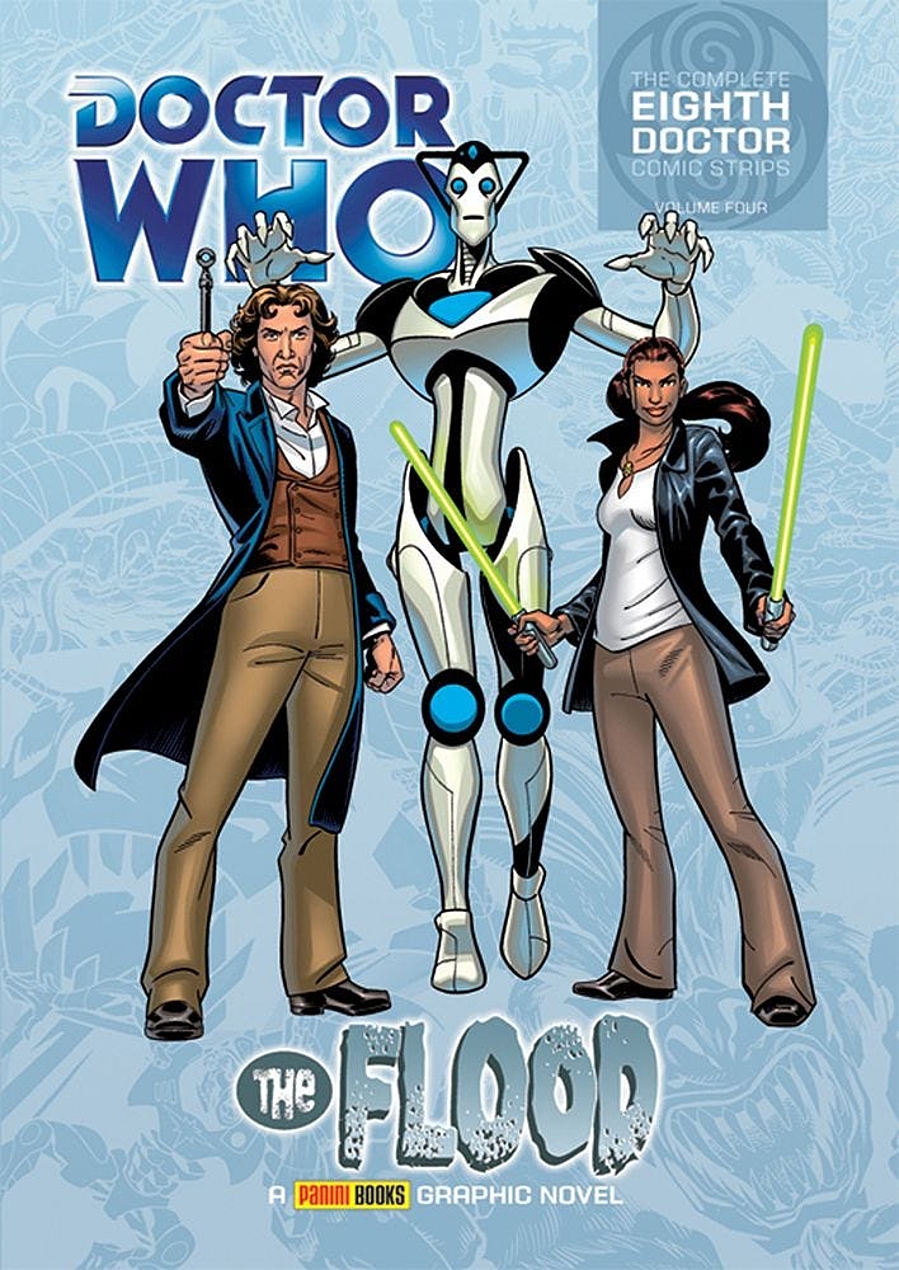
The Flood: Collected Comic Strips from the Pages of Doctor Who Magazine
by Scott Gray, Martin Geraghty, Mike Collins, John Ross, et al.

Collection published: 2007
Contents originally published: 2003-05
Previously read: August 2008
Reread: September 2022

And here we come to the end. Not just the eighth Doctor, but the end of an unprecedented era in Doctor Who Magazine history.

Something I've tracked in this project is for how long the strip functions as a self-contained narrative. For example, you can read from #1-60 and it all makes sense... but then the Doctor changes appearance between #60 and 61! Peri spontaneously disappears between #129 and 130. Benny appears suddenly in #193, and Ace disappears; Ace reappears in #203; and then Ace and Benny disappear after #210. The tv programme and other external factors prevent the strip from working as a totally self-contained story, even if it almost gets away with it at times. (The Shape-Shifter picks right up from The Moderator even though the Doctor changed his appearance!)

But from #244 to 353, we have a continuous story (side-strips like The Last Word or Character Assassin aside): over a hundred strips, not quite ten years' worth, that you can read without interruption. The characters, the themes, the ideas, develop from story to story. It had never been done before in Doctor Who Magazine history—no one prior to Alan Barnes, Martin Geraghty, Scott Gray, and company had ever had such a canvas to work on, and thus far, no one has ever had one again. Even more amazingly, it's clear this could have kept on going. This volume introduces Destrii as a new companion, only to immediately wrap up the narrative of her and the eighth Doctor. The universe where Doctor Who didn't come back to tv is probably a darker one overall, but its DWM strip could have kept going for another five years at least, I bet.

from Doctor Who Magazine #329
Where Nobody Knows Your Name, from Doctor Who Magazine #329 (Apr. 2003)
story by Scott Gray; pencils, colours & lettering by Roger Langridge, inks by David A. Roach
The eighth Doctor, a bit mopey after the events of the Ophidius/Oblivion arc, ends up in a bar that is—unbeknownst to him—run by Frobisher—who doesn't recognize the Doctor either. It's a great one-off, with some good character moments and strong comedy and heartfelt writing. The idea that they don't recognize each other is good; as Gray says in the end notes, "it avoided becoming a cosy, nostalgic reunion then and made it a bit more poignant." Not to spend my time here complaining about Big Finish, but compare this to the obnoxious sentimentality of something like the eighth Doctor meeting the Brigadier again in Stranded: UNIT Dating.
from Doctor Who Magazine #334
The Nightmare Game / The Power of Thoeuris! / The Curious Tale of Spring-Heeled Jack, from Doctor Who Magazine #330-36 (May-Nov. 2003)
stories by Gareth Roberts and Scott Gray; art by Mike Collins & Robin Smith, Adrian Salmon, and Anthony Williams & David A. Roach; colours by Dylan Teague and Adrian Salmon; lettering by Roger Langridge
For me, the DWM strip is always a bit less interesting when it becomes continuity-light. These aren't quite a series of one-offs, but they are pretty close to it. We have a story of the Doctor involved in a goofy plot involving aliens and football, one about Osirians in ancient Egypt, and one about an alien acting as Spring-Heeled Jack in nineteenth-century London. The Nightmare Game didn't work for me; I think it wants to be The Star Beast, but it doesn't have the energy or inventiveness of that story, and Gareth Roberts's Doctor's voice doesn't feel like Scott Gray's—too stiff and old-fashioned. Even the usually reliable Mike Collins seems to be having a bad day. The Power of Thoueris! is fun if slight—hard to go wrong with Adrian Salmon—but Curious Tale is again kind of a plod.

The first and third stories here both try to fake you into thinking you're meeting a new companion. I guess, anyway; Roberts claims in the end notes it was his intention to make readers think the pointless kid character was going to be a companion? Goodness knows why he wanted to do that, or why anyone fell for it. Gray pulls off a similar twist to much better effect in Curious Tale.

I do like the recurring gag across #330 to #338 about the Doctor turning up everywhere in a new, often ludicrous hat.
from Doctor Who Magazine #337
The Land of Happy Endings, from Doctor Who Magazine #337 (Dec. 2003)
story by Scott Gray, pencils by Martin Geraghty, inks by Faz Choudhury and David A. Roach, colours by Daryl Joyce and Adrian Salmon, lettering by Roger Langridge
Has anyone had to come up with more "celebratory" strip concepts than Scott Gray? He certainly had to do it a lot of times, and in the end notes to these collections, he sometimes comes across as increasingly desperate. Here it's Doctor Who's fortieth anniversary, and he would still be doing it ten years later for the fiftieth! This is surely one of the better ones, a tribute to the pre-DWM comics framed as a dream of the depressed eighth Doctor. The actual story is bonkers and charming, the coloring is beautiful, and the end is poignant.
from Doctor Who Magazine #344
Bad Blood / Sins of the Fathers, from Doctor Who Magazine #338-45 (Jan.-July 2004)
stories by Scott Gray, art by Martin Geraghty & David A. Roach and John Ross, colours by Adrian Salmon, lettering by Roger Langridge
And suddenly, the ongoing story is back. Bad Blood is the return of Destrii—who becomes a companion—and her uncle Jadafra—who becomes a villain. I remember this not sitting well with me the previous time I read this collection; way back in January 2008, I wrote, "I feel the return of Jodafra was bungled; the one-dimensional villain here is nothing like the enjoyable fop from Oblivion." Fourteen years later (!) I think I was wrong: Jodafra is an enjoyable fop if he thinks he can use you, but an awful bastard otherwise, and Bad Blood does a great job drawing that out, and establishing what makes him distinct from Destrii. A strong story with lots of great characters and concepts; after a minor slump, the strip is once again firing on all cylinders. This continues into Sins of the Fathers, which mostly is there to set up Destrii as a companion, especially the logistics of her holo-disguise, but is another solid story. Like the late Moffat/Smith era, Gray and his artists make it feel like a new movie every time.
The Flood, from Doctor Who Magazine #346-53 (Aug. 2004–Mar. 2005)
story by Scott Gray, pencils by Martin Geraghty, inks by David A. Roach, colours by Adrian Salmon, lettering by Roger Langridge
from Doctor Who Magazine #350
The end of the eighth Doctor's comic run is surely also one of its best stories. An amazing setting, a great use of the Cybermen, some real meaningful, human stuff from both the Doctor and Destrii, perfect artwork. So good that Russell T Davies cribbed from it two different times (the Doctor absorbing the Time Vortex in The Parting of the Ways, the Cybermen as ghosts in Army of Ghosts), but of course he did, because this is operating right in the same ethos as him, my preferred ethos for Doctor Who, where the fantastic crashes right into the ordinary. The Cyberman plan—to make people want to by Cybermen by making their emotions unbearable—has never been bettered. The Doctor's increasingly desperate plans and ploys are done amazingly well. The new Cyberman design is fantastic. Martin Geraghty is on fire as much as the Doctor is during the climax. The narration by Izzy is the icing on the cake, and the cameos from her, Maxwell Edison, and Grace are well-placed. The ending isn't a regeneration, but it could have been, and it works either way.

Even the coda with the cows is great. I'm sad it had to end, but it couldn't have ended better than this.
from Doctor Who Magazine #353
Stray Observations:
  • There's never been much sign that DWM cares about the Big Finish uses of their concepts; the woman Frobisher is married to here is seemingly not the one he settled down with when he left the Doctor in The Maltese Penguin.
  • #337 was, fact fans, the very first issue of Doctor Who Magazine I ever picked up, meaning The Land of Happy Endings was my first-ever DWM strip. I picked up that issue so I could get ahold of its exclusive Big Finish audio drama, Living Legend, written by Scott Gray himself! It would be a few years before I would become a regular purchaser of DWM... I own The Coup / Silver Living, which came free with #351, but the cover to that one doesn't strike a chord; I think I might have just bought the CD on its own on eBay in that case.
  • Normally I think Gray does a great job capturing the Doctor in general and Paul McGann specifically, but I don't care for a Doctor who makes scalping jokes and thinks Native Americans went around saying "How!" and calls them "Red Indians." Ugh.
  • One thing I don't like about The Flood: the bit where Destrii is inadvertently racist. It's just not what I want to read about a companion doing? I think the story might get away with it if Destrii or anyone else acknowledged it, but all the only reaction comes from someone who's been emotionally compromised by the Cybermen. Similarly, I don't quite buy that you could watch as much Earth tv as Destrii has and not know about money!
  • Can I just say, Martin Geraghty has always drawn Paul McGann as kind of tall... but in reality, McGann's only a couple inches taller than the "short" Sylvester McCoy. I feel like this is surely because of those TVM promo photos where McCoy hands McGann the TARDIS key, where McGann is clearly way taller. Supposedly McGann was standing on a box! Can we assume that even if McGann is average height, the character of the eighth Doctor is tall, and thus Martin Geraghty draws him correctly?
  • The "Flood Barriers" behind-the-scenes here, about how DWM almost got to do the regeneration, and their pitch of Ninth Doctor: Year One, is really fascinating to read. I totally see the reason neither panned out, but it does seem a bummer that DWM could be offered something so titanic yet not get to do it, and I bet Scott Gray and Martin Geraghty would have made The Ninth Doctor: Year One something special. But they made the right call—especially once Night/Day of the Doctor came along!

This post is the twenty-ninth in a series about the Doctor Who Magazine comic strip and Marvel UK. The next installment covers The Cruel Sea. Previous installments are listed below:

  1. The Iron Legion
  2. Dragon's Claw 
  3. The Transformers Classics UK, Volume One
  4. The Tides of Time
  5. The Transformers Classics UK, Volume Two
  6. Voyager
  7. The Transformers Classics UK, Volume Three
  8. The World Shapers
  9. The Transformers Classics UK, Volume Four
  10. The Age of Chaos
  11. The Transformers Classics UK, Volume Five
  12. A Cold Day in Hell!
  13. Death's Head: Freelance Peacekeeping Agent (part 1)
  14. Nemesis of the Daleks
  15. Death's Head: Freelance Peacekeeping Agent (part 2)
  16. The Good Soldier
  17. The Incomplete Death's Head
  18. Evening's Empire
  19. The Daleks
  20. Emperor of the Daleks
  21. The Sleeze Brothers File
  22. The Age of Chaos
  23. Land of the Blind
  24. Ground Zero
  25. End Game
  26. The Glorious Dead
  27. Oblivion
  28. Transformers: Time Wars and Other Stories

18 July 2022

Ground Zero (From Stockbridge to Segonus: A Doctor Who Magazine Comics Marathon, Part 24)

Ground Zero: Collected Comic Strips from the pages of Doctor Who Magazine
by Scott Gray, Martin Geraghty, Alan Barnes, Gareth Roberts, Adrian Salmon, et al.

Collection published: 2019
Contents originally published: 1995-96
Acquired: December 2020
Read: April 2022

This volume continues the "past Doctor" focus of Land of the Blind, but with a more unified approach otherwise. Bar two fill-ins, every story in the volume is illustrated by Martin Geraghty; the strip hasn't had a unified artistic vision since John Ridgway went from primary artist to one of many back in 1988, so around seven years prior! I like the unity of approach, but even better that it's Geraghty, who is great both with likenesses and storytelling, the combo you need—but don't always find—in a tie-in artist. There's also a new unity of vision behind the scenes; the commentary in this volume by strip editor Gary Gillatt is great stuff, showing how he decided to totally change the approach of the strip.

Curse of the Scarab / Operation Proteus / Target Practice, from Doctor Who Magazine #228-34 (Aug. 1995–Jan. 1996)
stories by Alan Barnes and Gareth Roberts, art by Martin Geraghty and Adrian Salmon, lettering by Elitta Fell
We open with a three-part fifth Doctor and Peri story, a three-part first Doctor and Susan story, and a one-part third Doctor and Jo story. They are all pretty competent. Curse of the Scarab is a decent adventure runaround, with some fun ideas and some more implausible ones; like a lot of Alan Barnes's Big Finish work, this involves plunging the Doctor into a certain moment in historical pop culture, and Barnes is a good pop culture historian, so it works. Some lush artwork from Geraghty helps. Operation Proteus is okay; again, there's some good stuff and some other stuff I found harder to buy, such as the way the cure is deployed. Target Practice is the DWM main strip debut of Adrian Salmon (I guess he was already doing the Cybermen strip, but I won't get to that for some time), and he is one of my favorites. His style is well suited to the subject matter.
from Doctor Who Magazine #235
Black Destiny, from Doctor Who Magazine #235-37 (Feb.-Apr. 1996)
story by Gary Russell, art by Martin Geraghty, inks by Bambos Georgiou, letters by Elitta Fell
Martin Geraghty may be a good artist, but he's not a good enough artist (yet, anyway) to save us from Gary Russell's confusing transitions; there were several moments in this story where I didn't know what was going on or who was who. The resolution is total nonsense, introducing a whole idea never before mentioned in the story.
from Doctor Who Magazine #238
Ground Zero, from Doctor Who Magazine #238-42 (Apr.-Aug. 1996)
story by Scott Gray, pencils by Martin Geraghty, inks by Bambos Georgiou, letters by Elitta Fell
It feels different this time...

This story does a lot of things to change it up, to signal that the comic strip as you knew it is at an end. There's an ongoing story in DWM for the first time since, I think, The Mark of Mandragora way back in #169-72... five years prior! Ground Zero picks up on hints dropped in three of the previous four stories in this volume, paying off why a mysterious a voice accosted Peri, Susan, and Sarah Jane.

It's also our first story with more than three installments since Final Genesis in 1993. It uses its five parts to good advantage, twisting and turning through a complicated plot; it has powerful cliffhangers. Obviously the death of Ace, but the reappearance of the old companions and the TARDIS plunging into the human collective unconsciousness are also great moments, well executed. The story uses its space to good advantage.

It also feels very now for the first time in a long time. This is the Doctor of the tv movie, not the show, not just in costume, but in attitude, and in an indication that both he and Susan are part human. The death of Ace adds to this: the strip is an ongoing concern, able to change its own narrative in a way that hasn't been true since the introduction of Bernice Summerfield. But it's not just the death of Ace. The story builds off what has come before and sets up what is to come.

On top of all that, it's a dang good story. I will say it runs a bit intense for my tastes—Peri is put through the wringer in a way I don't quite like—but it's engaging, it's interesting, the identity of the narrator is a good reveal, it has great concepts, it has great visuals. The empty streets, the Threshold, the TARDIS straining itself, the console room exploding, and of course Ace's death. Tremendous stuff, and I devoured it. Though I have enjoyed the strip more than I have not since A Cold Day in Hell!, it really does feel like something special is back.
from Doctor Who Magazine #243
Doctor Who and the Fangs of Time, from Doctor Who Magazine #243 (Sept. 1996)
story + art by Sean Longcroft, lettering by Elitta Fell
This is a neat little semiautobiographical story about writer and artist Sean Longcroft's on-again off-again love affair with the show, peronified by him interacting with Tom Baker as the Doctor. Well done, I found it amusing and heartwarming in equal measure. "[Y]ou can't be four years old forever, you know. But part of you always will be."
Stray Observations:
  • Gary Gillatt says in the commentary that around this time, strips by Colin Baker, Barry Letts, and Andrew Cartmel all fell through. We've seen good stuff from Cartmel, but the other two leave me a little more apprehensive. Did we dodge a bullet or miss works of artistic genius? We'll never know, I guess.
  • It took a few posts of explanation from friendly GallifreyBase posters for me to get the last-panel joke in Curse of the Scarab that Barnes is so proud of in the notes. A bit belabored.
  • Gary Russell admits he can't actually write comics in the notes, but he only realized this after being punted off IDW's Doctor Who comic after six issues of its eighteen-issue run. I agree, to be frank (his IDW story was terrible), and I admire his honesty. Despite this self-realization, he's evidently writing an upcoming comic for Cutaway...
  • I understand the reasoning behind jettisoning the Bernice Summerfield era from the strip's history (#193-208), maybe even all the way back to the first VNA allusion (The Grief in #185). But by showing the classic tv console room being exploded, the strip lops off a bit of its own history, as the new console room was its invention, in The Chameleon Factor (#174).
  • It's particularly a shame, as the strip had made this "yes our own history does matter" move before, with the sequence leading up to The Mark of Mandragora. As the new-era strip will do in its next installment in End Game, that storyline even referenced the very first ever DWM story to make it clear that yes, the ongoing story you have read since The Iron Legion is back! But that is gone, along with the VNAs, even though I don't think it had to go with them.
  • When logging this collection in LibraryThing, I realized that my children already own a book by Sean Longcroft... he is the illustrator of Usborne's First Book about the Orchestra, a "noisy" book I read them many times until the circuitry shorted. Now that I know, I can actually see it in the style.

This post is the twenty-fourth in a series about the Doctor Who Magazine comic strip and Marvel UK. The next installment covers End Game. Previous installments are listed below:

  1. The Iron Legion
  2. Dragon's Claw 
  3. The Transformers Classics UK, Volume One
  4. The Tides of Time
  5. The Transformers Classics UK, Volume Two
  6. Voyager
  7. The Transformers Classics UK, Volume Three
  8. The World Shapers
  9. The Transformers Classics UK, Volume Four
  10. The Age of Chaos
  11. The Transformers Classics UK, Volume Five
  12. A Cold Day in Hell!
  13. Death's Head: Freelance Peacekeeping Agent (part 1)
  14. Nemesis of the Daleks
  15. Death's Head: Freelance Peacekeeping Agent (part 2)
  16. The Good Soldier
  17. The Incomplete Death's Head
  18. Evening's Empire
  19. The Daleks
  20. Emperor of the Daleks
  21. The Sleeze Brothers File
  22. The Age of Chaos
  23. Land of the Blind