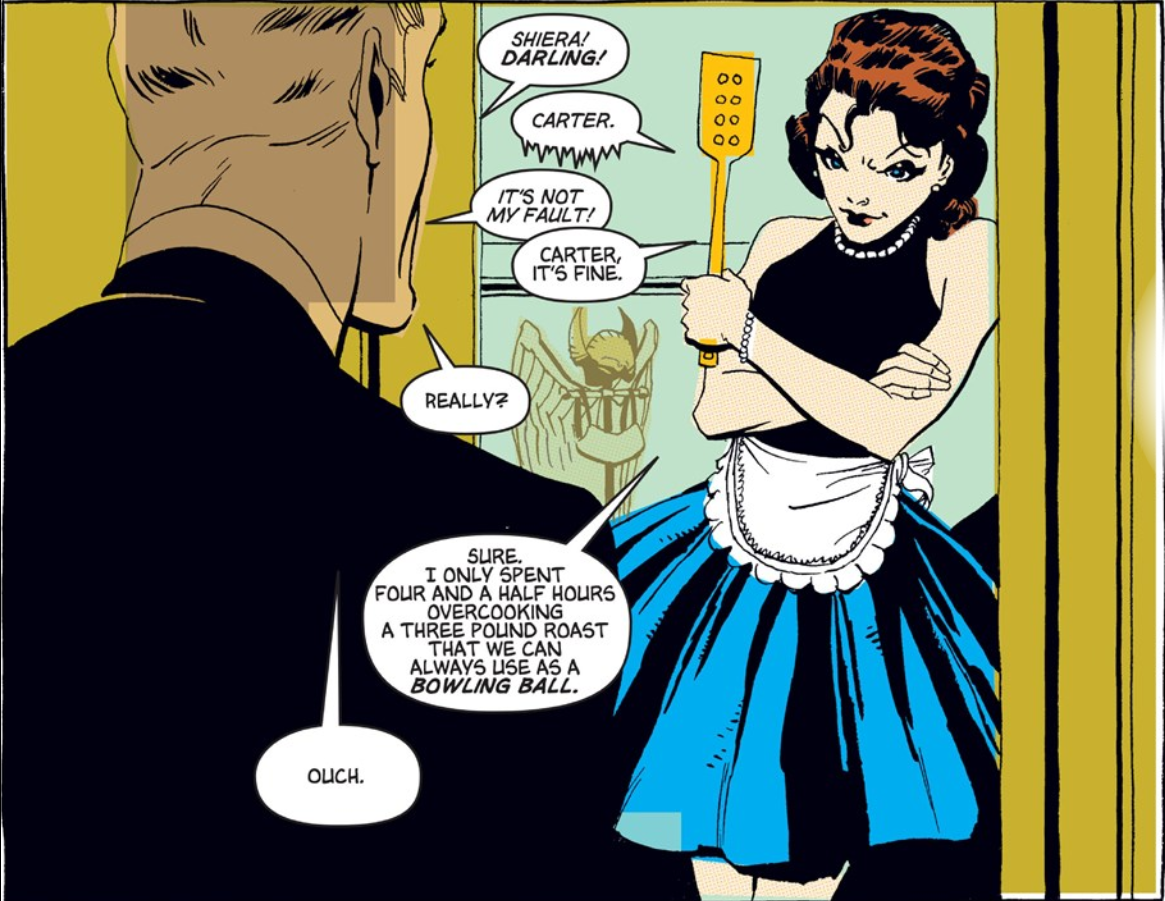
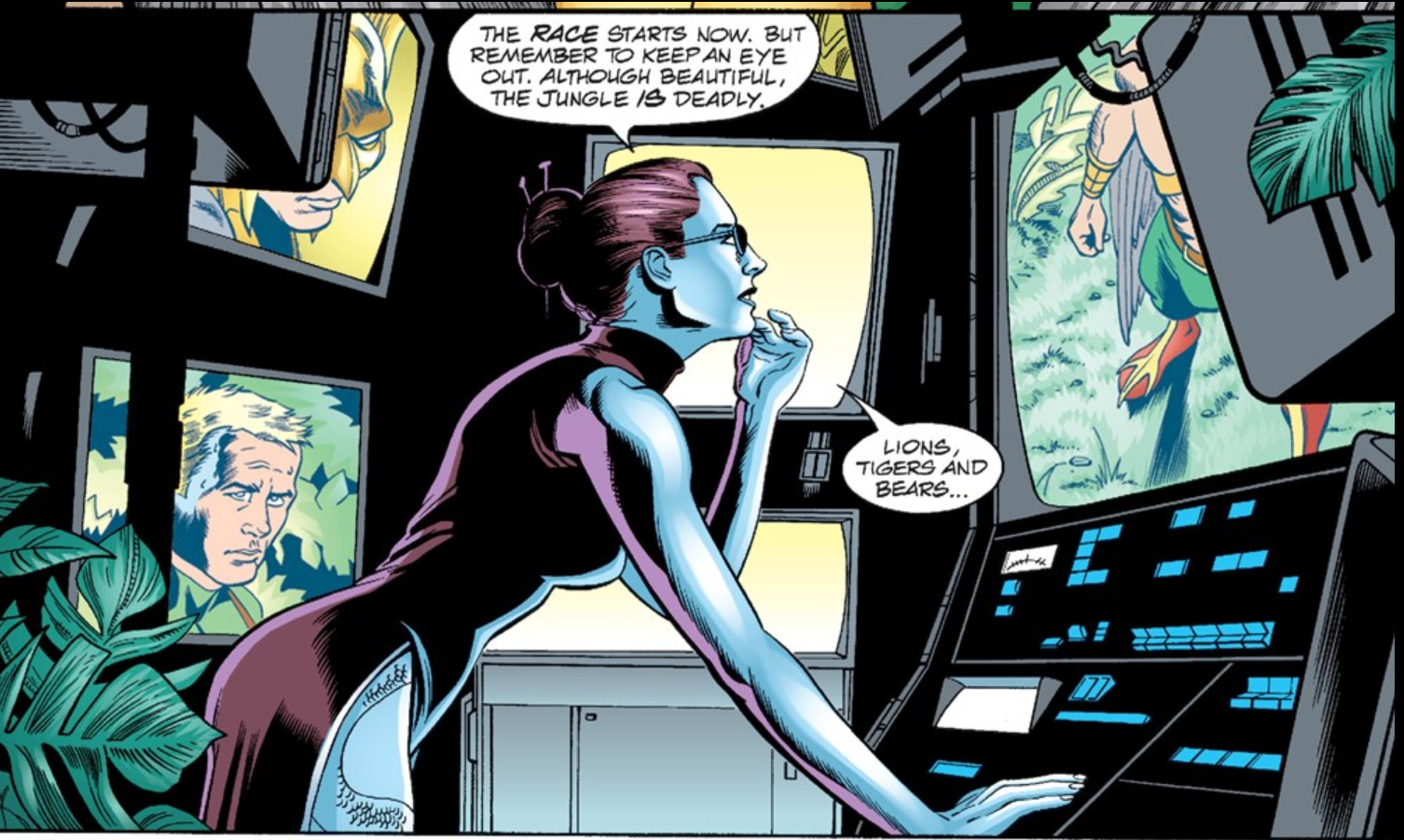
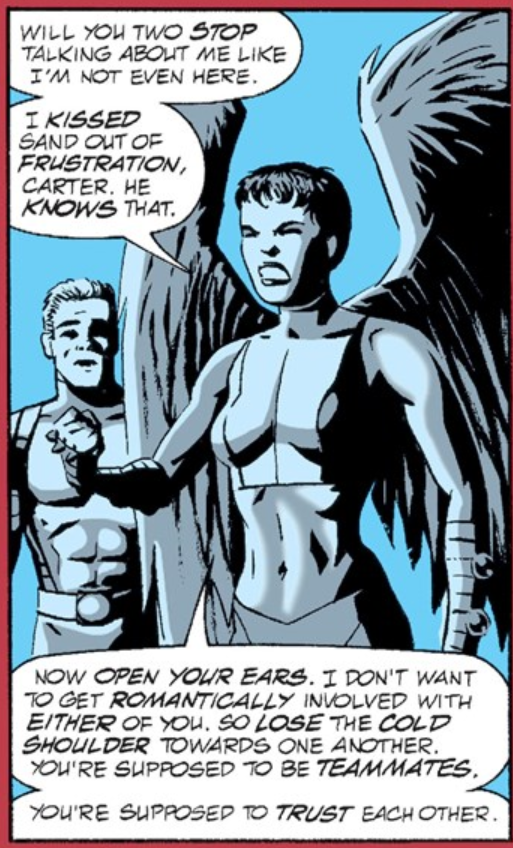
Showing posts with label creator: michael bair. Show all posts

18 August 2025

JLA: Year One by Mark Waid, Brian Augustyn, Barry Kitson, et al.

JLA: Year One: The Deluxe Edition

Collection published: 2017
Contents originally published: 1998-99
Acquired and read: July 2025
Writers: Mark Waid & Brian Augustyn
Penciller: Barry Kitson
Inkers: Michael Bair, Barry Kitson, Mark Propst, John Stokes
Colorist: Pat Garrahy
Letterers: Ken Lopez

Like the previous installment of this series (see below), this one covers a story that is arguably pretty tangential to the Blackhawks. But I couldn't see how I wouldn't like this book, so I really wanted an excuse to buy it and read it sooner rather than later.

This book comes from a (somewhat odd, in retrospect) period of DC history where Batman, Superman, and Wonder Woman were not founding members of the Justice League, thanks to various changes in continuity introduced following Crisis on Infinite Earths. Thus, the main characters are the Flash (Barry Allen), Green Lantern (Hal Jordan), Black Canary (Dinah Laurel Lance), Aquaman, and the Martian Manhunter. The story chronicles the first year of the JLA, picking up from them fighting off an alien invasion. They organize as a group, face various crises, discover that the alien invasion they fought off is not quite over, try (and fail) to recruit Superman, and learn about each other and themselves and how to work as a team.

I loved it. This is, as far as I am concerned, perfect superhero comics. This should be of little surprise to anyone familiar with the other work of the creative team; Mark Waid is, in my opinion, one of the all-time greats, able to unite continuity with characterization in really compelling ways. I haven't read much by his frequent collaborator Brian Augustyn, but Waid sings his praises in the intro, so clearly they are simpatico. Definitely also simpatico is Barry Kitson; Kitson came out of the UK comics scene (specifically, of course, Transformers), but really won himself over to me with his amazing five-year run on L.E.G.I.O.N., where he went from pencilling the title to plotting it and then scripting it. That was, I believe, where he first worked with Waid, who scripted the title for a year. After JLA: Year One, the two would work together on the excellent Legion of Super-Heroes "threeboot".

I understand why Batman and Wonder Woman couldn't be founding members of the JLA in the post-Crisis continuity—Batman was supposedly an "urban legend" in the post–Batman: Year One comics, which would hardly be true if he was giving Justice League press conferences, and George PĂ©rez's Wonder Woman reboot moved her origins up to the present day—and I can also see why the editors of the Superman titles might not want him in the JLA in the present day—presumably they didn't want his actions in that book to constrain what they were doing in theirs—but it's not clear to me why Superman couldn't have been a past member of the JLA. But I guess it worked out; I don't think this story would have been anywhere near as good if these five characters were outclassed by a hero of Superman's power and narrative significance.
from JLA: Year One #7 (art by Barry Kitson & Michael Bair)

When I was a young comics fan, I used to make fun of Aquaman. This book made me feel bad for that.
from JLA: Year One #3 (art by Barry Kitson)
All of this is to say, I think this creative team was entirely on the same page, and what was on that page is beautiful. I like my superhero comics to be character-driven and fun, and this is undoubtedly both. One of the benefits of this odd team is that they have a lot of good hooks for characterization, especially early in their superheroic careers. Aquaman is trying to adjust to living on the surface world, where he feels like an alien of sorts; I liked the idea that he mumbles compared to people from the surface because of how sound propagates more loudly underwater. 

I think Hal is probably the one who gets the fewest character moments, actually, but he's fine, even if the playboy thing is laid on a bit thick. (I do, however, think the decision to call Tom Kalmaku "Pie" was not really any better than "Pieface" surely.)

Black Canary is a real highlight of the book, which as a Dinah Laurel Lance stan I very much appreciated. Post-Crisis, Black Canary was split into two characters: Dinah Drake (later Dinah Drake Lance), who was the Justice Society's Black Canary, and Dinah Laurel Lance, her daughter. But in most of the comics I've read, this is a fact of backstory, not something dealt with in the narrative; one of the benefits of going back to Black Canary's origin is actually seeing how she relates to her mother. The elder Dinah wants to mold the younger into her own image, but the younger Dinah must find her own path. There is a lot of good JSA stuff in the book; Dinah is often comparing her new colleagues to the heroes she grew up alongside, but also she discovers that those heroes weren't so perfect, as Waid and Augustyn make good use of the revelation from Starman that the elder Dinah had an affair with Ted Knight, the original Starman.

Honestly, I was a bit skeptical about going back over this ground, but the story did a great job with it.
from JLA: Year One #4 (art by Barry Kitson & Michael Bair)

I think Barry Allen's thread is less involved than either Black Canary's or Martian Manhunter's, but Waid and Augustyn and Kitson do well by him. (Which I guess makes sense, as they cowrote an acclaimed and long run on The Flash, even if it was about Wally West.)

Reading this book made me think I really must get around to reading some actual Martian Manhunter comics someday.
from JLA: Year One #1 (art by Barry Kitson)

The other real highlight is Martian Manhunter, even more of an outsider than Aquaman, but also able to pass thanks to his shapeshifting and telepathy. His discomfort at seeing the way his teammates treat the aliens they fight, his need to better understand them that goes places that violate their privacy, his belief that they and humanity can do better, they're all very well done.

What really makes the characterization sing, though, is the interactions. There are lots of moments between them all: John and Aquaman, Hal and Barry, Barry and Dinah, and so on, all the permutations you can think of, perfectly rendered. This is a team of people, in their highs and their lows; you understand why the team (briefly) turns on Martian Manhunter, but the moment where he needs to tune himself telepathically into an alien device, and the whole team comes together to help him do it is a genuine punch-the-air moment, I loved it.

Awww...
from JLA: Year One #12 (art by Barry Kitson & Michael Bair)

Beyond that, the book is just fun and inventive, taking those old Silver Age stories and filtering them through a modern perspective without being either overly nostalgic or cynical. (Weird to think, actually, that this book is now thirty years old, which is about how old the original Justice League stuff was when this was written.) We see Vandal Savage, we see the Doom Patrol, we see Snapper Carr, we get cameos from Oliver Queen and Maxwell Lord. At the end of the book, the invading aliens trap every superhero on Earth in a prison, which gives the JLA its chance to shine—but also means that once the JLA liberates the others, we get glimpses of all the superheroes of the Earth at this time. (In some cases, I suspect the continuity timing doesn't add up, but who cares.) I found that each issue of this series just flew by, perfect superhero comics. 

Lots of characters in this image who should be dead!
from JLA: Year One #2 (art by Barry Kitson)
As for the Blackhawks? Well, I'm saving a discussion of their post-Crisis continuity for a future post, but this story very much doesn't seem to care about it, nor does it even sit very well with their Silver Age continuity. Their role in the story is small but significant. In an early issue, we see them in their 1970s red-and-green uniforms, and Blackhawk suggests they need to update with the times. But then in a later issue, they're all in their superhero gear from the "Junk-Heap Heroes" era (see item #6 in the list below), and they decide they all look ridiculous and go back to how they were. Additionally, Blackhawk Island is the site of the prison where the aliens put the Earth's superheroes.

You might see this as massaging how their superheroic career could fit into their new post-Crisis history... except that all the characters who got killed off during the Rick Burchett run (see #10 and 11) are there! Additionally, so is Lady Blackhawk, but we were told in Guy Gardner (see #12) that she was plucked out of time at some point in the past and brought to the present thanks to the Crisis in Time. But this isn't a complaint or anything, just observations. The joke about how they look terrible as superheroes is probably worth everything else! (It is shooting fish in a barrel, though.)

Chuck's face just screams, "Blackhawk, you promised me this outfit looked cool."
from JLA: Year One #8 (art by Barry Kitson & Michael Bair)

This is the thirteenth in a series of posts about the Blackhawks. The next installment covers Guns of the Dragon. Previous installments are listed below:

  1. The Blackhawk Archives, Volume 1 (1941-42)
  2. Military Comics #18-43 / Modern Comics #44-46 / Blackhawk #9 & 50 (1943-52)
  3. Showcase Presents Blackhawk, Volume One (1957-58) 
  4. Blackhawk vol. 1 #151-95 (1960-64) 
  5. Blackhawk vol. 1 #196-227 (1964-66)
  6. Blackhawk vol. 1 #228-43 (1967-68)
  7. Blackhawk vol. 1 #244-50 / The Brave and the Bold #167 (1976-80)
  8. Blackhawk (1982) 
  9. Blackhawk vol. 1 #251-73 / DC Comics Presents #69 (1982-84) 
  10. Blackhawk: Blood & Iron (1987-89)
  11. Blackhawk vol. 3 (1989-92) 
  12. Guy Gardner: Warrior #24, 29, 36, 38-43 / Annual #1 (1994-96)

19 April 2023

Catwoman: Her Sister's Keeper by Mindy Newell, J. J. Birch, and Michael Bair

Catwoman: Her Sister's Keeper

Collection published: 1992
Contents published: 1989
Acquired and read: March 2023

Writer: Mindy Newell
Penciller: J. J. Birch
Inker: Michael Bair
Letterer: Agustin Mas
Colorist: Adrienne Roy

My journey through the Justice Society and related comics will never come to an end, because I continually find other stuff to add to it. When I read JSA Classified, the story where Wildcat goes to Gotham and bumps into Catwoman indicated there was a history between these two characters... one I knew nothing about! So I did some research and that brought me to this collection, which contains the four-issue Catwoman vol. 1 miniseries from 1989.

This is basically "Catwoman: Year One" in all but name. It runs in parallel to Batman: Year One, showing how Selina Kyle decided to become Catwoman after being inspired by Batman, and how being Catwoman let her escape from her life as a prostitute and rescue both her fellow prostitute and ward, Holly Robinson, and her sister, who is now a nun named Sister Magdalene.

The Wildcat content is pretty small. Basically, Selina bumps into Flannery, a cop in the vice department who advises she protect herself from her abusive pimp and recommends a guy named Ted to her. Ted appears a bit in the first two issues, training Selina in how to fight and teaching her how to use her whip. Honestly, he comes across as a bit sleazy but ultimately well-intentioned. And then that's it; he doesn't appear in issues #3 or 4, though it's one of those issues where we finally learn his last name is "Grant" and thus that he's the JSA's Wildcat. In the then-current post-Crisis timeline, this would be many decades after the JSA had to retire from superheroics because of Congressional interference, and a couple years before their first encounter with the new JLA would bring them back into action. So I guess for those forty years, Ted Grant just worked in some sleazy gyms... which, you know, I buy. I will have to see if future stories featuring Ted and Selina make more explicit use of Ted's identity as Wildcat.

Ted Grant: always a charmer.
from Catwoman vol. 1 #1

Other than that, this is a solid story, albeit one very much of its time. That's not a criticism per se, but this is definitely right out of the gritty-but-without-being-gruesome Batman aesthetic birthed by Frank Miller and David Mazzucchelli in Year One and continued into other stories of the time like Shaman, Venom, and Night Cries; it's little surprise to see that it was edited by Denny O'Neil, because it was a vibe he was cultivating all over the place at the time. If you like that vibe, it's one of its more effective examples. Writer Mindy Newell effectively takes what could be kind of an awful twist on Selina from Year One (making her into a prostitute) and uses that to launch a character who feels like a meaningful person. I appreciated the fleshing out of her supporting cast with both Holly and Magdalene; giving Catwoman two people she's working on behalf of stops her from feeling like an out-and-out villain. (Holly Robinson will go on to have big role in Catwoman vol. 3, as I recall, but I'm not sure what becomes of Sister Magdalene in future stories.)

The story gets Selina from her fetish-y outfit from Batman: Year One into this more sedate grey one.
from Catwoman vol. 1 #3

J. J. Birch and Michael Bair are strong artists, capturing the Year One aesthetic without feeling derivative, and there's some great coloring from the ever-capable Adrienne Roy. I really like 1980s coloring, and this book's noir stylings are particularly suited for it.

I really liked the relationship between the sisters, two people broken by their upbringing trying to find a refuge in the world.
from Catwoman vol. 1 #4

My edition is from 1992; I would guess it was collected (in this case by Warner Books, not by DC itself) in order to have a Catwoman-related product in bookstores when Batman Returns came out. Since then, DC seems to have let it go out of print... which is weird, given DC's love of having "Year One" collections. Thirty years later, why haven't they rereleased this as Catwoman: Year One with a more legible cover? (Possibly throw in the uncollected Catwoman: Year 2 as well! But more on that next time.)

This post is forty-first in an ever-expanding series about the Justice Society and Earth-Two. The next installment is a supplement covering Catwoman: Year 2. Previous installments are listed below:

26 September 2022

JSA, Book Three: The Power of Legacy! by Geoff Johns, David S. Goyer, Stephen Sadowski, Rags Morales, Peter Snejbjerg, et al.

JSA by Geoff Johns, Book Three

Collection published: 2019
Contents published: 1999-2003
Read: July 2022

Writers: Geoff Johns, David S. Goyer, Michael Chabon, Dan Curtis Johnson, James Robinson, J. H. Williams III, Brian Azzarello, Howard Chaykin, Darwyn Cooke, Jeph Loeb, Ron Marz
Pencillers: Stephen Sadowski, Rags Morales, Peter Snejbjerg, Sal Velluto, Buzz, Javier Saltares, Adam DeKraker, Barry Kitson, Michael Lark, Mike McKone, Dave Ross, Phil Winslade, Uriel Caton, Derec Aucoin, Rick Burchett, Tony Harris, Howard Chaykin, Darwyn Cooke, Eduardo Risso, Tim Sale, Chris Weston
Inkers: Bob Almond, Michael Bair, Peter Snejbjerg, Wade Von Grawbadger, Jim Royal, Ray Kryssing, Keith Champagne, Wayne Faucher, Barry Kitson, Michael Lark, Prentis Rollins, Phil Winslade, Anibal Rodriguez, Christian Alamy, Dave Meikis, Derec Aucoin, Rick Burchett, Howard Chaykin, Darwyn Cooke, Eduardo Risso, Tim Sale, Chris Weston
Colorists: John Kalisz, Tom McCraw, Carla Feeny, Mark Chiarello, Tony Harris
Letterers: Ken Lopez, Kurt Hathaway, Michael Lark, Patricia Prentice, Richard Starkings, Darwyn Cooke, Janice Chiang

I complained when reading book two of this series that it seemed like the stories were being collected out of order; book three (called The Power of Legacy! on the cover but subtitle-free on the title page) makes that particularly clear, with later issues collected here introducing things that had already happened in book two, like the transfer of the JSA chairship to Mr. Terrific. But anyway: let's take this part by part as it's presented.

Women, amirite?
from JSA All Stars vol. 1 #2 (script by Jeph Loeb, art by Tim Sale)

The book begins with JSA All Stars vol. 1, an eight-issue miniseries about the various "legacy" characters in the JSA, those who are successors to older heroes: Hawkgirl, Dr. Fate, Stargirl, Hourman, Dr. Mid-Nite, and Mr. Terrific. The middle six issues all follow the same format. First, there's a sixteen-page story about the modern hero written by Geoff Johns and David Goyer, usually delving into character points for them, like Hourman's addiction (this is the Rick Tyler version from Infinity, Inc.) or Stargirl's relationship with her biological father. Then, there's a six-page story about their Golden Age predecessor, written and drawn by high-profile guest artists, like Howard Chaykin, James Robinson and Tony Harris, or Darwyn Cooke. Overall, I enjoyed these; the present-day stories actually give us some solid character work, especially for characters who haven't really had much meaningful focus in the present-day stories, like Hourman, Dr. Mid-Nite, and Mr. Terrific. The flashback stories are good fun stuff: if you take a great writer and artist (or writer/artist) and tell them to do what they want in a six-page Golden Age adventure, they will deliver.

Learning that the new Dr. Mid-Nite also did a residency with the original makes me wonder even more what happened to Beth Chapel. Ah, well, gotta replace those black legacy characters with white ones.
from JSA All Stars vol. 1 #6 (story by David S. Goyer & Geoff Johns, script by Geoff Johns, art by Stephen Sadowski & Wade Von Grawbadger)

The only thing I didn't like was the frame, which I have a sneaking suspicion was added after the middle six issues were completed, because of it how it contorts to not be mentioned in them. A villain turns up, but disguises himself as the Spectre and tells the characters to take time off to think about their histories but also that they shouldn't think about the events of the frame. It's pretty pointless, to be honest, and the six issues would have stood up on their own just fine. But overall, JSA All Stars is my favorite thing I've read thus far in this title... though technically, it's not part of it!

I often find Dr. Fate thaumababble tedious, but I would have read the hell out of a Darwyn Cooke Fate ongoing.
from JSA All Stars vol. 1 #3 (script & art by Darwyn Cooke)

Then come three stories about a character named Nemesis, two from JSA Annual #1 and JSA Secret Files & Origins #2. She's raised by the Council (the same organization responsible for some of DC's various Manhunters), and I felt like a lot of time was spent on her for reasons that weren't clear to me. But maybe this will come in during book four more? The Ultra-Humanite seems to be part of the Council storyline, and he's in book four. (There are some other stories from that Secret Files issue, too; one I already read in the Chase collection, and the other is to foreshadow an upcoming storyline.)

I will never care about Sand, especially his self-doubt, but this was a neat moment.
from JSA Secret Files & Origins #2 (story by Geoff Johns & David S. Goyer, script by Geoff Johns, art by Javier Saltares & Ray Kryssing)

After this, we finally get back to the main JSA series. First we have one of those standalone stories where nothing in particular is going on and we check in on various character that team books like to do—and that I like them to do. After the icky stuff in book two where everyone was expecting teenage Hawkgirl to hook up with octagenarian Hawkman because it was her "destiny," this volume thankfully pushes back against that, with her telling everyone she's going to do what she wants to do. I hope the series sticks to this, and that it's not a set-up for her coming around and getting together with Hawkman anyway. We also have some interrogation of the idea that Black Adam can be part of the team; I liked that Captain Marvel turned up, though was Atom Smasher (then called Nuklon) this hot-headed back in Infinc? Thankfully Sand, the team's most boring nonentity of a character, finally steps down as team leader.

My favorite part of this is that like two panels later, Captain Marvel goes on to use the word "legit." Such grace!
from JSA #27 (script by Geoff Johns, art by Rags Morales & Michael Bair)

This book also introduces Alex, a new character who was a cousin to Yolanda Montez, the Wildcat of Infinity, Inc. He was inspired by her JSA enthusiasm, and now he manages the JSA museum in the JSA's HQ. Fun idea... but he never actually appeared in Infinc! Didn't Yolanda have a younger brother? Why not use him? 

This lady's power is to always pose like a man is watching her.
from JSA #28 (script by Geoff Johns, art by Stephen Sadowski and Christian Alamy & Dave Meikis)

Lastly, we have a storyline where villains kidnap a number of JSA members and force them to fight each other as part of a gambling operation. This I thought was pretty good, probably the best actual storyline thus far, with lots of good moments of characterization, something sorely lacking from the series up to this point. I've been complaining about Geoff Johns, but this is actually the first story not co-written with David Goyer, so maybe it's him who's the problem. My favorite issue here was one where Stargirl and Jakeem Thunder (modern-day inheritor of Johnny Thunder's Thunderbolt) are the only two heroes left in HQ during the events of the Joker: Last Laugh crossover and have to protect New York City from a Joker-venom infected Solomon Grundy. Just two principal characters gives the characterization and the action time to shine, aided by some excellent moody art from Peter Snejbjerg. There's also a decent story about the JSA working with Batman. So... after three 400-page books things are finally looking up?

Finally!
from JSA #31 (script by Geoff Johns, art by Peter Snejbjerg)

The last story in the collection is "History 101," which the back cover proudly declares has never before been reprinted... but in fact it was already reprinted in The Justice Society Returns! way back in 2003! There are also lots of profiles and such from various issues of Secret Files & Origins, which is nice to have if you like that kind of thing; I did enjoy the diagram of JSA HQ.

This post is thirty-fourth in a series about the Justice Society and Earth-Two. The next installment covers JSA by Geoff Johns, Book Four. Previous installments are listed below:
  1. All Star Comics: Only Legends Live Forever (1976-79)
  2. The Huntress: Origins (1977-82)
  3. All-Star Squadron (1981-87)
  4. Infinity, Inc.: The Generations Saga, Volume One (1983-84)
  5. Infinity, Inc.: The Generations Saga, Volume Two (1984-85)
  6. Showcase Presents... Power Girl (1978)
  7. America vs. the Justice Society (1985)
  8. Jonni Thunder, a.k.a. Thunderbolt (1985)
  9. Crisis on Multiple Earths, Volume 7 (1983-85)
  10. Infinity, Inc. #11-53 (1985-88) [reading order]
  11. Last Days of the Justice Society of America (1986-88)
  12. All-Star Comics 80-Page Giant (1999)
  13. Steel, the Indestructible Man (1978)
  14. Superman vs. Wonder Woman: An Untold Epic of World War Two (1977)
  15. Secret Origins of the Golden Age (1986-89)
  16. The Young All-Stars (1987-89)
  17. Gladiator (1930) ["Man-God!" (1976)]
  18. The Crimson Avenger: The Dark Cross Conspiracy (1981-88)
  19. The Immortal Doctor Fate (1940-82)
  20. Justice Society of America: The Demise of Justice (1951-91)
  21. Armageddon: Inferno (1992)
  22. Justice Society of America vol. 2 (1992-93)
  23. The Adventures of Alan Scott--Green Lantern (1992-93)
  24. Damage (1994-96)
  25. The Justice Society Returns! (1999-2001)
  26. Chase (1998-2002)
  27. Stargirl by Geoff Johns (1999-2003)
  28. The Sandman Presents: The Furies (2002)
  29. JSA by Geoff Johns, Book One (1999-2000)
  30. Wonder Woman: The 18th Letter: A Love Story (2000)
  31. Two Thousand (2000)
  32. JSA by Geoff Johns, Book Two (1999-2003)
  33. Golden Age Secret Files & Origins (2001)

07 September 2022

JSA, Book Two by Geoff Johns, David Goyer, Stephen Sadowski, Michael Bair, Carlos Pacheco, Jesus Merino, et al.

JSA by Geoff Johns, Book Two

Collection published: 2018
Contents published: 1999-2003
Read: June 2022

Writers: Geoff Johns, David Goyer
Artists: Stephen Sadowski, Michael Bair, Carlos Pacheco, Jesus Merino, Phil Winslade, Mike Perkins, Steve Yeowell, Keith Champagne, Buzz, Rags Morales, Dave Meikis, Paul Neary, Rob Leigh, Javier Saltares, Ray Kryssing, Andrew Pepoy
Colorists: John Kalisz, Tom McCraw
Letterers: Ken Lopez, Pat Prentice, Kurt Hathaway

This volume of JSA by Geoff Johns (where every story is co-written by David Goyer, but I guess he doesn't rate) collects two story arcs from the main JSA comic and also the graphic novel JLA/JSA: Virtue and Vice and then some other stuff. What I am realizing is that I don't really care for Johns's approach to this book. First we have the seemingly obligatory storyline about a new Injustice Society, which like a lot of Geoff Johns stuff, is full of seemingly gratuitous violence in order to prove the situation is serious: he invents a whole Chicago superteam just to torture and brutally murder them, there's an evil Flash who runs through kids so fast they explode. It's just like... it's juvenile, and I don't read superhero comics to read about kids being murdered. I found it very hard to care.

The second big storyline is about a trip to Thanagar to resurrect Hawkman. I did really like Hawkworld, but Johns ignores any of its interesting complexities in favor of a melodramatic sub-Darkseid villain and a subplot about how a teenage girl just needs to give in and be romanced by an eighty-year-old man for the good of the universe.

Why does everyone assume she wants to be with him? (Also I spent some time wondering which Phantom Lady this was. The Action Comics Weekly one? But not so much time that I actually looked it up.)
from JSA: Our Worlds at War #1 (script by Geoff Johns, art by Javier Saltares & Ray Kryssing)

This book isn't totally unlikeable. In between those two storylines, there's a decent done-in-one that gives us some much-needed character focus, and actually the Our Worlds at War tie-in issue was pretty good too. And I also enjoyed the Secret Files & Origins issue that leads into Virtue and Vice, as well as the early parts of Virtue and Vice itself. When Johns (and Goyer) want to write these characters hanging out and talking about things, they do a decent job... but it seems they rarely do. If you compare this to the characterful and deft way that Len Strazewski wrote the last JSA ongoing, this just doesn't compare; I have very little sense of these people as, well, people. Like I said, Virtue and Vice starts good, but it soon becomes Yet Another Apocalyptic Battle with huge masses of people dying violently... which I am sure will promptly never be mentioned again. I also don't care much for stories where heroes are mind-controlled to be evil, especially if they promptly become stupid.

I have never cared for Johns's take on Power Girl.
from JLA/JSA: Virtue and Vice (script by David S. Goyer & Geoff Johns, art by Carlos Pacheco & Jesus Merino)

Some other thoughts: I think Secret Files & Origins and Virtue and Vice are included out of sequence; suddenly Mr. Terrific is JSA chair, and Stargirl is living in Metropolis, and Captain Marvel is a member, and there's a new Hourman who I don't think is the new Hourman from the previous book. None of these things have happened in the actual JSA series yet. It amused me that suddenly Green Arrow is alive again, so he has to contend with the fact that Black Canary has moved on romantically since his death. Virtue and Vice had some good President Luthor stuff. The way the heroes swap places with the statues in the Rock of Eternity is pretty neat.

This post is thirty-second in a series about the Justice Society and Earth-Two. The next installment covers Golden Age Secret Files & Origins. Previous installments are listed below:
  1. All Star Comics: Only Legends Live Forever (1976-79)
  2. The Huntress: Origins (1977-82)
  3. All-Star Squadron (1981-87)
  4. Infinity, Inc.: The Generations Saga, Volume One (1983-84)
  5. Infinity, Inc.: The Generations Saga, Volume Two (1984-85)
  6. Showcase Presents... Power Girl (1978)
  7. America vs. the Justice Society (1985)
  8. Jonni Thunder, a.k.a. Thunderbolt (1985)
  9. Crisis on Multiple Earths, Volume 7 (1983-85)
  10. Infinity, Inc. #11-53 (1985-88) [reading order]
  11. Last Days of the Justice Society of America (1986-88)
  12. All-Star Comics 80-Page Giant (1999)
  13. Steel, the Indestructible Man (1978)
  14. Superman vs. Wonder Woman: An Untold Epic of World War Two (1977)
  15. Secret Origins of the Golden Age (1986-89)
  16. The Young All-Stars (1987-89)
  17. Gladiator (1930) ["Man-God!" (1976)]
  18. The Crimson Avenger: The Dark Cross Conspiracy (1981-88)
  19. The Immortal Doctor Fate (1940-82)
  20. Justice Society of America: The Demise of Justice (1951-91)
  21. Armageddon: Inferno (1992)
  22. Justice Society of America vol. 2 (1992-93)
  23. The Adventures of Alan Scott--Green Lantern (1992-93)
  24. Damage (1994-96)
  25. The Justice Society Returns! (1999-2001)
  26. Chase (1998-2002)
  27. Stargirl by Geoff Johns (1999-2003)
  28. The Sandman Presents: The Furies (2002)
  29. JSA by Geoff Johns, Book One (1999-2000)
  30. Wonder Woman: The 18th Letter: A Love Story (2000)
  31. Two Thousand (2000)

20 July 2022

JSA, Book One by Geoff Johns, David Goyer, Stephen Sadowski, Michael Bair, et al.

JSA by Geoff Johns, Book One

Collection published: 2017
Contents published: 1999-2000
Read: April 2022

Writers: Geoff Johns, David Goyer, James Robinson
Artists: Stephen Sadowski, Michael Bair, Buzz, Scott Benefiel, Derek Aucoin, Marcos Martin, Keith Champagne
Colorist: John Kalisz
Letterer: Ken Lopez

In this series of posts, I've been tracking an impending Justice Society renaissance. After the brief flurry of JSA-related material from 1991 to 1993 or so, the JSA was largely left behind... and then it exploded in 1999. That all culminated in JSA, a new ongoing series, the Justice Society's first in six years, and also its longest; it lasted eighty-seven issues, beating out the original All Star Comics run's fifty-seven. Plus, as we'll see going forward, it led to any number of spin-offs and tie-ins.

It seems weird to me that this series of reprints is branded "JSA by Geoff Johns," as he works on just ten of this collection's fifteen issues, and the five he doesn't work on are the first five, which set up what this new team is and how it works. David Goyer is the only one of this volume's contributors who works on every issue. But, I guess if you're Chief Creative Officer and President of DC Comics, you can make sure your name is displayed prominently wherever you like.

I felt like this series was pushing a Dinah/Jack thing. Am I reading in too much? Kind of weird, if so, because their parents had an affair!
from JSA #12 (script by David Goyer & Geoff Johns, art by Buzz)

Basically, this volume sees the reestablishment of the JSA, and like Paul Levitz and Gerry Conway's 1976-79 revival, it makes it into a multigenerational team, leaning into the idea of heroic legacy that Roy Thomas laid the foundations of over in Infinity, Inc. By now, though, we are up to three generations of heroes: we have members of the original team like Alan Scott (formerly Green Lantern, but still ghettoized as "Sentinel" here), Wildcat, and the Flash (Jay Garrick); immediate descendants and sidekicks like Atom-Smasher (formerly Nuklon of Infinity, Inc.), Sand (formerly Sandy the Golden Boy, sidekick to the Sandman), Doctor Fate (Hector Hall, formerly the Sandman, formerly formerly the Silver Scarab of Infinity, Inc.), and Black Canary (Dinah Lance, daughter of the original, Dinah Drake); and then brand-new heroes like the new Starman (Jack Knight), Stargirl (Courtney Whitmore), and the new Hawkgirl (Kendra Saunders). Plus there's a new new Hourman who is some kind of android, and a new new Doctor Mid-Nite who is a white dude.* It's a neat idea, a team composed of mentors and mentees... but I found the book didn't actually do very much with it.

Always up for a Director Bones appearance, but this was a pretty pro forma one.
from JSA #11 (script by David Goyer & Geoff Johns, art by Michael Bair & Buzz)

Overall, this is an approach to team superheroics that wasn't very much to my liking. The book moves from apocalyptic event to apocalyptic event with no time to breathe; I would have very little sense of any of these people as characters if it wasn't for the fact I know them from other books. There are a lot of shock events—deaths and people going evil and people being plunged into terrible universes—but there is little sense that any of it matters, and I found it difficult to care. Geoff Johns always gets a lot of praise for his handling of history and continuity, but I feel like this is only true if you are a character Johns is nostalgic for from his youth. Obsidian from Infinity, Inc., for example, makes a comeback here just to become a villain so that his father, Alan Scott, can angst about its for a few panels. Hector Hall is resurrected... but I'm not really sure why, as once he comes back to life, he exhibits as much personality as a lamp-post. We do hear a lot from Sand... and I would quite frankly like to never do so again. What a poorly conceived, uninteresting character. Has any Golden-Age-kid-sidekick-turned-lead ever worked out except for Robin?

You can tell me he is connected to much more interesting characters... but you can't make me care.
from JSA #1 (script by James Robinson & David Goyer, art by Stephen Sadowski & Michael Bair)

I recently reread my very first post in this series, where I wrote, "I'm not going into the Geoff Johns era because, really, a little bit of Geoff Johns goes much too far in my experience." Over two years later, I actually don't remember thinking that, nor do I remember when I changed my mind and added all the Geoff Johns stuff to my list. There is quite a lot of it: seventy-two more issues of JSA, the spin-off JSA Classified, and the soft reboot of JSA as Justice Society of America vol. 3, plus myriad miniseries. I feel committed at this point—how can I follow the JSA from 1977 to 1999, but not the one more decade it would take to get me up to the end of the "original" JSA with Flashpoint?—but I can't claim to exactly be excited about it all based on reading this.

* Roy Thomas introduced a new Wildcat and a new Doctor Midnight, both women of color, during Infinity, Inc., but I see they were both killed off to prove the situation was serious in an issue of Eclipso back in 1993, paving the way for white dudes to reclaim the mantles. Of course.
 
This post is twenty-ninth in a series about the Justice Society and Earth-Two. The next installment covers Wonder Woman: The 18th Letter: A Love Story. Previous installments are listed below:
  1. All Star Comics: Only Legends Live Forever (1976-79)
  2. The Huntress: Origins (1977-82)
  3. All-Star Squadron (1981-87)
  4. Infinity, Inc.: The Generations Saga, Volume One (1983-84)
  5. Infinity, Inc.: The Generations Saga, Volume Two (1984-85)
  6. Showcase Presents... Power Girl (1978)
  7. America vs. the Justice Society (1985)
  8. Jonni Thunder, a.k.a. Thunderbolt (1985)
  9. Crisis on Multiple Earths, Volume 7 (1983-85)
  10. Infinity, Inc. #11-53 (1985-88) [reading order]
  11. Last Days of the Justice Society of America (1986-88)
  12. All-Star Comics 80-Page Giant (1999)
  13. Steel, the Indestructible Man (1978)
  14. Superman vs. Wonder Woman: An Untold Epic of World War Two (1977)
  15. Secret Origins of the Golden Age (1986-89)
  16. The Young All-Stars (1987-89)
  17. Gladiator (1930) ["Man-God!" (1976)]
  18. The Crimson Avenger: The Dark Cross Conspiracy (1981-88)
  19. The Immortal Doctor Fate (1940-82)
  20. Justice Society of America: The Demise of Justice (1951-91)
  21. Armageddon: Inferno (1992)
  22. Justice Society of America vol. 2 (1992-93)
  23. The Adventures of Alan Scott--Green Lantern (1992-93)
  24. Damage (1994-96)
  25. The Justice Society Returns! (1999-2001)
  26. Chase (1998-2002)
  27. Stargirl by Geoff Johns (1999-2003)
  28. The Sandman Presents: The Furies (2002)

04 November 2020

Review: Last Days of the Justice Society of America by Roy Thomas, Michael Bair, David Ross, Mike Clark, et al.

Collection published: 2017
Contents originally published: 1986-88
Acquired: June 2020
Read: September 2020

Last Days of the Justice Society of America

Written by Roy Thomas
Co-plotter: Dann Thomas
Pencillers: David Ross, Michael Bair, Tom Grindberg, George Tuska, Luke McDonnell, Mike Clark, Michael T. Gilbert, George Freeman
Inkers: Mike Gustovich, Steve Montano, Jerry Acerno, Tony DeZuniga, Dave Hunt, Michael T. Gilbert, George Freeman, Bob Downs
Colorists: Carl Gafford, Anthony Tollin, Julianna Ferriter
Letterers: David Cody Weiss, Mary DeZuniga, Agustin Mas, Jean Simek, Helen Vesik, Susan Kronz & Janice Chiang

This trade paperback collects the triple-length Last Days of the Justice Society of America one-shot from 1986, as well as twelve Secret Origins stories from 1986 to 1988 about members of the JSA. I dipped in and out of the volume while reading Infinity, Inc., reading the Last Days special where it was set chronologically, and interspersing the Secret Origins stories where they were released. This definitely added to the experience: origins, in my experience, can be kind of tedious read one right after the other, but I liked them as breaks from the ongoing storylines of Infinc that were nonetheless loosely related.

The Last Days special is an odd one. It was designed to kill off the JSA, which 1980s DC management felt was irrelevant as a present-day concern in the new unified post-Crisis DC universe-- why do you need the JSA when the Justice League is the world's preeminent superhero team? An answer to this question would emerge in the 1990s and 2000s, but DC was as yet only groping towards the idea of "legacy." But writer Roy Thomas and co-plotter Dann Thomas didn't want to kill kill the JSA; they rightfully realized someone would want to bring them back someday. It also seems like they wanted there to be a last "Golden Age" adventure as well as a last present-day one.

Even when he's facing the reality of his own death, I still kind of hate Sandy the Golden Boy.
from Last Days of the Justice Society of America Special #1 (co-plotted by Dann Thomas, art by David Ross & Mike Gustovich)

So what happens is this: gathering for the funeral of the Earth-Two Huntress and Robin (they died in the Crisis, and were eventually eliminated from history, but early post-Crisis stories still had some of the pre-Crisis characters remembered), the JSA discovers that when they gathered for the funeral of President Roosevelt back in 1945, they ended up going on a mission to Germany to stop Hitler from using the Spear of Destiny to summon Ragnarok, and died in the process, so the 1980s JSA has to travel back to the stop the 1940s JSA from dying, and prevent Ragnarok.

I like the way this sequence uses captions to parallel what's happening in Ragnarok with what's happening in the real world.
from Last Days of the Justice Society of America Special #1 (co-plotted by Dann Thomas, art by David Ross & Mike Gustovich)

In the process, the JSA ends up joining in Ragnarok, merging with various Norse gods in the story and dying-- but then coming back to life and fighting again and again.

Hawkman may always suck, but the art here is nice at least.
from Secret Origins vol. 2 #11 (art by Luke McDonnell & Tony DeZuniga)

I'm of two minds about it all. As a moody, atmospheric story about the doom of the universe, it mostly works. A real sense of fatalism permeates both the 1940s JSA and the 1980s JSA segments, especially thanks to the pencils of David Ross. It hurts when the JSA are gunned down by Nazis; it feels inevitable when they get sucked into playing roles in the Ragnarok cycle. And what better way to go out than in preventing the end of everything?

I love how they draw Corrigan's big beefy face.
from Secret Origins vol. 2 #15 (art by Michael T. Gilbert)

On the other hand, we get a lot of thaumababble, but really makes it not totally work is that in the end, the JSA feels kind of irrelevant. They get pulled into Ragnarok, and that's it: there's no big moment of choice, no big moment of heroism, they just become subject to whims of the universe. Yes, they do the right thing, but the choice doesn't land like it ought to, it feels like someone else made the choice for them. It's not really based in their characters, but rather it feels like it could have happened to any group of characters. So it's unsatisfying in that sense.

A lot of JSA members sure seem to be wimps hanging out with women who want them to be less wimpy.
from Secret Origins vol. 2 #16 (co-plotted by Dann Thomas, art by Michael Bair & Mike Gustovich)

Of course, it would be all undone, so the Thomases played it right. In addition to what this story implies itself about its reversibility, Neil Gaiman would actually reveal in The Sandman that it wasn't the real Ragnarok at all that the JSA entered, but a simulation run by Odin. I look forward to seeing if this fact is used when the JSA is eventually returned to the normal universe in the 1990s. And speaking of Gaiman, reading Last Days cleared up a long-standing mystery for me, of why the corpses of JSA members turned up in the 1940s in Legend of the Green Flame, though I admit to not being entirely certain as to how those corpses still managed to be there once the Ragnarok timeline was averted!

Having a one-hour strength pill doesn't really put someone in Fate's league.
from Secret Origins vol. 2 #31 (art by Michael Bair & Bob Downs)

The Secret Origins issues collected here cover all of the post-Crisis 1940s JSA members (i.e., there's no origins for the Golden Age Superman or Batman), plus the Star-Spangled Kid (who didn't join the JSA until the 1970s). They're mostly pretty satisfying; I got bored reading about incarnation in the Hawkman one (that shit is tedious), but otherwise these were generally satisfying updates of where a lot of classic characters came from. Highlights included the Star-Spangled Kid one (despite his centrality to the 1970s All Star Comics revival and Infinity, Inc., his origin wasn't really covered in either series), the atmospheric Spectre one, and the charming one for the Atom. Roy Thomas writes all of them, and some are co-plotted by Dann Thomas, but the real star in many of them are the excellent art teams who really bring these 1940s stories to new life.

The new JSA origins puts too much emphasis on the Spectre. I know taking Superman out meant the emphasis had to shift somewhat, but I don't think the Spectre's brand of mumbo-jumbo was the answer.
from Secret Origins vol. 2 #31 (art by Michael Bair & Bob Downs)

I didn't really get the point of the new JSA origin, though. I know the previous JSA origin by Paul Levitz from All Star Comics is out of date because it has the Earth-Two Superman and Batman in it, but this story is pretty much that one over again minus those two characters, and with somewhat obscure art. (I find Michael Bair hit or miss.) Just reread Levitz's version and pretend Superman and Batman aren't in it.

This post is the eleventh in a series about the Justice Society and Earth-Two. The next installment covers All-Star Comics 80-Page Giant. Previous installments are listed below:

  1. All Star Comics: Only Legends Live Forever (1976-79)
  2. The Huntress: Origins (1977-82)
  3. All-Star Squadron (1981-87)
  4. Infinity, Inc.: The Generations Saga, Volume One (1983-84)
  5. Infinity, Inc.: The Generations Saga, Volume Two (1984-85)
  6. Showcase Presents... Power Girl (1978)
  7. America vs. the Justice Society (1985)
  8. Jonni Thunder, a.k.a. Thunderbolt (1985)
  9. Crisis on Multiple Earths, Volume 7 (1983-85)
  10. Infinity, Inc. #11-53 (1985-88) [reading order]