Showing posts with label subseries: deep space 9. Show all posts

01 September 2025

Star Trek: The Destiny Era: Enigma Tales

late 2386, weeks after Section 31: Control (according to the Historian's Note) or late 2388, three years after The Fall (according to internal chronological clues)
Sometimes, one might find it easier to write a negative review than a positive one. To write a negative review, one can simply lapse into a catalogue of grievances, and there's a certain terrible joy in that, even if it doesn't necessarily make for a good review. A good negative review, I think, articulates what a book wanted to do and then analyzes how and why it fell short of that—or perhaps even explains why that wasn't a good thing to attempt in the first place.

Similarly, a positive review might simply say again and again, "well here's a good bit about the text." We could start, for example, by mentioning that Enigma Tales is just a joy to read on a word by word basis; there's none of the purposefully beige prose one finds in most Star Trek novels. In my review of Collateral Damage, I discussed the limitations of that third-person limited perspective that most Star Trek tie-ins are written in, and thankfully, McCormack sets out her stall almost immediately in this regard, with a touch of delightful third-person omniscient about Pulaski and Alden on pp. 7-8: "There was a pool on the ship (neither of them knew this) as to how soon she would make him the fourth Mr. Pulaski. There was also another pool (they perforce knew nothing about this either) as to how quickly she would divorce him."

But if you do this, at a certain point a kind of tedium sets in. Oh this was good and this was good and this was good, the end. A good positive review articulates what a book wanted to do and then analyzes how it accomplished that. I'm going to do my best here.

Star Trek: Deep Space Nine: Enigma Tales
by Una McCormack

Published: 2017
Acquired: July 2025
Read: August 2025

What did this book want to do? Well, if you ever sit through one of my lectures about literature (3 stars on Rate My Professor), you'll know that in fiction, one of the most important things to pay attention to is when the book you're reading starts talking about books, because that's usually when the book is trying to tell you how to read it. (See my discussion of Sinclair Lewis's Arrowsmith for an example I use a lot.) Enigma Tales tells us how to read it quite early on, on pp. 11-12, when we get a discussion of, well, enigma tales from Natima Lang:

That's it, that's the book given to you in a nutshell right there! (The book comes back to this on pp. 53-4 and basically says it for a second time, so McCormack really doesn't want you to miss it.) This book uses the University of the Union as a microcosm of Cardassian society, exploring the way that guilt and innocence work. As we see here, the book consistently comes back to an idea from the Deep Space Nine episode "Distant Voices": "The problem with Cardassian enigma tales is that they all end the same way. All the suspects are always guilty." "Yes, but the challenge is determining exactly who is guilty of what." (This itself picked up from what we learned about the Cardassian legal system in "Tribunal.")

Okay, but so what? Part of the joy of science fiction is that it allows us to explore imaginary worlds, permits us to, as Isaac Asimov puts it in the introduction to More Soviet Science Fiction (1962), ask "what if—" and then build up a whole world:
The actual plot of the story, the suspense, the conflict, ought to arise—if this were a first-class story—out of the particular needs and frustrations of people in such a society. The author, while attending to the plot, may well find his chief amusement, however, in designing the little details (the filigree-work, if you like) of the society, even where they do not have any direct connection with the plot. (8)
Una is very good at this kind of filigree work; Cardassia always comes alive in her books, and this one is no exception, filled with little details about what life is like there in general, and how it's changed since the end of the Dominion War ten years prior. There's a compelling subplot, for example, about how some of the part-Bajoran descendants of the so-called "comfort women" raped by Cardassian soldiers are learning how to live with their inheritance in the open.

In that essay, however, Asimov goes on to say something I find completely wrongheaded: "such a story has no lesson to teach with respect to the advanced societies of the here and now" (8). Here, I must part ways with the grandmaster of science fiction and say that I am much more sympathetic to the claims of China Miéville in his introduction to H. G. Wells's The First Men in the Moon: "Science fiction is not, whatever its advocates may sometimes claim [...] 'about' the future. It is, like any worthwhile literature, 'about' now, using a technique of rationalized (rather than free-for-all) alienation from the everyday to structure its narratives and investigate the world" (xvii). So, if we believe Miéville, this filigree work (and everything in the novel) shouldn't be telling us stuff about the totally made up world of Cardassia, but also the world we live in.

Again, Una's book lays this out for us from the very beginning. Sure, we get the (confusing) Historian's Note telling us the book is set in late 2386, but the very next page of the book tells us that's not true, that Enigma Tales is "[a] novel about the past, the future, and everything in between"—i.e., the present. The book came out in July 2017, shortly after the election of Trump. I would guess the manuscript was probably entirely or at least mostly finished before that, but of course the book certainly was being written during the election campaign. Probably more relevant from the perspective of a UK author would be the Brexit referendum, in June 2016.

Just like Una's The Fall: The Crimson Shadow, it unfortunately feels like it is about the future, in that the book's discussion of nationalism and authoritarianism are even more relevant in 2025 than they were when the book was written. One suspects that Una probably feels like Emily Tesh, who said this of her novel Some Desperate Glory: "It still shakes me that so many people have picked up the book I started in 2017 based on the worst things I could see in contemporary politics, and responded: yes, this is what's happening right now. I would rather the book were an irrelevant historical curiosity. I hope it becomes so one day." Alas, that hasn't been the case. As an academic in Florida, it was pretty tough to read the discussion here of what happened at the University of the Union when Dukat and the Dominion took over: "Directives came down stating what could and could not be studied. Some teachers complained and were promptly suspended. The shelves in the library thinned once again. Outlandish topics such as [Elima's] were sidelined, with the grants and prizes going to more traditional accounts of great guls and battles won" (p. 70).

In Una's hands, "everyone is guilty" is not just a joke about how bad Cardassians are, though, but a commentary on what it's like to live under an authoritarian regime. In such a society, everyone is guilty, because there's no way to survive without doing something wrong. (Shades of the oft-repeated maxim "There is no ethical consumption under capitalism." Shades also of Audre Lorde's line, "the master's tools will never dismantle the master's house," which is slightly misquoted on p. 215.*) In the book, this appears primarily in a subplot about whether, when serving on a U of U appropriations committee during the old regime, peace activist Natima Lang approved some horrific experiments on children (p. 107). Did she? Even if she did, was it wrong? Lang is a little bit guilty because there is no way to not be a little bit guilty.

So, Enigma Tales is (as per what Natima Lang herself told us on pp. 11-12) is not just about the U of U and Cardassia, but "the crimes and misdemeanors of the wider world"—that is to say, our world. We all do things to protect ourselves and our loved ones. Unfortunately, in the world we live in, we will increasingly see this everyday. Even if Lang didn't do what she was accused of, she wasn't always the best she could be; she didn't return when the civilian government briefly took power on Cardassia (2372-73) because she was afraid.

But Enigma Tales offers us hope, too. At the beginning of the novel, Lang asks, "Is it possible that in the future an enigma tale might contain a character who is—I can hardly imagine it—innocent?" This enigma tale does. As comes out in a conversation late in the novel, we can't only focus on guilt. Everyone might be guilty to some degree... but this also means we're also innocent to some degree. This develops a line of thought McCormack began in The Crimson Shadow: all we can do in an unethically constructed world is attempt to act ethically ourselves. Of course, this is a sentiment baked into the detective novel, as highlighted by Raymond Chandler: "Down these mean streets a man must go who is not himself mean." Natima Lang may have been guilty. Garak may have been guilty. (He certainly was!) But also they were innocent, and they can be innocent. Even Garak can be innocent, as he reflects that for once, he was (pp. 343-4). Maybe it's hard to imagine you really can be innocent. But as Garak himself notes, that's why we read enigma tales, that why we read Enigma Tales: "Garak [...] savor[ed] [...] the joy of a fiction in which innocence was not only possible but brought reward" (p. 347).

It also offers us hope in the future. A recurrent theme throughout the novel is that rise of the new generation of Cardassians, who carry with them hard work and determination to not repeat the crimes of their ancestors. Garak will give way to Natima Lang someday, but Lang in turn will give way to people like Elima, who spent their childhood under the old regime but most of their adulthood under the new, and thus can see a way to make it better. Elima, in turn, will give way to her own children, who will never know a world where a part-Bajoran Cardassian couldn't openly wear a Bajoran earring. This, too, is the hope we see in our world, a hope that the future will be better because of those who come after us. This doesn't (as the book highlights) mean that we stop working, because our descendants will fix it, but that we have a reason to keep working, because we know that if we can leave our descendants a world better than we found it, they can make it even better than that.

It's a hard hope to believe in, at times. I've discussed here before that in my Star Trek Adventures RPG campaign, the players are contending with a friendly alien race sliding into authoritarianism. I think they will end up losing to the authoritarians, because in 2025, it's not very clear to me how one wins against them. Enigma Tales gives us hope, because the Cardassians, as the novel explicitly reminds us a couple times, are us: Garak, for example, points out that when he was ambassador to the Federation, they gave him a residence in Paris where Nazis used to live (p. 155); Garak writes to Bashir, "I loved Paris, Doctor, but I knew Berlin. I pass through a city like that every day" (p. 100); later Garak opines that probably only humans have as brutal a history as the Cardassians. If the Cardassians can do it, so can we.

But it's not a naïve hope. I have come to very much despise so-called "cozy" fantasy (two "good" examples: Legends & Lattes and Someone you can Build a Nest in), and an essay I recently read by Abigail Nussbaum did a great job of highlighting the issue I have with it:
the ongoing fashion for "cozy", "optimistic", "kind" science fiction [...] often seems to fail on its own terms. Too often, what these novels call kindness is actually the flattening of all difference, and what they call coziness is a refusal to acknowledge cruelty. This novel recognizes that kindness is hard, that well-intended people can have wildly diverging points of view that can lead them to abuse and dehumanize others, and that conflicts are not won by "destroying" your opponent with a killer argument, but by getting them to see you as someone worth compromising with—even if that means sitting across a table from someone who thinks you shouldn't be allowed to make your own decisions.
This book shows that though there is hope, it is also hard. Pulaski, Garak, Elima, Mhevet, Alden, Lang, even the anonymous Starfleet Intelligence spook Pulaski confronts near the end of the book, are all well-intentioned people "only trying to do right in this wicked world," but that still brings them into conflict with each other, in ways both small and big. I found particularly devastating a scene where Garak needles Peter Alden, who still has PTSD from his time as an SI agent among the Tzenkethi (pp. 202-3). It's very cruel, but it unfortunately rings true for Garak. Similarly, Garak and Mhevet are working to the same end, but they come into conflict regardless, partially because of Garak's long-standing inability to trust others (p. 244). Because it is hard, it is hope I can believe in.

There's a very powerful scene near the end of the novel, where Garak confronts Gul Telek, a member of the Cardassian military opposed to the investigations into what crimes Cardassian committed during the Occupation. Garak realizes that Telek is one of the children who was experimented on; the son of a Cardassian soldier and a Bajoran comfort woman, Telek was subjected to procedures to expunge his Bajoran DNA because his father wanted an heir. As Garak says, "you can't wipe away history like that. Something always breaks through" (p. 310). At first this almost seems like a repeat of the Alden scene, with Garak using his psychological insight to disable an opponent, but then Garak extends Telek the compassion no one else ever has. It's beautiful, and had me misting up a little. Similarly, Peter has to help out the rogue SI agent even though he'd rather not: "I can't escape my past, Kitty. Those experiences made me who I am. I can only live with the consequences" (p. 343).

I'm glad I positioned Enigma Tales where I did, as the last novel of the Destiny era before Coda. I don't think there was a better one. If there was, it could only have been a different one by Una. I loved this book, I tore through it in a day and a half, and I didn't want it to end. I think someday I'll just do a reread of all the Una/Cardassia stories from the relaunch era.

If there's a flaw to this book, it's that it made me imagine another book that we will never get. I think Una would write a brilliant campus murder mystery starring Kate Pulaski with Peter Alden as her hapless sidekick. Just imagine it! Pulaski comes to give a guest lecture somewhere, someone dies in mysterious circumstances, local authorities are baffled, Pulaski's keen eye for scientific detail and willingness to trammel over social niceties solves the case while Alden runs around apologizing for her and getting her out of scrapes. So good!! I'm sure we could contrive a way to make this fit into the Picard continuity, figure it out, Simon & Schuster.†

Continuity Notes:

  • The doctor-loving soccer-playing Cardassian shop owner who helps Pulaski while she's on the run (pp. 172-4) is Rugal, right? It has been fifteen years since I read The Never-Ending Sacrifice but doesn't he open a shop in the country?
Other Notes:
  • Lots of good lines. I like this bit from Elima about the Federation's presence on Cardassia during the reconstruction that really captures Star Trek utopianism in a very casual way: "I loved having you here. All your people—they were so young, so friendly. They laughed a lot, like there was something to laugh about, like they could see that the future was going to be okay. After a while it sort of rubbed off on you. You started to believe them when they said it would be okay. And one day it was" (p. 141).
  • Lots of good moments of characterization, especially of Garak. Take this little internal aside from Gark about how he could charm even Bajorans: "Not Kira Nerys. Charm had not been key to winning over Kira. Killing other Cardassians had been necessary to prove himself to Kira" (pp.156-7). Or this bit, when Garak discusses how beneficial Bashir was to him during his exile. "'It was everything he represented. His capacity to see good—even in me—his capacity to strive, to seek to find and not to yield...' He could hear his voice catching. I am delivering a eulogy, he thought, for a man who is not yet dead" (p. 63).
  • The book is also quite funny. I loved the bit where Pulaski has to use the comm but says she has no money and the Cardassian who might be Rugal grumbles, "You lot never do." Or when Pulaski goes on a Cardassian 'cast and causes a diplomatic incident. Pulaski is great throughout, as I've alluded to. Or the Or the bit where Pulaksi tells Alden she's been violating the Prime Directive since he was in diapers (p. 255). Or the bit where Mhevet goes "That bloody woman!" and Garak says that when he wrote Picard to ask about Pulaksi, he said the exact same thing (p. 273).
  • McCormack has a Ph.D. in sociology, and worked as a professor in higher ed for many years. For that reason, the details of academia always ring true in a way I very much appreciated, such as the recounting of Elima's academic career thus far on pp. 20-21. She knows exactly the scope of a doctoral thesis, knows what kind of work early career academics do and how it gets recognized.
  • I enjoyed the occasional comments about human literature Garak read and enjoyed, which includes Douglas Adams (p. 156). Garak even goes on to claim that if he needs to a new career, he'd like to be a book reviewer!
  • The book is filled with unsent letters from Garak to Bashir, comatose since the events of Section 31: Control. (This is one of the details that makes the 2388 setting more compelling than the 2386 one; the way everyone talks about Bashir makes it seem like he's been unconscious for years, not months.) In the letters, Garak rues that he has finally gotten Bashir to Cardassia, and Cardassia is the most beautiful it's ever been... and Bashir can see none of it. I was originally a little grumpy that McCormack couldn't write, that no one could write, a story of Bashir and Garak together on postwar Cardassia because of the events of a novel I liked much less, but I came around on this because as much as we might want things to work out perfectly, of course they don't. I myself said it earlier; the book works because making a better world is difficult. The letters are beautiful and they're sad. I'm sure there's an perfectly serviceable audiobook of this novel read by Robert Petkoff, but it's a shame there's not one read by Andrew Robinson.
  • The two scenes at the bedside of the comatose Bashir are quite moving: Pulaski's is (p. 298) but particularly Garak's (p. 346-7).

I read Destiny-era Star Trek books in batches of five every few months. Next up in sequence: Coda: Moments Asunder by Dayton Ward

* Surely this is the only Star Trek novel to quote Audre Lorde? I wish it weren't so.
† Wait, wait, I've got it! What if it was set between seasons one and two of Picard, when he's the chancellor of Starfleet Academy! "That bloody woman!" C'mon, it'd be brilliant!!

26 June 2024

Star Trek: The Destiny Era: Gamma: Original Sin

Star Trek: Deep Space Nine: Gamma: Original Sin
by David R. George III

March 2386 / 2380
Published: 2017
Acquired: June 2023
Read: May 2024

Ah, we've finally tied off all the lingering threads of the Deep Space Nine time jump. Now the story can move forward at last! David R. George III set up some new concepts in his previous book, so surely we'll be building on them.

What's that? We never heard the story of Rebecca Sisko's kidnapping? Oh, well, I guess so...

To be honest, I had forgotten this had even happened. It was part, I think, of the litany of bad things that was used in Rough Beasts of Empire to justify Sisko running away from his family, along with "neighbors who the reader never saw died." Because, as we know, the thing good fathers do when their children are kidnapped is spend less time around them. I don't think this was a story that actually demanded to be told.

Original Sin has two parallel plotlines; in the present day, Sisko's command, the USS Robinson, has set out on a journey of exploration in the Gamma Quadrant, but Rebecca is kidnapped (along with a bunch of other children aboard the Galaxy-class starship). This reminds Sisko of the last time she was kidnapped, so we get that filled in, too.

It is dead boring. I can't imagine anyone reading all the post-Destiny DS9 novels up until this point and thinking to themselves, "Gee, I really want more of Sisko sitting around thinking about how worried he is," but that's exactly what we get here. Ad nauseam. It may be realistic that Sisko does nothing to find Rebecca in the flashback while a trained investigator works on it... but that kind of realism is not what I read Star Trek books for! Seriously, he's barely in the flashbacks, it all focuses on some investigator lady who I assume must have been in earlier books but whom I did not remember at all. Like, what's the point of this? It just goes on and on and on. Also, at at least one point, the frame narrative deflates the flashback by telling us something about it before we actually get to see it (p. 142). C'mon, why do this?

In theory, Sisko is the active character in the present-day narrative, but it also feels like little happens here. The kids are kidnapped, the Robinson crew putzes around a lot, they rescue the kids, the end. No plot twists, no character development, no interesting worldbuilding. The whole thing is incredibly linear and dull. Thematically, there doesn't seem to be anything going on, there's just people doing stuff... but why? The original Mission: Gamma novels (see below) largely managed to explore interesting alien cultures and tell gripping character stories, but this does neither.

Other Notes:

  • Am I supposed to parse this as a book called Gamma: Original Sin? Or a book called Original Sin in a subseries called Gamma that only lasted one installment? Or was this supposed to be book five of Mission: Gamma but someone screwed up? (This is, after all, the publishing era where Section 31 and The Lost Era were revived for further installments, a decade on.)
  • Are the crew of the Robinson the least interesting "leads" to ever grace the pages of a Star Trek book?
Deep Space Nine
Overall:

Other than a Cardassia-focused Una McCormack book, this is our last Deep Space Nine novel. As someone who found the original sequence of DS9 relaunch novels from Avatar to Unity one of the best things Star Trek fiction has ever done, I have found the sequence from Rough Beasts of Empire to here one of the worst. All the characters have been dispersed, many of them eliminated, others changed to the point of unrecognizability. The characters never seem to do anything except think about the past, slowly; ongoing plots are doled out so slowly as to become profoundly tedious. I really like how Alvaro Zinos-Amaro puts it in his review of the novel for the late, lamented* Tor.com:
The sequence in which the Robinson is encased in null space is neat, but it sticks in my mind as a microcosm of the relaunch series itself at this point. We’re in uncharted waters, but seem to have become adrift in a kind of oblivion, with too many recent books expending significant effort on filling in previous gaps in the chronology and slowly crawling us back into the “normal space” of present time, rather than boldly pushing the story forward.​
Or as the TrekBBS's David cgc once put it, referring to the very slow doling out of ongoing plotlines in this era, "'When are the[y] going to get to the fireworks factory?!' ... [T]he answer turned out to be 'never.'"

But worst of all is surely the handling of Sisko. The trajectory of the original show was to take a guy who was uncomfortable with this alien planet and its society and to show him slowly becoming part of it. He began a Starfleet officer and ended up the Emissary. (I have my issues with Sisko in "What You Leave Behind," but this was not one of them.) Post-Destiny, this was entirely undone. He totally abandons Bajor, he becomes a guy obsessed with exploration. Why? Nothing about this captures what made the character appealing in his original run. Fundamental to the way I think about Sisko is something Michael Piller says in the Deep Space Nine Companion: Picard is the explorer, but Sisko is the builder. But the Sisko of the books builds nothing: not a planet, not a station, not even his own family.

I don't think David R. George understands Sisko at all and if there is any saving grace to the abrupt cutting off of the DS9 novels with so many threads unresolved, it's that I don't have to keep reading about this boring character masquerading as Sisko.

I read Destiny-era Star Trek books in batches of five every few months. Next up in sequence: Prey: The Hall of Heroes by John Jackson Miller

* You don't have to find it funny but this is a joke. I have been reliably informed that despite the seemingly misguided rebranding to the bland Reactor, the site is very much alive. I hope this is true but I promised to eat my hat if it wasn't, so now I am hoping the site dies, sorry.

20 May 2024

Star Trek: The Destiny Era: I, the Constable

Star Trek: Deep Space Nine: I, the Constable
by Paula M. Block & Terry J. Erdmann

supposedly 2385, but after The Long Mirage
"But the sun seldom shines above Bowog Bog."

Published: 2017
Acquired: May 2022
Read: March 2024

This brings the Block/Erdmann Quark trilogy to a close, though this one has a stronger focus on Odo, especially at first. Quark learns that an uncle of his is dead and he might inherit... except Rom recently made it legal for wives to inherit, and his uncle has three! So Quark goes to Ferenginar to try to woo them, but disappears; Odo, at a loose end waiting for Federation bureaucracy to resolve the issue of the Dominion refugees following the events of The Long Mirage, reluctantly volunteers to go to Ferenginar and find Quark.

It's fun enough, probably my favorite of the three of these enovellas. The humor is a bit broad and sometimes overegged (there's a joke about Rom wearing a hat that's laid on way too thick), but I think the Ferengi work best when there's some kind of cultural contrast, and it's more entertaining to read about Odo trying to navigate Ferengi society than Quark trying to navigate it. Block and Erdmann have a strong grasp of Odo's voice, and enjoy seeing him in the familiar role of investigator, instead of the wishy-washy ex-Dominion leader he is in George's stories. I wish the mystery was more of a genuine mystery; once Quark reenters the story, things get a bit less interesting.

But it's fun to see Odo encounter different aspects of Ferengi culture. We get to meet a Ferengi homicide investigator—and we learn there's so little violent crime on Ferenginar they have just one guy who investigates it and he still doesn't have much to do! This is opposed to the huge Ferengi Commerce Authority devoted to combating financial crime. I zipped through it (hard not to, it's so short), and I had a good enough time.

Grand Nagus Gint
Continuity Notes:
  • Some of these DS9 enovellas have slotted into their timeline slots kind of awkwardly, but this one picks up from the end of The Long Mirage fairly well; the status quo for all the characters is pretty much as David R. George III left it.
  • Quark insists the Rules of Acquisition can't be amended and haven't been for 10,000 years, but on-screen evidence indicates this is not correct; we know from Enterprise that there were fewer rules in the twenty-second century than there are in the twenty-fourth.
  • Rom designs a communication device and Odo shifts his own comm badge to match the new design. I don't really buy that Odo can successfully imitate comm badge components on the molecular level, but I think my preferred explanation (Odo pins a real comm badge to himself) probably doesn't hold up either.
  • Rom also gets excited that he "actually invented something." What about those self-replicating mines?
Other Notes:
  • There's a character here named "Quirk"; we learn that both "Quirk" and "Quark" are derived from the "same Ferengi word for 'splattered mud,' but different regions have different mud..."
  • "Everybody makes jokes about the 113th Rule: 'Always have sex with the boss.'" Including Quark himself, in Legends of the Ferengi.
  • Never thought I would read a clear Virginia Woolf reference in a Quark comedy story.
  • Okay, but surely someone ought to say, "Forget it Quark, it's Ferenginar," at some point?

I read Destiny-era Star Trek books in batches of five every few months. Next up in sequence: Prey: Hell's Heart by John Jackson Miller

08 May 2024

Star Trek: The Destiny Era: The Long Mirage

Star Trek: Deep Space Nine: The Long Mirage
by David R. George III

late January 2386
The Long Mirage picks up from the last David R. George III Deep Space Nine novel, Ascendance, following up on the stories of Quark, Ro, Nog, Kira, and Odo, most prominently. And this is absolutely going to sound like damning with faint praise, but... it is a book about people with goals trying to accomplish them! After my frustrations with Ascendance ("Can you really write sixty pages of a novel with no clear narrative direction? Apparently so."), this is a blessed relief. Quark wants to find Morn... and sets out to do so. Ro wants to avoid her boyfriend and figure out her relationships with Quark... and sets out to do so. Nog wants to fix Vic Fontaine's program... and sets out to do so. Kira wants to figure out the mystery of the falsework and help with unrest on Bajor... and sets out to do so. Odo wants to find out what's going on with a Dominion ship approaching the station... and sets out to do so! Amazingly competent plotting. I'll tackle each of these in turn, and talk about the extent to which they work.

Published: 2017
Acquired: May 2022
Read: March 2024

A long-deferred thread in this series has been what happened to Morn... and to be honest, I don't think what happened to a glorified extra is sufficiently interesting to drag out for years of both publication time and story time. But in this book, instead of getting updates on it from some other character, Quark actually goes to find out for himself, and Ro comes with him. So that's nice, but in the end, the two characters don't really accomplish much themselves; basically, they bump into some other characters also looking for Morn, and those characters tell them everything they want to know, and that's it. So although Quark and Ro are actually taking action, their actions don't really drive the narrative, nor do they really do anything interesting or clever. Their relationship gets a couple good scenes but nothing in it seems to really resolve or develop.

In the Nog plotline, he and Candlewood (DS9's science officer who, like most of the new crew, lacks any kind of personality or character hook) go into Vic's program to unravel its issues once and for all. Okay, so I am glad this has finally happened, but it beggars belief that it took Nog two years to undertake the really obvious action of asking Felix for help. What follows is a fun enough Las Vegas escapade, but like the Quark/Ro plot, it's undermined by someone turning up and explaining everything to Nog rather than Nog piecing anything together himself. On the other hand, Nog does get some good moments of coming up and executing a plan... which does actually work! Of all the book's plots, this is the most successful, though I wish it had felt like something was actually stake for Nog rather than us constantly being told this was the case. I also did appreciate how it turns out that the Morn and Vic plots actually go together.

The Kira plotline is okay. I can't really muster up any enthusiasm for her relationship with Altek Dans, and I refuse to believe there's anyone out there who can. I did like she got a classic Kira moment, in doing the right thing that no one else liked. I didn't find the resolution to the falsework dilemma very compelling; the whole thing about a remembered childhood comet seemed fairly uncompelling and circumstantial.

The Odo plotline is, alas, like the ones from earlier Deep Space Nine books, in that no one is called on to make a choice. The ship of Dominion refugees turns up, they tell Odo what they're doing, the end. There are no interesting decisions or character moments at all. Like, why even do this?

So yes... this is probably the best of the post-Destiny Deep Space Nine novels, in that the characters actually try to do things... but it's still pretty boring and could have been a lot better.

Molly O'Brien, age 26?
Continuity Notes:
  • This does reference The Light Fantastic, but the Nog stuff doesn't have any reference to Force and Motion. We do learn a little bit about what the O'Brien kids are like as teenagers, though, which is nice.
Other Notes:
  • Occasionally we get scenes from the third-person limited perspectives of holosuite characters. I don't think this makes any real sense. Surely they do not have interiority?
  • Characters in this book are often weirdly skeptical of people's claims to have traveled through time given this is, you know, Star Trek.
  • Compared to other DS9 books of this era, this one has surprisingly little recapping; indeed, unlike Ascendance, which constantly recapped itself, this one barely recaps previous novels at all. Thank the Prophets!

I read Destiny-era Star Trek books in batches of five every few months. Next up in sequence: Deep Space Nine: I, the Constable by Paula M. Block & Terry J. Erdmann

18 October 2023

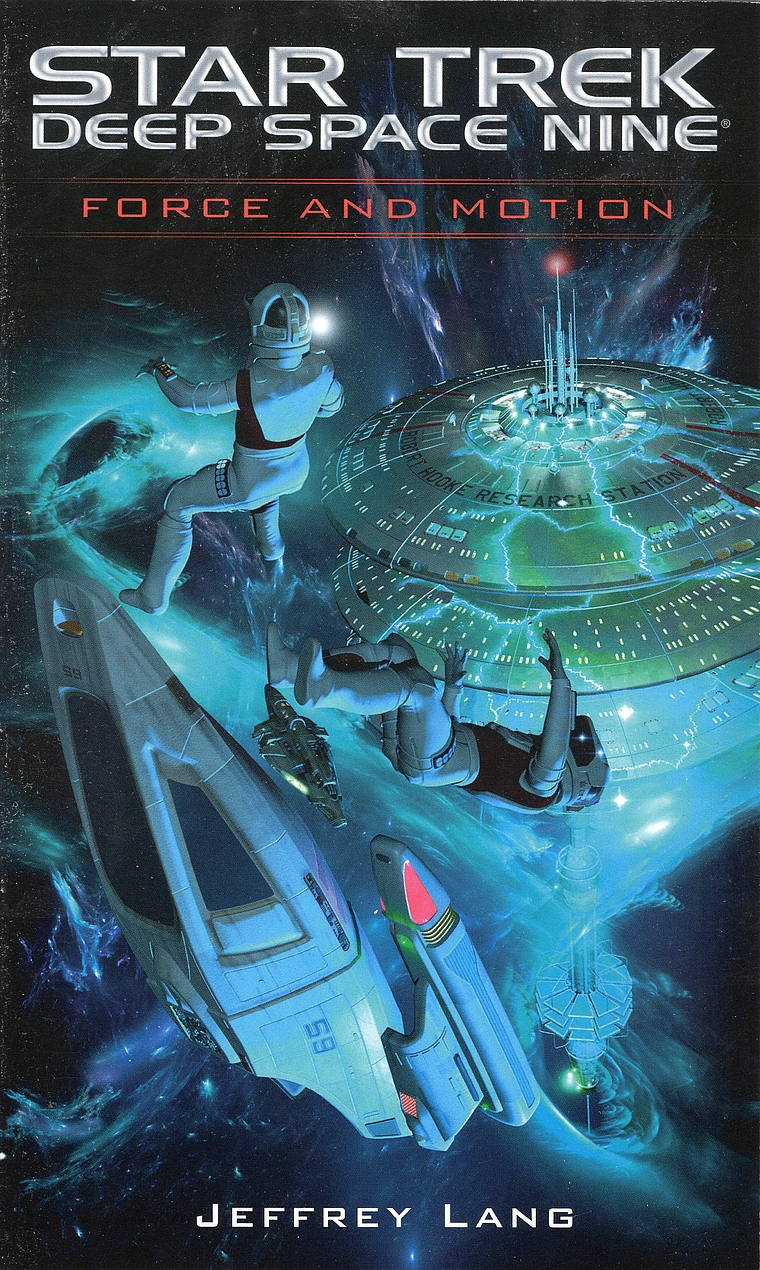
Star Trek: The Destiny Era: Force and Motion

Star Trek: Deep Space Nine: Force and Motion
by Jeffrey Lang

January 9-10, 2386 (and innumerable flashbacks)
Published: 2016
Acquired: October 2021
Read: July 2023

One of my favorite novels is Lawrence Durrell's Justine (1957), which is told not in chronological order. Rather, at one point the narrator tells us, "What I most need to do is to record experiences, not in the order in which they took place—for that is history—but in the order in which they first became significant to me." Most Star Trek books are told fairly conventionally from a structural point-of-view; they begin at the beginning and proceed to the end. Even when they jump around a bit, that tends to be pretty structured.

Force and Motion is no Lawrence Durrell novel (for that to be the case, it would have to drop all the very helpful captions and just leave the reader to sink or swim) but it's still one of those rare, refreshing Star Trek novels that seems more interested in being a novel than in being Star Trek, if that makes sense. Nog and O'Brien are visiting Robert Hooke station to meet up with O'Brien's old captain, Benjamin Maxwell of the Routledge (see TNG's "The Wounded"), who is now the station's maintenance engineer.

In the present, there's a crisis: the station exists outside of Federation space in order to enable its residents to pursue a variety of slightly unusual experiments (my favorite was the one researching quantum beekeeping with fractal honeycombs). When Nog and O'Brien arrive, one of the experiments, a living breeding ground for microorganisms, is set free, seeking out a new energy source, threatening the integrity of the station. Nog and O'Brien and Maxwell must work together to save the other researchers and contain the threat. This is fun stuff—it's hard for DS9 as a series to incorporate "strange new worlds" but this one is able to pull in a lot of strange new concepts, and it has a bit of a classic Star Trek feel to it, with clever problem-solving. (In what is always a good sign, I found myself thinking of how I would rebuild it into a Star Trek Adventures module. Fairly easily, I think.) Mother is a neat idea, the spiders are fun, and I liked who the "villain" turned out to be.

That said, I wanted a bit more depth in the present-day stuff. It sets up some strands and ideas when it comes to O'Brien and Nog that I wish had been explored a bit more than they were: Nog and O'Brien needing to make new friends on this new station, Nog's recent trauma with Active Four and older traumas like Empok Nor. These are bubbling in there, but by novel's end, aside from the fact that they had gone through a crisis together, I didn't feel like Nog and O'Brien had grown closer much.

In the past, we see snippets of Benjamin Maxwell: him days after the Setlik III massacre, him just after the events of "The Wounded," him in therapy in New Zealand, him during the Destiny trilogy, him coming home to find his mother dead, him trying to settle into a new life. But these are all out of order scattered throughout the book. And it's not just him either, there are flashbacks to O'Brien during his time on the Routledge, Nog hanging out with Jake after school, O'Brien following "The Wounded," Nog meeting up with Jake for New Year's, and more.

Whenever a novel has a weird structure, I think it's important that that structure be significant. Like, anyone can choose to tell their story out of chronological order, but what prevents it from just being a gimmick? Well, if the form of the novel intersects meaningfully with the project of the novel, then it works. The project of Justine is the narrator attempting to understand Justine but eternally being unable to do so. He writes of one of his failed novels, "In art I had failed (it suddenly occurred to me at that moment) because I did not believe in the discrete human personality. ('Are people', writes Pursewarden, 'continuously themselves, or simply over and over again so fast they give the illusion of continuous features—the temporal flicker of old silent film?') I lacked a belief in the true authenticity of people in order to successfully portray them." Hence, the book is told out of order because the narrator doesn't believe in the continuity of people.

Force and Motion is told out of order for a very different reason. Benjamin Maxwell may have been a captain, but he started his career as an engineer and he ended it as one too: his goal is to put broken things together. In this case, the broken thing is Maxwell himself—his pieces are scattered all across the novel, and as we put them back together, so does he. Maxwell is a man who wanted to fix what he found, and when he lost his own family, he couldn't put himself back together anymore. Here, he rebuilds himself, not quite as he was before, but into something that works. Given how his first attempt to do so led to him leading a deadly attack, I really liked how his second attempt to rebuild focused on the protection of life at all costs—even the lives of a band of pirates. In the end, he gets to do something he'd never done before, and he gets to protect a new life-form. I loved a lot of the snippets we saw of him across the years: him in therapy telling stories about gerbils and (somewhat surprisingly) him talking to Worf were particular highlights. I've seen some complaints there should have been fewer flashbacks, or they should have been more linear, but to be honest, if that was the case, it wouldn't be a better novel, it would be a different one. It wouldn't come together.

There are lots of thematic connections without them hitting you over the head, lots of depth to mine here. In the end, Maxwell finds some broken creatures and helps them the way he failed to do so many times before. It's a meaningful ending to a good book.

This was to be Jeff Lang's last contribution to the Star Trek line, which is a real shame, because I felt like he was developing into someone like Una McCormack, an interesting distinctive voice with real stories to tell. I sort of felt like they gave him The Light Fantastic as a sop for mining his work so heavily in Cold Equations, but if so, I'm impressed and glad he was asked back to write this.

Continuity Notes:

  • In one flashback, Nog is tending bar while O'Brien and Bashir talk about the Alamo. Did Nog really keep working in the bar when he was a cadet on his field placement?
  • Given the book picks up on O'Brien's arachnophobia from "Realm of Fear" it seems weird it didn't also acknowledge him having a pet spider from the same episode.
  • One of the flashbacks indicates that as of when Nog and Jake were kids, Nog's mom was already dead; this contradicts Ferenginar: Satisfaction Is Not Guaranteed, where she makes an appearance.
  • Unlike some other recent DS9 books, this seems to slot into its location fairly well; the flashback of Nog and Jake on New Year's is set between The Poisoned Chalice and Nog's return to the station in part 2 of Ascendance.
Other Notes:
  • I hadn't realized until reading Force and Motion how similar O'Brien and Nog were in one sense—they are both great vehicles for suffering. DS9 is famous for its "O'Brien must suffer" episodes but only upon reading this book did it really dawn on me that we got a string of "Nog must suffer" episodes too: "Empok Nor," "Valiant," "The Siege of AR-558," "It's Only a Paper Moon." I guess just like O'Brien's everyman status makes him a good vehicle for suffering, so too does Nog's innocent status.
  • There are lots of good flashbacks, some of which I've already mentioned. The Worf one is excellent: "It might be an honorable course of action... But I do not think he would sleep well." The best day / worst day ones were also good. Also Maxwell waiting for the Borg and frustrated he can't serve in defense of Earth. Maxwell saving a dog. I liked the two with Jake a lot, especially Jake's reflections on what happened to Sisko after Jennifer died, which has some nice but not overdone parallels to Maxwell. Nog watching O'Brien and Bashir when they beat the Alamo was good, but even better was O'Brien's present-day explanation of why that moment mattered so much.
  • It's nice to actually have a novel that actually makes some use of O'Brien, even though he's been back on the station for some five novels now, and we get some small updates on his family. I will never believe that Miles O'Brien lived on Cardassia as long as he lived on Deep Space 9, but this book does tell us that Kirayoshi resents having to live on the station. It would be interesting to see a kid who would rather live on Reconstruction-era Cardassia than the new Deep Space 9!
  • There are lots of small nice moments of character here; I particularly liked one where Maxwell notices how much in sync Nog and O'Brien are on p. 133. Nog feeling like he's not as good friends with Jake's wife as he'd prefer rings true to my experience of what happens when a long-distance friend gets married.
  • "Do they have ships that just clean up the mess after the big ships are finished doing whatever they need to do?" Well, actually, yes! Jeff Lang got that one right many years in advance.

I read Destiny-era Star Trek books in batches of five every few months. Next up in sequence: The Next Generation: Armageddon's Arrow by Dayton Ward

04 October 2023

Star Trek: The Destiny Era: Ascendance

Star Trek: Deep Space Nine: Ascendance
by David R. George III

December 2377–February 2378 / December 2385–January 2386
Published: 2016
Acquired: August 2021
Read: June 2023

It's sort of a miracle we got an Ascendants wrap-up book, you know? If Deep Space Nine was a comic book, it would have just moved on and forgotten about all this once the big crossover (i.e., Destiny) came along. It certainly wouldn't have spent time wrapping up a dangling plotline from a previous editorial regime. So, maybe we should be grateful?

And yet...

As I said in my previous write-up, it was a long time ago that I read Rising Son and its following books, so I am going off some pretty vague memories at this points. Yet if I recall correctly, what made the Ascendants interesting was the potential for cultural and religious conflict. These were people who had the same gods as the Bajorans but interpreted them differently. What would happen when they met the Bajorans?

This book is somewhat oddly structured. While Sacraments of Fire moved back and forth between 2377 and 2385, using the Kira of 2385(ish) as its focalizing character in 2377, Ascendance is split into half. The first half is all set in 2377; I wonder if you could just read it on its own as the next installment in the OG relaunch after The Soul Key. In this, Iliana Ghemor leads the Ascendant fleet through the Bajoran wormhole. I recently reread my review of The Soul Key from back in the day, and I wrote, "What really bothers me is that Fearful Symmetry gave Iliana Ghemor a complex backstory and strong character... but that felt entirely pointless here, as she became just another sneering madwoman." That continues here; Ghemor decides to blow up Bajor because she's so mad at Kira.

On the surface this has more action than Sacraments, but mostly all the characters seem to do is watch the Ascendant fleet come. Which is unfortunate because there are a lot of characters to do this watching: Kira, Sisko, Ezri, Vaughn. But no one does anything interesting. Basically what happens is that Taran'atar takes the only action of significance. We spent a big chunk of the previous book getting reacquainted with the Even Odds crew, but they're irrelevant here, they don't even show up.

The Ascendants attack... and Taran'atar sucks them all up. That's it? It doesn't feel worthy of the buildup, and it's not the kind of conflict I remember imagining. It fills a gap, but it kinds of feels like that's all it does. Sisko has a good idea, but doesn't feel like he plays an interesting role—weren't the Ascendants the whole reason he came back in Unity? Plus, it continues the thing I hate that all the post-Destiny novels have done with Sisko, which is take him away from being the Emissary.

Then we get an overly long double epilogue about Kira and Ezri, setting up the former's switch to religious life (still not sold on this) and the latter's transfer to the Aventine. Like so many George moments of "characterization," it's just someone sitting around thinking about something, not something that happens in the actual story.

* * *

Then we jump back to the present of Deep Space Nine narrative. This happens on p. 171... and the first inkling we get of something approaching a plot is p. 229. For sixty pages, people think about things and people have meetings. What will happen to Cenn Desca? I couldn't care less. Nog thinks about Vic, Ro thinks about Altek Dans, Quark thinks about Ro, Sisko thinks about exploring. Can you really write sixty pages of a novel with no clear narrative direction? Apparently so. I was so continually frustrated by this.
 
One of my problems is that the main characters so very rarely interact with each other. Everyone seems lost in their own thoughts all the time; the real strength of DS9 on tv (and the original relaunch) was in how the members of its ensemble interacted. Whenever something like that does happen (Kira/Taran'atar in Sacraments, Ro/Taran'atar here) it actually is pretty good, but it so rarely happens. Every now and then there's a moment of characterization that actually does shine; I liked Quark asking if Nog was okay following the events of The Poisoned Chalice a lot. Even with Quark/Ro, it's never Quark and Ro interacting, but rather Quark scenes where he thinks about Ro and Ro scenes where she thinks about Quark. But originally it was George who made Quark/Ro into a believable thing back in Twilight!

Finally things come into focus. When Odo linked with the mysterious shapeshifter at the end of Sacraments, it came to life; now it begins flying through space faster-than-light toward the Bajoran system and the Defiant must intercept it. There is some nicely creepy stuff, but once again, I can't shake the feeling that our characters are just watching the story, not participating in it. Only Ro does anything that matters, when she opts to board the shapeshifter (which has by this point formed a duplicate DS9) against everyone else's objections. Even now, though, I am wondering why this is in the same book as the first half. What does it have to do with anything?

Here, we learn that when Taran'atar and the Ascendants blew up they merged into a weird collective life form but it was inert until it learned how to shapeshift from Odo. The Ascendants want to complete their ascension, so they fly into the wormhole and become the "planet" from "Emissary" whose existence I was dubious about back in Revelation and Dust. And... that's it?

Here, I feel the the ingredients existed to do something interesting. George is clearly trying to explore faith, in particular Taran'atar's, who in the end tragically cannot break free of the need to worship. I did like the return of Raiq and wonder if future novels will find anything interesting for her to do. But again, few characters have moments they make choices.

Moreover, from an ongoing storyline perspective, it's a bit of a fizzle. I think the ingredients are here—the merged Ascendant entity is like a Founder because of something one Ascendant did with the Founder god corpse in Olympus Descending. But, is there some kind of connection between the Founders and their god and the Prophets? But these are ideas in my head, not ones the novel explores or even raises. Instead, we are treated to a scene about which boring nonentity will replace another boring nonentity as the first officer of DS9. Will it be—checks notes—uh, Stinson, who I guess has been in four previous novels but left no mark at all and who we are treated to a two-page backstory infodump about? No, it's Jefferson Blackmer, Starfleet's worst chief of security. Well, at least he's been promoted to a position where he's no longer responsible for stopping sabotage or assassination, I guess.

The gaps are filled, I guess, the storyline tied off. But what was the point? What was it actually about? This one read much better than Sacraments, with more action... but very little of it seemed to matter in the end.

Continuity Notes:

  • As this project's second installment, I read the original series novel Allegiance in Exile. Thirty-nine books later that finally paid off when someone looked up the Ascendants in the computer and found the Memory Beta entry on Allegiance in Exile. Result!
  • No one in this book knows where Bashir is. Meanwhile over in Section 31: Disavowed (which I read just after this and takes place roughly at the same time, and was published over a year earlier) he's been pardoned and commended and is living publicly on Andor.
Other Notes:
  • What is up with Altek Dans? As in, what is the purpose of this character? Why is he in this series. Two 300-page books later and I have no idea. How is he a vehicle for new stories? I cannot fathom it. The "romance" with Ro comes from nowhere and nothing. Just why? I also don't get why no one just shows him a map of Bajor and asks him where his city was. Even if he's from 500,000 years ago, there should be enough familiar geographical features for him to answer this question.
  • Odo spends basically the whole book unconscious, then he leaves.
  • The station's new senior staff is largely so boring. Candlewood is fine if your requirement is "after Jadzia died, we need to say someone is doing science stuff," but he was never designed to be a focal character and it shows, and that goes for most of these people, and whenever the Defiant goes somewhere, its crew is almost entirely made up of people like that.
  • Like Sacraments of Fire, the back cover blurb fails to describe the book in any meaningful way, feeling like someone just pasted in the first two paragraphs of George's outline.

I read Destiny-era Star Trek books in batches of five every few months. Next up in sequence: Section 31: Disavowed by David Mack

27 September 2023

Star Trek: The Destiny Era: Sacraments of Fire

Star Trek: Deep Space Nine: Sacraments of Fire
by David R. George III

September–December 2385 (plus time travel to December 2377)
The Ascendants storyline was first introduced in Rising Son in January 2003; its last appearance prior to now was in August 2009's The Soul Key, to which this book makes a number of references. Then, with the Destiny time jump, it seemed to vanish entirely, with some vague references to it having happened during the missing years. Finally with July 2015's Sacraments of Fire it returns for an explanation at long last—six years since its previous appearance, over twelve since it first began. And here am I reading it eight years after that. It's been two decades since Rising Son!

Published: 2015
Acquired: June 2021
Read: June 2023

Little wonder, then, that this book is filled with exposition and reminders. Who is Iliana Ghemor, what happened to Taran'atar, what did the Ascendants do, who were the Eav'oq, what was the Even Odds? So many threads from the first eight years of the relaunch get woven together here. Yet even though there's a lot of reminding, I often found myself slightly confused anyway, unable to discern what was significant new information and what was mere reminding of old information. What had happened to Taran'atar? He died? Was this during the Destiny time jump, or was this something that happened in The Soul Key but I forgot about in the past fourteen years?

Probably some of this was my fault. Probably also some of it was unavoidable. If George was going to finally wrap this storyline up, then how could he not interact with the details of twelve-year-old novels?

Yet like many of George's recent Star Trek novel's, it has a fundamental flaw. I said of his last one, Revelation and Dust, that it was "a book where almost nothing happens for the first 250 pages," adding "[n]o one is trying to accomplish anything and encountering obstacles." Exactly what bugs me about George's recent novels crystallized while reading Sacraments of Fire; to build on my line about Revelation, this is not a book where anyone has a goal. Rather things happen, then people react; more things happen, then people react; still more things happen, then people react. No one is trying to do anything. There's a whole multi-chapter escapade where Sisko is sent on the Robinson to intimidate the Tzenkethi and has to figure out what happened to a Starfleet ship—it has nothing to do with the plot of the novel, but worse, it doesn't really have anything to do with anything. It just takes up pages. Things keep happening involving a Bajoran moon and some religious fundamentalists, but our characters don't do anything, they just witness it. Odo spends the entire book looking at a Changeling artifact and thinking about it. The characters are never proactive... not even in their own heads, where they mostly just think about things that have happened to them in other books or between books. There's no drive or energy here. Blanks are being filled in, but no story is being told. Who are these people? I couldn't tell you. What is this book actually about?

Yet, you know, it's fairly clever. Following her utterly tedious (and still of no clear relevance) wormhole experience in Revelation, Kira is deposited in, it turns out, 2377, just prior to the Ascendant attack on Bajor. This means that what happened in the Destiny time jump isn't just a flashback, but it happens in the "present" for her. This takes what has been a "bug" of the DS9 novels and turns it into a feature.

Yet, Kira's dilemma about how to act in the past is too abstract; since we as readers don't really know what happened to the Even Odds, it's hard to perceive the issues in changing its history. It's hard to feel any suspense when all that Kira does in the past is continually be introduced to characters from Rising Son. I remember loving the Even Odds crew in Rising Son, eager for more adventures with them. Well, I finally got my wish... and it's so boring?

To add to all this, the book is often a plod in its prose and in its plotting. Prose-wise, I know we need some recapping, but there's often too much of it; the book indiscriminately recaps stuff we don't actually need to know. Many scenes would have benefited from a slash of the red pen. For example, when Ro and Cenn Desca discuss whether Altek Dans reminds them of Akorem Laam, Ro says she doesn't rememeber him because, "Thirteen years ago, I was living on Galion." The narrator then says:

Cenn knew that, at that time, the planet Galion had fallen within the Demilitarized Zone established by a treaty between the Federation and the Cardassians. If he recalled correctly, many of the Maquis leadership—and apparently Ro Laren—had settled there. He also remembered that, during the Dominion War, Jem'Hadar forces had wiped out most of Galion's population. All of which suggested why Ro might not have learned about the lightship that traveled out of both the wormhole and Bajor's past.​

You probably don't need most of that paragraph, which provides way more detail than is needed to communicate the fact that Ro wasn't in Starfleet thirteen years ago. You certainly don't need the last sentence, which makes obvious an inference that anyone who had read the rest of the paragraph could have made. But it's typical of the book. In fact, in part II, there are these little recaps of part I, written as though it's recapping a previous book. Quark, I know who Altek Dans is and how he got onto the station because I read about it in this book earlier today!

The plot also plods. The conversation above is one that about happens about fifteen times. Is Altek Dans from the past like Akorem Lans? People wonder about this again and again. This is annoying because 1) everyone who read Revelation and Dust knows the answer is "yes" and 2) the characters make no progress in this question, and eventually decide the answer is probably "yes." Why did we have to spend all this time debating it? Isn't there some kind of Star Trek science test that could tell us he's from the past? On p. 190, this is still being debated!? Why are there interminable scenes about Ro trying to decide if Altek should be extradited or not extradited?

This book leads right into Ascendance, but the station present-day plotline doesn't even have a cliffhanger; it just stops. The cliffhanger is about what is happening eight years in the past!

Continuity Notes:

  • When Nog tries to access the Vic Fontaine holoprogram, he notices someone else accessed it. I initially thought this was a reference to The Light Fantastic, but that happens after this part of Sacraments, so I am not sure.
  • Blackmer offers his resignation to Ro again, but there's no acknowledgement he already did this in The Missing.
Other Notes:
  • You can write paragraph upon paragraph about how Cenn Desca and Kira were friends, David R. George III, but you can't make me feel it.
  • Speaking of which, Cenn Desca is boring, like all of the other new station characters. I don't think they've really been designed as main characters; they're names and species and jobs and that's it. They don't have hooks or desires. The original relaunch characters, Vaughn, Shar, Taran'atar, and so on, had things they wanted to do, and other things in conflict with them. What does Jefferson Blackmer want? Gregory Desjardins?* Wheeler Stinson? It's okay for side characters not to have this level of development... but they're too often the new ones are focused on like they are main characters. Indeed, I actually forgot Cenn Desca even existed, because I don't think he's even mentioned in The Missing or Rules of Accusation. Probably those authors forgot about him too!
  • The back cover blurb is a very detailed description of the first scene and it gives little sense of most of what the novel is about. I would not be at all surprised to learn it was lifted almost verbatim from the first paragraph of George's outline.

* Why put a JAG office on the station if you never use it to tell a story, anyway?

I read Destiny-era Star Trek books in batches of five every few months. Next up in sequence: Deep Space Nine: Ascendance by David R. George III

20 September 2023

Star Trek: The Destiny Era: Rules of Accusation

Star Trek: Deep Space Nine: Rules of Accusation
by Paula M. Block & Terry J. Erdmann

2385
Published: 2016
Acquired: March 2021
Read: June 2023

I pretty much bounced off Block & Erdmann's previous DS9 novella, which had little of substance to say about Quark and also not terribly funny jokes. This, of course, makes it of a piece with the Quark/Ferengi television episodes it sought to emulate, which were hit-and-miss at best.* For me, the Ferengi episodes were at their worst when they totally took place within the Ferengi sphere (e.g., "Ferengi Love Songs," "Profit and Lace") and at their best when they involved some element of cultural clash, the intrusion of something from outside Ferengi society (e.g., "The Magnificent Ferengi," "Body Parts," "Little Green Men"). Quark can be a great character, but he is rarely so in the purely Ferengi episodes; the better Quark episodes are ones like "House of Quark" and "Profit and Loss" and "Business as Usual" where Quark is put into unusual situations that test who he is.

At first, Rules of Accusation is a lot like one of the worse Ferengi episodes. Quark has a new wacky scheme to get business; Rom will dedicate the new station bar as the Ferengi embassy to Bajor, and the big attraction will be the first showing of the original handwritten manuscript of the Ferengi Rules of Acquisition in decades. There's lots of stuff about Quark planning his scheme, and "funny" Ferengi names and customs and such; basically every Ferengi you ever saw on the show pops up.

This is all set up, but it goes on a bit too long before things finally go wrong, which is when the book kicks into gear; you will not be surprised to learn that the manuscript disappears. But, technically the bar is Ferengi soil so Starfleet's worst security chief, Jefferson Blackmer, has no authority to investigate... so Quark is forced to call upon Odo. Then things get fun, with a series of interviews and investigations and twists. It's fun to have Odo and Quark interacting, and I think I genuinely laughed a couple times.

This is good, enjoyable stuff... but then the novel fizzles out. Neither Odo nor Quark actually solve their own problems. Worst of all, the book doesn't really tell us anything about Quark: the best Quark episodes showed us something about his values. As happened too often in the early seasons of the show, this is just another wacky Quark scheme that goes horribly wrong and leaves everything exactly as it was before. What's disappointing is that I really enjoyed the second half of the book up until that ending; I feel like it wouldn't have required much rewriting to give this overly frothy novella the exact right amount of oomph.

Continuity Notes:

  • The "Historian's Note" places this novel after The Missing and before Sacraments of Fire. The Missing takes place in late November 2385, but Sacraments of Fire actually takes place September through December 2385. Presumably this really means before part II of Sacraments, which is when the action jumps to December. The details kind of, but don't totally, line up. On the one hand, Odo is chilling on the station—he came aboard in The Missing and decided to stick around, so that fits. Additionally, Nog is away on assignment; he left in The Fall: The Poisoned Chalice, and doesn't come back until part II of Sacraments. (This is a bit of shame, because it makes Nog basically the only Ferengi character not to appear in the book; no reunion with his father.)
  • On the other hand, Sisko is on the station (though he leaves with the Robinson partway through the story), and part II of Sacraments indicates he's been gone from DS9 for three months. Also, we're told Odo is waiting for Sisko to be free to take him to see the Changeling, but in fact Sisko doesn't say he'll be taking Odo until part II of Sacraments; at the time this is set, Odo knows the Federation found a Changeling-like life-form but doesn't know where it is or have an indication of how he'll get there.
Other Notes:
  • When the characters need to check something on Ferenginar, it's decided Odo will do it because it's quicker for him to shapeshift into a spacegoing life-form than to take a shuttle... though then we're told Odo's form can "move at a rapid clip, just shy of warp speed"! So just a few decades to Ferenginar and back? One might infer the writers of this book don't know much about the Star Trek universe.
  • Morn is in this... quite a lot actually. He technically doesn't speak, because the book uses indirect speech to describe what he says, but this goes on quite a bit, to the extent of whole conversations. I didn't like it; might follow the letter of law, but it breaks the spirit. When it comes to Morn, less is more. All of the Morn scenes could have been substantially trimmed.
* All Ferengi episodes are Quark episodes, but not all Quark episodes are Ferengi episodes, if you take my meaning.

I read Destiny-era Star Trek books in batches of five every few months. Next up in sequence: Deep Space Nine: Sacraments of Fire by David R. George III

30 August 2023

Star Trek: The Destiny Era: The Missing

Star Trek: Deep Space Nine: The Missing
by Una McCormack

late November 2385
Published: 2015
Acquired: February 2021
Read: June 2023

Well, look! Following on from Lust's Latinum Lost, our first DS9-branded book in five years, we now get our first actual DS9-branded novel, shelved right next to The Never-Ending Sacrifice.

But as a Deep Space Nine novel, it might seem a bit odd. Its main characters are Beverly Crusher and Katherine Pulaski, both main characters on The Next Generation. Beyond that, there's a lot of Ro Laren, who appeared in TNG on screen, though she became a DS9 prose character way back in 2001's Avatar, Book One. Plus, it follows up some on the events of Typhon Pact: Brinkmanship, a TNG novel in all but name, and it features chapter openers extracted from Captain Picard's logs!

Yet, I said "it might" because until it was pointed out by a poster on the TrekBBS, I didn't even really notice! It felt like a DS9 novel right from the off. I think this is down to a few reasons. One is that Pulaski, prickly and full of personality, but fundamentally decent, fits right in with the DS9 cast. I really enjoyed the way McCormack wrote Pulaski, which felt a bit redemptive, in that I think it's what TNG might have been going for in season two, but didn't quite accomplish most of the time. I liked her developing friendship with Crusher, and McCormack does a good job of writing her as someone whose personality traits are sometimes weaknesses, but which she knows how to leverage as strengths. I never thought I'd say this, but more Pulaski please.

Another plus is the return of Odo to the fold. I guess he was up to something in The Fall that I didn't remember, but here he comes to DS9 to intervene on behalf of an old Cardassian colleague and ends up drawn into the events of the novel. McCormack excels with Odo just as she does so many other DS9 characters, capturing his dialogue—and his occasional lack of it. The scenes between him and the Tzenkethi asylee Cory were a particular highlight, both when he runs into her in the station temple and when he seeks her ought in the station security cells. Plus there's some great stuff with Quark and Odo. (And just Quark in general; he's not a big part of this book, but all his scenes work well.)

But most of all this works as a Deep Space Nine book because it feels like a Deep Space Nine book. It's about the kind of things Deep Space Nine was about: the legacies of colonialism, empire, and war, the tension between idealism and realpolitik in espionage, and the making of families by people who have none. There's four plotlines here: a group of travellers called the People of the Open Sky come to DS9 and there's something a little suspicious about them, the civilian science vessel Athene Donald launches with a crew including Typhon Pact members and immediately runs into some belligerent aliens, the Tzenkethi expert from Starfleet Intelligence, Peter Alden, comes to DS9 with asylee Cory and she runs away, and Ro and Odo try to track down some Cardassian prisoners who never returned home after the Dominion War. All four plots intersect with those three themes.

Colonialism, empire, and war always run through DS9, of course; here we see them in the People fleeing them, but unable to ever fully leave them behind; Ro must deal with some harsh crimes perpetrated against the people who once did much the same to her people. That tension between idealism and realpolitik is a key one, and the novel keeps it complicated. Should Castellan Garak do what is political or what is right? Is Peter Alden too suspicious for his own good? Is he exploiting Cory? It would be easy to sneer at Peter (some in the review thread for this book on the TrekBBS seemed to find him a caricature), but though Pulaski sneers at him, I don't think the novel does; sometimes he's wrong... but he's also right a couple times, and without his know-how Pulaski would have never saved the day... and in the end, it turns out she's been the one who's too pessimistic.

And then we come to family. The "missing" of the title are the children, family, and friends we've lost. Maybe we left them because we had to walk away, maybe they left us. Maybe we were left by them. The People leave their original society, Odo is left by his people, the Cardassians leave prisoners with the Romulans, Cory leaves Ab-Tzenketh, Pulaski and the Athene Donald leave the Federation, Ro left her people way back when. Even Crusher leaves hers. They are all missing. But what goes missing can be found: the People find a new home and a new family, Odo made his own family on DS9, the Cardassians made a new home and so even do Cory and Peter, Ro made a new family in Starfleet even if it took a long time. And at the end Crusher goes back to her family: missing and found.

That's not all; the book plunges into questions of exploration and first contact in ways that feel very Star Trek but also put some pressure on it—surely the most Deep Space Nine of moves. You can see the influence of Ursula K. Le Guin here; her League of All Worlds, later the Ekumen, comes across as influenced by Star Trek's Federation in some ways, and here the influence comes back, some of the questions Le Guin posed being returned to their point of origin. Crusher even cites Le Guin's "The Ones Who Walk Away from Omelas," and I found this a much more interesting engagement with its ideas than the somewhat ham-handed take on them in Strange New Worlds.

All of this is wrapped up, of course, in McCormack's deft characterization and strong narrative voice. I often feel that Star Trek novels are written by people who want the words to be as unobtrusive as possible, as though the words get in the way of the story. But the words are the story, and McCormack's playful narrative voice is fun to hang out with. It's not perfect—one occasionally feels something important to the plot has been elided or rushed (is there no Defiant to help the Athene Donald?)—but what is important to the book is always there in full so it's hard to be annoyed with it since you're always being entertained by it.

I keep thinking about a line from the very first chapter, what Picard thinks is the ultimate challenge: "the challenge that one sets oneself: to be pitted against the unknown and to find within oneself the capacity to respond not with fear but with curiosity, empathy, and humility." It's a good summation of what Star Trek teaches us we can do, and what this novel reminds us that we must find in ourselves to do again each day.

image courtesy ScreenRant
Continuity Notes:
  • Doctor Crusher is taking a leave from the Enterprise to replace Bashir as CMO of Deep Space 9 following the events of The Fall. This was a thing I totally did not remember happening. To be honest, I remembered hardly anything about the status quo of DS9 following The Fall, and had to be reminded and/or look a lot of stuff up.
  • I read this after Picard: Second Self but of course it was published first; both books focus on the fallout of the Romulan/Cardassian front during the Dominion War, describing it as one of the most brutal. I don't think this derives from anything on screen, so McCormack is carrying over one of her own ideas from the Destiny continuity into the new one.
  • One would think if there was an ongoing galactic terrorism crisis targeting space stations where the perpetrators seemingly had the ability to just appear anywhere it would come up in this book set on a space station where the villains have the ability to just appear anywhere. One would think. :shifty:
Other Notes:
  • I felt like there was a bit of meta shade directed at earlier books when Pulaski observed it didn't make sense for someone in a marriage to work through a problem by temporarily splitting up.
  • O'Brien appears very suddenly and very late, almost like two-thirds of the way through the book someone reminded the writer he was back on the station so she started using him as a character from that point on.
  • Starfleet's worst chief of security, Jefferson Blackmer, appears in this book. Not even McCormack can totally salvage a character whose entire personality is "likes space stations," but he is more interesting here than in any of his David R. George III–penned appearances. He offers his resignation to Ro, but alas, she does not take it.
  • Oh! Garak is in this. He's well written, of course, but my favorite part was how Odo responds to Garak's new position of authority.
  • McCormack's inspiration was a tweet from Dan Tostevin, my former editor at Unreality SF. He showed me this tweet back when the novel came out, but I think his twitter has vanished now.
  • I want to know what "excellent speculative novel" about a first contact Picard mentions reading. It sounds Le Guinnish but doesn't map onto anything I can think of from Le Guin.

I read Destiny-era Star Trek books in batches of five every few months. Next up in sequence: The Next Generation: Takedown by John Jackson Miller