Showing posts with label creator: david r. george iii. Show all posts

26 June 2024

Star Trek: The Destiny Era: Gamma: Original Sin

Star Trek: Deep Space Nine: Gamma: Original Sin
by David R. George III

March 2386 / 2380
Published: 2017
Acquired: June 2023
Read: May 2024

Ah, we've finally tied off all the lingering threads of the Deep Space Nine time jump. Now the story can move forward at last! David R. George III set up some new concepts in his previous book, so surely we'll be building on them.

What's that? We never heard the story of Rebecca Sisko's kidnapping? Oh, well, I guess so...

To be honest, I had forgotten this had even happened. It was part, I think, of the litany of bad things that was used in Rough Beasts of Empire to justify Sisko running away from his family, along with "neighbors who the reader never saw died." Because, as we know, the thing good fathers do when their children are kidnapped is spend less time around them. I don't think this was a story that actually demanded to be told.

Original Sin has two parallel plotlines; in the present day, Sisko's command, the USS Robinson, has set out on a journey of exploration in the Gamma Quadrant, but Rebecca is kidnapped (along with a bunch of other children aboard the Galaxy-class starship). This reminds Sisko of the last time she was kidnapped, so we get that filled in, too.

It is dead boring. I can't imagine anyone reading all the post-Destiny DS9 novels up until this point and thinking to themselves, "Gee, I really want more of Sisko sitting around thinking about how worried he is," but that's exactly what we get here. Ad nauseam. It may be realistic that Sisko does nothing to find Rebecca in the flashback while a trained investigator works on it... but that kind of realism is not what I read Star Trek books for! Seriously, he's barely in the flashbacks, it all focuses on some investigator lady who I assume must have been in earlier books but whom I did not remember at all. Like, what's the point of this? It just goes on and on and on. Also, at at least one point, the frame narrative deflates the flashback by telling us something about it before we actually get to see it (p. 142). C'mon, why do this?

In theory, Sisko is the active character in the present-day narrative, but it also feels like little happens here. The kids are kidnapped, the Robinson crew putzes around a lot, they rescue the kids, the end. No plot twists, no character development, no interesting worldbuilding. The whole thing is incredibly linear and dull. Thematically, there doesn't seem to be anything going on, there's just people doing stuff... but why? The original Mission: Gamma novels (see below) largely managed to explore interesting alien cultures and tell gripping character stories, but this does neither.

Other Notes:

  • Am I supposed to parse this as a book called Gamma: Original Sin? Or a book called Original Sin in a subseries called Gamma that only lasted one installment? Or was this supposed to be book five of Mission: Gamma but someone screwed up? (This is, after all, the publishing era where Section 31 and The Lost Era were revived for further installments, a decade on.)
  • Are the crew of the Robinson the least interesting "leads" to ever grace the pages of a Star Trek book?
Deep Space Nine
Overall:

Other than a Cardassia-focused Una McCormack book, this is our last Deep Space Nine novel. As someone who found the original sequence of DS9 relaunch novels from Avatar to Unity one of the best things Star Trek fiction has ever done, I have found the sequence from Rough Beasts of Empire to here one of the worst. All the characters have been dispersed, many of them eliminated, others changed to the point of unrecognizability. The characters never seem to do anything except think about the past, slowly; ongoing plots are doled out so slowly as to become profoundly tedious. I really like how Alvaro Zinos-Amaro puts it in his review of the novel for the late, lamented* Tor.com:
The sequence in which the Robinson is encased in null space is neat, but it sticks in my mind as a microcosm of the relaunch series itself at this point. We’re in uncharted waters, but seem to have become adrift in a kind of oblivion, with too many recent books expending significant effort on filling in previous gaps in the chronology and slowly crawling us back into the “normal space” of present time, rather than boldly pushing the story forward.​
Or as the TrekBBS's David cgc once put it, referring to the very slow doling out of ongoing plotlines in this era, "'When are the[y] going to get to the fireworks factory?!' ... [T]he answer turned out to be 'never.'"

But worst of all is surely the handling of Sisko. The trajectory of the original show was to take a guy who was uncomfortable with this alien planet and its society and to show him slowly becoming part of it. He began a Starfleet officer and ended up the Emissary. (I have my issues with Sisko in "What You Leave Behind," but this was not one of them.) Post-Destiny, this was entirely undone. He totally abandons Bajor, he becomes a guy obsessed with exploration. Why? Nothing about this captures what made the character appealing in his original run. Fundamental to the way I think about Sisko is something Michael Piller says in the Deep Space Nine Companion: Picard is the explorer, but Sisko is the builder. But the Sisko of the books builds nothing: not a planet, not a station, not even his own family.

I don't think David R. George understands Sisko at all and if there is any saving grace to the abrupt cutting off of the DS9 novels with so many threads unresolved, it's that I don't have to keep reading about this boring character masquerading as Sisko.

I read Destiny-era Star Trek books in batches of five every few months. Next up in sequence: Prey: The Hall of Heroes by John Jackson Miller

* You don't have to find it funny but this is a joke. I have been reliably informed that despite the seemingly misguided rebranding to the bland Reactor, the site is very much alive. I hope this is true but I promised to eat my hat if it wasn't, so now I am hoping the site dies, sorry.

08 May 2024

Star Trek: The Destiny Era: The Long Mirage

Star Trek: Deep Space Nine: The Long Mirage
by David R. George III

late January 2386
The Long Mirage picks up from the last David R. George III Deep Space Nine novel, Ascendance, following up on the stories of Quark, Ro, Nog, Kira, and Odo, most prominently. And this is absolutely going to sound like damning with faint praise, but... it is a book about people with goals trying to accomplish them! After my frustrations with Ascendance ("Can you really write sixty pages of a novel with no clear narrative direction? Apparently so."), this is a blessed relief. Quark wants to find Morn... and sets out to do so. Ro wants to avoid her boyfriend and figure out her relationships with Quark... and sets out to do so. Nog wants to fix Vic Fontaine's program... and sets out to do so. Kira wants to figure out the mystery of the falsework and help with unrest on Bajor... and sets out to do so. Odo wants to find out what's going on with a Dominion ship approaching the station... and sets out to do so! Amazingly competent plotting. I'll tackle each of these in turn, and talk about the extent to which they work.

Published: 2017
Acquired: May 2022
Read: March 2024

A long-deferred thread in this series has been what happened to Morn... and to be honest, I don't think what happened to a glorified extra is sufficiently interesting to drag out for years of both publication time and story time. But in this book, instead of getting updates on it from some other character, Quark actually goes to find out for himself, and Ro comes with him. So that's nice, but in the end, the two characters don't really accomplish much themselves; basically, they bump into some other characters also looking for Morn, and those characters tell them everything they want to know, and that's it. So although Quark and Ro are actually taking action, their actions don't really drive the narrative, nor do they really do anything interesting or clever. Their relationship gets a couple good scenes but nothing in it seems to really resolve or develop.

In the Nog plotline, he and Candlewood (DS9's science officer who, like most of the new crew, lacks any kind of personality or character hook) go into Vic's program to unravel its issues once and for all. Okay, so I am glad this has finally happened, but it beggars belief that it took Nog two years to undertake the really obvious action of asking Felix for help. What follows is a fun enough Las Vegas escapade, but like the Quark/Ro plot, it's undermined by someone turning up and explaining everything to Nog rather than Nog piecing anything together himself. On the other hand, Nog does get some good moments of coming up and executing a plan... which does actually work! Of all the book's plots, this is the most successful, though I wish it had felt like something was actually stake for Nog rather than us constantly being told this was the case. I also did appreciate how it turns out that the Morn and Vic plots actually go together.

The Kira plotline is okay. I can't really muster up any enthusiasm for her relationship with Altek Dans, and I refuse to believe there's anyone out there who can. I did like she got a classic Kira moment, in doing the right thing that no one else liked. I didn't find the resolution to the falsework dilemma very compelling; the whole thing about a remembered childhood comet seemed fairly uncompelling and circumstantial.

The Odo plotline is, alas, like the ones from earlier Deep Space Nine books, in that no one is called on to make a choice. The ship of Dominion refugees turns up, they tell Odo what they're doing, the end. There are no interesting decisions or character moments at all. Like, why even do this?

So yes... this is probably the best of the post-Destiny Deep Space Nine novels, in that the characters actually try to do things... but it's still pretty boring and could have been a lot better.

Molly O'Brien, age 26?
Continuity Notes:
  • This does reference The Light Fantastic, but the Nog stuff doesn't have any reference to Force and Motion. We do learn a little bit about what the O'Brien kids are like as teenagers, though, which is nice.
Other Notes:
  • Occasionally we get scenes from the third-person limited perspectives of holosuite characters. I don't think this makes any real sense. Surely they do not have interiority?
  • Characters in this book are often weirdly skeptical of people's claims to have traveled through time given this is, you know, Star Trek.
  • Compared to other DS9 books of this era, this one has surprisingly little recapping; indeed, unlike Ascendance, which constantly recapped itself, this one barely recaps previous novels at all. Thank the Prophets!

I read Destiny-era Star Trek books in batches of five every few months. Next up in sequence: Deep Space Nine: I, the Constable by Paula M. Block & Terry J. Erdmann

04 October 2023

Star Trek: The Destiny Era: Ascendance

Star Trek: Deep Space Nine: Ascendance
by David R. George III

December 2377–February 2378 / December 2385–January 2386
Published: 2016
Acquired: August 2021
Read: June 2023

It's sort of a miracle we got an Ascendants wrap-up book, you know? If Deep Space Nine was a comic book, it would have just moved on and forgotten about all this once the big crossover (i.e., Destiny) came along. It certainly wouldn't have spent time wrapping up a dangling plotline from a previous editorial regime. So, maybe we should be grateful?

And yet...

As I said in my previous write-up, it was a long time ago that I read Rising Son and its following books, so I am going off some pretty vague memories at this points. Yet if I recall correctly, what made the Ascendants interesting was the potential for cultural and religious conflict. These were people who had the same gods as the Bajorans but interpreted them differently. What would happen when they met the Bajorans?

This book is somewhat oddly structured. While Sacraments of Fire moved back and forth between 2377 and 2385, using the Kira of 2385(ish) as its focalizing character in 2377, Ascendance is split into half. The first half is all set in 2377; I wonder if you could just read it on its own as the next installment in the OG relaunch after The Soul Key. In this, Iliana Ghemor leads the Ascendant fleet through the Bajoran wormhole. I recently reread my review of The Soul Key from back in the day, and I wrote, "What really bothers me is that Fearful Symmetry gave Iliana Ghemor a complex backstory and strong character... but that felt entirely pointless here, as she became just another sneering madwoman." That continues here; Ghemor decides to blow up Bajor because she's so mad at Kira.

On the surface this has more action than Sacraments, but mostly all the characters seem to do is watch the Ascendant fleet come. Which is unfortunate because there are a lot of characters to do this watching: Kira, Sisko, Ezri, Vaughn. But no one does anything interesting. Basically what happens is that Taran'atar takes the only action of significance. We spent a big chunk of the previous book getting reacquainted with the Even Odds crew, but they're irrelevant here, they don't even show up.

The Ascendants attack... and Taran'atar sucks them all up. That's it? It doesn't feel worthy of the buildup, and it's not the kind of conflict I remember imagining. It fills a gap, but it kinds of feels like that's all it does. Sisko has a good idea, but doesn't feel like he plays an interesting role—weren't the Ascendants the whole reason he came back in Unity? Plus, it continues the thing I hate that all the post-Destiny novels have done with Sisko, which is take him away from being the Emissary.

Then we get an overly long double epilogue about Kira and Ezri, setting up the former's switch to religious life (still not sold on this) and the latter's transfer to the Aventine. Like so many George moments of "characterization," it's just someone sitting around thinking about something, not something that happens in the actual story.

* * *

Then we jump back to the present of Deep Space Nine narrative. This happens on p. 171... and the first inkling we get of something approaching a plot is p. 229. For sixty pages, people think about things and people have meetings. What will happen to Cenn Desca? I couldn't care less. Nog thinks about Vic, Ro thinks about Altek Dans, Quark thinks about Ro, Sisko thinks about exploring. Can you really write sixty pages of a novel with no clear narrative direction? Apparently so. I was so continually frustrated by this.
 
One of my problems is that the main characters so very rarely interact with each other. Everyone seems lost in their own thoughts all the time; the real strength of DS9 on tv (and the original relaunch) was in how the members of its ensemble interacted. Whenever something like that does happen (Kira/Taran'atar in Sacraments, Ro/Taran'atar here) it actually is pretty good, but it so rarely happens. Every now and then there's a moment of characterization that actually does shine; I liked Quark asking if Nog was okay following the events of The Poisoned Chalice a lot. Even with Quark/Ro, it's never Quark and Ro interacting, but rather Quark scenes where he thinks about Ro and Ro scenes where she thinks about Quark. But originally it was George who made Quark/Ro into a believable thing back in Twilight!

Finally things come into focus. When Odo linked with the mysterious shapeshifter at the end of Sacraments, it came to life; now it begins flying through space faster-than-light toward the Bajoran system and the Defiant must intercept it. There is some nicely creepy stuff, but once again, I can't shake the feeling that our characters are just watching the story, not participating in it. Only Ro does anything that matters, when she opts to board the shapeshifter (which has by this point formed a duplicate DS9) against everyone else's objections. Even now, though, I am wondering why this is in the same book as the first half. What does it have to do with anything?

Here, we learn that when Taran'atar and the Ascendants blew up they merged into a weird collective life form but it was inert until it learned how to shapeshift from Odo. The Ascendants want to complete their ascension, so they fly into the wormhole and become the "planet" from "Emissary" whose existence I was dubious about back in Revelation and Dust. And... that's it?

Here, I feel the the ingredients existed to do something interesting. George is clearly trying to explore faith, in particular Taran'atar's, who in the end tragically cannot break free of the need to worship. I did like the return of Raiq and wonder if future novels will find anything interesting for her to do. But again, few characters have moments they make choices.

Moreover, from an ongoing storyline perspective, it's a bit of a fizzle. I think the ingredients are here—the merged Ascendant entity is like a Founder because of something one Ascendant did with the Founder god corpse in Olympus Descending. But, is there some kind of connection between the Founders and their god and the Prophets? But these are ideas in my head, not ones the novel explores or even raises. Instead, we are treated to a scene about which boring nonentity will replace another boring nonentity as the first officer of DS9. Will it be—checks notes—uh, Stinson, who I guess has been in four previous novels but left no mark at all and who we are treated to a two-page backstory infodump about? No, it's Jefferson Blackmer, Starfleet's worst chief of security. Well, at least he's been promoted to a position where he's no longer responsible for stopping sabotage or assassination, I guess.

The gaps are filled, I guess, the storyline tied off. But what was the point? What was it actually about? This one read much better than Sacraments, with more action... but very little of it seemed to matter in the end.

Continuity Notes:

  • As this project's second installment, I read the original series novel Allegiance in Exile. Thirty-nine books later that finally paid off when someone looked up the Ascendants in the computer and found the Memory Beta entry on Allegiance in Exile. Result!
  • No one in this book knows where Bashir is. Meanwhile over in Section 31: Disavowed (which I read just after this and takes place roughly at the same time, and was published over a year earlier) he's been pardoned and commended and is living publicly on Andor.
Other Notes:
  • What is up with Altek Dans? As in, what is the purpose of this character? Why is he in this series. Two 300-page books later and I have no idea. How is he a vehicle for new stories? I cannot fathom it. The "romance" with Ro comes from nowhere and nothing. Just why? I also don't get why no one just shows him a map of Bajor and asks him where his city was. Even if he's from 500,000 years ago, there should be enough familiar geographical features for him to answer this question.
  • Odo spends basically the whole book unconscious, then he leaves.
  • The station's new senior staff is largely so boring. Candlewood is fine if your requirement is "after Jadzia died, we need to say someone is doing science stuff," but he was never designed to be a focal character and it shows, and that goes for most of these people, and whenever the Defiant goes somewhere, its crew is almost entirely made up of people like that.
  • Like Sacraments of Fire, the back cover blurb fails to describe the book in any meaningful way, feeling like someone just pasted in the first two paragraphs of George's outline.

I read Destiny-era Star Trek books in batches of five every few months. Next up in sequence: Section 31: Disavowed by David Mack

27 September 2023

Star Trek: The Destiny Era: Sacraments of Fire

Star Trek: Deep Space Nine: Sacraments of Fire
by David R. George III

September–December 2385 (plus time travel to December 2377)
The Ascendants storyline was first introduced in Rising Son in January 2003; its last appearance prior to now was in August 2009's The Soul Key, to which this book makes a number of references. Then, with the Destiny time jump, it seemed to vanish entirely, with some vague references to it having happened during the missing years. Finally with July 2015's Sacraments of Fire it returns for an explanation at long last—six years since its previous appearance, over twelve since it first began. And here am I reading it eight years after that. It's been two decades since Rising Son!

Published: 2015
Acquired: June 2021
Read: June 2023

Little wonder, then, that this book is filled with exposition and reminders. Who is Iliana Ghemor, what happened to Taran'atar, what did the Ascendants do, who were the Eav'oq, what was the Even Odds? So many threads from the first eight years of the relaunch get woven together here. Yet even though there's a lot of reminding, I often found myself slightly confused anyway, unable to discern what was significant new information and what was mere reminding of old information. What had happened to Taran'atar? He died? Was this during the Destiny time jump, or was this something that happened in The Soul Key but I forgot about in the past fourteen years?

Probably some of this was my fault. Probably also some of it was unavoidable. If George was going to finally wrap this storyline up, then how could he not interact with the details of twelve-year-old novels?

Yet like many of George's recent Star Trek novel's, it has a fundamental flaw. I said of his last one, Revelation and Dust, that it was "a book where almost nothing happens for the first 250 pages," adding "[n]o one is trying to accomplish anything and encountering obstacles." Exactly what bugs me about George's recent novels crystallized while reading Sacraments of Fire; to build on my line about Revelation, this is not a book where anyone has a goal. Rather things happen, then people react; more things happen, then people react; still more things happen, then people react. No one is trying to do anything. There's a whole multi-chapter escapade where Sisko is sent on the Robinson to intimidate the Tzenkethi and has to figure out what happened to a Starfleet ship—it has nothing to do with the plot of the novel, but worse, it doesn't really have anything to do with anything. It just takes up pages. Things keep happening involving a Bajoran moon and some religious fundamentalists, but our characters don't do anything, they just witness it. Odo spends the entire book looking at a Changeling artifact and thinking about it. The characters are never proactive... not even in their own heads, where they mostly just think about things that have happened to them in other books or between books. There's no drive or energy here. Blanks are being filled in, but no story is being told. Who are these people? I couldn't tell you. What is this book actually about?

Yet, you know, it's fairly clever. Following her utterly tedious (and still of no clear relevance) wormhole experience in Revelation, Kira is deposited in, it turns out, 2377, just prior to the Ascendant attack on Bajor. This means that what happened in the Destiny time jump isn't just a flashback, but it happens in the "present" for her. This takes what has been a "bug" of the DS9 novels and turns it into a feature.

Yet, Kira's dilemma about how to act in the past is too abstract; since we as readers don't really know what happened to the Even Odds, it's hard to perceive the issues in changing its history. It's hard to feel any suspense when all that Kira does in the past is continually be introduced to characters from Rising Son. I remember loving the Even Odds crew in Rising Son, eager for more adventures with them. Well, I finally got my wish... and it's so boring?

To add to all this, the book is often a plod in its prose and in its plotting. Prose-wise, I know we need some recapping, but there's often too much of it; the book indiscriminately recaps stuff we don't actually need to know. Many scenes would have benefited from a slash of the red pen. For example, when Ro and Cenn Desca discuss whether Altek Dans reminds them of Akorem Laam, Ro says she doesn't rememeber him because, "Thirteen years ago, I was living on Galion." The narrator then says:

Cenn knew that, at that time, the planet Galion had fallen within the Demilitarized Zone established by a treaty between the Federation and the Cardassians. If he recalled correctly, many of the Maquis leadership—and apparently Ro Laren—had settled there. He also remembered that, during the Dominion War, Jem'Hadar forces had wiped out most of Galion's population. All of which suggested why Ro might not have learned about the lightship that traveled out of both the wormhole and Bajor's past.​

You probably don't need most of that paragraph, which provides way more detail than is needed to communicate the fact that Ro wasn't in Starfleet thirteen years ago. You certainly don't need the last sentence, which makes obvious an inference that anyone who had read the rest of the paragraph could have made. But it's typical of the book. In fact, in part II, there are these little recaps of part I, written as though it's recapping a previous book. Quark, I know who Altek Dans is and how he got onto the station because I read about it in this book earlier today!

The plot also plods. The conversation above is one that about happens about fifteen times. Is Altek Dans from the past like Akorem Lans? People wonder about this again and again. This is annoying because 1) everyone who read Revelation and Dust knows the answer is "yes" and 2) the characters make no progress in this question, and eventually decide the answer is probably "yes." Why did we have to spend all this time debating it? Isn't there some kind of Star Trek science test that could tell us he's from the past? On p. 190, this is still being debated!? Why are there interminable scenes about Ro trying to decide if Altek should be extradited or not extradited?

This book leads right into Ascendance, but the station present-day plotline doesn't even have a cliffhanger; it just stops. The cliffhanger is about what is happening eight years in the past!

Continuity Notes:

  • When Nog tries to access the Vic Fontaine holoprogram, he notices someone else accessed it. I initially thought this was a reference to The Light Fantastic, but that happens after this part of Sacraments, so I am not sure.
  • Blackmer offers his resignation to Ro again, but there's no acknowledgement he already did this in The Missing.
Other Notes:
  • You can write paragraph upon paragraph about how Cenn Desca and Kira were friends, David R. George III, but you can't make me feel it.
  • Speaking of which, Cenn Desca is boring, like all of the other new station characters. I don't think they've really been designed as main characters; they're names and species and jobs and that's it. They don't have hooks or desires. The original relaunch characters, Vaughn, Shar, Taran'atar, and so on, had things they wanted to do, and other things in conflict with them. What does Jefferson Blackmer want? Gregory Desjardins?* Wheeler Stinson? It's okay for side characters not to have this level of development... but they're too often the new ones are focused on like they are main characters. Indeed, I actually forgot Cenn Desca even existed, because I don't think he's even mentioned in The Missing or Rules of Accusation. Probably those authors forgot about him too!
  • The back cover blurb is a very detailed description of the first scene and it gives little sense of most of what the novel is about. I would not be at all surprised to learn it was lifted almost verbatim from the first paragraph of George's outline.

* Why put a JAG office on the station if you never use it to tell a story, anyway?

I read Destiny-era Star Trek books in batches of five every few months. Next up in sequence: Deep Space Nine: Ascendance by David R. George III

24 February 2021

Star Trek: The Destiny Era: The Fall: Revelation and Dust

Published: 2013
Acquired: April 2019
Read: November 2020

Star Trek: The Fall: Revelation and Dust
by David R. George III

22 August–1 September 2385
As much as I have often been critical of Destiny-era fiction, I would say that it has all reached a basic level of competence: they are all stories about people trying to accomplish things against obstacles placed in their way. Now, this might seem like damning with faint praise... but it's praise one cannot bring to Revelation and Dust, a book where almost nothing happens for the first 250 pages.

No one is trying to accomplish anything and encountering obstacles; rather, we just get a series of dull scenes intended to establish what all the Deep Space Nine characters have been up to since they were last seen in Raise the Dawn. Sisko thinks a lot while Yates makes dinner in a replicator. Ro thinks a lot while looking at a park. Quark thinks a lot while looking at his bar. O'Brien thinks a lot while putting on his dress uniform. Nan Bacco has meetings that don't really go anywhere, but I assume are meant to set up things that will happen in later installments of The Fall. There seem to be an interminable number of scenes where people go to memorials or other ceremonies. But nothing actually happens.

A lot of the book seems to be there to set up the new Deep Space 9. There are paragraphs about things like turbolift design and the layout of Ops and what the new hospital is like and what the names of every counselor assigned to the station are. Quite frankly, I don't care what it all looks like if there's not a story it's all in support of. In any case, as long as the station gets rebuilt and replaced, there's no way destroying it could really change the fundamentals of DS9 storytelling in a meaningful way. It's like when a comic book crossover kills off a minor-but-beloved character to prove the situation is serious... it doesn't prove anything at all, because you know that the next time a writer wants to use, say, Firestorm, he'll be back, and he'll be fine. DS9 is back, and it doesn't matter if "Ops" is now called "the Hub," everything was fine.

The one exception to this is the Kira subplot. Kira was on a runabout that exploded in the wormhole in Raise the Dawn (I guess? I actually totally forgot about this), and we find out what happened to her here. First she spends her time observing a, I shit you not, 25-page line-by-line recap of every single wormhole scene from "Emissary." It is so boring. I have seen "Emissary," and whatever new spin one might gain on it is quickly drained away by the fact that Kira is way behind the reader in terms of what is happening. I have no idea what this was supposed to be in aid of.

I should have counted my blessings, because soon Kira is in the ancient past of Bajor, inhabiting the existence of someone named "Keev," and it is 100% people you don't care about with space names interacting with other people you don't care about with space names. The novel never gives you a reason to want Keev to succeed, and I quickly turned to skimming these chapters when they appeared. This is actually the third time in the DS9 relaunch there's been an extended sequence of Kira in Bajor's past (it also happened in "Horn and Ivory" and Warpath), so this is a well that's been gone to a bit too much at this point. As my friend Brendan pointed out, "all they ever feel like is a thematic crutch. Why not have Kira evolve and learn lessons based on events in her actual life?"

SPOILERS: Two thirds of the way into this book, Federation president Nan Bacco is assassinated. You might thing this would kick the book into high gear, but instead, people sit around and think about how sad they are. The investigation has little sense of urgency, and not all the actions Ro and Blackmer take make a lot of sense. (Ro announces Bacco is dead, and it doesn't occur to her that all the other heads of state might have security concerns until they contact her.)

The lack of urgency is exacerbated by the fact that at this point the Keev chapters increase in frequency, now alternating with present-day events, so every time something does happen, you're promptly jerked to something you don't care about.

I like David R. George III as a writer-- Twilight and Serpents among the Ruins rank among my favorite Star Trek books-- but his Destiny-era stuff started out feeling misguided, and seems to keep getting worse.

Continuity Notes:

  • The O'Brien family moved to Cardassia in 2376, if I recall correctly; O'Brien was then assigned to build the new Deep Space 9 in 2383. That means he lived on Cardassia for seven years... as long as he lived on the original Deep Space 9! To be honest, I just don't feel it, and I don't know if I ever will.
  • Also, why has Nog essentially been demoted in responsibility? Before his assignment to the Challenger in Indistinguishable from Magic he was chief engineer of Deep Space 9; now that he's returned, he's assistant chief engineer! And he's assistant to a guy he considerably outranks.
Other Notes:
  • Copy editing is a bit poor. On p. 45, for example, we're told Kira "didn't care much for the sport [of baseball]-- or really even understand it," and then two paragraphs later that Kira "[a]lthough she had eventually learned the rules of the sport, she had never really understood it." Yes, I got it the first time!
  • There's also some very clunky dialogue, such as a sequence where O'Brien, Nog, Bashir, and Sarina discuss how many heads of state are on the station: "'I'm not talking about worlds,' O'Brien said, 'I'm talking about empires and unions and hegemonies.' 'Don't forget alliances,' Nog said, doubtless speaking about his Ferengi origins" (p. 239).
  • To be honest, I feel like it's hard to justify Ro and Blackmer keeping their jobs. They had one station sabotaged out from under them, and then on the day the next one opened, the president of the Federation was killed! What kind of operation are they running?
I read Destiny-era Star Trek books in batches of five every few months. Next up in sequence: The Fall: The Crimson Shadow by Una McCormack

19 November 2019

Star Trek: The Destiny Era: Typhon Pact: Raise the Dawn

Mass market paperback, 394 pages
Published 2012

Acquired September 2012
Read June 2019
Star Trek: Typhon Pact: Raise the Dawn
by David R. George III

August 2383–September 2384
Plagues of Night and Raise the Dawn are definitely one of those duologies that's a single novel in two parts. In my review of Plagues of Night, I wrote, "Plagues of Night [is] very much a novel of set-up, especially for the traditional protagonist characters [...]. We get glimpses of Sisko captaining the Robinson, the Enterprise battling Tzenkethi privateers, and updates for a number of long-unseen characters on Deep Space 9 (plus introductions to new ones). These characters don't really drive any kind of plot, except on a personal level. The plot drivers all happen at the galactic political level, with characters like Praetor Gell Kamemor and President Nan Bacco making the choices that shape the story." I also said I felt like I couldn't really judge it until I read part two.

I don't think Raise the Dawn lived up to the set-up of Plagues of Night. Plagues of Night felt like watching David R. George play a game of cosmic chess, moving characters into position for some kind of exciting end game. Unfortunately, no exciting end game ever emerges. Instead, it feels as though the book is a series of conversations between people about how much they do not know about things. President Bacco talks to Esperanza Piñiero, Praetor Gell Kamemor talks to her nephew, Sisko talks to Odo, Kamemor talks to Bacco, around and around this novel goes with long conversations about how much no one knows about what's going on, with no new information being uncovered. It's especially frustrating because the reader does know what's going on. It's not until around 300 pages into this novel of almost 400 that I felt like people really began to figure anything out worth knowing. The end does have a pretty dramatic climax, but by that point I was too checked out to enjoy it very much, although Odo becoming a space creature and flying into the Bajoran Wormhole is pretty badass.

The really weird thing about the book is that when I got to the end, I realized Gell Kamemor is the protagonist. Its her decisions that tend to move things forward; the antagonists (Tomalak and Sela) are primarily operating against her. This is okay, though I wish Kamemor was more interesting; mostly she seems to just give long speeches about how she's a nice Romulan. I guess, based on some comments characters make, she was in The Lost Era: Serpents Among the Ruins? I don't remember her at all.

But if Gell Kamemor is the protagonist... what are all these other characters doing in the book? That Deep Space 9 should be destroyed in a book very much not a Deep Space Nine book reeks of the worst aspects of comic book crossovers, where some mid- or lower-tier character is cynically killed or maimed in a high-tier book to prove the situation is serious without actually hurting any high-tier characters (e.g., Infinite Crisis, Infinite Crisis Companion, World War III). It just seems weird that something as titanic as destroying DS9 would not really result in a story about DS9, but just raise the stakes in a story about Gell Kamemor. We get a lot of the DS9 crew on Bajor post-destruction, but it's not really a story, more snapshots of exposition so that we know where the new DS9 comes from when it finally materializes (it's halfway done by the time of the book's epilogue), so I assume I will be seeing it in future novels. O'Brien and Nog come back, Quark is doing a thing, Ro is in charge. It's all kind of pointless within the context of story actually being told here, and it's all very low-key given how weighty the actual destruction is. One would hope that the destruction of DS9 would feel important to the characters and stories of DS9, but it's just kind of a thing that happened.

Finally, Sisko. Sisko finally goes back to his family in this book, but I found the explanation of the Prophets' prophecy tortured and ultimately unsatisfying. Sisko couldn't be with Kasidy because it would lead to sorrow, but the sorrow actually came from not being with Kasidy because he ran away from her because of the prophecy, so he can be with Kasidy because... you can't step in the same river twice? What was the point of this whole storyline, because it just makes Sisko look like a giant asshole. It's hard for me to believe Kasidy would even want him back after all this, because who wants a spouse whose reaction to crisis is to run off with no discussion? He's clearly not committed to her or their child or their relationship in any meaningful way, even if he did technically come home in the end.

Continuity Notes:
  • No one mentions that this is actually the second time Odo plunged into the Bajoran Wormhole like a badass. (Time's Enemy is technically in continuity thanks to S.C.E. and DTI.)
  • Like me, David R. George seems to have found Nog's motivations for joining the Challenger crew in Indistinguishable from Magic confusing, so when Ro asks why Nog did it, Nog himself can't provide an answer-- and then provides four different ones, none of which convince. I feel like I would have glossed over this instead of spending two ultimately unsatisfactory pages on it.
  • Lots of discussion of the status of Andorians in Starfleet; no mention of how Starfleet recalled Andorians from sensitive posts in Fallen Gods. And hey, I'm assuming those transporter duplicates will become important any book now.
Other Notes:
  • This book could be a hundred pages shorter without all the exposition. I feel like the dialogue is always contorting to have the characters communicate things that 1) could be more smoothly communicated in narration, 2) the reader actually already knows, because they saw the tv show (or, in some cases, read this very book), and/or 3) don't actually matter. Like, there are multiple discussions of the so-called planet in the wormhole from "Emissary." But never upon watching "Emissary" did I think there really was a planet, and it ultimately doesn't even matter, so why does it need to be crowbarred into dialogue multiple times?
  • The narration itself does this too. For example, at one point Picard thinks to himself about who Kira is, how he knows who Kira is, and how the Enterprise rescued Kira earlier in the book. I don't need the specifics of Picard's knowledge of Kira spelled out (I'm happy to know they know each other), and why do I need to be told the Enterprise rescued her? I remember it because it happened in the book I am reading!
  • I found the motivation of the DS9 bomber profoundly unsatisfying and improbable.

14 May 2019

Star Trek: The Destiny Era: Typhon Pact: Plagues of Night

Mass market paperback, 388 pages
Published 2012

Acquired September 2012
Read January 2019
Star Trek: Typhon Pact: Plagues of Night
by David R. George III

April 2382–August 2383
The original run of four Typhon Pact novels wasn't one story, but four standalone ones with a common framework, like the Deep Space Nine relaunch's Worlds of... miniseries. One of the interesting things about Plagues of Night is that it takes most of the previous Typhon Pact novels inside itself. It begins just after Rough Beasts of Empire ends; its opening chapters overlap with the opening chapters of Zero Sum Game, showing the theft from Utopia Planitia from a different perspective; later, we see Bashir and Sarina debriefed following ZSG's events; we also get some context for the Tholian machinations in Paths of Disharmony. On the other hand, if Seize the Fire was mentioned, I missed it. (Oh, what a shame.) The first two-thirds of the novel span fourteen months.

These fourteen months make Plagues of Night very much a novel of set-up, especially for the traditional protagonist characters, who we just see snippets of until the final third or so. We get glimpses of Sisko captaining the Robinson, the Enterprise battling Tzenkethi privateers, and updates for a number of long-unseen characters on Deep Space 9 (plus introductions to new ones). These characters don't really drive any kind of plot, except on a personal level. The plot drivers are all at the galactic political level, with characters like Praetor Gell Kamemor and President Nan Bacco making the choices that shape the story. All of this is clearly to set up the final third of the novel, which where a plan concocted by Romulan dissidents and Tzenkethi comes to fruition in the Gamma Quadrant. It's a plan that affects the Enterprise, the Robinson, and Deep Space 9. This part of the novel is suspenseful, as the reader can feel something building, but is uncertain as to exactly what. The cliffhanger, even though I was long spoiled on it, was still impressive and epic.

This book also is more interesting than the previous Typhon Pact novels because it explores them as a pact; there's much more of the consequences of the alliance than in the four standalone novels, which honestly often didn't do much with the pact itself despite the subtitle.

You might think this would make Plagues of Night a novel of two halves, but I surprised myself by liking the set-up. I think it's down to David George's trademark focus on character, and because you can get a sense that something is happening, even if you're not entirely sure what. Some parts of the book I'm a little uncertain what they added (the Enterprise crew pretending to be a freighter), but it's got a lot of good scenes that carry you along: Martok's arrival at the summit of Khitomer Accord and Typhon Pact powers is delightful, for example, and I really liked the scenes between Captains Ro and Picard. It's not a fast novel, but it is one that keeps you reading. It feels much more well-shaped than Rough Beasts of Empire, with its meandering plots.

I objected to a lot of what happened in Rough Beasts on the basis of character implausibility. It's interesting how Plagues of Night kind of rectifies some of this. I still don't think Sisko running away from Kasidy without consulting her makes any sense, but Plagues wisely spends its time exploring the after-effects rather than the causes of these events. This material convinces me in a way that the events it follows from did not. I don't buy that Sisko would leave Kasidy, but if he did, this is how it would play out afterwards. The novel does still lean too much on unseen events; the attempted kidnap of Rebecca isn't very successful as an explanation for some of the Siskos' emotional issues when we haven't actually seen it. And I'm still totally unconvinced by everything that involves Kira as a vedek.

But as I alluded to above, this novel ends on a cliffhanger, and it feels like one of those duologies that's one story in two parts, rather than two linked stories. So my complete reaction to what happens here will have to wait until the story is complete. But The Struggle Within aside, this is the best Typhon Pact story so far, for its continued suspense, and for its fuller exploration of the politics, and for its more convincing character work.

Continuity Notes:
  • You might think a mission where the Enterprise spends a lot of time in close contact with an alien culture might require some kind of specialist, but all T'Ryssa Chen does as far as I can tell is fly the Argelian freighter that the Enterprise uses to capture the Tzenkethi privateers.
  • Considering all Andorians serving in sensitive positions were recalled from their posts, there sure are a lot of them serving on Deep Space 9. (I know Plagues of Night actually came out before Fallen Gods, so that's actually another point against Fallen Gods.)
  • The Internet claimed that Indistinguishable from Magic gets ignored, but each of the books to follow it thus far has referenced it; Plagues of Night even bothers to retcon how come Tomalak was proconsul in a passing comment in Indistinguishable when he was said to be stepping down and returning to the navy in Rough Beasts.
  • On the other hand, La Forge's rank reduction to commander seems completely unnecessary; I'm not sure what would have been lost by having him continue as "captain of engineering" as per Indistinguishable. La Forge is now second officer of the Enterprise, which raises the question for me of who had been in the position since Kadohata departed in Losing the Peace, around two years ago.
  • I don't know what is being referred to when Sisko thinks that Vaughn could have been the Emissary in the "so-called mirror universe." Also I think this was the first time "mirror universe" is used as a term in story, though Discovery now does that on the regular.
Other Notes:
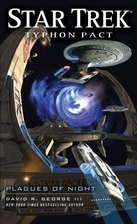
  • The cover, logo, and spine design change for this installment of Typhon Pact. Ships instead of faces, new fonts, slightly different alignment of text. I wouldn't mind, except I can see just looking at my bookshelf that for some reason the old design comes back for Brinkmanship.
  • Prynn is reading the Iliad aloud to her comatose father, Elias Vaughn. Sisko thinks it's appropriate because it's about destiny and fate, but it's also appropriate because the Iliad is the inspiration for Tennyson's "Ulysses," itself one of the inspirations for the Mission: Gamma miniseries that starred Vaughn.
  • George does have a weird storytelling tic, of occasionally summarizing events instead of showing them. Worf finds signs the Romulans have already been to the Gamma Quadrant, and doesn't know what to do. We later find out what he did through a summary dropped in during a Picard scene; I don't get why we just didn't see this scene.
  • Am I wrong in feeling like there's no way a Jem'Hadar could wear a Breen helmet?

12 March 2019

Star Trek: The Destiny Era: Typhon Pact: Rough Beasts of Empre

Mass market paperback, 387 pages
Published 2011

Acquired September 2012
Read November 2017
Star Trek: Typhon Pact: Rough Beasts of Empire
by David R. George III

2381-82
This is essentially two entirely separate novels crowbarred together, so I'm going to review each in turn, and then discuss they way they are brought together.

The first is what's promised by the series title: Rough Beasts of Empire is (chronologically) the first of eight books about the Typhon Pact, the Warsaw Pactesque Federation adversary introduced in A Singular Destiny. Basically, it's a set of alien species often opposed to the Federation banding together. With six members and eight books, there's more or less one alien race explored per book. Rough Beasts of Empire covers the Romulans, who in some previous book (Articles of the Federation, I think? it's been a while) split into two different polities, each led by a female character from Nemesis: Praetor Tal'Aura's Romulan Star Empire (which has joined the Typhon Pact) and Empress Donatra's breakaway Imperial Romulan State (which is friendly to the Federation).

The main focus of the novel is that Romulus is an empire divided, which basically no one wants: Tal'Aura and Donatra both desire to rule over a united Romulus. Many of the Star Empire's allies, particularly the Tzenkethi, would prefer to be dealing with a united nation as well. And then there's Ambassador Spock, still doing his Vulcan-Romulan reunification thing underground (literally and figuratively), who realizes that a united Romulan people makes reuniting with the Vulcans easier. So in classic Romulan tradition, we have plots and counterplots, as Tal'Aura, the Tal Shiar, Spock, Donatra, the Tzenkethi, and various Romulan families each pursue their own interests clandestinely.

It's entertaining enough. I didn't love it, but it's well done. It's hard to care about any of the Romulan characters, so really it's just Spock carrying you through the whole book. David R. George III has a pretty good grasp on Spock for the most part, as a principled man. Spock is attacked by a Reman assassin early in the book, and has the plan to turn him into the authorities, even though Spock is wanted by those same authorities, and that seemed very in character to me. There was a spot where he was overly naïve (I didn't buy that he would not foresee how his movement being legitimated could lead to long-term harm), but on the whole I enjoyed his story.

I do wish Donatra had appeared in the narrative earlier: she doesn't really become significant until near the end, and she shines then, as a principled woman trying to save her people from autocrats. On the other hand, she's distressingly passive for a head of state, especially one who's declared herself an empress! I would have liked to have seen her fighting more actively.

The Romulan plot kind of fizzles out, though. You figure out what's going on, the characters do too, and then it all plays out inevitably. There's no suspense as events draw to a close: some characters get what they want, and Spock watches it all happen. I did like how complicated it was, though. Almost no one here is an obvious black hat, and arguably the Romulan people are better off once the book is over even though the "villains" technically won!

There's a whole second book in here, though, that follows Benjamin Sisko. Now, Sisko ascended into the Bajoran wormhole at the end of Deep Space Nine to live with the Prophets, but he came back in the tenth-anniversary special Unity. Personally, I feel that after Unity, Sisko should have been quietly shunted off-stage somewhere to never play a major role in a Star Trek story again. How can you keep writing him into action-adventure stories in a way that doesn't undermine the celestial experience he would have had?

According to this novel, though, Sisko reactivated his Starfleet commission during the Borg invasion in Destiny to command the USS New York. I can kind of buy this, but everything that follows just seems wrong. Sisko is convinced that his is a life of sorrow (following on from the Prophets' warning to him in "Penumbra"): since he's returned from the wormhole, his daughter has been kidnapped, his neighbors have died, Elias Vaughn has been rendered brain-dead, and then a few chapters into this novel, his father Joseph passes away. I can just about buy that Sisko would be hurting from all this, though it's somewhat unconvincing for the novel to depend on past events only briefly described for its emotional heft. (Like, why the heck should I care about his dead neighbors?)

But what I really don't buy is what Sisko does in reaction to all this. He shuts down, leaving his siblings to manage his father's funeral while he aimless wanders the streets of New Orleans, ignoring Jake. Then he permanently reactives his commission (accepting command of the USS Robinson)... without telling Kasidy! I can only assume that when Sisko returned from the wormhole, it was another man who looked exactly like him, because this bears no relationship to the man whose adventures I saw on screen for seven years. Sisko was a builder and a doer, never a runner. Even when he suffered the greatest tragedy of his life, he did his job: through all of "Emissary" he does his best to set up Deep Space 9 to run successfully even though he has no intention of staying in command of it.

It also flies in the face of everything we've seen about Sisko as a family man. He would never ignore Jake like this; he would certainly never ignore Kasidy and his daughter like this. This is a man who lost it all and managed to put it back together. He is not so emotionally immature as to do what he does here, and the recent tragedies in his life don't make it plausible. The death of Jennifer is the defining tragedy of Sisko's life, and not even the death of his father comes close. This is the man who once said, "Running may help for a little while, but sooner or later the pain catches up with you, and the only way to get rid of it is to stand your ground and face it."

It also is just so pedestrian. Sisko should be enlightened and shit, not doubting that his experiences with the Prophets ever happened. I get that George probably wanted the prophecy from "Penumbra" to have some weight, but this was not the way to do it. I found this entire plotline frustrating to read about in the extreme.

Unrelated to all this, there's this sort of weird non-subplot about the Tzenkethi in the Sisko half of the novel. The Robinson ends us patrolling a sector of space where they sight some Tzenkethi vessels. This leads to a series of flashbacks to when Sisko fought against the Tzenkethi under the command of Leyton on the Okinawa (as mentioned in "The Adversary"). Why? Who knows because Sisko doesn't even interact with the Tzenkethi in the present day of the story; he just monitors sensor contacts from the bridge of the Robinson. It's really strange and pointless and has nothing to do with anything. It feels to me like when the initial set of Typhon Pact novels was reduced from six to four,* George was asked to jam them into his book because they weren't going to get a focus novel otherwise.

I read most of Rough Beasts on a flight; my wife sat next to me noted that the cover indicated a team-up between Sisko and Spock. "So far," I said, "their storylines have had nothing to do with each other." I think I was two-thirds of the way through at that point; the rest of the novel didn't remedy it. As close as the two plotlines come is when Spock gets a secret message to the Federation president asking for information to be passed onto Donatra, Sisko and the Robinson are assigned to do it. Why? I don't know. The president's staff tells her that Spock is the diplomatic service's expert on Romulans so that without him available, they should ask Starfleet. The head of Starfleet ends up recommending Sisko, because 1) according to a deleted scene he worked at the Federation embassy on Romulus, and 2) he met Senator Vreenak. Really!? There's no one in the whole Federation Diplomatic Corps who knows more about Romulans than that? Seems unlikely.

It's a contrived attempt to jam together what really are two completely separate stories. Take out the trip to see Donatra and the flashbacks to the Tzenkethi conflicts, and Sisko's story has nothing at all to do with the Typhon Pact in general, or the Spock/Romulus tale in particular. I also didn't really see any thematic resonance, though George tries to bring up a commonality of home at the very end. Based on the acknowledgements, it seems like George realized that with former Deep Space Nine editor Marco Palmieri gone from Simon & Schuster, the DS9 story wasn't going to advance unless he slipped it into unrelated novels.

Unfortunately, it doesn't serve it to advance it in such a weird way.

Continuity Notes:
  • There are a few small references to Diane Duane's Rihannsu novels: "High Rihan" is said to be the name of the Romulan language, some Romulan characters reference the Elements that Duane's Romulans swore by. It's subtle enough that it works: I didn't really like how Martin and Mangels' Enterprise novels gave all their Romulan characters Rihannsu-style names nothing like the screen Romulan names.
  • Amanda is said to have passed onto her son Spock a love of physical books. When the book came out, on-screen canon said she liked Alice's Adventures in Wonderland but said nothing about a love of physical books (often shown to be odd in the 23rd century)... but by the time I read it, Discovery revealed that Amanda gave Michael Burnham a physical copy of Alice's Adventures in Wonderland.
  • There's a joke about how Romulans have a lot of ancient sayings about serpents. A previous George novel, Serpents Among the Ruins, takes its title from a Romulan saying.
Other Notes:
  • Kira has become a vedek!? I know future novels will fill in more of the backstory in the four-year gap between this novel and the previous chronological DS9 novel, The Soul Key, but I find it hard to believe that George could ever make me believe in such a transformation, which is as bad a misunderstanding of Kira's character as this book is of Sisko's.
  • It also seems pretty shitty to (essentially) kill off Vaughn.
  • So who's in command of the station, then? If we're told, I missed it. But Kira's gone, and Vaughn's gone, and Ezri's gone. Even Bowers is gone. I guess that leaves Nog or Shar?
  • Sisko emotionally isolates himself from the crew of the Robinson and gets called out on it; George repeated this subplot almost precisely with Sulu's transfer in Allegiance in Exile.
  • The book's title is taken from the notes accompanying a Romulan painting. Based on the full poem (the novel's epigraph), the painter was really into William Blake.
* I'll talk more about the overall shape of the Typhon Pact series in a future review.

12 February 2019

Star Trek: The Destiny Era Prelude: Allegiance in Exile

Mass market paperback, 375 pages
Published 2013

Acquired January 2017
Read August 2017
Star Trek: The Original Series: Allegiance in Exile
by David R. George III

2269
David R. George III is/was one my favorite Star Trek novelists. The 34th Rule was a strong debut, and I also enjoyed works such as Twilight, McCoy: Provenance of Shadows, and Serpents Among the Ruins. But I didn't get much out of Kirk: The Star to Every Wandering, which maybe should have thrown up some flags before proceeding into another Kirk-focused story. The thing is, that George can write very character-driven stories, but he has a sort of pattern he uses a lot, which is someone morosely obsessed with some singular event in their backstory. This works perfectly with Deep Space Nine, where basically every character has some traumatic backstory event that informs their present day actions. It even worked for the original series in Provenance of Shadows because McCoy is the one classic Star Trek character to have that kind of backstory.

It just doesn't work for James T. Kirk. I'm not saying Kirk isn't introspective (I think he's very introspective), and that he doesn't occasionally brood over the past. But Kirk usually presses his doubts into actions, he keeps moving forward. He doesn't (in what is a bit of a George writing tic) fall into a reverie in the middle of a scene where he rues over three pages of backstory between two lines of dialogue. I definitely buy that Kirk would begin to feel uncertain as he nears the end of the five-year mission. I don't buy that it would be this kind of uncertain. George kind of piles on the uncertainties, too. When the novel opens, Kirk ruminates over a lot of random old mistakes; later in the book, a seemingly routine mission goes horribly wrong so that Kirk can obsess over that for the rest of the book.

Other than Kirk, the book's big focus is Sulu, who goes through a whole whirlwind of events here. He falls in love (with a woman who has a deep trauma in her backstory she's morosely obsessed with), she gets horribly injured, he gets mad at Captain Kirk and transfers to another ship, he comes back to the Enterprise. Again, I didn't buy it. Sulu is sort of relentlessly cheerful and optimistic, and it was hard for me to imagine him reacting toward Kirk the way he did here. Which isn't to say he ought to be Mr. Cheerful all the time, especially in the kind of circumstances we see in this book, but he comes across as petulant in a way that's hard to believe of a trained officer. A Sulu who throws himself into his hobbies as a means of distraction I could buy; ditto a Sulu who's friendly to everyone but lets no one get close. A Sulu who sits in his quarters all night every night is less plausible. I also don't think George adequately sold the relationship between Sulu and Trinh, so how angry he was over it wasn't quite believable.

The first third or so of the book was the best part. The exploration of the abandoned colony on the planet the Enterprise crew nicknames AÄŸdam was well done and creepy (it reminded me of, um, A Choice of Catastrophes), and the way those events climaxed was harrowing. But the novel lost its energy and focus after that; I'd've liked to have seen the Enterprise actively investigate the powers behind AÄŸdam rather than stumble into them repeatedly. I also don't get the purpose of the Lori Ciana subplot-- George doesn't sell the flirtation, and it doesn't resonate with the themes elsewhere in the book.

So it'll be interesting to see if the 24th-century books pick up on this book's revelations, though there's not much to them (more on that in a second), but on its own, I didn't get a whole lot out of this.

Continuity Notes:
  • As alluded to above, Kirk meet Vice Admiral Lori Ciana for the first time. In Roddenberry's Motion Picture novelization, she's Kirk's ex-wife who dies in the transporter accident at the beginning of the film. (With whom he split up amicably, as I recall; in Roddenberry's book but not really elsewhere in Star Trek, people can enter into short-term marriage contracts. The Lost Years tetralogy expanded on a lot of this backstory. It's been too long since I've read those for me to know if The Lost Years is consistent with Allegiance in Exile.)
  • The Enterprise makes first contact with the Bajorans. Is it too small universe for Captain Kirk to make this significant first contact? It does make you think that Kira ought to have known who Captain Kirk was a little bit more than she did in "Crossover." I was a bit bummed these colonists didn't call themselves the "Bajora"; if they had, then Picard's use of the old-fashioned collective noun could have had a subtle explanation. The Ascendants also play a role, but not a huge one, and not one that tells us much about them beyond that they don't like Bajorans. (To be honest, I don't really remember anything about the Ascendants at this point, given it's been over a decade since the relevant Deep Space Nine relaunch novels.) It's kind of neat but ultimately pointless.
  • Is Wesley returning to Starfleet after his time as a planetary governor in "One of Our Planet Is Missing" a pre-established thing? The whole conversation Kirk and Wesley have about how Wesley became a governor as part of a Starfleet Intelligence plot seemed very random.

Other Notes:
  • This book is the first time I can remember seeing the word "olio" (a reliable feature of the LA Times crossword puzzle) used in the wild. I might have squealed.
  • Now that I have a doctorate, whenever I encounter a character in fiction with two doctorates (used as a shorthand to show someone is so smart), I just roll my eyes. Getting a second doctorate is about the dumbest thing I can imagine doing with my life.
  • Despite the best efforts of some folks on the TrekBBS, I have no idea what the title is meant to mean.

08 December 2015

Deep Space Nine Reread, Season Four: The 34th Rule by Armin Shimerman and David George with Eric Stillwell

Reread June 2015
Star Trek: Deep Space Nine #23: The 34th Rule
by Armin Shimerman and David George with Eric Stillwell

In terms of "fitting in," The 34th Rule has a big advantage over previous novels I've read for this project-- instead of being written during its broadcast season, it was actually written much later. In this case, the book was released during Season 7, so the Deep Space Nine of this era was very much a known quantity. The 34th Rule fits comfortably between "Bar Association" and "Body Parts"; I didn't notice any real irregularities. Indeed, the book fills a minor gap in the show's continuity, depicting how the Orb of Wisdom got from Zek's possession in "Prophet Motive" to Bajor's in "In the Cards."

This is really a book of two parts. The first is Quark's imprisonment at the hands of the Bajorans. In classic David R. George III (note, however, that he is listed on the title page only as "David George") fashion, this plot line takes a long time to build up, but once it gets going, it's quite brutal, and of course Armin Shimerman and George have a strong grasp on the characters of Quark and Rom. I would have really liked to have seen the characters receive dramatic material this powerful more often on screen-- even the best "Ferengi episodes" like "Bar Association" still have comic turns that this book just does not.

But the real protagonist is, surprisingly, Sisko. Quark is not really changed by the experiences of The 34th Rule. He's been through a rough time to be sure, and he's learned that Zek is even smarter than he can imagine, and he's had some of his assumptions about the fundamental prejudices of hew-mons confirmed, but he's still basically Quark. But the most interesting thing about the novel is Sisko's character arc of learning about his own prejudice, and trying to move past it. The book's highlight scene is definitely the one where Ben and Jake discuss prejudice while watching Jackie Robinson play baseball in the holosuite, and again, it's a scene that would have been really great to have seen on screen.

What also surprised me in this reread is the extent to which some characters are not changed: Kira moves a little, but barely so, and she's pretty awful to Quark before that, so it's hard to see her shift as very big. There's also a very awkward scene where after Quark has been brutally tortured, Bashir is cracking jokes about his appearance. It's intentionally awkward. I can imagine that if it was on screen, it would have been funny-- Quark's injuries are often played for laughs-- but seeing it from Quark's interiority is not funny. It's actually quite a damning indictment of some of our main characters. Both Kira and Bashir come across quite unsympathetically when you're looking at things entirely from Quark's perspective.

Continuity Points:
  • Sirsy is introduced as Shakaar's aide; she will reappear in that role in the relaunch novels.
  • Similarly, the USS New York is mentioned, and Sisko evidently commands it in some later novels. (I still haven't read beyond... Losing the Peace, I think.)
  • On one hand, the book can't have any of the Federation characters change their hearts and stop being jerks to the Ferengi simply because of its chronological placement-- they act the same way to Quark in Seasons 5 through 7 as they did before. But it's not a bug, it's a feature: it would be unrealistic for any of them to experience cathartic, large shifts in behavior. And you can imagine everyone's experiences here informing their behavior in the last scene of "Body Parts."
  • When the Prophets Cried is a Bajoran religious text about how the Orbs came to Bajor, much read by Kira (and also read by Sisko). This is probably our most sustained and detailed knowledge of any Bajoran religious text. It's nice to have one that's not just a plot-catalyzing spooky prophecy. The only other ones I think we have are Akorem's poems, but I don't think they're canonical.

Other Notes:
  • Has Zek ever been smarter than he is here? This is probably the only time he ever does something in-story that would validate the idea that he controls a vast financial empire.
  • No, seriously, the stuff in Gallitep is brutal. Man, I would love to see Max Grodénchik do some of this.
  • I find it odd that Nog only comes up tangentially here. As a Ferengi in Starfleet, what does he think of the Federation's actions here? Even just a chapter from his perspective would have been nice. Wouldn't he have called his dad up?

Next Week: Worf checks up on his son in Honor Bound!