Showing posts with label creator: stephen sadowski. Show all posts

26 September 2022

JSA, Book Three: The Power of Legacy! by Geoff Johns, David S. Goyer, Stephen Sadowski, Rags Morales, Peter Snejbjerg, et al.

JSA by Geoff Johns, Book Three

Collection published: 2019
Contents published: 1999-2003
Read: July 2022

Writers: Geoff Johns, David S. Goyer, Michael Chabon, Dan Curtis Johnson, James Robinson, J. H. Williams III, Brian Azzarello, Howard Chaykin, Darwyn Cooke, Jeph Loeb, Ron Marz
Pencillers: Stephen Sadowski, Rags Morales, Peter Snejbjerg, Sal Velluto, Buzz, Javier Saltares, Adam DeKraker, Barry Kitson, Michael Lark, Mike McKone, Dave Ross, Phil Winslade, Uriel Caton, Derec Aucoin, Rick Burchett, Tony Harris, Howard Chaykin, Darwyn Cooke, Eduardo Risso, Tim Sale, Chris Weston
Inkers: Bob Almond, Michael Bair, Peter Snejbjerg, Wade Von Grawbadger, Jim Royal, Ray Kryssing, Keith Champagne, Wayne Faucher, Barry Kitson, Michael Lark, Prentis Rollins, Phil Winslade, Anibal Rodriguez, Christian Alamy, Dave Meikis, Derec Aucoin, Rick Burchett, Howard Chaykin, Darwyn Cooke, Eduardo Risso, Tim Sale, Chris Weston
Colorists: John Kalisz, Tom McCraw, Carla Feeny, Mark Chiarello, Tony Harris
Letterers: Ken Lopez, Kurt Hathaway, Michael Lark, Patricia Prentice, Richard Starkings, Darwyn Cooke, Janice Chiang

I complained when reading book two of this series that it seemed like the stories were being collected out of order; book three (called The Power of Legacy! on the cover but subtitle-free on the title page) makes that particularly clear, with later issues collected here introducing things that had already happened in book two, like the transfer of the JSA chairship to Mr. Terrific. But anyway: let's take this part by part as it's presented.
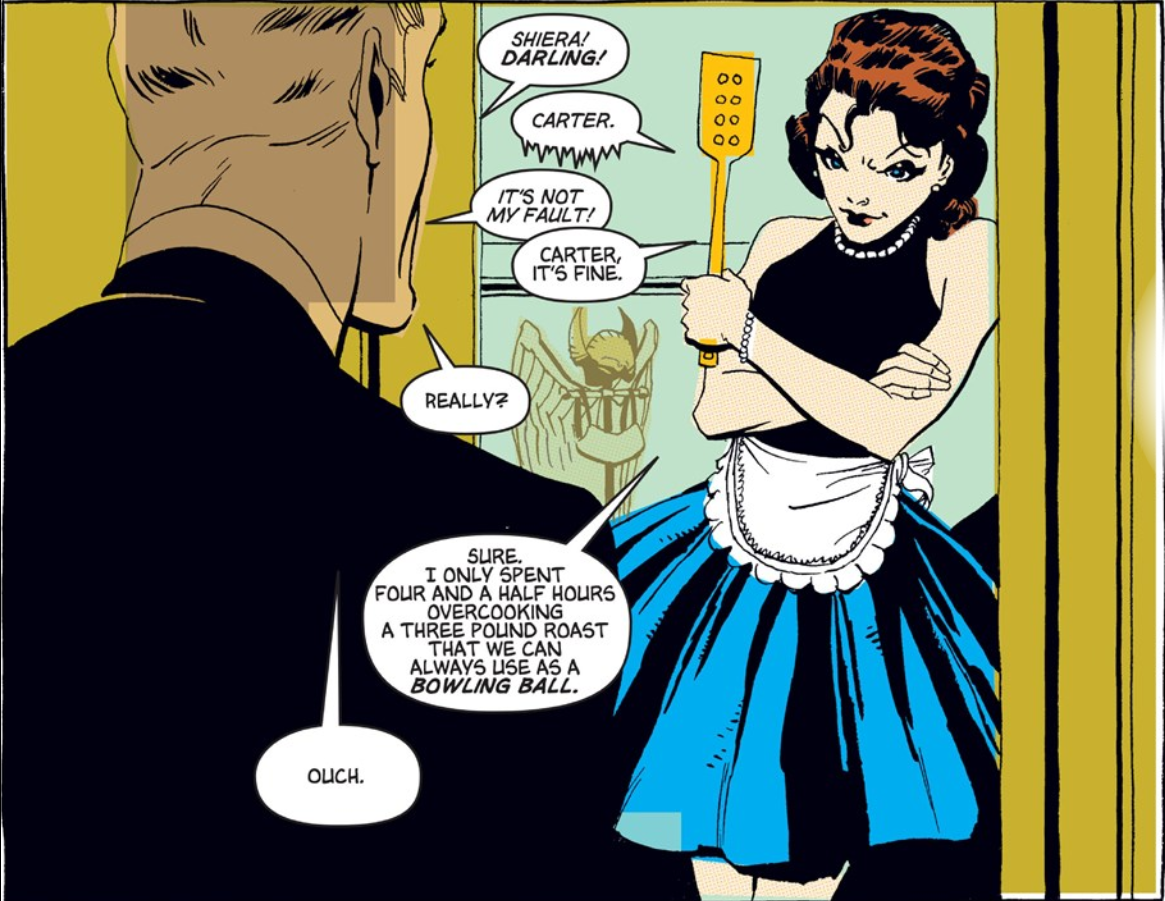
Women, amirite?
from JSA All Stars vol. 1 #2 (script by Jeph Loeb, art by Tim Sale)

The book begins with JSA All Stars vol. 1, an eight-issue miniseries about the various "legacy" characters in the JSA, those who are successors to older heroes: Hawkgirl, Dr. Fate, Stargirl, Hourman, Dr. Mid-Nite, and Mr. Terrific. The middle six issues all follow the same format. First, there's a sixteen-page story about the modern hero written by Geoff Johns and David Goyer, usually delving into character points for them, like Hourman's addiction (this is the Rick Tyler version from Infinity, Inc.) or Stargirl's relationship with her biological father. Then, there's a six-page story about their Golden Age predecessor, written and drawn by high-profile guest artists, like Howard Chaykin, James Robinson and Tony Harris, or Darwyn Cooke. Overall, I enjoyed these; the present-day stories actually give us some solid character work, especially for characters who haven't really had much meaningful focus in the present-day stories, like Hourman, Dr. Mid-Nite, and Mr. Terrific. The flashback stories are good fun stuff: if you take a great writer and artist (or writer/artist) and tell them to do what they want in a six-page Golden Age adventure, they will deliver.

Learning that the new Dr. Mid-Nite also did a residency with the original makes me wonder even more what happened to Beth Chapel. Ah, well, gotta replace those black legacy characters with white ones.
from JSA All Stars vol. 1 #6 (story by David S. Goyer & Geoff Johns, script by Geoff Johns, art by Stephen Sadowski & Wade Von Grawbadger)

The only thing I didn't like was the frame, which I have a sneaking suspicion was added after the middle six issues were completed, because of it how it contorts to not be mentioned in them. A villain turns up, but disguises himself as the Spectre and tells the characters to take time off to think about their histories but also that they shouldn't think about the events of the frame. It's pretty pointless, to be honest, and the six issues would have stood up on their own just fine. But overall, JSA All Stars is my favorite thing I've read thus far in this title... though technically, it's not part of it!

I often find Dr. Fate thaumababble tedious, but I would have read the hell out of a Darwyn Cooke Fate ongoing.
from JSA All Stars vol. 1 #3 (script & art by Darwyn Cooke)

Then come three stories about a character named Nemesis, two from JSA Annual #1 and JSA Secret Files & Origins #2. She's raised by the Council (the same organization responsible for some of DC's various Manhunters), and I felt like a lot of time was spent on her for reasons that weren't clear to me. But maybe this will come in during book four more? The Ultra-Humanite seems to be part of the Council storyline, and he's in book four. (There are some other stories from that Secret Files issue, too; one I already read in the Chase collection, and the other is to foreshadow an upcoming storyline.)

I will never care about Sand, especially his self-doubt, but this was a neat moment.
from JSA Secret Files & Origins #2 (story by Geoff Johns & David S. Goyer, script by Geoff Johns, art by Javier Saltares & Ray Kryssing)

After this, we finally get back to the main JSA series. First we have one of those standalone stories where nothing in particular is going on and we check in on various character that team books like to do—and that I like them to do. After the icky stuff in book two where everyone was expecting teenage Hawkgirl to hook up with octagenarian Hawkman because it was her "destiny," this volume thankfully pushes back against that, with her telling everyone she's going to do what she wants to do. I hope the series sticks to this, and that it's not a set-up for her coming around and getting together with Hawkman anyway. We also have some interrogation of the idea that Black Adam can be part of the team; I liked that Captain Marvel turned up, though was Atom Smasher (then called Nuklon) this hot-headed back in Infinc? Thankfully Sand, the team's most boring nonentity of a character, finally steps down as team leader.

My favorite part of this is that like two panels later, Captain Marvel goes on to use the word "legit." Such grace!
from JSA #27 (script by Geoff Johns, art by Rags Morales & Michael Bair)

This book also introduces Alex, a new character who was a cousin to Yolanda Montez, the Wildcat of Infinity, Inc. He was inspired by her JSA enthusiasm, and now he manages the JSA museum in the JSA's HQ. Fun idea... but he never actually appeared in Infinc! Didn't Yolanda have a younger brother? Why not use him? 
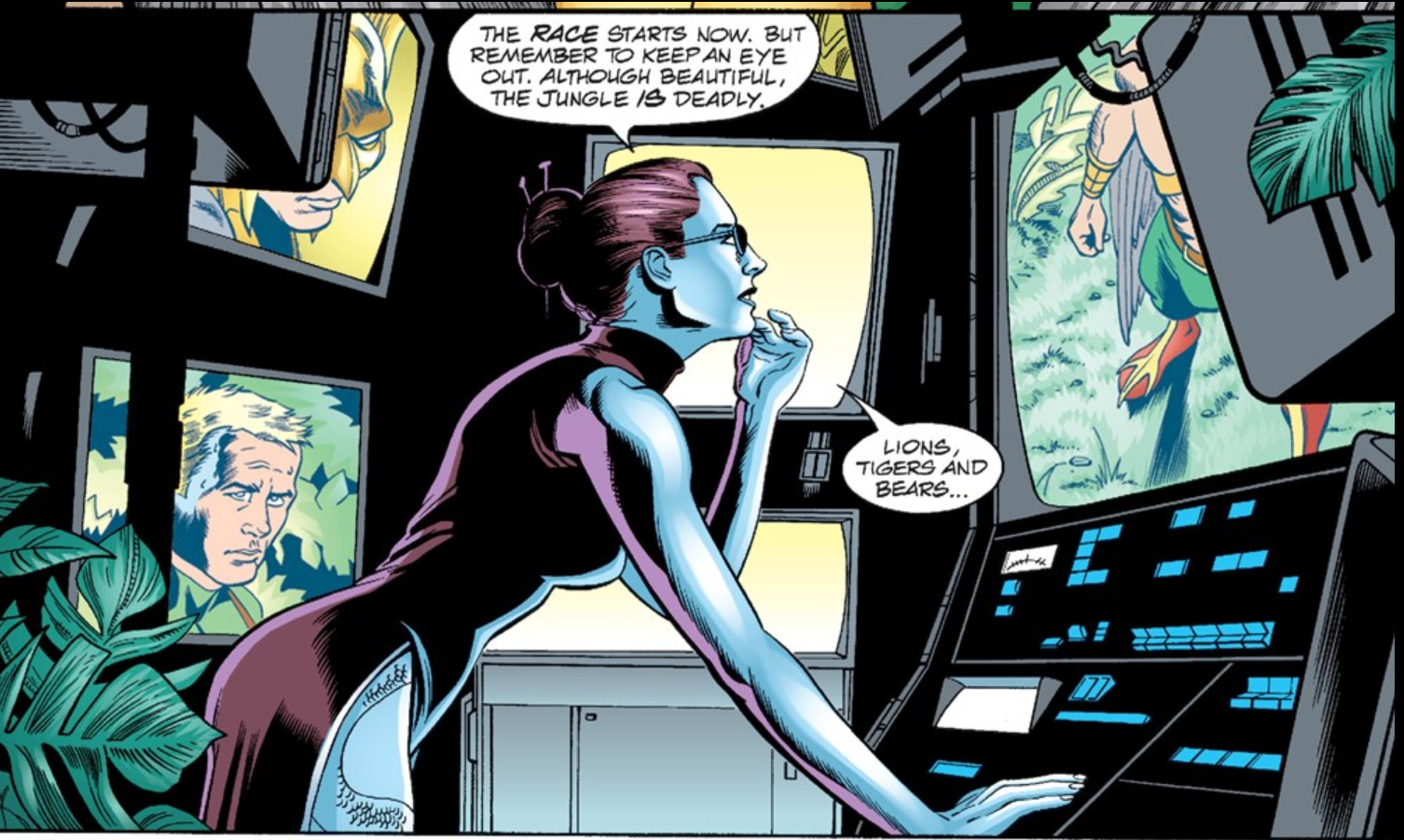
This lady's power is to always pose like a man is watching her.
from JSA #28 (script by Geoff Johns, art by Stephen Sadowski and Christian Alamy & Dave Meikis)

Lastly, we have a storyline where villains kidnap a number of JSA members and force them to fight each other as part of a gambling operation. This I thought was pretty good, probably the best actual storyline thus far, with lots of good moments of characterization, something sorely lacking from the series up to this point. I've been complaining about Geoff Johns, but this is actually the first story not co-written with David Goyer, so maybe it's him who's the problem. My favorite issue here was one where Stargirl and Jakeem Thunder (modern-day inheritor of Johnny Thunder's Thunderbolt) are the only two heroes left in HQ during the events of the Joker: Last Laugh crossover and have to protect New York City from a Joker-venom infected Solomon Grundy. Just two principal characters gives the characterization and the action time to shine, aided by some excellent moody art from Peter Snejbjerg. There's also a decent story about the JSA working with Batman. So... after three 400-page books things are finally looking up?
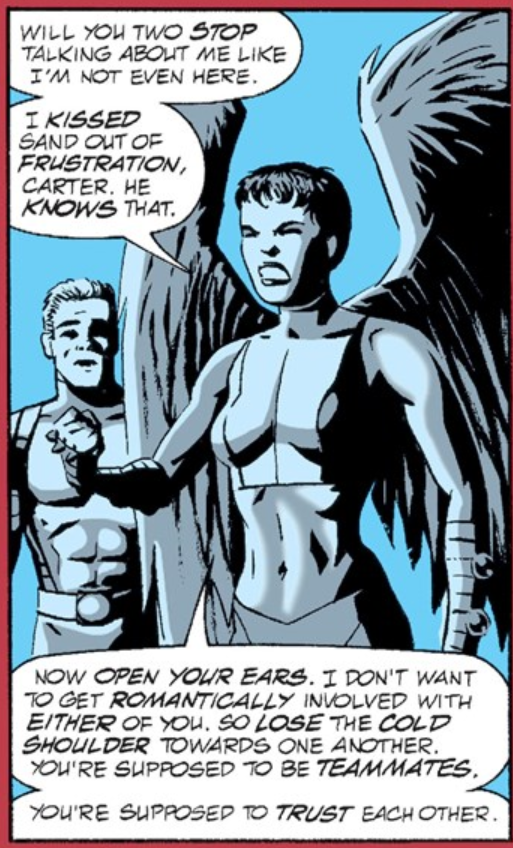
Finally!
from JSA #31 (script by Geoff Johns, art by Peter Snejbjerg)

The last story in the collection is "History 101," which the back cover proudly declares has never before been reprinted... but in fact it was already reprinted in The Justice Society Returns! way back in 2003! There are also lots of profiles and such from various issues of Secret Files & Origins, which is nice to have if you like that kind of thing; I did enjoy the diagram of JSA HQ.

This post is thirty-fourth in a series about the Justice Society and Earth-Two. The next installment covers JSA by Geoff Johns, Book Four. Previous installments are listed below:
  1. All Star Comics: Only Legends Live Forever (1976-79)
  2. The Huntress: Origins (1977-82)
  3. All-Star Squadron (1981-87)
  4. Infinity, Inc.: The Generations Saga, Volume One (1983-84)
  5. Infinity, Inc.: The Generations Saga, Volume Two (1984-85)
  6. Showcase Presents... Power Girl (1978)
  7. America vs. the Justice Society (1985)
  8. Jonni Thunder, a.k.a. Thunderbolt (1985)
  9. Crisis on Multiple Earths, Volume 7 (1983-85)
  10. Infinity, Inc. #11-53 (1985-88) [reading order]
  11. Last Days of the Justice Society of America (1986-88)
  12. All-Star Comics 80-Page Giant (1999)
  13. Steel, the Indestructible Man (1978)
  14. Superman vs. Wonder Woman: An Untold Epic of World War Two (1977)
  15. Secret Origins of the Golden Age (1986-89)
  16. The Young All-Stars (1987-89)
  17. Gladiator (1930) ["Man-God!" (1976)]
  18. The Crimson Avenger: The Dark Cross Conspiracy (1981-88)
  19. The Immortal Doctor Fate (1940-82)
  20. Justice Society of America: The Demise of Justice (1951-91)
  21. Armageddon: Inferno (1992)
  22. Justice Society of America vol. 2 (1992-93)
  23. The Adventures of Alan Scott--Green Lantern (1992-93)
  24. Damage (1994-96)
  25. The Justice Society Returns! (1999-2001)
  26. Chase (1998-2002)
  27. Stargirl by Geoff Johns (1999-2003)
  28. The Sandman Presents: The Furies (2002)
  29. JSA by Geoff Johns, Book One (1999-2000)
  30. Wonder Woman: The 18th Letter: A Love Story (2000)
  31. Two Thousand (2000)
  32. JSA by Geoff Johns, Book Two (1999-2003)
  33. Golden Age Secret Files & Origins (2001)

07 September 2022

JSA, Book Two by Geoff Johns, David Goyer, Stephen Sadowski, Michael Bair, Carlos Pacheco, Jesus Merino, et al.

JSA by Geoff Johns, Book Two

Collection published: 2018
Contents published: 1999-2003
Read: June 2022

Writers: Geoff Johns, David Goyer
Artists: Stephen Sadowski, Michael Bair, Carlos Pacheco, Jesus Merino, Phil Winslade, Mike Perkins, Steve Yeowell, Keith Champagne, Buzz, Rags Morales, Dave Meikis, Paul Neary, Rob Leigh, Javier Saltares, Ray Kryssing, Andrew Pepoy
Colorists: John Kalisz, Tom McCraw
Letterers: Ken Lopez, Pat Prentice, Kurt Hathaway

This volume of JSA by Geoff Johns (where every story is co-written by David Goyer, but I guess he doesn't rate) collects two story arcs from the main JSA comic and also the graphic novel JLA/JSA: Virtue and Vice and then some other stuff. What I am realizing is that I don't really care for Johns's approach to this book. First we have the seemingly obligatory storyline about a new Injustice Society, which like a lot of Geoff Johns stuff, is full of seemingly gratuitous violence in order to prove the situation is serious: he invents a whole Chicago superteam just to torture and brutally murder them, there's an evil Flash who runs through kids so fast they explode. It's just like... it's juvenile, and I don't read superhero comics to read about kids being murdered. I found it very hard to care.

The second big storyline is about a trip to Thanagar to resurrect Hawkman. I did really like Hawkworld, but Johns ignores any of its interesting complexities in favor of a melodramatic sub-Darkseid villain and a subplot about how a teenage girl just needs to give in and be romanced by an eighty-year-old man for the good of the universe.

Why does everyone assume she wants to be with him? (Also I spent some time wondering which Phantom Lady this was. The Action Comics Weekly one? But not so much time that I actually looked it up.)
from JSA: Our Worlds at War #1 (script by Geoff Johns, art by Javier Saltares & Ray Kryssing)

This book isn't totally unlikeable. In between those two storylines, there's a decent done-in-one that gives us some much-needed character focus, and actually the Our Worlds at War tie-in issue was pretty good too. And I also enjoyed the Secret Files & Origins issue that leads into Virtue and Vice, as well as the early parts of Virtue and Vice itself. When Johns (and Goyer) want to write these characters hanging out and talking about things, they do a decent job... but it seems they rarely do. If you compare this to the characterful and deft way that Len Strazewski wrote the last JSA ongoing, this just doesn't compare; I have very little sense of these people as, well, people. Like I said, Virtue and Vice starts good, but it soon becomes Yet Another Apocalyptic Battle with huge masses of people dying violently... which I am sure will promptly never be mentioned again. I also don't care much for stories where heroes are mind-controlled to be evil, especially if they promptly become stupid.

I have never cared for Johns's take on Power Girl.
from JLA/JSA: Virtue and Vice (script by David S. Goyer & Geoff Johns, art by Carlos Pacheco & Jesus Merino)

Some other thoughts: I think Secret Files & Origins and Virtue and Vice are included out of sequence; suddenly Mr. Terrific is JSA chair, and Stargirl is living in Metropolis, and Captain Marvel is a member, and there's a new Hourman who I don't think is the new Hourman from the previous book. None of these things have happened in the actual JSA series yet. It amused me that suddenly Green Arrow is alive again, so he has to contend with the fact that Black Canary has moved on romantically since his death. Virtue and Vice had some good President Luthor stuff. The way the heroes swap places with the statues in the Rock of Eternity is pretty neat.

This post is thirty-second in a series about the Justice Society and Earth-Two. The next installment covers Golden Age Secret Files & Origins. Previous installments are listed below:
  1. All Star Comics: Only Legends Live Forever (1976-79)
  2. The Huntress: Origins (1977-82)
  3. All-Star Squadron (1981-87)
  4. Infinity, Inc.: The Generations Saga, Volume One (1983-84)
  5. Infinity, Inc.: The Generations Saga, Volume Two (1984-85)
  6. Showcase Presents... Power Girl (1978)
  7. America vs. the Justice Society (1985)
  8. Jonni Thunder, a.k.a. Thunderbolt (1985)
  9. Crisis on Multiple Earths, Volume 7 (1983-85)
  10. Infinity, Inc. #11-53 (1985-88) [reading order]
  11. Last Days of the Justice Society of America (1986-88)
  12. All-Star Comics 80-Page Giant (1999)
  13. Steel, the Indestructible Man (1978)
  14. Superman vs. Wonder Woman: An Untold Epic of World War Two (1977)
  15. Secret Origins of the Golden Age (1986-89)
  16. The Young All-Stars (1987-89)
  17. Gladiator (1930) ["Man-God!" (1976)]
  18. The Crimson Avenger: The Dark Cross Conspiracy (1981-88)
  19. The Immortal Doctor Fate (1940-82)
  20. Justice Society of America: The Demise of Justice (1951-91)
  21. Armageddon: Inferno (1992)
  22. Justice Society of America vol. 2 (1992-93)
  23. The Adventures of Alan Scott--Green Lantern (1992-93)
  24. Damage (1994-96)
  25. The Justice Society Returns! (1999-2001)
  26. Chase (1998-2002)
  27. Stargirl by Geoff Johns (1999-2003)
  28. The Sandman Presents: The Furies (2002)
  29. JSA by Geoff Johns, Book One (1999-2000)
  30. Wonder Woman: The 18th Letter: A Love Story (2000)
  31. Two Thousand (2000)

20 July 2022

JSA, Book One by Geoff Johns, David Goyer, Stephen Sadowski, Michael Bair, et al.

JSA by Geoff Johns, Book One

Collection published: 2017
Contents published: 1999-2000
Read: April 2022

Writers: Geoff Johns, David Goyer, James Robinson
Artists: Stephen Sadowski, Michael Bair, Buzz, Scott Benefiel, Derek Aucoin, Marcos Martin, Keith Champagne
Colorist: John Kalisz
Letterer: Ken Lopez

In this series of posts, I've been tracking an impending Justice Society renaissance. After the brief flurry of JSA-related material from 1991 to 1993 or so, the JSA was largely left behind... and then it exploded in 1999. That all culminated in JSA, a new ongoing series, the Justice Society's first in six years, and also its longest; it lasted eighty-seven issues, beating out the original All Star Comics run's fifty-seven. Plus, as we'll see going forward, it led to any number of spin-offs and tie-ins.

It seems weird to me that this series of reprints is branded "JSA by Geoff Johns," as he works on just ten of this collection's fifteen issues, and the five he doesn't work on are the first five, which set up what this new team is and how it works. David Goyer is the only one of this volume's contributors who works on every issue. But, I guess if you're Chief Creative Officer and President of DC Comics, you can make sure your name is displayed prominently wherever you like.

I felt like this series was pushing a Dinah/Jack thing. Am I reading in too much? Kind of weird, if so, because their parents had an affair!
from JSA #12 (script by David Goyer & Geoff Johns, art by Buzz)

Basically, this volume sees the reestablishment of the JSA, and like Paul Levitz and Gerry Conway's 1976-79 revival, it makes it into a multigenerational team, leaning into the idea of heroic legacy that Roy Thomas laid the foundations of over in Infinity, Inc. By now, though, we are up to three generations of heroes: we have members of the original team like Alan Scott (formerly Green Lantern, but still ghettoized as "Sentinel" here), Wildcat, and the Flash (Jay Garrick); immediate descendants and sidekicks like Atom-Smasher (formerly Nuklon of Infinity, Inc.), Sand (formerly Sandy the Golden Boy, sidekick to the Sandman), Doctor Fate (Hector Hall, formerly the Sandman, formerly formerly the Silver Scarab of Infinity, Inc.), and Black Canary (Dinah Lance, daughter of the original, Dinah Drake); and then brand-new heroes like the new Starman (Jack Knight), Stargirl (Courtney Whitmore), and the new Hawkgirl (Kendra Saunders). Plus there's a new new Hourman who is some kind of android, and a new new Doctor Mid-Nite who is a white dude.* It's a neat idea, a team composed of mentors and mentees... but I found the book didn't actually do very much with it.

Always up for a Director Bones appearance, but this was a pretty pro forma one.
from JSA #11 (script by David Goyer & Geoff Johns, art by Michael Bair & Buzz)

Overall, this is an approach to team superheroics that wasn't very much to my liking. The book moves from apocalyptic event to apocalyptic event with no time to breathe; I would have very little sense of any of these people as characters if it wasn't for the fact I know them from other books. There are a lot of shock events—deaths and people going evil and people being plunged into terrible universes—but there is little sense that any of it matters, and I found it difficult to care. Geoff Johns always gets a lot of praise for his handling of history and continuity, but I feel like this is only true if you are a character Johns is nostalgic for from his youth. Obsidian from Infinity, Inc., for example, makes a comeback here just to become a villain so that his father, Alan Scott, can angst about its for a few panels. Hector Hall is resurrected... but I'm not really sure why, as once he comes back to life, he exhibits as much personality as a lamp-post. We do hear a lot from Sand... and I would quite frankly like to never do so again. What a poorly conceived, uninteresting character. Has any Golden-Age-kid-sidekick-turned-lead ever worked out except for Robin?

You can tell me he is connected to much more interesting characters... but you can't make me care.
from JSA #1 (script by James Robinson & David Goyer, art by Stephen Sadowski & Michael Bair)

I recently reread my very first post in this series, where I wrote, "I'm not going into the Geoff Johns era because, really, a little bit of Geoff Johns goes much too far in my experience." Over two years later, I actually don't remember thinking that, nor do I remember when I changed my mind and added all the Geoff Johns stuff to my list. There is quite a lot of it: seventy-two more issues of JSA, the spin-off JSA Classified, and the soft reboot of JSA as Justice Society of America vol. 3, plus myriad miniseries. I feel committed at this point—how can I follow the JSA from 1977 to 1999, but not the one more decade it would take to get me up to the end of the "original" JSA with Flashpoint?—but I can't claim to exactly be excited about it all based on reading this.

* Roy Thomas introduced a new Wildcat and a new Doctor Midnight, both women of color, during Infinity, Inc., but I see they were both killed off to prove the situation was serious in an issue of Eclipso back in 1993, paving the way for white dudes to reclaim the mantles. Of course.
 
This post is twenty-ninth in a series about the Justice Society and Earth-Two. The next installment covers Wonder Woman: The 18th Letter: A Love Story. Previous installments are listed below:
  1. All Star Comics: Only Legends Live Forever (1976-79)
  2. The Huntress: Origins (1977-82)
  3. All-Star Squadron (1981-87)
  4. Infinity, Inc.: The Generations Saga, Volume One (1983-84)
  5. Infinity, Inc.: The Generations Saga, Volume Two (1984-85)
  6. Showcase Presents... Power Girl (1978)
  7. America vs. the Justice Society (1985)
  8. Jonni Thunder, a.k.a. Thunderbolt (1985)
  9. Crisis on Multiple Earths, Volume 7 (1983-85)
  10. Infinity, Inc. #11-53 (1985-88) [reading order]
  11. Last Days of the Justice Society of America (1986-88)
  12. All-Star Comics 80-Page Giant (1999)
  13. Steel, the Indestructible Man (1978)
  14. Superman vs. Wonder Woman: An Untold Epic of World War Two (1977)
  15. Secret Origins of the Golden Age (1986-89)
  16. The Young All-Stars (1987-89)
  17. Gladiator (1930) ["Man-God!" (1976)]
  18. The Crimson Avenger: The Dark Cross Conspiracy (1981-88)
  19. The Immortal Doctor Fate (1940-82)
  20. Justice Society of America: The Demise of Justice (1951-91)
  21. Armageddon: Inferno (1992)
  22. Justice Society of America vol. 2 (1992-93)
  23. The Adventures of Alan Scott--Green Lantern (1992-93)
  24. Damage (1994-96)
  25. The Justice Society Returns! (1999-2001)
  26. Chase (1998-2002)
  27. Stargirl by Geoff Johns (1999-2003)
  28. The Sandman Presents: The Furies (2002)

05 April 2017

Faster than a DC Bullet: All-New All-Different DC, Part IV: Manhunter: Origins

Comic trade paperback, 222 pages
Published 2007 (contents: 2005-06)
Borrowed from the library
Read January 2017
Manhunter: Origins

Writer: Marc Andreyko
Pencillers: Javier Pina, Diego Olmos, Stephen Sadowski, Sean Phillips, Shawn Martinbrough, Rags Morales
Inkers: Fernando Blanco, Andrew Pepoy, Sean Phillips, Shawn Martinbrough, Bob Petrecca
Colorists: Steve Buccellato, Jason Wright
Letterers: Travis Lanham, Pat Brosseau, Phil Balsman

I feel about this volume a lot like I did about the previous one: the pieces are there for greatness, but the book isn't achieving it.

Part of this is that it isn't capitalizing on its own premise. The idea of the book is that Manhunter kills the supercriminals the justice system can't take down, but in this volume, she doesn't fight anyone like that: just her own father (and goons hired by him) and a new villain (I think) named Sweeney Todd who's a superpowered serial killer. This kind of stuff could happen in any superhero book-- but I always want to see each book be itself as much as it can. There are hints that we're going somewhere, though, as Kate is now a defense attorney, and there's clearly something up with her most recent client, Doctor Psycho.

Yes you are!
from Manhunter vol. 3 #21 (art by Javier Pina & Fernando Blanco)

The other part is that the book vanishes up its own backside sometimes. I like my superhero stories to be outwardly focused: it they're not out there saving people from problems that would exist without them, it's kind of like, what's the point? (For example, when Superman only saves people from invasions by General Zod that wouldn't have happened without Superman's presence, that would seem to indicate the world is better off without Superman.) Unfortunately, this is a very inwardly focused book in all three of its stories.

21 August 2011

Faster than a DC Bullet: The Sandman Spin-Offs, Part XIII: JSA: Justice Be Done

Comic trade paperback, 138 pages
Published 2000 (contents: 1999)

Borrowed from the library
Read August 2011
JSA: Justice Be Done

Writers: James Robinson, David S. Goyer
Pencillers: Scott Benefiel, Stephen Sadowski, Derec Aucoin
Inkers: Mark Propst, Michael Bair
Colorist: John Kalisz
Letterer: Ken Lopez

There's a tiny cameo by the Daniel Hall Dream (man he's been popping up a lot of late), and Hector Hall, who was the third Sandman (after Garrett Sandford) finally returns from the Dreaming in this story, but the main Sandman element in Justice Be Done, the first volume of the 1990s JSA series, is the legacy of Wesley Dodds, the original 1930s Sandman. Justice Be Done merges two previously distinct versions of the character: the Wesley Dodds here is characterized the way Matt Wagner wrote him in Sandman Mystery Theatre, especially as regards his romance with Dian Belmont, but he still participated in the more fanciful adventures of the Golden Age version of the character. His sidekick Sanderson Hawkins even has a big role in this story, even though Sandman Mystery Theatre took some pains to established that "Sandy" didn't exist.

Wesley's brief appearance here culminates in his death, but he goes out like a hero, and it works. Having him battling cosmic forces in the mountains of Tibet jars with the SMT Wesley's encounters with powerless psychopaths in New York sewers, but the SMT was written as so smart and well-intentioned that you've no doubt he could have handled such situations had he been pushed into him. The building of the JSA memorial is a little harder to buy, and the oft-referenced fact that Wesley once built a "silicoid gun" that turned Sandy into a sand monster doesn't really fit at all, but then again, Justice Be Done isn't a Sandman Mystery Theatre story, but a no-holds-barred nostalgic Justice Society one, uniting a hodgepodge of characters with ties to the organization, from founding members, to the children of other founding members, from an android reincarnation of Hourman (who actually appeared in Sandman Mystery Theatre), to Wonder Woman's mom.

Even if you take Justice Be Done on its own terms, Sandy, who declares himself "Sand" here with some ferociously bad dialogue, is one of the less convincing elements of the story. The writers seem desperate to give him relevant powers: he starts out with Wesley Dodds's legendary gas gun, and he picks up Wesley's bad dreams as well, but he soon also acquires the power to turn into sand at will, not to mention "hyper-sensitized to seismic activity." For some reason. It's a disjointed powerset that reeks of an attempt to make something of this character, as does the hackneyed combination of man-out-of-time and trying-to-live-up-to-a-legacy characterizations, which try really hard to make him more than the most generic of sidekicks that he began as.

On a side note, I was amused by an introductory illustration of the new Justice Society, which labels illustrations of the characters to help the newbies. In this we see WILDCAT, STAR-SPANGLED KID, STARMAN, OBSIDIAN, BLACK CANARY, HOURMAN, and... AL ROTHSTEIN. Nice codename, dude.