Showing posts with label creator: david michelinie. Show all posts

06 January 2026

Justice League International Year Seven, Part I: Destiny's Hand (JLA #70-77 / JLTF #1-3)

This series of posts took a bit of a breather. Partially because I have to track down out-of-print trade paperbacks, but partially also because trying to read the stories in any kind of reasonable or accurate sequence gets much harder around this point! I had been using the Cosmic Teams timeline, but it has lots of placements that very obviously do not make sense if you read the actual stories, making me think it was done from someone's vague memories of the series. So I kept on reading, but put my writeups on pause while I tried to work out the best order.

Now, finally, I am back in action. It is interesting; this era gives you some signs that the Justice League family of titles was in trouble, in that approaches are constantly being jerked around and creative teams switching. But it also gives you indications things were going quite well, because a third ongoing monthly title was added to the lineup. Has there ever been any other era in the history of DC where there were four ongoing Justice League titles? (AmericaInternational, and Task Force all as monthlies, but also Quarterly keeps going, with three issues' worth of content every quarter, so essentially another monthly.)

This post covers the end of Dan Jurgens's run on Justice League America (collected in a book called Superman and Justice League America, Volume 2... even though Superman is dead for every single one of these issues!) and the first three issues of Justice League Task Force. Based on chronological considerations, it will be a bit before we get back to JLE, now retitled Justice League International. Plus, a single issue of JLQ!

from Justice League America #76
"Grieving" / "A New Look" / Destiny's Hand / Blood Secrets, from Justice League America #70-77 (Jan.-Late July 1993), reprinted in Superman and Justice League America, Volume 2 (2016)
words/layouts by Dan Jurgens (guest pencils by Sal Velluto), finishes by Rick Burchett and Romeo Tanghal & Bob Smith, letters by Willie Schubert, colors by Gene D'Angelo

So, JLA #69 ended with Superman showing up to battle Doomsday. JLA #70 begins with him dead, having been killed off in Superman #75 as part of the Death of Superman story. The issue first focuses on the reactions of the various League members to the events of the battle with Doomsday: Ice, who had a crush on Superman, is devastated; Blue Beetle is in a coma; Booster is beside himself at both the injury of his best friend and the destruction of his suit. It then takes a broader approach, as other characters show up to grieve, like the Flash and Aquaman and Hawkman and Green Arrow. Even Guy Gardner is sad! It's fine, it does exactly what it should, I suppose. Dan Jurgens's art lifts his story; he's very good at classical heroic heroes emoting, which is exactly what this needs.

The next issue is one of those dull transitional issues, establishing the new status quo for the League: who quits, who joins, &c. Wonder Woman takes over as team leader. Ice quits. Booster and Fire are still around but neither has powers. A bunch of new members join, including the Ray (who lasts for quite a while) and two other characters who I honestly forget were even in the title until I went to write these issues up just now! These are Condor and Agent Liberty. Jurgens never really establishes their deals in an interesting way during his run, and they just vanish after it's over; I am pretty sure they are not written out, they just stop appearing after issue #75! I would say that's typical of the post-Giffen/DeMatteis JLA, which very much struggles to create a compelling mix of characters no matter who's writing.

At this point, Jurgens's run fizzles out. First we get a really boring four-part story about Doctor Dee dreaming a harsher Justice League into existence, which begins to bleed into the real world. It's just not a very interesting idea and it goes on far too long. The whole thing wraps up with a two-part story finally explaining what's been going on with Bloodwynd: he's the Martian Manhunter in the form of Bloodwynd. This is a great twist but not a great story because it turns out J'onn J'onnz thinks he's Bloodwynd so he's acting exactly how Bloodwynd would act. It tells us nothing about either Bloodwynd or J'onn as a character, so what's the point? I do like how Jurgens writes Blue Beetle, though, never forgetting that in addition to being a goofball he's also an obsessive genius.

from Justice League Quarterly #11
"Beautiful, Wonderful, Perfect" / "Heat Wave" / "The Damnation Agenda, Part 1 of 5: The Hiding Kind", from Justice League Quarterly #11 (Summer 1993)
writes by William Messner-Loebs, Pat McGreal & Dave Rawson, and Michael Jan Friedman; pencils by Mike Wieringo & Lee Moder, Dave Cockrum, and Mike Mayhew; inks by Richard Space, Peter Gross, and Dan Davis; letters by Bob Pinaha and Tim Harkins; colors by Gene D'AngeloSteve Mattsson, and Glenn Whitmore

The lead story in this issue is said to "take place before current issues of Justice League," but there's pretty much nowhere it could go, as it features both Wonder Woman and Ice in the JLA, and Ice quit the same issue Wonder Woman joined (JLA #71). Additionally, Beetle is unseen but mentioned as active, yet he was comatose from JLA #69 to 75. But it can't go later, once Ice rejoins (JLA #85), because by then, Crimson Fox has quit the League!

Anyway, the lead story here has potential but, like all of William Messner-Loebs's contributions to JLQ, is not very well done. The League is asked to protect the wife of a conservative Muslim prince, so only female members can be used. The main characters have to be pretty dumb and gullible for the whole thing to work. There are some decent character moments among the leads, but also I feel like Mike Wieringo and Lee Moder's art wasn't quite ready for prime time. (But then, I guess JLQ isn't exactly prime time.) There's also a flashback story about the Martian Manhunter in the 1960s, battling racism in the South. I wouldn't say it's great comics, but I thought it was solid, and surprisingly nuanced for the early 1990s. It's cowritten by Pat McGreal, who overall did some solid stuff for JLQ; I'd've liked to have seen more work from him. And the art is by the great Dave Cockrum; nice to see him get to cut loose with something other than standard superhero fare.

Lastly, this issue sees the debut of JLQ's first-ever ongoing feature. This stars Praxis... and if you're going, "Who?", I don't blame you. Praxis has a very flimsy JL connection; way back in JLQ #1 he was a member of Conglomerate. It would be quite easy to not remember him! (I see from DCUGuide that he actually debuted in a 1989 Spectre story arc, but I don't think that's ever mentioned in any of his JLQ appearances.) Why would he be picked up for a return appearance? Well, if you remember the 1990s, it's not too surprising: he wears a leather jacket and sunglasses and mostly goes around angsting. So totally of his time it almost reads as parody. Praxis was a cop who failed to save his niece from a serial killer and got superpowers; after Conglomerate fell apart, he returned to police work. The story here, told from the perspective of his female partner, focuses on them trying to stop a new serial killer with a grisly MO. It's by Michael Jan Friedman and Mike Mayhew, both solid comics creators, but I found there was a bit too much narration. Let the story breathe!

from Justice League Task Force #1
"The Tyranny Gun!" / "Split Hit" / "Twisted Glass!", from Justice League Task Force #1-3 (June-Aug. 1993), reprinted in Justice League Task Force, Volume 1: The Purification Plague (2018)
written by David Michelinie, pencils by Sal Velluto, inks by Jeff Albrecht, letters by Bob Pinaha, colors by Glenn Whitmore

Justice League Task Force is a new ongoing. It only has two consistent lead characters, Martian Manhunter and Gypsy; other than the two of them, each story arc sees a new team assembled every issue, from a broad mix of DC superheroes. Interestingly, this grabbag approach also extends to the series's writing: David Michelinie gets first author on the collection cover, but actually only writes three of the twelve issues it collects... but no one writes more than three. While ongoing comics with rotating creators aren't unusual, I can't remember another comic I've read where the writer is constantly changing, but the artist is not; Sal Velluto pencilled all but two of the series's first fifteen issues.

In the first story, the UN uses the newly formed Task Force to take down rebels in a Caribbean nation. In this one, in addition to Manhunter and Gypsy, there's the Flash, Aquaman, and Nightwing. I don't really care for it. Sal Velluto has done good work elsewhere but this isn't his best, leaning too much into the early 1990s grim-and-gritty style; the writing is like that, too, with the characters always barking and snarling at each other. I don't find attempts to insert mainstream superhero characters into "realistic" geopolitics very interesting. This must go shortly after JLA #77 for J'onn, but the trauma he went through there is never mentioned, and weirdly, the actual JLA series never mentions why J'onn suddenly never appears again after his return!

I feel like David Michelinie was probably meant to write more of this title than he did. He gets cover credit on the fourth issue even though it was written by someone else (more on that next time), and the ending of #3 seems to set up a recurring villain who never recurs.

This is the eleventh in a series of posts about Justice League International. The next covers issues #78-83 of JLA, #51-52 of JLI, and #4-8 of JLTF. Previous installments are listed below:

  1. Justice League #1-6 / Justice League International #7-12 (May 1987–Apr. 1988)
  2. Justice League International #13-21 (May 1988–Dec. 1988)
  3. Justice League International #22-25 / Justice League America #26-30 / Justice League Europe #1-6 (Jan. 1989–Sept. 1989) 
  4. Justice League America #31-36 / Justice League Europe #7-12 (Oct. 1989–Mar. 1990)
  5. Justice League America #37 / Justice League Europe #13-21 (Apr. 1990–Dec. 1990)
  6. Justice League America #38-50 / Justice League Europe #22 (May 1990–May 1991)
  7. Justice League America #51-52 / Justice League Europe #23-28 (Feb. 1991–July 1991) 
  8. Justice League America #53-60 / Justice League Europe #29-36 (Aug. 1991–Mar. 1992) 
  9. Justice League America #61-65 / Justice League Europe #37-42 (Apr. 1992–Sept. 1992)
  10. Justice League America #66-69 / Justice League Europe #43-50 (Sept. 1992–May 1993) 

19 January 2018

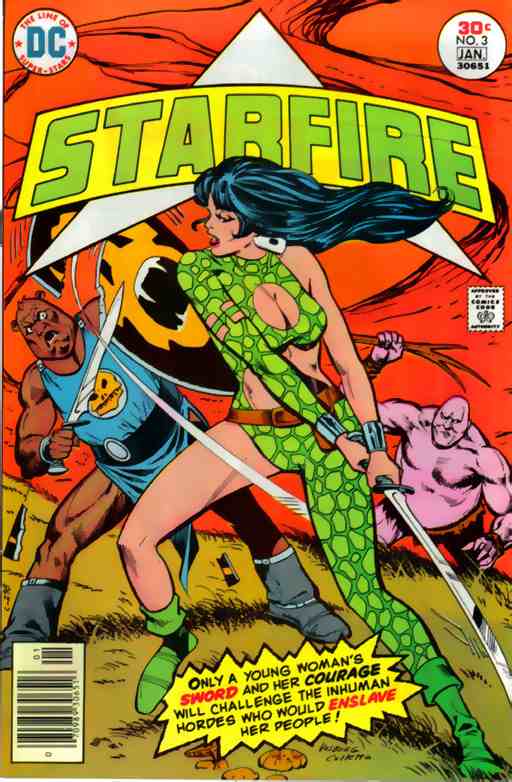
Review: Starfire by Mike Vosburg, Vince Colletta, Elliot S! Maggin, et al.

Four years before the Teen Titan Starfire debuted, and almost forty years before she got her own series, there was a very different DC series called Starfire. A take on the sword-and-sorcery comics then popular, it billed itself as "sword-and-science": it was set on another planet, and in a world not with magic, but one that had been conquered by aliens and partially regressed into barbarism after an era of great scientific achievement.

In this era, humans are the subjects of the Mygorg, a brutish alien race; the main character, Starfire, began her life as a human slave of the Mygorg, but when she's about to turn eighteen, she realizes she's going to become their sex slave! She runs away, and is rescued by a priest who helps train her in the ways of combat. They fall in love, he dies, and she vows to destroy the Mygorg forever. So she sets off with a band of adventurers seeking the people and resources to do exactly that.

Starfire was one of very few female-led DC superhero-adjacent titles in the 1970s (were the other just Wonder Woman, Lois Lane, and Supergirl?), but more importantly it was probably the first comic to feature an Asian protagonist.* Well, sort of-- since Starfire is set on an alien planet nothing to do with Earth, she can't be from China or Cambodia, but we are told, "her mother was white, and the father yellow," artist Mike Vosburg draws her with East Asian facial features, and the colorists depict her skin tone as slightly different from all the white characters (though she has blue eyes). Though I suspect it was done to make her a little more "exotic" and thus sexy, it was a surprising moment of diversity for the comics of the 1970s.

If you look at the credits at the bottom of this entry, you'll see that even though Starfire had a consistent penciller, the series accrued four writers and three editors in eight issues. The series is kind of jerked around and never really takes off as a result. David Michelinie creates the baseline in his original two issues: the first gives Starfire's backstory, climaxing in a surprisingly brutal scene where she beheads the Mygorg who killed her lover and would have taken her as a "bride." Then in #2, he establishes the formula: Starfire and her band (the only named member of which is Thrumdahg) come to a place, fight some Mygorg, and advance onwards. In this story, they acquire a map with the location of the fabled "Lightning Lords" on it, humans with advanced weapons that will help Starfire's band win their battles, thus setting up a quest behind the formula.

Michelinie stops it from being too straightforward, though; Starfire's eagerness for a fight in #2 disrupts a manor whose human lord has an uneasy truce with the Mygorg, for example, culminating in the accidental death of the manor lord's young son. So Starfire's quest will be tinged with a need for understanding complexity, and an undercurrent of tragedy.

The next three issues are the work of Elliot Maggin, who basically reproduces Michelinie's issue #2 formula. He keeps adding new members to Starfire's band, including the mute Thump and the poet Moonwatcher. Beginning with Thrumdahg back in #2, though, there's this consistent thing that the members of Starfire's band all think she really needs some loving, and so she's always fending off unwanted advances. Thump is the only exception to this. It's a weird, unpleasant choice, even in the context of a comic that began with its protagonist almost being forced into a life of sexual slavery. Like, why do I want to read about a band of would-be rapists? Still, Maggin's first two issues are solid adventure tales, each setting up its own interesting situation and then resolving it in the course of a single issue.

In issue #5, though, things begin to change, as Starfire meets the Lightning Lords at last in what's the first part of a three-part story by two different writers. The premise of the series begins to warp: while in the first five issues, it was sword-and-science, no sorcery needed, #6 introduces an out-and-out sorceress with magical powers!

The attempts to retool the series also become pretty brazen. In #6, while camping outside the lair of the Lightning Lords, who live in the middle of a mountainous wilderness, Starfire runs off in the middle of the night and comes back in a new costume. Which she allegedly picked up at a marketplace? Like why is there a human marketplace in the middle of nowhere selling sexy costumes for adventuresses?

This new costume lasts one whole issue, as in #7, Starfire is charging through a doorway and her costume gets caught on a nail and falls off, meaning she has to run around in a bra and short pants. I shit you not. Vosburg doesn't even draw the nail; in one panel, Starfire's shirt is ripping, and in the next she observes, "Looks like I lost my modesty to a rusty nail! Nothing ever comes free in this world!" Like, what does that even mean? And then she never mentions it again, apparently content to wear what is essentially a chainmail bikini. (I actually did like her original outfit, a sort of asymmetrical Seven of Nine-esque jumpsuit.)

Also, in #7, new new writer Steve Englehart must have also disliked the fact that the majority of Starfire's band were rapists, because he kills off all the supporting characters except for Thump and Moonwatcher in a teleporter accident! Like, a supercomputer tries to beam a group of them out of danger, but it doesn't know human biology, and they all die except Moonwatcher (the least rapey of the ones who weren't Thump; he seemed to want to charm Starfire into sleeping with him). Starfire also becomes a bystander in her own story in this storyline, as it turns out Thump is a genius computer programmer, and he makes a lot of decisions while Starfire just yells and fights a lot.

#8 introduces a new new direction, bringing back the order of priests Starfire's lover from #1 belonged to. The book promises there are more issues to come, but they never happened; I'm not sure why. The DC Implosion that killed Star Hunters was over a year away. Well, I mean I guess I know why, because this book's writer and premise were constantly shifting, and each change made it worse, not better. (Creator David Michelinie did slip Starfire into a one-panel cameo in Star Hunters #7 as another avatar of the same multiversal force as Star Hunters's lead character. But that was Star Hunters's last issue too!)

The one consistently good part of the book was the artwork of Mike Vosburg and Vince Colletta. They do great fantasy stuff, especially with Starfire herself: thick lines that really show off her beauty and her power. Too bad the writing couldn't consistently match what they were capable of.

Starfire vol. 1 was originally published in eight issues (Aug./Sept. 1976–Oct./Nov. 1977). The series was written by David Michelinie (#1-2), Elliot S! Maggin (#3-5), Steve Englehart (#6-7), and Tom DeFalco (#8); pencilled by Mike Vosburg; inked by Robert Smith (#1) and Vince Colletta (#2-8); colored by Liz Berube (#2); and edited by Joe Orlando (#1-4), Jack C. Harris (#5-7), and Denny O'Neil (#8).

* Karate Kid received an ongoing series in Mar./Apr. 1976, and he's half-Japanese, but that's a retcon, and I'm not sure when it was established.

12 January 2018

Review: Star Hunters by David Michelinie, Bob Layton, Rich Buckler, et al.

In addition to reprinting old material, DC Super-Stars was also a venue for launching new series. One of these was Star Hunters, which had its first (double-length) installment in Super-Stars before spinning off into its own series. Published 1977 to 1978, it was definitely riding the same space opera zeitgest that gave us IronWolf and Star Wars; the text feature in Super-Stars #16 explains that writer David Michelinie was inspired by Space: 1999 and Star Trek when he first pitched the concept in 1975, though it wasn't accepted until 1976, and the first part went on sale in June 1977, almost exactly one month after Star Wars appeared on screen, though the text feature doesn't mention Star Wars at all despite some obvious similarities.

The text page sort of waffles about whether it is a team book or not: Micheline pitched it as a team book called The Survivors because team books did better in the market at the time, but the text piece indicates that as ideas coalesced, it became a solo book: Donovan Flint, Starhunter. Obviously things changed between when the text piece was finalized and when the cover to Super-Stars #16 was printed! I'd say the book itself waffles about this. Donovan Flint is definitely the main character, but he's one of a group of adventurers on a spaceship together, and the title highlights all of them, yet the story rarely does.

Premise

The basic premise of the book is that the mysterious and nefarious Corporation infects a group of varied people with particular skills with a deadly illness that means they will die if they set foot on Earth. In exchange for the cure, the Star Hunters will have to travel into space on the C.S.V. Sunrider, to recover the second half of an alien artifact that contains the location of an ancient alien race that seeded life on Earth and other planets.

It's sort of a contrived premise, I feel. The death sentence aspect makes the nefarious nature of the Corporation too obvious from the beginning, and it's never adequately explained why they have to go to such lengths, why they can't  just pay some people to go find it instead, and get more loyalty that way. It's also a premise that's never really developed. You might think that finding the second half would be a challenge (otherwise why go to such lengths?), but the Star Hunters just go straight to the planet where the first half was and find the second half in the same cave! By the end of the second issue! (Star Hunters #1, that is.) From there the story swerves massively, with first some battles against terrorists, and then Donovan is killed and resurrected and becomes a messiah dedicated to taking down the Corporation with an army at his back all in time for a massive battle over Earth in Star Hunters #7, which turned out to be the final issue, even though the lettercol in #7 promises more to come with a new creative team.*

Obviously you can have series where the seeming premise turns out to not be the actual premise, but Michelinie doesn't really pull it off here, as the book rockets through both the old and the new premise unbelievably fast. Why is Donovan a space messiah? How does he recruit a resistance army with basically one speech? Someone was clearly watching Star Wars, but I don't think he was learning the right lessons. (Though, after Star Hunters, Michelinie wrote nineteen issues of Marvel's Star Wars comic from 1981 to 1983.)

I would say the book was influenced by Blake's 7 too: when the original Sunrider is destroyed, the crew find a mysterious advanced warship that they take for their own, completely with an obliging supercomputer in a box. It's basically the Liberator with ORAC/ZEN aboard. C'mon, it has to be a Blake's 7 rip-off! A band of rebels in an awesome but enigmatic spaceship fighting to liberate a dystopian Earth! Except, you know, Blake's 7 didn't premiere in the UK until January 1978, several months after the first installment of Star Hunters. And the lines of influence wouldn't make any sense going the other way, either. Convergent evolution, I guess. Like I said, something was in the air in the 1970s!

Characters

Donovan Flint is the main character: an Irish space rogue who spouts lines like, "'Twould seem someone's had a bit much o' the grape t'night" and "All right, bucko, ye've had yer fun." (See him front and center on the cover of issue #1 to the right.) He's a little obnoxious in a fun way-- brash and over-the-top, but the writer clearly knows it. Well, at first, because any enjoyment you might get from his antics is ruined by the way he acts toward...

Darcy Vale is originally set up as the leader of the Star Hunters and the captain of the Sunrider, even though Flint is clearly the main character. (She's in the foreground of the cover of #2 to the left; that's her best cover appearance, since she's usually unconscious or in the far background on the others.) Flint is condescending and obnoxious to her; in Super-Stars #16 he makes a pass, but she rejects it, and he thinks, "she was rather pretty-- in a computerish sort o' way..." Once she's placed in command, he constantly disregards her orders, and condescends to her, calling her "girly" even though she's a highly trained scientist who the Corporation recognizes for her leadership skills. I liked her a lot: attractive and intelligent and standoffish. But it all goes downhill because after Donovan dies and comes back to life, she's like, "Oh maybe you should be in command" and his sexism is validated. Like, why do I want to read about an obnoxious boor who turns out to be right?

Mindy Yano, the Sunrider's computer technician and electrician, seems to be the model of the ideal female character, meek and timid, and consistently left behind on the ship. She initially gets to show her stuff in Super-Stars #16, but she fades into the background after that, only becoming important when the crew realizes she has a spy device implanted in her, so they isolate her from the rest of the crew and you never hear from her again!

Some Other Guys also are part of the crew, but honestly I could never remember who they were because they were subsumed under the book's increasing focus on ALL DONOVAN FLINT ALL THE TIME.

Final Thoughts

Despite my initial misgivings about the premise, I think I would have enjoyed Star Hunters had it continued to be like the second half of the first issue, where the whole crew works together to overcome a crisis with their wits and ingenuity. But as the book goes on, everyone who's not Donovan Flint ceases to be important (I don't know why they didn't just go with Starhunter as the title, given that), and the book becomes increasingly battle-driven too. Making Donovan a space messiah didn't help, either-- the god-like "Entity" who reanimates him feels completely grafted on, ill-fitting with the tone of the rest of the book.

Michelinie's writing is okay; he's prone to melodrama in his captions, much like Denny O'Neil. Don Newton, the original artist, is pretty good (though he sometimes draws women's faces a bit weird); of Newton's various replacements, I thought Larry Hama was not great, Mike Nasser was strong, and Rich Buckler was decent. Inker Bob Layton is the only artistic contributor to work on more than half the series, and I suspect he brings some continuity to the rotating pencillers. Sometimes his lines are a bit too thick, but that might be down to technical limitations of the 1970s. (Layton is also credited with helping plot issue #7... one of two he actually didn't ink! I wonder what's going on there.)

If it had continued, Gerry Conway would have taken over as writer (with Rich Buckler and Tom Sutton continuing on art); I really liked Gerry Conway's work on Crisis on Multiple Earths, and I wonder what he could have done here, since Star Hunters seems suited to his talents (weird sci-fi stuff, space-time epics, large casts). Maybe he could have redeemed it, but we'll never know.

Star Hunters originally appeared in DC Super-Stars #16 (Sept./Oct. 1977) and Star Hunters #1-7 (Oct./Nov. 1977–Oct./Nov. 1978). The series was written by David Michelinie (S-S #16/SH #1-7) with plot assist by Bob Layton (#7); pencilled by Don Newton (S-S #16/SH #1), Larry Hama (#2), Mike Nasser (#3), and Rich Buckler (#4-7); inked by Bob Layton (S-S #16/SH #1-5) and Tom Sutton (#6-7); colored by Liz Berube (#1), Tatjana Wood (#2-3), and Jerry Serpe (#4-7); lettered by Ben Oda (#2), Shelly Leferman (#4, 7), Jean Simek (#5), and Milt Snapinn (#6); and edited by Joe Orlando (S-S #16/SH #1-6) and Allen Milgrom (#7).

* Star Hunters was a victim of the legendary "DC Implosion," when inflation and recession hit DC Comics hard, resulting in widespread lay-offs (including of Star Hunters editor Al Milgrom) and the cancellation of sixty-five ongoing series.