The other day I was saying something about reading the Oz novels with my older son, and one of my friends asked what I thought about removing the racist content from Roald Dahl: L. Frank Baum and Ruth Plumly Thompson were no strangers to racist language in their books. Like Dahl's, it's usually more of a casual background element—as opposed to the really nasty stuff you might find in, say, the Frank Reade, Jr. dime novels.
There are of course a couple approaches to when a book gets old like this, and what was once generally acceptable becomes unacceptable. You can reprint it as it was, you can reprint it as it was but contextualize it or disclaim it, or you can edit it to remove what is offensive.
All three approaches have been taken in the case of the Oz novels: Dover has reprinted much of Baum's writing as is, with no amendments or editorializing; ditto Del Rey for Thompson's. On the other hand, when Books of Wonder reprinted Patchwork Girl of Oz, they took out some of the racist language and deleted one picture. The terribly named "Empty-Grave Retrofit" editions* of the Oz novels make similar adjustments to stories like Silver Princess, changing the black slaves of the Red Djinn into rock servants. Books of Wonder took the other approach too, appending a note to its reprint of Thompson's Royal Bookindicating there was material modern readers would find offensive, but leaving the text unaltered.
In each case, the difference is one of market. Books of Wonder's reproductions of the Baum novels were targeting the library market and contemporary readers: these were editions intended to be given to current children. So it would make sense that the text would be edited. On the other hand, their Thompson editions are aimed at a market of Oz collectors, adults who want the original texts and can also understand the difference between 1923 and 2023.
And this is reflected in my own reading. When I read the Oz books to my son, I take out the racist content. Usually this just means a couple words here and there, but in the case of Royal Book, I had to skip over a two-page screed about Chinese food. I take out other stuff that doesn't fit with the moral ethos I want to project, too: in Lost King, the main characters killed Mombi, and I took that out! My wife has read our son a few Roald Dahls (both Charlie books, James and the Giant Peach, The B.F.G., and one other one, I think), and she made similar tweaks, I believe. If Son One ever reads the books on his own when he's older, we can talk about what he's reading—but I can have an informed conversation with him because I've read them all. A kid who picks up or is gifted Roald Dahl might not have that going for them.
There's something in here, of course, about what we think children's literature does and what it's for. It is okay for an adult to read a book with racism in it, but not a child. I probed at these attitudes back when I taught a class on children's literature. We praise The Outsiders because it doesn't filter things for its reader, it shows them the good and the bad and lets them decide. But then we turn around and say, no, when it comes to issues of race or gender, you ought to decide for the kids. I don't think this is a wrong distinction to make, but I think sometimes we are not honest with ourselves that, like the Victorians, we expect our literature for children to provide good moral instruction. It's just that we've changed our minds about what good moral instruction is.
The thing that's different about Oz versus Dahl is that for Oz, the original texts can continue to circulate alongside revised ones. This isn't true for Dahl, who remains under copyright. I think that his works will not enter into the public domain until 2060! Which is, frankly, an absurdly long amount of time. Over a century from publication to public domain for some of his works! Why? Back when the similar Dr. Seuss thing was going down, I read someone's take that the real problem here is that publishers and literary estates are able to extend control over the works of dead authors far too long. If we had good copyright laws, there would be amended Dahl books and original Dahl books. Parents and readers would have the same options they already do for Oz.
Now, okay, as for James Bond. If you read a James Bond, I would argue, the imperialism is the point. As I read through the original novels, it struck me how much Bond was always classifying, evaluating, and listing things. In all kinds of ways, but most often: women, race, and food. Everything gets organized and systematized. It's the sight of empire, it's what the James Bond books are for. If James Bond isn't going around making racist jokes while eating fried chicken in Harlem, he's some other character entirely. And when he's not doing that, he's battling to maintain Britain's colonial power across the globe. Oh, he's not being casually racist while trying to reinforce a violent global hegemony? Well, that's nice I guess. Like, go read some other spy novel if that's what you want! (Though... are there really any spy novels that aren't about this?)
* Seriously, what is up with that? It makes it sound like they're going to be Pride & Prejudice & Zombies–style retellings.
EDIT: I learned after I wrote this before it was published that Dahl's publishers backtracked, and they will keep the original texts in print as separate editions... I would not be surprised, however, if they quietly let them fall out of print. I also appreciated this Guardian column about how there's some stuff you just can't take out of James Bond without it all falling apart; the series is intrinsically built around ableism, for example.
There have been a lot of James Bond comic books from the 1990s onward; I don't have the inclination to pick up most of them. After his adaptation of Licence to Kill, though, Mike Grell wrote and illustrated a three-issue miniseries for Eclipse Comics and Acme Press, and that, I thought, had to be interesting. Grell is, of course, the writer and illustrator of Green Arrow: The Longbow Hunters, and he excels at stories about the brutality of masculine men. How could his take on Bond not be worth picking up?
I think that technically this is only based on the novels. Certainly Grell's Bond is a generic one, not based on any specific actor, and he does have the facial scar from the novels. When Felix Leiter shows up, he has a hook for a hand, so we know Live and Let Die happened. There are also a number of reference to From Russia with Love. There must, however, be some timeline sliding akin to the films, as it's definitely 1989 in this story (a newspaper about the fall of the Berlin Wall appears on the last page of issue #3), and those novels were both published in the 1950s, and nothing gives the impression that over thirty years have passed.
Indeed, stylistically, the whole thing is clearly patterned after the films. It begins with an action-focused teaser that's not relevant to the overall story; it ends with an enormous action set piece in a villain's underground lair that's about saving the world from destruction. Bond sleeps with four different women, I think, which is more of a film thing; in the novels, it's usually just one per book.
from Ian Fleming's James Bond 007: Permission to Die #2
Grell does a great job of it, on the whole. His artwork, combined with Julia Lacquement's coloring, is lush and detailed. The action is usually excellent, and I often don't care for big action sequences in comics, but Grell really makes them work. If in 1991, someone said this was going to be the basis for the next James Bond film, I would be pretty delighted, I think. The villain is a good one, a Phantom-of-the-Operaesque fellow who plays organ in a cave underneath a mountain from which he is launching a nuclear bomb. He comes across as deadly earnest in a pretty compelling way. Some elements feel a bit rushed, especially Bond's relationships with some of the women in issue #3; one does wonder if a fourth issue could have helped. (The issues are, though, double-length, so it's equivalent to a six-issue miniseries.)
I couldn't track down any firm release dates for these issues, but the first two have 1989 copyright dates and the third a 1991 one. There is a bit of a wonkiness to the plotting that makes me wonder about the original plans here. The first two issues almost work as a complete story; they're about Bond having to extract a woman from the other side of the Iron Curtain, smuggling her out through Hungary, while the communists desperately try to stop him. Despite their filmic touches (the teaser, how big some of the action gets), those two parts feel more Fleming on the whole with their emphasis on the details and logistics of spycraft. The main thing that stops them from working on their own is that the woman's backstory is somewhat too elaborate: if that was all the story was, we wouldn't need to know so much about her uncle.
from Ian Fleming's James Bond 007: Permission to Die #3
The third issue changes locale to America and focuses on her uncle and his plot to end nuclear war, which wasn't a thing at all in the first two issues. It's set up a little, but not very much, and so feels like the climax to a different story than the one we were reading. A solid revision could smooth it all out, I reckon, but given the apparent two-year gap between issues #2 and 3, was Grell hedging his bets in case there wasn't a third issue?
Like many post-1989 Bond writers, Grell has to reckon what you do with Bond if there's no Cold War anymore. I did really like the ending moment of the story where Bond thinks about the fact that his purpose in the world is coming to an end; it's the kind of masculine angst Grell did so well in The Longbow Hunters, and to be honest, I wish we had seen more of it here. Grell never did any more Bond comics, but I would have been all over them if he had.
Ian Fleming's James Bond 007: Permission to Die was originally published in three issues (1989-91). The story was written and illustrated by Mike Grell, with art assists by Dameon Willich (#1-3), Mark Jones (#2-3), and Rick Hoberg (#3); colored by Julia Lacquement; lettered by Wayne Truman; and edited by Catherine Yronwode and Richard Hansom.
The very first James Bond film comic was of the very first James Bond film. An adaptation of Dr. No was intended to be a Dell Movie Classic according to the Grand Comics Database, but I don't know why it wasn't. It was published in 1962 as part of the Classics Illustrated series in the UK. Though the UK series mostly reprinted the American one, they published (Wikipedia tells me) thirteen original stories, including this one. It seems a bit of an odd fit between Goethe's Faust and Tolstoy's Master and Man! Perhaps for this reason, it wasn't picked up by the American Classics Illustrated, and eventually found print in Showcase, DC's anthology series, in 1963. Again, it's an odd fit between stories about the Metal Men, Tommy Tomorrow, and Sergeant Rock.
I actually haven't read this comic: it goes for hundreds of dollars usually in any version. It has never been reprinted or officially digitized, though you can find scans if you poke around a bit.
In the 1980s, Marvel adapted two James Bond films into comic books. An adaptation of For Your Eyes Only was published as a 1981 issue of Marvel Super Special, a series that mostly consisted of adaptations of films. (For example, the previous issue adapted Raiders of the Lost Ark, and the following one, Dragonslayer.) It was then later reprinted as a two-issue miniseries of its own, which is the version I read. This one has an impressive creative team: Larry Hama scripts, Howard Chaykin pencils, and Vince Colletta inks. Surely if any comics illustrator was made to draw Bond, it's Chaykin, and surely if any illustrator was made to draw Bond girls, it's Colletta. But it's a pretty typical film-to-comic adaptation, in that it doesn't really breathe like it ought.
In 1983, another issue of Marvel Super Special contained an adaptation of Octopussy. This one is interesting to me as it was clearly the work of Marvel UK going by the creative team: Steve Moore, Paul Neary, and Annie Halfacree are all names I know from Doctor Who Magazine, Transformers UK, and Death's Head. I haven't ever found anything on the Internet to indicate why this arrangement might have come about. Again, it's a strong creative team, but again it's a pretty perfunctory adaptation.
The last complete James Bond film comic was an adaptation of Licence to Kill from Eclipse Comics. This was published as a standalone graphic novel, apparently in both trade paperback and hardcover (I have the former). It's oversized, as I think a lot of early graphic novels were. The cover trumpets it as being by Mike Grell, but it actually has a large number of contributors. Grell just did the breakdowns, while the script was by Robert Ashford, the pencils by three different artists, and the inks two.
Despite that, it's definitely the best of the three Bond film comics I've read. Grell, like Hama/Chaykin, seems like a creator born to do Bond, and this one does breathe as a comic book even if it has a lot of compression to fit the page length. (This is most notable in the very brief climax.) The art is strong and atmospheric, even if it seems to me that sometimes Bond looks like Timothy Dalton, sometimes he looks like Roger Moore, and sometimes he looks like the sort of generic, idealized Bond from the Daily Express strips. I assume the use of three different pencillers is responsible for this. Interestingly, he's often drawn with the facial scar he had in the books, but which was never used on screen! The painted style is a good fit for the atmosphere of Bond.
from James Bond 007: Licence To Kill: The Official Comic Book Adaptation
The last Bond film comic was a three-issue adaptation of GoldenEye from Topps... the first issue of which was the only one to appear. I don't really feel motivated to track this down, to be honest.
I don't know what the rights issues are with any of these; it seems to me you could get a nice trade paperback out of bunging them all together. It's certainly the kind of omnibus I could imagine, say, Dark Horse or IDW doing. Boom has the Bond comics rights these days, and I don't know if they are interested in that sort of thing even if it is feasible. But if it meant I got to read "Doctor No," I would get it!
"James Bond: For Your Eyes Only" was originally published in issue #19 of Marvel Super Special (1981). It was republished as James Bond: For Your Eyes Only #1-2 (Oct.-Nov. 1981) The story was written by Larry Hama, pencilled by Howard Chaykin, inked by Vince Colletta, colored by Christie Scheele, lettered by Jean Simek, and edited by Dennis O'Neil.
"James Bond 007: Octopussy" was originally published in issue #26 of Marvel Super Special (1983). The story was written by Steve Moore, illustrated by Paul Neary, lettered by Annie Halfacree, and edited by John Barraclough.
James Bond 007: Licence To Kill: The Official Comic Book Adaptation was originally published in 1989. The story had breakdowns by Mike Grell; a script by Richard Ashford; pencils by Chuck Austen, Tom Yeates, and Stan Woch; inks by Tom Yeates and Stan Woch; colors by Sam Parsons, Sally Parsons, Mel Jöhnson, and Reuben Rude; lettering by Wayne Truman; and editing by Dick Hansom and Cat Yronwode.
Now that I've seen all the James Bond movies based on books, it's time to go through the remaining ones, which I'll be doing in release order. There's just seven of them (as I've determined it), of which Licence to Kill is the first. On the other hand, this is actually the last James Bond movie I've never seen, as I rented all the Pierce Brosnan ones on VHS back when I was a kid, and saw all the Daniel Craig ones in the theatre.
This might have been the first Bond film without a book title, but on watching it, it actually did turn out to be based on some books. Like a lot of the 1980s Bond films did, it went back and mined bits from earlier Bond books that had never been used on screen: specifically, this film takes the maiming of Bond's CIA counterpart Felix Leiter via shark from Live and Let Die and the character of Milton Krest, a supposed biological researcher up to no good on his yacht the Wavekrest, from the short story "The Hildebrand Rarity." What it does with them, though, is pretty original.
The movie has a great pre-titles sequence. Bond is best man at Felix's wedding in the Florida Keys, but the wedding is interrupted by some DEA agents showing up to tell Felix they have the opportunity to take out Sanchez, a Central American drug lord who's come to the United States to chase a fleeing girlfriend. Felix goes to help—and of course, so does Bond. There are some good hijinks like Bond jumping from the DEA helicopter to Sanchez's plane and tying a cable around it, and then Bond and Felix parachute right in front of the church to make the wedding. Good stuff.
If you want to make it up to your bride for being late, arrive via parachute.
Only, Sanchez escapes custody and then goes out for revenge; on Felix's wedding night, he kills his wife, and (as I said before) maims Felix via shark. So the movie follows Bond as he goes rogue in pursuit of revenge, deciding to bring down Sanchez's drug empire single-handedly when M revokes his licence to kill. The movie is one of the grimmer and darker Bond films, a lot more in line with a Daniel Craig story than anything the Bond films had done up until that point; Timothy Dalton's only other outing as Bond, had been a bit lighter, and films' previous attempt at an off-the-books Bond, For Your Eyes Only, wasn't quite this brutal. There are a lot of shocking cold deaths by both Bond and villains.
Overall, I liked it. The plot is complicated enough to be interesting, but not so complicated as to be confusing (as has been the case with a few recent Bonds, e.g., Octopussy, Quantum of Solace). The film might be a bit grim, but it still has some good moments of Bondian levity. We particularly enjoyed the sham religious leader who works for Sanchez, who shouts "bless your heart!" every time he gets outwitted, and much of the climactic battle is sublimely ridiculous, such as when Bond pops a wheelie in a gasoline tanker truck.
There are only two "Bond girls" here, and Bond doesn't seem very interested in one of them. There's Lupe Lamora, Sanchez's girlfriend. She sees Bond as a way out of her situation, and helps him so he can help her. She melodramatically and unconvincingly declares she loves him; she's not a very good actress.
This sets up a pretty great moment where Bouvier downs Bond's "shaken, not stirred" martini herself and makes a face.
The main Bond girl is Pam Bouvier, a former U.S. Army pilot, who ended up running drugs for Sanchez, but then decided to go straight by turning informant. Bond goes to her for information, but then hires her to fly him to Isthmus (the thinly veiled Panama analogue where Sanchez is based); she pretends to be his "executive secretary" while he infiltrates Sanchez's organization, and ends up helping in a variety of ways up to and including the climax. Bond and Bouvier are given a bit of a mutual-animosity-turns-to-passion thing: they make love on a boat in the middle of the ocean when it runs out of gas. Bouvier is in the line of Melina in For Your Eyes Only: she's not a secret agent, but she has her own competencies, and the film doesn't undermine them, presenting her as closer to an equal than most Bond women.
She's clearly meant to resent Bond's dominance, but also resent when Bond doesn't pay her enough attention—if there's a bit of commentary in here, it's that these short-haired independent women aren't as independent as they imagine! What I found fascinating, though, was the scene at the very end. Lupe is flirting with Bond, Bouvier is once again jealous—and Bond, recognizing this, pushes Lupe off on another guy, and then goes after Bouvier! Like, he is clearly concerned about her feelings, and wants to make it up to her. Would Sean Connery act like this?
In The Living Daylights, Dalton was a bit more emotionally sensitive than your average James Bond; here, on the other hand, he's out for revenge. This actually plays quite a bit on Bond's history: as happened to Bond himself, Felix's wife is killed on their wedding day. The film alludes to this very indirectly, and it actually took me a while to remember how close the parallels were, as they are never explicitly named. It seems a bit off, if I am honest, for your protagonist's emotional arc to depend on something that happened ten films prior, twenty years ago, and three actors before! I wish it had been discussed more directly.
It was interesting watching this in close proximity to Quantum of Solace, which is a very similar film: it pursuit of revenge, Bond defies M and has to flee his own people. Both movies focus on Central/South America, and in both, one of the Bond women is even a villain's girlfriend who gets abused! Quantum is all about whether or not Bond has gone too far; his emotional arc centers on this question. In Licence to Kill, neither Bond nor the film itself really engages in any introspection about Bond's choices. He just does it. M revokes Bond's licence to kill... but the end of the film doesn't even mention this! No one chews Bond out or welcomes him back into the service or anything. In Living Daylights, Dalton was effective at alternating between hardened killer and sensitive soul; here, he's all hardened killer, and I wish we'd seen more introspection, because I know he could have done it based on Living Daylights. I don't know that it needed to go all angst as the Craig films often do, but there was room for more emotion than we got.
When I wrote up Living Daylights, I said, "People say License to Kill is Dalton's good one, so I look forward to getting to see it," but I would pretty much place them on par with one another. Still, what a hit rate! If you only make two Bond films, I guess odds are neither of them will be clunkers.
Other Notes:
David Hedison was only actor to play Felix Leiter more than once prior to Geoffrey Wright showing up in Quantum of Solace. I gather that since the film depended on Bond's relationship with Felix for its emotional core, they wanted an actor that had actually been seen on screen with Bond before. It's a bit odd, though, in that it's a different Felix to the one from the immediately previous film (John Terry); in fact, Hedison had previously appeared sixteen years prior, opposite Roger Moore! Still, he's pretty likable, though I found the ending scene where he's goofing with Bond about getting his golf swing back pretty odd. I wonder if the producers didn't kill him off in case they wanted to use him again, but the Pierce Brosnan films would go on to introduce a different American counterpart for Bond.
I felt this was one of Desmond Llewellyn's better turns as Q, who sneaks off from MI6 to help Bond. On the other hand, Caroline Bliss puts in a pretty fleeting appearance as Moneypenny, her last.
Bond infiltrating the villains and taking them down from within by sowing distrust was pretty nicely done, and felt more in line with the early Fleming Bond than what we often see on screen.
I spent the movie suffering from a sense of vague recognition for both villains, Sanchez and his subordinate Krest. Upon looking it up later, it turned out that Robert Davi (Sanchez) played a recurring villain in Stargate Atlantis and Anthony Zerbe (Krest) was one of the principal villains in Star Trek: Insurrection.
There's a scene at Hemingway House, complete with all the cats. This lets Bond make a real groaner of a literary pun about A Farewell to Arms.
The first two stories here are written by Henry Gammidge and illustrated by John McLusky; McLusky illustrated every story in volume 001 and Gammidge wrote most of them, and as there, they are perfectly serviceable adaptations. Gammidge doesn't make a lot of tweaks to the stories, usually just streamlining them a bit, e.g., long passages about Bond learning about Japanese culture in You Only Live Twice just don't make the cut. He does make the biggest change I can recollect from him in YOLT; in the novel, Bond infiltrates Blofeld's Japanese base alone, but here, Kissy Suzuki sneaks in with him. The story also has a weird discontinuity; at its beginning, Mary Goodnight is introduced as Bond's new secretary, but at its end, when Bond is thought dead, we're told she's so sad because she had been Bond's secretary for years. He does also massage the way one story leads into the next; we see Mary get reassigned to Station J after Bond dies, setting up her role in The Man with the Golden Gun.
from The Man with the Golden Gun (ser. 3, no. 194) script by Jim Lawrence, art by Yaroslav Horak
With The Man with the Golden Gun, Jim Lawrence takes over the writing and Yaroslav Horak the art. Horak's art is more exaggerated and even sometimes grotesque than McLusky's more realist style; the women are more apt to pose suggestively. I did sometimes find it harder to follow, but I also found it more immersive.
from The Living Daylights (ser. 3, no. 255) script by Jim Lawrence, art by Yaroslav Horak
Lawrence is much more likely to take liberties in his adaptations. He adds a whole subplot in The Man with the Golden Gun before Bond goes to Jamaica; Bond is recuperating from his brainwashing at the same clinic where one of Scaramanga's victims is recovering, and is turns out the victim's nurse is a Russian spy who tries to seduce Bond, and then whom he foils. The Living Daylights is a pretty straight adaptation, but Octopussy adds a lot. The short story is told from the perspective of the villain; Bond comes to see him, tells him he's been caught, and the villain ends his own life. But here, we see Bond's investigation play out in Austria, aided by (of course) a young woman, and then in Jamaica, aided by both her and Mary Goodnight, picking up from TMWTGG. Chinese gangsters try to kill Bond; the whole thing is much more elaborate.
from Octopussy (ser. 3, no. 271) script by Jim Lawrence, art by Yaroslav Horak
This, then, becomes the go-to method for the last two adaptations. There's no spy plot in the original of "The Hildebrand Rarity"; Bond just bumps into some rich American jerk collecting wildlife specimens while on vacation. Here, the rich American jerk is also working with the Soviets to steal an experimental NATO unmanned submarine. Many people seem to praise these strips for capturing the feel of the novels, but in this one, I felt the influence of the movies a bit; the strips began before the films did, but by the time of this strip, the first four or five films were out, and it feels a bit Thunderball to me in particular. The Spy Who Loved Me is also quite different; the first two thirds of that novel don't feature Bond at all, but tell the life story of Vivienne Michel, whose life Bond saves in the final third. The novel replaces all this with a completely unrelated story about Bond trying to stop a recently revived SPECTRE from stealing technical data on a new stealth airplane. This expands massively on a very brief story Bond tells Vivienne in the novel. Again, it feels more film Bond than novel Bond.
from Octopussy (ser. 3, no. 428) script by Jim Lawrence, art by Yaroslav Horak
But it also works. I like adaptations best when they bring something new to the table; Gammidge and McLusky did solid work, but it often didn't add much. Lawrence and Horak's work is at its best when they are adding their own stuff, and I look forward to seeing where they go in future volumes, when the strip's adventures became (with one exception) wholly original, because based on this, they know how to spin an entertaining Bond tale even without Fleming as a basis.
I became curious: On Her Majesty's Secret Service is the longest Bond comic story so far, clocking in at 274 strips. On the other hand, The Living Daylights is the shortest, at just 54. But volume 001's Thunderball was 64, and adapted an entire novel, while this volume's The Hildebrand Rarity is 174 strips but is adapting a short story. So which strips were the most expanded/condensed? To work this out, I counted out how many strip installments each comic story took up, and counted how many pages each corresponding story ran in my 2006 Penguin editions of the Bond books.
Blue indicates stories by original artist McLusky and his various collaborators, yellow stories by Horak and Lawrence, and red is for averages.
The average compression is that one page of prose becomes 0.65 strips; if you remove the short stories from that, it drops to 0.53, because the average page of a short story becomes 2.24 strips! It's quite a difference, but even the two Horak/Lawrence novel adaptations are the only novel adaptations to have more than one strip per page of prose. The later McLusky/Gammidge ones were trending longer, though, with You Only Live Twice and On Her Majesty's Secret Service the only two of their novel adaptations to be above the average compression. Were they expanding the stories as the grew closer to running out of Fleming stories to adapt?
Astoundingly, the 48 pages of "Octopussy" can become 167 strips (3.48 strips per page), while the 336 pages of Thunderball become just 64 strips (0.19 strips per page).
This is it! My last James Bond film in my novel-order marathon. "Quantum of Solace" was a short story collected in For Your Eyes Only, but when this movie came out, all the James Bond short stories were repackaged into a single volume called Quantum of Solace as a tie-in, so I watched it after reading it. It's all kind of pointless, of course, in that the film has literally nothing to do with the short story except for the title. The short story is an interesting but weird little thing where Bond only appears in the frame, as he is told a story about a degenerating marriage where once the couple's marriage no longer contains even the smallest possible amount (i.e., a quantum) of solace, they turn on each other. Bond is in it mostly to serve as a contrast: "Suddenly the violent dramatics of his own life seemed very hollow."
In the film, "Quantum" is revealed as the name of the evil organization that was responsible for the events of Casino Royale, but also the film is about Bond chasing "solace" for the death of Vesper in that film. It isn't spelled out, but one presumes he manages to find the smallest possible amount of it.
As I think I said back when I reviewed Spectre, I've seen all the Daniel Craig films in the theater. Thus, I have two contexts to think about each of them: how they fit into the other Daniel Craig films, and how they fit into the Bond films more broadly. I wasn't a big fan of Spectre as a Craig film when it originally came out, for example, but as a Bond film, I found it good fun on rewatching. I feel like the opposite happened here. I know this is a minority view, but I remember really enjoying Quantum of Solace when I saw it in the theater; on rewatching, I found it interesting how it played with Bond tropes but also it feels less like a Bond film and more like a generic action film of the Bourne era.
Okay, as a Craig film first. The movie opens literally an hour after the events of Casino Royale; the guy Bond went to confront at the end of Casino Royale, Mr. White, is stuffed into Bond's trunk when this film begins. Bond spends the film trying to get to grips with the plans of Quantum, who were behind Casino Royale, and spends the film trying to come to terms with the death of Vesper. This all worked for me when Casino Royale was indeed my previous Bond film, and I had seen it just a couple years prior, but in this sequence, Casino Royale was over seven years ago, nineteen Bond films back! I think some of it still lands okay, but it does feel like the movie is trading off your memory of the first one for your emotional investment here. Thank God for composer Daniel Arnold's occasional invocation of his beautiful "Vesper" theme. The one part that really didn't work for me was the return appearance of Mathis; Mathis has no real reason to go with Bond, so he clearly only does it because he's a familiar character who can die to prove the situation is serious, as in this new continuity, Bond doesn't really have any old friends.
On the other hand, it's pretty interesting how this one plays with tropes and expectations of Bond films, which is something I hadn't clocked watching it in its original context. Bond is pretty charmless for the first half, and also not particularly clever; as M points out repeatedly, he keeps killing his leads. There's a bit where he hijacks a boat driven by Olga Kurylenko's agent Camille so that he save her life. In a Roger Moore or Sean Connery film, she would get mad at him, but then they would flirt, he would save her life, and then they would sleep together. (This is basically what does happen in a very similar scene in Licence to Kill.) Here, she gets winged during the gun battle and falls unconscious, and he just ditches her! (We actually thought she was dead at first, but we may not have been watching too closely, as we were also folding laundry; she pops up again thirty minutes later, evidently fine.) This is "not your father's Bond," made very plain in a pretty clever way.
(The Goldfingeresque death of Agent Fields comes across as pretty gratuitous, though, and not really in character.)
On the other hand, I struggled with the action. Casino Royale had some big extravagant action sequences in its first sixty minutes, before the casino plot actually kicks in, but then the main body of the film is much more restrained than the old Bond films. But I felt like Quantum of Solace, having removed the over-the-top goofy action of a Roger Moore film and also lacking the intensity of Casino Royale, didn't know what to replace it with, so there were a lot of just pretty generic action sequences that could come from any 2000s action flick. There's no humor and no intensity. It did improve for me with the final sequence—the villain lair is visually striking—but even that lacked the climactic oomph it needed.
In trying to figure out what a non–Cold War, non-SPECTRE villain might want, Quantum of Solace comes up with a pretty clever answer. Mr. Greene, this film's Quantum representative, is supposedly an environmentalist, but secretly he's after oil... but that's another cover, and he's really after capturing water and then selling it back to impoverished countries at high premiums. This is clever... but it's also a bit too complicated, or at the very least, under-explained. It also means that the stakes don't really escalate. I mean, giving thirsty people their water back is noble, but it's not saving the West from Communism, you know? I do think the next film overreacted in its course correction, but it's little wonder that Quantum isn't even mentioned in Skyfall.
I feel like the filmmakers really missed a trick. Any movie where Bond discovers the villains have built a dam for nefarious purposes really ought to end with the dam exploding! That would have given us a great climax.
Craig himself does a good job with what he can, of course, but though we know he can be charming, there's little evidence of it here, even when he charms Gemma Arteron's Agent Fields and sleeps with her. She's the only woman he sleeps with; his relationship with Camille is very different, and probably the strongest part of the film, as he genuinely wants her to be a better person than he is... but he also wants her to get that same "quantum of solace" he's after.
So all in all, it's okay stuff. Probably the worst Daniel Craig film, but Craig had an above-average run. Better than Moonraker—there's your pull quote.
Other Notes:
In this part of my review, I often comment on all the recurring character actors, but at this point in the Daniel Craig chronology, there's no Moneypenny yet and no Q! Judi Dench does a good job with generic material as M; I did really like the moment where she lets him get on with the job because she knows that if Bond's seemingly gone rogue, he has a good reason for it. Rory Kinnear puts in his first appearance as M's chief of staff, Bill Tanner, and ohmigosh, he looks like such a baby. (Actually, so does Daniel Craig. Somehow this movie came out thirteen years ago!)
It's not exactly a competition to be "best Felix," but Jeffrey Deaver wins it by a country mile.
The bit where Bond goes to the opera isn't much of an action sequence per se, but it does have good modern vibe to it, and is visually interesting.
The theme song is not the worst one, but it is much less memorable than this delightful fake one I have always loved:"The Suantum of Qolace. Is that how it goes?"
Of course, this isn't the end of my film Bond-a-thon. Even if the books have come to an end, I will go through all the movies not based on books in release order. That means next up is the second Timothy Dalton film, License to Kill; then all the Pierce Brosnan ones; and then finally a couple other Daniel Craig ones, Skyfall and No Time to Die. (If you've seen No Time to Die, you know that I could have slotted it in as a second You Only Live Twice adaptation, but it didn't exist back when I read that book in early 2020.) So only seven to go!
Thus, I have slowly worked my way through the BBC's radio adaptations of the novels, produced by Martin Jarvis and Rosalind Ayres since 2008; I wrote up the first four (in my order, not the release order, which is wonky) back in 2017, and then another four in 2019. Since then, one more has been released, of the very last Bond novel, so I am doing a quick write-up here to complete my thoughts on the series.
(I don't know if there are more to come. Each of the three remaining novels seems to have some kind of disqualifying mark. I think Casino Royale's rights are more complicated than other novels; The Spy Who Loved Me has very little James Bond in it; and the BBC already did You Only Live Twice, albeit back in the 1990s with Michael Jayston. That would just leave the various short stories of For Your Eyes Only and Octopussy & The Living Daylights. Some of them would make pretty bad radio, I think, but you could do some good stuff with "For Your Eyes Only," "Risico," and "Octopussy," at least.)
I don't love these as much as others seem to, mostly because lead actor Toby Stephens just seems to be "there" as Bond and little else. There's no charm, no danger, to his performance.
The Man with the Golden Gun by Archie Scottney (2020)
This is, thus, like most of them, okay. I like the actors who play M and Felix, even if I don't like Bond, and this has good parts for both. Lisa Dillon, who plays the "Bond girl" in most of these, is in it, but plays a different character, somewhat to its detriment; I didn't think Moira Quirk quite hit the right note. The big problems of the audio, though, are mostly the big problems of the book: Bond's brainwashing is resolved too easily, Bond has no real reason to not kill Scaramanga as soon as he meets him, and Scaramanga is a bit of low-rate villain. The novel does has a good action climax, but that gets truncated and becomes less effective on audio for obvious reasons.
The Man with the Golden Gun was Roger Moore's second film as Bond, but in our weird, book-based sequence, it's his last, not to mention the second-last film to use a book as its basis... at least hypothetically, anyway. This is one of those Bond films that uses very little from its literary antecedent: the idea that there's an assassin out there with a golden gun is basically all the comes over. Which makes sense, because the book is pretty small-stakes, even for a Bond novel. Bond just shuts down a money laundering operation on Jamaica.
The film makes Francisco Scaramanga into an international assassin, and shifts the action to Lebanon, Hong Kong, and China, as Scaramanga works with an evil Chinese corporation to exploit the energy crisis by monopolizing the ability to use solar power.
It doesn't hang together entirely. At the beginning, it seems as though we're watching a personal conflict between Bond and Scaramanga; Scaramanga has seemingly dared Bond to come and get him, and M pulls Bond off the the energy crisis because he doesn't want the increased liability of someone coming after Bond when he's on his missions. So Bond goes after Scaramanga on his own, without authorization. This is the kind of move a lot of later Bond films would make, but I think this is its first use. Roger Moore doesn't really pull it off here; he doesn't seem like he's off the books, pursuing his own agenda, he's just Roger Moore-ing it up like usual. He does have the range to do it because he does it in For Your Eyes Only, but maybe he didn't know how to stretch the character yet on what was only his second outing.
Then, halfway through the film, we learn Scaramanga does have a connection to the whole energy crisis thing, but because we only heard about the energy crisis thing in one tossed-off line over an hour ago, it's like, "wait, what?" and suddenly we're watching a different movie and having to absorb a lot of exposition. It's not a very effective transition.
I think this film's problem is that it's frequently dull; the serious stuff isn't serious enough to care about, the goofy stuff (often the strength of the Moore films) isn't goofy enough to be truly enjoyable. The climax especially is not very interesting. The duel between Bond and Scaramanga isn't very intense, and the threat of the giant solar beam and the energy complex being in danger of exploding is blatantly tacked on.
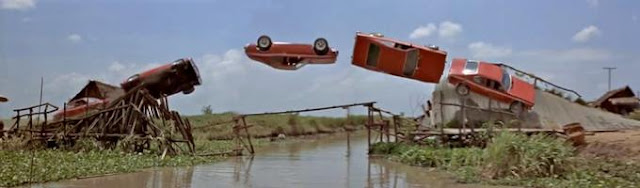
Still, when it leans into the ridiculousness it gets it right. The best part of the film is probably the chase sequence where Bond contrivedly bumps into the yokel sheriff from Live and Let Die, who accompanies him on an extended chase sequence that culminates in Bond's car doing a corkscrew jump across a river and Scaramanga converting his car into an airplane in a secret hangar. Why is the sheriff guy in the movie? I don't know but I came to love it.
Really, its biggest fault is the waste of its villain and its title character. Scaramanga is played by Christopher Lee, and Christopher Lee ought to play a delectable Bond villain... but why cast someone with such an amazing voice and then have him barely speak? Scaramanga is a silent thug for most of the film, and when he finally does get some good dialogue sequences, it's too little, too late.
Other Notes:
This film introduces an MI6 agent named Mary Goodnight. (This is the name of Bond's secretary in the books, but she's never appeared before in the films, what she does usually being merged into Moneypenny.) The film never seems to be able to decide if she's a competent agent or, you know, a woman. She gets trapped in a car trunk trying to bug it; she accidentally triggers the self-destruct of the solar energy facility; she almost kills Bond by bumping a switch with her butt. The Roger Moore films would do somewhat better with women agents in The Spy Who Loved Me and (especially) For Your Eyes Only.
Other genius moments:
Bond tries to get a golden bullet turned into a piece of jewelry out of a woman's navel with his teeth, and inadvertently swallows it, meaning the scene ends with him rushing off to the pharmacy. Can't believe they never got Daniel Craig to do something like that!
Bond is about to sleep with Mary Goodnight when Scaramanga's girlfriend turns up, and Bond needs to sleep with her to get information. So first Goodnight has to pretend to be pillows under the sheets, and then Goodnight must hide in a cupboard for hours while Bond and the woman have sex!
MI6 turns the wreck of the Queen Elizabeth liner in Hong Kong harbor into a base, so a bunch of scenes take place on an askew ship.
For reasons that aren't clear, Bond is at one point dropped into a martial arts school by the villains. What does work is a sequence where two schoolgirls beat up all the martial artists while Bond mostly just stands there.
There is a lot of delightful technical nonsense about the solar energy facility that we got a big kick out of.
Apparently Lee was suggested by Ian Fleming as a candidate to play the villain in Dr. No. How good would that have been!
Quantum of Solace: The Complete James Bond Short Stories by Ian Fleming
Whoever holds the Bond novel rights typically republishes the appropriate Fleming novel when a film adaptation comes out—if one is available. When Quantum of Solace came out, the complication was that "Quantum of Solace" was a short story, not a novel, and that it was already part of the collection For Your Eyes Only. In 2008, Penguin solved this issue by taking both Bond collections, For Your Eyes Only and Octopussy & The Living Daylights, and combining them to make Quantum of Solace: The Complete James Bond Short Stories. I dutifully picked it up even though I had already read all the contents because it featured a new cover by Richey Fahey matching the design of his gorgeous covers for the previous fourteen books... although because Quantum of Solace was only published by Penguin US, and my copies of the previous fourteen were the Penguin UK editions, its height is slightly taller than the other ones, and so it doesn't really match at all. Oh well.
I don't have much to say about this that I didn't about the constituent parts. Fleming was a good short story writer, perhaps a better short story writer than he was a novelist. I read in detail the stories I remembered liking ("From a View to a Kill," "For Your Eyes Only," "Quantum of Solace," "Octopussy," "The Living Daylights"), and liked them again this time around. I didn't waste my own time and only skimmed the ones I remembered not being very into ("Risico," "The Property of a Lady," "007 in New York"). There was one I remembered liking last time but couldn't get into this time ("The Hildebrand Rarity"); I guess because it's kind of complicated and I wasn't in the mood for complicated.
I will dutifully watch the film adaptation (though I am behind; as of this writing I still haven't even watched The Man with the Golden Gun) even though I know it has nothing to do with this book! I wonder what film fans who picked up this edition in 2008 thought. I wonder if it will be mined for more titles. Possibly: I can't imagine "Risico" or "007 in New York" being used, but "The Property of a Lady" seems Bondian enough, though it would have to have a new plot, as that story's essentials were already used on screen in Octopussy.
I read a James Bond book every four months. Next up in sequence: nothing!
This is the last James Bond novel; if I had known it would pick up right from the end of You Only Live Twice, I would have made sure to read it in that order, but oh well.
This isn't Fleming's best work; indeed, having now finished all the novels, I feel pretty certain that he peaked with On Her Majesty's Secret Service, and he should have just stopped there. It would have been a much better final Bond adventure than what came next. Man with the Golden Gun opens okay, with Bond-- after the events of YOLT-- having been brainwashed by the Soviets. But once he's been deprogrammed, he's sent on a mission to Jamaica to kill a thug, which feels way beneath his talents. I think another writer could really do something with this: Bond having to prove to other and himself that he's still the man who he used to be. But Fleming doesn't do that, and this is Just Another Bond Mission.
Fleming always does pretty well with the mechanics of it all: Bond playing detective is good, and Scaramanga is a good villain, and the final action sequence is excellent, and the last line is a sad summation of Bond's character. But the novel has a fatal flaw, which is that Bond could just kill Scaramanga outright early on, and his reason for not doing so is completely unconvincing. Honestly, if Fleming hadn't pointed it out, I might not have noticed it, but he lampshades it, and everything that follows from there is undermined as a result.
I read a James Bond book every four months. Next up in sequence: Quantum of Solace
The woman on this poster represents no actual film character, though.
The Living Daylights brings a new James Bond: my first one in four films. Timothy Dalton would play Bond twice, and for the first time in this marathon, I'll be going through a Bond's films in the order they actually came out. (Though I will watch two other films before getting to License to Kill.) I liked him. My wife said he was very "smiley"; I can't say I noticed that per se, but I did notice that he was more genuinely-- or at least seemingly genuinely-- emotional than Roger Moore's smarmy charm. There were a couple key scenes in this regard for me: one is when he's trying to get Kara Milovy, the villain's girlfriend, to accompany him out of Czechoslovakia. She's a cellist, and insists they need to go back for her cello before leaving the city. Bond forcefully says they don't have the time because the KGB is already on their tail. Smash cut to: Bond loading the cello into the car. I bet Sean Connery wouldn't have done that!
The sequence that really made it stand out to me, though, is one where Bond is accompanying Kara on a day in Vienna. There's a sort of film-romance-style montage of them doing things like going on fun fair rides and Bond winning teddy bears at the shooting gallery and them going on a roller coaster. It's hard for me to imagine any previous Bond doing this, except for George Lazenby. But then Bond's MI6 contact in Vienna is killed-- and he becomes all seriousness and business, snapping at Kara as he tells her what they're doing next. Unlike with some other actors, it's not entirely clear to me which is meant to be the "real" Bond, which I like.
Interestingly, there's really only one "Bond girl" in this one, a far cry from some of the Connery and Moore movies that Bond seemed to sleep his way through. This probably adds to the sense of Dalton's Bond as more genuinely emotional. I liked Maryam d'Abo a lot, as someone out of her depth but game for it all. She sure does ditch her boyfriend for Bond easy, though!
The Living Daylights takes the short story of that title as its jumping-off point. The short story is about Bond facing down a Soviet sniper so he can help a defector cross the Berlin Wall; after a pre-credits sequence, the film opens with a similar set-up, though with a number of changes. While in the story, a KGB sniper uses a cello case to smuggle her sniper rifle, in the film, Kara is a real cellist acting as a sniper in order to trick MI6 into believing a fake defection is real. The film mostly concerns the consequences of that fake defection.
It's decent, a solid mid-tier Bond film. Like the better Roger Moore films, it starts a bit goofy but gets serious as it goes. Near the beginning, there's a chase scene through the snow. I'm a sucker for a Bond ski chase, so at first I was disappointed because there were no skis in sight. But then a bunch of KGB skiers show up... then I was disappointed that Bond wasn't on skis. But then Bond and Kara begin sledding on her cello case while Bond uses the cello itself to steer! Amazing. The later parts of the film, though, get more serious, with Bond helping break up an opium-smuggling operation in Afghanistan. (There are still some moments of levity, though, such as when Bond and Kara use a baggage loader to escape a Soviet airfield.) The progression works well, as does the plot. I called early on that the defection was fake, but it was still enjoyable for Bond to work out the villains' plan and begin to foil it. I especially liked the way Bond actually had to team up with the head of the KGB.
The plot-- as far as these things go-- even feels vaguely plausible. There are no death lasers or space bases. The villains in this one are a Soviet general who wants to become head of the KGB and an American arms dealer. They're okay, and probably the weakest part of the film, but their plans make sense: political aspirations and greed. I did think it was a bit hard to swallow when the film tells us that Bond will feel bad about having to kill the head of the KGB because he doesn't think he's as bad as he's been told! John Rhys-Davies plays General Pushkin, but this development makes more sense when you realize that the part was originally scripted for Walter Gotell as General Gogol, who appeared in seven previous films, and was often portrayed-- most notably in For Your Eyes Only and Octopussy-- as a voice of sanity against those who wanted to escalate the Cold War. (Gotell was sick when The Living Daylights was filmed, and just has a one-scene cameo.)
A lot of Bond films go from place to place seemingly at random, but I felt this one's globe-trotting felt quite natural; Bond gets Kara out of Czechoslovakia to Vienna, then takes her to where her boyfriend is in Tangier, and then both are taken to Afghanistan. It makes things feel big without feeling arbitrary. (In some films it's like, "And the villains ishiding in [rolls dice] a Chinese casino.") Art Malik was good as the Mujahideen leader, though I felt like he was underused.
This is the Wiener Riesenrad, the same Ferris wheel that prominently appears in The Third Man.
The end deflates it a bit: Bond must stop a shipment of opium; initially he plans to blow it up, but then he ends up trapped on the same plane as the opium, so he must defuse the bomb and kill a henchman, and then the plane is crashing, etc.... it all goes on a bit, and then there's a whole second (but smaller) climax, in the style of Octopussy, where Bond then takes down the American arms dealer. I like that the film avoids some of the usual overdramatic Bond perils, but that comes at the cost of a suitably grand climax; once everyone knows the villain plot, it seems like they could really be stopped at Bond's leisure.
But on the whole, like I said, this film was solid, and I enjoyed it. People say License to Kill is Dalton's good one, so I look forward to getting to see it!
Other Notes:
This is the first pre-Daniel Craig film I've see where someone other than Lois Maxwell plays Moneypenny. (She had finally given up the role of the flirty secretary at the age of 58 after A View to a Kill.) Caroline Bliss debuts as her replacement. Moneypenny was (arguably) the last of the recurring Bond characters to be recast, lasting an astounding fourteen films and twenty-three years with one actress.
Virginia Hey, of Farscape fame, appears as Rubavitch, Gogol's mistress. I would not have recognized her! A few of the Roger Moore films gave Gogol a mistress and secretary named Rublevitch or Rubelvitch played by Eva Rueber-Staier; presumably this is the same woman.
John Terry appears as Felix Leiter, the eighth guy I've seen play him in seventeen films. We'll generously dub him "not the worst" but he doesn't make much of an impression as per usual. Give me book Felix any day.