Showing posts with label creator: nicholas briggs. Show all posts

14 February 2025

What Is a Dalek?: Nicholas Briggs's Dalek Empire, Series Three and Four (2004–08)

A couple weeks ago, I wrote up my thoughts on the first two series of Dalek Empire; here are my thoughts on the third and fourth ones. Again, I'm kind of reviewing them, but I'm more interested in thinking through what Daleks "represent" in each of the stories. While in first two series I argued they stood for the "violent sublime," humanity's propensity toward violent conflict, I think Briggs quite smartly does not keep the representations the same, but cannily explores something different every time out.

Dalek Empire III

Series three of Dalek Empire is very different to the first two, in that it jumps millennia into the future. Series two was framed by a couple historians trying to uncover what the "Great Catastrophe" was that ruined the galaxy; series three moves us into the era of those historians, as one of them tries to warn the galaxy about the Daleks... though it is, of course, too late. While series one and two had a main cast of about three characters across four discs, series three is more sprawling, both in terms of the number of cast members, and in the fact that it occupies six discs. Like he often does, Briggs uses a lot of nonlinear storytelling. I don't think the characters here will be as close to my heart as Suz, Alby, and Kalendorf, but I admired the audacity and scope of this a lot. The cliffhanger ending to episode four is genuinely beautiful. Well done, Nick Briggs, on writing, directing, music, and sound design. (And, some actor named David Tennant. Wonder why he never made it big, he was quite good.)

It was the day after the U.S. presidential election, when I listened to episode three, though, I realized what the Daleks represent in Dalek Empire III.

If I was going to be pretentious, what I love most about fiction is a sense of what you might call "epistemic crisis": the world does not work the way you think it does. Your systems for understanding the world are at fault. Obviously this drives mystery stories, honestly a genre I don't partake of very much, but always enjoy when I do. My favorite genre is science fiction, and of course this permeates science fiction; as Jo Walton says, sf stories are mystery stories where the world itself is the mystery. What are the rules then? It's a game I love to play. (I don't like fantasy as much because the game is more arbitrary there.) I don't do a lot of thrillers, but again, when I do, that's why I enjoy them; I love that disconcerting feeling you get in the best of them. Everything you know is wrong. (I've discussed this idea at length in this review of We Have Always Lived in the Castle; am I the first person to ever argue that Shirley Jackson and Nick Briggs are doing something similar?)

The critic George Levine argues that even the realist novel is about epistemology, it's about finding a system you can operate under in the world. He says that practice of realism “suggest(s) how central [...] was the enterprise of knowledge seeking and truth telling, how often plots turn on the power of protagonists to develop the proper temper and state of mind to allow realistic confrontations with the ‘object’—what one might see as the acquisition of the proper ‘method.’” One must figure out how the world works. (This is what I love about Sinclair Lewis's Arrowsmith, of course.)

Throughout Dalek Empire III, there's this ongoing undercurrent of epistemic crisis. The Graxus Rangers find out that they are ultimately disposable, that the society they thought valued their environmentalist efforts in fact didn't value them at all, and is happy to throw them away in the name of expediency. There's a thriller-type quality as they keep being surprised by the way things have shifted politically and they hadn't noticed. Listening to this right after the election, it was impossible not to notice this. The world didn't work they way they thought it did. The Daleks are simply the literalization of this discovery. There's a creeping unease to these sections that really resonated with me.

At the end of Dalek Empire III episode three, we get epistemological crisis upon epistemological crisis. Giorgi Selestru realizes he doesn't have the level of authority he thought he did, as the Galactic Union Council moves against him politically. Galanar turns out to not be a human being. Siy Tarkov's daughter turns out to have been dead all along. Galanar himself finds out that he's been created by the Daleks. The world doesn't work the way you thought it did. Again and again, characters have their assumptions shattered. It would be easy to criticize Nicholas Briggs's out-of-sequence storytelling and layered narration as gimmicky, and certainly there are authors for whom this kind of thing is a gimmick, but just like in the first two series, it is anything but. The whole story is about the shifting, contingent nature of knowledge. How could it be told any other way?

The Daleks are an epistemic rupture made metallic flesh: you are exterminated by your own lack of understanding of the nature of the universe. If only you had understood, might you have survived? But of course you can't. The universe never conforms to our expectations; that's why we need fiction to try to make sense of it all.

I had all these thoughts formulated following the end of episode three. If that had been all there was to Dalek Empire III, I would have been satisfied. Indeed, I might have worried I was projecting a bit. But as I listened to episode six, I only found more evidence for my assertion. Again and again, characters confront the fact that not only don't know what's really going on, there is no way to ever know what's going on. Did Elaria betray the Graxus Wardens to the Daleks? How did the Daleks track down their ship? Did Elaria switch sides and aid the Galactic Union? We don't know and we never will know. The only certainty that Galanar can find is that Siy Tarkov, a man who threw away two decades of his life working to stop the Daleks, will become one himself. Siy Tarkov realizes that humanity will make itself more Dalek-like willingly, it will choose to become fascist. No wonder Galanar becomes homicidal.

At the end, though, Galanar is brought before the Dalek Supreme, and in this conversation—a brilliant, clever exchange, perhaps the best thing Nicholas Briggs has ever written—we realize that the Daleks aren't just a force of epistemic crisis, they are also an embodiment of the futility of attempts to prevent it. Why do Daleks do what they do? Because the universe doesn't work the way they think it does, either. In the Dalek Supreme's last conversation with Galanar, she reveals her own lack of knowledge of how the universe works. Fascism is an attempt to stave off epistemic crisis: by forcing the universe to work the way you think it works.

The only power you can have then, in the face of the Daleks, in the face of epistemic crisis, is acceptance. Not acceptance of what the Daleks, the fascists do, but acceptance of the fact that the universe will surprise you in terrible ways. You can't force it not to, otherwise you will become them.

Dalek Empire: The Fearless

Though Dalek Empire III ends with a lot of unknowns that certainly could be followed up, the fourth series of Dalek Empire totally ignores them—perhaps wisely, given what I wrote above. Would the ending of Dalek Empire III be so effective on a relisten if, when you heard it again, you knew the answers to all of those questions?

In the extras to series two, Briggs had stated his original intention was for series two to be a series of one-offs set during the war. I think this was even his original intention for series three as well. Each time, though, he was persuaded to continue the story and move it forward instead. He finally did move backward with the final series of Dalek Empire, The Fearless, which returns to the time of the first set (it's set during episode three of series one, I think), though it's one big story as opposed to a number of one-offs. We even get an appearance by Suz.

But even if the story moves backward chronologically, it moves forward thematically. If you are first-time listener, do not slot this in chronologically, because episode one of The Fearless picks right up from episode six of Dalek Empire III. In the latter, Siy Tarkov speculates that the only way to  defeat a Dalek is to willingly make yourself more Dalek-like... and that's exactly what humanity is doing in The Fearless, which focuses on a group of Earth Alliance soldiers in dehumanizing power armor, mainly one played by Noel Clarke (Mickey on the tv show) named Salus Kade.

I thought this idea was potentially quite strong, but I found The Fearless the least effective and least interesting of the four Dalek Empire sets. Thematically, at least, I feel like it's a bit too bound in Salus Kade specifically and thus not interested enough in the broader social forces that give rise to something like fascism. Kade's life is horrific, but it's also very specific and unique. Noel Clarke gives it his all, but I think the character as written is a bit one-note, and Clarke doesn't do enough to open him up. (Even though, on the extras, he reveals himself to be a very thoughtful performer.) I did really like Maureen O'Brien (Vicki in the tv show) as the ruthless general.

I like the idea of exploring humanity's tendency to fascism, it's a very obvious use of the Daleks but surprisingly not one we see in a lot of stories, but the story doesn't do enough with the concept. Unfortunately!

31 January 2025

What Is a Dalek?: Nicholas Briggs's Dalek Empire, Series One and Two (2001–03)

Back before Big Finish became a Doctor Who content machine, spin-offs were a rare thing indeed. The very first of them came in 2001, a four-part miniseries called Dalek Empire about a Dalek invasion of the galaxy... with no Doctor around to stop it. Written, directed, sound-designed, and composed by Nicholas Briggs (plus with Daleks and one other character played by him), the series strikes a very different tone to other Big Finish releases; it doesn't just feel like Doctor Who without the Doctor in it as many of Big Finish's later spin-offs have. 

It was successful enough to spawn three further series: Dalek Empire II: Dalek War (2003), an immediate sequel; Dalek Empire III (2004), set thousands of years later; and Dalek Empire: The Fearless (2007-08), an interquel set during the original Dalek Empire. There was also a Doctor Who story where the Doctor met a couple of the main characters, Return of the Daleks (2006), and a Short Trips volume (2006).

I picked the set up in a Humble Bundle sale in 2014... but with my Big Finish backlog, didn't get around to listening to them until late 2024! I'm sorry I waited so long, and here I kind of want to review them, but mostly want to think a little bit about what the Daleks "represent" in each story.

Dalek Empire Series One

As much as I have gone off a lot of Nick Briggs's writing tics at this point, it's interesting how much I enjoy his approach to something like this. I wouldn't say he's a great master of characterization, but I think he does a good job with some archetypes that a set of skilled performers successfully bring to life. The ground-level view here also plays to his strengths a lot. The stuff with Suz and the Daleks is genuinely clever.

As he often did early in his career, I think Briggs make some interesting structural choices; I really like the bait-and-switch about who the narrator is, which totally wrongfooted me. Some comedy aliens with sound effects, so points off for that, but overall this plays to his strengths in that the end is totally about the futility of resistance, which isn't something I want from all or even most of my Doctor Who stories, but does seem to me the exact kind of story the Daleks deserve on their first solo outing. And at the end, we even learn that the Daleks themselves are kind of pointless. A lot of stuff here, Briggs would do again later but worse (e.g., the Cutbert stories), so it's good to hear it done well.

The cast is largely great. I particularly like Gareth Thomas as Kalendorf, though I hope he gets more to do in series two. Sarah Mowat is excellent, she teeters between likeable and unsympathetic perfectly. And the guy who plays Alby Brook manages to make a somewhat stock character come to life.

What I really miss is the early 2000s Big Finish sound design. It's funny that when Briggs became the head honcho, the company largely moved away from this style. I don't know if I have the vocab to support my claims, but it's not doing the "episode of the new show without pictures" style that dominates now, but it has a real tactile feel to it. I miss those clunky Nick Briggs space doors opening and closing! When you listen to a piece of sound design and music by early 2000s Nick, you live it. I much prefer the "moody noise" style of music to the "orchestral warblings" that dominate Big Finish now. All those clunking doors and electronic dings... beautiful!

Even the covers are unique and beautiful; again, a lot of 2020s Big Finish product looks samey, all photoshopped floating heads, but from the moment you pick up the CD (or open up your download, I guess), you know you're in for something different here.

I also miss that early 2000s "Big Finish universe" feel; it's not distracting, but in addition to the ties to the main range Dalek Empire stories, we also get ties to The Sirens of Time (the Knights of Velyshaa) and Sword of Orion (the Garazone sector... complete with the notorious cell phone ring!).

Dalek Empire II: Dalek War

Dalek War is less focused than the original Dalek Empire but I still enjoyed it a lot. Like in a good movie, we actually don't know these characters—Kalendorf, Suz, Alby—very well in the sense that we've only spent a few hours with them, but in actuality you become quite attached to them, which really makes the ending quite effective. Maybe it's because I was an emotional wreck for other reasons at the time, but I teared up a bit at Kal and Suz's final scene in Dalek Empire II. Would not have expected that of a Nick Briggs script, to be honest.

What Is a Dalek?

Surely the best Doctor Who monsters "mean" something beyond the literal. A Sontaran, for example, is over-the-top patriotism and militarism; hardly subtle, but a good Sontaran story does something thematically with this. (Part of the reason they work so well in the Crimean War in Flux, for example.) A Cyberman can represent ideas about transhumanism or conformity—the monster doesn't have to be the same thing in every story.

Daleks are often stand-ins for fascism and/or xenophobia; in the original series, this is probably most clear in their first and last stories, The Daleks and Remembrance of the Daleks. The latter, in particular, makes it very obvious by having the Daleks team up with humans who think England should have allied with the Nazis during World War II!

I spent a lot of the first two series thinking about what the Daleks "mean" for Nick Briggs. Though there are flashes of Daleks-as-fascists here, that's not really his mode. So what is it? The ending drove home that they are humanity's need for conflict, for war (what, if we want to get pretentious, literary theorist Elana Gomel calls "the violent sublime"). The frame story of DE II makes it clear that the Daleks will always be with us, they will always comes back-- just as war always comes back. The flip-flopping of who is on whose side in DE II shows that someone will always be fighting someone else, and Kalendorf's story in particular shows that if he wasn't fighting the Daleks, he would be fighting someone. The Daleks always return, because humanity always returns to violence. It's bleak, but hey, it's Nick Briggs writing a universe (essentially) without the Doctor, of course it's bleak.

24 January 2024

Doctor Who: Dalek Empire by Nicholas Briggs (ed.)

Doctor Who: Short Trips #19: Dalek Empire
edited by Nicholas Briggs with Simon Guerrier

Dalek Empire is a 2001-08 audio spin-off series from Big Finish (its first, actually, I believe), chronicling a Dalek invasion of the galaxy, focusing on the humans caught up in it when the Doctor's not around to save anyone. I picked it up in a sale a few years ago, but have never actually gotten around to listening to it; there is always too much new Big Finish to listen to first! The range engendered a tie-in of its own, the sixteenth volume of Big Finish's Short Trips series of anthologies, which was released between the third and fourth series.

Published: 2006
Acquired: July 2008
Read: December 2023

I haven't heard Dalek Empire, but I know the broad outlines of the plot; probably there's stuff here I'd get better having heard it, but I felt okay for the most part. Most of the stories here fall into two buckets. The first is made up of character studies of Dalek Empire's three human leads: "Kalendorf" by Nicholas Briggs and "Alby" and "Suz" by Sharon Gosling. "Kalendorf" takes place at the very beginning of the series, during the initial Dalek assault, while "Alby" and "Suz" take place later on, delving into the thoughts of those characters. They were all decent stories (I liked the horror of the Daleks in "Kalendorf") best, but also the ones that I suspect would most benefit from actually having heard the series.

Most of the rest of the stories are side stories to the Dalek invasion of the Milky Way, many of them including the Doctor in some capacity. But in these stories, he doesn't go around defeating dastardly plans; because the events of Dalek Empire already proceed without him, they're kind of what you might call "future historicals," featuring the Doctor on the fringes of future history, helping the little people, but not making any significant changes. My favorites among these included Ian Farrington's "Hide and Seek," where the third Doctor and Jo help a group of refugees evacuate; Farrington captures the Doctor and Jo particularly well.

The best of them as definitely Joseph Lidster's "Natalie's Diary," which is about a young woman named Natalie trying to stay alive during the Dalek assault on her planet, aided by the seventh Doctor, Ace, and Hex. As usual for Lidster, the strength of the story is in its characterization, as Natalie slowly discovers the hardness of the world she has come into. Ace and Hex aren't focal characters, but are deftly drawn, recalling one of Big Finish's best runs. The story is framed by a history student reading Natalie's diaries sometime later, which I think is set during the events of Dalek Empire III (when the Daleks return). The other ones are fine enough, though I found Ian Farrington's "Private Investigations" and Justin Richards's "Mutually Assured Survival" kind of pointless and dull.

There are two stories that break from this format. One is Simon Guerrier's "The Eighth Wonder of the World," which isn't a Dalek Empire tie-in at all, but a follow-up to the first Doctor serial The Daleks' Master Plan, featuring the sixth Doctor and Evelyn investigating what happened to a Dalek left behind in ancient Egypt during that adventure. Guerrier does his usual clever and interesting work, but it feels too fanciful in this context; Dalek Empire just isn't this kind of Dalek story.

The other is the volume's definitely standout, "Museum Peace" by James Swallow. Long after the events of Dalek Empire II: Dalek War, Kalendorf is retired and visiting a museum devoted to the Dalek War, contemplating how time has moved on. The Doctor is there, too (who he already knows; more on that in a minute), in his eighth incarnation, contemplating some terrible action against the Daleks. It's a deftly written, powerful story about grief and anger and moving on. Clearly when it was written, Swallow intended the eighth Doctor to be thinking about obliterating the Daleks, though subsequent revelations in "The Day of the Doctor" mean that can't be the case. But it holds up regardless—you can imagine the Doctor is at some terrible low during the Time War. (Or, in a very tenuous pet theory of mine, it takes place between To the Death and Dark Eyes, with the Doctor driven to despair.)

The book also includes the script for The Return of the Daleks, a 2006 audio drama that crossed the seventh Doctor into the events of Dalek Empire, as well as a sequel to the tv story Planet of the Daleks. (Hence, how Kalendorf knows the Doctor.) It wasn't a particularly great audio (I have actually heard it; it was a freebie for subscribers to Big Finish's main Doctor Who range), and reading a script is honestly never really that interesting. It feels like it's there to pad the book out—a whole forty pages! Given how many authors contribute two stories, one wonders if the volume was put together in a hurry.

(Despite the cover, the first, second, fourth, and fifth Doctors do not appear in this book.)

Every three months, I read the unread Doctor Who book I've owned the longest. Next up in sequence: Short Trips: The Quality of Leadership

25 May 2022

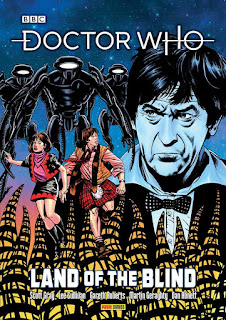
Land of the Blind (From Stockbridge to Segonus: A Doctor Who Magazine Comics Marathon, Part 23)

Land of the Blind: Collected Comic Strips from the pages of Doctor Who Magazine
by Warwick Scott Gray, Lee Sullivan, Gareth Roberts, Martin Geraghty, Dan Abnett, et al.

Collection published: 2018
Contents originally published: 1993-95
Acquired: December 2018
Read: January 2022

I think at the time, this surely must have been an abrupt transition. From the dangerous and moody seventh Doctor in #211, straight into the fourth Doctor and Romana gadding about in #212. Ace and Bernice are gone without a word; the strip of course has had to write out TV companions before (i.e., Peri) but usually at least says something about it. We get nothing like that this time. For me, though, it reads a little less abruptly because of where I included The Age of Chaos, which caps off the VNA era with The Last Word and eases us into the "past Doctor" stuff with Under Pressure and The Age of Chaos itself; plus, in publication order, Bringer of Darkness opens this volume, which is sort of a second Doctor story in a seventh Doctor style, giving another transitional point.

Unfortunately, the backmatter doesn't include anything from Gary Russell, who was strip editor at the time, and thus the one responsible for the sudden, unprecedented change in the DWM comics format. No longer is the strip one ongoing story; it's now a nostalgia tour. Thankfully, Gareth Roberts does explain a bit in his notes on The Lunar Strangers: there was no longer a television programme to follow, and so the mag became a celebration of Doctor Who's history, driven in part by the VHS range, which randomly dipped into the show's history, "So he was going to follow a similarly randomised pattern in DWM." I'm not sure this would have been my choice, but it has a good logic behind it.

First, it makes sense to uncouple from the NAs: why should one range of tie-ins be beholden to another, when the other clearly doesn't care about this one? Had the strip kept following the books, Ace would have had to disappear again around the time of #223, and then two new companions would have appeared out of nowhere in #227. But if you're going to uncouple, it makes sense to do so in a strong, distinctive way: continuing to do seventh Doctor adventures, just without Benny and "Spacefleet" Ace I think would have raised questions as to why the strip wasn't consistent with the NAs (a range the mag promoted every month with the preludes!) if it was featuring the same characters. Going into the show's past gives a clear reason for the strip to be unconnected to the novels, even if I don't like the loss of the strip's ongoing nature.

from Doctor Who Magazine Summer Special 1993
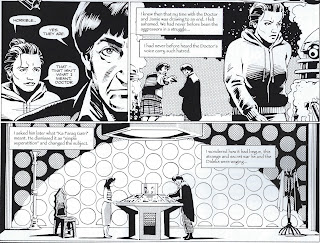
Bringer of Darkness, from Doctor Who Magazine Summer Special 1993
written by Warwick Gray, art by Martin Geraghty
This is a neat little story, very effectively done. We begin our "past Doctor" adventures with the second Doctor, Jamie, and Victoria, and the story follows on from The Evil of the Daleks in having the Doctor investigate if he really did kill off all the Daleks or if he needs to finish the job, and in examining Victoria's emotional reactions to the Daleks, who killed her father; Victoria narrates the story in retrospect from some time shortly after she leaves the TARDIS. Add the dark, moody art of Martin Geraghty, and it all works rather well: a story with some darkness, but also some emotional depth, and it does a neat job of foreshadowing the NAs in a plausible, interesting way. (This came out during Emperor of the Daleks!, so arguably at the height of DWM's VNA era.)
from Doctor Who Magazine #212
Victims, from Doctor Who Magazine #212-14 (May-July 1994)
story by Dan Abnett, art by Colin Andrew, letters by Enid Orc
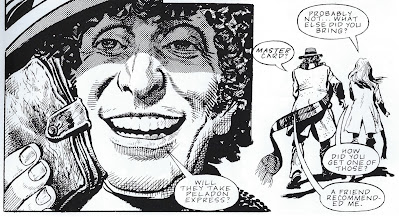
The fourth Doctor and second Romana investigate murders on a world known for its high fashion. The best part of this is the repartee between the Doctor and Romana; Abnett captures season 17 perfectly in that regard. No, strike that; the best part is the joke about the Doctor trying on Colin Baker's coat, which made me laugh out loud. The story is a bit darker than a real season 17 story, which works; what works less well is that it's kind of a mystery... but it has exactly one suspect, who turns out to have done it. I felt like it fizzled out by the end despite a strong start. Colin Andrew does a reasonable Tom Baker, but his Lalla Ward likeness is very inconsistent; if you're going to go for this retro/nostalgia approach, though, I think you need artists who are good at likenesses.
from Doctor Who Magazine #215
The Lunar Strangers, from Doctor Who Magazine #215-17 (Aug.-Sept. 1994)
script by Gareth Roberts, art by Martin Geraghty, letters by Elitta Fell
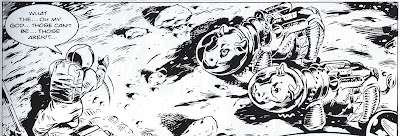
The very first page of this one is genius, stuff only the DWM comic could do: cows in spacesuits on the moon. Nothing else here quite lives up to that. The evil space cows' evil plan didn't strike me as wholly plausible, even by the standards of reading about the plans of evil space cows, and I didn't buy the human base administrator's actions either; it turns out she's been pretending, but 1) a good fake-out needs to be plausible, and 2) if she was suspicious, she could have just locked up the evil space cows and every subsequent problem would have been avoided! Gareth Roberts does capture the voices of the fifth Doctor, Tegan, and Turlough well, though, and Martin Geraghty draws a good evil space cow, even if I struggled to distinguish the two.
from Doctor Who Magazine #218
Food for Thought, from Doctor Who Magazine #218-20 (Oct.-Dec. 1994)
script by Nick Briggs, art by Colin Andrew, letters by Elitta Fell and Warwick Gray
In his notes, Nicholas Briggs says this wasn't his first comic strip, but it was his last. We can be thankful for this, I guess, because it feels like a first attempt, full of awkward, confusing transitions and unclear action, though perhaps a good artist could have saved the script somewhat. At least Briggs correctly notes that the characterization for Polly is downright awful.
Change of Mind, from Doctor Who Magazine #221-23 (Jan.-Mar. 1995)
story by Kate Orman, art by Barrie Mitchell, letters by Warwick Gray and Elitta Fell
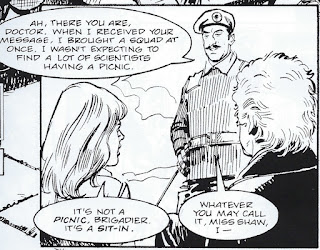
This third Doctor and Liz Shaw story is, I believe, Kate Orman's only comics work, though I gather one of the characters here recurs from her novels. She has a good handle on Liz; the throughline of the Doctor trying to figure out why Liz left (this is set some time later) works very well. It has some good set pieces, such as where the Doctor and Liz use a sit-in to distract the villain, and the climax. Unfortunately, there are two mysterious men in long coats, and as Orman herself points out, some sequences are hard to follow the action of.
from Doctor Who Magazine #223
This leads me on to a different point: there are three different writers in this volume who were new to comics (essentially, as far as I can tell) in Roberts, Briggs, and Orman; contrast this against Dan Abnett, by this point highly experienced, and Warwick Scott Gray, gradually amassing a body of quality DWM work. For most of its run, the strip has been written by experienced comics writers from outside the Doctor Who world, but that's been slowly changing since the late 1980s. We've seen fan writers with little comics experience come aboard before, of course (e.g., Paul Cornell, Marc Platt), but this is the first volume where I've read a couple strips and thought to myself that the writers were clearly inexperienced comics writers. Orman mentions making mistakes of the medium: but addressing this kind of mistake the exact thing an editor ought to have been on top of! My inference would be that, say, John Freeman and Richard Starkings knew how to nurture a new comics writer in a way that Gary Russell does not. Which, if you've read any of Gary Russell's comics work, is entirely to be expected.
from Doctor Who Magazine #225
Land of the Blind, from Doctor Who Magazine #224-26 (Apr.-June 1995)
story by W. Scott Gray, art by Lee Sullivan, letters by Elitta Fell
Thankfully, the volume closes out as strongly as it opens, with another well put together second Doctor story (this time with Jamie and Zoe) from Scott Gray, now paired with Lee Sullivan. This is a clever, inventive story about a city cut off from the outside universe, with some neat turns, good villains, and one really good joke. You could have stuck this in the Dave Gibbons era and no one would have batted an eye: not crazy ambitious, but the exact kind of thing the strip ought to be doing. I breezed through it in the best of ways.
Stray Observations:
  • Surely the story should have been called Fashion Victims. It's so obvious it boggles my mind that it's not.
  • After a pretty substantial run on the writing roster, Dan Abnett finally exits the Doctor Who Magazine comic strip. It's not his final Doctor Who work; he also wrote a couple Big Finish audio dramas and the Christmas novel The Silent Stars Go by. He has also been a pretty prolific writer in American comics. My favorite comics work by him is the excellent Legion Lost, but he's also the kind of writer who will reliably churn out tie-in issues to crappy "events," so I've actually read quite a lot by him, with things like Flashpoint and Convergence. Oh, and he also invented something called "Guardians of the Galaxy"!
  • Enid Orc has got to be a pseudonym, yes? But for who...
  • I always like to imagine what my hypothetical knows-Doctor Who-only-from-the-comics reader is thinking. In this volume, it's "Who the heck are Romana, Tegan, and Turlough? Where are Sharon and Gus?"
  • It is not clear to me what comics Nicholas Briggs has written other than Food for Thought; not Doctor Who ones at any rate. You may have heard of him, though, for going on to voice the Daleks on tv, and for writing a couple Big Finish audio dramas. (I have 79 releases written or co-written by him, according to iTunes!)
  • A hard-bitten space freighter captain going, "I ain't waitin' up here to get what's due! I don't care what the hell's goin' on down there! We're goin' in now, or we'll frazz the atmosphere!" (about which another character thinks "...hell's going on down there...") is surely one of the most Nick Briggs pieces of dialogue to ever Nick Briggs. I'm sure he put his heart and soul into it.
  • How do they decide who gets cover credit on these collections, anyway? Poor Colin Andrew contributes to more strips than anyone else in this volume (he draws six of them) but is shut out by Scott Gray (writes four), Lee Sullivan (draws three), Gareth Roberts (draws three), Martin Geraghty (draws four), and Dan Abnett (writes three). Well, I'm sure it's about who is famous, either to comicdom at large, or to Who fans, but it does seem unfair.

This post is the twenty-third in a series about the Doctor Who Magazine comic strip and Marvel UK. The next installment covers Ground Zero. Previous installments are listed below:

  1. The Iron Legion
  2. Dragon's Claw 
  3. The Transformers Classics UK, Volume One
  4. The Tides of Time
  5. The Transformers Classics UK, Volume Two
  6. Voyager
  7. The Transformers Classics UK, Volume Three
  8. The World Shapers
  9. The Transformers Classics UK, Volume Four
  10. The Age of Chaos
  11. The Transformers Classics UK, Volume Five
  12. A Cold Day in Hell!
  13. Death's Head: Freelance Peacekeeping Agent (part 1)
  14. Nemesis of the Daleks
  15. Death's Head: Freelance Peacekeeping Agent (part 2)
  16. The Good Soldier
  17. The Incomplete Death's Head
  18. Evening's Empire
  19. The Daleks
  20. Emperor of the Daleks
  21. The Sleeze Brothers File
  22. The Age of Chaos

26 September 2012

Audio Catchup: Doctor Who: The New Fourth Doctor Adventures, Season One

I can't be bothered to do elaborate posts for what are essentially links, so here are all of the releases in the fourth Doctor's first-ever season of adventures for Big Finish Productions, which I've worked my way through over the last three months:
I'll excerpt my summative comment from the final one:
I’d like to take a step back for a moment and talk about this first season of the “New Fourth Doctor Adventures” as a whole, now that it’s come to an end. I was initially turned off by Big Finish’s marketing for it, since it was primarily nostalgia-based; I have no particular affection for Tom Baker over any other Doctor, and “Saturday night tea time in 1977” is an event I’ve literally never experienced. Destination: Nerva felt like it confirmed all my worst suspicions, but I found The Renaissance Man and The Wrath of the Iceni both very enjoyable — though Energy of the Dalekswas a big, big low point.

The consistent strength of this season, though, has been Tom Baker and Louise Jameson. I mean, I knew they were good on television, but it’s easy to get complacent with that sort of thing; even in Energy of the Daleks, they’ve never done less than give the Doctor and Leela their all. Every word that comes out of either character’s mouth is a joy to listen to, and that’s no small feat. The writing helps, too, of course: though Leela is a great character, one often felt that Louise Jameson made her so by overcoming scripts that didn’t serve her well. Justin Richards, John Dorney, Alan Barnes, and even Nicholas Briggs have really played to her strengths in a way one more usually associates with a “modern” companion like Charley or Evelyn, and she’s been all the better for it.

So, to my surprise, I find myself actively looking forward to the second season of the New Fourth Doctor Adventures. Tom Baker in action again, Mary Tamm back as Romana, Jonathan Morris penning a Wodehouse pastiche, John Leeson back as K-9, David Warner appearing in multiple episodes, and Nicholas Briggs writing 50 percent of the stories. What’s not to look forward to? (Don’t answer that.)

28 August 2012

Review: Doctor Who Storybook 2007 edited by Clayton Hickman

Hardcover, 76 pages
Published 2006
Acquired August 2011

Read June 2012
Doctor Who Storybook 2007
edited by Clayton Hickman

I picked this book up because my wife and I had just listened to Patient Zero and Blue Forgotten Planet, two Big Finish appearances of the Viyrans, and she was curious about them; the story "No One Died" by Nicholas Briggs contains their only appearance in prose. It's an okay story-- there are some good ideas, but the resolution obnoxiously leaves a central mystery dangling!

The rest of the stories are fine: there are no particular standouts, positive or negative. Part of the problem stems, I think, from the fact that most of the writers try to tell a "typical" Doctor Who story in a few pages, not reworking the format to the shorter length as the Short Trips usually do. Still, some are fun, such as Gareth Roberts's "The Cat Came Back," about a strange civilization discovered by the Doctor and Rose. (Martin Geraghty's illustrations are great.) Robert Shearman's "Untitled" has some good ideas-- a picture coming to life-- but the best part of it are the Brian Williamson illustrations it engenders.

I did find Justin Richards's "Gravestone House" sacrificed logic for poorly done "scares," and Jonathan Morris's comic strip "Opera of Doom" is kinda disappointing as well.

On the other hand, Steven Moffat's "Corner of the Eye"-- told in the form of an implausibly detailed instant messenger conversation-- is hella creepy.