Showing posts with label topic: hugos 2020. Show all posts

16 February 2024

How Often Do I Agree with the Hugo Electorate?

In my recent post comparing my final ballot to the winners of the 2023 Hugo Awards, I noted that my first place choice and the actual final winner were the same in four of the nine categories in which I vote. I then speculated, "I think this is a record."

But was it a record? Good question! I trawled backward through my old posts to see how often the broader Hugo electorate had made the right choice (i.e., my choice).

Here's how many categories my first-place choice and the voters' has coincided in each year:

  • 2017: 4 (Novelette / Short Story / Related Work / Dramatic Long)
  • 2018: 1 (Short Story)
  • 2019: 1 (Dramatic Long)
  • 2020: 1 (Novel)
  • 2021: 4 (Short Story / Related Work / Dramatic Short / Lodestar)
  • 2022: 1 (Lodestar)
  • 2023: 4 (Novel / Short Story / Related Work / Dramatic Long)

Far from being a record, four matches is my second most common result! I had not realized that my distribution was so sharply bimodal; either I agree in one category or four. Never zero, two, or three!

I then wondered how I did more broadly. To figure this out, I looked at whatever I ranked first and then averaged where it ranked in the final results. That is to say, if my picks for first came in fifth, sixth, first, first, sixth, first, first, and second, that would average out to 2.9. A lower score is better; thus on this graph, I've flipped things around.


You'll see that 2023 actually is a record at 2.3; I've never been so consistently in agreement with the other voters. My low point was 2019; I don't know what was wrong with everyone else. 

I am not sure what we can infer from this: it may be that in years where I match up well, there's a weak finalist pool and thus only one obvious winner for me and everyone else.

Having compiled this data, it was then easy to also figure out what was the category where my tastes are most often aligned with the broader electorate's:

I didn't find anything too surprising here. Dramatic Long usually has one very good choice and a bunch of Marvel movies, so I am not surprised to see I usually line up well here. I have picked the eventual first-place winner three out of seven times.

Two categories do much worse on a regular basis. I have never picked a first-place winner in Graphic Story; indeed, one time my first-place pick finished in second, and all other times fourth or sixth. But it is a category usually made up of a bad set of finalists (in my opinion), and one where my tastes clearly do not line up with others' at all. Novella fares even worse, with my first-place pick coming in fifth on average. I have never picked the winner, and my pick for the winner has come in sixth three times and in seventh once! (In 2019, I liked the set of finalists so little that I voted No Award in first.) Though apparently me and the voters do pretty well for Short Story,* when it comes to novella-length fiction, we just do not get on.

Which is to say, the electorate loves Tordotcom novellas and I do not.

* My first-place choice has come in first four out of seven times, actually, which is my best result for any category, but this is counterbalanced by my first-place choices coming in fourth, seventh, and fifth in the three other years.

05 October 2020

Hugos 2020: Exhalation: Stories by Ted Chiang

Collection first published: 2019
Contents originally published: 2005-19
Acquired: May 2020
Read: August 2020

Exhalation by Ted Chiang

I picked this up for my Hugo reading, since two of its stories ended up on the Hugo ballot; once Hugo voting was closed, I circled back and read all the other stories. Other than Arrival and "Story of Your Life," this was my first exposure to his work. At his best, Chiang hits that doubling effect of science fiction I love so much: he build other worlds based on scientific ideas, and his ideas serve as metaphors about our world. Chiang tends toward the hard sf end of the spectrum, which is to say that his ideas are put forth in great detail. I don't know if the science is real but it feels real, and Chiang keeps explaining it interesting, usually by paralleling it with the human impact of the technology.

Stories that really worked in this way including "The Truth of Fact, the Truth of Feeling," about how writing reshaped our cognition, and about how memory retrieval is likely to do so again; I really liked his point that memory technologies will do for individual people what writing did on a societal scale. (As I was reading the story, I thought, "someone knows his Walter Ong," and then I got to "story notes"... and yes he does!) I also really liked "Anxiety Is the Dizziness of Freedom," about branching timelines. It's clearly a grounded, realistic take on the idea, and in being so, does some really interesting stuff that I've never seen before in sf.

The more middling stories don't quite thread this needle. I thought "The Merchant and the Alchemists' Gate" (a take on how a time machine would "actually" work) was intellectually interesting, but it didn't have the emotional impact of Chiang at his best; similar thoughts were spurred by "Omphalos."

Chiang seems to be at his weakest when in short-short mode; all the stories I liked least were ones that explored an idea but didn't really support it with character or thematic work. Thus you lose the doubling effect of the best sf: I liked the weird other worlds, but I want to see the connection to our world. I felt the title story fell into this trap, as did "What's Expected of Us" (I didn't even remember what this one was about until I flipped back through it to write this review) and "Dacey's Patent Automatic Nanny" (about a Victorian who makes a mechanical child-rearer, it's told in the form of a museum guidebook, which keeps you rather distant from the actual events, and as a Victorianist, I didn't think the period details rang true; it felt like someone's stereotypes of the era). I think Chiang actually did pull off the form in "The Great Silence," a cute story about the parrots who live near the Arecibo Observatory.

My favorite story in the book was "The Lifecycle of Software Objects," about a group of people "raising" AIs in a computer environment. I really appreciated its accurate depiction of AI; ever since I read Gödel, Escher, Bach, it's seemed unlikely to me that AI would spring into the world fully sapient. Any truly emergent system would have to be taught just like human have to be taught. It's a really neat look at how that process might go, and how difficult it might be, and how external factors might influence it-- and it's also a really moving depiction of the difficulties of parenting and figuring out when to let someone be autonomous. An incredible piece of sf writing that does what only sf can do at its best.

14 August 2020

The 2020 Hugo Awards: Interesting Statistics


I called my post from last week "Results and Final Thoughts"... but after it went up, I had another thought. So that title was a lie! Many people out there analyze various aspects of the results, but I want to look at two things: how many people vote in each category, and how many people vote No Award.

First here are the categories ranked in terms of how many ballots were received:

So you'll see that the prose fiction categories pull in the most ballots typically, and the fan activity categories the least. I do think it's interesting that Best Novel (won by A Memory Called Empire) does the best of all the prose fiction categories, and Best Short Story (won by "As the Last I May Know") the worst (except for the Lodestar, won by Catfishing on CatNet), even though reading six short stories is the least amount of work! Best Series (won by The Expanse) gets a lot of votes, which makes me think people are voting based on their general knowledge of the series rather than, say, diligently reading all of Emma Newman's Planetfall books.

You'll also see that the "body of work" categories (those that go to a person, not a specific item), like Best Professional Artist (won by John Picacio), Best Editor (won by Ellen Datlow and Navah Wolfe), and so on, all languish pretty far down, with Best Fanzine (won by The Book Smugglers) coming in lowest of all categories, getting just a third of the ballots of Best Novel. The Best Novel Hugo is the one that has all the prestige attached to it, and that clearly leads to it garnering the most fan ballots, too. Best Dramatic Presentation (won by Good Omens and The Good Place) is probably the least amount of work to cover (I had seen three of the six nominees in Long Form beforehand, for example), which probably helps it.

Next, here are all the categories ranked in terms of how many ballots ranked No Award in first place:

Voting No Award in first place usually means one of two things, I would claim. First, it could mean that you find the concept of the category invalid. Every year, I vote No Award for Best Series, Best Editor, and a couple other categories, for example, and leave the rest of my ballot blank. I have some fundamental disagreements with the premises of those categories, and do not think they should be awarded. (Very few Hugo voters agree with me, though, clearly.) It could also mean that you just found everything in that category subpar: this year I voted No Award for Best Short Story, but still ranked finalists below it.

We might guess that Hugo voters agreed with me about Best Short Story, for example, as it had the highest level of first-place No Award votes of any prose fiction category. On the other hand, Best Novella (won by This Is How You Lose the Time War) had the least, indicating a category where every voter but seventeen felt comfortable saying one of the six finalists deserved to win.

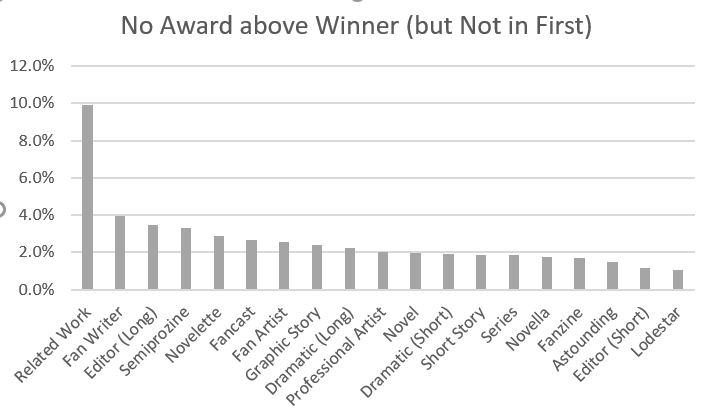
One interesting piece of information given on the results is how many ballots ranked No Award above the eventual winner. This could mean 1) the ballot just No Awarded the entire category, as I did Best Series and Best Short Story, or it could mean that 2) on that voter's ballot, No Award was placed higher than the winner, as was true for me in Best Related Work, where I had No Award in 6th, and the actual winner in 7th (Ng's acceptance speech for the 2019 Campbell Award). (This is reported because if a certain number of ballots include No Award above the winner, No Award wins, even if it doesn't on the normal counting method. I don't think this has ever actually come to pass.)

So here are all the categories ranked in terms of how many ballots had No Award ranked above the eventual winner:

What this lets us see is particularly controversial winners. For example, we can tell that though Ng's 2019 speech won Best Related Work, over 10% of voters thought (like me) that they'd rather see nothing win than see it win. Best Short Story still ranks highest on this list of all the prose fiction categories, too, potentially indicating a weak set of finalists. (To the extent that we can call a set of finalists 5% of voters objected to weak!)

We can highlight controversial winners even more by subtracting the number of people who ranked No Award first from the number of people who ranked it above the winner. So this shows how many ballots had No Award in 2nd place or lower, but above the winner:

What this reveals, I would argue, is how many voters believed a category had some basic level of validity (so they didn't put No Award first for whatever reason), but didn't like what actually ended up winning. You'll see that Best Related Work sticks out very prominently by this metric-- almost 10% of voters in that category didn't think the category was bad per se, just the work that won it. In this new metric, the most prominent prose fiction category actually becomes Best Novelette, indicating that N. K. Jemisin's Emergency Skin was arguably a controversial winner. (I didn't rank it below No Award, but I did think it a weak finalist.) Best Fanzine, which was really high on the last list, drops very low, showing that many people are against the category as a whole, but those who did vote in it largely thought the eventual winner a worthy one. And I guess everyone just loved Catfishing on CatNet!

There's one other statistic I want to explore, but I'm not sure if it even represents a real thing. Is there a correlation between how many people vote in a category, and how many first-place No Award votes it receives? Without looking at the data, you might expect a positive correlation: the bigger a category, the more people vote No Award, so a consistent-ish percentage. But in fact, there is an inverse correlation: the bigger a category, the fewer people vote No Award.

One explanation I came up with was perhaps there's just a dedicated core group of No Award voters? So say there are thirty Hugo voters who like using No Award a lot. They would be a bigger percentage of a category with 700 ballots received (4%) than one with 1,800 ballots received (1.5%). But if you look at absolute numbers, there's still a trend, just not as clear of one:

(I think; I'm not statistician, obviously.) The bigger the category, the fewer No Award votes it received. I'm not sure what to make of this fact. Does it indicate that the bigger categories are bigger for a reason, i.e., people view them as more legitimate? What I find particularly interesting, though, is the two outliers: there are just two categories where the number of No Award votes is significantly higher than we would expect based on category size. One is Best Short Story, which I've discussed a couple times already as an outlier, but the other is Best Series (won by The Expanse). I mentioned above that I always No Award this category because I don't believe it's a good idea; for whatever reason, a disproportionate number of other voters are also voting No Award here.

I'd be curious to know if the supposed trend I've identified here actually is a trend. Perhaps in a future post I'll look at the use of No Award in previous Hugo years to see if anything similar emerges.

07 August 2020

The 2020 Hugo Awards: Results and Final Thoughts

The timing of this year's Hugo ceremony was such that I couldn't watch the livestream: 7pm Eastern time overlaps too much with my toddler's bedtime routine! By all accounts, it sounds like I made the right call in any case, given that the ceremony ran over three hours instead of the usual two-ish. One would have thought that pre-recording most of the ceremony (as has to be done in "these unprecedented times") would have made it easier to keep the ceremony to time, not harder. Have Worldcon chairs ever had to apologize for their Hugo ceremony before? Between this and last year's Hugo losers' party fiasco, it seems like George R.R. Martin might be more trouble than he's worth as an ambassador for the World Science Fiction Society.

Also if you want a cool visual representation of how ranked choice voting works, I recommend this thread on Twitter by someone named Martin P.

So what did I think of the results, and how did they compare to my own votes? Just some brief thoughts here:

Category What Won Where I Ranked It What I Ranked #1 Where It Placed
Best Novel A Memory Called Empire 1st A Memory Called Empire 1st
I believe this is the first time in my four years of voting where the thing I voted into first place for Best Novel came first! (It was the only such category this year.) So naturally I am pleased because my favorite won, and also pleased because I called it: "My guess is that Memory Called Empire will win; it has the slightly-literary-and-set-in-space-but-not-too-weird tone that I think appeals to Hugo voters." I had been surprised and disappointed that Ann Leckie's Raven Tower wasn't on the ballot, since I wanted an excuse to read it; it turns out that it did have enough votes to make the ballot, but Leckie declined nomination, allowing The City in the Middle of the Night (which I ranked second but came in fifth) on.

Best Novella This Is How You Lose the Time War 3rd The Deep 6th
I enjoyed this; as I said in my ballot post, I would have happily seen anything in my top three in this category win, and I predicted that either it or Ted Chiang's "Anxiety Is the Dizziness of Freedom" would win. Chiang came in fifth, though, so I'm not such a savant! I am bummed but not surprised that The Deep languished down in sixth.

Best Novelette Emergency Skin 4th "For He Can Creep" 4th
I am both surprised and not surprised by this outcome. Surprised because Emergency Skin was not great; not surprised because Hugo votes love rewarding people who already won Hugos with more of them for substandard work. This was a weak category this year, though, so I find it hard to get worked up about it. (The work I placed sixth did come in sixth, though, so I wasn't the only one who found it obscure.)

Best Short Story "As the Last I May Know" 7th No Award --
In my notes on the winner, I wrote, "it is overall banal and obvious and unaffecting, and I am surprised it was published, much less nominated for a Hugo." Well, now I have to revise that to "much less won a Hugo"! Clearly I am out of step on this category, which I No Awarded because nothing really struck me as award-worthy. I look forward to reading Clarke's Best Science Fiction of the Year for 2019 and seeing if he found more worthy short fiction than the Hugo nominators.

Best Related Work 2019 John W. Campbell Award Acceptance Speech 7th The Pleasant Profession of Robert A. Heinlein 5th
One of my Hugo pet peeves is when Worldcon members award something that happened at Worldcon, but it clearly is not a pet peeve of the wider membership. I do find it funny that there's a group of people (mostly on Twitter) who complain that WSFS is full of sexist racist dinosaurs. Perhaps it is... but who do they think is voting for Hugo Awards for things like this and AO3, other than WSFS members? The Heinlein book deserved better, but judging by this and last year, nuanced discussions of Golden Age sf figures are clearly out of fashion.

Best Graphic Story or Comic LaGuardia: A Very Modern Story of Immigration 3rd Paper Girls 6 4th
This category should be cancelled, in my opinion. Hugo voters have a strong preference for mediocre comics written by people who have won Hugos for prose work, and by and large, the best in contemporary sf comics is not making the ballot, and when it does make the ballot, not winning. The longlist shows, for example, that two different Seanan McGuire comics ranked eighth and eleventh, and I refuse to believe Spider-Gwen and Nightcrawler were among the form's best work for 2019. Thank God we were spared Questionable Content, inexplicably down in thirteenth!

Best Dramatic Presentation (Long Form) Good Omens 6th Russian Doll Season One
3rd
Of course.

Best Dramatic Presentation (Short Form) The Good Place: "The Answer"
2nd Watchmen: "This Extraordinary Being" 5th
Somehow the good Watchmen episode on the ballot came in fifth, and the bad one second. But the Hugo voters did agree with me that the 2019 Doctor Who New Year's special deserved to come in last.

Lodestar Award for Best Young Adult Book Catfishing on CatNet 3rd Riverland 4th
Catfishing was one of three books I thought might win this category, because Hugo voters love rewarding previous winners, and Catfishing was a sequel to a Hugo-winning short story. I also knew it wouldn't be Riverland, and indeed, it languished down in fourth. Minor Mage had a nice second place showing, at least. I do feel that anyone looking to the Lodestar as a guide for the best in YASF is going to find a very eclectic bunch.

As always the reading experience was a bit of a mixed bag; Gideon the Ninth (which I ranked sixth for Best Novel but came in third) nearly made my whole reading process stall out before it even began! But I did get to read and watch some great stuff I wouldn't have gotten around to for a long time, if ever: Russian Doll, both stories from Exhalation, "For He Can Creep," This Is How You Lose the Time War, The Deep, The Light Brigade, The City in the Middle of the Night, A Memory Called Empire, Becoming Superman, The Pleasant Profession of Robert A. Heinlein, Minor Mage, Riverland. I was pretty disappointed in short fiction this year, but at least all that is, well, short. Much worse to slog through a bunch of bad novels, as I have done in years past!

24 July 2020

My 2020 Hugo Awards Ballot: Visual Categories

Here is my final set of Hugo reviews for 2020, covering the two dramatic presentation categories, and the (now cumbersomely titled) Best Graphic Story or Comic. Links, as always, are to longer reviews when I have written such a thing.

Best Dramatic Presentation (Long Form)


6. Good Omens, written by Neil Gaiman, directed by Douglas Mackinnon

This miniseries adapts the Gaiman/Pratchett novel of 1990-- which I've never read. This doesn't make me want to. I found it slow-moving and the humor belabored. David Tennant and Michael Sheen are good, but man does this take its time to spell out the obvious again and again, and take a variety of sidetracks that go nowhere. The whole thing is peppered with notifications of an urgent countdown, but you never once feel anything urgent is happening. The villains brought it down considerably I felt. (What a waste of Anna Maxwell Martin.)

5. Captain Marvel; screenplay by Anna Boden & Ryan Fleck, Geneva Robertson-Dworet, and Jac Schaeffer; directed by Anna Boden and Ryan Fleck

To be honest, my memory of this is pretty vague at this point, but I seem to recall that it's Yet Another Solidly Enjoyable Variation on the Marvel Formula. Good jokes, an overly rushed moral dilemma, a surprise inversion, some decent character moments. Probably less interesting than Good Omens in some ways, but it's also considerably less long.

4. Us, written and directed by Jordan Peele

I really enjoyed Get Out; I found this about a tenth as interesting. It seemed more of a straight horror film; unlike Get Out, where the sfnal explanation at the end makes every little element suddenly cohere brilliantly, the explanation in Us seems hugely nonsensical. I don't think it wants to be taken seriously as sf, which is fine, but horror doesn't do much for me, and this is an sf/f award, after all. I am probably more likely to want to watch Captain Marvel again, but I did feel this is trying to do something interesting in a way Captain Marvel is not, even if I have no idea what that actually is.

3. Avengers: Endgame, written by Christopher Marcus & Stephen McFeely, directed by Anthony and Joe Russo

I liked this more than Infinity War. For all its hugeness, it's more streamlined and more focused, deftly drawing together the character themes of much of the Marvel Cinematic Universe thus far, especially for Iron Man and Captain America. It's like four movies in one (finding Thanos, living in the postapocalypse, time-travel hijinx, and a big battle), and three of them were pretty good. I didn't see much of it coming, and I appreciate that. I'm not sure the time travel logic holds up even by the standards of these things, though, and the final battle, as always with these things, does kind of go on and on.

2. Star Wars, Episode IX: The Rise of Skywalker, written by J. J. Abrams & Chris Terrio, directed by J. J. Abrams

I have heard many valid criticisms of this film... but suffice it to say I fundamentally enjoyed this movie for providing me what I have wanted since the end of The Force Awakens. I do think that there are some weird missteps (I think it could be the same film if Rey wasn't a Palpatine, and what does Finn keep trying to tell Rey? I thought that it was going to be him and Poe being an item), and the climax heavily depending on Rey tying into the Jedi legacy feels like a deliberate eff-you to The Last Jedi (I wasn't a big fan of Episode VIII, but at least try to make these movies go together, guys). But it had some good group adventuring, some great character moments, lots of feelings, and a great end for General Hux. I didn't want much else.

1. Russian Doll Season One, created by Natasha Lyonne, Leslye Headland, and Amy Poehler

Despite providing feedback on a paper about this for a colleague, I didn't know much about it beyond that it concerned a woman trapped in a time loop. I found it highly enjoyable: eight thirty-minute episodes turns out to be a great length for a self-contained story, and it had me laughing uproariously at times while also coming to feel for these people. I'm a sucker for a good time loop story, and this is an excellent one, while also being a great, oddly uplifting character study. (I'm not sure why there's going to be a second season, though; it seems perfect as is.) If all streaming sf shows were like this, maybe I would actually watch tv more. Moreso than anything else on this particular ballot, it seems like the kind of thing the Hugos should be rewarding: not just competent genre stuff, but interesting genre stuff.

Best Dramatic Presentation (Short Form)


6. Doctor Who 12x00: "Resolution," written by Chris Chibnall, directed by Wayne Yip

Once again, a Doctor Who episode makes the ballot seemingly because Doctor Who fans deem that a Doctor Who episode must always make the ballot. This was the only Doctor Who episode broadcast in 2019, so here it is. Well, it also wasn't very good, exemplifying a lot of the issues that plague the current incarnation of the show: terrible sledgehammered character work, unfunny jokes, unearned emotional moments, a glut of characters who only stand around and utter interchangeable dialogue, little sense of threat. The current era has produced some worthy stuff, admittedly, but this is it at its worst.

5. Watchmen, ep. 8: "A God Walks into Abar," written by Jeff Jensen & Damon Lindelof, directed by Nicole Kassell

Like The Expanse (see below), this is an installment in a serialized show I haven't been watching. Watchmen the tv show is (as I understand it) actually a sequel to the comic book, not a retelling or adaptation. I was able to follow the main thrust of events with my knowledge of the comic and couple memory jogs from Wikipedia. Like the other Watchmen finalist (also see below), it's mostly flashbacks, which helps too. However, I found this one less effective. Technically it's very well put together, but from a writing standpoint, I didn't find much to interest me here: it's a love story told nonsequentially and, I felt, quite ponderously, as though we were meant to be impressed by it. I'm sure the context of the show adds more, but on its own it was weak. When I finished, one of my first thoughts was that if Steven Moffat had written it, it would have had more jokes.

4. The Expanse 4x10: "Cibola Burn," written by Daniel Abraham & Ty Franck and Naren Shankar, directed by Breck Eisner

I stalled out with The Expanse back at 3x03; this isn't the show's fault but that of my own busy life. Still, I was able to follow this because I've read up through book five of the novels. This closes out the fourth season, adapting the fourth book. I'm not sure why this episode in particular was a finalist, as it wasn't very great on its own: clearly the climax actually happened previously in the season, as this was primarily devoted to wrapping up some loose ends and setting up season 5. (Also clearly there were some major deviations from the source material!) But this was a fundamentally successful piece of television, so I rated it above Doctor Who.

3. Star Wars: The Mandalorian, Chapter 8: "Redemption," written by Jon Favreau, directed by Taika Waititi

Like "Cibola Burn," this seems to have been nominated on the basis of being the end of a satisfying conclusion to a serialized narrative that I haven't actually experienced. Unlike "Cibola Burn," I could kind of see why: even if you haven't seen any of the other episodes, you can work out who these people are and what they're doing and what their relationships are. I found it moderately entertaining though parts of it seemed oddly paced. When it was over, I was like, "That was it?" I wonder if watching all eight episodes would remedy or exacerbate that problem. Great soundtrack.

2. The Good Place, Chapter 48: "The Answer," written by Dan Schofield, directed by Valeria Migliassi Collins

It's been twelve episodes since the last episode of The Good Place that I saw, and I have no idea what the context is now (they're not in Australia anymore), but since this one is mostly a series of flashbacks about the character of Chidi, it was pretty easy to follow the main idea of it. It's fun, with some good jokes that I actually laughed at (Chidi's grad school advisor chewing him out for turning in a 3,000-page paper is great), and a cute central point well made.

1. Watchmen, ep. 6: "This Extraordinary Being," written by Damon Lindelof & Cord Jefferson, directed by Stephen Williams

This episode clearly fits into a larger tapestry, but stands on its own, delving into the history of the comic's Hooded Justice, the first superhero in Watchmen's alternate twentieth-century history. There are some surprising but effective reveals about Hooded Justice's backstory, and some great sequences. It's occasionally obvious, but it has a sense of style and sound, and revealed to me an aspect of American history I was shamefully ignorant of. (Fun fact: co-writer Cord Jefferson is also a writer on The Good Place. Not two shows I would have thought go together!)

Best Graphic Story or Comic


[UNRANKED] The Wicked + The Divine: "OKAY", script by Kieron Gillen, art by Jamie McKelvie

It's not this book's fault per se, but there was really no way I could enjoy reading the last six issues of a 45-issue comic book series on their own. I tried at first to work out who all the characters were from the chart in the front, but there were too many of them in too many guises and it wasn't really helping me enjoy it. To their credit, the publisher did provide all eight preceding volumes for free in the voting packet, but I didn't have the time to actually read all of them. Maybe someday! I didn't actually give this a sixth place vote, but just didn't vote for it at all, though in a functional sense, that has the same outcome in ranked choice voting (I think).

5. Mooncakes, art by Wendy Xu, script by Suzanne Walker

I thought I would like this more than I did; one of the cover blurbs is by Tillie Walden, whose On a Sunbeam got my vote last year, but this tale of a witch falling in love with a werewolf while they both try to find themselves largely left me cold. I felt like the fact that the two characters had met before was meant to do too much heavy lifting (they were friends in junior high, and they get back together after high school) and some other key elements were more told than shown as well. The dialogue and panel transitions were occasionally awkward, though a lot of the actual art was cute. I struggled to rank it among the mid-range finalists, but I think there's a fundamental assuredness to Monstress that this lacks.

4. Monstress: The Chosen, script by Marjorie Liu, art by Sana Takeda

This is the volume of Monstress I've enjoyed the most since the first one, even if I'm still not very into the comic. I find the main character uninteresting, the politics confusing, and the mythos beyond me. But the art is nice and I like the fox girl, and this one largely made sense to me in a way that volumes 2-3 did not.

3. LaGuardia, script by Nnedi Okorafor, art by Tana Ford

I often have trouble ranking my mid-range finalists. What was better: this or Monstress? It's hard for me to have an opinion because I neither loved nor hated them, and which one is more meh than the other? But LaGuardia is a standalone work that I fundamentally enjoyed even if it's not particularly award-worthy, while The Chosen is an installment in a series I do not fundamentally enjoy even if it has its moments. Plus Monstress has won three times before, so maybe in pushing it down my ballot I can stop it from winning yet again!

2. Die: Fantasy Heartbreaker, script by Kieron Gillen, art by Stephanie Hans

This is the first volume of a new series about a group of kids who in the 1990s are sucked into an RPG world for two years; it picks up 25 years later when they're pulled in again as adults. I think that description makes it sound kind of dull, but it does some genuinely interesting stuff with the form and function of the fantasy RPG in the space of six issues (though I wonder if I would realize that without Gillen's essays in the back telling me what he's trying to do). The art by Stephanie Hans isn't really my jam: like a lot of painterly comic art, it looks nice but struggles to communicate the fluidity of motion I would argue is essential for good comics. I think it's trying and largely succeeding to do something interesting, though, and the series had enough potential that I would continue to read it, so it slots in easily below the strength of Paper Girls, but above the mediocrity of everything else.

1. Paper Girls 6, script by Brian K. Vaughan, art by Cliff Chiang

My ranking here isn't really about volume 6, as I don't really remember what specifically happens in it (I read it some eight months ago now!), and more about the Paper Girls series as a whole. The Hugos introduced me to it when volume 1 was a finalist in 2017, and though volumes 3 and 4 were finalists in subsequent years, it has always lost to the Monstress juggernaut. This is its last chance, and it's a series I enjoyed and highly recommend. Good local Ohio color, great character moments, and fun sf inanity, even if I didn't fully understand it. I'd be happy if it finally won.

Overall Thoughts


Best Dramatic Presentation (Long Form) was less interesting than it's been in some other years, with three franchise films I'd already seen among the finalists-- that said, Russian Doll was a delightful discovery. Short form seemed a little meh this year, though really the whole category was rigged against me, as five out of six finalists were installments in arc-driven tv show that I don't actually watch! Admittedly, though, the one finalist that came from a show I do watch and the one finalist from a non-arc show, ended up at the bottom of my ballot. My guesses: Good Omens for long form and Good Place for short form.

This was a less interesting year for Best Graphic Story, too. This category suffers from a lot of repeat finalists: this is the fourth straight year for Paper Girls and Monstress, and the second for Nnedi Okorafor (who I don't think is a very noteworthy comics writer, tbh). It is pretty surprising that this is Kieron Gillen's first year on the ballot; he seems like the kind of writer who would be on it a lot, like Brian K. Vaughan, for whom this is an eleventh showing in a category of twelve years' standing! Will Monstress win yet again? I feel like probably, but I don't know why.

I feel like there must be better stuff in sf/f film, tv, and comics than we usually get here... just don't ask me what it is or where to find it!

23 July 2020

My 2020 Hugo Awards Ballot: Short Fiction Categories

Today, I'm ranking the finalists in the various short fiction categories of the 2020 Hugo Awards. Here are my ballots (from lowest-ranked to highest) in each short fiction category, with quotations and commentary. Links are to where you can freely read the stories on-line (when possible) or to full reviews (if I did one).

Best Short Story


7. "As the Last I May Know" by S. L. Huang
Didn’t she deserve to be her own person, for whatever time she did have?
This is a take on the so-called "Fisher protocol," the idea that the president should have to kill someone to gain access to the nuclear codes. (This is also the basis for the Star Trek novel Dwellers in the Crucible, fact fans.) In this story's secondary world, they are implanted in children, and this story follows one such child as she is attached to a new president. It has some occasional moments, but it is overall banal and obvious and unaffecting, and I am surprised it was published, much less nominated for a Hugo.

6. "And Now His Lordship is Laughing" by Shiv Ramdas
She often wonders how the English have come by their belief that the inability to emote is a virtue. It seems so unnatural.
I very much struggled to rank this versus "Do Not Look Back, My Lion," in that I felt both were well-written from a prose perspective, but neither seemed particularly interesting beyond that. This is set in colonial Bengal during World War II; a British ruler asks for a doll from a Bengali woman who has lost her whole family to colonial rule. She seeks revenge. It's pretty predictable on a number of levels.

5. "Do Not Look Back, My Lion" by Alix E. Harrow
Eefa wonders how long it will be until their own slaves slaughter them in their sleep. When they do, she thinks, we will deserve it.
Okay, this one bothered me because of the worldbuilding. It's set in a world where things like fighting in wars are coded feminine, and nurturing children are coded masculine. The main character is a woman, but a husband because she takes care of kids, married to a great woman warrior. But once you figure out the gender stuff, I felt like the story never did anything interesting. This could be any story about a person who is a terrible spouse and parent because they care about war and glory more... except that they just happen to be a woman, and their spouse is called a "husband." But also I'm meant to believe that a pregnant woman goes into battle! I guess it must be possible, but it doesn't track with my experiences observing pregnant women. Anyway, the worldbuilding consequently feels shallow, but I did think it was well told, so there's that.

4. "A Catalog of Storms" by Fran Wilde
A Glare: a storm of silence and retribution, with no forgiveness, a terror of it, that takes over a whole community until the person causing it is removed. It looks like a dry wind, but it’s always some person that’s behind it.
This is a fantasy story (so many on the ballot this year!) about an island where people transform into "weathermen," who leave their homes to rail against devastating storms, protecting the island, but in the long run becoming part of them. I thought it had a decent central idea and some good prose, but it just never really grabbed me. Definitely stronger than the shallow worldbuilding of the Harrow story, though.

3. "Blood Is Another Word for Hunger" by Rivers Solomon
What bothered Sully most about Ziza’s relentless happiness was that it was not the result of obliviousness, naivete, or ignorance. It was a happiness that knew pain and had overcome it.
This story is set during the Civil War: a young slave murders the family that has enslaved her, and the universe balances itself out by her giving birth to a being from the etherworld. It's weird, and I'm not entirely sure I got what it was going for, to be honest, but I enjoyed the journey, and was actually invested in the main character, which is more than you can say for anything I've ranked lower on the list.

2. "Ten Excerpts from an Annotated Bibliography on the Cannibal Women of Ratnabar Island" by Nibedita Sen
“[L]et's be real, ladies, who among us hasn't sometimes had a craving to eat the whole damn world?”
As you can infer, this story is in the form of an annotated bibliography (though one that consists entirely of excerpts from sources, not summary/commentary on them). The form is probably the best thing about it, but it does make the form work quite well, a tantalizing glimpse at a story and culture and a civilization, and raising issues of empire, race, gender, and sexuality in an evocative way (as opposed to the heavy-handed way of "And Now His Lordship"). I do kind of feel I've placed it here by default, but it does get bonus points for having flawless MLA style in the citations.

1. No Award

I don't think I can give my top vote to something that ends up where it is "by default," so I am actually giving my top vote to No Award. I know it won't make any difference, but this is a mostly uninspired bunch of short stories in my estimation. I don't think I've ever before encountered a set of them in my Hugo voting where I can't imagine myself recommending a single one of them to someone else. Not sure what happened here.

Best Novelette


6. "The Archronology of Love" by Caroline M. Yoachim
He was gone, why should it matter what happened to the Chronicle of his life? But it felt like deleting his letters, or erasing him from the list of contacts on her tablet.
This one never really grabbed me, maybe because I never really grokked the central technological idea. Something about looking at the past? But it's not a recording, you're actually there? An archronologist has to figure out what killed her husband. As a portrayal of grief, it didn't really ring true, either, especially in the protagonist's relationship with her son, and I didn't buy that no one would make her recuse herself from such a personal inquiry when there were other qualified personnel.

5. "The Blur in the Corner of Your Eye" by Sarah Pinsker
“You found him. You write detective books. Isn’t the person who found a dead body usually one of the people who has to be ruled out? You had opportunity.”

“But no motive. Well, except lack of coffee, but that hardly seems worth killing someone over.”
Sarah Pinsker is the modern master of short sf, in my opinion, but this isn't one of her best. It has a good horror premise, but it takes an awful long time for that to become clear, and then it's related in a long infodump that feels on the contrived side. The set-up is pretty mundane, and the story drags it out way too long. For over half the story, there's no indication that something sfnal has even happened. I'd probably like it fine if I encountered it in the wild, but it didn't convince as one of the best six novelettes of the year.

4. Emergency Skin by N. K. Jemisin
Nothing's changed with these people. They still build societies around their least and worst instead of the best and brightest.
The resident of a dystopian space colony returns to what they think is an abandoned Earth only to discover it's inhabited and thriving. The story is narrated by an AI speaking to the explorer in the second person, telling them what they think of the society on Earth. It's kind of interesting, kind of preachy, kind of too straightforward. I think it works better if you think of it as less a piece of science fiction and more a piece of utopian fiction (in the classic nineteenth-century mold): the narrator being a skeptic of the society is a good twist on the old utopian cicerone. It has some fun moments, but I still felt like there was a much better story that could have been told with the same basic set-up. (If the explorer was more skeptical of Earth society, for example, and needed winning over, as opposed to falling for it right away.) However, I felt like this was trying to do something more interesting than "The Blur in the Corner of Your Eye," even if it's not the thing I wanted it to be doing, and I was more consistently entertained by it.

3. "Away With the Wolves" by Sarah Gailey
She tells people that she’s three hundred years old, and I believe her, if only because I don’t know for sure that spite can’t pickle a person into immortality.
I thought this was a solid story, told from the perspective of a werewolf who is disabled in human form coming to realize that maybe they ought to prioritize their wolf self. The trajectory of it is a bit obvious once you know what's going on, but it's well done and focused. Not as strong as Gailey's "STET" from last year, but definitely better than the weak bottom half of this category.

2. "Omphalos" by Ted Chiang
And, I said, this is why I am a scientist: because I wish to discover your purpose for us, Lord.
This is set a world where young-Earth creationism is true, and is clearly demonstrable because you can find evidence of the point where things just snapped into being: primordial humans without navels, tree fossils without rings, and so on. As a Victorianist who slogged through Philip Henry Gosse's Omphalos, I was predisopsed to like this (since Gosse was stuck in our world, he had to argue that God would create humans with navels, but that doing so wasn't a deception on His part), and I loved the details of the world Chiang constructed, how science and scientists would work in such a world. However, I did not find the story that Chiang told with the premise as absorbing as the premise itself, nor the story of "For He Can Creep," so it nicely slots into second place.

1. "For He Can Creep" by Siobhan Carroll
“Exactly. Let us face facts, Jeoffry. The Poem your human labors over—the thing to which he has devoted his last years of labor, burning away his health, destroying his human relationships—even setting aside my feelings on its subject matter, Jeoffry, the fact is this: The poem he writes is not very good.”
This was the fourth novelette finalist I read, but the first where upon finishing it, I thought, I really enjoyed that. It's told from the point of view of Jeoffry, the cat of Christopher Smart, a real eighteenth-century poet committed to an asylum. Smart is trying to write the Divine Poem, but when the Devil comes to bargain with Smart, Jeoffrey (being a cat) impulsively signs away the soul of his owner in exchange for a bowl of cream, and must get it back. Carroll does a great job capturing the perspective of a cat in an utterly believable way, and the story is epic and charming all at once.

Best Novella


6. In an Absent Dream by Seanan McGuire
"I have to go home soon," she said, and her words were hollow, obligations spoken where the wind could hear them, and not things that lingered in the chambers of her heart.
This is my fourth year voting in the Hugos, and the fourth year that one of Seanan McGuire's Wayward Children books has been a finalist. I liked the first one a lot, but have found the later ones less interesting, the compelling premise being stretched thin, or abandoned altogether. The School for Wayward Children is where protagonists of portal fantasies end up after their portals close; but like book 2, this one abandons the idea of riffing on portal fantasies in favor of just doing a portal fantasy. Katherine is a girl who occasionally finds portals to the Goblin Market, a world where everything that passes between people is an exchange that must be exactly accounted for with "fair value." I think there's a good idea here, but the story is much too long for the point it comes to make, and I find McGuire's affected narrative voice annoyingly twee, especially when describing real-world events. Plus I found the rules of "fair value" too murky and inconsistent to hang a story on. I would not be excited for this to win. (McGuire won for the first installment in 2017, but hasn't won since.)

5. To Be Taught, If Fortunate by Becky Chambers
It ended up being far easier, once the science matured, to engineer our bodies instead.
To put this in creative writing critique terms, I think this was probably one draft away from being very good. It definitely wasn't in the same bracket as the Ted Chiang or the Rivers Solomon. But it rarely actively annoyed me as the Wayward Children novellas have come to.

4. The Haunting of Tram Car 015 by P. Djèlí Clark
"No woman would ever think up something so ridiculous."
This is set in an alternate 1910s Cairo, where the flooding of djinn and other magical creatures from a portal has made Egypt into a dominant world power. The book follows two detectives from the Egyptian Ministry of Alchemy, Enchantments, and Supernatural Entities as they investigate a haunted tram car. It's a bit plodding at first-- too much clunky exposition-- and like many Tor.com novellas it feels more like the pilot for a tv show than a novella. I also found the leads thinly characterized. (One's a serious detective who's good at his job, the other is an eager rookie, and that's about it.) But as it goes it picks up steam and becomes a fun supernatural take on the police procedural. Though I think it's less ambitious than To Be Taught, If Fortunate, I think it basically succeeds in its ambitions, so I'm ranking it higher.

3. This Is How You Lose the Time War by Amal El-Mohtar & Max Gladstone
Perhaps someday they'll assign us side by side, in some village far upthread, deep cover, each watching each, and we can make tea together, trade books, report home sanitized accounts of each other's doings. I think I'd still write letters, even then.
I enjoyed this a lot. That it's down in third is a testament to the strength of the top half of the finalist list in novella this year. Though I enjoyed its cleverness and its prose, it's one of those love stories where you understand it more intellectually than emotionally. Similar to Chiang, I guess, but I think they wanted it to achieve an emotional effect more than he probably did. I'd happily see it win, but the Chiang feels like it more fully carried out its ambitions than this did. This sounds like damning with faint praise, but the top three were all quite good, so placement is pretty arbitrary.

2. "Anxiety Is the Dizziness of Freedom" by Ted Chiang
"You know there's some timeline where I shoot you right now."
     "Yeah, but I don't think this is the one."
This is a hard sf story about a world with prisms, devices that let people communicate across diverging timelines-- but the premise here is that the timelines only diverge once the devices are activated, so the people you can communicate are often all too similar to yourself. Chiang does a good job simultaneously exploring the ways such a device would be used, and using them to highlight a human dilemma about free will, one that I actually think about a lot. (Is it even possible for someone to choose to do something differently than they do?) I really enjoyed it, and it's probably my preferred form of sf, so I struggled to rank it against The Deep, which as a vague fantasy is less the kind of thing that I read. But The Deep gave me an emotional little twinge whereas "Anxiety Is"'s emotional work ultimately felt more abstract. I'd happily see either win, but I know that, based on "Story of Your Life," Chiang is capable of hitting the emotional and the scientific better than he did here.

1. The Deep by Rivers Solomon with Daveed Diggs, William Hutson, and Jonathan Snipes
[S]he didn't mind the unknowing because it came with such calm, such a freedom from the pain.
This is a novella based on a Clipping. song that was a finalist for Best Dramatic Presentation (Short Form) in 2018. The song was (to quote myself) "about an underwater race made up of the children of pregnant African women thrown off slave ships." I expected the novella to be about the original founding of the underwater species; to my surprise, it was about one of their descendants, an historian who carries her civilization's traumatic memories so everyone else can be spared them. (Some of the founding is filled in in flashback, but it's not the focus.) I expected the novella to be a mediocre Tor.comesque thing; to my surprise, it was a really powerful meditation on the pain of history versus the bliss of ignorance, and the need to reach out and embrace the unfamiliar. I will have to look out for more by Rivers Solomon.

Overall Thoughts


Every year that I've voted in the Hugos thus far, I've found Best Short Story a weak category, but this is the first year I've been moved to rank No Award above any (non-Puppy) finalist, much less all of them. It's clear that my tastes and those of the Hugo nominators don't really align in this area. Partially, I think, the problem is the lack of science fiction. Every finalist this year is fantasy, and not the kind of fantasy that interests me. When I read Neil Clarke's The Best Science Fiction of the Year last year, I found a number of stories I thought would have been better finalists than what was on the ballot. Clarke, of course, only picks sf, and he also reads the print magazines, which Hugo nominators entirely ignored this year, so there are some systemic biases that result in a weak (to me) category.

Best Novelette was basically fine this year, but this was Best Novella's best showing in a while, I think; I'd gladly see any of my top three win. Probably not a coincidence that there are only two Tor.com novellas on the ballot this year. I suppose the Wayward Children novellas will continue until moral improves. (Though the only novella I nominated myself was from Tor.com, Una McCormack's The Undefeated.) Saga Press (who published both The Deep and This Is How You Lose) seems to be doing good work.

I find it hard to guess what will win in most of these categories. I have no guess at all for Best Short Story, where nothing sticks out to me as being to the taste of the Hugo electorate. For Best Novelette, I have a slight suspicion it will be Ted Chiang, but who knows, it could be another win for N. K. Jemisin. I feel most confident in Best Novella, where I feel certain it will be either Ted Chiang or This Is How You Lose.

22 July 2020

My 2020 Hugo Awards Ballot: Book(ish) Categories

It's that time of year again! This is the first of three posts that will cover how I voted in the 2020 Hugo Awards; this one is for categories that are (mostly) made up of books. Hugo reading was slow going at first-- I hadn't been reading very much since lockdown started, and I very quickly fell weeks behind on the pace I needed to maintain to read all of my books by the voting deadline of July 15. Partially, this was a lack of time, but partially I found it hard to focus on reading, and hard to get much joy out of it. But once the school year came to an end, I could fold more reading time into my day (I was very deliberate about it), and I found that the more I read, the more I came to like reading once again. Thankfully I finished up slightly ahead of pace, actually!

Anyway, here's what I thought. As usual, I did a full review post of anything I either bought or borrowed from Hayley, and in those cases, I've linked to that blog entry. My usual rule of thumb is to buy all Best Novel finalists, as well as any other books by authors I already like and collect. Anything I borrowed from the library or got from the voter packet, I just did a capsule review as part of this post. (If a work is freely available on the Internet, I linked to it.)

Best Novel 


6. Gideon the Ninth by Tamsyn Muir

I didn't enjoy this much at all: mediocre worldbuilding and mediocre characterization add up to poor sf.

5. The Ten Thousand Doors of January by Alix E. Harrow

This book never grabbed me and kept hold of me... but it did sometimes grab me and let me go. That's more than you can say for Gideon the Ninth, so it slots in pretty easily between Gideon and Middlegame.

4. Middlegame by Seanan McGuire

I was into this at first, but somewhere around the two-thirds mark it went in a direction that I didn't care for, and which seemed to me inconsistent with the tone of the previous part of the book, and not as interesting as where I had imagined it was going. So this was an easy placement: nowhere near as good as The Light Brigade or even The City in the Middle, but definitely better than Gideon.

3. The Light Brigade by Kameron Hurley

I didn't think this book nailed what I like in sf as well as The City in the Middle or A Memory Called Empire did, but despite a somewhat (intentionally, I think) generic start for a piece of military sf, I quickly felt myself pulled in by the writing, the complicated story, and the themes of this book. It was a very enjoyable piece of work that I would be glad to see win.

2. The City in the Middle of the Night by Charlie Jane Anders

This is exactly the kind of sf I do like, and the kind I want the Hugos to lead me to: interesting worldbuilding, great characterization, strong sense of voice. Like in the best sf, the characterization resonates with lived experiences from our world and arises from the complexity of an alien one. The set-ups that Anders explores work both metaphorically and literally (to draw on China Mieville's definition of sf), and even if I didn't find the last third or so of the book 100% satisfying, Anders is doing what I want sf to do, and deserving of an award for doing it well. I enjoyed All the Birds in the Sky, but this was on another level.

1. A Memory Called Empire by Arkady Martine

When I finished The City in the Middle of the Night, I said it was "the one to beat"... and then Memory came along! Up until the last quarter of Memory or so, even though I was really enjoying it, I was still mentally placing City above it, because Memory Called Empire felt less innovative. It's very much working in an sf subgenre that Ancillary Justice carved out, even though (like all good genre works), it innovates within that genre and doesn't become generic. City, for all its seeming indebtedness to Le Guin, felt more original. But the end of City didn't entirely satisfy me, whereas the end of Memory made me go oomph. So here's the eternal dilemma of a genre award (for me, anyway): do we privilege originality when we say "best"? Or just that ineffable experience of reading something good? I think I go different ways on this question at different times. At this time, though I decided to go with Memory. I guess when I get sad about a character death, I know a book worked, and I know I need to put it at the top!

Best Related Work


7. 2019 John W. Campbell Award Acceptance Speech by Jeanette Ng

Last year at Worldcon, Ng decried John W. Campbell as a fascist when accepting the award given in his honor. I don't think Campbell can meaningfully be called a fascist, but he was a racist whose tastes shaped the genre is some negative ways as Alec Nevala-Lee documented well in last year's Best Related Work finalist Astounding. It was a startling and powerful moment. However...

6. No Award

...one of my Hugo Award pet peeves is when they get too self-referential, and Worldcon rewarding acceptance speeches given at Worldcon makes me roll my eyes. That said, this is arguably more deserving than many, as it did lead to real change. The award is now called the Astounding Award, named after the magazine Campbell edited rather than the man himself. So maybe I am being overly peevish in ranking the speech below No Award? But, here it goes.

5. Joanna Russ by Gwyneth Jones

The most recent installment in University of Illinois Press's Modern Masters of Science Fiction series is not as successful as the one that was a finalist in 2018. Unfortunately for a scholarly monograph, Jones's book doesn't have a clear narrative, making it feel more like a catalog: Russ wrote this story, and here's what I think of it; Russ wrote this story, and here's what I think of it; Russ wrote this story, and here's what I think of it. The novels are over-summarized, and I'm not convinced we needed to hear about literally every book review Russ ever wrote. A good single-author monograph gives you a lens to focus on a writer's trajectory, but here I feel like I have a lot of interesting parts, but no coherent whole. (It is possible this is because I've read very little Russ, just a couple short stories. It did make me want to read more of her, at least.)

4. The Lady from the Black Lagoon: Hollywood Monsters and the Lost Legacy of Milicent Patrick by Mallory O'Meara

This is a biography of a little-known woman named Milicent Patrick, who worked as one of the first woman animator at Disney (on Fantasia), then became a model and background actress, then a costume designer, famously designing the eponymous Creature from the Black Lagoon. O'Meara's thorough biography is entertaining and tragic, the vibrancy of its central figure bleeding through on the page despite the many enigmas surrounding her. There are lots of interesting facts her to annoy your friends with! O'Meara also details her own history of interest in Patrick, which was sometimes interesting; I liked her explanations of the research she did. On the other hand, her personal stories sometimes seemed to boil down to, "I too have experienced sexism," to which my reaction was that I was here to read about Milicent Patrick, not Mallory O'Meara.

3. Becoming Superman: My Journey from Poverty to Hollywood, with Steps along the Way at Murder, Madness, Mayhem, Movie Stars, Cults, Slums, Sociopaths, and War Crimes by J. Michael Straczynski

This is the autobiography of J. Michael Straczynski, who, among other things, (co-)created She-Ra, Babylon 5, and Sense8, wrote for Murder, She Wrote and The Real Ghostbusters, penned heralded runs on Spider-Man and Superman, scripted the Clint Eastwood film Changeling, and more. JMS turns out to have had a rather awful childhood. His father was abusive and violent, his mother suicidal (and once attempted to kill him), they moved constantly, his father would kill JMS's pet cats, JMS was sexually abused by his grandmother. It goes on and on, and is definitely compelling if horrific reading. JMS chronicles his childhood, and how it shaped him, then into his time living in an evangelical Christian group home, his adventures in college (there's a great story about how he faked having a master's degree), and then into the entertainment industry. There's lots of good stories here about things like She-Ra, The Real Ghostbusters (JMS walked off the show when asked to dumb it down, and later returned to it and retconned out the character changes made while he was gone), Murder, She Wrote, and Jake and the Fatman (who knew?). I got some new insight into the poor pilot of Babylon 5 and the reason Commander Sinclair was written out. (JMS had no showrunning experience before making B5, and was in way over his head.) It's almost funny how he keeps pissing people off and having to switch trajectories, but he also keeps making it work. I don't think it's the best written thing, but I downed it super-quickly. The Lady from the Black Lagoon might have a worthier subject in a sense, but I thought this was better written, and about someone more central to science fiction.

2. Worlds of Ursula K. Le Guin, written and directed by Arwen Curry

This short (70 minutes) documentary film covers the influence on and of Ursula K. Le Guin, mostly focusing on the first couple Earthsea books and a couple of the Hainish novels. I liked it a lot; if I've heard Le Guin speak before, it was just in little snatches, whereas much of the documentary is given over to her own thoughts on what she was doing, as well her reading excerpts of key passages. Le Guin is always great to hear from, and this was no exception; there's also some good archival footage. I liked her discussion of the Indian genocide and The Disposssesed and of the feminist shift in Tehanu in particular. It's also a well put together documentary: the animations accompanying the Earthsea excerpts were gorgeous. The talking heads were a mixed bag, some with only banal insights, but I was really surprised by David Mitchell (author of Cloud Atlas), whose descriptions and interpretations I found very interesting. It does at times overly simplify the history of sf in order to highlight Le Guin's greatness; we don't need to misrepresent (for example) Heinlein to glorify Le Guin; we don't need to associate pre-Le Guin written sf with cheesy sf films of the 1950s; and we don't need to act as though Le Guin was the first woman sf writer to show how she changed the genre! But I'd be quite happy if this won, and perhaps it's just my natural affinity for scholarly monographs that makes me put Pleasant Profession above it.

1. The Pleasant Profession of Robert A. Heinlein by Farah Mendlesohn

Though I liked many of the finalists, this is the kind of thing that (for me anyway) epitomizes what the Best Related Work category should be rewarding. A thorough critical study of a major figure in sf, brimming with insightful analysis.

Lodestar Award for Best Young Adult Book 


6. Dragon Pearl by Yoon Ha Lee

As I said in my review, I thought this was a solid and interesting book, but ultimately a little shallow. It's a good adventure yarn, but not without its weaknesses, and I doubt it's the best of sf&f YA.

5. The Wicked King by Holly Black

I didn't much enjoy the book to which this was a sequel, The Cruel Prince, ranking it fifth out of sixth for the 2019 Lodestar. Sexy forbidden romance elements aside, though, I was surprised to find myself interested in this one. Jude, the human-raised-by-elves protagonist, ended the first book by placing an elf prince on the throne of Faerie as her puppet, suddenly in charge of the realm where she has struggled to fit in her entire life. She wants to protect her younger half-brother by helping him ascend to the throne, and her long-term goal is to manipulate now-King Cardan into letting this happen. Only this turns out to be quite difficult, as she has to navigate the complexities of fairy politics without weakening her position. There's actually some pretty emotional and harrowing stuff in here, which I didn't expect; I feel like the first book was really all about lining everything up so that this book could soar, and Black makes it work. Plus the final twist is excellent, something I did not see coming but also that makes perfect sense. And I found myself thinking I'd willingly pick up book three!? Anyway, I was definitely more emotionally drawn into this than Dragon Pearl, so here it goes.

4. Deeplight by Frances Hardinge

I would have guessed, based on how much I liked previous Hardinge novels, that I was going to place this at the top of my ballot. (I voted for her in 2018.) But by the end, I found this book perfunctory, not captivating like A Skinful of Shadows or The Lie Tree. I'm finding most of the YA books difficult to rank, because they're all kind of middling-- nothing great or terrible. Deeplight I'm placing here because I was more emotionally engaged by Catfishing, especially at the climax, but I found the fantasy world more interesting than that of Wicked King.

3. Catfishing on CatNet by Naomi Kritzer

This is a near-future science fiction novel, focusing on a high school junior who is a heavy user of a social media site called CatNet, where the primary currency is uploading cat pictures. She has a lot of on-line friends, but no real-life ones, because her mother relocates them every couple months to avoid an abusive ex-husband. But unbeknownst to her, one of her on-line friends is actually an AI called CheshireCat, who upon achieving sentience so loved cat pictures it created a site to amass them. (The backstory is derived from a short story Kritzer wrote.) It's a fun novel with some heavy parts, as Steph makes her first set of real-world friends as it also seems like her father is coming back into her life. I didn't think the book always reconciled those two tones well, but I enjoyed it. I'm not sure if I liked it more than The Wicked King or not: King I didn't like at first but came to be somewhat invested in, whereas I thought Catfishing was pretty levelly enjoyable the whole time. I ended up giving Catfishing the edge because I hate fairies.

2. Minor Mage by T. Kingfisher

This was a charming but also harrowing book, in the way that Kingfisher does so well: deep topics considered with gentle humor. I'd be happy to see it win, but I found Riverland more emotionally engaging and more innovative, so I'm giving it the edge. (Not that Minor Mage was unengaging: I'm talking the difference between very good and excellent here.)

1. Riverland by Fran Wilde

This is the YA book I went into knowing the least about: most of the others were by authors I knew, or sequels to things I'd read, or I had read the blurb. I went into Riverland blind, not even remembering Fran Wilde had written a couple Hugo finalists from past years. So I went in not expecting much, especially since none of the YA books I'd read thus far really rose above the level of "pretty good." It took me a bit of time to orient myself in Riverland, and I wasn't sure what I thought because I wasn't exactly sure what was actually happening. (It's a tricky thing, fantasy books where something is magic and something else is only pretend magic.) But once I figured it out, I was hooked. Riverland is about two preteen sisters who use storytelling as a refuge from an awful home life; the older sister, Eleanor, is our viewpoint character as she works her hardest to protect her younger sister, and to keep herself out of the line of fire, too, by taking on responsibilities no child should have to. I found the book's depiction of her home life actually made me anxious, I was so worried about her. The way the fantasy elements are woven in is really effective, and though I struggled a tiny bit with the exposition, the fantasy world is evocative and the stakes high. It was an easy and obvious placement, far and away the best of these books.

Overall Thoughts


This is a stronger set of Best Novel finalists than last year, with three books in the "I would happily see them win" bucket. It was probably the easiest Best Novel ballot I've ever assembled, though: there was a clear excellent book, a very good one, a good one, an okay one, a meh one, and a terrible one. (I could arguably put Gideon the Ninth under No Award, but I don't see a reason to bother.) It's interesting to note that I ranked all three sf books over all three fantasy books. Science fiction really just is more interesting than fantasy to me, especially low fantasy, which both Ten Thousand Doors and Middlegame are. (Though the one fantasy novel that did create a fully realized secondary world was my least favorite novel of all of them! But that was because I actually didn't find its secondary world to make a lot of sense.) My guess is that Memory Called Empire will win; it has the slightly-literary-and-set-in-space-but-not-too-weird tone that I think appeals to Hugo voters. If it's not Memory, I don't know what it will be.

Related Work was a good bunch of finalists; I learned a lot from all five things that weren't a speech. I have no sense of what will win this category; last year I said AO3 would definitely not win, and it came in first.

The YA books are always very hit and miss for me, and this year was no exception. I think Hugo nominators just don't value what I value in YA fiction. As is often the case, though, I read my two favorite books near the end of the process, so I spent the first half of my reading thinking there was no good to be found in contemporary YA sf&f, and then realizing I just hadn't got to the good stuff yet. I'm not sure what will win this category, but I would be willing to say it won't be The Wicked King, Deeplight, or Riverland, which I don't think are quite to the taste of the Hugo electorate. I could see any of the other three winning, though. (Lee is a many-time Hugo finalist but has not won yet; Kritzer and Kingfisher have won before.)