Showing posts with label creator: mike vosburg. Show all posts

21 September 2026

"Starman" by Gerry Conway, Mike Vosburg, and Mike Royer

A long time ago, I didn't read superhero comics. It's hard to believe, I know! But compared to many of my interests, I came to them relatively late, not until I was in college. One of my gateways was a blog called, I think, Comics 101 by Scott Tipton (later a writer for IDW's Star Trek and Doctor Who comics). Tipton would do deep dives on different comics characters—his history of Green Arrow was responsible, for example, for my deep and abiding interest in the character. I feel like you can find this stuff all over the Internet these days, but back then it was much rarer.

One of Scott's favorite ever comics was James Robinson's Starman, which he did a multi-part deep dive on, and he made it sound so good and so much to my taste, than when DC released the six-volume Starman Omnibus set a couple years later, I blind-bought the entire run as it came out. These days, the giant hardcover omnibus that reprints everything in order is a common format, but back then it was brand new; in fact, I am pretty sure that Starman was only DC's second foray into it, following the Jack Kirby's Fourth World Omnibus. If you read Reddit's "OmnibusCollectors" sub, you will see lots of people who blind buy stuff they don't actually like based on hype, but I like to think I am actually very good at it, and I loved the run; I even got my wife to read it, and she enjoyed it too. My reviews of it from the time are all posted here on this blog.

One of the things that Robinson was very good at was pulling strands of the DC universe together. Though Robinson's Starman, Jack Knight, was the son of the original Starman, Ted Knight, DC had actually published several unrelated Starman characters between the two. Robinson didn't ignore these, but worked them into his story. I've long been curious about the original appearances of those Starmen: Mikaal Tomas, Prince Gavyn, and Will Payton. So my next comics project is to read the back issues about those other Starman characters, and then reread the James Robinson run, with both those original stories, not to mention twenty years of further comics reading, to inform my understanding. (For example, Starman is heavily connected to the Justice Society mythos, something I knew little about when I originally read it, but now know far too much about!)

Back when I added them to my list of things to check out, the stories of Mikaal and Gavyn were both uncollected, and though they have been collected since, I've still elected to pick up their original publications, since the collected editions in question have a lot of other material that makes them more expensive than just picking up the back issues. The fourth Starman, Will Payton, has never been collected at all. (I do wonder if this will all get collected in a "DC Finest" someday and how it will be handled if so. A DC Finest is typically 500-650 pages long... all of the 1970s Starman content totals less than 150 pages. Would they collect it alongside either the end of Golden Age run, or the beginning of the late 1980s run? It will be a weird collection either way.)


So the first post–Golden Age Starman revival was in the pages of DC's 1st Issue Special, a thirteen-issue series where every issue was the "first issue" of a potential run. In most cases, however, the hypothetical run never materialized, and Starman was no exception. Until James Robinson brought him back two decades later, this remained the only outing for this version of Starman.

This Starman is Mikaal Tomas, who is a blue-skinned alien from space. (The lettercol implies he could be from the same planet as Shadow Lass of the Legion of Super-Heroes.) It's the 1970s, and disco and David Bowie are popular, so he wears a shirt with a plunging neckline and a gold medallion. I feel like I often hear this version of the character referred to somewhat dismissively as the "disco Starman"...

...but that must be by people who have not actually read the comic, who have just seen pictures of the character, because this is excellent. Seriously, this isn't high art, but I thought it was masterfully put together. The creative team here is an all-star one: Gerry Conway (Steel, the Indestructible Man, Sun Devils), Mike Vosburg (Starfire), and Mike Royer (Fourth World, Kamandi) were all probably at their heights when they assembled to do this.

If only you didn't suck, Mikaal!
Basically, in eighteen pages, this story does exactly what a good first issue ought to do. Efficiently and effectively, Gerry and the Mikes give us a clear premise and a number of drivers of future conflict. Mikaal comes from a planet whose inhabitants intend to invade the Earth; both he and his girlfriend think this is wrong... but only his girlfriend is willing to do anything about it, and she dies in the attempt. This spurs him to travel to Earth to try to protect its people, only his spaceship crash lands, injuring him. He is rescued by a grocery store owner; meanwhile, a pair of cops investigate his crashed ship, and one of them dies... and then he's followed to Earth! 

So we already have a clear cast of characters with some interesting dynamics, especially the cop who thinks that Mikaal's the bad guy. The action is clear and sharp, the exposition is efficient and not heavy handed at all, it ends on an excellent cliffhanger. I get why this was never followed up on (1st Issue Special was cancelled one issue later, and the Wikipedia page on the series quotes an interview with Conway that does a good job of explaining of why it never really worked as a "tryout" book anyway), but it's a shame. I flew through this issue, and I loved reading it.

Presumably this guy and his beef with Mikaal are never heard from again.
I'll be curious to see how much of it James Robinson actually draws on when he brings back Mikaal; I don't remember much beyond the bare fact of his existence!

(Incidentally, there's no indication this is set in the DC universe: the humans in the story certainly don't act like people who are used to superheroes and aliens flying around. Robinson would place the story specifically in the 1970s, not on DC's sliding timescale, so this actually works out, as it's set in the relatively superhero-light period between the retirement of the JSA and the emergence of the JLA.)

"Starman" originally appeared in issue #12 of 1st Issue Special (Mar. 1976). The story was written/edited by Gerry Conway and illustrated by Mike Vosburg & Mike Royer. 

This is the first in a series of posts about Starman. The next covers Adventure Comics #467-78.

10 January 2024

Bloodstone & the Legion of Monsters by Dennis Hopeless, John Warner, Stever Gerber, Juan Doe, Mike Vosburg, Sal Buscema, Val Mayerik, Alan Kupperberg, et al.

Bloodstone & the Legion of Monsters

Collection published: 2022
Contents originally published: 1975-2012
Acquired and read: November 2023

Writers: Dennis Hopeless, John Warner & Stever Gerber with Christopher Yost, Rick Spears & Faith Erin Hicks
Pencilers: Juan Doe, Mike Vosburg, Sonny Trinidad, John Buscema, Bob Brown, Sal Buscema, Val Mayerik & Alan Kupperberg with Joh James, James Callahan & Faith Erin Hicks [and Pat Boyette*]
Inkers: Juan Doe, Bob McLeod, Sonny Trinidad, Rudy Nebres & Bob Wiacek with Victor Olazaba, James Callahan, Faith Erin Hicks, Rod Santiago & Rudy Mesina
Colorists: Wil Quintana, Diane Buscema & George Roussos with Ulises Arreola, Nathan Fairbairn & Cris Peter
Letterers: Dave Lanphear, Dave Sharpe, Tom Orzechowski, Sonny Trinidad & Jim Novak with Faith Erin Hicks & co. [and Pat Boyette]

Having at last finished my journey through Justice Society comics, I can finally read something else! I am next turning my attention to Elsa Bloodstone, a character with an interesting, complicated legacy—which is, of course, one of my favorite things about superhero comics.

Bloodstone & the Legion of Monsters collects all of the original 1970s appearances of her father, Ulysses Bloodstone, plus a few one-shots featuring her, and a four-part miniseries, Legion of Monsters. It does not collect, despite what the solicitation indicated, the 2001-02 miniseries that introduced Elsa and indeed, remains inexplicably uncollected. But more on that in a future post. The stories are put in a somewhat weird order here (though I can see the logic), but I will go through them in publication order.

I don't know why "dopey but loyal actor" and "camp film director" are key recurring characters in this series, but I am here for it.
from Marvel Presents #1 (script by John Warner, art by Pat Boyette)

The earliest issues are nine featuring Ulysses Bloodstone. Ulysses made his debut in Marvel Presents #1, appeared again in the second issue of that title, and then transferred over to the black-and-white series Rampaging Hulk, appearing in seven of its first eight issues. Ulysses is an immortal; ten thousand years ago, he was present when the magical bloodstone was shattered, and a bit of it was embedded in his chest, granting him immortal life. He's spent his time tracking down other fragments, stopping those who misuse them—especially rampaging kaijuesque giant monsters. There's a core of a good idea here, but I didn't find it to be terribly well executed. The first two issues, in particular, are very choppy; writer John Warner clearly thought he was setting up a long epic when he wrote Marvel Presents #1, and then issue #2 has to hastily wrap up and explain everything, and completely ignores some key aspects of issue #1 in the process!

To be honest, I don't really know why this is happening but it looks good, so I am here for it.
from Rampaging Hulk vol. 1 #2 (script by John Warner, art by Bob Brown & Rudy Nebres)

His six issues of Rampaging Hulk are fine; mostly the high point is the beautiful black-and-white artwork. I did like Bloodstone's supporting cast, a lackadaisical actor turned assistant monster hunter and a crusading journalist, but the actual stories focused too much on the tedious machinations of a globe-spanning conspiracy, and never seemed to really go anywhere. Bloodstone was always on the backfoot, bizarre twists were being piled on top of bizarre twists, new complications being introduced at random. And again, it all gets abruptly cut short, this time in a one-issue conclusion by writer Stever Gerber that somewhat tastelessly discards the characters you've spent six issues getting to know. So what was the point?

That was (spoiler) the end of Ulysses Bloodstone, and as far as I know, he's stayed dead. I did pause reading the collection at this point to read the 2001-02 miniseries, but I'll cover that in another post. The short version, though, is that Ulysses's somewhat overcomplicated backstory was played down; no more mention of the bloodstone fragments or the conspiracy, he just became a flamboyant hunter of monsters of all sorts and his mantle passed on to his daughter, Elsa. The omission of this miniseries from this collection is, frankly, obnoxious and inexplicable. Elsa was then reinvented with a somewhat different backstory in the miniseries Nextwave: Agents of H.A.T.E., which I haven't read yet but will next. I can see why this isn't here (it's twelve issues long and not all about Elsa) but the retooling of a retooling is jarring.

Now, this is my preferred way of doing a retcon.
from Astonishing Tales: Boom-Boom and Elsa #1 (script by Rick Spears, art by James Callahan)

It's this retooled Elsa who is the focal character of three short comics from 2009-10, reprinted from Marvel Assistant-Sized Spectacular #2, Astonishing Tales: Boom-Boom and Elsa #1, and Girl Comics #2. The first is kind of meh, but the other two are fun stories about her overdramatic, overviolent life and her friendship with Tabitha "Boom-Boom" Sparks. You can never go wrong with some Faith Erin Hicks.

Using one's powers for... sandwich making.
from Girl Comics vol. 2 #2 (script & art by Faith Erin Hicks)

Lastly, there's Legion of Monsters (2011-12), a miniseries where Elsa has to work with some monsters, helping defend an enclave of ostensibly peaceful monsters from an attack via plague. The art is nice to look at, dark and moody, and I certainly appreciate any superhero comic that attempts to do something different, but I found both art and writing difficult to follow and ultimately got a bit lost in the contortions of it all; I think the story assumes a deeper familiarity with Marvel's bench of monster characters than I actually possess.

Not the naïf she seems.
from Legion of Monsters vol. 2 #1 (script by Dennis Hopeless, art by Juan Doe)

So overall, it's not the best Bloodstone collection that could have been published. If I hadn't read the 2001-02 miniseries in the middle, I don't think it would have been coherent at all; as it is, it seems to be about two characters related in nothing other than their name and the vague concept of monster hunting.

This is the first post in a series about Elsa Bloodstone. The next installment covers the 2001-02 Bloodstone miniseries.

* Pat Boyette illustrated the second half of Marvel Presents #1, as indicated in that issue's credits, but is omitted from the collection's credit page.

19 January 2018

Review: Starfire by Mike Vosburg, Vince Colletta, Elliot S! Maggin, et al.

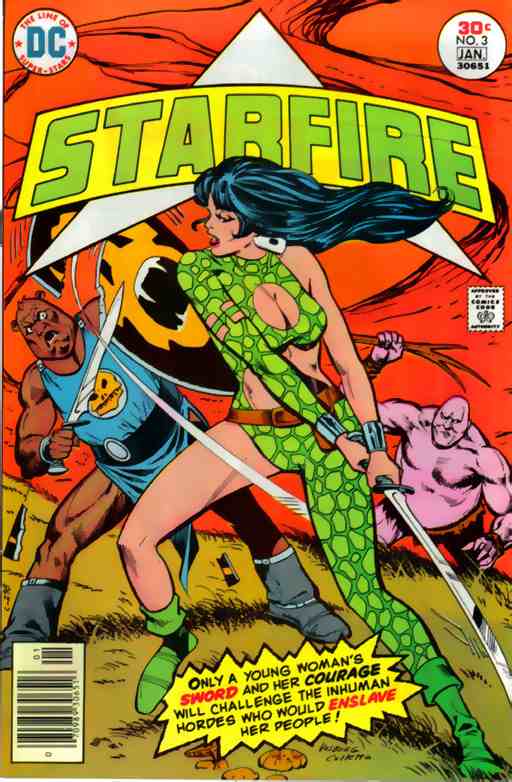
Four years before the Teen Titan Starfire debuted, and almost forty years before she got her own series, there was a very different DC series called Starfire. A take on the sword-and-sorcery comics then popular, it billed itself as "sword-and-science": it was set on another planet, and in a world not with magic, but one that had been conquered by aliens and partially regressed into barbarism after an era of great scientific achievement.

In this era, humans are the subjects of the Mygorg, a brutish alien race; the main character, Starfire, began her life as a human slave of the Mygorg, but when she's about to turn eighteen, she realizes she's going to become their sex slave! She runs away, and is rescued by a priest who helps train her in the ways of combat. They fall in love, he dies, and she vows to destroy the Mygorg forever. So she sets off with a band of adventurers seeking the people and resources to do exactly that.

Starfire was one of very few female-led DC superhero-adjacent titles in the 1970s (were the other just Wonder Woman, Lois Lane, and Supergirl?), but more importantly it was probably the first comic to feature an Asian protagonist.* Well, sort of-- since Starfire is set on an alien planet nothing to do with Earth, she can't be from China or Cambodia, but we are told, "her mother was white, and the father yellow," artist Mike Vosburg draws her with East Asian facial features, and the colorists depict her skin tone as slightly different from all the white characters (though she has blue eyes). Though I suspect it was done to make her a little more "exotic" and thus sexy, it was a surprising moment of diversity for the comics of the 1970s.

If you look at the credits at the bottom of this entry, you'll see that even though Starfire had a consistent penciller, the series accrued four writers and three editors in eight issues. The series is kind of jerked around and never really takes off as a result. David Michelinie creates the baseline in his original two issues: the first gives Starfire's backstory, climaxing in a surprisingly brutal scene where she beheads the Mygorg who killed her lover and would have taken her as a "bride." Then in #2, he establishes the formula: Starfire and her band (the only named member of which is Thrumdahg) come to a place, fight some Mygorg, and advance onwards. In this story, they acquire a map with the location of the fabled "Lightning Lords" on it, humans with advanced weapons that will help Starfire's band win their battles, thus setting up a quest behind the formula.

Michelinie stops it from being too straightforward, though; Starfire's eagerness for a fight in #2 disrupts a manor whose human lord has an uneasy truce with the Mygorg, for example, culminating in the accidental death of the manor lord's young son. So Starfire's quest will be tinged with a need for understanding complexity, and an undercurrent of tragedy.

The next three issues are the work of Elliot Maggin, who basically reproduces Michelinie's issue #2 formula. He keeps adding new members to Starfire's band, including the mute Thump and the poet Moonwatcher. Beginning with Thrumdahg back in #2, though, there's this consistent thing that the members of Starfire's band all think she really needs some loving, and so she's always fending off unwanted advances. Thump is the only exception to this. It's a weird, unpleasant choice, even in the context of a comic that began with its protagonist almost being forced into a life of sexual slavery. Like, why do I want to read about a band of would-be rapists? Still, Maggin's first two issues are solid adventure tales, each setting up its own interesting situation and then resolving it in the course of a single issue.

In issue #5, though, things begin to change, as Starfire meets the Lightning Lords at last in what's the first part of a three-part story by two different writers. The premise of the series begins to warp: while in the first five issues, it was sword-and-science, no sorcery needed, #6 introduces an out-and-out sorceress with magical powers!

The attempts to retool the series also become pretty brazen. In #6, while camping outside the lair of the Lightning Lords, who live in the middle of a mountainous wilderness, Starfire runs off in the middle of the night and comes back in a new costume. Which she allegedly picked up at a marketplace? Like why is there a human marketplace in the middle of nowhere selling sexy costumes for adventuresses?

This new costume lasts one whole issue, as in #7, Starfire is charging through a doorway and her costume gets caught on a nail and falls off, meaning she has to run around in a bra and short pants. I shit you not. Vosburg doesn't even draw the nail; in one panel, Starfire's shirt is ripping, and in the next she observes, "Looks like I lost my modesty to a rusty nail! Nothing ever comes free in this world!" Like, what does that even mean? And then she never mentions it again, apparently content to wear what is essentially a chainmail bikini. (I actually did like her original outfit, a sort of asymmetrical Seven of Nine-esque jumpsuit.)

Also, in #7, new new writer Steve Englehart must have also disliked the fact that the majority of Starfire's band were rapists, because he kills off all the supporting characters except for Thump and Moonwatcher in a teleporter accident! Like, a supercomputer tries to beam a group of them out of danger, but it doesn't know human biology, and they all die except Moonwatcher (the least rapey of the ones who weren't Thump; he seemed to want to charm Starfire into sleeping with him). Starfire also becomes a bystander in her own story in this storyline, as it turns out Thump is a genius computer programmer, and he makes a lot of decisions while Starfire just yells and fights a lot.

#8 introduces a new new direction, bringing back the order of priests Starfire's lover from #1 belonged to. The book promises there are more issues to come, but they never happened; I'm not sure why. The DC Implosion that killed Star Hunters was over a year away. Well, I mean I guess I know why, because this book's writer and premise were constantly shifting, and each change made it worse, not better. (Creator David Michelinie did slip Starfire into a one-panel cameo in Star Hunters #7 as another avatar of the same multiversal force as Star Hunters's lead character. But that was Star Hunters's last issue too!)

The one consistently good part of the book was the artwork of Mike Vosburg and Vince Colletta. They do great fantasy stuff, especially with Starfire herself: thick lines that really show off her beauty and her power. Too bad the writing couldn't consistently match what they were capable of.

Starfire vol. 1 was originally published in eight issues (Aug./Sept. 1976–Oct./Nov. 1977). The series was written by David Michelinie (#1-2), Elliot S! Maggin (#3-5), Steve Englehart (#6-7), and Tom DeFalco (#8); pencilled by Mike Vosburg; inked by Robert Smith (#1) and Vince Colletta (#2-8); colored by Liz Berube (#2); and edited by Joe Orlando (#1-4), Jack C. Harris (#5-7), and Denny O'Neil (#8).

* Karate Kid received an ongoing series in Mar./Apr. 1976, and he's half-Japanese, but that's a retcon, and I'm not sure when it was established.