Showing posts with label creator: matt wagner. Show all posts

26 November 2025

Doctor Mid-Nite by Matt Wagner and John K. Snyder III

One of the things about my projects to read through various superhero comics is that you are inevitably discovering that you missed something. Since finishing my JSA project, I've found a few such comics; most recently that was a Doctor Mid-Nite miniseries from 1999. I was dimly aware of this—when the third Doctor Mid-Nite popped up in the 1999-2006 JSA ongoing (see items #29, 32, 34-35 and 37 on the list below), certainly I must have known he came from somewhere—but I hadn't really seriously thought about it until it was mentioned in a recent thread on the "DC Finest" subreddit about what a set of Justice Society collections might look like. That cause me to actually look into it, and upon seeing it was written by Matt Wagner, whose work co-writing Sandman Mystery Theatre I really enjoyed, I decided to take a chance on it. (I think I had always kind of assumed it was by Geoff Johns, and thus avoided it on that account.)

Doctor Mid-Nite

Collection published: 2000
Contents originally published: 1999
Acquired and read: November 2025
Writer: Matt Wagner
Artist: John K. Snyder III
Letterer: Ken Bruzenak

The original Doctor Mid-Nite was Charles McNider. Eventually he retired from superheroing (I think, it's been a while) and was replaced by Beth Chapel in Infinity, Inc. (see #10 below). She, being black and female, was eventually killed off to prove the situation was serious. This left the stage open for a third Doctor Mid-Nite to debut, in a three-issue prestige format miniseries. I've spoken in the past about my love of this form, where DC would hand a somewhat moribund property over to an interesting creator (or creators) and let them run wild. Mostly these were released in the late 1980s and early 1990s, so 1999 is a bit of late manifestation of the concept, but the foreword to the trade does note it was originally supposed to be released in 1994, but was delayed!

Matt Wagner and John K. Snyder's version of Doctor Mid-Nite is Doctor Pieter Cross, of the depressed coastal city of Portsmouth. Cross is mostly seen from the outside in the first issue, which is told from the perspective of Camilla, a young woman addicted to a steroid that Cross helps, and then employs to help him. Cross is no superhero at first, but a wealthy doctor who spends his time and money helping the poor and the downtrodden. In the first issue, he ends up angering some powerful people, whose agents spike his drink; he crashes his car, and when he awakes from the accident discovers that he's blind... except he can see in darkness. Hence, now that his enemies think Pieter Cross is essentially incapacitated, he takes inspiration from the superheroes of old and reinvents himself as "Doctor Mid-Nite."

The light!
from Doctor Mid-Nite #2

This is one of those comics where writing and art come together perfectly. Both are dramatic, occasionally grotesque, and privilege the interplay between light and dark. This isn't the grounded noir sensibility Wagner brought to Sandman Mystery Theatre: the corporate villains of the piece, for example, dress up as a shark, a vulture, and a rat for no readily apparent reason; their plan involves massive underground bases of steroid-powered soldiers used in pursuit of a real-estate scam. Cross and Camilla inhabit a larger-than-life world, where darkness predominates, but provides a space for heroism to skulk but sometimes shine. Pieter is a distant but well-drawn character, superhuman even before he becomes a superhero. There's a whole gang of people who assist him, with exaggerated personalities and intriguing backstories. I feel like Wagner must have had the creation of an ongoing in the back of his mind, even if none ever eventuated.

The campaign to bring back Nite-Lite begins here.
from Doctor Mid-Nite #1

I really enjoyed reading this overall. Superhero comics are a strange medium, and I think the best ones lean into that: they commit to being completely and totally themselves, and that's what Doctor Mid-Nite is. There's nothing else quite like it... which is great.

Alas, Camilla.
from Doctor Mid-Nite #3
The real shame of it is that there never was anymore. Mid-Nite of course made the jump to JSA, and I think there were even two stories in JSA Classified (see #39 below) that focused on him... but they were both bad, and I don't think picked up on anything specific from this story. The fact that Camilla was in none of the future appearances of Doctor Mid-Nite had me suspicious that Wagner and Snyder were going to kill her off in the final issue to prove the situation was serious... a suspicion that was confirmed when I looked up issue #3 on some comic indexing website and it had a "dies" notation for her! So I was grumpy going into issue #3... but this turned out to be in error, she survives just fine! It's just that the interesting milieu and set of characters Wagner and Snyder came up with were, alas, never used again. On the JSA, Pieter Cross is just another guy, but in his own setting he was a light in the darkness.

This post is the fifty-third in an improbably long series about the Justice Society and Earth-Two. The next installment covers Power Girl Uncovered. Previous installments are listed below:

14 October 2015

Faster than a DC Bullet: Project Gotham, Part XI: Batman/Superman/Wonder Woman: Trinity

Comic hardcover, 198 pages
Published 2004 (contents: 2003)

Borrowed from the library
Read December 2014
Batman/Superman/Wonder Woman: Trinity

Writer & Artist: Matt Wagner
Colorist: Dave Stewart
Letterer: Sean Konot

Not in Continuity*
This is my third all-Matt Wagner comic in the course of this readthrough... and I want to like every one of them more than I do. Wagner's art is great, it's expressive, and he really captures the characters' personalities. I like the contrasts between Metropolis and Gotham and Paradise Island. I like how he mixes and matches villains between the three heroes here.

But his stories always seem to fail to coalesce. I think it's because they're maybe too ambitious. If this was just a superhero punch-up, it would be fine. But it wants to be something more, it wants to be first meeting between the three most important heroes of the DC universe, and it wants to say something about them as people, and about their ideals. What that statement is, however, gets lost in the muddle that is the plot, and I'm left dissastisfied, having glimpsed from a distance an excellent story that I haven't been allowed to read. This is good, but it's hard to shake the feeling that it ought to have been great.

* This readthrough of Batman stories is supposed to be of in-continuity (continuity being that of the 1985-2011 iteration of the DC universe) ones, but I didn't realize that Trinity didn't fit into continuity until I read it. There's no point in time where Superman and Batman would have met each other, but not Wonder Woman, and Batman has already been joined by Robin, as Robin's debut comes after the formation of the Justice League. I think.

Next Week: It gets a little cold outside, as Batman faces Mr. Freeze for the first time. Plus: his first attempt at a "Bat-Family" in Snow!

19 August 2015

Faster than a DC Bullet: Project Gotham, Part III: Batman and the Mad Monk

Comic trade paperback, 144 pages
Published 2007 (contents: 2006-07)

Borrowed from the library
Read October 2014
Dark Moon Rising: Batman and the Mad Monk

Story and Art: Matt Wagner
Colors: Dave Stewart
Letters: Rob Leigh

Year One, November
I found the second volume of Dark Moon Rising less successful than the first; despite Wagner's visual flourish, things felt muddled, and not in a good way-- the book often seemed like it was lurching from subplot to subplot. And though I like the idea of seeing Batman's first confrontation with the "supernatural," I don't think Wagner exploited it as much as he might have.

Next Week: Hugo Strange returns in Prey!

12 August 2015

Faster than a DC Bullet: Project Gotham, Part II: Batman and the Monster Men

Comic trade paperback, 144 pages
Published 2006 (contents: 2006)

Borrowed from the library
Read September 2014
Dark Moon Rising: Batman and the Monster Men

Story and Art: Matt Wagner
Colors: Dave Stewart

Year One, November
This story squeezes between the last few pages of Batman: Year One, along with a few other tales we'll be reading soon. Batman goes up against the deranged psychologist Dr. Hugo Strange-- a psychologist who for some reason spends his time carrying out genetic experiments. In the meantime, Bruce Wayne may have found true love with one Julie Madison. The story here is pretty straightforward, but it's all worth it for Matt Wagner's distinctive art. More cartoony than what David Mazzucchelli does in Batman: Year One, but still quite good. This won't set your world on fire, but it's a worthy addition to the "Year One" milieu.

Next Week: Batman fights the supernatural for the first time in Batman and the Mad Monk!

28 February 2014

Faster than a DC Bullet: The Houses of Mystery and Secrets, Part XV: House of Mystery: Conception

Comic trade paperback, n.pag.
Published 2011 (contents: 2010-11)
Borrowed from the library
Read February 2014
House of Mystery: Conception

Writer: Matthew Sturges
Artists: Luca Rossi, Werther Dell'Edera, José Marzán, Jr.
Colorists: Lee Loughridge, Brandon Graham, Trish Mulvihill
Letterer: Todd Klein
Short Story Writers: Matt Wagner, Peter Milligan, Chris Roberson, Mike Carey
Short Story Artists: Marley Zarcone, Enrique Breccia, David Lloyd, Ulises Farinas, Gene Ha, Brandon Graham, Giuseppe Camuncoli, Michael Allred, Peter Gross, Stefano Landini
Short Story Colorists: Laura Allred, Daniel Vozzo
Short Story Letterers: Jared K. Fletcher, Sal Cipriano

The title of this volume implies answers, but they're in short supply. Or rather, meaningful answers are. Or rather, I think I'd care if anything had ever made any sense-- finding out what the Conception are up to only really matters if previously we'd ever been given anything to grab onto beyond "They're so mysterious!" There is half-hearted attempt at a cast page this time, but it's too little, too late. Fig and Cain spend most of this volume getting from one side of a house to another. And for some reason, the House of Secrets is in the Goblin Market now, and Abel is trying to run a bar out of it. Why? Who knows. Allegedly these characters ran a bar together in the House of Mystery because they couldn't leave, but now they're out and giving it a try regardless.

Still: there's some good short stories here. "The Mystery of the Missing Ghost" is a pretty uninventive Encyclopedia Brown pastiche and "Murder Most Foul"'s joke is ruined by the fact that Enrique Breccia's renditions of the characters are unrecognizable, but "Great Artists Steal" is creepy in the way that an old-time House of Mystery story would be (making it quite appropriate that Cain tells this one himself), while "Bloodsucker" is yet another awesomely terrible film script, and "Necessary Evil" is a delightful piece of metafiction.

The best part of this volume, as in The Beauty of Decay, is the special Halloween issue in the back, which sees a group of strange trick-or-treaters visiting not just the House of Mystery (where Fig is dressed as Supergirl!), but also Madame Xanadu, John Constantine, the girl from iZombie, and (best of all) Lucifer and Gaudium! Whoo! Now there's a real treat. Bring back Gaudium.

07 January 2013

Faster than a DC Bullet: The Sandman Spin-Offs, Part XXVIII: Batman: Whatever Happened to the Caped Crusader?: The Deluxe Edition, With other tales of the Dark Knight

Comic hardcover, n.pag
Published 2009 (contents: 1989-2009)
Borrowed from the library
Read November 2012
Batman: Whatever Happened to the Caped Crusader?: The Deluxe Edition, With other tales of the Dark Knight

Writer: Neil Gaiman
Artists: Andy Kubert, Scott Williams, Simon Bisley, Mark Buckingham, Mike Hoffman, Kevin Nowlan, Bernie Mireault, Matt Wagner
Colors: Alex Sinclair, Nansi Hoolahan, Tom McCraw, Joe Matt
Letters: Jared K. Fletcher, John Costanza, Agustin Mas, Todd Klein

This is close to the end of my Sandman spin-off runthrough. It's also stretching the definition of "Sandman spin-off," though no moreso than when I included Gaiman's early DC work like Black Orchid and Legend of the Green Flame. Whatever Happened to the Caped Crusader? actually teases you with an appearance of someone who might be Death... but turns out not to be. (Or so I think, anyway. Some evidently disagree!) The story takes place after Batman's death in Grant Morrison's Batman R.I.P. and Final Crisis, with all of his old allies and enemies gathering in Gotham to pay homage to him. Only... everyone thinks they did it. So we get a succession of stories told, by Catwoman, Alfred, the Mad Hatter, Joker, Robin, Clayface, Superman, each telling completely contradictory stories about something they did (or did not do) that lead to the death of Batman.

The stories range from a few pages to a panel or two to just dialogue, but each of them manages to be completely and utterly Batman. It's the greatest hits of Batman deaths, if he was allowed to have more than one. There are a lot of nice details-- my favorite part is the guy outside the club where the funeral is being held who watched the villains' cars-- in both the (beautiful) art (by Andy Kubert) and the writing. It's the perfect tribute to the Batman, the man who never gave up, no matter how crazy he seemed.

The whole funeral is overlaid by two people talking in caption boxes, who turn out to be Batman and not Death ("I don't think death is a person, Bruce."), and Batman passes from the funeral, from life, into something greater and beyond reality. Here, Bruce gets a chance to reflect on who he was and why he did everything he did. There are a lot of great lines, my favorite being, "Do you know the only reward you get for being Batman? You get to be Batman." And then he's done... or as done as Batman can ever be, because he's apparently got to pass on somewhere else. I know that when Darkseid kills Batman in Final Crisis, Batman actually goes tumbling into the past, so I assume this is all tied into that, but it works on its own as a story about the endurance and struggle of Batman, too.

The still-thin book is padded out by everything else Gaiman wrote related to Batman, which amounts to a weird set of stories. "A Black and White World" is about what Batman and the Joker do "off-panel" in their comics, but Simon Bisley's art is just a little too "gritty 1990s" to work for me. Check out those ears on the Batman! And those R. Crumb-style women. "Pavane" is about a Suicide Squad agent trying to recruit Poison Ivy, giving her origin story-- pretty good stuff. "Original Sins" and "When is a Door" are two linked stories about a news team visiting Gotham to do a feature on supervillains.

I like the frame a lot, being filled with big and small character moments, and jokes at the Penguin's expense, but "When is a Door," the teams encounter with the Riddler, ended up being a long metafictional rant about the death of fun in superhero comics. Well, Neil Gaiman, go write some fun superhero comics then. This is your world; as I was just reminded, Batman and the Riddler just live in it.

19 June 2011

Faster than a DC Bullet: The Sandman Spin-Offs, Part IV: Neil Gaiman's Midnight Days

Comic hardcover, n.pag.
Published 1999 (contents: 1989-99)

Borrowed from the library
Read June 2011
Neil Gaiman's Midnight Days

Writers: Neil Gaiman with Matt Wagner
Artists: Stephen Bissette, John Totleben, Richard Piers Rayner, Mike Hoffman, Kim DeMulder, Mike Mignola, Dave McKean, Teddy Kristiansen
Colorists: Tatjana Wood, Danny Vozzo
Letterers: John Costanza, Tim Harkins, Todd Klein

This book collects much (all?) of Gaiman's non-Sandman Vertigo work, presumably so the dedicated Gaiman-ite doesn't have to sully themselves by buying comics by other people. (Actually, most of the work here had never been collected in trade paperback before, so I'm just being mean.)

Swamp Thing: "Jack in the Green"
This story is about a Swamp Thing from the Middle Ages. It's the second comic Gaiman ever wrote. It's okay, I guess. Nothing really happens.

Swamp Thing: "Brothers"
In this story, Brother Power the Geek comes back to the Earth. He's a character who hadn't appeared for years before this and no one cared about him. I'm not sure why anyone should after reading this. I guess that's kinda the point-- he's the hippie who can't let go. I did enjoy the two side characters, though, one of which who actually was a hippie who couldn't let go. The evil government agent (who was also an ex-hippie) was a pretty cool character. The Claw or whatever his name was, not so much. Oh, and Batman is in it.

Swamp Thing: "Shaggy God Stories"
what is this I don't even

John Constantine, Hellblazer: "Hold Me"
I've never read a John Constantine story before. This was pretty good. The resolution makes little sense on a plot level, but is nice emotionally. Poor Constantine, keeps the world at bay, and even when he lets it in... it doesn't actually like him. The art is amazing. McKean and Gaiman showed they made a good team in Black Orchid, but this is even better from an artistic standpoint.

Sandman Midnight Theatre
I've read this story before, on its own, and it takes up half the book! Why not throw in the Poison Ivy story that Gaiman mentions instead; I want to read that, since he did such an intriguing Ivy in Black Orchid. Sandman Midnight Theatre belongs in a collection, sure... but in a Sandman Mystery Theatre one instead, where it's an important part of an ongoing narrative. It was nice to read it again, though, and Gaiman's introduction to the story provides some nice insight into the way it was written. (Gaiman and Wagner worked out a plot in a hotel room, Wagner wrote detailed breakdowns, Kristiansen drew the art following these, Gaiman wrote the dialogue to match the pictures.) Other than that, I have nothing to say that I didn't say last time.

The collection as a whole is a bit of a jumble, really. Nice to have it all collected, but none of it really stands out or impresses on its own, except for maybe "Hold Me."

Faster than a DC Bullet: The Sandman Spin-Offs, Part III: Green Lantern/Superman: Legend of the Green Flame

Perfect-bound comic, 38 pages
Published 2000

Borrowed from the library
Read June 2011
Green Lantern/Superman: Legend of the Green Flame

Written by Neil Gaiman
Artwork by Michael D. Allred & Terry Austin, Mark Buckingham, John Totleben, Matt Wagner, Eric Shanower & Arthur Adams, Jim Aparo, Kevin Nowlan, Jason Little
Colored by Matt Hollingsworth
Lettered by Todd Klein

Action Comics Weekly sounds like the kind of thing I'd've liked, given my enjoyment of Wednesday Comics: an anthology title that came out weekly, with several stories advancing slowly issue to issue. But it was apparently a nightmare to pull together, and so it didn't even last a year. Legend of the Green Flame is the finale it never got, as Gaiman's script was dumped for someone else's, finally being illustrated and published some twelve years later. The story unites all of the characters-- the Blackhawk Squadron, the Green Lantern, Superman, Catwoman, the Phantom Stranger, Deadman, and a demon who totally isn't Etrigan, honest-- from Action Comics Weekly into one big story.

In this tale, Hal Jordan and Clark Kent find an old green lantern, originally found in some rubble in 1949, in a museum exhibit. When Hal uses it to charge his ring, the two of them end up flung into Hell itself. It's short, only a little longer than your typical single issue, so not a whole lot actually happens. What does happen is fun enough, I suppose, though I suspect it would have been funner had it actually been read as the conclusion to all of these characters' stories in Action Comics Weekly. I think my favorite random appearance was Deadman, who gets some funny material. I don't get why the Blackhawks find dead members of the Justice Society (including the Sandman, natch) in 1949, though.

As it is, it's nice to see Clark Kent and Hal Jordan hang out together. I don't know why Hal Jordan is so mopey here, or why the events of this story make him get over it, but Gaiman write a nice Clark/Superman. There's a fun bit where in the middle of a conversation, Clark flies off and gets a cat out of a tree, and the best scene in the book is probably when, upon their arrival in Hell, Superman is incapacitated by being able to hear the torment of every single being in Hell at once. Sometimes it sucks being Superman.

The resolution is a bit too easy, given all the buildup it gets, but that's a done-in-one story for you, I suppose. There are a number of different artists for some reason, but it's not as jarring as you might think, since each of them does a different chapter, and each chapter takes the story some place completely different. Oh, and the ending joke is fun, though it wasn't until just now that I finally got it. "The place is all yours," indeed, Neil.

12 April 2011

Faster than a DC Bullet: Sandman Mystery Theatre, Part X: The Blackhawk and The Return of the Scarlet Ghost

Comic trade paperback, 221 pages
Published 2010 (contents: 1996-97)

Borrowed from the library
Read March 2011
Sandman Mystery Theatre: The Blackhawk and The Return of the Scarlet Ghost

Writers: Matt Wagner, Steven T. Seagle
Artists: Guy Davis, Matthew Smith, Richard Case, Daniel Torres
Colorists: David Hornung, Daniel Torres
Letterers: John Costanza, Gaspar Saladino

The first story contained here, "The Blackhawk," continues Sandman Mystery Theatre's recent trend of including characters from DC universe. Janos Prohaska, however, is no superhero and never is-- he's the future leader of Blackhawk Squadron, an international group of fighter pilots resisting the Nazis. In this story, Janos has come to America to seek funding for his resistance efforts, and Wesley Dodds finds himself drumming up said funding, while as the Sandman, he is investigating Janos for his involvement in (of course) a series of mysterious murders.

Plot-wise, it's definitely one of the better SMT stories, with a well-executed mystery. It also finally completely dispenses with the subplot about Dian not wanting Wesley to be the Sandman; in this story, she acts as "Sandy" for the first time, actively assisting the Sandman with one of his plots. Oh, and it's got a good Lieutenant Burke subplot. I'm gonna miss that guy; Wesley Dodds pops up in JSA stories, but I sure bet he doesn't. The art is even pretty all right; Matthew Smith is the least terrible fill-in artist the series has had, and when he's joined by Richard Case on inks, he gets even better. His Dian is kinda ugly, okay, but he nails Wesley in a way that most artists on this series do not.

The next story is all weird and metafictional. "The Return of the Scarlet Ghost" reveals that the Sandman's exploits have become so well known that he's become a character in pulp magazines-- the kind of magazines this comic book strives to emulate! It's a neat idea, though it's undercut by the fact that in no previous story has anyone ever said, "Hey, you're the guys from those stories!" while in this one it happens all the time. Of course, there's death threats and murders in the publishing biz, but that's all a side show to a story about adaptation and appropriation. Not only is the Sandman fodder for pulp fiction, but some of the publishers are starting to do comic books about him! There's even an interlude where Wesley and Dian read one of the comics-- a harsh-but-relatively-accurate parody of how the Sandman was written by Joe Simon & Jack Kirby-- and make fun of their fancifulness. (I think this must've been intended to take those adventures-- especially the Sandman's kid sidekick, Sandy the Golden Boy-- out of continuity, but later comics have used both the SMT characterization of Wesley and Dian and the existence of Sandy and the Simon/Kirby gold-and-purple costume. But having both SMT and the Simon/Kirby stories be "canon" is just awkward. Does this mean the comic artist just happens to accurately predict the existence of Sandy? Let's just ignore it.) The story even ends with them making a none-too-accurate film out of the whole thing. Minus the Sandman!

It's fun, and I also enjoyed the subplot about Dian trying to make it as a writer of pulp fiction. The mystery itself is so-so, but enough about the story is entertaining that that doesn't really bother me. I am really ticked off, though, that this is apparently the last reprint of Sandman Mystery Theatre that DC is doing; not only were there another eighteen issues after this, but this volume ends on a tremendous cliffhanger that I will apparently never read the resolution to!

08 March 2011

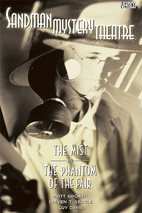
Faster than a DC Bullet: Sandman Mystery Theatre, Part IX: The Mist and The Phantom of the Fair

Comic trade paperback, 200 pages
Published 2009 (contents: 1996)

Borrowed from the library
Read March 2011
Sandman Mystery Theatre: The Mist and The Phantom of the Fair

Writers: Matt Wagner, Steven T. Seagle
Artist: Guy Davis
Colorist: David Hornung
Letterer: John Costanza

The other DC characters come thick and fast in this volume, which features Ted Knight (the future Starman), the Mist (a future Starman villain), Jim Corrigan (the future Spectre), and the Crimson Avenger, not to mention a passing reference to the Flash himself. I don't know if Sandman Mystery Theatre was in trouble or what, but it's a little jarring in what had been a fairly self-contained series. Wagner and Seagle work most of them in just fine, though; Knight, the Mist, and Corrigan don't have their powers yet, while the Crimson Avenger doesn't have any at all. (Oddly, he's the most disconcerting-- with his flamboyant posturing and public presence, he's a very different kind of superhero to the Sandman.)

Both stores in this volume are good but disjointed. "The Mist" suffers from the same problem as "The Hourman," in that the tale of the other characters is often more interesting than Wesley's; I loved the rise and fall of the villainous scientist known as the Mist. Meanwhile, Wesley is rebuilding his relationship with Dian and investigating a series of mysterious crimes, but he only finds the Mist by accident. Plus there's just too many shady characters to keep track of. It's not a satisfying mystery, but I still enjoyed reading it.

"The Phantom of the Fair" takes the Sandman back to where he began in the Golden Age-- the New York World's Fair-- and it's a neat story, especially in how it shows Wesley confronting his own homophobia. The explanation for it is a bit too pat, though: he saw a friend of his forced to give a man oral sex when they were children. The roots of such prejudice are much less easily traced and destroyed than that. I did like all the ruminations on utopia in this story. This story isn't really a mystery as such, though; Lieutenant Burke does more work on the case than Wesley again. (Though it's one of the most enjoyable Burke stories in Sandman Mystery Theatre so far. I love it when Burke is allowed to be an all-out asshole.) So again, The Mist and The Phantom of the Fair is a mixed bag; Wagner and Seagle seem to have a difficult job balancing the personal plots and the mystery plots without compromising the latter.

Faster than a DC Bullet: Sandman Mystery Theatre, Part VIII: Sandman Midnight Theatre

Perfect-bound comic, n.pag.
Published 1995

Borrowed from the library
Read February 2011
Sandman Midnight Theatre

Written by Neil Gaiman
Plotted by Matt Wagner
Story by Wagner and Gaiman
Painted by Teddy Kristiansen
Lettered by Todd Klein

There was a time when Neil Gaiman's The Sandman and Wagner and Seagle's Sandman Mystery Theatre were running alongside one another, so it must have seemed logical to cross the two series over. But despite an appearance by Dream (one of many mainstream DCU appearances in SMT of late), this is definitely a Sandman Mystery Theatre tale, albeit one filtered through a Neil Gaiman style. With Dian gone to England to find herself, Wesley eventually pursues a mystery there, and the two have a number of confrontations while solving a mystery and then reconciling. The mystery is a bit thin, and the reconciliation comes out of nowhere, but I enjoyed the story all the same. It just oozed atmosphere, partially because of Gaiman's dreamlike writing, but mostly because of Teddy Kristiansen's amazing artwork. He's the first artist who's not Guy Davis to do successful work on Sandman Mystery Theatre, and I really liked the story as a result. He is the only other person to get Wesley's dashing-but-awkward, young-but-pudgy appearance just right, and the way he does Wesley's glasses was especially great. Sometimes Wesley was as impenetrable as his disguise.

What really bothered me, though, was the Wesley referred to "the Sandman" as a different person throughout the story. Which is a neat idea, but Dian claims it's something he always does-- when he's never done it in Sandman Mystery Theatre ever! Nor does he do it again, to my knowledge. A weird little inconsistency.

Faster than a DC Bullet: Sandman Mystery Theatre, Part VII: The Hourman and The Python

Comic trade paperback, 199 pages
Published 2008 (contents: 1995-96)

Borrowed from the library
Read February 2011
Sandman Mystery Theatre: The Hourman and The Python

Writers: Matt Wagner, Steven T. Seagle
Artists: Guy Davis, Warren Pleece
Colorist: David Hornung
Letterer: John Costanza

This is the first volume of Sandman Mystery Theatre to draw connections with the wider DC universe-- in this case, the appearance of Rex Tyler, here called the "Man of the Hour," but eventually to become the superhero "Hourman." The Hourman is an oddly imbalanced story; half of it is about Wesley and Dian's evolving relationship, as usual, and half of it is about the Hourman's attempts to begin a crime-fighting career. They cross over in that Wesley discovers the Hourman in the course of his own activities as the Sandman, and the Hourman's investigations lead him to the same crime the Sandman is hearing about in his dreams. The relationship stuff is good, especially now that Dian is actively helping Wesley's crime-fighting, but it's overshadowed by the stuff with Hourman; I love a good origin story, and this is an excellent one. It doesn't help that the mystery here is perfunctory; Wesley spends more time investigating Rex Tyler than he does the crime, and the crime itself is stealing jewelry from an immoral and obnoxious rich person. It's hard to get worried about this. Far more interesting is Rex's fumbling attempts to help a family in trouble with local gangs.

The second story here, "The Python," is the first SMT story that completely did not work for me. To start with, it suffers from the same problem as every story with a fill-in artist: Warren Pleece is not Guy Davis. His art is simpler than Guy Davis's and more cartoony, which isn't really appropriate for the gritty atmosphere of SMT, but it's also just less accomplished. There's a lot of ugly or distorted faces, and not always in spots where they're wanted, I think. But also, the mystery this one just doesn't work-- earlier SMT stories suffered from a superfluity of suspects; this one has almost none, and then the murderer is someone completely different, with no previously indicated means, motive, or opportunity. (But still a contrived link to Dian.) It's lame, and the Sandman scarcely contributes until the obligatory fight scene at the end; everyone's favorite asshole cop Lieutenant Burke does most of the work again. Which is cool, I like Burke, but this isn't Lieutenant Burke Mystery Theatre. The other thing that doesn't work about "The Python" is that while Dr. Death and The Night of the Butcher showed Dian's initial horror at Wesley's secret life and then acceptance, and "The Hourman" showed her actually helping him, she all of a sudden backslides here for no readily apparent reason. Call my cynical, but I think Wesley and Dian's split is solely to set up the crossover in the next installment...

12 February 2011

Faster than a DC Bullet: Sandman Mystery Theatre, Part VI: Dr. Death and The Night of the Butcher

Comic trade paperback, 197 pages
Published 2007 (contents: 1994-95)

Borrowed from the library
Read January 2011
Sandman Mystery Theatre: Dr. Death and The Night of the Butcher

Writers: Matt Wagner, Steven T. Seagle
Artists: Guy Davis, Vince Locke
Colorist: David Hornung
Letterers: John Costanza, Gaspar Saladino

Like The Face and The Brute, Dr. Death and The Night of the Butcher includes two complete tales of the Sandman, a.k.a. Wesley Dodds, as he fights crime in the dark underbelly of New York City. And as if the writers read my objection to the fact that every victim in this series deserves it, the book even opens up the murder of an innocent man! (Um, yay?) But as was the case in the last couple stories, the murder mystery (which as usual is coincidentally linked to Dian Belmont's social circle) is a sideshow to the developments in the relationship between Wesley and Dian. Dian has figured out that Wesley is the Sandman, but doesn't quite know what to do about it. And Wesley doesn't quite know how to integrate her needs into his already-structured life.

Wesley actually has very little to do with solving "The Night of the Butcher" especially, but that's okay, as it allows Lieutenant Burke to really shine, along with Hubert Klein. But as Wes's personal life disintegrates, so does his crimefighting one-- Burke discovers the radio hidden under his desk that transmits all his conversations to the Sandman! What's a masked mystery man to do? And what's Dian to do? There are no easy answers here, and the series swings back and forth between tender and painful, as they try to negotiate their strange new status quo. Especially effective here are the recurring dreams of the Sandman, a staple of the series from the beginning, that in this one hit a new high in disturbingness, probably thanks to some nice comic book tricks (Scott McCloud would be proud).

The only downside to this volume is that Guy Davis only does layouts for "Dr. Death," with the somewhat inferior Vince Locke on art. On the other hand, the brutal fight at the end of "The Night of the Butcher" is probably the series' best action sequence so far, nicely showcasing the Sandman's determination, Lieutenant Burke's antagonism, and Dian Belmont's passion. Sandman Mystery Theatre continues its string of successes.

Faster than a DC Bullet: Sandman Mystery Theatre, Part V: The Scorpion

Comic hardcover, 100 pages
Published 2006 (contents: 1994)

Borrowed from the library
Read January 2011
Sandman Mystery Theatre: The Scorpion

Writers: Matt Wagner, Steven T. Seagle
Artist: Guy Davis
Colorist: David Hornung
Letterer: John Costanza

The Scorpion continues the high standard set by its predecessor, with Dian and Wesley's relationship continuing to progress-- as a vicious serial killer is on the loose, of course. The strong character work is again the highlight; this volume probably gives us more of Wesley's thoughts than the previous three combined, and it's fascinating: a quiet, shy man driven by forces he cannot comprehend to do what he does, who wants to do right by Dian, but held back by fear. If there's any downside to this installment, it's that the murderer is completely obvious. Also, every installment of this series features completely despicable people being murdered, so it's hard to be too engaged in the hunt for their killers. Some innocent victims would be nice. (That's not something you say a lot.) But on the whole, there's a lot to enjoy here; this is probably the most proactive the Sandman's been in an investigation, and it's also the start of a new, more pivotal role for Dr. Hubert Klein, the NYPD's medical examiner, the first character to actively assist the mysterious vigilante.

Faster than a DC Bullet: Sandman Mystery Theatre, Part IV: The Vamp

Comic hardcover, 98 pages
Published 2005 (contents: 1994)

Borrowed from the library
Read January 2011
Sandman Mystery Theatre: The Vamp

Writers: Matt Wagner, Steven T. Seagle
Artist: Guy Davis
Colorist: David Hornung
Letterer: John Costanza

With this, its third volume, Sandman Mystery Theatre has jumped above the lackluster performance of The Face and The Brute and even exceeded its strong debut in The Tarantula. There are two important creator changes in this volume. The first is that Guy Davis, who illustrated The Tarantula, returns to the series, and it is all the better for it. The fellows who did The Face and The Brute just didn't have his skill; Davis draws some of the most real people in comics. I shudder to think how the cute Dian Belmot would look in the hands of your typical superhero artist. Perhaps more importantly, Steven T. Seagle joins Matt Wagner as co-writer.

I dunno if he's responsible for the subtle changes that made this story really work, but it really really does. One of the recurring themes of SMT has been prejudice, a natural enough topic for a story set in upper-crust 1930s New York City, but unfortunately it had a tendency to get a little bit obvious, with its protagonists (Wesley and Dian) being properly undiscriminating in a world where everyone else tosses off ethnic slurs against the Chinese. The Vamp handles this with a bit more nuance, such as scenes where Dian is repulsed by the idea of lesbianism, showing that she's not quite the hero we "enlightened" 21st-century readers might like her to be. And Lieutenant Burke, who in the first volume revealed that he considered his sister dead to him because she married a black man, is himself the target of racism, when he's stared at upon entering a social club. One of the members tells him they don't have any Italians, and Burke growls back, "I'm Sicilian." The club member simply replies, "Well, whatever you are, we don't have any of those either. At least I don't think we do." The take on 1930s racism feels much more complex as a result. Also, I laughed at that scene, and indeed, I found The Vamp much more prone to humor than its predecessors, though that never came at the cost of atmosphere-- all of the light moments were well-placed.

The characters are also on fine form here. Wesley and Dian's relationship continues to grow, and the theme of Dian "waking up" from her long sleep also continues, as she even does some amateur sleuthing of her own. Wesley and Dian's relationship is one of the better-portrayed relationships I've read in comics. The two characters love each other madly, but that doesn't make things magically easy for them, yet the conflict and misunderstandings in their relationship all come across completely naturally. Lieutenant Burke also gets fleshed out, going from yet another random cop to a competent detective who also happens to be a complete asshole. He's the sort of character you love to hate-- or in my case, you just love.

Story-wise, this is probably one of the better mysteries the series has given us. Though the perpetrator of the murders is pretty obvious to the reader from around the halfway point, the detection by the Sandman, Burke, and Dian all feels logical, and the end of the story works particularly well, with none of the leaps that made some of the previous stories unsatisfying. All told, The Vamp was a brilliant piece of work that left me immediately looking forward to the next installment of Sandman Mystery Theatre.

22 January 2011

Faster than a DC Bullet: Sandman Mystery Theatre, Part III: The Face and The Brute

Comic hardcover, 206 pages
Published 2004 (contents: 1993-94)

Borrowed from the library
Read January 2011
Sandman Mystery Theatre: The Face and The Brute

Writer: Matt Wagner
Artists: John Watkiss, R. G. Taylor
Colorist: David Hornung
Letterer: John Costanza

The second volume of Sandman Mystery Theatre is decidedly weaker than the first. The first story, "The Face," sees a series of brutal murders in Chinatown escalating tensions between rival gangs to the point of war as the Sandman tries to find the murderer before that happens. Unfortunately, though the story often criticizes many of its characters for racist thinking, the story still falls victim to many Orientalist tropes itself, especially in John Watkiss's artwork, where the Chinese characters are so slanty-eyed they don't have any pupils. "The Face" of the title (again, not the same Face as in the Golden Age Sandman stuff, though quite similar) barely has any interaction with the Sandman, and the resolution of the mystery is a bit underwhelming. As in the first volume, Dian Belmont was probably the best thing about this story, especially the part where she takes matters into her own hands and steals her father's gun.

The second story, "The Brute," is a bit better but still not as successful as The Tarantula. The Sandman himself feels lost here, doing little actual investigation until things suddenly fall into place for him at the end of the story. The focus on Dian's growing conscience works well, though, as does her growing relationship(s) with Wesley Dodds and the Sandman. A lot of the story is taken up by the travails of a boxer and his daughter that, though gripping, keep the focus solidly off the Sandman himself. And the "Brute" of the title is kind of random and pointless; I'm not sure why each Sandman Mystery Theatre story has to have a gimmicky villain when the series is otherwise uninteresting in the conventions of superhero comics. R. G. Taylor's art is too stiff, and his Wesley looks too middle-aged. Overall, The Face and The Brute fails to follow up the strong beginning of the series, though it's entertaining enough on its own merits, mostly for Dian Belmont's continued growth and presence.

Faster than a DC Bullet: Sandman Mystery Theatre, Part II: The Tarantula

Comic hardcover, 111 pages
Published 2004 (contents: 1993)

Borrowed from the library
Read January 2011
Sandman Mystery Theatre: The Tarantula

Writer: Matt Wagner
Artist: Guy Davis
Colorist: David Hornung
Letterer: John Costanza

After the success of Neil Gaiman's The Sandman, DC revisited the original Sandman with Sandman Mystery Theatre, a pulp-influenced reworking of Wesley Dodds. In these stories, Wesley is not a playboy, but a shy, retiring man plagued by terrible dreams to fill the gap in the cosmos caused by the capture of Dream. Instead of the array of shorts we got in the 1940s, Matt Wagner gives us a sprawling, complicated tale of the Sandman trying to track down a mysterious murderer known only as "the Tarantula." (There was a Tarantula in one of the original Golden Age Sandman stories, but he isn't related to this one as far as I can tell.)

Dodds, though, is largely an enigma in this story, driven by strange dreams and mostly seen from an outside perspective, even when a scene focuses on him. The viewpoint character of The Tarantula is very much Dian Belmont, no longer a safecracker, but still the daughter of the District Attorney. One of her friends is one of the victims of the Tarantula, and her efforts to assist in the case-- and her interactions with the mysterious Sandman, not to mention the charming Wesley Dodds-- begin to give some aim and purpose to her until-now aimless life.

The plot of The Tarantula is a labyrinthine mystery, mostly taking place at night in New York City. The mystery is well-done, cutting the difficult line between obvious and impossible just right. The primary things that makes this story work, though, is the atmosphere that it oozes-- these are the dark, decadent adventures the Sandman should have been having all along. The Sandman inhabits a world every bit as frightening as his visage, tormented by dreams that show him the worst things he can imagine.

I really like Guy Davis's art. It's a little cartoony, but it works. He has a nice command of human faces, especially, and his characters look like real people: you can see Wesley's slight slump, and Dian is attractive but not a supermodel, more cute (and plump) than a knockout. On the other hand, he handles the dark and the creepy just exactly right as well. Moody and mysterious, The Tarantula is everything the original Sandman should have been all along.

03 July 2010

Faster than a DC Bullet: The Sandman, Part II: The Absolute Sandman, Volume Two

Comic hardcover, 616 pages
Published 2007 (contents: 1990-98)

Borrowed from the library
Read June 2010
The Absolute Sandman, Volume Two

Writer: Neil Gaiman
Artists: Sean McManus, Kelley Jones, Mike Dringenberg, Bryan Talbot, John Watkiss, Matt Wagner, Stan Woch, Coleen Doran, Duncan Eagleson, John Bolton, Malcolm Jones III, George Pratt, Dick Giordano, P. Craig Russell, Vince Locke
Colorists: Dave Vozzo, Steve Oliff
Letterer: Todd Klein

There's two big storylines collected in this volume of The Absolute Sandman. The first is Seasons of Mists, which opens with a meeting between Dream and the rest of the Endless. They suggest that Dream was a bit of a jerk for exiling his lover to Hell ten thousand years ago (described in a side story in Volume One), and that he should get her back. Apparently that's all it takes to change someone's mind, because Dream launches himself into Hell to reclaim her soul. Why? No one knows. Upon getting there, he finds out that Lucifer has opened the Gates of Hell and let everyone go because he's tired of the whole thing, and Lucifer hands the place over to Dream and promptly absconds, leaving Dream with the question of what to do with Hell. Various claimants come to petition Dream, and I was initially excited-- who Dream chose would give me some insight into his character surely, or even just watching him deliberate would-- but the whole storyline just stops with a literal divine intervention. Seeing Gaiman's depictions of the various claimants is fun, though; I think my favorites were Thor and the Lord of Order. His Loki is pretty underwhelming for the ultimate trickster, though. The best part of the storyline, however, is the side story about the boy left behind at a boarding school when all the souls are released from Hell.

The second story, A Game of You, is much better for the reason that it doesn't focus on Dream at all, but rather Barbie, a human who previously appeared in Volume One. Her dreams are starting to spill over into the real world and into the lives of those who share her apartment building. We see almost everything from the perspective of Barbie, her transvestite friend Wanda, the lesbian couple Hazel and Foxglove (one of whom is pregnant!), and a witch named Thessaly. Barbie soon becomes lost in her dreams, which are a little girl's depiction of a fantasy land, with herself as the princess, surrounded by a cast of goofy animal characters. Watching these characters try to make sense of the weird world they've been projected into, as well as their own personal lives, is great, and I was totally on board with every moment of it. The ending is a bit underwhelming, however, as Dream just shows up all of a sudden and takes care of everything. But other than that (and the epilogue), this was my favorite Sandman storyline yet.

There's also a quality side story about Emperor Norton I of the United States, which I just loved. A fun look at a fun historical personage.

My reviews of the first two volumes of The Absolute Sandman might make it seem like I'm down on the series, and I'm not-- I think the writing is usually sharp, most of the characters are fully-fledged people, the tone and atmosphere are great, the Dreaming is a fantastic mythology, and Matthew the Raven is pretty much awesome. But it's hard to get too enthused about a series whose protagonist leaves you so little to connect to, even at supposedly defining moments.