Showing posts with label creator: scott kolins. Show all posts

04 July 2022

Stargirl by Geoff Johns, Lee Moder, Scott Kolins, Dan Davis, et al.

Stargirl by Geoff Johns

Collection published: 2020
Contents originally published: 1999-2003
Read: March 2022

Writers: Geoff Johns, James Robinson, David S. Goyer
Artists: Lee Moder, Scott Kolins, Dan Davis, Chris Weston, John Stokes, Mike McKone, Wayne Faucher
Colorists: Tom McCraw, Carla Feeny, John Kalisz
Letterers: Bill Oakley, Kurt Hathaway

This volume collects the entirety of Stars and S.T.R.I.P.E., a modernized take on the Star-Spangled Kid that began slightly before and ran alongside the Robinson/Goyer/John JSA revival of 1999. Our main character is Courtney Whitmore, a teenager who has recently relocated to Blue Valley, Nebraska because her mother has remarried, to Pat Dugan, who back during World War II was Stripesy, sidekick to the Star-Spangled Kid. She ends up becoming the new Star-Spangled Kid, eventually dubbing herself "Stars" and then "Stargirl," while Pat operates as her sidekick in  a robotic suit called S.T.R.I.P.E. (As the cover of my edition indicates, it eventually became the basis for the CW tv series Stargirl starring Brec Bassinger.)

As a concept, it's great. Definitely a good storytelling engine: you have high school stuff, secret identity stuff, interpersonal stuff, legacy stuff. Courtney is ultimately the inheritor of the Star-Spangled Kid mantle and the Starman mantle. But I ended up feeling like Geoff Johns might not have been the writer to successfully pull off his own idea. The idea here is that Courtney becomes a superhero to annoy her stepfather, and then sort of grows into it... but I felt like this is an idea that we were told more than we actually saw on the page. The interpersonal dynamics were often crowded out by the superhero plots and the crossover storylines; some of Courtney's development as a hero was seemingly happening over in JSA, not here. I never really got a feel for her and Pat's relationship in a meaningful way.... but of course this is Geoff Johns. Great idea, but hand the execution over to, say, a John Rogers or a G. Willow Wilson, and I think this would have soared.

Heck of a kick for a brand-new superhero.
from Stars and S.T.R.I.P.E. #1 (script by Geoff Johns, art by Lee Moder & Dan Davis)

Still, it's entertaining stuff. Johns picks up on the kind of "legacy" work Roy Thomas was doing in Infinity, Inc., and the result is strong. I liked the story about Courtney interacting with Starman, for example, paralleled with a flashback adventure about how the original Star-Spangled Kid became Skyman, and also tying in how Star-Spangled Kid got the cosmic converter belt way back in the very first story I reviewed for this project, Only Legends Live Forever. I don't know if this kind of storytelling is meaningful to people who haven't been reading JSA comics nonstop for over two years now, but I dug it.

Of course I am always up for an Infinc flashback!
from Stars and S.T.R.I.P.E. #4 (script by Geoff Johns, art by Lee Moder & Dan Davis)

The Teen Titan appearances were fun. The story delving into the post-Crisis version of the JLA/JSA/Seven Soldiers of Victory crossover that brought the Star-Spangled Kid and Stripesy into the present day was fun... almost certainly better than the original story, actually! (Although, since when was the Crimson Avenger's sidekick, Wing, a kid? In the Roy Thomas version, he was the chauffeur!) I liked the occasional conversations between Pat and the original Starman, Ted. The villain being an evil cheerleader was good. The only "legacy" element I disliked was learning that Danette Reilly, Firebrand in All-Star Squadron, was fridged off-panel sometime in the decades since WWII in order to give the Shining Knight some angst. She is too good a character to deserve that, but apparently has made no post-A-SS appearances except in the All-Star Comics 80-Page Giant.

Poor Danette.
from Stars and S.T.R.I.P.E. #13 (script by Geoff Johns, art by Lee Moder & Dan Davis)

Overall, this is fun, and I look forward to seeing Courtney shine in JSA. But I can't help feel that somewhere in the multiverse there's a version of this comic that rivals G. Willow Wilson's Ms. Marvel!

This post is twenty-seventh in a series about the Justice Society and Earth-Two. The next installment covers The Sandman Presents: The Furies. Previous installments are listed below:
  1. All Star Comics: Only Legends Live Forever (1976-79)
  2. The Huntress: Origins (1977-82)
  3. All-Star Squadron (1981-87)
  4. Infinity, Inc.: The Generations Saga, Volume One (1983-84)
  5. Infinity, Inc.: The Generations Saga, Volume Two (1984-85)
  6. Showcase Presents... Power Girl (1978)
  7. America vs. the Justice Society (1985)
  8. Jonni Thunder, a.k.a. Thunderbolt (1985)
  9. Crisis on Multiple Earths, Volume 7 (1983-85)
  10. Infinity, Inc. #11-53 (1985-88) [reading order]
  11. Last Days of the Justice Society of America (1986-88)
  12. All-Star Comics 80-Page Giant (1999)
  13. Steel, the Indestructible Man (1978)
  14. Superman vs. Wonder Woman: An Untold Epic of World War Two (1977)
  15. Secret Origins of the Golden Age (1986-89)
  16. The Young All-Stars (1987-89)
  17. Gladiator (1930) ["Man-God!" (1976)]
  18. The Crimson Avenger: The Dark Cross Conspiracy (1981-88)
  19. The Immortal Doctor Fate (1940-82)
  20. Justice Society of America: The Demise of Justice (1951-91)
  21. Armageddon: Inferno (1992)
  22. Justice Society of America vol. 2 (1992-93)
  23. The Adventures of Alan Scott--Green Lantern (1992-93)
  24. Damage (1994-96)
  25. The Justice Society Returns! (1999-2001)
  26. Chase (1998-2002)

02 October 2019

Joe Casey's Adventures of Superman #596: The Aftermath of Our Worlds at War

"Shipbuilding" / "Prelude to The Big Noise: Three Months Away"


The Adventures of Superman vol. 1 #596 (Nov. 2001)
Superman/Batman #64 (Nov. 2009)

Words: Joe Casey
Pictures: Mike Wieringo and Scott Kolins
Inks: Jose Marzan, Jr.

Letters: Bill Oakley and Rob Leigh
Colors: Michael Atiyeh
Asst. Edits: Tom Palmer, Jr.

Associate Editor: Adam Schlagman
Edits: Eddie Berganza 


Here we have two issues that follow up (or may have followed up) on Our Worlds at War. I'll tackle them in turn, because there's not much unity between them, aside from both being written by Joe Casey. "Shipbuilding" (Adventures of Superman #596) is a quiet issue, taking place as the world reconstructs following the devastation of the Imperiex War (I don't think anyone ever calls it that, but I need to call it something). While the JLA is stretched thin doing reconstruction, though, and President Luthor is making media appearances, Superman is largely sitting it all out: staying at home in his Clark Kent guise, watching the news. As the end of Our Worlds at War pointed to, he's questioning how is it all worth it if his parents can die.

from The Adventures of Superman vol. 1 #596
(art by Mike Wieringo & Jose Marzan, Jr.)
It's not a funk that lasts long, though-- one conversation with Plastic Man and the Martian Manhunter, and Superman is back at it, fighting Flash villains in the Antarctic and saving a construction worker who tumbles off a dam. Luthor chastises Superman for not doing all the reconstruction himself, but Superman gives a speech about how "[h]umanity has to rebuild itself. If I do it for them, it means nothing." Luthor calls it "[c]onvenient," and I agree, though for more metatextual reasons. Superman can't rebuild the Earth because it would break the premise of Superman comics... but I feel like there must be millions of homeless and displaced people who probably would think it would still be quite meaningful if someone rebuilt their homes for them. As always, I feel like ongoing superhero comics are better off not calling attention to this problem than trying to explain it.

Anyway, the construction worker whose life Superman saved comes to his defense, and Superman and Luthor both go back to doing what they do best. It's a fine issue; I'm glad we finally got some emotional fall-out to Our Worlds at War and I hope we get more going forward, but the trajectory of the whole thing was pretty predictable. It wasn't likely to end with Superman not being helpful, was it?

from The Adventures of Superman vol. 1 #596
(art by Mike Wieringo & Jose Marzan, Jr.)
Two other points: 1) Superman debuts a new costume, where the yellow in his S-shield is replaced by black, presumably as a sign of mourning. I wonder how long this will last going forward. 2) This issue can be hella expensive on its own. At the time I purchased my complete run of Joe Casey's Adventures of Superman, the cheapest copy on MyComicShop was $20, for example. (It's since come down a little; it's $4.80 as of this writing.) Thankfully, I picked it up as part of a 29-issue set on eBay for $55, absorbing the cost. Anyway, this is apparently because it features an image of the smoking LexCorp Towers, which were damaged in Our Worlds at War. The LexCorp Towers are very obviously visually based on the World Trade Center... and this issue's cover date of Nov. 2001 means that it was actually distributed to comic shops on September 12, 2001! So it's become a sort of collector's item. But here's the panel; I just saved you $20. You're welcome.

The other issue is Superman/Batman #64, the prelude to a Superman/Batman story arc called The Big Noise (#68-71), which I'll be reviewing next week. Joe Casey returned to Superman over five years after his run on Adventures was over to pen an additional story arc set during it. I only had a rough idea of when it was set when planning my readthrough, so I had to do some guesswork. The main Big Noise storyline is cover-branded "Our Worlds at War Aftermath!: Casualties of War!", leading me to place it after "Shipbuilding," and I guessed that the Big Noise prelude might fall between those.

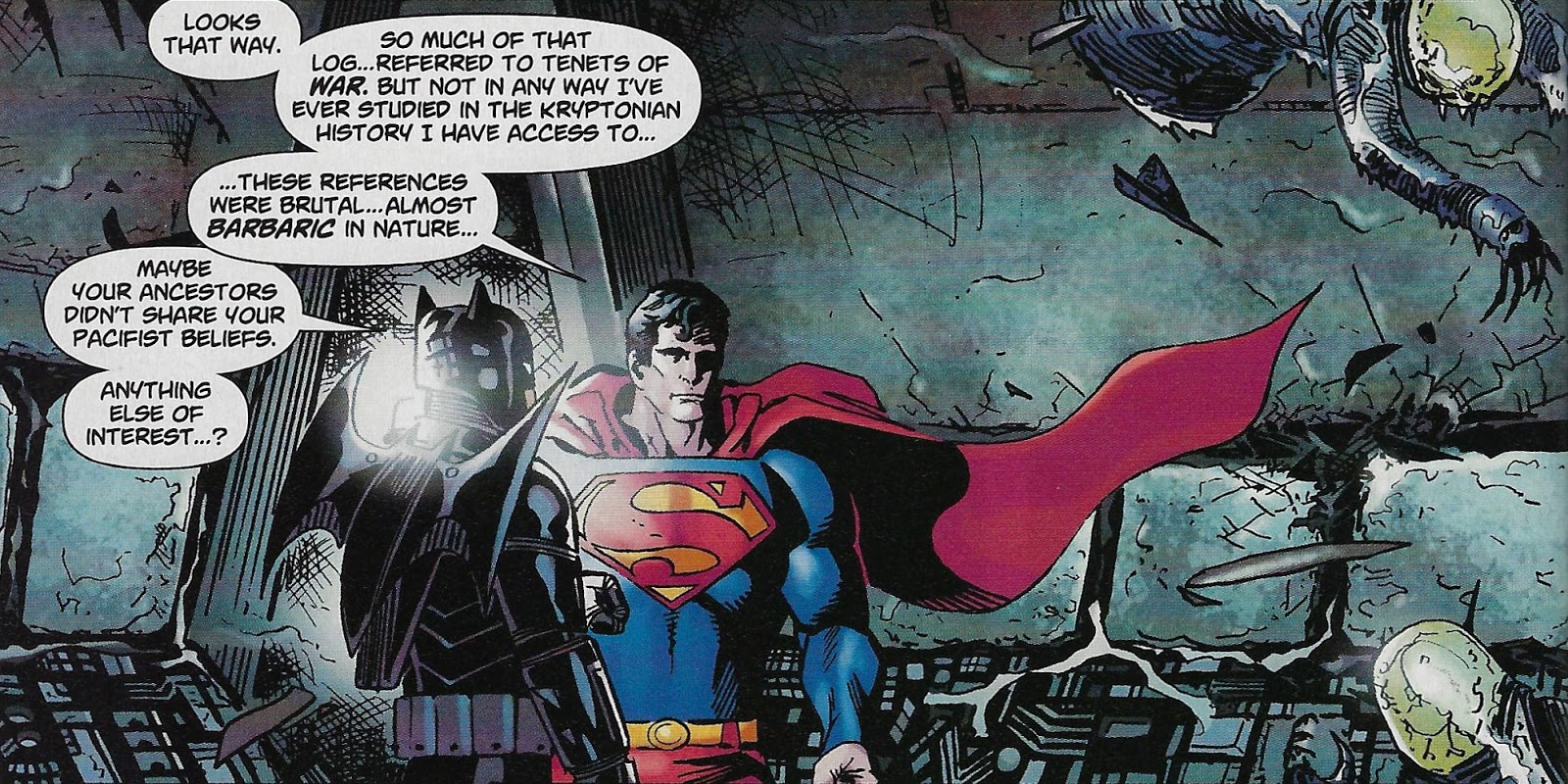
from Superman/Batman #64 (art by Scott Kolins)
It's okay, bordering on meh. It's very much a prelude, and very much an example of overly decompressed comics. We see a spaceship in the time of ancient Krypton fight another Kryptonian spaceship that's been taken over by aliens... then we jump ahead to the present where the commandeered Kryptonian ship is found abandoned in the asteroid belt by Batman and Superman, who realize an escape pod means one of the alien hijackers is on Earth. The whole thing probably could have been done in 5-10 pages, or maybe have even just been implied backstory. Seeing it all happen in detail is kind of pointless.

As for placement, I think I got it wrong. While the main Big Noise series definitely goes where I guessed (as of this writing, I've read three of its four issues), the prelude takes place earlier. I'm deducing that it goes before Return to Krypton, as some of Superman's dialogue makes me think he has not yet ever been to Krypton; for example, he says, "seeing their [his people's] fate...and my inability to do anything about it except bear witness to the aftermath... time and time again... that's been my primary relationship with my own heritage." Those do not sound like the words of someone who travelled back in time to before the disaster and actually averted it (even if it was a Phantom Zone projection)! So, I am retroactively slotting it between Adventures #588 and #589 in my reading order.

ACCESS AN INDEX OF ALL POSTS IN THIS SERIES HERE

26 February 2018

Review: Threshold: The Hunted by Keith Giffen, Tom Raney, Phil Winslade, Scott Kolins, et al.

Comic trade paperback, n.pag.
Published 2014 (contents: 2013)

Acquired December 2016
Read January 2017
Threshold, Volume 1: The Hunted

Writer: Keith Giffen
Artists: Tom Raney, Phil Winslade, Scott Kolins, Andrei Bressan, Timothy Green II, Joseph Silver
Colorists: David Curiel, Andrew Dalhouse, John Kalisz, Chris Sotomayor
Letterers: Dave Sharpe, Dezi Sienty

Threshold was DC's first attempt at a "New 52"-era space-based ongoing comic, and The Hunted is its first and last volume. Threshold is the creation of Keith Giffen, co-creator of two 1980s space-based DC ongoings, The Omega Men and L.E.G.I.O.N. I don't know why it's called Threshold, but The Hunted is like the Hunger Games in space, sort of: it's a reality television series in Lady Styx's domain of Tolerance where political undesirables are forcibly enrolled. They have bounties placed on their heads, and are then let loose in Tolerance, and anyone who kills them gets the prize money. Anyone can take a shot, but popular groups of professionals have evolved. The longer you avoid being killed, the higher your bounty goes; L.E.G.I.O.N.'s Stealth appears as a long-time survivor of the games. The main character is Jediah Caul. Caul is a Green Lantern who sells out a trio of other "spectrum warriors" (purple, blue, and yellow) to The Hunted, but when they escape the game, Styx's people replace them with Caul.

Caul's not a very nice guy, and we watch him try to survive as he encounters 21st-century reworkings of a lot of old-school DC space characters, like Space Ranger and Tommy Tomorrow and Captain Carrot and Star Hawkins and the Star Rovers. Plus characters like the Blue Beetle show up, too. This was what made the book difficult for me: there was a lot to keep track of, and given that these characters were mostly created in the 1950s, most of them were generic white dudes. It seemed like there were too many for Keith Giffen to keep track of, too, as ideas and characters would be set up that went nowhere, or popped up sporadically.

Captain Carrot is about the worst partner one could have.
from Threshold #2 (art by Tom Raney)

I just could never get into the book as much as I would have liked. Too many characters, a premise that came across as both thin and overegged, a main character I never really enaged with, and too much sub-Firefly future slang that reminded me of the kind of thing Kris Straub parodied in Starslip. That's not to say it was bad: I liked Captain K'rot, and the whole Brainiac subplot was kind of interesting, but at times it was a slog that didn't seem to be going anywhere.

That said, there were two things I enjoyed. The first is the Star Hawkins backups, ten-page strips about what Tolerance's worst P.I. and his robot secretary (who has the mind of his ex-wife) are up to while Caul's on the run. They have some legit laugh-out-loud parts:
With friends like this, who needs enemies?
from Threshold #6 (art by Timothy Green II & Joseph Silver)

The other was the last issue, where Giffen provides a meta-commentary on the whole series by cancelling The Hunted. Blue Beetle even shows up to complain he didn't have anything to do with anything:
Between writing this review and making this scan is when I began reading Blue Beetle, so now I feel even more sorry/annoyed about his treatment here.
from Threshold #8 (art by Tom Raney)

And a spin-off is proposed, disposed of on the second-last page, a new spin-off is proposed and disposed of on the same page!

What is that font used in the last two captions, and why does the world consider a sci-fi font? DC and IDW both use it on their sci-fi titles pretty consistently.
from Threshold #8 (art by Tom Raney)

The sheer brazenness of the last issue made it hugely enjoyable, especially the way Giffen dovetails the last Star Hawkins backup into the main story, but I think if the best part of your comics series is the issue where you complain about being cancelled, you kinda had a problem from the very beginning.

11 January 2017

Faster than a DC Bullet: Project Crisis!, Part LIX: The World of Flashpoint featuring the Flash

Comic trade paperback, n.pag.
Published 2012 (contents: 2011)
Borrowed from the library
Read September 2016
The World of Flashpoint featuring the Flash

Writers: Scott Kolins, Adam Glass, Sean Ryan, Sterling Gates
Artists: Joel Gomez, Scott Kolins, Rodney Buchemi & José Marzán Jr., Ig Guara & Ruy José, Oliver Nome & Trevor Scott
Colorists: Brian Buccellato, Mike Atiyeh, Artur Fujita, Stefani Rennee
Letterers: Sal Cipriano, Dave Sharpe, Carlos M. Mangual, Dezi Sienty

It seemed to me that the volume of The World of Flashpoint featuring the Flash would have the most to do with Flashpoint proper given that it features the Flash, which I think is why I read it last. Actually, it doesn't really shed that much light on Flashpoint. (I don't think so, anyway-- keep in mind I actually haven't read Flashpoint yet!) There's a short "Reverse Flash" story written by Scott Kolins (a longtime collaborator with Geoff Johns on The Flash) which seems to be laying some groundwork for what will come in Flashpoint, but also is somewhat redundant with the Reverse Flash story contained in The Road to Flashpoint (which was illustrated by Kolins). I'm not well-versed enough in Flash lore to know how much of what is contained here-- the Reverse Flash manipulates the Flash's childhood a little bit-- is new information, and how much is a reminder of old information. I did quite like Joel Gomez's artwork, however; it reminds me of Kolins, as well as other frequent Johns collaborator Francis Manapul, and the stuff featuring kid Barry Allen is especially cute.

You can't change history. Not one line! Except when you can.
from Flashpoint: Reverse Flash #1 (script by Scott Kolins, art by Joel Gomez)

The other story that seems to be directly tying into Flashpoint proper is "Kid Flash Lost," about young Bart Allen winding up in a dystopian future ruled by Brainiac alongside Hot Pursuit, who in Road to Flashpoint was an alternate-Earth Barry Allen, but whose equipment and identity has been taken by Patty Spivot, a forensic scientist who also appeared in Road to Flashpoint. This story doesn't take place in the world of Flashpoint like most other World of Flashpoint stories, but rather has Bart jumping through time, trying to find Barry Allen and help him put time back together. It's nothing incredible, but Sterling Gates writes a decent little story of an optimistic little kid maintaining his outlook in the face of a pessimistic universe and doing what he has to do to help his idol put things right, complete with Crisis on Infinite Earths throwback. I assume this will tie into Flashpoint in some way, like Bart shows up at the climax and tosses Barry some speed force. This seems to also be an ending point of Bart Allen, a character I don't know much about, but do know was sorely mishandled in the period between Infinite Crisis and Flashpoint.

By the time I write this caption, I have read Flashpoint. This has nothing to do with anything. I guess it happens between panels.
from Flashpoint: Kid Flash Lost #3 (script by Sterling Gates, art by Oliver Nome & Trevor Scott)

The other three stories here are mostly just more glimpses of the alternate world of Flashpoint, and I didn't find any of them terribly interesting. "Citizen Cold" shows us that in a world without the Flash, Captain Cold is instead "Citizen Cold," hero of Central City, but despite some quality Scott Kolins art (he also writes the story), the story doesn't really say anything interesting: the alternate Cold is still an asshole who is cruel to women.

The Hero of Central City.
from Flashpoint: Citizen Cold #1 (script & art by Scott Kolins)

Even more unpleasant to read is "Legion of Doom," one of those World of Flashpoint stories that's basically just about how cruel people are in the world of Flashpoint. Like, do I really need three issues of this gross shit? It is nice to get a glimpse at how heroic Cyborg is in this world (he's been a side character in tons of these stories, but this is the closest he gets to the spotlight), but other than that this tale produces little of value.

The same goes for "Grodd of War," where we learn Grodd's gorillas control all of Africa in the Flashpoint timeline. It's most more gratuitous, uninteresting violence.

So, in the end, the balance of this collection is a little odd: two stories (four issues) that might or might not add something to our understanding of Flashpoint, three stories (seven issues) that seemingly don't, and none of them are really standouts. At this point, though, I just want to get to the real deal!

Next Week: Finally! The main event is upon us! A race against time to solve the mystery of the Flashpoint!

23 December 2016

DC's 2011-12 My Greatest Adventure Revival: A Brief Return into Space


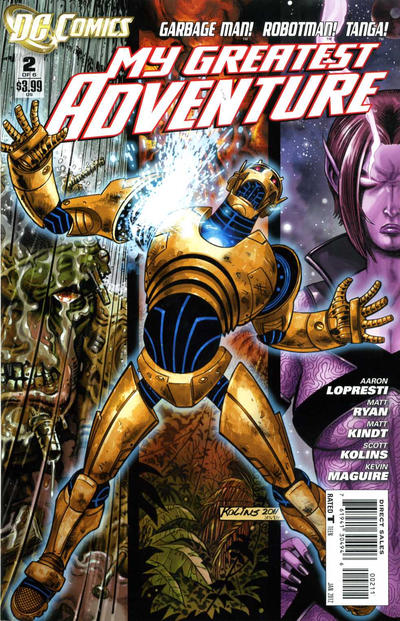
The original My Greatest Adventure was an anthology comic from DC that ran for 85 issues, from 1955 to 1964. In issue #80, the Doom Patrol (a group of superpowered misfits) became the focus of the book, and with issue #86 the book was retitled Doom Patrol. The Doom Patrol book lasted until #124, and the book's been revived many times since. My Greatest Adventure, however, remained moribund from 1964 until 2011, when it was brought back as a six-issue follow-up to Weird Worlds. Like Weird Worlds, each issue of My Greatest Adventure contains ten pages apiece of three features. Garbage Man and Tanga return from Weird Worlds, while My Greatest Adventure replaces Lobo with Robotman, who was in fact one of the original members of the Doom Patrol back in 1963.

Like with Weird Worlds, I'm reading it as part of my mission to read all of DC's non-Green Lantern space comics, as Tanga takes place in space.

Robotman (written by Matt Kindt, art by Scott Kolins, colors by Mike Atiyeh, letters by Jared K. Fletcher)

I've never read a Doom Patrol comic, so I don't know what here is preexisting and what is new by Matt Kindt. Kindt depicts a Robotman who's left the Doom Patrol and set himself as a sort of high-tech troubleshooter. Robotman was created when a daredevil's body was destroyed in an attempt to set a new landspeed record, and nanites created a robot body for his brain; his assistant is same woman assigned to him for the landspeed record attempt by the mysterious U.N.R.E.A.S.O.N. organization, who feels responsible for his accident.

Kindt flirts with interesting ideas here: mind/body dualism seems to drive his take on the character of Robotman, whose body must obey Asimov's Three Laws of Robotics, but whose mind is under no such obligation. But I don't think the story ever did much with that concept. In this story, he investigates creatures created by the same nanites that created him, and returns to the island of his accident. Part six doles out some interesting revelations-- but by then the story's over! So it's oddly paced, especially given that part six's big revelations are mostly given by Robotman in narration, not in actual dialogue. Less time on the giant monster fights in earlier installments could have balanced this one out a bit better.

That said, I'm falling in love with Scott Kolins as an artist, having recently encountered his work on The Flash with Geoff Johns a couple times. He draws a great Robotman (Robotman's form can change as the nanites rebuild him to suit his current situation), amazing Kirbyesque monsters, realistic-looking but attractive human beings (I really liked the appearance of Robotman's human assistant), and ornate-but-eminently-readable layouts. This feature had the best art in a book of good artists doing excellent work.

from My Greatest Adventure vol. 2 #4

Garbage Man (story and pencils by Aaron Lopresti, inks by Matt Ryan, colors by John Kalisz, letters by Jared K. Fletcher)

This continues the story begun in Weird Worlds, with Garbage Man returning to Gotham to investigate the crooked law firm that had him bumped off, seek revenge, reunite with his old flame, fight with Batman, and battle mysterious monsters in the sewers. I guess you can't say that Aaron Lopresti doesn't pack it into his ten-page installments! The premise clicked a bit better for me here than it did in the first six parts; I like the idea of the scumbag high-powered lawyer becoming the protector of Gotham's homeless. The pacing was better in this half of the story, too, and I was so sure there was going to be a certain twist I ended up surprised by the lack of one.

Lopresti's unity of art and story continue to impress, though the whole thing still seems to be a bit too much Swamp Thing; the "twist" that does happen is one that Alan Moore did with Swamp Thing back in the 1980s! The end sets us up to expect more adventures for Garbage Man, but to my knowledge, this was the character's final appearance.

Tanga (story and art by Kevin Maguire, colors by Rosemary Cheetham, letters by Jared K. Fletcher)

Similarly, this story was the last appearance of Kevin Maguire's free-spiriting space adventurer Tanga, even though the story ends with her flying off into space for more hijinks and also indicates there's some mysteries behind the character.

Like with Garbage Man, this half of the story hangs together better than the half in Weird Worlds, as the secret of Za is revealed. I'm not so keen on making female characters overcome sexual threats to prove themselves-- it seems very limiting-- but other than that I enjoyed this. Maguire always does great stuff with facial expressions, and an outraged Tanga gives him a lot to play with. The events of the last part were very good, too, being a lot more downbeat than I expected, and giving some tragedy to the otherwise exuberant Tanga. It seems like it would be easy to work Tanga in as a guest star in another space-based book even if she's not going to get her own feature again, but then again, I suppose there haven't been very many DC space heroes books post-Flashpoint that she could appear in.

07 December 2016

Faster than a DC Bullet: Project Crisis!, Part LIV: The Flash: The Road to Flashpoint

Comic hardcover, n.pag.
Published 2011 (contents: 2011)
Borrowed from the library
Read July 2016
The Flash: The Road to Flashpoint

Writer: Geoff Johns
Artists: Scott Kolins, Francis Manapul
Colorists: Brian Buccellato, Michael Atiyeh
Letterer: Sal Cipriano

You might have expected Final Crisis to be the end of my reviews of DC's Crisis books. It was, after all, about the Final Crisis, and thus far, DC has actually kept to that claim. But there have been a couple events since that seem to be Crises in all but name, so I'll be tackling those next, starting with Flashpoint.

This is the lead-in to Flashpoint, featuring the Flash. The Barry Allen version, recently returned from beyond the grave during the Final Crisis, and slipping back into his old life. The book opens with a standalone story about Professor Zoom, a.k.a. the Reverse-Flash, and for me, this was the most effective part of the book, a creepy tale of an obsessed man rewriting his timeline to make himself the man he was, removing any obstacle to his goals. I don't think I've read anything substantive with the Reverse-Flash before (he did turn up in some of the Infinite Crisis tie-ins, I think), but I enjoyed this.

That said, that's not how professorships work, Geoff Johns.
from The Flash vol. 3 #8 (art by Scott Kolins)

The rest of the book is less focused. Barry is having trouble settling back into his old life now that's he's undead. (Former sidekick Bart is also undead, thanks to the events of Legion of 3 Worlds. I think Wally West is also resurrected? Didn't he die during the Infinite Crisis?) In the meantime, a Barry Allen from one of the other 51 Earths has appeared in Central City, riding a motorcycle around, plus there are some murders. To be honest, the contours of all this were a bit vague. I wasn't sure what Barry was doing that was so bad it required an intervention, and the book's superhero plot was pretty simple. Guess what: the mysterious newcomer in town is the murderer. Then at the end, Zoom turns up, there's a lot of shouting, and a mysterious lightning bolt indicates the coming of Flashpoint.

C'mon, Barry, you were the first person to ever breach the vibrational barrier. Aren't you used to this by now?
from The Flash vol. 3 #10 (art by Francis Manapul)

I hope that when I read Flashpoint, the point of much of this will be more apparent. I must say, I did really like the artwork from Scott Kolins and Francis Manapul, which was human and dynamic, and the coloring is above average as well.
Good use of white space. (Yeah, that might sound sarcastic, but I mean it.)
from The Flash vol. 3 #11 (art by Scott Kolins)

Next Week: Meanwhile, in another universe: we step into The World of Flashpoint featuring Wonder Woman!

16 March 2016

Faster than a DC Bullet: Project Crisis!, Part XLVII: Final Crisis: Rogues' Revenge

First off, my ongoing attempt to catch up on audio reviews continues, with The Diary of River Song: Series One at Unreality SF.

Secondly, for months now, you've been reading (whoever you are, dear reader) comics reviews written months after I read the comics in question, and since I get them from the library, usually without the comic in question to hand. That all changes today! Even though this review didn't appear until March 2016, I actually wrote it in July 2015, immediately after finishing the book. This means, I hope, better reviews with more detailed commentary.

Comic hardcover, 144 pages
Published 2009 (contents: 2002-08) 

Borrowed from the library
Read July 2015
Final Crisis: Rogues' Revenge

Writer: Geoff Johns
Penciller: Scott Kolins
Inkers: Scott Kolins, Dan Panosian, Doug Hazlewood
Colorists: Dave McCaig, James Sinclair
Letterers: Nick J. Napolitano, Gaspar Saladino, Kurt Hathaway

This is the last of the during-Final-Crisis tie-ins in my readthrough-- there are still some "aftermath" titles to review, though. Like Legion of 3 Worlds and Revelations, this story seems to primarily be using the events of Final Crisis as an excuse to catch up with some other characters, the basic hook here being that Libra is trying to recruit the Flash's Rogues Gallery into his organization (this is before Libra is revealed as the herald of Darkseid), but the Rogues want nothing of it: they just want to lay low, since they're still on the run for the murder of the Bart Allen Flash. They plan to take out Inertia, the evil speedster who co-ordinated their murder of Allen.

I don't have much familiarity with the Rogues, unlike the characters featured in Legion of 3 Worlds and Revelations, which definitely hindered my enjoyment of the story; all I really know about them comes from their appearances in Countdown to Final Crisis (where they're also on the run for Bart's murder). In reading Rogues' Revenge, I felt like I was on the edge of reading a good story, it was just that I didn't have the emotional investment in these characters that the story wants you to have. Johns doesn't do much to introduce the reader to them, but rather throws you in at the deep end of their characterizations and histories. What I did grasp had me interested: these are a group of messed-up criminals, to be sure, but they're people, not supervillains cackling and trying to take over the world. Captain Cold especially is put through the emotional wringer here, but he seems to emerge the stronger for it. You do get those Geoff Johns splash pages that seem designed to excite someone who knows more than me; "I'm Kid Zoom!" shouts Inertia triumphantly, as if that has some kind of intrinsic significance.

Scott Kolins's art is very good; he does interesting things with panel layout that are occasionally hard to follow, but usually work well in establishing the oppressive tone of the book; it's really on tone where this books succeeds, between Kolins's art and Dave McCaig's colors, everything is appropriately gloomy. There's the occasional flashback scene that's not clearly marked as such, but if such a technique is good enough for Chris Ware, then I'm sure Johns and Kolins can use it too. The pasts of the Rogues very much live on in their presents.

There are two extra stories in the back of the book, "Absolute Zero" and "Rogue Profile: Zoom," which lay out histories for Captain Cold and Zoom, respectively, both reprinted from Johns and Kolins's 2000-05 run on The Flash. I ought to have read them first, as they make stuff in the main story much more clear. I have Johns's Flash Omnibus volumes on my shelf, waiting to be read; perhaps I'll reread Rogues' Revenge once I have the grounding in Flash lore the story obviously expects.

Next Week: We finally move to the aftermath of the Final Crisis, and it's time to Run!