Showing posts with label creator: mike wieringo. Show all posts

22 January 2020

Joe Casey's Adventures of Superman: Final Post and Reflection

from The Adventures of Superman vol. 1 #594
(art by Mike Wieringo & Lary Stucker)
What makes a good run?

This is the question I'm trying to answer, but I think it requires us to step back and ask another question first: What makes a run?

People always talk about "runs" in comics, but I think we're talking about a couple different things.
1. When a single creator or creative team defines a character or title from beginning to end. Good examples of this would be Neil Gaiman on The Sandman, Matt Wagner/Steven T. Seagle and Guy Davis on Sandman Mystery Theatre, James Robinson and Tony Harris/Peter Snjejbjerg on Starman, Roy Thomas on All-Star Squadron, Walter Simonson on Orion. Though most of those titles had existences outside of those creators, there are versions of those titles entirely defined by those creators. There was a Sandman vol. 1 and a Sandman before Neil Gaiman, but every issue of Sandman vol. 2 was written by him. The character of Orion existed before Walter Simonson, but the comic book called Orion was primarily his work as writer and artist. 
2. When a creator or creative team takes over a character or title, but that character/title extends beyond that creator. Here I'm thinking things like Geoff Johns's The Flash vol. 2 #164-225, George Pérez's Wonder Woman vol. 2 #1-62, Paul Cornell's Action Comics vol. 1 #890-904, Judd Winick's Green Arrow vol. 3 #26-75/Green Arrow and Black Canary #1-14. There were 163 issues of The Flash vol. 2 before Geoff Johns and another 22 after him; Geoff Johns was just there for a time.
    from The Adventures of Superman vol. 1 #596
    (art by Mike Wieringo & Jose Marzan, Jr.)
    But you can identify another way of looking at a "run":
    A. The telling of a discrete story with a beginning, middle, and end. Brian Michael Bendis and Michael Gaydos's Alias, for example.
    B. When a writer is just in charge of a character/title for a while. There's no "climax" to the run-- it's just a series of stories. Mark Waid's The Brave and the Bold, or Gail Simone's Birds of Prey. This doesn't mean that there are no arc elements, just that there's not One Big Story being told.
    Of course, there's certainly a midpoint between type A and type B. Cameron Stewart and Brendan Fletcher's Batgirl vol. 4 #35-52 is a good example of this, as it (as I recall) tells three discrete stories, but each one leads into the next. Or there's the Mark Waid and Barry Kitson run on Legion of Super-Heroes, which tells two over-arching stories.

    from The Adventures of Superman vol. 1 #600
    (art by Mike Wieringo & Jose Marzan, Jr.)
    So these two typologies overlap. I could draw you a chart with four quadrants if I wanted, but I'll just make a list of examples:
    • 1A. Single Title, Single Story: Gaiman's Sandman; Brian Michael Bendis and Michael Gaydos's Alias; Tom King and Gabriel Hernandez Walta's The Vision
    • 2A. Partial Title, Single Story: Brian Azzarello and Jim Lee's Superman; Don McGregor and P. Craig Russell's Killraven
    • 1B. Single Title, No Overarch: Matt Wagner's Sandman Mystery Theatre; Paul Cornell's Captain Britain and MI13
    • 2B. Partial Title, No Overarch: Paul Cornell's Action Comics; Gail Simone's Birds of Prey; G. Willow Wilson's Ms. Marvel; Walter Simonson's Thor
    Okay, why do I bring all this up? Because I think comic fans and comic critics tend to prioritize type-1 runs and type-A runs. Obviously a type-1A is the best: a single creative vision, no extraneous stuff you have to disregard (imagine if there was a Sandman vol. 2 #76 by John Ostrander!), a a beginning, middle, and an end. It's hugely satisfying to read and discuss-- comics at its best. Type-2A and -1B runs aren't quite as good, but they're still very good. You either get a complete creative vision or a complete story.

    from The Adventures of Superman vol. 1 #602
    (art by Pete Woods & Jose Marzan, Jr.)
    In the era of the collected edition, the type-1A is king. You can get a nice set of Sandman volumes, an Alias Omnibus, and a complete Vision hardcover. 2A doesn't do too badly. Azzarello and Lee's Superman fit nicely into two trades. Both type-B variants fare less well. DC has fizzled out doing a run of SMT collected editions twice now; you can get all of Paul Cornell's Action Comics in trade, but I doubt there will ever be an omnibus.

    But then type-2B runs languish at the bottom of what we appreciate. This is, perhaps, silly on the face of it. People love Simone's Birds of Prey and Wilson's Ms. Marvel. But I think it casts its effect on the way you read it. It's a little tough to get into Birds of Prey because these characters have some not-quite-explicated history. The whole run kind of fizzles out without a climax if you leave when Simone does. On the other hand, if you keep going, Tony Bedard takes over, and he maintains some stuff, but up-ends the status quo in other ways.

    from The Adventures of Superman vol. 1 #610
    (art by Derec Aucoin)
    And Joe Casey's Adventures of Superman is probably more type-2B than most 2Bs! There's no one big story here; in fact, Casey's run was often in service to other people's stories. In the 35 issues of his run, eight were part of crossovers with other Super titles, not to mention that there were two other fill-ins, and one issue wrapped up the previous writer's story arc. That's almost a third! What was left was not telling one big story; the closest the run got to that was #612-16, just five issues. 

    And Adventures of Superman had a long history before and after Casey wrote it. (His run was #588-623; Adventures of Superman ran from #424 to 649, plus before and after that, it was just called Superman vol. 1, which ran from #1 to 423 and 650 to 714. He's just a drop in the bucket!) His run begins by trying up someone else's, as I said, and the early parts of the run in particular are very dependent on you knowing what Superman had been up to in Action Comics, Superman, and The Man of Steel. He's happily married to Lois, he's on a break, they're together; he's happily employed, he's fired from the Daily Planet, now he's not.

    from The Adventures of Superman vol. 1 #612
    (art by Derec Aucoin)
    It just doesn't satisfy as a cohesive unit. I wanted it to. I felt like there's a really good story to be told about Superman's growing uncomfortable with the amount of power he possesses and what he does with it... but this, to be honest, isn't it. It's jumpy, it's not always in focus, and the thread doesn't come to a climax so much as a stop.

    But is this fair? Am I judging a type-2B run by the standards of a type-1A? Why should the best comic book runs be ones where a single creator tells a single story? Isn't that just the imposition of a certain kind of storytelling that came into vogue in the late 1980s? Comics didn't do that for fifty years prior. Maybe I should be judging Casey's run by what it was actually trying to do (telling interesting individual Superman stories focusing on his power while weaving in and out of Big Events), not what I wanted it to do.

    Type 1 isn't better than type 2; type A isn't better than type B. They're just different ways of writing comic books, with their strengths and weaknesses.

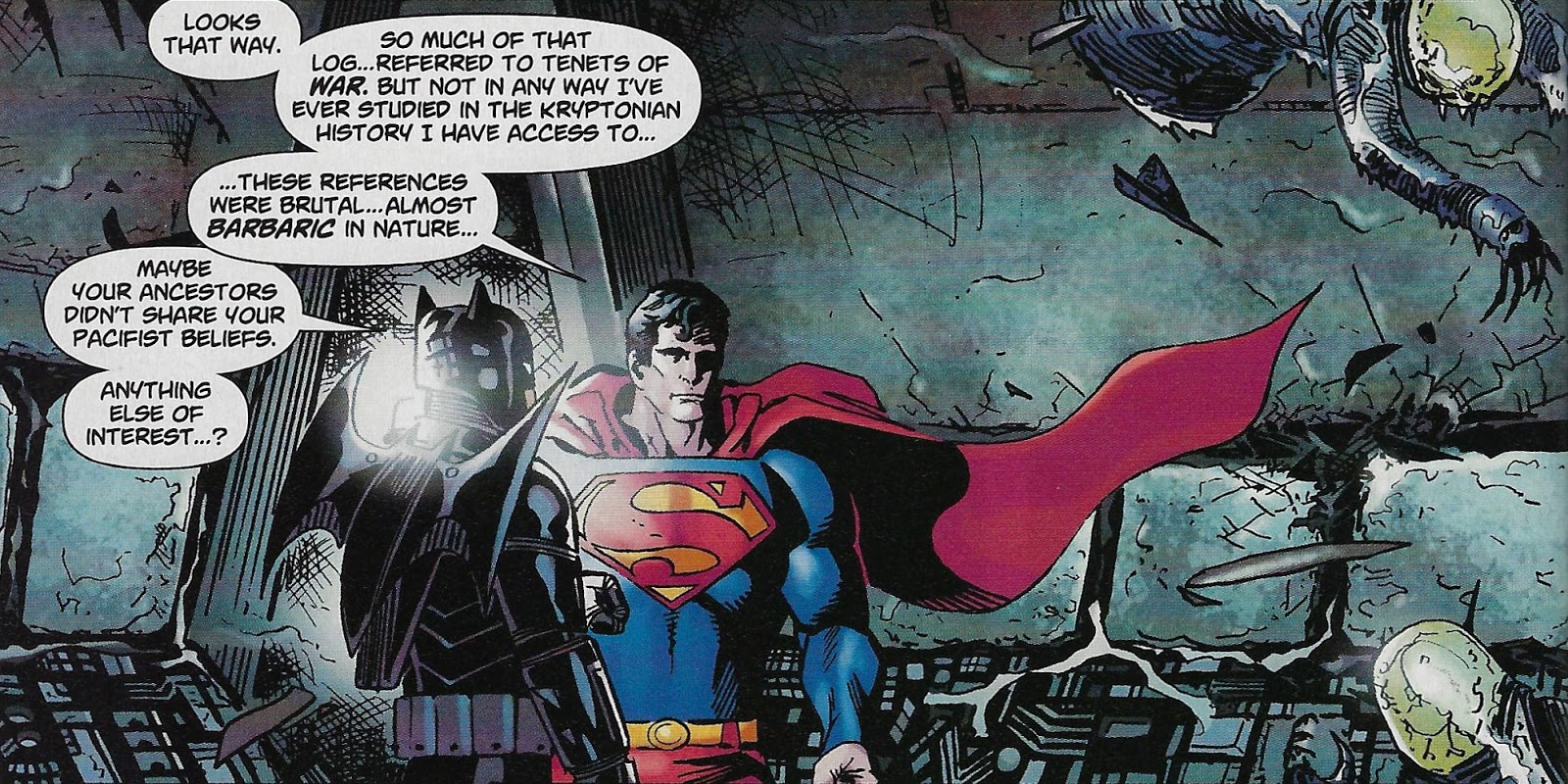
    I think what bothers me, though, is that the part of this type-2B run with the most potential to take off was often the most frustrating. The set of stories where Superman is a pacifist didn't work for me! Casey sets out a great challenge for himself: to tell Superman stories where he can't win through force. Yet the ways he does win often seem as arbitrary as the fact that he's always the strongest guy around. Many of the run's later issues invoke great ideas, but fail to climax satisfactorily (e.g., #603-05, 614-16, 617-18, 619-20, 621-22). I love of a lot of the premises here, but too often Superman doesn't do anything that feel brave or clever, and instead he wins just because. Plus, I really wish there had been a story that tested his pacifism. (Ending Battle is kind of this, but it felt hollow, and it actually comes before he's a pacifist!)

    from The Adventures of Superman vol. 1 #619
    (art by Derec Aucoin)
    Indeed, if I list the individual issues I liked the most, most of them, though not all, come from early in the run (e.g., #590, 594, 596, 599, 600, 608, 610). I feel like Casey did some of his best work when he was constrained by the overall plan of all the Super titles. Maybe because he couldn't tell complete stories based on external conflicts (as those ran across the Super titles), so he had to settle for stories based on internal conflicts purely (as those he could handle in a single issue on its own). Or maybe he just wasn't that good coming up with Superman plots on his own, but as part of a group doing it, he was just fine.

    I don't know. This makes it seem like I really didn't like the run, and while I did groan my way through both Return to Krypton stories and The Harvest and big chunks of Our Worlds at War, most of my problems with those stories can't be laid at Casey's feet.

    When he was writing, I was enjoying what I was reading more often than not. Casey himself has a good grasp on Superman as a person, and on the sense of humor and playfulness a good Superman story should engender. It reminded me of All-Star Superman in that regard, without being quite so on the nose about it. And both Casey's main artistic collaborators, Mike Wieringo and Derec Aucoin, were great in very different ways. I always like me some José Marzan, Jr., and it was nice to see early Pete Woods. And even if the story doesn't lead to a satisfying climax, there's a great continuity of theme: the stuff that will come into the open with Superman's pacifism in #616 is clearly layered at least as far back as #590, over two years earlier.

    from The Adventures of Superman vol. 1 #623
    (art by Derec Aucoin)
    This was solid Superman stuff on the whole.

    I guess I just feel like I was promised spectacular, and this isn't it. I think I went in thinking I was getting a type-1A run (even though obviously I couldn't be!) or perhaps a type-2A, and that's why a type-2B was doomed to disappoint me. If you read Casey's Adventures of Superman, judge it on its own terms as much as you are able.

    ACCESS AN INDEX OF ALL POSTS IN THIS SERIES HERE

    I link to my usual reading guide above. A couple thoughts on it now that I'm done:
    • Reading the Super title events that included Casey's Adventures (e.g., Return to Krypton, Our Worlds at War) was the right move even when I didn't enjoy them.
    • The Superman/Batman story Casey wrote in 2009-10 (The Big Noise) is utterly terrible and utterly skippable, but it you are going to read it, definitely read it where it seems to go chronologically (S/B #64 after Adventures #588; S/B #68-71 between Adventures #596 and 597). If you read it in publication order, it would be a very dismal way to go out. Chronologically, it just reads like another mediocre Super titles crossover.
    • Jay Faerber's fill-in (#607) was worth it.
    • The Joe Kelly stuff I added in (Lost Hearts, The Harvest, Hungry Ghost) mostly wasn't worth it, and it contradicts what Casey was doing in Adventures. I probably should have saved it for, say, a Traci Thirteen-focused read, if I had to read it at all.

    16 October 2019

    Joe Casey's Adventures of Superman #597-600: President Luthor and Other Celebrations

    "Rubber Crutch" / "Cult of Persuasion (prologue)" / "Borba za Zhivuchest" / "A Lex" / "The Dailies 2002"


    The Adventures of Superman vol. 1 #597-600 (Dec. 2001Mar. 2002)

    Writer: Joe Casey
    Pencillers: Derec Aucoin, Mike Wieringo, and Mauricet 

    Inkers: Derec Aucoin and Jose Marzan, Jr.
    Colors: Rob Ro & Alex Bleyaert and Tanya & Rich Horie
    Letterer: Bill Oakley
    Comic Strips: Jeph Loeb & Tim Sale, Mark Schultz & Dave Gibbons, and Joe Kelly & Carlos Meglia
    Assistant Editor: Tom Palmer, Jr.
    Editor: Eddie Berganza 


    In early 2002, the Super titles changed their approach. Though there would still be stories that spanned all four series, they would be less frequent. (I think there are just three more during Joe Casey's time on Adventures of Superman.) Issues #596-605 therefore make up our first stretch of any length of issues just by Joe Casey (though #597 is a tie-in to a Batman event, Joker: Last Laugh), allowing his own writerly voice to begin to emerge; today I'll be dealing with the first half of that run.

    from The Adventures of Superman vol. 1 #599
    (art by Derec Aucoin)
    In the better issues, Casey seems interested in probing the limits of Superman's power. Not in terms of finding bigger physical threats, but in terms of figuring out what he can't do or what he doesn't want to do. The two best issues are therefore "Borba za Zhivuchest" (#599) and "A Lex" (#600). The former opens with a sinking Russian nuclear submarine; Superman flies in and saves it so fast that no one even sees him. Some time later, he follows up with the captain of the submarine, Gussev, a man whose job might be sailor, but whose identity is farmer. Thanks to a bit of heroism he pulled during the disaster, Gussev is now dying. Of course, Clark Kent empathizes with a man who thinks that a farm is the best place on Earth.

    I think it's probably not very surprising how things play out, but it is touching. Superman admits to Gussev that he is from a farm in Kansas: "it's the place where I have always found peace... it is where my family lives... that land is my heart as well..." The captain talks about being a farmer shaped his worldview: "We work the land... it becomes a part of us. And so... we see the Earth as a whole... we don't see borders..." Superman can't save this man's life, but he is able to do a couple things for him as he dies. I like it when Superman stories emphasize that being Superman isn't just about fighting bad guys, but about helping little guys in all sorts of ways. My preferred Superman is the one who can take a day out to keep a man company as he passes away.

    from The Adventures of Superman vol. 1 #600
    (art by Mike Wieringo & Jose Marzan, Jr.)
    I also really enjoyed "A Lex." President Luthor goes missing, and Vice President Pete Ross asks Superman for help. Superman, of course, doesn't want Luthor to be president... but Pete says that Luthor really cares about America. Superman knows that the right thing for the country is to bring him back. Or does he? Casey rotates between Superman searching for Luthor, Clark visiting Lois to discuss his doubts, and a mysterious new criminal leading the downtrodden of Metropolis in an uprising against corporatism.

    from The Adventures of Superman vol. 1 #600
    (art by Mike Wieringo & Jose Marzan, Jr.)
    I like that it shows Superman as someone who struggles with doing the right thing... not in that Superman wouldn't do the right thing, but in that it's not always clear what the right thing is. I also like how the story ends; the new criminal is Luthor, of course, wearing a toupee and without his memory. Superman saves him, partially thanks to Talia al Ghul, who's running LexCorp while Luthor is president; she gives Luthor his daughter, shocking him back to normal. (Lena is an infant here, but last time I saw her, in Our Worlds at War, she was a Brainiac-enhanced adult; I guess this is one of those things you just gotta roll with in comics.) At the end of the story, we find out that Luthor liked being a sewer-dwelling supervillain: "I almost had it... I was free...! Wealth... political power... nothing can match the intoxication of... that freedom... Why couldn't you just leave me alone...?!" We're just about a year away from Public Enemies, where Luthor ditches the presidency to wreak havoc in a battllesuit. I didn't like that turn in that storyline when I read it back in the day, but we're clearly setting it up here.

    There's also some references to the Ricard Donner Superman films; this kind of thing can be overdone, but here it was a nice touch, reminding you of what another kind of Luthor could be at a time where Luthor had been a "respectable businessman" for almost two decades of publication.

    from The Adventures of Superman vol. 1 #597
    (art by Derec Aucoin)
    On the other hand, Casey is weaker when he attempts straight action stories. In "Rubber Crutch" (#597), Luthor is infected by Joker venom and goes mad (remember when beginning your re-election campaign only one year into your term was a sign of madness?); Superman has to stop him from destroying the Earth with nuclear launch codes. There's some okay political jokes, but it's all pretty perfunctory otherwise.

    Issue #598 is the prologue to Cult of Persuasion, a storyline that will appear in #601-02. I found it confusing and undramatic. Apparently removing the futuristic Brainiac 13 technology from Metropolis increases the use of automation? Seems counter-intuitive. It's not really clear to me why a group of disgruntled workers decide to pattern themselves after a member of the Legion of Super-Heroes's Fatal Five, even if footage of Superman fighting with them is replayed on television. Hopefully the full storyline is better.

    from The Adventures of Superman vol. 1 #600
    (art by J. G. Jones)
    In addition to all of this, Adventures #600 has some backmatter in honor of its milestone status. (Note that the title being celebrated here was actually just called Superman from issues #1 to #423; in January 1987, it was retitled The Adventures of Superman so that DC could have a new Superman #1 but not lose the numbering of the original title.) There's a page of three "comic strips," the conceit being we're reading a single daily installment of three different newspaper comics: The Daily Planet, Super-Commander KentIn the 7th Millennium!, and The Most Bizarro Case of All. They're cute glimpses of what could be-- I want to read an actual story where Harley Quinn goes undercover at the Planet and Jimmy Olsen falls for her-- and worth it for the art. Work by Dave Gibbons and Tim Sale is always appreciated!

    Finally, #600 contains a set of pin-ups covering key moments in Superman's life. Pin-ups often feel like padding to me, and this is a below-average set, alas, but there are still some nice ones. J. H. Williams & Mick Gray's and John Cassaday's were the two best.

    Issues #598 and 600, by the way, mark the last work of regular penciller Mike Wieringo on the title. I don't think I ever said much about his work in this reviews, but I liked it. He was at his best when Casey was writing Superman as heroic and/or uplifting. On the other hand, I don't think he was always suited for Casey's take on the darker sides of the character. Just within this stretch, for example, I thought he was a good fit for #600, but I would have put him on #599 as well, instead of Derec Aucoin, whose sensibilities seem better suited elsewhere.

    ACCESS AN INDEX OF ALL POSTS IN THIS SERIES HERE

    02 October 2019

    Joe Casey's Adventures of Superman #596: The Aftermath of Our Worlds at War

    "Shipbuilding" / "Prelude to The Big Noise: Three Months Away"


    The Adventures of Superman vol. 1 #596 (Nov. 2001)
    Superman/Batman #64 (Nov. 2009)

    Words: Joe Casey
    Pictures: Mike Wieringo and Scott Kolins
    Inks: Jose Marzan, Jr.

    Letters: Bill Oakley and Rob Leigh
    Colors: Michael Atiyeh
    Asst. Edits: Tom Palmer, Jr.

    Associate Editor: Adam Schlagman
    Edits: Eddie Berganza 


    Here we have two issues that follow up (or may have followed up) on Our Worlds at War. I'll tackle them in turn, because there's not much unity between them, aside from both being written by Joe Casey. "Shipbuilding" (Adventures of Superman #596) is a quiet issue, taking place as the world reconstructs following the devastation of the Imperiex War (I don't think anyone ever calls it that, but I need to call it something). While the JLA is stretched thin doing reconstruction, though, and President Luthor is making media appearances, Superman is largely sitting it all out: staying at home in his Clark Kent guise, watching the news. As the end of Our Worlds at War pointed to, he's questioning how is it all worth it if his parents can die.

    from The Adventures of Superman vol. 1 #596
    (art by Mike Wieringo & Jose Marzan, Jr.)
    It's not a funk that lasts long, though-- one conversation with Plastic Man and the Martian Manhunter, and Superman is back at it, fighting Flash villains in the Antarctic and saving a construction worker who tumbles off a dam. Luthor chastises Superman for not doing all the reconstruction himself, but Superman gives a speech about how "[h]umanity has to rebuild itself. If I do it for them, it means nothing." Luthor calls it "[c]onvenient," and I agree, though for more metatextual reasons. Superman can't rebuild the Earth because it would break the premise of Superman comics... but I feel like there must be millions of homeless and displaced people who probably would think it would still be quite meaningful if someone rebuilt their homes for them. As always, I feel like ongoing superhero comics are better off not calling attention to this problem than trying to explain it.

    Anyway, the construction worker whose life Superman saved comes to his defense, and Superman and Luthor both go back to doing what they do best. It's a fine issue; I'm glad we finally got some emotional fall-out to Our Worlds at War and I hope we get more going forward, but the trajectory of the whole thing was pretty predictable. It wasn't likely to end with Superman not being helpful, was it?

    from The Adventures of Superman vol. 1 #596
    (art by Mike Wieringo & Jose Marzan, Jr.)
    Two other points: 1) Superman debuts a new costume, where the yellow in his S-shield is replaced by black, presumably as a sign of mourning. I wonder how long this will last going forward. 2) This issue can be hella expensive on its own. At the time I purchased my complete run of Joe Casey's Adventures of Superman, the cheapest copy on MyComicShop was $20, for example. (It's since come down a little; it's $4.80 as of this writing.) Thankfully, I picked it up as part of a 29-issue set on eBay for $55, absorbing the cost. Anyway, this is apparently because it features an image of the smoking LexCorp Towers, which were damaged in Our Worlds at War. The LexCorp Towers are very obviously visually based on the World Trade Center... and this issue's cover date of Nov. 2001 means that it was actually distributed to comic shops on September 12, 2001! So it's become a sort of collector's item. But here's the panel; I just saved you $20. You're welcome.

    The other issue is Superman/Batman #64, the prelude to a Superman/Batman story arc called The Big Noise (#68-71), which I'll be reviewing next week. Joe Casey returned to Superman over five years after his run on Adventures was over to pen an additional story arc set during it. I only had a rough idea of when it was set when planning my readthrough, so I had to do some guesswork. The main Big Noise storyline is cover-branded "Our Worlds at War Aftermath!: Casualties of War!", leading me to place it after "Shipbuilding," and I guessed that the Big Noise prelude might fall between those.

    from Superman/Batman #64 (art by Scott Kolins)
    It's okay, bordering on meh. It's very much a prelude, and very much an example of overly decompressed comics. We see a spaceship in the time of ancient Krypton fight another Kryptonian spaceship that's been taken over by aliens... then we jump ahead to the present where the commandeered Kryptonian ship is found abandoned in the asteroid belt by Batman and Superman, who realize an escape pod means one of the alien hijackers is on Earth. The whole thing probably could have been done in 5-10 pages, or maybe have even just been implied backstory. Seeing it all happen in detail is kind of pointless.

    As for placement, I think I got it wrong. While the main Big Noise series definitely goes where I guessed (as of this writing, I've read three of its four issues), the prelude takes place earlier. I'm deducing that it goes before Return to Krypton, as some of Superman's dialogue makes me think he has not yet ever been to Krypton; for example, he says, "seeing their [his people's] fate...and my inability to do anything about it except bear witness to the aftermath... time and time again... that's been my primary relationship with my own heritage." Those do not sound like the words of someone who travelled back in time to before the disaster and actually averted it (even if it was a Phantom Zone projection)! So, I am retroactively slotting it between Adventures #588 and #589 in my reading order.

    ACCESS AN INDEX OF ALL POSTS IN THIS SERIES HERE

    25 September 2019

    Joe Casey's Adventures of Superman #595: Our Worlds at War: Casualties of War!

    Our Worlds at War: Casualties of War!: "The Red Badge of Courage" / "Kissing on the Apokolips" / "Escalation" / "Split Decision" / "War Letters" / "Total Abandon" / "Amazons! Attack!" / "Trial by Fire" / "Finale"


    The Adventures of Superman vol. 1 #595 (Oct. 2001)
    Superman: Our Worlds at War (2006), reprinting Action Comics vol. 1 #782, Impulse #77, Superboy vol. 4 #91, Superman vol. 2 #173, Superman: The Man of Steel #117, Wonder Woman vol. 2 #173, World's Finest: Our Worlds at War #1, Young Justice vol. 1 #36 (Oct. 2001)

    Writers: Jeph Loeb, Peter David, Joe Casey, Todd Dezago, Joe Kelly, Mark Schultz, and Phil Jimenez 

    Pencillers: Ed McGuinness, Bill Sienkiewicz, Todd Nauck, Mike Wieringo, Carlo Barberi, Pascual Ferry, Doug Mahnke, Phil Jimenez, Kano, Mark Buckingham, Yvel Guichet, and Duncan Rouleau 
    Inkers: Cam Smith, Bill Sienkiewicz, Marlo Alquiza, Jose Marzan, Jr., Juan Vlasco, Keith Champagne, Tom Nguyen, Andy Lanning, Walden Wong, Mark Morales, Wayne Faucher, Dexter Vines, Lary Stucker, and Duncan Rouleau
    Colorists: Tanya & Rich Horie, Jason Wright, Tom McCraw, and Patricia Mulvihill
    Letterers: Richard Starkings, Ken Lopez, Bill Oakley, and Janice Chiang

    Asst. Editor: Tom Palmer, Jr.
    Editors: Eddie Berganza, Joey Cavalieri, and Mike McAvennie


    from Superman vol. 2 #173
    (script by Jeph Loeb, art by Ed McGuinness & Cam Smith)
    The last third of Our Worlds at War, "Casualties of War!", kind of thuds to a close. The middle third of this storyline was definitely the best part. In theory, things should be winding up, but instead, the story piles on unnecessary and seemingly un-thought out twists and complications that it has no time to explore the repercussions of.

    At first, things get off to a good start. "The Red Badge of Courage" (Superman #173) kind of picks up from the end of All-Out War!, with Superman now voluntarily working for President Luthor (though at the end of All-Out War! he seemed very resigned and submissive, whereas here he's all confrontational), and still awkward around Lois. Superman leads a space expedition to destroy Imperiex with some American soldiers and Strange Visitor (back for the first time since Adventures of Superman #592), and this has some decent moments, though I thought it was a little cruel for the erstwhile Sergeant Rock to lecture Strange Visitor the way she did. She clearly did not ask for any of this, of course she doesn't know how it works!

    At the end of this issue, though, things begin to spiral out of control. Imperiex is destroyed, but Warworld (from all the way back in the first issue of this storyline) reappears and absorbs Imperiex's power. Brainiac 13 somehow fires on Apokolips using LexCorp Towers (though the art here in confusing; when I first read the issue I though Warworld was firing on LexCorp Towers and on Apokolips), and Darkseid declares war on Earth, ending the alliance. I'm not sure why Darkseid is so dumb in this moment.

    from The Adventures of Superman vol. 1 #595
    (script by Joe Casey, art by Mike Wieringo & Jose Marzan, Jr.)
    Superman goes to Apokolips to stop Darkseid, but is somehow surprised to learn Warworld is at fault even though we all saw it happen. Darkseid's son (?) Grayven says he's taking over Apokolips, but it's the worst conceived coup ever because Darkseid just shoots him with his eye-beams and throws him into a boom tube. Like, what did he think Darkseid would do?

    Then things accelerate even more. The last two Super titles issues here, Superman: The Man of Steel #117 and Action Comics #782, are more exposition than story, piling explanation upon explanation about who Brainiac 13 is, what his plan is, what Imperiex (not actually dead) is up to, how they are going to be defeated, and how they are actually going to be defeated when that doesn't work. So much stuff happens in these two issues that it mostly has to be explained in narration boxes, and loses all of its potential impact. Maxima breaks the alliance (why?), Steel comes back to life, Wonder Woman volunteers to throw Paradise Island at Warworld, Jimmy Olsen has some kind of computer powers, the Amazons worship Darkseid to revitalize his depleted powers, the heroes decide to send Warworld back in time to jumpstart the Big Bang(!), and more. It's all a bit too much, and a bit too messy to be enjoyable.

    A lot of things set up in the first third, "Prelude to War!", never really came into fruition. Like, why did the population of Metropolis have to be evacuated into space?

    from Superboy vol. 4 #91
    (script by Joe Kelly, art by Pascual Ferry & Keith Champagne)
    As always, there are a few issues of other titles sprinkled in here. Three star Young Justice and its members (Young Justice #36, Impulse #77, and Superboy #91). They were running medical aid missions during the space battle when they got sidetracked and crash-landed on Apokolips; the three issues follow their attempts to stay alive on the most inhopsitable planet in the universe. These are both fun and dark at the same time; I was surprised how much I liked them. I've never read any Young Justice before, but it's a group of well-meaning but often-at-odds characters trying to do their best, but often doing their worst, so of course I enjoyed them. The Superboy issue was particularly good (showing what's beneath his 1990s "attitude" as he writes a letter home from the war), but they're all good. The issues do feel pretty irrelevant to the big story, though, so I'm not sure why they're in here. I also wish the issue showing how they actually escaped Apokolips (Young Justice #37, I think) had been included, since as it is, their story just kind of stops, aside from a one-page appearance in the "Finale" epilogue.

    There's also an issue of Wonder Woman again, "Amazons! Attack!"* (#173), which makes sense as some pretty dramatic things in Wonder Woman's life happen. It's oddly placed, though (I would have moved it to after Action #782), and doesn't really answer the big question I had after reading Man of Steel #117: why would Wonder Woman make such a dramatic choice as to destroy her homeland so easily? On the other hand, the mental powers of Aqualad (I think that's who this "Garth" fellow is) prove key to the final battle... but were never mentioned before it. It might have been nice to throw in whatever the relevant issue of the relevant title was beforehand.

    from World's Finest: Our Worlds at War #1
    (script by Jeph Loeb, art by Ed McGuinness & Cam Smith)
    The story is technically over before its final issue. "Finale" (World's Finest: Our Worlds at War #1) is an epilogue, showing various bits of fall-out: mourning for Aquaman (I forgot he died, actually), a ceremony for Wonder Woman's mother, Mongal (!) taking over Warworld, Strange Visitor's husband being mad, and so on. It's fine. Jeph Loeb's schtick of running famous speeches over the action of this series has lost its impact, though.

    Overall, I feel like this series didn't live up to its potential. Too much spectacle, not enough humanity. The first third threw too many ideas out; the middle one had some great character hooks that never got followed up on because the last third got overtaken by the Big Action of the story. But it's possible the character moments will get followed up in Adventures of Superman going forward, which might redeem the story for me somewhat. We shall see!

    ACCESS AN INDEX OF ALL POSTS IN THIS SERIES HERE

    * Note the two exclamation marks, which most indexers on the Internet seem to have missed. "Amazons Attack!" is something else entirely.

    18 September 2019

    Joe Casey's Adventures of Superman #594: Our Worlds at War: All-Out War!

    Our Worlds at War: All-Out War!: "Death Be Not Proud" / "A Date Which Will Live in Infamy" / "The Doomsday Protocol" / "Chest Deep in Heroes' Blood" / "Thousand Yard Stare" / "Her Mother's Daughter"


    The Adventures of Superman vol. 1 #594 (Sept. 2001)
    Superman: Our Worlds at War (2006), reprinting Action Comics vol. 1 #781, JLA: Our Worlds at War #1, Superman vol. 2 #172, Superman: The Man of Steel #116, Wonder Woman vol. 2 #172 (Sept. 2001)

    Writers: Jeph Loeb, Joe Casey, Mark Schultz, Joe Kelly, and Phil Jimenez
    Pencillers: Ed McGuinness, Ron Garney, Mike Wieringo, Doug Mahnke, Kano, and Phil Jimenez
    Inkers: Cam Smith, Mark Morales, Lary Stucker, Tom Nguyen, Marlo Alquiza, and Andy Lanning

    Colors: Tanya & Rich Horie, Rob Schwager, and Patricia Mulvihill
    Letters: Richard Starkings, Bill Oakley, and Ken Lopez
    Ass't Editor: Tom Palmer, Jr.
    Editor: Eddie Berganza


    Imperiex arrives in the solar system in force in the middle third of Our Worlds at War, appropriately called "All-Out War!" Honestly, I found many aspects of the story confusing at first-- with a high focus on action, Superman vaults from escapade to escapade and there's not a lot of time spent explaining what's actually going on. Big events seem to happen off-page. Possibly they happen in tie-in comics not collected here, but still. (At one point, there's an alien armada coming to Earth's defense; at another, it's been destroyed.)

    from Wonder Woman vol. 2 #172
    (script by Phil Jimenez, art by Phil Jimenez & Andy Lanning)
    There's an issue of Wonder Woman (#172) collected here in addition to the Superman-focused titles, and I'm not really sure why from a storytelling standpoint, as it doesn't seem to add much to Superman's story (it expands on events from JLA: Our Worlds at War #1 and Action Comics #781 from Wonder Woman's perspective)... but I was so thankful it was included, because it contains a bunch of exposition clearly designed to bring Wonder Woman readers up to speed. However, this is all exposition that was never provided to readers of the actual Superman issues of Our Worlds at War! Finally, someone explains who Imperiex is, how he works, what his goals are, and how his weapons function. I'll come to the actual story later, but by God I was so grateful for this much-need dump of information the characters already know because no one had ever told me!

    The stories here chronicle increasing desperation on the part of Earth in general and Superman in particular as Imperiex advances. Lots of big fights and big losses and big deaths: Lois's dad and Aquaman and John Henry Irons and Wonder Woman's mother all die, Atlantis is destroyed. Some are more about what happens than how or why, and those I struggled to engage with. Jeph Loeb usually uses character narration to keep things grounded, but both of his issues in this span populate their narration boxes with famous speeches that counterpoint the action: the Gettysburg Address in Superman #172 and FDR's Pearl Harbor speech in JLA:Our Worlds at War. It's not really interesting enough to have a noteworthy positive effect.

    from The Adventures of Superman vol. 1 #594
    (script by Joe Casey, art by Mike Wieringo & Lary Stucker)
    The best issues take you into Superman's head during all of this action. Joe Casey's Adventures of Superman story (#594) teams Superman up with Doomsday for a battle in space. It's called "The Doomsday Protocol," but I would argue that the "Doomsday protocol" of the title isn't Luthor's decision to release Doomsday and use him as a weapon to defend Earth, but Superman's decision to essentially become Doomsday in his mentality: "he has cut loose. Subsequently, the probes have offered little resistance. He can't help but think... if only he'd come to this conclusion on Earth, how many more might have been saved...? Is this how men like Luthor can walk between the raindrops...? By cultivating their inherent ruthlessness... their lack of conscience...?" I like how it's done, too-- a third person narration that's next to the imagery, not in it, giving it all a timeless feel, like you've lost track of time just as much as Superman has in the fight, pondering the difficult questions while the battle goes on automatically. It's well done and character driven, and I can also envision how it's going to contribute to Superman's legendary renunciation of violence whenever I get to that part of the run.

    from Action Comics vol. 1 #781
    (script by Joe Kelly, art by Kano & Marlo Alquiza)
    I also liked Action Comics #781, where we continue to see Superman's emotional self-isolation; an increasingly desperate Lois keeps reaching out to him, but he literally cannot hear her even though he can hear everything else, because he cannot afford to let himself hear her, otherwise he will break. At the end of the issue, he has this cold, heart-breaking moment with her. They're in public, so they can't acknowledge that they're married as he tries to say he's sorry for the death of her father. But then he turns to Luthor and says, "Tell me what to do, Mister President. Whatever it takes to win this... I'm yours." Wow. Heck of a way to end the chapter!

    Which is why it's kind of a bummer that Wonder Woman #172 comes next. If it had to be included, I think it would have been better placed earlier, before Action #781. As it is, the Wonder Woman issue feels like a backtrack, but moved earlier, I think the chronology of Superman's actions would be more straightforward, and we'd have a better sense of what he's actually doing in Action. The first issue of the next chapter, Casualties of War!, picks up with Superman working for Luthor, so it seems like it should go right after the cliffhanger. Anyway, the issue itself is fine, and Phil Jimenez's art is great, but it's really a Wonder Woman story, clearly tying up some big emotional threads from that series that the reader has to struggle to catch up on if they haven't been reading it already.

    from Superman vol. 2 #172
    (script by Jeph Loeb, art by Ed McGuinness & Cam Smith)
    On the whole, this was okay, and better than the first chunk of Our Worlds at War because of the parts more focused on Superman himself. I hope the story continues to develop that approach going forward.

    It's also interesting to note that this set of issues are dated September 2001 and this story is all about how you respond to an existential violent threat without compromising your ideals, including an American president who is willing to put values aside for security. But the on-sale date was July 2001, and of course it would have all been plotted and written much earlier than that. Something was in the ether, I guess. If the comic ends up doing anything particularly interesting with these themes, I'll discuss them more when I get to "Casualties of War!"

    ACCESS AN INDEX OF ALL POSTS IN THIS SERIES HERE

    11 September 2019

    Joe Casey's Adventures of Superman #593: Our Worlds at War: Prelude to War!

    Our Worlds at War: Prelude to War!: "Of Course, You Know This Means... Warworld!" / "Suicide Mission" / "Metropolitan Rapture" / "The End of the Beginning" / "Down And Out In Kansas"


    The Adventures of Superman vol. 1 #593 (Aug. 2001)
    Superman: Our Worlds at War (2006), reprinting Action Comics vol. 1 #780, Supergirl vol. 4 #59, Superman vol. 2 #171, Superman: The Man of Steel #115 (Aug. 2001)

    Writers: Jeph Loeb, Joe Casey, Mark Schultz, Joe Kelly, and Peter David
    Pencils: Ed McGuinness, Mike Wieringo, Doug Mahnke, Kano, and Leonard Kirk
    Inks: Cam Smith, Jose Marzan, Jr., Marlo Alquiza, and Robin Riggs
    Letters: Richard Starkings, Bill Oakley, and Ken Lopez

    Colors: Tanya & Richard Horie, Rob Schwager, and Gene D'Angelo
    Asst. Ed.: Tom Palmer, Jr.
    Editors: Eddie Berganza and Mike McAvennie


    And we're back in giant crossover mode, for what I am pretty sure was the most giant Super titles crossover of them all: Our Worlds at War. The crossover ran through 37 different issues across three months! Reading all that seemed excessive, so I decided I'd either buy just the Super titles (only 14 issues), or I'd pick up the trade (20 issues), whichever was cheaper. That turned out to be the trade. The trade is almost 500 pages long, so I'll be reviewing in three chunks; Our Worlds at War had a different subtitle each month, the first of which is "Prelude to War!"

    from The Adventures of Superman vol. 1 #593
    (script by Joe Casey, art by Mike Wieringo & Jose Marzan, Jr.)
    It's not an entirely satisfying read, mostly because it's a lot of foreshadowing. First Superman goes into space to see if Pluto is back and ends up fighting the Fatal Five (from the Legion of Super-Heroes) and is warned something is coming; then he goes to a deserted military base and fights Manchester Black and a new Suicide Squad and is warned something is coming; then the inhabitants of Metropolis are abducted into space and Superman fights Darkseid and is warned something is coming; then goes to Germany and fights General Zod and is warned something is coming. Okay, I get it! But the hints are all so vague that I found them hard to put together into anything coherent as a reader. Plus it seems like Superman keeps punching people instead of actually trying to get explanations, and thus undermining his own purpose.

    Part of the issue is, I think, that I've only been reading Adventures of Superman for five issues. This story draws on a lot, and is clearly a climax for a number of long-running storylines. But that just gives me a lot of questions: what did happen to Pluto? Who is the woman Brainiac? Is there some kind of connection between Mongal and longtime Superman foe Mongul? Why is General Zod a guy from the Middle East? How do all the myriad different villains here relate to each other? Maybe I should look some of this up in my copy of the Essential Superman Encyclopedia, but I'm worried I'll read spoilers for the storyline.

    from Superman: The Man of Steel #115
    (script by Mark Schultz, art by Doug Mahnke & José Marzan Jr.)
    There were two issues I wanted to comment on specifically. First, I thought the Man of Steel installment was the weakest component of Return to Krypton, so I was pleasantly surprised when its contribution here turned out to be the best part of Prelude to War! In "Metropolitan Rapture" (#115), all of the citizens of Metropolis wake up to find themselves in some kind of internment facility. Superman must try to investigate things without giving away who he is; Lois must try to organize everyone. It's a neat premise that stands on its own as a story. When Superman figures out what's going on-- a cabal of people including Adam Strange abducted everyone so that futuristic Metropolis's technology could be used in the coming war-- the answer actually makes sense, and thus the foreshadowing works. Plus, Adam Strange is 1) someone known to me, 2) not a villain, and 3) actually somewhat explains himself. A great example of how to do a single issue that still manages to inform a bigger story.

    from Supergirl vol. 4 #59
    (script by Peter David, art by Leonard Kirk & Robin Riggs)
    The other is the one issue here that's not actually part of the core Super titles: "Down And Out In Kansas" (Supergirl #59). I should say that near the end of Prelude to War! things actually start to happen instead of just being foreshadowed. At the end of Action #780, while Superman is fighting General Zod, a beam of energy hits Kansas, causing massive devastation. "Down And Out" follows Supergirl, who happened to be travelling through Kansas at the time, in the aftereffects of the blast, along with a friend of hers whose name I don't think is ever even mentioned but is clearly meant to be a loveable amoral jerk. (Also, judging by his over-the-top dialogue, English.) It's weird because between Supergirl having a concussion and the jerk's hijinks, it seems like writer Peter David is going for... comedy? In a story showing the ground-level devastation of a cosmic war? Of course it has its dark elements, but the result is a bizarre tonal mishmash that undermines what I imagine was the intended effect of closing out Prelude to War! with it.

    ACCESS AN INDEX OF ALL POSTS IN THIS SERIES HERE

    04 September 2019

    Joe Casey's Adventures of Superman #590-92: "Don't Cry for Me, Bialya" / "Strange Behavior"

    "Don't Cry for Me, Bialya" / "Strange Behavior"


    The Adventures of Superman vol. 1 #590 & 592 (May & July 2001)

    Writer: Joe Casey
    Pencils: Derec Aucoin and Mike Wieringo
    Inks: Jose Marzan, Jr.

    Letters: Bill Oakley
    Assistant Ed.: Tom Palmer, Jr.
    Editor: Eddie Berganza 


    In the lull before the next big Super titles crossover event (Our Worlds at War, coming to you here next week!), we finally get Joe Casey doing his own thing, with two issues where he's not wrapping up someone else's ongoing story, or tying into a crossover. So maybe here we can get a glimpse of what makes Joe Casey's Adventures of Superman Joe Casey's. (I skipped issue #591 because it wasn't by Joe Casey; in June 2001, there was a crossover between all four Super titles called Infestation, but most of its issues were by Marv Wolfman instead of those titles' regular writers.)

    from The Adventures of Superman vol. 1 #590
    (art by Derec Aucoin & Jose Marzan, Jr.)
    The two issues are very different, so I'll tackle them separately. The first issue, "Don't Cry for Me, Bialya" (#590), deals with some of the fall-out from Lex Luthor's election to the presidency, which happened shortly before Joe Casey came along. Luthor asks Superman to go into Bialya (one of the DC universe's all-purpose fictional Mideastern countries) and liberate a captive American journalist. I'm not particularly into stories that try to insert Superman into realistic geopolitics, because I think they reveal some unavoidable problems with the conceit of Superman as a character. Here, Superman justifies his actions as not being political and not at Luthor's whim; he tells Luthor, "Finch is in Bialya as a journalist, correct? [...] His gifts are meant to benefit the world... as are mine," and he tells the dictator of Bialya, "I am not here representing any nation or political ideology. Regardless of your issues with the U.S., I am taking back an individual whose human rights are clearly being violated..."

    But if Superman cares about the human rights of people in Bialya, why does he spend most of his time flying around Metropolis, beating up street thieves? Why isn't he liberating all the unjustly held prisoners of Bialya, not just the American one? If you follow this chain of reasoning to its logical endpoint, of course, you'd end up with a very different Superman comic, and one that wouldn't be tenable as an ongoing adventure series. (Miracleman, The Authority, and Red Son all explore these kind of issues.) But that's why I think Superman comics are better off avoiding these issues altogether, rather than raising ones they can't really ever resolve.

    from The Adventures of Superman vol. 1 #590
    (art by Derec Aucoin & Jose Marzan, Jr.)
    But perhaps all that is beside the point, because "Don't Cry for Me, Bialya" is a really well done comic book. It opens with Superman going to talk to Luthor, and after three pages, transitions to Superman's mission to Bialya. But while this mission unfolds, the left margin of the comic continues to depict Superman's conversation with Luthor through color-coded image-less dialogue. It's one of those neat things that it's hard for me to imagine another medium doing as well (film/tv can overlay a conversation, but it would be confusing for there to also be a conversation beneath the overlay), and the two sides of the story give each other weight. We know how important Superman's actions in Bialya are because we read his deliberations over it, and we know that those deliberations matter because we see what actions he takes as a result. It also lets the comic pack more information/events in than it would be able to if it handled these events in chronological order.

    The end of the story clearly has Superman rethinking his relationship with President Luthor, and the kind of violence he carried out on Luthor's behalf. I assume (I hope) that this will continue to be an issue Casey explore going forward, and that it plays into the transformation that I know the comic will eventually undergo.

    from The Adventures of Superman vol. 1 #592
    (art by Mike Wieringo & Jose Marzan, Jr.)
    The second issue, "Strange Behavior" (#592), is kind of weird. There's a storm in Metropolis on a night where Jimmy Olsen is playing a new RPG with his buddies on a Brainiac 13-enhanced gaming console. Jimmy get sucked into the game, but then Superman shows up and resets the console and Jimmy is fine. I don't like people-trapped-in-computer-game stories because the tension always feels forced, but this one didn't even try to create tension; there was a lot of set-up, and the problem was resolved almost as quickly as it was created. Meanwhile, Superman briefly encounters "Strange Visitor," a superhero with electrical powers I guess he met sometime before, but then she vanishes. This is clearly set-up for something to come, but not interesting on its own.

    I hope that going forward, this comic is more like #590 than 592. I prefer an interesting standalone drawing on the ongoing background story than a flimsy tale that only seems to exist to foreshadow the ongoing background story.

    Incidentally, #592 is the first issue where the lettercol discusses an issue I have actually read. All four letters about #588 reprinted here focus on the use of the triangle numbering system; there are no letters about the issue's actual content!

    ACCESS AN INDEX OF ALL POSTS IN THIS SERIES HERE