Showing posts with label creator: bob wiacek. Show all posts

12 March 2018

Review: The Mighty Thor, Vol. 4 by Walter Simonson

Comic trade paperback, 237 pages
Published 2014 (contents: 1986)

Acquired December 2015
Read August 2017
The Mighty Thor, Vol. 4

Writer & Artist: Walter Simonson
Artist: Sal Buscema 
Inking: Bob Wiacek & Al Milgrom, Geoff Isherwood, Bret Blevins
Remastered Coloring: Steve Oliff
Letterer: John Workman

Like vol. 3, this volume of The Mighty Thor is a mixed bag. Were vols. 1-2 Walter Simonson's peak? I only have one volume to go, so I guess I'll see. But this has some good stuff and some dull stuff. Definitely the highlight is the storyline where Loki turns Thor into a frog, and frog Thor then has an adventure in Central Park, rescuing a group of frogs from evil rats. It's pure comedic genius in some ways:
Best "translation" caption in comics?
from Thor vol. 1 #364 (art by Walter Simonson)

But it succeeds in its playing of the peril as completely straight. These are beings in trouble on Midgard,* and Thor will defend them, as is his duty.

Even as a frog, Thor gives the best pretentious speeches.
from Thor vol. 1 #364 (art by Walter Simonson)

And then, once he's able to lift Mjolnir, he goes from being a strong and large frog to being... THOR FROG!

'NUFF SAID!
from Thor vol. 1 #365 (art by Walter Simonson)

It's a masterful example of things you can do in the goofy-but-epic medium of the long-form superhero comic. I can only hope that we get to hear Chris Hemsworth voice this storyline on screen in Thor 4.

Other than that, Thor having to rescue Balder from evil crones in disguise is classic fairy tale stuff, and pretty enjoyable, and I also liked Thor returning to his "human" life on Midgard and befriending the very large family of his Italian foreman.

These kids are the greatest. And Thor is a terrible liar.
from Thor vol. 1 #373 (art by Sal Buscema)

But some stuff was less interesting: Malekith and Kurse aren't really good villains, so stuff revolving around them kind of bored me, and whatever was going on with mutants in the tunnels of New York was okay. And there's this weird story where a Judge Dredd rip-off comes from the future. It would work if it was completely goofy, but it gets pretty dark, and unlike with the frogs, the balance isn't quite hit right.

"I AM THE LAW!"
from Thor vol. 1 #371 (art by Sal Buscema & Bret Blevins)

Still, the volume was fun enough, and better than the third, I think. I just hope Simonson ends his acclaimed run on a high note.

* Earth.

08 September 2017

The End of R.E.B.E.L.S. (2009-11): To Be a R.E.B.E.L. and Starstruck

It ought to be a crime that DC stopped collecting Tony Bedard's 2009-11 revival of R.E.B.E.L.S. with only eight issues to go. One more trade paperback would have sufficed to get the whole series in book form. It's a particular shame because this was probably the best DC space-based ongoing since L.E.G.I.O.N.-- it has its flaws (mostly too many characters that didn't get enough focus), but it certainly outdid both The Darkstars and the original R.E.B.E.L.S.

There is a sense here that the book is on its way out, though. Issues #21-23 are To Be a R.E.B.E.L., a story bringing Vril Dox's reestablished L.E.G.I.O.N. into conflict with the Green Lantern Corps. With Green Lanterns featuring prominently in the stories and on the covers, it feels like an attempt to cash in on how popular the Green Lantern Corps was at the time under Geoff Johns-- which surely wouldn't be needed if R.E.B.E.L.S. had been doing fine on its own. But Tony Bedard and Claude St. Aubin make the most of this mandate (if mandate this was): the two Green Lanterns are a Psion and an Okaaran, both Vegan species from the old Omega Men series, and using them allows for some new perspectives on the Vega system (L.E.G.I.O.N.'s new home base), and a decent role for Starfire.

The last five issues constitute Starstruck (numbered "Part 1," "Part 2," "Part 3," "Part 3," and "Conclusion"), which brings back series nemesis Starro the Conqueror for one last confrontation. Compared to the previous Dox/Starro clashes we've seen, this one feels much less epic, as Starro never controls more than the Psion homeworld and Ranagar, and it also seems rushed. One assumes Bedard knew his time was up and brought back the series's big bad for a finale (it was indicated when Starro was originally defeated that he would indeed be back), but didn't have enough issues to make it as exciting as he wanted. (It also hurts that with #24, the issues go from 22 pages to 20.)

It's not without its moments, however. Lobo using a clothespin to stop himself from being seduced via scent is great, as is how Lobo eventually defeats Starro's sub-boss, Smite. The Psion plan is a pretty incredible one, though there's something seeded with it that will never be followed up on, given that shortly after this was published, the DC universe was rebooted in Flashpoint. It's always fun to see Dox be Dox, but he probably gets the fewest good moments of the whole series in this storyline. Previously, Bedard and company balanced action and character well, but this climax tilts a little bit too much to action, and the solution to the Starro menace is surprisingly simple. Though I obviously wish it had been collected, this is only an adequate end to R.E.B.E.L.S.

16 May 2016

Review: The Mighty Thor, Vol. 2 by Walter Simonson

First off, let me note the presence of another Torchwood audio review at Unreality SF: Gwen Cooper, Rhys Williams, and Yvonne Hartman return in episodes 3-4 of series 1, Forgotten Lives and One Rule.

Comic trade paperback, 236 pages
Published 2013 (contents: 1984)

Acquired December 2015
Read April 2016
The Mighty Thor, Vol. 2

Writer & Artist: Walter Simonson
Artist: Sal Buscema
Inkers: Terry Austin & Bob Wiacek
Remastered Coloring: Steve Oliff
Letterer: John Workman

Volume 1 of The Mighty Thor ended with a somewhat complicated plot about elves and food and an old guy who looked young and Wild Hunt and cops? Something like that. To my surprise, this plotline blossoms in volume 2 and turns out to be the payoff to what was an ongoing thread in volume 1: a mysterious weapon being forged outside of time and space. Well, Malekith's dark elves are after the Casket of Ancient Winters, so they can deploy it in aid of Surtur, Ruler of Muspelheim, an ancient evil that once battled Thor's father Odin and his brothers. Odin's brother's sacrificed themselves to seal Surtur in Muspelheim, but now he's back, and he threatens all of the Nine Realms, especially Asgard and Midgard.*

What delights me about Thor, both on screen and now in these comics, is how it uses a heightened style: everything about these comics is always on the next level from our mere mortal existence. The gods of Asgard are always speaking in dramatic pronouncements; I loved how Odin's story of his first encounter with Surtur ended:
One imagines that Odin tells all his stories this way. "THUS DID I PERSUADE THE CASHIER TO ACCEPT MY COUPON BEYOND ITS EXPIRATION DATE. LO! SUCH IS THE RHETORICAL POWER OF ODIN, HONED IN HIS UNIVERSITY FRESHMAN ENGLISH COURSES!"
from Thor vol. 1 #349 (art by Walter Simonson)

In volume 1, Odin obtained intelligence that the final battle was coming, and so mustered the forces of Asgard throughout this volume, meaning that when Thor encounters the forces of Muspelheim on Midgard, Asgard is ready, having summoned not only the warriors of Valhalla and Beta Ray Bill and Lady Sif, but also many of the former enemies of Asgard who do not wish to see the Nine Realms burn. What follows is a four-issue battle between Asgard and Muspelheim, and it is incredible. I wouldn't have thought that I would like such a thing-- it occupies almost 100 pages, yet is never dull. The forces of Asgard cross the Rainbow Bridge to make a stand in New York City, assisted by the Avengers and the Fantastic Four and suchlike. The whole setup actually make me think somewhat of the first Avengers film, with alien demons swarming from a portal atop a New York tower. Deliberate or coincidence?

Anyway, Surtur devastates New York City, his effectiveness enhanced by his opponents having to flight through a worldwide glacier. Thor calls a rain from Asgard to stifle the flames of Surtur-- but Surtur uses the link to Asgard to travel there himself, where only Odin and Heimdall stand to protect the City of the Gods. Beta Ray Bill takes command of the Asgard forces while Thor follows Surtur, but Thor is too slow: Surtur defeats Heimdall and destroys the Rainbow Bridge. The scene were its pieces rain down on New York City is ominous:
Lady Sif is kind of impulsive.
from Thor vol. 1 #351 (art by Walter Simonson)

Basically, it's lots of fighting: Beta Ray Bill, Sif, and the Fantastic Four vs. the demons of Muspelheim on Midgard, and Odin and Thor vs. Surtur in Asgard. Simonson has a good grasp of character throughout; Bill and Sif keep the Midgard battle anchored, stopping it from becoming sheer overwhelming spectacle. I also liked Roger Willis, the Korean War vet whose mysterious father passed to him the task of guarding the Casket of Ancient Winters. He's an ordinary guy caught up in extraordinary events who does his best to do the right thing.

Things in Asgard get epic when Loki turns up, too:
I guess it's no longer possible for such a scene in a Thor film, which is a shame because it would be amazing.
from Thor vol. 1 #353 (art by Walter Simonson)

There's also a nice subplot about Frigga, mother of Thor, getting the children of Asgard to safety. Simonson never forgets to leaven the seriousness. On all fronts, this is everything a giant superhero battle should be-- would it that they were all so good. Sadly, it all ends in the death of Odin.

What this review really omits is John Workman's tour-de-force lettering. I guess this will have to do.
from Thor vol. 1 #353 (art by Walter Simonson)

The whole thing is followed by a nice pair of aftermath issues. The destruction of the Rainbow Bridge means that the forces of Asgard are trapped in New York City; they decide to bivouac in Central Park. (Sif has the power to transport herself through spacetime, and I assume Beta Ray Bill can use his hammer, but otherwise they're all trapped.) The Warriors Three go to Macy's:
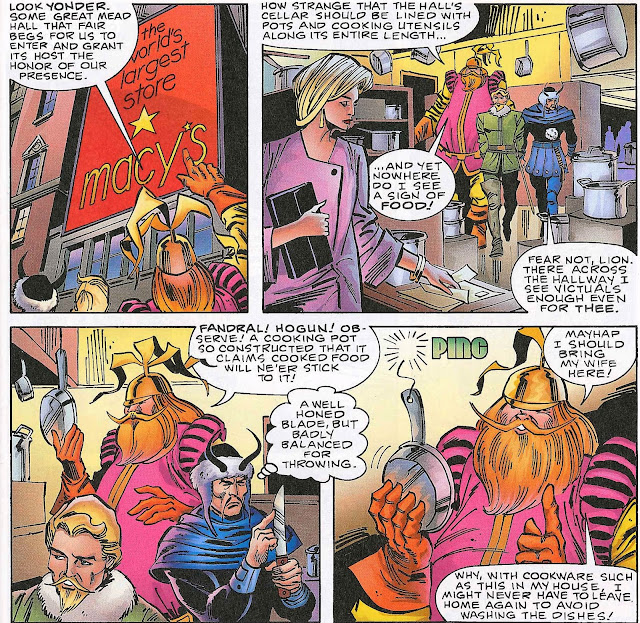
I love this kind of stuff. The best scene in the Thor films is the one where Thor goes to a diner and drinks coffee.
from Thor vol. 1 #355 (art by Sal Buscema)

I am of course looking forward to more culture-clash hijinks in volume 3. Meanwhile, Death herself turns up to collect Odin's soul, but can't find it. Thor lays the smackdown on Death, in what has to be one of my favorite scenes in any superhero comic:
You have to admire Thor's thought process (or lack thereof): "THERE IS NO PROBLEM, NOT EVEN DEATH ITSELF, THAT CANNOT BE SOLVED VIA A HAMMER SWUNG WITH SUFFICIENT POWER."
from Thor vol. 1 #354 (art by Walter Simonson)

Insisting his father is still alive, Thor heads out on a mystical quest (as you do). I look forward to seeing where this all goes in volume 3 as well. Simonson's run on Thor is clearly cyclical; as one big story cycles down, another one begins to cycle up in turn, and I'm sure this is all going somewhere new and exciting.

A final note: Simonson always pepper his stories with humor, which I appreciate. My favorite moment comes when (in a subplot I haven't had the space to mention in this review because this book is chock-full of them) Roger Willis doesn't buy Thor's girlfriend's explanation of how she saw through the disguise of Thor's secret identity of Sigurd Jarlson. She claims that "anybody would have known. You're just too big to hide behind a pair of glasses and an Izod shirt." But Roger is genre-savvy enough to know it doesn't work that way:
Someone's been reading his TV Tropes.
from Thor vol. 1 #349 (art by Walter Simonson)

I also enjoy the running gag about Sigurd's boss at the construction company where he works when he's not battling demon hordes (he doesn't come to work very much, to be honest) trying to guess which superhero he is. He's never right.

* Earth.

02 April 2014

Review: Legion of Super-Heroes Archives, Volume 12

Comic hardcover, 239 pages
Published 2003 (contents: 1975-77)
Acquired November 2012
Read March 2014
Legion of Super-Heroes Archives, Volume 12

Writer: Jim Shooter, Cary Bates, Paul Levitz
Pencils: Mike Grell, Ric Estrada, Mike Nasser
Inks: Mike Grell, Bill Draut, Joe Staton, Bob Wiacek, Bob Layton

I enjoyed this more than volume 11 of Legion of Super-Heroes; the plots felt less insubstantial, the characters more rounded. I mean, some of these are just really not good (one of the stories is resolved via a machine that lets our heroes win by wishing they win, which they then just hide away; another is one of those aggravating stories where the Legion deceives a (potential) member for no good reason; and then there's the infamous one that "explains" the lack of black characters in this 1950s future by revealing the world's blacks all live on one isolationist island), but when it hits, it hits!

I particularly enjoyed "The Hero Who Wouldn't Fight!" (Cosmic Boy is the only member of the Legion available on a day where the people of his planet are forbidden from using their magnetic powers), "The Private Lives of Bouncing Boy and Duo Damsel" (that Mike Grell art is probably illegal), "The Super Soldiers of the Slave-Maker" (the Legion tries to save a planet of slaves who don't want to be saved, requiring quick-thinking and heroism from Superboy and especially Phantom Girl), and "We Can't Escape the Trap in Time!" (which has some cool panel transitions). More of the stories in this volume seem to have involved real thought to write, which makes a nice change over volume 11. Nothing amazing perhaps (those days are yet to come), but good outer-space adventure.

21 November 2012

Faster than a DC Bullet: The Sandman Spin-Offs, Part XXVI: The Brave and the Bold: The Book of Destiny

Comic trade paperback, 156 pages
Published 2008 (contents: 2007-08)
Borrowed from the library
Read October 2012
The Brave and the Bold: The Book of Destiny

Writer: Mark Waid
Pencillers: George Pérez, Jerry Ordway
Inkers: Bob Wiacek, Scott Koblish
Colorist: Tom Smith
Letterer: Rob Leigh

The connections to The Sandman are even more tenuous in the second volume of The Brave and the Bold than in the first, though this is a direct sequel to The Lords of Luck. The Challengers of the Unknown spend much of the book puzzling over the Book of Destiny, but Destiny of the Endless does not actually appear.

What we get are a number of superhero teamups, as usual: Power Girl and Wonder Woman, the Flash and the Doom Patrol, Superman and the Silent Knight, and so on. They're good, but there's a spark in The Lords of Luck that's not quite present here. Is it that the connections between the stories here feel a little more forced? The Lords of Luck managed to balance the needs of done-in-one stories with an overall arc, whereas The Book of Destiny feels like a series of one-shots jammed together with an arbitrary villain. The fact that although the Challengers are the focus, they never really pop as characters (all I could remember was that "Red" was the redhead and June was the woman), which undermines the story somewhat, especially the final issue.

Still, if you focus on the individual stories and the artwork (George Pérez is joined in this volume by the almost-as-good Jerry Ordway), you have here a fun set of superhero stories. I might not ever know why what's-his-face was travelling through time and space, but I got to watch the Boy Commandos team up with the Blackhawks, and that's good enough for me.

26 October 2012

Faster than a DC Bullet: The Sandman Spin-Offs, Part XXIV: The Brave and the Bold: The Lords of Luck

Comic hardcover, 152 pages
Published 2007 (contents: 2007)
Borrowed from the library
Read October 2012
The Brave and the Bold: The Lords of Luck

Writer: Mark Waid
Penciller: George Pérez
Inkers: Bob Wiacek, Scott Koblish
Colorist: Tom Smith
Letterer: Rob Leigh

The first volume of the 2000s revival of The Brave and the Bold has some tenuous ties to Gaiman's Sandman: Destiny of the Endless appears here (though he was the one Endless who had been established before Gaiman came along). Destiny has subsequently appeared in his own spin-off, gotten a story of his own in Endless Nights, and even popped up in Lucifer.

Before I get to Destiny's role, though, I want to talk about The Lords of Luck as a whole. It's fun. It's amazingly fun. I wouldn't say that all superhero comics should be all fun all the time, but given their subject matter, there's often a surprising lack of the stuff. Well, not here: Mark Waid manages to give us a story that takes in the length and breadth of the DC universe, showing off just how awesome it is in almost all regards. The old Brave and the Bold comics was, I believe, one-and-done superhero team-ups; Waid hits the perfect middleground between that and the sprawling six-plus-part stories of the modern day by making The Lords of Luck a succession of team-ups that are all one story, meaning characters come and go from the story in rapidfire fashion. But Waid's a smart writer, and I was rarely confused, unlike with the deep levels of referencing going on in JSA: Mixed Signals.

We start with a team-up between Batman and Green Lantern, who discover that something powerful is after two weapons, and they split up to pursue each weapon. Green Lantern and Supergirl head to a casino planet following one. This is my first exposure to the 2000s Supergirl after Jeph Loeb's mediocre introduction of her, and (perhaps obviously) Waid writes her a heckuva a lot better; she's smart but seventeen, and wins you over even when she does stupid stuff. Then we get Batman teaming up with Blue Beetle, Supergirl teaming up with Lobo(!), and Batman teaming up with the Legion of Super-Heroes (!!).

Each of these is more awesome than the last. I always enjoy a bit of Lobo, and the banter between him and Supergirl never stops being entertaining. Even better, though, is watching Batman one-up the Legion of Super-Heroes; one should never give Batman a flight ring, apparently. I was laughing all the way through. It's a very real love letter to the DC universe and all the marvelous strangeness it contains. This is how you use continuity to your advantage. It helps that Waid treats his characters like people with personalities, not datapoints with histories.

It helps even more that Waid is paired with the legendary George Pérez on art.  Pérez's art is always great; he has storytelling skills that are rarely matched in modern comics. His pages are dense and eventful in the best way, and his splash pages have real impact. His characters are as fun-looking as the story, and he even manages to restrict himself to just one Supergirl panty-shot. (Sigh.)

Destiny himself is not exactly the imperturbable Endless we usually see; here, he's distracted and amnesiac, having given up control of the Book of Destiny that contains all history. He seems a little less inscrutable when he talks to Lobo and Supergirl as opposed to Dream and Lucifer, but watching Lobo drive his motorcycle through Destiny's garden is worth the price of admission.

The Brave and the Bold is kind of comic I'd wish I'd read when I was a kid, and that I hope my kids will read one day. I'm going to read the next volume because it too has some Sandman connections, but I'm looking forward even more to my eventual readthrough of the whole series. Cool stuff.