Showing posts with label creator: mike decarlo. Show all posts

03 August 2016

Faster than a DC Bullet: Project Gotham, Part XXXIII: The Many Deaths of the Batman

Comic trade paperback, n.pag.
Published 1992 (contents: 1989)

Borrowed from the library
Read January 2016
The Many Deaths of the Batman

Writer: John Byrne
Penciller: Jim Aparo
Inker: Mike DeCarlo
Letterer: John Costanza
Colorist: Adrienne Roy

Year Thirteen, March
I get a weird little frisson out of comic book titles that use the character name in them, as opposed to a series prefix, like this or World Without a Superman. I don't know why; it's just neat. Anyway, this book adds support to my Jim-Starlin-and-Jim-Aparo-are-better-apart-than-together theory by pairing Aparo with John Byrne. This short book begins with a silent chapter where the Gotham City police find a dead Batman, the best efforts of a hospital can't save him, a nosy reporter's leak means the whole city quickly knows, and then a second Batman corpse turns up. John Byrne used to infuriate me with his excess verbosity on Alpha Flight, but like issue #13 of that series showed, he can do great stuff without them when he wants to. The chapter is a masterpiece of storytelling by Aparo, communicating a whole story with only a single, well-chosen word.

That said, there are times Aparo uses motion lines to excess, making one think of actors overdoing the wild gesticulating in old silent films.
from Batman vol. 1 #433

When the second issue begins, there's a ton of text and I got worried, but Byrne actually balances the word and image well throughout. The core of the story is that someone is dressing people as Batman and then killing them, often in grotesque fashion; it's actually kind of a dark 1980s take on a Silver Age story, and it works quite well, as Batman, Commissioner Gordon, and the rest of the police have to mobilize against this increasingly bizarre threat. Eventually the answers materialized and they're improbably convoluted, even for the kind of story this is imitating, but the ride up until the point was so enjoyable it was hard for me to care. This is a "typical Batman" story: no huge stakes, no deranged supervillains, and it works as a very solid example of that genre.

Holy Wall of Expository Text, Batman!
from Batman vol. 1 #435

As a side note, I read this book where it takes place, between A Death in the Family and A Lonely Place of Dying. I didn't gain anything from the experience: the Batman here doesn't show any effects of the death of Jason Todd.

Next Week: We draw nearer and nearer the end of this project with the return of Poison Ivy!

27 July 2016

Faster than a DC Bullet: Project Gotham, Part XXXII: DC Comics Classics Library: Batman: A Death in the Family

Comic hardcover, 271 pages
Published 2009 (contents: 1988-89)

Borrowed from the library
Read January 2016
DC Comics Classics Library: Batman: A Death in the Family

Writers: Jim Starlin, Marv Wolfman
Layouts and Co-Plotter: George Pérez
Pencillers: Jim Aparo, Tom Grummett
Inkers: Mike DeCarlo, Bob McLeod

Year Twelve, November - Year Thirteen, June
One of the results of the continuity-driven nature of superhero comics is that there are a number of comics known better for what happened in them than how it happened. A Death in the Family is one of those stories. Chronicling the death of the second Robin, Jason Todd (who's only been in the role for two years, poor fellow), A Death in the Family is just not a good story. It lurches along weirdly and depends on coincidence way too much, and even for a superhero comic, it's contrived: the idea that Iran would appoint the Joker its UN ambassador is untenable, a completely bizarre merging of comic goofiness with real-world politics that is tonally misjudged.

But let's start at the beginning with this one. A Death in the Family seems to have been originally designed as a six-issue story but released as a four-part one, as its first and second issues both consist of two 22-page chapters. The first has Jason acting particularly like a jerk, and Batman benching him as a result. Their relationship hasn't particularly been consistent in the Jason stories I've read: Jason is very bloodthirsty in the the beginning of Second Chances, pretty chummy with Batman later on in the same book (except for learning that Batman hid who killed his father from him), and they got along perfectly in Ten Nights of the Beast and The Cult. But now Jason is a jerk again, and Batman doesn't handle it well at all.

Your hero, ladies and gentlemen!; or, Don't you think kids who are little bit snotty deserve to be brutally murdered?
from Batman vol. 1 #426 (script by Jim Starlin, art by Jim Aparo & Mike DeCarlo)

I really don't get why this approach was taken. A character's last story should show them at their best, to make you really regret it when they're gone; for all their flaws, later DC shock killings like Identity Crisis and Countdown to Infinite Crisis got this exactly right, sending Sue Dibny and Blue Beetle out on career highs. This story should show Jason Todd as his heroic best as Robin. But A Death in the Family, bizarrely, wants to make you glad he's dead.

Batman discovers that the Joker is trying to sell a cruise missile to terrorists in Lebanon at the exact same time Jason realizes that the woman he thought was his mother actually isn't, and that a woman who might be his birth mother is-- completely coincidentally-- also in Lebanon. So while Batman shuns his runaway sidekick to chase the Joker (apparently there's no one Batman can ask for help; if only he wasn't always such a jerk to Nightwing), the two end up in the same place anyway and team up.

13 July 2016

Faster than a DC Bullet: Project Gotham, Part XXX: Batman: Ten Nights of the Beast

Comic trade paperback, 96 pages
Published 1994 (contents: 1988)

Borrowed from the library
Read January 2016
Batman: Ten Nights of the Beast

Writer: Jim Starlin
Penciller: Jim Aparo
Inker: Mike DeCarlo
Colorist: Adrienne Roy
Letterers: John Costanza, Agustin Mas

Year Twelve, June
I'm sort of pushing the definition of Batman's "early years" at this point, but I wanted to maximize my Jason Todd stories before seeing him get killed off in A Death in the Family. He actually doesn't play a very big role in Ten Nights of the Beast, which pits Batman against the KGBeast, the trained Soviet assassin. I'd first encountered him in the uncollected miniseries Robin III: Cry of the Huntress, but this was his first appearance. Here he goes rogue and travels to Gotham City to disrupt the Star Wars missile defense program, and Batman must team up with the Gotham PD, the FBI, the CIA, and the KGB to stop him. The KGBeast has a list of ten key Star Wars personnel (conveniently, they're all residents of Gotham or will visit it during the same week) that he's working his way through, but despite acquiring his list early in the book, the KGBeast is so strong and powerful there's not a whole lot Batman can do to stop him: Batman gets pushed to his limit as the KGBeast kills person after person on the list, plus anyone who gets in his way. (Or gets his Iranian Shi'ite terrorist friend to do it for him.)

One of my favorite things in comics is people who have to wear hats to disguise the masks they're wearing as a disguise.
from Batman vol. 1 #419

The problem is that the KGBeast is so good that the story becomes implausible. There is an early effort to move one of the people on the list out of town, but other than that, Batman and company take little preventative action. The last person on the list is President Reagan,* who for some reason still comes to Gotham for a fundraising dinner! It really pushes my credulity that in a circumstance where the KGBeast has caused deaths in the triple digits in pursuit of his goal that anyone would think it appropriate to bring the President of the United States into the city where's he operating. Also, given Batman only saves the lives of about three of the people on the KGBeast's list, I don't see how the Star Wars program isn't permanently crippled. It's a very small victory, I guess.

Greatest double-take in the history of comics?
from Batman vol. 1 #420

Jim Starlin seems to really like stories where Batman is pushed to his limit-- it's something we'll see again in The Cult and A Death in the Family-- but this one doesn't really work for me; you don't feel the desperation to the extent the story needs you to. I'll expand on this in my writeups of both those collections, but I think the problem is Jim Aparo. Or rather, the Starlin/Aparo collaboration. Aparo is a great artist and supposedly a great Batman artist, but I think he's more remembered for his ten-year run on The Brave and the Bold than his late 1980s Batman stint, where I don't think he's a good tonal match for Starlin's dark and brutal scripts. But like I said, more on that next week.

* Previous appearances of Ronald Regan include Legends, Millennium, and the Deadman storyline in Action Comics Weekly. There's probably more I'm forgetting. Invasion!, maybe? DC Comics really loved this guy, I guess.

Next Week: Batman faces a Dark Knight of the Soul when he comes up against The Cult!

15 June 2016

Faster than a DC Bullet: Project Gotham, Part XXVI: Batman: Second Chances

Comic trade paperback, 276 pages
Published 2014 (contents: 1986-87)

Borrowed from the library
Read November 2015
Batman: Second Chances

Writers: Max Allan Collins, Jo Duffy, Jim Starlin
Pencillers: Jim Starlin, Denys B. Cowan, Chris Warner, Ross Andru, Dave Cockrum, Kieron Dwyer, Jim Aparo, Norm Breyfogle
Inkers: Jim Starlin, Greg Brooks, Mike DeCarlo, Dick Giordano, Don Heck, Norm Breyfogle
Colorists: Daina Graziunas, Adrienne Roy
Letterers: John Costanza, Todd Klein, Agustin Más, Albert DeGuzman

Year Ten, October
Out of universe it's been ten years, but in universe it's just been two since Batman moved to a downtown penthouse and Dick Grayson went off to college. Now Bruce is back in Stately Ward Manor and there's a new Robin in town. Second Chances collects twelve stories, whose unifying feature is that the majority of them are by Max Allan Collins, and all of them feature Jason Todd as the new Robin. (Unfortunately, there's almost no consistency in the artistic team.)

The book opens with a two-part tale: "There's Nothing So Savage-- As a Man Destroying Himself!"/"One Batman Too Many." Criminals are turning up violently murdered... seemingly by the Batman! Jim Starlin provides some great, dynamic layouts in the first half, which I really enjoyed; the second part, where the faux Batman escapes Arkham and Batman hunts him down, was less interesting, partly because the art of Denys Cowan and Greg Brooks was not as sharp as Starlin's. In this story, Jason is already the new Robin, and evidencing a slight bloodthirsty streak, as he wonders if Batman maybe should be employing some of the techniques of his impersonator.

The book then jumps backward to explain how Jason got to be the new Robin; "Did Robin Die Tonight?" opens with Dick Grayson still operating as Robin, receiving an injury at the hands of the Joker. Bruce fires Robin: "In what I do, there is no place for a child. [...] Son, I'm sorry. And you are a man-- man enough to accept my decision." We don't even see what happens to Dick, though; he informs Bruce that though Robin will stay "dead," he has a destiny to pursue, but as far as we see, he doesn't even leave. What's he off doing? Who knows! After operating solo for a little bit, Batman goes to visit Crime Alley on the anniversary of his parents' death, where while he's out walking (Batman strolling down the street, saying "Gentlemen" to a pair of men on the sidewalk, is a surreal sight), a juvenile delinquent steals the tires off the Batmobile.

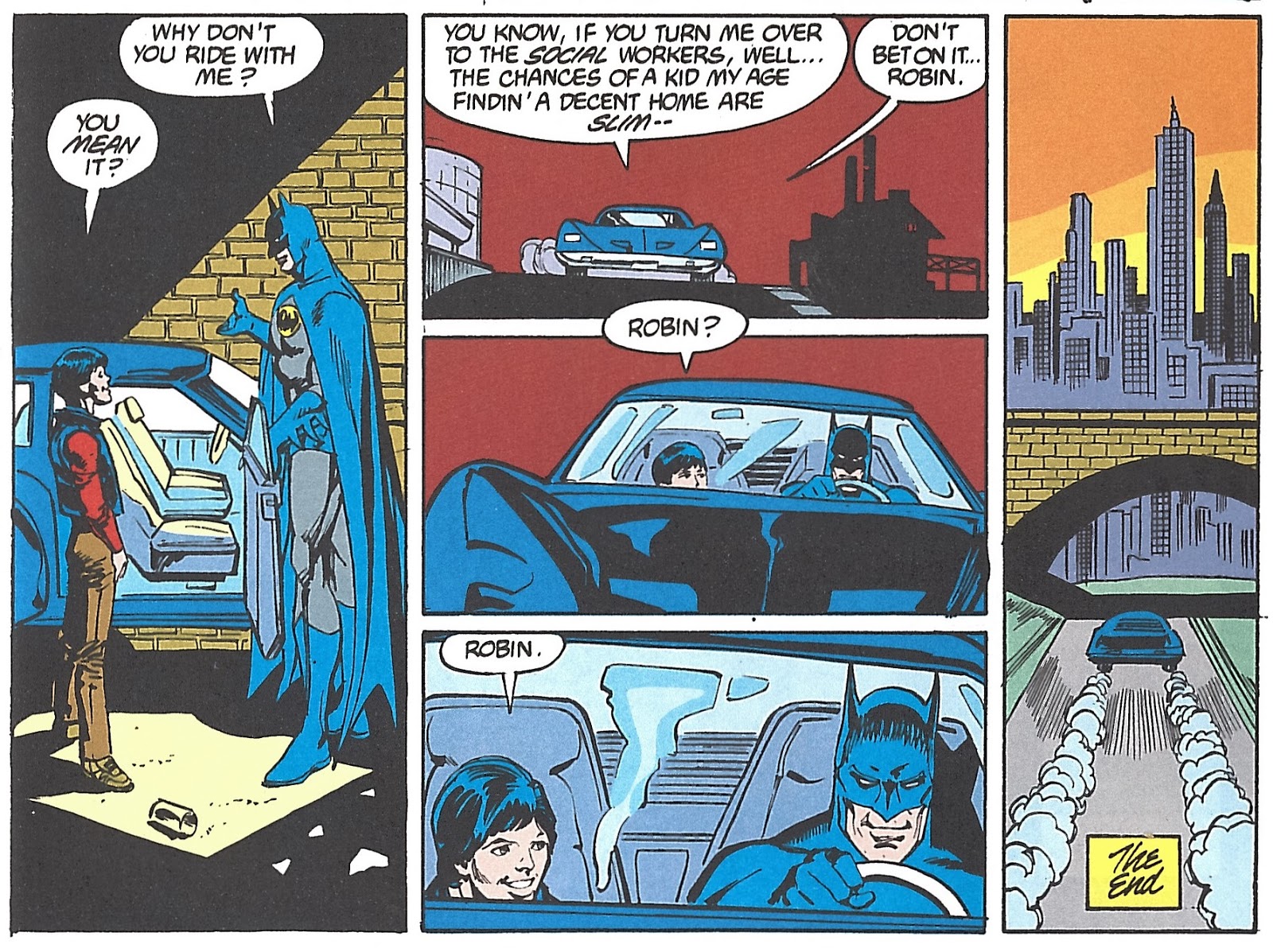
Batman enrolls Jason in a reform school, but in "Just Another Kid on Crime Alley," it's revealed the school is actually a front for a crime ring, which Jason helps Batman break up. And then, even though Batman just claimed he didn't want any kids around, he's calling Jason "Robin" just like that. If I was Dick, I'd be ticked off! I know from reading interviews with Collins was that the idea was Jason would live a life so dangerous on the streets that being Robin was actually a safer alternative, but no one in the story actually says this, and it's not convincing: surely Bruce making Jason his ward without revealing he was Batman would be safer than either crime or crime-fighting!

"Dick Grayson? Who cares about Dick Grayson? Screw that guy."
from Batman vol. 1 #409 (script by Max Allan Collins, art by Ross Andru & Dick Giordano)

The next few stories chronicle the early days of Jason Todd as Robin, as they face Two-Face, who turns out to be responsible for Jason's father's death. It's a lot of weird, Silver Age-style hijinks, with Two-Face employing the "Dopple Gang" and robbing one of Gotham's two major league baseball stadiums during the second half of the second inning when there's two strikes, two balls, and two men on base! It's not Starlin's best work on the title. I assume the intro story about the false Batman slots in here, before the next couple tales, each more weird than the last: an evil mime and a samurai ghost.

That last tale is by Jo Duffy, and then Jim Starlin takes over as writer. His first story is a sort of grim, but consequence-free story of Batman hunting a serial killer. With only 22 pages to make us care about some woman and kill her off, the story isn't big enough to succeed. Then Batman discovers Commissioner Gordon is a Manhunter in a crossover with Millennium that totally does not stand on its own, and then Dick Grayson comes back in "White Gold and Truth"-- which is dated "ONE YEAR AGO." I have no idea where that's mean to place it relative to the other stories in the volume.

This story finally fills in what Dick Grayson has been up to. In a retcon I don't think later writers abided by, allegedly all of Dick's adventures with the Teen Titans occurred after he left Batman's company. Dick's retelling of their split is also a little more acrimonious than the one we saw in "Did Robin Die Tonight?" Bruce and Dick argue, but Dick and Jason team up to beat up some criminals while Bruce smiles from the rooftop, unseen. It feels more like a patch over Collins's sparse story than a story of its own.

Collins isn't all done; the last story in the book is "Love Bird," a cute tale illustrated by Norm Breyfogle about a paroled Penguin seeking love and trying to go straight.

A common denominator between many of these stories is the presence of Vicki Vale as Bruce's girlfriend who hates the Batman and also hates Bruce's idling about all the time. Her presence is inconsistent; Collins seems to keep forgetting about her. As a result, I never really had a good feel for what she and Bruce saw in each other, so she comes across as largely superfluous.

"Batman, if you just drive a couple more miles to the other Kroger's, their bananas are two cents cheaper!"
from Batman vol. 1 #402 (script by Max Allan Collins, art by Jim Starlin)

So: historically important tales, yes, but inconsistent in quality. But I got very intrigued from this era of Batman history, and I actually added a few more 1980s/Jason Todd stories to my list after reading it, wanting to flesh him and his era out before hitting A Death in the Family. These came out after Batman: Year One, but that story didn't change the other Batman tales overnight; these later stories feel like a weird jumble of the Silver Age aesthetic and the Frank Miller one (Commissioner Gordon looks more like a jolly grandpa than a hard-hitting cop/special forces vet), and I look forward to seeing how that changes over time.

Next Week: It's Year One again as Huntress makes her debut on the Gotham stage!

29 October 2008

Faster than a DC Bullet, Issue #6: Crisis on Infinite Earths

Comic trade paperback, ~368 pages
Published 2000 (contents: 1985-86)

Borrowed from a friend
Read October 2008
Crisis on Infinite Earths

Writer: Marv Wolfman
Penciller: George Pérez
Inkers: Dick Giordano, Mike DeCarlo, Jerry Ordway
Colorists: Anthony Tollin, Tom Ziuko, Carl Gafford
Color Reconstruction: Tom McCraw
Letterer: John Costanza

DC Universe Timeline: Six Years Ago
Real World Timeline: July 1985

(We've vaulted straight over the early careers of the modern superheroes-- it's been seven years since Superman For All Seasons and The Superman Chronicles, six years since The Long Halloween. It also happens to be the MONTH I WAS BORN. Coincidence that a multiverse-shaking event happened at that very moment? I sincerely doubt it. Though, going by DC Universe time, it's 1991 and I'm only six years old right now. Or maybe my body was infused with antimatter and I grew at a fantastically accelerated rate. In any case, I must be posting this on Usenet.)

It's a well-known fact that by the 1980s, the continuity of the DC Universe-- sorry, Multiverse-- was in such a state that students of Russian hermeneutics were rejecting it as too confusing. But Marv Wolfman was a man with a plan: destroy it and replace it with something even more bizarre and inexplicable. The vehicle for this transformation was Crisis on Infinite Earths, an twelve-issue miniseries that would change the state of comics forever, subjecting us to poorly thought out crossovers on a regular basis for the next 25 years and beyond, I'm sure. Actually, I've never read any of the other "crises", but my perusal of Internet bulletin boards has confirmed that I'm supposed to hate them.

Actually, I find it bizarrely hard to pass judgment on Crisis on Infinite Earths. It's not so much a work of art as a fact of life. It's not something you can judge, it just is. It's known for what it did, not how it did it. Because even if it had done it all poorly, it still would have been as famous and influential as it is today.

But I don't think it did do it poorly. Sure, it's melodramatic as possible sometimes, but it's a comic book crossover dealing with the collapse of an infinite number of universes, what do you expect? Most of the time, it's just plain fun-- Marv Wolfman has an encyclopedic knowledge of DC characters and continuity, and that shines through here in the ridiculous number of characters who appear in this comic. In fact, he knows so many obscure characters, it frequently becomes a problem-- when the Monitor assembles his team to defend his vibrational forks (whatever), he brings together Superman, Blue Beetle, Dawnstar, Green Lantern, Psimon, Geo-Force, Cyborg, Obsidian, Firebrand, Firestorm, Killer Frost, Psycho Pirate, Doctor Polaris, and a giant gorilla. Who the heck are these people? Obviously I known Superman and the other heavy hitters, but Geo-Force? Firebrand? Doctor Polaris, the Master of Magnetism? I don't think anyone yearning for a crossover of DC's infinite characters was ever clamoring for a Psimon/Doctor Polaris teamup.

The other problem is that when you've got a threat that's big enough to bring all these people together... it's a threat too big for them to actually handle. The protagonists in this story are little more than tools for the Monitor, who is privy to a plot that is never really fully revealed, jerking our heroes from point to point, having them run contrived little tasks, such as guarding his vibrational cutlery. Often, threats are contrived just to spice things up, such as when Lex Luthor, never to be outdone, decides that he's going to take over four Earths at once with the help of every supervillain ever, prompting a protracted battle to fill page space while the heroes fight back.

The deficiency of our own heroes in such cosmic occurrences is really shown fully in "Death at the Dawn of Time", when our heroes stand around watching the Spectre do all of the work that it takes to defeat the Anti-Monitor. Well, one of the times-- the Anti-Monitor comes back from the dead about three times after this, sometimes a mere page after his most recent demise. I was so happy when the Superman of Earth-2 punched him so hard that he exploded. Though why this should have killed him when the power of Darkseid could not, I have no idea.

I guess these are just the natural problems of writing a crossover this big. And most of the time, Wolfman is solid enough to keep you from realizing that the main characters aren't actually doing much other than looking at the oh-so-slow moving walls of antimatter. There's certainly a lot to like here, too. One of the biggest deals that of course happens in this book is that Supergirl is killed off. (Which is convenient, since she doesn't exist in the new continuity at the story's end. Indeed, all of the characters who don't exist in the new timeline are killed off at some point, all of them just happening to get in the way of one of the Anti-Monitor's blasts.) This didn't really affect me a whole lot when I read the story for the first time-- I knew it was going to happen (it's on the cover, for crying out loud), and I've never been attached to the Silver Age Supergirl.

But what did get me was the death of the Flash-- I had no idea! And it's such a great death, too. Despite everything that's happened to him, to his world, he just keeps on running and running and running, doing his best to stop the Anti-Monitor from making a giant cannon or whatever the heck it is, running so hard and so fast that he dissolves. How freaking awesome is that? I was genuinely moved the first time I read the book. Barry Allen, I'll miss you. Even if I've never read another story featuring you.

The other weird thing, but mostly in retrospect, is all the sideplots that were obviously setups for what was going to happen in other comic books. What's all that nonsense about the Red Tornado, anyway? And the blue dude with the horns meeting those guys in space? And you know I'm never going to pick up New Teen Titans #15 to read about Starfire's wedding plans. As for the new Wildcat? Who the crap cares?

I've been remiss-- all this time and I've yet to mention George Pérez's artwork. Because that, more than anything else, is what sells this story. I find it amazing that the man could pump out work of this caliber on a monthly basis-- and some of the issues are double-sized! The level of detail is extraordinary. Some of his panels feature Every Character Ever-- and all of them are recognizable! Well, recognizable to someone much more well-versed in DC minutia than myself. And as for his layouts... some of these pages feature more than a dozen panels! All of them clear and distinct. A Pérez comic does not waste space. He chooses his full-page panels carefully. The destruction of entire universe can sometimes be one panel out of many-- when he does a two-page spread, you know it's important! I wish I could say more about his artwork, but I don't know a thing about artwork, and the best I could do would be to say "It's awesome" again and again. (Oh, I really dig the black-and-white extracts from "The Monitor Tapes" at the bottom of the pages of "Death at the Dawn of Time!" Obviously Pérez was a master of any color scheme.)

Great Rao, this review has been all over the place. But I think that's appropriate for a story like Crisis on Infinite Earths, one so big it could scarcely be contained or summed up in an effective manner, thanks to Marv Wolfman's encyclopedic knowledge and cosmic plotting and George Pérez's masterful artwork and incredible layouts. One can only hope that like Crisis, the legacy of this review will live on... forever! Or at least the next 25 years of Faster than a DC Bullet.

Note that this originally appeared on my old LiveJournal and included pictures back then. Sadly, the pictures are lost in the mists of the Internet.