Showing posts with label topic: LEGO. Show all posts

26 July 2019

The Rise and Fall of Paradise City: LEGO in the Basement

When my brother Andy and I were kids, we had a lot of LEGO. Andy was always better at building than I, but I was the storyteller. Together, we came up with elaborate stories about the residents of Paradise City. I recently found a trove of photographs of Paradise City on an external hard drive, because apparently at age 14 I built a web site to chronicle its adventures and happenings.


This is the best photo of the overall city I could find. (Apparently the photos were taken with a literal potato.) Basically half of the basement was given over to the LEGO city. The train took citizens of Paradise over to the neighboring town of Muddville, which I think was where we let my dad build stuff. Here's another angle:

That table in the background is now mine and Hayley's dining room table! It has been with the Mollmanns since my late grandfather was a boy, I think. The web files I found indicate we had a lot of backstory for every aspect of the city; that sphere in the bottom left of the photo (a Megabloks piece, I think) was an "agridome and power plant":

Paradise City was a hopping town, with a roller coaster...

...a cycle rental...

...a garbage dump...

...a rescue operations center ("RES-Q: Rescue Everything Squad Q")...

...a church (St. Bob's)...

...a drawbridge...

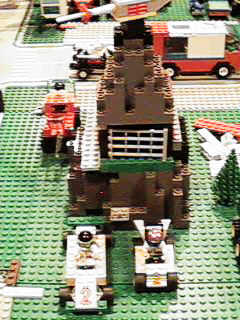
...a very forbidding looking jail ("Mt. Jailus")...

...and even a spaceport!

I seem to recall that the necessity of tying our Space LEGO into the story meant the city was constantly being invaded by aliens. But this also gave us an excuse to blow up the town and rebuild everything whenever we got bored of a particular configuration.

My web site indicates we had histories and personalities for tons of town residents: the owner of the junkyard, the mayor (a Civil War vet, apparently), a guy called the Infomaniac (a character from the LEGO computer game) who had a Q&A newspaper column, and so on. Every police officer was named "Bob."

The best set of developments, though, usually came from my mother. For example, my brother once put window washers on the tall tower in the center of the city. They had a little platform hanging on a string. One day we woke up and one of the strings had disconnected, the window washers were hanging on for dear life, and news helicopters were in position to record the whole thing.

Or another time, we woke up to a shark in the water and a swimmer cut in half and a panicked crowd on the beaches.

The only one my hard drive includes pictures of is when a bunch of protestors sat on the train line and the train ran them all over:

My mother has a macabre imagination, I guess.

Also the town was periodically invaded by Cat Kong.


#159: What things did you create when you were a child?

27 April 2018

Summer Is for Learning and LEGO

When I was a kid, there were three of us, and our mother was a stay-at-home mom. So, I am convinced it was her mission to pack us off to as many summer camps as possible. There was always the week of camping with the Boy Scouts, of course, but there was also rocketry camp, science camp, bible camp, nature camp, and LEGO robotics camp.

Outside of Boy Scout camp, these were all day camps. Go to the local high school everyday and build model rockets while learning about space. Go to some local park everyday and put pepper and soap into water for some reason. Go to the church gym everyday and make Jesus out of macaroni. Go to the woods everyday and be dared into eating leg-less daddy-long-legs. Mom got me out of the house, I learned stuff about surface tension and explosions and dirt and Father Abraham's many sons, many sons had Father Abraham.

Other than Boy Scout camp, which was probably the most fun, LEGO robotics camp was the best. This was probably like 1995 or 1996? I would have been in middle school. I was a self-taught programming whiz in those days, which is to say I taught myself QBasic with the help of a book from the library and could do pretty simple stuff on my own. My brother and I were sent off to LEGO robotics camp together, and we naturally selected each other as partners.

This was pre-LEGO Mindstorms. LEGO robotics in those days was through "Dacta," LEGO's educational line, which had their own programming language. There doesn't seem to be much out there about it on the Internet, but you could write code to test the input of various sensors, and output commands to motors. There were temperature and touch sensors, and various motors and lights and stuff. This thing here was the interface between the PC and the LEGO:
from Eurobricks

It's kind of hard to see in the picture, but the studs on that have metallic rims; the sensors and motors connected to them so data could move through. The core of the whole thing was, I believe, LEGO set 9701, the "Control Lab Building Set," which contained parts and directions for a variety of things you could do.

My kid brother and I were an amazing team; I would write the code and he would build the LEGO. We quickly moved through all the easy stuff and soon we were making the greenhouse. The greenhouse had a temperature sensor inside, so when it got too warm, the door would open; then when it got too cool, it would close up again. Here's the cover page to the directions:
from bricks.argz.com

The interior didn't really heat up, to be honest; I think we had to cheat the whole thing by squeezing the temperature sensor with our fingers. But we accomplished it together. In researching this, I've even found a bit of what I think is the actual code floating around on the Internet:
to open
tto "motora setright on
waituntil [angle5 > 16]
tto "motora off
end
to close
tto "motora seleft on
waituntil [angle5 < 1]
tto "motora off
end
to greenhouse
loop [if temp1 > 22 [open] if temp1 < 22 [close]]
end
There were directions and code for a scanner, even, which used a light sensor moving slowly across a piece of paper to feed into the computer its light/darkness bit by bit. Even for us this was too ambitious. (I should note that memories conflict on this point; Andy insists we did build the scanner, and says he remembers scanning in a picture of Mickey Mouse. But I was ten and he was eight, so I know whose recollections I trust more here.)

The next year we went back, but we were too good, and the camp director broke us up, and we accomplished much less paired with others than with each other.

I remember the LEGO sets having this air of age to them, but the LEGO wiki tells me set 9701 came out in 1995, so clearly not. Perhaps it was just that even in what was 1996-ish, the graphic design was sparse, but I guess in retrospect that was probably because it was an educational product, not available commercially, and done on the cheap in some ways.

As a result of these experiences we were so hyped up for LEGO Mindstorms when it came out a couple years later... and we were profoundly disappointed. The GUI-optimized puzzle piece code of Mindstorms was nowhere near as robust as the Dacta programming language, and we lost interest pretty quickly. Which, in retrospect, makes me feel bad, because I suspect it hadn't been a cheap buy for our parents.

But, you know, I'd had the second most fun I ever had at summer camp. (I kind of do miss programming at times.)

#579: What would your ideal summer camp be like?

14 July 2017

Paying for the Aliens

I would have been about fourteen when I started "working"-- I became a babysitter for my neighbors. I was a freshman in high school; the two kids were, I think, five and six at the time. They had a full-time babysitter, but she wanted to go home about an hour before their mother got off work, so I filled in that gap, and I also worked longer days in the summer.

Babysitting well-behaved, imaginative kids is a kind of work that doesn't really feel like work. I read them the first four Harry Potter books aloud, completely with a panoply of voices. (By the time of book five, they were capable of reading them themselves.) Nothing reveals a pacing problem like reading a book aloud a chapter per day to a preschooler. I showed them episodes of Doctor Who and Star Trek; as far as I know they still watch both. I watched Fox Kids along with them, which is how I got into television triumphs like Beast Wars: Transformers, Digimon, Power Rangers in Space, and Mystic Knights of Tir Na Nog.

The best part of the job, though, was the aliens. "The aliens" was a long-form improvisatory story I told them, which much have lasted for years. Its original basis was a group of K'nex guys like these:

Plus some spinning plastic fairies, which I'm pretty sure were these:

Between them, these were the males and females of an alien species invading the Earth. There was also a purple plastic dragon; he was named "Pyre, Dragon of Dare," which was the name of the dragon in Mystic Knights. The dragon could be summoned to aid them, but he was not always a willing servant. The aliens had a base, which was something one of my charges had built out of K'nex. It span around, and it may have just been an adapted merry-go-round now that I think about it:

Spinning generated an impenetrable shield around the base.

The basic set-up, as I recall, was that the aliens (I don't think they had a name per se, but I feel like they came from "the Dominion") wanted to invade the Earth, so they set up a forward based to scout it out while the main fleet was on its way. So they would come under attack by native humans, usually played by LEGO figures (the aliens were very big). There were two spinning fairies; one was an empress, who stayed with the mothership after it deposited the aliens, while the other was her daughter, who joined the scouting force. The colors of the aliens corresponded to their jobs-- I think I cribbed from Star Trek, so the Gold Commander was in charge, with Blue Scientists and Red Guards and Engineers working under him. (There were more than one of each color, though.) Some of them had names (I seem to recall there was a little Blue Scientist named Oscarnarsius!), but many did not. I think there were even romances.

The story evolved in fits and starts, based on toys the kids acquired and/or built, things we/I watched on television or read, and just random ideas that popped into our heads. Like, they got a LEGO rock monster:

...and so the aliens fought a rock monster, who eventually was revealed to be under mind control, and so he joined the team under the name "Rocky." Over time, the aliens became more sympathetic in their objectives. They still wanted to invade the Earth, but in the meantime they had to protect it from other threats. Most formidable of all were the living flying bricks known as "the biots" (since I had just read Rendezvous with Rama):
This isn't actually them, but it's close. They were 1x2 in size, but they did have flip-open lids and interlocking pegs.

The biots were so dangerous that in one traumatic "episode" they actually managed to smash through the shield and destroy the alien base, putting our heroes on the run. The biots could stack and form large cubes that were invincible. Thankfully, our heroes could rebuild the base's remnants into a more-formidable spaceship. Characters lives, characters died-- things got pretty epic. As the tv we watched changed, so too the plotlines. When Beast Machines: Transformers came along, an encounter with a mystical circuit gave the aliens the ability to transform into "techno-organic" birds by saying "I am transformed!" The birds were actually Klingon and Romulan MicroMachines from my collection with bird-like designs, like so:
...or so:

Rocky, though, gained the ability to transform into a flying battleship of awesome proportions, I guess because he was in touch with his spiritual side, or maybe because one of them got this for Christmas:

I'm pretty sure that around this time they also ended up in the distant past, and eventually got to cause the Big Bang itself. Like I said, things got pretty epic, and the original goal of invading the Earth was long forgotten. Like a lot of adventure narratives always trying to outdo themselves, I think I eventually lost control of it all as it stopped being possible to go bigger. I even attempted a "soft reboot" where they went back to the core premise of running the invasion base, but no one's heart was in it.

Like I said, this went on for years, and though it was certainly derivative, it was always inventive. People who pay attention to my tastes in entertainment will see lots of resonances: long-form-but-reasonably-episodic stories about groups of people in/from space doing epic things (i.e., Star Trek, Legion of Super-Heroes, Farscape). And somehow I got paid to do it, which seems like a racket in retrospect.

I also learned how to use a gas stove doing that job, without burning down their house, so there's that too.

#456: What have you done to earn money?

03 June 2016

H. G. Wells, Lego Cities, and Civilization (the game, not the concept): Little Wars

I've been reading H. G. Wells's autobiography over the past week or so (at 600+ pages, it's not a quick read), and in it, he briefly mentions his younger interest in war games. Wells really liked games, I think; in his semiautobiographical novel The New Machiavelli (1910), his narrator discusses building towns of bricks:
I still remember with infinite gratitude the great-uncle to whom I owe my bricks. He must have been one of those rare adults who have not forgotten the chagrins and dreams of childhood. He was a prosperous west of England builder; including my father he had three nephews, and for each of them he caused a box of bricks to be made by an out-of-work carpenter, [...] made out of oak and shaped and smoothed, bricks about five inches by two and a half by one, and half-bricks and quarter-bricks to correspond. There were hundreds of them, many hundreds. I could build six towers as high as myself with them, and there seemed quite enough for every engineering project I could undertake. I could build whole towns with streets and houses and churches and citadels; I could bridge every gap in the oilcloth and make causeways over crumpled spaces (which I feigned to be morasses), and on a keel of whole bricks it was possible to construct ships to push over the high seas to the remotest port in the room. And a disciplined population, that rose at last by sedulous begging on birthdays and all convenient occasions to well over two hundred, of lead sailors and soldiers, horse, foot and artillery, inhabited this world. 
Much of The New Machiavelli is drawn from Wells's actual life (like many of his literary novels, it's about a man who has good reasons for having an affair), but it appears this detail is drawn from his children's lives. In 1911, Wells published a book called Floor Games, about building worlds on the floor out of soldiers, bricks, boards, and railway pieces, based on games he played with his sons. Wells and his kids were given the bricks by a friend, who got them from their parents, who got them from their uncle. The "game" in question is pretty simple: it's basically 'build cities with the bricks.'

Like this guy does.
from Andrew on Flickr

Reading The New Machiavelli and Floor Games, I was struck by how much Wells would have loved having access to Lego. He could have had many more than hundreds of bricks, and built way more than six towers if my childhood basement was any indication. "Sedulous begging" is probably how I acquired many of my Lego, after all, and he could have had a much more diverse population than sailors and soldiers. Indeed, the lack of diversity in figurines is something Wells complains about in Floor Games:
But we want civilians very badly. [...] I wish, indeed, that we could buy boxes of tradesmen: a blue butcher, a white baker with a loaf of standard bread, a merchant or so; boxes of servants, boxes of street traffic, smart sets, and so forth. We could do with a judge and lawyers, or a box of vestrymen. [...] With such boxes of civilians we could have much more fun than with the running, marching, swashbuckling soldiery that pervades us. They drive us to reviews; and it is only emperors, kings, and very silly small boys who can take an undying interest in uniforms and reviews. 
I actually don't think there are any military Lego at all, right? I guess only in an historical or sci-fi/fantasy context: there are knights and Jedi knights and so on. But one of our most prized Lego minifigures when we were children was a pizza baker.

"Paizza, want some paizza?"

It's funny that Wells denigrates those who love uniforms, because two years after Floor Games came Little Wars: A Game for Boys, from Twelve Years of Age to One Hundred and Fifty and for That More Intelligent Sort of Girls Who Like Boys' Games and Books. It's essentially a set of rules for playing with toy soldiers and toy artillery; I imagine one can draw a straight line from it to modern war games, and I know there's a line to be drawn from war games to role-playing games, so I guess we can blame Wells for Dungeons & Dragons and Warhammer 40K.

If Wells was as good a social prophet as he thought he was, he would have seen this coming. And prevented it.

In Little Wars, he praises himself for making war into a more satisfying experience:
Here is a homeopathic remedy for the imaginative strategist. Here is the premeditation, the thrill, the strain of accumulating victory or disaster-- and no smashed nor sanguinary bodies, no shattered fine buildings nor devastated country sides, no petty cruelties, none of that awful universal boredom and embitterment, that tiresome delay or stoppage or embarrassment of every gracious, bold, sweet, and charming thing, that we who are old enough to remember a real modern war know to be the reality of belligerence.
He suggests that monarchs and patriots should all go play Little Wars and let the rest of the world get on in peace. I guess this is the 1910s equivalent to suggesting videogames as a safe release for one's violence; if Napoleon could have just played Civilization, he wouldn't have needed to actually conquer Europe.
A game that could only be improved by being set in space.

I think he ends with a bit of a weird statement: "You only have to play at Little Wars three or four times to realise just what a blundering thing Great War must be." This is weirdly optimistic, both in general and for Wells. Much of Wells's fiction is about how forms of detachment (emotional, like being an intellect vast and cool and unsympathetic, or physical, like riding inside a tank or on an air-ship) make you more likely to commit horrific acts of violence because you don't see or feel the consequences of your actions. In Wells's usual schema, I would think war games would make you more violent, not less, because it would train you to not see the violence of war.

Wells's optimism, it turns out, was dashed by the coming of actual war. This is surprising to me, because usually Wells was the one telling everyone else that the coming European war was not going to be as awesome as they thought; it's all the other guys who thought war was awesome and/or never going to happen again, and thus got disappointed by World War I. In Experiment in Autobiography, when discussing the war fantasies of his 13-year-old self, he says they persisted a date range we can pretty easily see the inspiration behind: "I like to think I grew up out of that stage somewhen between 1916 and 1920 and began to think about war as a responsible adult should." One should note that in 1916, he was 48 years old! And also note that, writing in 1933 or so, he cites Winston Churchill among those who have never grown beyond the Little Wars phase of their mental development.

Far from being the cure, it seems, Little Wars is the disease. Which is what I normally would have expected Wells to say all along.

N.B. One should not confuse Little Wars with Small Wars. Small Wars: Their Principles and Practice (1896) by C. E. Callwell is a guide on how to prevent your blameless colonizing army from being taken down by a nasty native insurgency. Every British home should have a copy of both, of course.