Showing posts with label creator: john beatty. Show all posts

02 December 2025

Justice League International Year Five, Part II: Breakdowns (JLA #53-60 / JLE #29-36)

Keith Giffen and J. M. DeMatteis wrapped up their five-year run on Justice League International with a massive fifteen-part crossover called Breakdowns; JLE scripter Gerard Jones would continue on that title without Giffen, but JLA would receive a wholly new creative team.

As I've said before, I read JLE in college, but I did not read its sister title, and most of the time that was fine... but it did leave this storyline totally incoherent. So, twenty years later, I was quite looking forward to finally understanding what was going on here!

Overall, these issues are sequenced perfectly in the omnibus, except that JLA Annual #5 obviously goes before JLA #53, but is placed after it. I appreciate that the omnibus includes both Green Lantern #18, a Breakdowns tie-in, and JLE #36, which Giffen didn't work on, presumably because it's branded as "Part 16 of 15" of Breakdowns. Subsequent issues of JLE by Jones will presumably never be collected, but we'll get to that in my next post, I suspect.

from Justice League America #54
"Tomorrow's League Today!" / Breakdowns, Parts 1-5 / "An Old Beginning" / "Too Much Time" / Breakdowns, Parts 6-7 / "One Angry Guy" / Breakdowns, Parts 8-16, from Justice League America Annual #5 (1991), Justice League America #53-55 & Justice League Europe #29-30 (Aug.-Oct. 1991), Justice League Quarterly #5 (Winter 1991), Justice League Europe Annual #2 (1991), Justice League Europe #31 & Justice League America #56 (Oct.-Nov. 1991), Green Lantern vol. 3 #18 (Nov. 1991), and Justice League Europe #32-36 & Justice League America #57-60 (Nov. 1991–Mar. 1992); reprinted in Justice League International Omnibus, Volume 3 (2024)
plots and breakdowns by Keith Giffen; scripts by J. M. DeMatteis, Gerard Jones, and Kevin Dooley; pencils by Steve Carr (with Chris Sprouse, Marshall Rogers, Dan Jurgens, Joe Phillips, Ty Templeton, Linda Medley, Russel Braun, Keith Giffen, John Beatty, Randy Elliott, and Curt Swan), Chris Wozniak, Darick Robertson, Andy Smith, Joe Staton, Bart Sears, and Kevin Maguire; inks by Jose Marzan Jr., Bruce Patterson, John Beatty, Bob Smith, Carlos Garzon, Randy Elliott (with Michael Golden), Art Nichols, Romeo Tanghal, Terry Austin, and Robert Campanella; letters by Bob Lappan, Willie Schubert, Tim Harkins, Michael Heisler, and Albert De Guzman; colors by Gene D'Angelo, Tom McCraw, and Matt Hollingsworth

Breakdowns is a complicated story, and this ultimately proves to be its downfall, I think. The inciting incident is that Maxwell Lord gets shot, and then the UN replaces him as the head of the JLI; this ultimately turns out to be a plot by the "Queen Bee" of Bialya. Max getting shot is great, in that the early issues here have a lot of good character focus as a result; the JLA argues about what to do for this man to whom they owe so much, and even the Injustice League gets involved, but in a good way. But I felt like this was wrapped up fairly abruptly; the whole conspiracy thing seemed over before it even began. (I do wonder if plans were derailed by the fact that Captain Atom dies between parts 5 and 6, thanks to the events of the Armageddon 2001 crossover; his beef with Bialya played a big role in some of the earlier installments.)

from Justice League America #56
At the same time all this is playing out, Despero escapes Lord Manga Khan's custody (see item #6 in the list below) and Dreamslayer of the Extremists (see #5) occupies Maxwell Lord's vacant mind and uses his mental powers to take over Kooeykooeykooey. I see what Giffen and DeMatteis were going for—you have two of the biggest threats to the JLI return at its lowest point—but in practice I felt like we ended up with a story that wasn't really a unified whole, but rather lurched from point to point. A lot of the individual parts are great—I particularly liked the battle with Despero and the way it was resolved—but it doesn't feel like a story so much as a bunch of things happening. This is probably at its worst where there's a whole issue that goes nowhere about the JLI finding weird stuff in the original JLA's cave headquarters, which has been borrowed by the Doom Patrol.

It also doesn't help that it feels like the JLI breaks up and reforms like three times in fifteen parts. How many times can these people realize that despite their bickering they do all belong together? (Or there's this weird bit where the UN assigns Doctor Light and the Tasmasian Devil to join the League... and they're out like two issues later, having never done anything.) However, some of those moments work well; I loved Guy Gardner and General Glory becoming roommates and Guy getting mad because General Glory runs a soup kitchen out of their apartment! It's good to see some focus on Guy as a serious human being in GL #18, too.

from Justice League America #60
Still, the story does have its high points. There's good character moments throughout, but particularly (as I said) in the battle with Despero and in part 15, where the League regroups after the intense events of the previous fourteen issues. The final scene between J'onn and Max was genuinely moving stuff; I've come to love these guys. I know they both persist as League members in future books, but I will miss these particular versions of them nonetheless.

Weirdly, part 15 ends with the League resolving to go on and then part 16 has them disbanding, with a lot of beats that directly contradict what just happened in part 15! It's very clearly just there so that the League can triumphantly come back together in the Justice League Spectacular (see my next post) but surely it could have been handled better given Gerard Jones scripted half the installments of Breakdowns, entirely wrote part 16, and cowrote JL Spectacular!

from Justice League America Annual #5
Of the other three stories here, two are Armageddon 2001 tie-ins. This was a 1991 crossover where a guy named Waverider came from the year 2001, seeking the hero who would become the tyrant "Monarch" in his era. He had the power to touch people and see ten years into their future, which let every story tell a story about what its characters would be up to in the future. The JLA and JLE ones are both cleverly put together, giving us a series of quick glimpses of each teammember, which the reader assembles to get a complete picture. In the JLE one, Waverider is confused because he keeps glimpsing each hero in the past, but in the end, you figure out how it all came to pass. This one is mostly goofy: Rocket Red becomes an Arthurian knight, Power Girl becomes General Glory's sidekick during World War II, Elongated Man eclipses Sherlock Holmes as the greatest sleuth of Victorian London, and so on. (There is a Mrs. Miniver reference in the Power Girl story, which was not something I expected!) 

The JLA one is proper great, though; the JLA isn't together anymore in the future, but across the course of the different glimpses, you see how much these people all meant to each other amidst all the jokes. I particularly like the moment where Ice gets Guy to admit his "nice" and "mean" selves are really just the same guy. But also some great jokes, like when Mr. Miracle decides to break Blue Beetle out of prison.

Lastly, there's a Global Guardians story here, about what they do after liberated from Bialya. Despite having to squeeze a dozen-member superhero team into a small number of pages, it has them teaming up with a second dozen-member superhero team. This is... not the way to get me to ever care about these guys. 

18 November 2025

Justice League International Year Four, Part II: Glory Bound (JLA #38-50 / JLE #22)

As mentioned in my previous post (see item #5 in the list below), during the fourth year of Justice League International, the two titles were largely independent of each other. My first post for year four covered a bunch of JLE issues with one JLA; here, I do the opposite. JLE #22 is best read shortly after JLA #44 because it picks up on a small plot element that had been running through JLA, but at that point jumps over to the other series.

from Justice League America #40
"Spy" / "Blow Up" / "Hell on Earth" / "Maximum Force" / "Solicitations" / "If You Play Your Cards Right..." / "Pastiche" / "Corporate Maneuvers (and leveraged buyouts)" / "Catnap", from Justice League America #38-44 (May-Nov. 1990), Justice League Quarterly #1 (Winter 1990), and Justice League Europe #22 (Jan. 1991); reprinted in Justice League International Omnibus, Volume 2 (2020)
plot & breakdowns by Keith Giffen; scripts by J. M. DeMatteis and Gerard Jones; pencils by Adam Hughes, Mike McKone, Chris Sprouse, and Marshall Rogers; inks by Joe Rubinstein, José Marzan, Jr., and B. D. Patterson; letters by Bob Lappan and Bob Pinaha; colors by Gene D'Angelo

Other than the fact that Booster Gold had left the team by this point, this might be the peak of JLA. Almost every issue is firing on all cylinders, we get hit after hit after hit. First comes a story where old-school Justice League villain Despero comes back to Earth, out for revenge after his defeat at the hands of the Detroit-era JLA. (I own the omnibus of that, but have never read it. Should I have read it before this? Oh well too late.) This means he attacks former JLA member Gypsy, murdering her entire family before the Martian Manhunter finally gets involved.

At the same time this was running in JLA, The Extremist Vector was running in JLE (indeed, I think the reason the JLA is temporarily out of contact during the early stages of that story is because that's when they're battling Despero), which just like this, was a very serious turn for an often comedic title. This story even starts with a bunch of jokes about the tabloid press getting hold of the JLA's trash! But while the turn into darkness in Extremist Vector didn't work for me, the one here did. I think the difference is that this turn into darkness feels earned, in that just like the comedy does, it springs from the characters. Specifically, the story—written as always by Keith Giffen and J. M. DeMatteis, and beautifully pencilled by Adam Hughes and—focuses on the Martian Manhunter, the alien man who found his home and his family on Earth in the Justice League, and thus responds particularly strongly to an enemy who threatens that family. The battle with Despero is brutal, but the core of the story is the way it pushes J'onn to his limits in order to protect those near and dear to him.

I was even surprised by how effective the death of Mister Miracle was. He's not really dead; this is the android double Scott for some reason deployed to cover for him back during JLI Special #1, but all of his teammates think he's really dead, and it's genuinely sad. In particular, the way that Beetle lashes out at Booster is really well done. So while I do think this subplot is one of the series's rare misfires, I did really enjoy what was done with it here.

from Justice League America #44
After this, we move back into more comedic territory, notably with a story about the JLA trying to recruit more members... and failing... except that out of respect for their fallen comrade, the JLA is joined by Orion and Lightray of the New Gods! This is, of course, hilarious. Orion and Lightray don't stay on the team for long, but Orion in particular is comedy gold. From this we go into a story about a tabloid journalist who ends up fleecing a bunch of down-on-their-luck supervillains in a poker game and ends up with all their equipment. Farce ensues, of course; these issues had a lot of fun stuff going on in them, especially the mediocre supervillains all chilling in a bar.

Two more stories complete this set. This first is the first issue of Justice League Quarterly. I assume the Justice League titles were doing really well sales-wise at this point, because now not only do we have two monthly ongoings, but also a new quarterly ongoing... but as its issues were all eighty pages long, it was like getting a whole extra monthly comic. This gives Giffen, DeMatteis, and their collaborators a broader canvas; here, they use that to tell a story about what Booster Gold has been up to since quitting the JLA. He becomes the leader of a new, corporate-backed superhero team. I found it surprisingly cute, as this group of B- and C-level players tries to navigate doing what's right in a world where that's difficult, and the end up rising above their origins. Also, we get to meet one of Maxwell Lord's ex-wives!

Finally, there's a JLE story where Power Girl's cat is kidnapped by a couple dumb young louts hoping for a payday who end in over their heads because, 1) that cat is awful (at one point it chews through a wall!), and 2) a evil consortium is attempting to kidnap the cat for their own purposes. This is the perfect set-up for comedy, and of course I loved it. 

from Justice League Quarterly #2
"Designing Humans!" / "Running Hot and Cold!", from Justice League Quarterly #2 (Spring 1991), reprinted in Justice League International Omnibus, Volume 3 (2024)
plot & breakdowns by Keith Giffen, scripts by J. M. DeMatteis, pencils by Tom Artis and Aldrin Aw, inks by Randy Elliott (with Bruce Patterson) and Macolm Jones III, letters by Bob Pinaha, colors by Gene D'Angelo

This issue of JLQ is collected in volume 3 of the JLI Omnibus, but must take place during volume 2, before issue #45 of JLA, because Oberon hasn't yet quit. Mister Nebula (a Galactus parody) comes to Earth to seek the wayward Scarlet Skier (a Silver Surfer parody). I was a bit worried this would be taking a good joke and spreading it too thin, but I needn't have worried; anything featuring the neurotic Scarlet Skier is always good stuff... especially if you toss in G'nort. It was great. I also really enjoyed the back-up, where Fire and Ice go shopping together and run into some old enemies of the Silver Age Flash, Heatwave and Captain Cold, who complain that superheroes just aren't as good as they used to be.

from Justice League America #47
"A Date with Density, Part Two: Hell on Ice!" / Glory Bound / "Ktrrogarrx!", from Justice League America #45-50 (Dec. 1990–May 1991), reprinted in Justice League International Omnibus, Volume 2 (2020)
plot & breakdowns by Keith Giffen; scripts by J. M. DeMatteis and Kyle Baker; pencils by Russell Braun, Linda Medley (with Paris Cullins), and Kyle Baker; inks by John Beatty, Jose Marzan (with Dave Elliott), and Kyle Baker; letters by Bob Lappan; colors by Gene D'Angelo

Finally, we get a one-off story about Guy Gardner and Ice going on another date, while Blue Beetle is up to some hijinks. The panel where Guy sees what's in his bed is comedy gold, perfectly timed. Beautiful stuff. This leads into a five-part storyline about Guy discovering that a WWII-era comic book character he used to read about when he was a kid, a thinly veiled Captain America pastiche named General Glory, was actually a real person. I could see that the jokes underlying General Glory could probably grow thin fast, but they are the exact kinds of jokes I love, and I really enjoyed the storyline. (The whole thing finishes out with a weird backup story about Guy Gardner visiting the DC offices to complain. I didn't really get it but sure, why not.)

This is the sixth in a series of posts about Justice League International. The next covers issues #51-52 of JLA and #23-28 of JLE. Previous installments are listed below:

  1. Justice League #1-6 / Justice League International #7-12 (May 1987–Apr. 1988)
  2. Justice League International #13-21 (May 1988–Dec. 1988)
  3. Justice League International #22-25 / Justice League America #26-30 / Justice League Europe #1-6 (Jan. 1989–Sept. 1989) 
  4. Justice League America #31-36 / Justice League Europe #7-12 (Oct. 1989–Mar. 1990)
  5. Justice League America #37 / Justice League Europe #13-21 (Apr. 1990–Dec. 1990)

20 October 2021

Death's Head: Freelance Peacekeeping Agent in the Marvel Universe (From Stockbridge to Segonus: A Doctor Who Magazine Comics Marathon, Part 15)

Collection published: 2019
Acquired: March 2020
Second half read: July 2021

Death's Head: Freelance Peacekeeping Agent
stories from Death's Head vol. 1 #9-10 (Aug.-Sept. 1989), Strip #13-20 (Aug.-Nov. 1990), Fantastic Four vol. 1 #338 (Mar. 1990), The Sensational She-Hulk #24 (Feb. 1991), Marvel Heroes #33 (Mar. 2011), and What If... vol. 2 #54 (Oct. 1993)

Writers: Simon Furman & Walter Simonson with Ferg Handley
Pencilers: Geoff Senior, Bryan Hitch & Walter Simonson with John Ross & Simon Williams
Inkers: Geoff Senior, Bryan Hitch, Walter Simonson & John Beatty with John Ross & Simon Willams
Colorists: Louise Cassell, Euan Peters, Geoff Senior, Christie Scheele, Glynis Oliver & Sarra Mossoff with John Charles, Jason Cardy & Kat Nicholson
Letterers: Annie Halfacree, Helen Stone, Todd Klein, Jim Novak & Janice Chiang with Tim Warran-Smith

Issue #8 brought a big change of direction for Death's Head... but due to rights issues, it can't be printed in this collection! Suffice it to say that the Doctor takes Death's Head out of the Doctor Who universe in 8162 and plops him in the Marvel universe in the present day; I will eventually read it when I pick up The Incomplete Death's Head. So now Death's Head is in his third universe thus far!

So #9 picks up with Death's Head on the roof of Four Freedoms Plaza, where the Fantastic Four live. At first they fight, of course, but then they must team up the Fantastic Four's security system goes haywire. At the end of this issue, the Fantastic Four try to send Death's Head back to 8162 (I guess no one knows he's in the wrong universe), but when Reed Richards realizes he's a paid killer, he switches it off, which ejects Death's Head in the far-off year of, um, 2020. (Iron Man 2020 had been a feature of some Marvel comics, so this was an established setting.) The set-up is a bit confusing, as Death's Head is already established, and trying to find money to fix up his spaceship... which didn't come with him... and which doesn't appear in 2020 until the issue's end! 

Even Death's Head can't resist a baby.
from Death's Head vol. 1 #9 (script by Simon Furman, art by Geoff Senior)

These two issues are basically fine. There's some fun interplay between Death's Head and the FF, and the Iron Man 2020 has some great Death's Head moments, but on the other hand falls foul of the dull convolutions that bedevilled a number of the pre-time-jump stories. Overall though, one can sense a comic frantically searching for a new direction... and getting cancelled abruptly, as an obviously hastily final two pages in #10 sum up a lot.

After this, Death's Head doesn't have a status quo. The graphic novel The Body in Question (which has three parts; book one is set between the antepenultimate and penultimate pages of #10, and then books two and three after #10) makes the mistake of delving into the history of Death's Head, though it does reunite him with his supporting cast from his ongoing. No one cares about where Death's Head came from; what makes him interesting is what he does. Unfortunately this story gives us very little of that, instead spending time on a lot of cod mysticism. There is one good joke, though.

Actually, the issue number below is an educated guess. I can find very little information out there about the original appearance of this story.
from Strip #17 (script by Simon Furman, art by Geoff Senior)

I don't know why Furman bothered bringing the supporting cast back, because they never appear again. We next follow Death's Head into Fantastic Four #338, when he's starting freelancing for the Time Variance Authority. This is not much of a Death's Head story; it's just a Fantastic Four one he happens to be in. Better use is made of him in Sensational She-Hulk #24; he's back in New York 2020... but in a grave for some reason. (He still has his TVA time-bike, though, because he never returned it.) The story is goofy, but enjoyable, and actually makes good use of the 2020 setting in that something She-Hulk does in 1991 has repercussions thirty years later... and vice versa. Then in 2011, he's being hired by aliens to fight on their behalf (against the Hulk, as Earth's champion). (I assume because of time travel again, but I don't think anyone says.) Each of these is probably fine as a guest appearance, but it is a pretty disappointing way for the character to go out. He's brought into the Marvel universe... and promptly amounts to nothing!

Only thing that comes close to Geoff Senior drawing Death's Head is Walt Simonson doing it, complete with those amazing Simonson sound effects.
from Fantastic Four vol. 1 #338 (script & art by Walter Simonson)

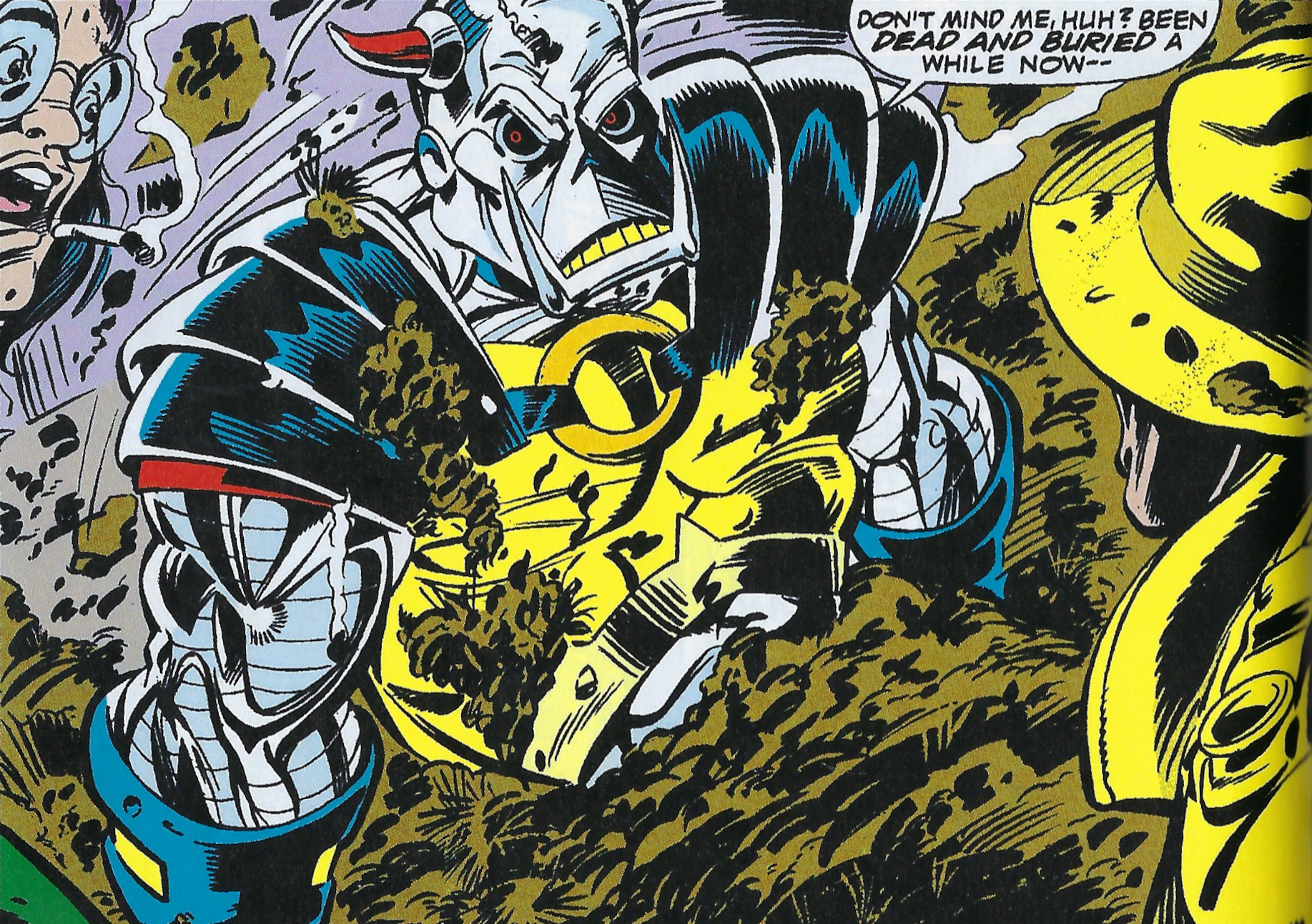
Part of the reason was that in 1992, he was killed off and replaced by Death's Head II, an "extreme" 1990s character. So Death's Head makes it into a new universe, and is killed off for his troubles. Simon Furman got the opportunity to kind of undo this in an issue of What If..., which has him uniting a team of 1992 superheroes to take down a villain in 2020. It probably would have been much more interesting if I was familiar with the story it was rewriting... but I also can't imagine I would enjoy reading that story either! Geoff Senior's usually solid art seems compromised in pursuit of the mediocre 1990s aesthetic, to boot.

Is he in a grave because the character was "dead," as in no longer published? Is that the joke? If so, he'd only been last published three months prior!
from The Sensational She-Hulk #24 (script by Simon Furman, art by Bryan Hitch & John Beatty)

So, I wish Furman had left Death's Head in Los Angeles 8162 and perfected that set-up instead. This was a pretty dismal way for a once-great character to go out. (Though, in my marathon at least, there is more Death's Head to come.)

(Also it seems like a bummer that this doesn't contain the 2011 Revolutionary War: Death's Head one-shot... I haven't read it, though, so maybe there's a good reason for that.)

This post is the fifteenth in a series about the Doctor Who Magazine comic strip and Marvel UK. The next installment covers The Good Soldier. Previous installments are listed below:

  1. The Iron Legion
  2. Dragon's Claw 
  3. The Transformers Classics UK, Volume One
  4. The Tides of Time
  5. The Transformers Classics UK, Volume Two
  6. Voyager
  7. The Transformers Classics UK, Volume Three
  8. The World Shapers
  9. The Transformers Classics UK, Volume Four
  10. The Age of Chaos
  11. The Transformers Classics UK, Volume Five
  12. A Cold Day in Hell!
  13. Death's Head: Freelance Peacekeeping Agent (part 1)
  14. Nemesis of the Daleks

17 February 2017

Review: Batman: Year 3 by Marv Wolfman, Pat Broderick, John Beatty, et al.

When I did my big readthrough of all of Batman's "Year One" stories (and related tales), there was perhaps one very notable omission: Batman: Year 3 by Marv Wolfman, Pat Broderick, and John Beatty, which was originally published in issues #436-39 of Batman vol. 1 in 1989. This is because Batman: Year 3, unlike Batman: Year One, Batman: Year Two, or indeed spin-offs like Batgirl: Year One and Two-Face and Scarecrow: Year One, has never been collected.

When you read it, though, it's easy to see why. Year One and Year Two were both interruptions to the ongoing narrative of Batman. Even though they originally appeared in issues #404-07 of Batman vol. 1 and issues #575-78 of Detective Comics vol. 1, respectively, they had nothing to do with what preceded or followed them-- they were sort of miniseries within an ongoing series. Year 3 is different: it was published between A Death in the Family and A Lonely Place of Dying, and has a frame story set during that time, with Batman dealing with the emotional fallout of the death of Jason Todd (Robin II) at the hands of the Joker.

"Frame story" is actually kind of misleading, as I would estimate that probably more of the story is set in the "present" than the "past." Year Three is when Dick Grayson's parents died, and he became Robin; the present-day storyline partially deals with the fact that Dick's parents' killer, Michael Zucco, is about to be released from prison. The flashbacks we see are primarily to provide context for this: the death of the Graysons, the hearing where Bruce adopted Dick, Dick's introduction to the Batcave, Dick's training and debut as Robin, and so on. (Much of this would later be re-depicted in Dark Victory and Robin: Year One.)

This means the bulk of the story focuses on Zucco's imminent release, and a gang war occurring in Gotham at the same time, which Batman handles with much more brutality than is typical. Part of the purpose of flashbacks is to show how parterning with Robin caused Bruce to soften from the Frank Milleresque way he was depicted in Year One-- and how now that a Robin is dead, his old brutality is reemerging. Wolfman is very good with the characters of both Bruce and Dick, and between this and A Lonely Place of Dying, I would definitely read more Batman stories by him.

But Wolfman's success with this is probably also the reason this story hasn't been collected. Batman: Year 3 is a good depiction of how Batman started to fall apart following the death of Jason Todd, but despite its title, it's not a very good standalone adventure in the early years of Batman: it's no Year One, that's for sure, but it's not even a Year Two. It ought to be collected, but not on its own. Better would be along with Wolfman's A Lonely Place of Dying, as it sets up Batman's need to always have a Robin, and Tim Drake (who becomes Robin in Lonely Place) even puts in a cameo at the circus during the flashback to the death of the Graysons.

Batman: Year 3 originally appeared in issues #436-39 of Batman vol. 1 (Early Aug.-Late Sept. 1989). The story was written by Marv Wolfman, pencilled by Pat Broderick, inked by John Beatty (#436-38) and Michael Bair (#439), colored by Adrienne Roy, lettered by John Costanza, and edited by Denny O'Neil.

16 September 2015

Faster than a DC Bullet: Project Gotham, Part VII: Batman: Shaman

Comic hardcover, n.pag.
Published 1993 (contents: 1989-90)

Borrowed from the library
Read November 2014
Batman: Shaman

Writer: Dennis O'Neil
Penciller: Edward Hannigan
Inker: John Beatty
Letterer: John Costanza
Colorists: Richmond Lewis

Year One, December
Except for some flashbacks, we finally move out of the timespan of Miller's Batman: Year One, into new territory; Shaman covers some of Batman's first winter in Gotham, as artifacts from an Indian tribe where he trained to become the Batman reappear in Gotham. This is the first of a couple Dennis O'Neil "Year One" tales, and probably the best of them; O'Neil and Edward Hannigan are consummate comics storytellers, and know how to write a gripping tale. It's not an amazing tale-- there are definitely some odd leaps-- but it is a well-told one. I also liked the reinsertion of some details from Batman's Golden Age origin into Batman: Year One, and the joke at their expense. It's actually a kind of brazen poke at a giant in a way.

Next Week: Green Arrow meets Green Lantern for the first time in The Ring, the Arrow and the Bat! Oh, and I guess Batman is there, too.