Showing posts with label creator: walter simonson. Show all posts

20 October 2021

Death's Head: Freelance Peacekeeping Agent in the Marvel Universe (From Stockbridge to Segonus: A Doctor Who Magazine Comics Marathon, Part 15)

Collection published: 2019
Acquired: March 2020
Second half read: July 2021

Death's Head: Freelance Peacekeeping Agent
stories from Death's Head vol. 1 #9-10 (Aug.-Sept. 1989), Strip #13-20 (Aug.-Nov. 1990), Fantastic Four vol. 1 #338 (Mar. 1990), The Sensational She-Hulk #24 (Feb. 1991), Marvel Heroes #33 (Mar. 2011), and What If... vol. 2 #54 (Oct. 1993)

Writers: Simon Furman & Walter Simonson with Ferg Handley
Pencilers: Geoff Senior, Bryan Hitch & Walter Simonson with John Ross & Simon Williams
Inkers: Geoff Senior, Bryan Hitch, Walter Simonson & John Beatty with John Ross & Simon Willams
Colorists: Louise Cassell, Euan Peters, Geoff Senior, Christie Scheele, Glynis Oliver & Sarra Mossoff with John Charles, Jason Cardy & Kat Nicholson
Letterers: Annie Halfacree, Helen Stone, Todd Klein, Jim Novak & Janice Chiang with Tim Warran-Smith

Issue #8 brought a big change of direction for Death's Head... but due to rights issues, it can't be printed in this collection! Suffice it to say that the Doctor takes Death's Head out of the Doctor Who universe in 8162 and plops him in the Marvel universe in the present day; I will eventually read it when I pick up The Incomplete Death's Head. So now Death's Head is in his third universe thus far!

So #9 picks up with Death's Head on the roof of Four Freedoms Plaza, where the Fantastic Four live. At first they fight, of course, but then they must team up the Fantastic Four's security system goes haywire. At the end of this issue, the Fantastic Four try to send Death's Head back to 8162 (I guess no one knows he's in the wrong universe), but when Reed Richards realizes he's a paid killer, he switches it off, which ejects Death's Head in the far-off year of, um, 2020. (Iron Man 2020 had been a feature of some Marvel comics, so this was an established setting.) The set-up is a bit confusing, as Death's Head is already established, and trying to find money to fix up his spaceship... which didn't come with him... and which doesn't appear in 2020 until the issue's end! 

Even Death's Head can't resist a baby.
from Death's Head vol. 1 #9 (script by Simon Furman, art by Geoff Senior)

These two issues are basically fine. There's some fun interplay between Death's Head and the FF, and the Iron Man 2020 has some great Death's Head moments, but on the other hand falls foul of the dull convolutions that bedevilled a number of the pre-time-jump stories. Overall though, one can sense a comic frantically searching for a new direction... and getting cancelled abruptly, as an obviously hastily final two pages in #10 sum up a lot.

After this, Death's Head doesn't have a status quo. The graphic novel The Body in Question (which has three parts; book one is set between the antepenultimate and penultimate pages of #10, and then books two and three after #10) makes the mistake of delving into the history of Death's Head, though it does reunite him with his supporting cast from his ongoing. No one cares about where Death's Head came from; what makes him interesting is what he does. Unfortunately this story gives us very little of that, instead spending time on a lot of cod mysticism. There is one good joke, though.

Actually, the issue number below is an educated guess. I can find very little information out there about the original appearance of this story.
from Strip #17 (script by Simon Furman, art by Geoff Senior)

I don't know why Furman bothered bringing the supporting cast back, because they never appear again. We next follow Death's Head into Fantastic Four #338, when he's starting freelancing for the Time Variance Authority. This is not much of a Death's Head story; it's just a Fantastic Four one he happens to be in. Better use is made of him in Sensational She-Hulk #24; he's back in New York 2020... but in a grave for some reason. (He still has his TVA time-bike, though, because he never returned it.) The story is goofy, but enjoyable, and actually makes good use of the 2020 setting in that something She-Hulk does in 1991 has repercussions thirty years later... and vice versa. Then in 2011, he's being hired by aliens to fight on their behalf (against the Hulk, as Earth's champion). (I assume because of time travel again, but I don't think anyone says.) Each of these is probably fine as a guest appearance, but it is a pretty disappointing way for the character to go out. He's brought into the Marvel universe... and promptly amounts to nothing!

Only thing that comes close to Geoff Senior drawing Death's Head is Walt Simonson doing it, complete with those amazing Simonson sound effects.
from Fantastic Four vol. 1 #338 (script & art by Walter Simonson)

Part of the reason was that in 1992, he was killed off and replaced by Death's Head II, an "extreme" 1990s character. So Death's Head makes it into a new universe, and is killed off for his troubles. Simon Furman got the opportunity to kind of undo this in an issue of What If..., which has him uniting a team of 1992 superheroes to take down a villain in 2020. It probably would have been much more interesting if I was familiar with the story it was rewriting... but I also can't imagine I would enjoy reading that story either! Geoff Senior's usually solid art seems compromised in pursuit of the mediocre 1990s aesthetic, to boot.
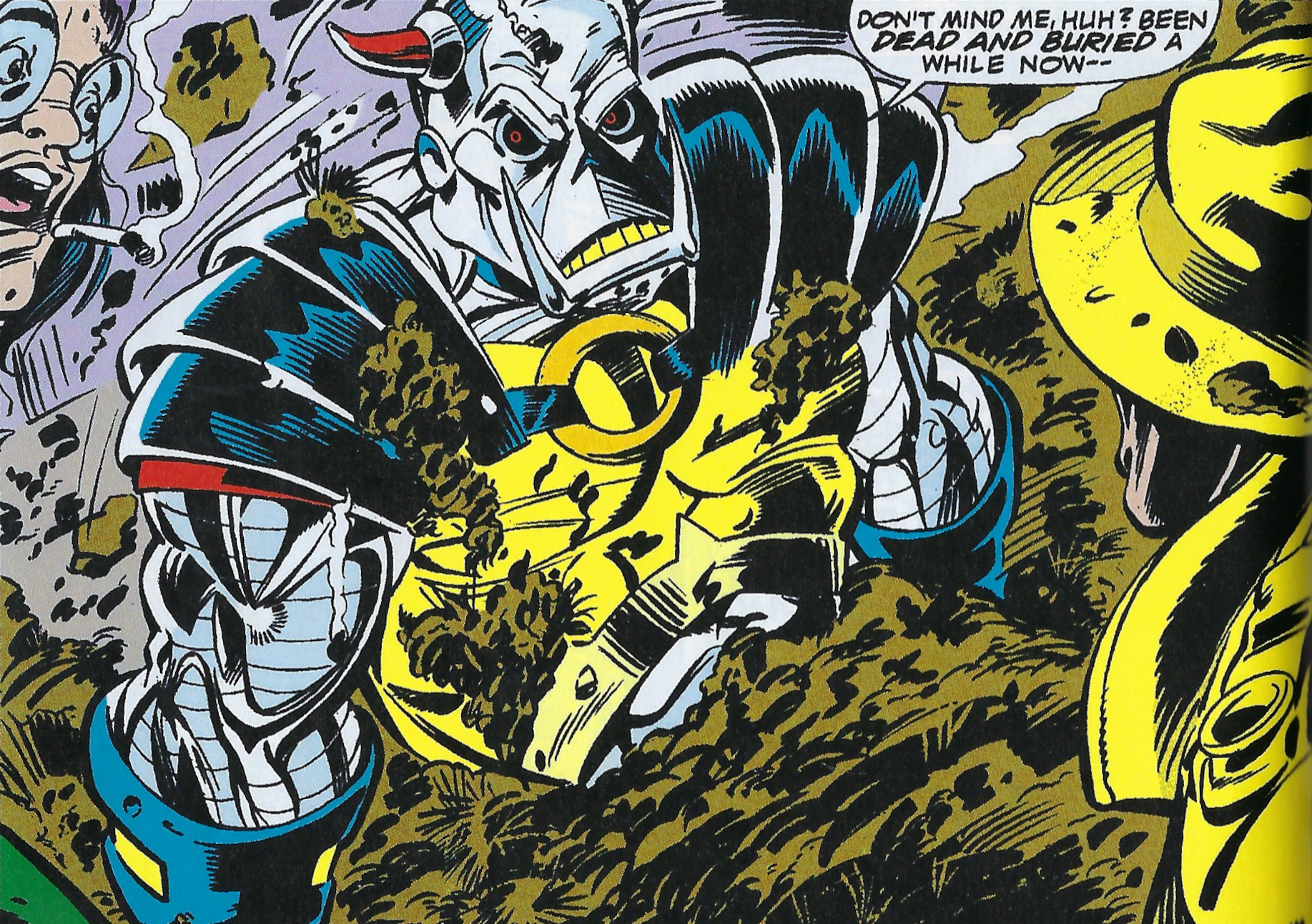
Is he in a grave because the character was "dead," as in no longer published? Is that the joke? If so, he'd only been last published three months prior!
from The Sensational She-Hulk #24 (script by Simon Furman, art by Bryan Hitch & John Beatty)

So, I wish Furman had left Death's Head in Los Angeles 8162 and perfected that set-up instead. This was a pretty dismal way for a once-great character to go out. (Though, in my marathon at least, there is more Death's Head to come.)

(Also it seems like a bummer that this doesn't contain the 2011 Revolutionary War: Death's Head one-shot... I haven't read it, though, so maybe there's a good reason for that.)

This post is the fifteenth in a series about the Doctor Who Magazine comic strip and Marvel UK. The next installment covers The Good Soldier. Previous installments are listed below:

  1. The Iron Legion
  2. Dragon's Claw 
  3. The Transformers Classics UK, Volume One
  4. The Tides of Time
  5. The Transformers Classics UK, Volume Two
  6. Voyager
  7. The Transformers Classics UK, Volume Three
  8. The World Shapers
  9. The Transformers Classics UK, Volume Four
  10. The Age of Chaos
  11. The Transformers Classics UK, Volume Five
  12. A Cold Day in Hell!
  13. Death's Head: Freelance Peacekeeping Agent (part 1)
  14. Nemesis of the Daleks

08 September 2021

Review: Armageddon: Inferno by John Ostrander, Luke McDonnell, Bruce N. Solotoff, et al.

I debated about reading this. I knew it was the story where the Justice Society returned from Ragnarok, the limbo they'd been in since 1986's Last Days of the Justice Society, so it was important, but I was also pretty sure the actual return was perfunctory, and there has never been a good Armageddon 2001 tie-in except for Justice League Europe Annual #2. I suffered through Countdown: Arena, okay? Surely I could go straight from The Demise of Justice to the JSA's present-day adventures in Justice Society of America vol. 2?

Anyway, the completist in me won out. Obviously!

I don't even know why this book exists. Armageddon 2001 was a crossover that ran through all of DC's annuals from May through November 1991. Was it really such a good seller that DC needed to follow it up with two different miniseries, this and Armageddon: The Alien Agenda? The hook of Armageddon 2001 was that the characters in every DC series got a vision of themselves ten years in the future; the stuff about Waverider and Monarch was just a vehicle to justify that. The only link between 2001 and Inferno is that Waverider is in it again, and boy I do not care about Waverider.

At first, though, I was like, "This isn't so bad!" Waverider has to gather heroes to battle some cosmic evil entity. The set-up is all quite dumb, and obviously it can't work: there are sixteen bad guys, all new characters, and there are four different teams of good guys in four different time zones. Like, how could you ever focus on any of them enough for this to be satisfying? But even a bad John Ostrander comic is better than a good Keith Champagne one, and there are some small bits of characterization and dialogue that lift this above the usual event comic dreck. Ostrander picks good characters for his out-of-time teams, even if the dialogue is often painfully clear about continuity. "Oh this guy comes from one year ago but this guy comes from five years ago." In a nice touch, though, Katar and Shayera of Hawkworld, which he was writing at the same time, are in it. It's not great-- Mark Waid would do this kind of thing much better during his run on The Brave and the Bold-- but hey it definitely could be worse.

from Armageddon: Inferno #2
(art by Walter Simonson)
And I had been worried about the fact that it has nine different artists for four issues, but the story actually does okay by this; the artists do different segments that correspond to different time periods, so there's no jarring mix of styles. Some artists just do single pages in an issue, but this is because they are splash pages that give you a quick sense of something that's happening somewhere, and usually quite atmospherically done. I mean, hey, if Walt Simonson draws a single page, it will be a good one even if it is a single one, right?

Actually it all goes downhill once the Justice Society is introduced! I don't know anything about the behind-the-scenes circumstances of this comic, but it actually reads to me like the idea of using at as a JSA revival was made up after issue #2 was written. In #3, Waverider and the Spectre decide to pluck the JSA out of time between moments in Ragnarok so that they can attack the master villain directly in his home dimension. (Waverider has already taken as many people as he dares out of time, but since the JSA is already out of time, they can be used without endangering anything as long as they are put back when it's all over.) And suddenly, the myriad characters introduced in the first two issues basically disappear! Like, why even bother? From then on, the comic focuses on the JSA battling Abraxis, where their abilities are enhanced by their participation in Ragnarok-- and eventually they pass the powers on to others. 

from Armageddon: Inferno #4
(art by Luke McDonnell & Bruce N. Solotoff)
So issues #3 and 4 focus on the JSA, who weren't really even alluded to in #1-2. The dialogue goes downhill in the JSA issues, as suddenly it's a bunch of cheesy quips. But what kind of personality could a battle with Abraxis ever express anyway?

But then the JSA has to go back, because otherwise Ragnarok cannot continue and the universe is doomed, so they get returned. But then literally on the last page in an aside, it's revealed that Waverider was able to swap their locations in time with Abraxis's minions. So they will fight in the battle, and the JSA can return to the normal flow of time. Like, if Waverider could move the bad guys in time... why didn't he just drop them all in a sun or something? So not only does it read like the JSA was added to #3 at the last minute, it reads like once they were added, the idea of their return was a last last minute change to #4!

This isn't good, and I shouldn't have read it. Like many superhero comics, what happens is noteworthy, but how it happens is not.

Armageddon: Inferno was originally published in four issues (Apr.-July 1992). The story was written by John Ostrander; pencilled by Luke McDonnell (#1-4), Art Adams (#1, 3-4), Mike Netzer (#1-2, 4), Walter Simonson (#1-4), Tom Mandrake (#1, 4), and Dick Giordano (#4); inked by Bruce N. Solotoff (#1-4), Art Adams (#1), Mike Netzer (#1-2, 4), Walter Simonson (#1-4), Tom Mandrake (#1, 4), Terry Austin (#3-4), and Frank McLaughlin (#4); colored by Gene D'Angelo; lettered by John Costanza; and edited by Dennis O'Neil.
 
This post is twenty-first in a series about the Justice Society and Earth-Two. The next installment is a supplement covering "Man-God!" Previous installments are listed below:
  1. All Star Comics: Only Legends Live Forever (1976-79)
  2. The Huntress: Origins (1977-82)
  3. All-Star Squadron (1981-87)
  4. Infinity, Inc.: The Generations Saga, Volume One (1983-84)
  5. Infinity, Inc.: The Generations Saga, Volume Two (1984-85)
  6. Showcase Presents... Power Girl (1978)
  7. America vs. the Justice Society (1985)
  8. Jonni Thunder, a.k.a. Thunderbolt (1985)
  9. Crisis on Multiple Earths, Volume 7 (1983-85)
  10. Infinity, Inc. #11-53 (1985-88) [reading order]
  11. Last Days of the Justice Society of America (1986-88)
  12. All-Star Comics 80-Page Giant (1999)
  13. Steel, the Indestructible Man (1978)
  14. Superman vs. Wonder Woman: An Untold Epic of World War Two (1977)
  15. Secret Origins of the Golden Age (1986-89)
  16. The Young All-Stars (1987-89)
  17. Gladiator (1930)
  18. The Crimson Avenger: The Dark Cross Conspiracy (1981-88)
  19. The Immortal Doctor Fate (1940-82)
  20. Justice Society of America: The Demise of Justice (1951-91)

30 August 2021

Review: The Immortal Doctor Fate by Martin Pasko, Keith Giffen, et al.

This is again a series that wasn't originally on my list, but I learned about from reading the lettercol in an earlier Earth-Two comic; Roy Thomas shilled for it at some point during All-Star Squadron. At first I was not interested-- and certainly in the future I will not be incorporating each and every Doctor Fate comic into my JSA read-through-- but 1) I liked Roy's Doctor Fate origin in All-Star Squadron #47, and 2) I am a sucker for the 1980s reprint miniseries where they took some archival material and reprinted it ad-free on high-quality paper with new covers. (I also have the IronWolf one-shot, the Green Lantern/Green Arrow one, and some other I cannot bring to mind.)

Mostly this series focuses on the Doctor Fate work of Martin Pasko, Keith Giffen, and Larry Mahlstedt; issues #2 and 3 each reprint a four-issue story originally published as a backup in The Flash in 1982. Issue #1 provides some context by including a Fate origin by Paul Levitz and Joe Staton from DC Special #10 (1978), a one-off by Martin Pasko and Walter Simonson from 1st Issue Special #9 (1975), and a six-page Golden Age story by Gardner Fox and Howard Sherman. (I assume the latter is included to bring the page count up, because it very much doesn't fit otherwise. It's also pretty nonsensical, even by Golden Age standards.)

from The Immortal Doctor Fate #1
(script by Martin Pasko, art by Walt Simonson)
I'm of two minds about this. One the one hand, I appreciate the artistry involved. The layouts-- especially those by Simonson and Giffen-- are explosive and energetic, communicating the apocalyptic tone, and unlike the kind of stuff you would have seen elsewhere in the late 1970s and early 1980s. There are disturbing, twisted, magical images here, and they feel unique to Doctor Fate. So too does the writing, which avoids the trap of being generic superheroics with a veneer of magic. I also like the "domestics" of Fate's set-up, his relationship with Inza and such. And Inza herself is pretty awesome.

from The Immortal Doctor Fate #2
(script by Martin Pasko, art by Keith Giffen & Larry Mahlstedt)

But something just never grabs me about Fate stories, even ones I can recognize as well done. I think it's because the magic can often be the fantasy equivalent of technobabble, what I often call "thaumababble." It feels like anything can happen, which is sometimes cool, but also means it's hard to grasp the logic of the world. Or maybe more accurately, I don't need to grasp the logic of fantasy stories (sometimes that removes the magic), but I do need to feel like there is a logic I could grasp. Le Guin treads this line well. It feels churlish to complain that Martin Pasko isn't Ursula K. Le Guin, but well, there you go. Worth tracking down (it took mildly more effort than 1980s comics usually do) and reading but I probably wouldn't reread them.

The Immortal Doctor Fate was published in three issues (Jan.-Mar. 1985). The original stories were published in various comics from 1940 to 1982, and were written by Paul Levitz, Gardner Fox, Martin Pasko, and Steve Gerber; pencilled by Joe Staton, Hal Sherman, Walt Simonson, and Keith Giffen; inked by Mike Nasser, Hal Sherman, Walt Simonson, and Larry Mahlstedt; lettered by Shelly Leferman, John Costanza, Ben Oda, and Adam Kubert; colored by Adrienne Roy, Anthony Tollin, and Tatjana Wood; and edited by Gerry Conway, Mike W. Barr, and Len Wein. The reprints were edited by Nicola Cuti.
 
This post is nineteenth in a series about the Justice Society and Earth-Two. The next installment covers Justice Society of America: The Demise of Justice. Previous installments are listed below:
  1. All Star Comics: Only Legends Live Forever (1976-79)
  2. The Huntress: Origins (1977-82)
  3. All-Star Squadron (1981-87)
  4. Infinity, Inc.: The Generations Saga, Volume One (1983-84)
  5. Infinity, Inc.: The Generations Saga, Volume Two (1984-85)
  6. Showcase Presents... Power Girl (1978)
  7. America vs. the Justice Society (1985)
  8. Jonni Thunder, a.k.a. Thunderbolt (1985)
  9. Crisis on Multiple Earths, Volume 7 (1983-85)
  10. Infinity, Inc. #11-53 (1985-88) [reading order]
  11. Last Days of the Justice Society of America (1986-88)
  12. All-Star Comics 80-Page Giant (1999)
  13. Steel, the Indestructible Man (1978)
  14. Superman vs. Wonder Woman: An Untold Epic of World War Two (1977)
  15. Secret Origins of the Golden Age (1986-89)
  16. The Young All-Stars (1987-89)
  17. Gladiator (1930)
  18. The Crimson Avenger: The Dark Cross Conspiracy (1981-88)

19 March 2018

Review: The Mighty Thor, Vol. 5 by Walter Simonson

Comic trade paperback, 208 pages
Published 2014 (contents: 1987)

Acquired December 2015
Read January 2018
The Mighty Thor, Vol.5

Writer & Artist: Walter Simonson
Artist: Sal Buscema 
Inking: Sal Buscema & Joe Sinnott
Remastered Coloring: Steve Oliff
Letterer: John Workman & Bob Pinaha

I found vols. 3-4 of Walter Simonson's run on Thor less interesting than vols. 1-2 (Frog Thor story aside, obvs), so I was a little worried going into vol. 5, but Simonson definitely turns it around, bringing things to an excellent and appropriate climax.

Sort of. Some comics creators tell one long story, but Simonson pursues a style of serialization that I prefer, where each story has some small hint or component that sets up the next story, so that the whole thing reads continuously, but the story being told at the beginning is not the story being told by the end. Like, way back in vol. 1 the whole thing started with Beta Ray Bill taking Thor's hammer. But in a series of natural progressions we're now reading about a Thor cursed by Hela (the goddess of death, and Thor's niece, not his sister like in Thor: Ragnarok) to experience great weakness but never die. And meanwhile Balder is ruling Asgard, and there are some human orphans from Midgard* being integrated into Volstagg's family.

The opening stories are okay, but things really come to life when Thor forges himself a new suit of armor to deal with his increasingly frail body, leading to this melodramatic showdown with the Frost Giants:
No one ever accused him of modesty.
from Thor vol. 1 #378 (art by Sal Buscema)

I love it when Thor shouts about how awesome he is.

In retribution, the Frost Giants try to send Jormungand, the Midgard Serpent (a giant dragon... also Loki's child???), after Thor, but end up sending comedy dragon Fin Fang Foom after him instead. Before they fight, Thor and Fin Fang Foom have a nice chat in a Brooklyn park:
I appreciate a philosoraptor.
from Thor vol. 1 #379 (art by Sal Buscema)

Fin Fang Foom is an erudite, honorable opponent, who ruminates on his relationship with humanity, and even lets Thor fight him in the wilderness so no bystanders will be hurt. It's a great little story featuring a great villain...

...who actually turns to be the Midgard Serpent after all!

!
from Thor vol. 1 #380 (art by Walter Simonson & Sal Buscema)

Simsonson comes back to the penciller's chair one last time during his run, drawing the issue where Thor fights Jormungan, and it is a tour-de-force. I mean, Simonson is always great on art, but here he excels himself: each page is its own panel. Sometimes this can be a cheap move (I wasn't too into it in The Death of Superman), but here it gives the fight weight and grandeur.

And its consquences are great, too: Thor become nothing but a pulp in a suit of armor, but he cannot die! Then the Destroyer turns up and all sorts of shenanigans ensue.

The run does feel slightly curtailed: Thor's supporting cast in New York City don't appear in this volume at all, for example, and there's a subplot about poison in Asgard that goes underexplained. Bu overall Simonson goes out almost as strong as he came in. I loved reading this imagining Chris Hemsworth doing the voices, and I look forward to tracking down more Thor comics.

* Earth.

12 March 2018

Review: The Mighty Thor, Vol. 4 by Walter Simonson

Comic trade paperback, 237 pages
Published 2014 (contents: 1986)

Acquired December 2015
Read August 2017
The Mighty Thor, Vol. 4

Writer & Artist: Walter Simonson
Artist: Sal Buscema 
Inking: Bob Wiacek & Al Milgrom, Geoff Isherwood, Bret Blevins
Remastered Coloring: Steve Oliff
Letterer: John Workman

Like vol. 3, this volume of The Mighty Thor is a mixed bag. Were vols. 1-2 Walter Simonson's peak? I only have one volume to go, so I guess I'll see. But this has some good stuff and some dull stuff. Definitely the highlight is the storyline where Loki turns Thor into a frog, and frog Thor then has an adventure in Central Park, rescuing a group of frogs from evil rats. It's pure comedic genius in some ways:
Best "translation" caption in comics?
from Thor vol. 1 #364 (art by Walter Simonson)

But it succeeds in its playing of the peril as completely straight. These are beings in trouble on Midgard,* and Thor will defend them, as is his duty.

Even as a frog, Thor gives the best pretentious speeches.
from Thor vol. 1 #364 (art by Walter Simonson)

And then, once he's able to lift Mjolnir, he goes from being a strong and large frog to being... THOR FROG!

'NUFF SAID!
from Thor vol. 1 #365 (art by Walter Simonson)

It's a masterful example of things you can do in the goofy-but-epic medium of the long-form superhero comic. I can only hope that we get to hear Chris Hemsworth voice this storyline on screen in Thor 4.

Other than that, Thor having to rescue Balder from evil crones in disguise is classic fairy tale stuff, and pretty enjoyable, and I also liked Thor returning to his "human" life on Midgard and befriending the very large family of his Italian foreman.

These kids are the greatest. And Thor is a terrible liar.
from Thor vol. 1 #373 (art by Sal Buscema)

But some stuff was less interesting: Malekith and Kurse aren't really good villains, so stuff revolving around them kind of bored me, and whatever was going on with mutants in the tunnels of New York was okay. And there's this weird story where a Judge Dredd rip-off comes from the future. It would work if it was completely goofy, but it gets pretty dark, and unlike with the frogs, the balance isn't quite hit right.

"I AM THE LAW!"
from Thor vol. 1 #371 (art by Sal Buscema & Bret Blevins)

Still, the volume was fun enough, and better than the third, I think. I just hope Simonson ends his acclaimed run on a high note.

* Earth.

05 March 2018

Review: The Mighty Thor, Vol. 3 by Walter Simonson

Up now: the first of three weeks of THE MIGHTY THOR! But before that, here are two recent reviews I've written for USF, both of Doctor Who releases with two stories in one: Vortex Ice / Cortex Fire and Shadow Planet / World Apart.

Comic trade paperback, 260 pages
Published 2013 (contents: 1985-86)

Acquired December 2015
Read January 2017
The Mighty Thor, Vol. 3

Writer & Artist: Walter Simonson
Artist: Sal Buscema
Remastered Coloring: Steve Oliff
Letterer: John Workman

This volume of The Mighty Thor feels a bit transitional, between the epic battles of vol. 2 (including the death of Odin) and whatever is to come in vol. 4. A lot of the book deals with the repercussions of the big battle in vol. 2: the army of Asgard is still trapped on Midgard* in Central Park (though when this is resolved, it's surprisingly easy), the city of Asgard is being rebuilt, and the question of who will rule Asgard is beginning to be considered. Loki of course wants it to be Loki, and uses Lorelei (who began pursuing Thor romantically in vol. 2) to make Thor agree. This results in a pretty great Thor/Loki fight where Thor throws his hammer and then grabs Loki's neck so that when the hammer returns it will take off Loki's head:
Between when I wrote this review and made this scan, this scene was directly ported into Thor: Ragnarok. Simonson actually got a credit in the film, which was nice.
from Thor vol. 1 #359 (art by Walter Simonson)

Also Thor has maybe the best "next issue" boxes:
NOTHING I CAN SAY CAN OUTDO THIS!
from Thor vol. 1 #357 (art by Walter Simonson)

There are also some hijinks on Earth with Beta Ray Bill, and Thor decides to deal with the death of his father by invading Hel-- as you do. He doesn't get his father's soul back, but he does liberate trapped human souls.

There are also four issues of a Balder the Brave miniseries collected here, which are decent. I've liked Balder's appearances in this series but don't know that I was clamoring for a spotlight for him. They are decently fun, though.

Walter Simonson knows his stuff, of course, but I felt like this volume didn't contain much meat. Hopefully vol. 4 gets back to the core of what made vols. 1-2 such a success.

How could I not be hyped for vol. 4, actually?
from Thor vol. 1 #363 (art by Walter Simonson)
* Earth.

05 September 2017

Review: Legion of Super-Heroes: Hostile World by Paul Levitz, Francis Portela, Walter Simonson, et al.

Comic trade paperback, n.pag.
Published 2012 (contents: 2011-12) 

Acquired August 2015
Read May 2016
Legion of Super-Heroes, Volume 1: Hostile World

Writer: Paul Levitz
Co-Plotter: Walter Simonson
Artist: Francis Portela
Penciller: Walter Simonson
Inkers: Dan Green, Sean Parsons
Colorist: Javier Mena
Letterers: Pat Brosseau, Travis Lanham

This is the first proper volume of the "deboot" Legion I've read-- by "proper," I mean stories that don't cross the Legion over with present-day DC characters, like in Superman and the Legion or Legion of 3 Worlds. It's confusing. It's dull. It's terrible. Levitz throws tons of characters at you, but gives you no reason to care about any of them. I've been reading the Legion for years now, and I don't give a shit about these people. How on Earth is a new reader supposed to? The extent to which the deboot Legion deviates from the core premise of the Legion is staggeringly misguided. Like, it's supposed to br about teenagers in the future, yet in this version they're all adults. What's going on? Who thought this was a good idea? I don't care for Francis Portela's stiff and posed artwork, but not even an issue drawn by Walt Simonson can get me involved. Is the deboot Legion a lost cause from its very inception?

Next Week: We warp back around to the beginning... or pretty close to it, anyway, with Legion of Super-Heroes Archives, Volume 3!

16 May 2016

Review: The Mighty Thor, Vol. 2 by Walter Simonson

First off, let me note the presence of another Torchwood audio review at Unreality SF: Gwen Cooper, Rhys Williams, and Yvonne Hartman return in episodes 3-4 of series 1, Forgotten Lives and One Rule.

Comic trade paperback, 236 pages
Published 2013 (contents: 1984)

Acquired December 2015
Read April 2016
The Mighty Thor, Vol. 2

Writer & Artist: Walter Simonson
Artist: Sal Buscema
Inkers: Terry Austin & Bob Wiacek
Remastered Coloring: Steve Oliff
Letterer: John Workman

Volume 1 of The Mighty Thor ended with a somewhat complicated plot about elves and food and an old guy who looked young and Wild Hunt and cops? Something like that. To my surprise, this plotline blossoms in volume 2 and turns out to be the payoff to what was an ongoing thread in volume 1: a mysterious weapon being forged outside of time and space. Well, Malekith's dark elves are after the Casket of Ancient Winters, so they can deploy it in aid of Surtur, Ruler of Muspelheim, an ancient evil that once battled Thor's father Odin and his brothers. Odin's brother's sacrificed themselves to seal Surtur in Muspelheim, but now he's back, and he threatens all of the Nine Realms, especially Asgard and Midgard.*

What delights me about Thor, both on screen and now in these comics, is how it uses a heightened style: everything about these comics is always on the next level from our mere mortal existence. The gods of Asgard are always speaking in dramatic pronouncements; I loved how Odin's story of his first encounter with Surtur ended:
One imagines that Odin tells all his stories this way. "THUS DID I PERSUADE THE CASHIER TO ACCEPT MY COUPON BEYOND ITS EXPIRATION DATE. LO! SUCH IS THE RHETORICAL POWER OF ODIN, HONED IN HIS UNIVERSITY FRESHMAN ENGLISH COURSES!"
from Thor vol. 1 #349 (art by Walter Simonson)

In volume 1, Odin obtained intelligence that the final battle was coming, and so mustered the forces of Asgard throughout this volume, meaning that when Thor encounters the forces of Muspelheim on Midgard, Asgard is ready, having summoned not only the warriors of Valhalla and Beta Ray Bill and Lady Sif, but also many of the former enemies of Asgard who do not wish to see the Nine Realms burn. What follows is a four-issue battle between Asgard and Muspelheim, and it is incredible. I wouldn't have thought that I would like such a thing-- it occupies almost 100 pages, yet is never dull. The forces of Asgard cross the Rainbow Bridge to make a stand in New York City, assisted by the Avengers and the Fantastic Four and suchlike. The whole setup actually make me think somewhat of the first Avengers film, with alien demons swarming from a portal atop a New York tower. Deliberate or coincidence?

Anyway, Surtur devastates New York City, his effectiveness enhanced by his opponents having to flight through a worldwide glacier. Thor calls a rain from Asgard to stifle the flames of Surtur-- but Surtur uses the link to Asgard to travel there himself, where only Odin and Heimdall stand to protect the City of the Gods. Beta Ray Bill takes command of the Asgard forces while Thor follows Surtur, but Thor is too slow: Surtur defeats Heimdall and destroys the Rainbow Bridge. The scene were its pieces rain down on New York City is ominous:
Lady Sif is kind of impulsive.
from Thor vol. 1 #351 (art by Walter Simonson)

Basically, it's lots of fighting: Beta Ray Bill, Sif, and the Fantastic Four vs. the demons of Muspelheim on Midgard, and Odin and Thor vs. Surtur in Asgard. Simonson has a good grasp of character throughout; Bill and Sif keep the Midgard battle anchored, stopping it from becoming sheer overwhelming spectacle. I also liked Roger Willis, the Korean War vet whose mysterious father passed to him the task of guarding the Casket of Ancient Winters. He's an ordinary guy caught up in extraordinary events who does his best to do the right thing.

Things in Asgard get epic when Loki turns up, too:
I guess it's no longer possible for such a scene in a Thor film, which is a shame because it would be amazing.
from Thor vol. 1 #353 (art by Walter Simonson)

There's also a nice subplot about Frigga, mother of Thor, getting the children of Asgard to safety. Simonson never forgets to leaven the seriousness. On all fronts, this is everything a giant superhero battle should be-- would it that they were all so good. Sadly, it all ends in the death of Odin.

What this review really omits is John Workman's tour-de-force lettering. I guess this will have to do.
from Thor vol. 1 #353 (art by Walter Simonson)

The whole thing is followed by a nice pair of aftermath issues. The destruction of the Rainbow Bridge means that the forces of Asgard are trapped in New York City; they decide to bivouac in Central Park. (Sif has the power to transport herself through spacetime, and I assume Beta Ray Bill can use his hammer, but otherwise they're all trapped.) The Warriors Three go to Macy's:
I love this kind of stuff. The best scene in the Thor films is the one where Thor goes to a diner and drinks coffee.
from Thor vol. 1 #355 (art by Sal Buscema)

I am of course looking forward to more culture-clash hijinks in volume 3. Meanwhile, Death herself turns up to collect Odin's soul, but can't find it. Thor lays the smackdown on Death, in what has to be one of my favorite scenes in any superhero comic:
You have to admire Thor's thought process (or lack thereof): "THERE IS NO PROBLEM, NOT EVEN DEATH ITSELF, THAT CANNOT BE SOLVED VIA A HAMMER SWUNG WITH SUFFICIENT POWER."
from Thor vol. 1 #354 (art by Walter Simonson)

Insisting his father is still alive, Thor heads out on a mystical quest (as you do). I look forward to seeing where this all goes in volume 3 as well. Simonson's run on Thor is clearly cyclical; as one big story cycles down, another one begins to cycle up in turn, and I'm sure this is all going somewhere new and exciting.

A final note: Simonson always pepper his stories with humor, which I appreciate. My favorite moment comes when (in a subplot I haven't had the space to mention in this review because this book is chock-full of them) Roger Willis doesn't buy Thor's girlfriend's explanation of how she saw through the disguise of Thor's secret identity of Sigurd Jarlson. She claims that "anybody would have known. You're just too big to hide behind a pair of glasses and an Izod shirt." But Roger is genre-savvy enough to know it doesn't work that way:
Someone's been reading his TV Tropes.
from Thor vol. 1 #349 (art by Walter Simonson)

I also enjoy the running gag about Sigurd's boss at the construction company where he works when he's not battling demon hordes (he doesn't come to work very much, to be honest) trying to guess which superhero he is. He's never right.

* Earth.

21 March 2016

Review: The Mighy Thor, Vol. 1 by Walter Simonson

Comic trade paperback, 215 pages
Published 2013 (contents: 1983-84)

Acquired December 2015
Read February 2016
The Mighty Thor, Vol. 1

Writer & Artist: Walter Simonson
Inker: Terry Austin
Remastered Coloring: Steve Oliff
Letterer: John Workman

Thor is, I kid you not, my favorite of the Marvel film series (well, though Guardians of the Galaxy may dethrone it). It's goofy, it has space aliens, it has lots of jokes, it has people stealing spaceships, it has mythology: it's basically everything I demand from cinematic entertainment. The actors who play Thor and the Warriors Three seem as if they really do come from a fantasy realm.

Since seeing the first one, I've been curious about the comics, and when it comes to Thor comics, it seems like all roads lead to Walter Simonson. Simonson's one of those people whose work I more know of than actually know. I own his Orion Omnibus and his Star Wars work but haven't actually read it; what I have read is limited to small contributions to things like World Without a Superman, 52: The Companion, and Batman: Strange Apparitions. But Simonson's Thor work is spoken of in hushed tones, and what I knew lead me to expect cosmic mythology, the exact register I would hope for.
Any guy whose power is to defeat his enemies by sitting on them and telling them a story is the kind of guy who gets my respect.
from Thor vol. 1 #339 (art by Walter Simonson)

Vol. 1 of The Mighty Thor did not disappoint. The whole thing is premised on Walter Simonson being the first writer to look at the inscription on Thor's Hammer, "WHOSOEVER HOLDS THIS HAMMER, IF HE BE WORTHY, SHALL POSSESS THE POWER OF THOR," and wonder, who would be worthy? Answer: Beta Ray Bill, warrior cyborg of an alien race. I like Simonson's answer; though being worthy is at least in part about moral purity, it must also be about warrior spirit-- something I would argue that, say, Captain America does not possess. The first four issues here are jam-packed, as Thor is drafted by Nick Fury, Thor goes into space after Bill's spaceship, Thor fights Bill, Bill seizes the hammer and acquires the power of Thor, Odin forces Thor and Bill to fight each other again, a warrior arrives in Asgard to challenge Balder the Brave only to be sat upon by Volstagg, Loki schemes with Lorelei, Lady Sif goes on a quest to the land of the dwarves, a new hammer called Storm Breaker is forged, Thor travels with Sif and Bill to battle alien demons, and Odin redistributes everyone's powers.
Lady Sif is the greatest.
from Thor vol. 1 #339 (art by Walter Simonson)

And after that there's still five issues to go! They don't make them like that any more. (This is why the mid-1980s are a peak era for comics: more sophisticated storytelling, but bloated decompression and gratuitous darkness haven't yet set in.) Like Jack Kirby, Simonson has the talent of packing in an incredibly large number of ideas into a small space, and casting them with a mythological tone that makes them feel even bigger than they are, and like Jack Kirby, he combines his command of word and image to achieve total comic book excellence. The Beta Ray Bill stories are definitely the best part of this collection, the rest of it being much more day-in-the-life-of-Thor-as-superhero-on-Midgard* stuff. He fights sea monsters, is wooed by a woman (who is really Lorelei is disguise), works as a construction worker, and gets involved in some kinda complicated plot involving people who can't eat food that I guess I have to wait for Vol. 2 to fully understand.

Normally this kind of stuff makes me roll my eyes, but I laughed here.
from Thor vol. 1 #341 (art by Walter Simonson)

It's not without its charms: hunky Thor trying to hide his might while working construction, Thor answering the call of the last scion of a Viking line in Antarctica, Thor running into Clark Kent and Lois Lane but no one recognizes each other because of the glasses. And Simonson is one of those writers who keeps a number of running subplots on the boil that come to the forefront in turn, my favorite being that of Balder the Brave who has forsworn killing, and the tragic moment where Loki forces him to confront that choice. Poor guy.
Another way to get my respect is to be a guy who considers the unleashing of his own violence the most regretful thing that could ever happen.
from Thor vol. 1 #344 (art by Walter Simonson)

Like I said, Simonson's art is amazing; his scripting may remind one of Kirby, but he has a bold visual style all his own, stopping this from feeling like pastiche. And John Workman provides some of the best lettering I've ever seen in a comic book, perfectly integrating with the image to drive home the scale of the cosmic events we're seeing. I never thought I'd write a sentence like that!
I originally scanned this page for the bad-ass parallel Thor and Beta Ray Bill pictures on top, but then I realized it was one of a great many examples of Workman's dramatic lettering, so I cropped it less than I had planned.
from Thor vol. 1 #340 (art by Walter Simonson)
* Earth.