Showing posts with label creator: tom raney. Show all posts

11 December 2019

Joe Casey's Adventures of Superman Supplement: The Harvest

"Seeds" / The Harvest, Parts One–Three and Conclusion


Action Comics vol. 1 #801-05 (May-Sept. 2003)

Writer: Joe Kelly
Pencillers: Tom Raney, Tom Derenick, and Pascual Ferry

Inkers: Walden Wong, Bob Petrecca & Norm Rapmund, and Cam Smith
Guest Artist: Jason Pearson
Colorists: Gina Going and Guy Major
Associate Editor: Tom Palmer jr
Editor: Eddie Berganza 


Up until now I've only read the other Super titles when they directly crossed over with Adventures of Superman. However, since I was already planning on reading two storylines guest starring Traci Thirteen, Lost Hearts and Supergirls (Action #806-08), I decided it made sense to read the storyline she appeared in between those two, The Harvest, in Action Comics. Plus I really liked the look of the covers. So I took a side-step away from Joe Casey to see what the other Joe was up to...

from Action Comics vol. 1 #801
(art by Tom Raney & Walden Wong)
The first issue, "Seeds" (Action #801), is a prologue about people all across the United States spontaneously becoming metahumans. Superman has to deal with people suddenly gaining powers they can't control. It's an okay story: I liked that the plot of the issue turned on Superman inspiring a scared kid to live up to Superman's legacy, and use his seemingly monstrous powers for good.

At the end of the issue, it's discovered that this was a targeted attack. Less than a month later is when "The Harvest, Part One" (Action #802) picks up, with the discovery that the perennial DC "rogue nation" of Bialya is at fault. (The Hollow Men story in Adventures #614-16 takes place during these weeks, and Superman reminds President Luthor about its events here. Not sure about this editorial choice to have the storylines overlap: surely so many Americans getting superpowers undermines the excitement of finding a community where everyone has superpowers!) Superman goes to Bialya to investigate, but discovers that General Zod, the Pokolistani general, has devastated the nation already.

A solution to the crisis of rampant superpowers is devised: Superman and Zod purposefully work together to turn the sun red to neutralize all the superpowers until the mutations can be reversed. At first people think Zod died and Superman lived, but it turns out that Zod surgically altered himself to look like Superman and switched places with him, so now Zod is the only powered metahuman, and he conquers the world.

Honestly, it's all a bit much. There's probably a good story to be told about Superman dealing with an outbreak of superpowers; this isn't it. There's probably a good story to be told about Superman purposefully turning Earth's sun red; this isn't it. It's one of those stories that moves too quickly to actually engage with anything. The events here should be hugely consequential, but are anything but. It's spectacle without substance.

from Action Comics vol. 1 #803 (art by Pascual Ferry & Cam Smith)
The main thing it accomplishes is to establish a relationship between the Pokolistani Zod and the Kryptonian Zod, but why do I care if this version of Zod is just a snarling monster, with none of the awesome severity of the film version. And it didn't matter in the end, anyway. Nine months after this storyline ended, a new, properly Kryptonian General Zod was introduced in For Tomorrow. And then just eighteen months after that storyline ended, a new new properly Kryptonian General Zod was introduced in Last Son. (DC keeps trying to translate the import of Terence Stamp to the comics page and largely failing; almost all of the comics takes on Zod have been damp squibs.)

Oh, and if Superman is a pacifist now, as per Adventures #616, there's no evidence of it here, as he reacts in anger to finding out about Bialya's involvement, and punches his way to victory over Zod!

As for Traci Thirteen? She has two small cameos, just establishing the she's moved from D.C. to Metropolis in order to set up Supergirls. She looks weird, which I thought was a thing penciller Pascaul Ferry was doing on purpose, but then when Lois Lane turns up in "The Harvest: Conclusion" (Action #805), she also looks weird, because Ferry apparently just doesn't know how to draw bangs. So reading it turned out not to be a particularly worthwhile endeavor. Oh well, such is life as a fan of shared-universe comics.

ACCESS AN INDEX OF ALL POSTS IN THIS SERIES HERE

28 May 2018

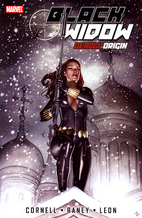
Review: Black Widow: Deadly Origin by Paul Cornell, Tom Raney, John Paul Leon, et al.

Comic trade paperback, n.pag.
Published 2010 (contents: 2010)

Acquired August 2012
Read February 2017
Black Widow: Deadly Origin

Writer: Paul Cornell
Pencils: Tom Raney
Inks: Scott Hanna
Colors: Matt Milla
Art & Colors, Flashbacks: John Paul Leon
Letterer: Cory Petit

Paul Cornell's Black Widow: Deadly Origin is one of those comics that takes the tangled history of a superhero character that's been jerked from status quo to status quo over the years, and tries to retroactively impose some kind of characterization on it all. Natalia Romanova was a super-agent of the U.S.S.R., a Russian superhero's wife, a spy in the West, a member of umpteen superhero teams, and a lover of umpteen male superheroes.

Matt Murdock lived in San Francisco?
from Black Widow: Deadly Origin #3 (art by John Paul Leon)

I don't think he really succeeds, unfortunately. If Natasha has her own core identity, I'm not sure what it is. Cornell's story alternates between the present day (where there's a plot to kill all those who she's ever loved) and the past (where we get snippets of her history). But there's either too many flashbacks or not enough of them. We never spend more than a page or two in any one time period, making it hard to get an emotional bead on Natasha at any given point. If they were expanded, they might work better. Alternatively, focusing on the present-day story might make Natasha's emotional throughline more clear. But as it is, it still feels more like a jumble of comic book continuity than actual story. I don't think I know Natasha any better as a person than I did before reading.

If you interpret creepy sex stuff here... you're not wrong!
from Black Widow: Deadly Origin #1 (art by John Paul Leon)

The art doesn't help. John Paul Leon's art for the flashbacks is nice and stylistic, but sometimes cold and hard to follow. Tom Raney's art for the present-day narrative, on the other hand, is often awkward, and his Natasha looks younger and more girly than Leon's in the flashbacks, which seems... misjudged.

Also, what mediocre faces!
from Black Widow: Deadly Origin #3 (art by Tom Raney & Scott Hanna)

My favorite part was when Natasha breaks into a Russian bunker to acquire some secret information, and all the young guys in the bunker are so excited to be defeated by her they just tell her everything she needs to know, and toast her with champagne as she leaves. The inclusion of Cornell's original pitch, including his editor's comments, is a nice bonus too.

Is it women's faces that trip him up? Faces drawn from angles? Something is always off, anyhow.
from Black Widow: Deadly Origin #2 (art by Tom Raney & Scott Hanna)

P.S. While writing this review, I came across this really nice review of the story from a feminist perspective on Fuck Yeah, Black Widow! A worthwhile read, and it helped clarify to this Black Widow novice what was preexisting continuity, and what was Paul Cornell's interpolation.

26 February 2018

Review: Threshold: The Hunted by Keith Giffen, Tom Raney, Phil Winslade, Scott Kolins, et al.

Comic trade paperback, n.pag.
Published 2014 (contents: 2013)

Acquired December 2016
Read January 2017
Threshold, Volume 1: The Hunted

Writer: Keith Giffen
Artists: Tom Raney, Phil Winslade, Scott Kolins, Andrei Bressan, Timothy Green II, Joseph Silver
Colorists: David Curiel, Andrew Dalhouse, John Kalisz, Chris Sotomayor
Letterers: Dave Sharpe, Dezi Sienty

Threshold was DC's first attempt at a "New 52"-era space-based ongoing comic, and The Hunted is its first and last volume. Threshold is the creation of Keith Giffen, co-creator of two 1980s space-based DC ongoings, The Omega Men and L.E.G.I.O.N. I don't know why it's called Threshold, but The Hunted is like the Hunger Games in space, sort of: it's a reality television series in Lady Styx's domain of Tolerance where political undesirables are forcibly enrolled. They have bounties placed on their heads, and are then let loose in Tolerance, and anyone who kills them gets the prize money. Anyone can take a shot, but popular groups of professionals have evolved. The longer you avoid being killed, the higher your bounty goes; L.E.G.I.O.N.'s Stealth appears as a long-time survivor of the games. The main character is Jediah Caul. Caul is a Green Lantern who sells out a trio of other "spectrum warriors" (purple, blue, and yellow) to The Hunted, but when they escape the game, Styx's people replace them with Caul.

Caul's not a very nice guy, and we watch him try to survive as he encounters 21st-century reworkings of a lot of old-school DC space characters, like Space Ranger and Tommy Tomorrow and Captain Carrot and Star Hawkins and the Star Rovers. Plus characters like the Blue Beetle show up, too. This was what made the book difficult for me: there was a lot to keep track of, and given that these characters were mostly created in the 1950s, most of them were generic white dudes. It seemed like there were too many for Keith Giffen to keep track of, too, as ideas and characters would be set up that went nowhere, or popped up sporadically.

Captain Carrot is about the worst partner one could have.
from Threshold #2 (art by Tom Raney)

I just could never get into the book as much as I would have liked. Too many characters, a premise that came across as both thin and overegged, a main character I never really enaged with, and too much sub-Firefly future slang that reminded me of the kind of thing Kris Straub parodied in Starslip. That's not to say it was bad: I liked Captain K'rot, and the whole Brainiac subplot was kind of interesting, but at times it was a slog that didn't seem to be going anywhere.

That said, there were two things I enjoyed. The first is the Star Hawkins backups, ten-page strips about what Tolerance's worst P.I. and his robot secretary (who has the mind of his ex-wife) are up to while Caul's on the run. They have some legit laugh-out-loud parts:
With friends like this, who needs enemies?
from Threshold #6 (art by Timothy Green II & Joseph Silver)

The other was the last issue, where Giffen provides a meta-commentary on the whole series by cancelling The Hunted. Blue Beetle even shows up to complain he didn't have anything to do with anything:
Between writing this review and making this scan is when I began reading Blue Beetle, so now I feel even more sorry/annoyed about his treatment here.
from Threshold #8 (art by Tom Raney)

And a spin-off is proposed, disposed of on the second-last page, a new spin-off is proposed and disposed of on the same page!

What is that font used in the last two captions, and why does the world consider a sci-fi font? DC and IDW both use it on their sci-fi titles pretty consistently.
from Threshold #8 (art by Tom Raney)

The sheer brazenness of the last issue made it hugely enjoyable, especially the way Giffen dovetails the last Star Hawkins backup into the main story, but I think if the best part of your comics series is the issue where you complain about being cancelled, you kinda had a problem from the very beginning.