Showing posts with label creator: chuck dixon. Show all posts

17 August 2026

Batgirl: Year One by Scott Beatty & Chuck Dixon, Marcos Martin, and Alvaro Lopez

Batgirl: Year One: The Deluxe Edition

Collection published: 2019
Contents originally published: 2003
Acquired: July 2025 
Read: March 2026
Writers: Scott Beatty & Chuck Dixon
Penciller: Marcos Martin
Inker: Alvaro Lopez

Colorist: Javier Rodriguez
Letterer: Willie Schubert

Maybe I've been spending too much time on Reddit's "Omnibus Collectors" sub, but recently I've been tracking down nice deluxe editions of classic DC storylines. On a very flimsy pretext, I purchased JLA: Year One; I also added a couple others to my wishlist, and I received this as a birthday present, the deluxe edition of Batgirl: Year One, which I borrowed from the library over a decade ago.

The original "Year One" was of course Batman: Year One, justly a classic, which established a "post-Crisis" origin for Batman. DC returned to this concept many different times and ways over the years; for example, in 1995, every DCU title's annual was a "Year One" story. One briefly common approach was the "Year One" miniseries: there were a whole spate of these in the 2000s, giving post-Crisis origins for characters like Robin, Green Arrow, Metamorpho, and the Huntress. I haven't enjoyed every one that I've read, but when they work, they really work: usually DC handed the reigns over to a high-profile creative team and got them to do good work in a timeless tale that stands alone. (And, of course, the post-Crisis pre-Flashpoint iteration of the DC universe is the best one, i.e., it's the one that was in effect when I got into superhero comics.)  

There's a nicely done subplot about how Commissioner Gordon knows Barbara is Batgirl... but just can't admit it to himself.
from Batgirl: Year One #9

Batgirl: Year One
 is no exception to this. Chuck Dixon isn't my favorite scripter, but he was everywhere on the Batman books in the 2000s, including Birds of Prey, so he was a good choice for Barbara Gordon's origin; outside of Robin and Nightwing: Year One, I'm less familiar with co-writer Scott Beatty's work, but he has done some very solid, very fun Batman-adjacent standalones, like the team-up with Elongated Man in Gotham Knights. And the quality work of Marcos Martin and Alvaro Lopez on this book is indisputable; they both seem like the kinds of illustrators who ought to have done more comics than they have. Their work here is slick and bold and stylized, full of energy that perfectly communicates the attitude of Barbara Gordon at this point in her life and superheroic career. The colors of Javier Rodriguez are excellent, too, bright and energetic.

Maybe I shouldn't be wasting one of my two images from Batgirl: Year One on a totally different character, but I can never say no to Dinah Laurel Lance.
from Batgirl: Year One #7

I don't think this is a great work of art. To be honest, I think the plot is unnecessarily confusing, and parts of it are a bit belabored. But what better "Year One" story could there be for Barbara Gordon? This is perfect bubblegum comics.

13 January 2026

Justice League International Year Seven, Part II: The Trouble with Guys (JLA #78-83 / JLI #51-52 / JLTF #4-8)

As I said in my previous post (see below), we're now in an era where the Justice League line of titles is juggling three ongoing monthly titles. My write-ups here are not aiming for strict chronology, but rather rotating through the series in a way that makes for the smoothest reading experience. It isn't totally possible to avoid any hiccups, though; for example, Hal Jordan turns up in JLA #83, a story that must take place before Bloodlines, with his arm in a sling, indicating that the story follows the destruction of Coast City in The Return of Superman. But Hal doesn't have his arm in a sling in any JLI stories until issue #61, which definitely takes place after Bloodlines. None of his JLI stories even mention the destruction of Coast City! 

Anyway, I've done my best to balance things out; I doubt, for example, that all five of the below JLTF  issues take place exactly where I've placed them, but you can read them there with no problems as JLTF doesn't intersect with either JLA or JLI until issue #9.

from Justice League International vol. 2 #51
"The New World" / "All Is Maya", from Justice League International vol. 2 #51-52 (June-July 1993)
written by Gerard Jones & Will Jacobs, pencilled by Ron Randall, inked by Randy Elliott, lettered by Willie Schubert, colored by Gene D'Angelo

Following the events of JLE #50 (see item #10 in the list below), the Justice League's London branch is now Justice League International, and as a result, is on an international goodwill tour; these two issues take the team to Mexico and India. We also have a slightly adjusted lineup, with Aquaman gone, but Tasmanian Devil and new hero Chandi joining the team. Each is a done-in-one story hinting at a larger plotline. I don't think these two stories are quite as good as the Jones/Randall/Elliott run on JLE #37-50, but they're decent enough. Jones has a good grasp on the characters (especially Ralph and Sue, though I'm not really sure where the Kara-is-pregnant plotline was intended to go), and he's always trying to do something more interesting than a generic superhero punchup.

from Justice League Task Force #8
"The Arsenal of Souls" / Knightquest: The Search / "Valley of the Daals!" / "How Green Was My Daalie?", from Justice League Task Force #4-8 (Sept. 1993–Jan. 1994), reprinted in Justice League Task Force, Volume 1: The Purification Plague (2018)
written by Chuck Dixon, Dennis O'Neil, and Peter David; pencilled by Gabriel Morrissette and Sal Velluto; inked by Dick Giordano and Jeff Albrecht (with Aaron McClellan); colored by Glenn Whitmore; lettered by Albert De Guzman, Clem Robins, and Bob Pinaha

Here we have three stories: a one-parter and two two-parters. Each of the stories has a different writer; all five of the issues but the first is drawn by Sal Velluto and Jeff Albrecht. The first is a Gypsy spotlight putting her up against regular Batman villain Lady Shiva, written by Chuck Dixon, regular Batman writer. I do like Lady Shiva, and in theory it's nice to get something focused on Shiva, but I didn't find the story very memorable.

Batman tie-ins continue to dominate the series with the next two issues, which are part of the Batman event Knightquest: The Search; Bruce Wayne (during the era where his back is broken and Azrael is Batman) asks the JLTF to help find Tim Drake's dad and Dr. Leslie Thompkins on the Caribbean island of Santa Prisca. (So many Caribbean islands in this era of Justice League comics.) For this mission, J'onn and Gypsy are joined by the Green Arrow (in his Mike Grell phase) and the Bronze Tiger (a character I do not remember ever encountering before or even hearing about). There's a lot of running around; I didn't find it very interesting, and of course it ultimately doesn't even go anywhere because a key plot point from a Batman event isn't going to be resolved in a second-tier Justice League tie-in.

Lastly, there's a two-part story by Peter David about the Justice League Task Force being sent into a hidden matriarchal society to retrieve a crashed UN operative. Only women can enter this society, meaning the team consists of Gypsy, Wonder Woman, Maxima, Dolphin, Vixen... and J'onn!? Because, of course, the Martian Manhunter can shapeshift into a female form. I read a lot of Peter David Star Trek when I was in high school and usually found it funny; I haven't reread any of that work recently, so I don't know if it this just isn't as funny, or if my tastes have changed, or it what worked in the 1990s does not work in the 2020s. I'd like to think there could be a funny story in the Martian Manhunter becoming a woman and this not being a big deal. Why should American constructions of gender matter to an immortal shapeshifting Martian alien? Or, even, a funny story in the fact that they somehow do? But what we get here is just hyuk hyuk hyuk lesbians. I mostly did not enjoy this, and it definitely verges into trans panic vibes at points. I'm not sure Sal Velluto is the right artist to pair with Peter David even on one of PAD's good days, in any case. 

The bit about Paradise Island was funny, though.

One thing in general about Justice League Task Force that bugs me is that Sal Velluto likes two-page spreads too much. This is definitely a "him" thing, not a writing thing, because it's consistent across the series's myriad writers. They're not the kind with one big image across two pages, but a full set of dozen panels like you might normally see on two pages, except instead of reading left-to-right-and-down across the lefthand page and then the right, you have to read left-to-right across the page gutter. Almost every time I initially read the lefthand page on its own, struggled with how incoherent it seemed, and then belatedly realized the righthand page should have been part of my sequence. Velluto isn't that great about clearly breaking the central panel in the first row in such a way that your eye follows it across so you know how to read the whole spread. (Admittedly, it must be tricky to do! I remember Lee Sullivan discussing how to do it in the commentary essay for the comic strip for Doctor Who Magazine #598.)

from Justice League America #81
"Lives in the Balance" / "Extreme Measures" / "Running from Justice" / "Do the Right Thing" / "Guilty as Sin" / The Trouble with Guys, from Justice League America #78-82 (Early Aug.-Nov. 1993) and Justice League America #83 & Guy Gardner #15 (Dec. 1993), reprinted in Wonder Woman and Justice League America, Volume 1 (2017)
written by Dan Vado and Chuck Dixon; pencils by Mike Collins, Kevin West, and Chris Hunter; finished art by Carlos Garzón & Romeo Tanghal, Rick Burchett, and Terry Beatty; letters by Willie Schubert, Tim Harkins, and Albert De Guzman; colors by Gene D'Angelo, Gina Going, and Anthony Tollin

Lastly, we have a pretty continuous run of stories from Justice League America. Issues #78 and 79 make a two-part story, then issues #80 through 83 make another story that's finished in an issue of Guy Gardner (and then, actually issues #84-85 make another two-part story that picks up right from Guy Gardner #15, but I'll cover that next time). All of the JLA issues are written by Dan Vado, who succeeded Dan Jurgens as writer; Mike Collins pencils the initial two-parter, and then Kevin West becomes the regular penciller. (Chuck Dixon writes the GG issue.)

Like Justice League Task Force, this run of JLA dials up the "character conflict" by having everyone constantly snarl at each other; on top of this, like JLTF, there's a lot of hamhandedly boring stuff about interventionist geopolitics. And then some new Extremists debuted. I found the Extremists of the weaker parts of the original Giffen/DeMatteis run, so the last thing they need is to be reinvented for the "extreme" 1990s. And also Jay Garrick there for some reason? Not even the usually reliable Mike Collins can save this.

All of these tendencies get even worse in the long story about alien refugees crash-landing on the Earth. The U.S government (we get a Bill Clinton appearance! Regan appeared a couple times in the late 1980s stories, but I feel like we totally skipped over Bush I) wants them handed over to another group of aliens, but Wonder Woman doesn't want to do that, so Captain Atom (who is back from the dead for reasons no one ever gives) is sent in to fight the JLA. Again, the characterization is about as subtle as being hit with a brick, and I don't get why Wonder Woman is constantly being shown up and/or undermined as team leader. I would say this is all the worst tendencies of 1990s comics, except I've already read volume 2, and I know it goes downhill even more.

The crossover with Guy Gardner at the end spins out of an incident in JLA #82, where Guy—who has been acting increasingly deranged—kills someone. We eventually find out he's been replaced by an alien clone, and the real Guy turns up to defeat him. Guy is slowly descending into his insufferable period here; I can't stand it. I did appreciate finding out where the Guy clone in Birds of Prey originated.

Other than quietly forgetting um... those two guys Jurgens added to the team, you know who I mean, Vado keeps the same line-up, and even gets Fire and Booster back into action. I guess I appreciate that intellectually, but they don't really do much that I enjoyed. Booster in particular is now wearing a particularly 1990s Imagetastic ugly suit of armor.

Anyway, uh, this is a great era for the Justice League. 

This is the twelfth in a series of posts about Justice League International. The next covers issues #84-85 of JLA, #53-57 of JLI, and #9 of JLTF. Previous installments are listed below:

  1. Justice League #1-6 / Justice League International #7-12 (May 1987–Apr. 1988)
  2. Justice League International #13-21 (May 1988–Dec. 1988)
  3. Justice League International #22-25 / Justice League America #26-30 / Justice League Europe #1-6 (Jan. 1989–Sept. 1989) 
  4. Justice League America #31-36 / Justice League Europe #7-12 (Oct. 1989–Mar. 1990)
  5. Justice League America #37 / Justice League Europe #13-21 (Apr. 1990–Dec. 1990)
  6. Justice League America #38-50 / Justice League Europe #22 (May 1990–May 1991)
  7. Justice League America #51-52 / Justice League Europe #23-28 (Feb. 1991–July 1991) 
  8. Justice League America #53-60 / Justice League Europe #29-36 (Aug. 1991–Mar. 1992) 
  9. Justice League America #61-65 / Justice League Europe #37-42 (Apr. 1992–Sept. 1992)
  10. Justice League America #66-69 / Justice League Europe #43-50 (Sept. 1992–May 1993) 
  11. Justice League America #70-77 / Justice League Task Force #1-3 (Jan. 1993–Aug. 1993) 

29 May 2023

Batman/Wildcat by Chuck Dixon, Beau Smith, Sergio Cariello, et al.

Batman/Wildcat

Collection published: 2017
Contents originally published: 1970-98
Acquired: March 2023
Read: April 2023

Writers: Chuck Dixon, Beau Smith, Bob Haney
Pencillers: Sergio Cariello, Irv Novick, Bob Brown, Jim Aparo
Inkers: Art Thibert, Danny Miki, Jaime Mendoza, Tom Palmer, Mike Esposito, Nick Cardy, Jim Aparo
Colorists: Jason Wright, Pat Garrahy
Letterers: Kevin Cunningham, Clem Robins

As I said when writing up Catwoman: Her Sister's Keeper, the discovery of a preexisting Ted Grant–Selina Kyle relationship in JSA Classified had me curious as to its origins; one of the stories that lead me to was a 1998 miniseries called Catwoman/Wildcat by Chuck Dixon, Beau Smith, and Sergio Cariello. I discovered it had been collected along with a 1997 mini from the same team, Batman/Wildcat, and five issues of The Brave and the Bold from the 1970s where Batman teams up with Wildcat. So, I picked up the whole collection.

Batman/Wildcat is fine. Like many Wildcat stories, it has to contrive some way to be about boxing. In this case, it's that old standby: the forced fight. Criminals are kidnapping people, mostly supervillains, and forcing them to fight each other on a super-secret pay-per-view channel (hey, it was the '90s). A mentee of Wildcat's get scooped up in it, though, and is forced to duke it out in a Wildcat costume, and so Batman and Wildcat run parallel investigations, then get kidnapped and forced to fight, and of course team up to dismantle the entire operation. I could probably go the rest of my life without reading another story where superheroes are forced to fight so rich people can gamble on it, to be honest; there's nothing about that premise that's ever interesting. What beggars belief is the bad guys don't even take Batman's and Wildcat's masks off to find out who they are; indeed, they put extra masks on them so they can't see who they're fighting! I think the story would have also benefited from making Ted's status quo clearer; at the end, he comes out of retirement to go back to fighting crime as Wildcat, but that was the moment I learned he was in retirement to begin with! (This would be set after the Justice Society falls apart in Zero Hour, before it reunites in Justice Be Done.)

Oracle! Ah, 1990s Birds of Prey nostalgia...
from Batman/Wildcat #2 (script by Chuck Dixon & Beau Smith, art by Sergio Cariello and Art Thibert, Danny Miki, & Jaime Mendoza)

The follow-up, Catwoman/Wildcat, is a bit better. Catwoman travels to Las Vegas to carry out a heist where, coincidentally, Ted Grant is in some kind of exhibition match. The heist, honestly, was very confusing. Selina's competing with like two other groups of criminals and there's a lot of double-crossing, and a lot of characters I didn't care about. What was consistently fun was the flirting between Selina and Ted. Selina knows who she is dealing with right away, but it takes most of the story for Ted to figure out who she is (there's a brief flashback to Her Sister's Keeper, despite Catwoman: Year 2's implication it didn't count), and so he doesn't get why this attractive younger woman is coming on to him. Whenever the story focuses on the antics of the two of them it is fun; whenever it focuses on the other characters, I hoped it would get back to Ted and Selina. Thankfully boxing has little to do with it.

It's a very different Selina to the one who seemed shocked at what Ted Grant might ask of her for defense training!
from Catwoman/Wildcat #3 (script by Chuck Dixon & Beau Smith, art by Sergio Cariello & Tom Palmer)

Both stories are pencilled by Sergio Cariello who has a... I guess I would say perfectly adequate 1990s style. It's not my jam, and I think he draws Selina/Catwoman a bit weird, but it's a good artistic fit for Chuck Dixon's over-the-top action-focused style of writing.

Cats in heat.
from Catwoman/Wildcat #1 (script by Chuck Dixon & Beau Smith, art by Sergio Cariello & Tom Palmer)

The five stories from The Brave and the Bold run the gamut. Each has to have some weird reason for Batman to pull Wildcat into the case; some are more compelling than others. The first, "Count Ten... and Die!" is probably the best. Bruce Wayne is coaching the American team in the World Youth Games in fencing, while Ted Grant is coaching the boxing team. Ted is heckled by the coach of the Russian team, but then also there's a lot of stuff about a spy and needing to transfer a secret tape. Boxing is worked in pretty organically here, and it has its moments, even if it can get a bit contrived. (At one point, Ted Grant sneaks out of a boxing match he is participating in to track Batman to a river in the countryside, rescues Batman from kidnappers after a pitched battle, and returns, all while forcibly dragging his opponent with him... and no one notices this because the lights are out!) I thought the culmination of Ted being goaded was going to be him rising above it, but Batman points out that if Ted Grant doesn't wallop this Russian guy, America may as well give up the Cold War, so Ted punches his lights out for patriotism.

If your story is set in Cold War Vienna, it is mandatory to have a key scene set on the Wiener Riesenrad.
from The Brave and the Bold vol. 1 #88 (script by Bob Haney, art by Irv Novick & Mike Esposito)

A couple feel like they could have been about any character, and Ted is barely even in them: in "The Smile of Choclotan!" he's mostly in a trance, in "A Very Special Spy!" Ted is for some reason an exec at an energy firm, and in "Dead Man's Quadrangle" he's running a health spa in the Caribbean. I guess post-JSA he made a run a lot of different businesses?

For some reason, everyone in Mexico calls him "Bat-Hombre." Not, say, "Murciélago Hombre"... or just, you know "Batman"!
from The Brave and the Bold vol. 1 #97 (script by Bob Haney, art by Bob Brown & Nick Cardy)

I was able to embrace the goofiness in "May the Best Man Win Die!" In this, Wildcat does an exhibition boxing match at a Gotham prison... only the guy he fights is a potential witness against the Joker, and the Joker uses the opportunity to infect Wildcat's opponent with a rare tropical illness, and soon the whole prison is in danger. A biologist brings a dog in whose blood he's incubated antibodies to Gotham, but the dog is stolen by the Joker, then it escapes from the Joker, and so Batman, Wildcat, and the Joker are all searching Gotham for a dog who has the key to hundreds of lives. So wacky you've got to love it! I even didn't mind the obligatory Batman/Wildcat slugfest, because it's really just an opportunity for the Joker to infect them with the disease too.

Like, a page later, Batman admits that he has no idea if this is true or not.
from The Brave and the Bold vol. 1 #118 (script by Bob Haney, art by Jim Aparo)

Bob Haney is certainly a wacky writer. In "May the Best Man Die!", Batman goes to the Gotham pound to pick up the dog, but is told someone claiming to be the dog's owner already picked it up... a weird guy with green hair! Like, how could you live in Gotham and see a guy with green hair and not think, "Hmmm... is that the Joker!?" In "Dead Man's Quadrangle," Batman travels to the Caribbean via a commercial flight... in costume! There he is just chilling in first class; the guy seated next to him just casually chatting him up. In the 1970s was airport security so lax? Or does Batman get an exemption? And is a Batsuit really comfortable clothing for a long flight?

Batman has the same annoyances on a flight as us regular folks.
from The Brave and the Bold vol. 1 #127 (script by Bob Haney, art by Jim Aparo)

Some continuity notes: When these stories came out they were evidently controversial, because they feature the "regular" Batman of DC, i.e., the Earth-One Batman, but Wildcat is from Earth-Two! The explanation (given in letter columns, I guess, because it never appears in the stories themselves) was that this was the Wildcat of Earth-One, a character who only appeared in these five issues of The Brave and the Bold and one issue of Super-Team Family. Thus, we are left to infer most of his history: an older superhero, seemingly not active anymore... but in this world there was no JSA. Post-Crisis, I think we can just imagine that these events did happen (approximately) as depicted here, with the new post-Crisis Batman and the new post-Crisis Wildcat. By publication sequence these would go in the period after the JSA kind of came out of retirement for its JLA team-ups, before the JSA was revived full-time in the 1970s issues of All Star Comics, and I think this depiction of Wildcat fits well with that.

Lastly, there's a weird bit in "Dead Man's Quadrangle," where Ted thinks that on his second comeback tour he accidentally killed a man ("Kid O'Hare") in the ring, and thus gave up throwing punches ever again. He gets over it, of course, but this was never mentioned before and thus must have happened in the year since his previous Brave and the Bold appearance yet is just kind of tossed in as if we already know about it! As far as I know, it never comes up again either.

This post is forty-third in an ever-expanding series about the Justice Society and Earth-Two. The next installment covers volume 3 of Justice Society of America. Previous installments are listed below:

15 June 2022

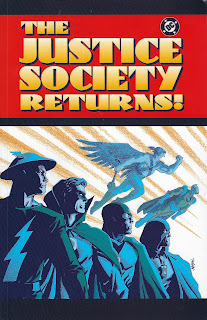
The Justice Society Returns! by David Goyer, James Robinson, et al.

 The Justice Society Returns!

Collection published: 2003
Contents originally published: 1999-2001
Acquired and read: February 2022

Writers: David Goyer, James Robinson, Chuck Dixon, Geoff Johns, Ron Marz, Tom Peyer, Mark Waid
Pencillers: Michael Lark, William Rosado, Eduardo Barreto, Scott Benefiel, Russ Heath, Aaron Lopresti, Stephen Sadowski, Peter Snejbjerg, Chris Weston, Peter Grau
Inkers: Michael Bair, Eduardo Barreto, Keith Champagne, John Dell, Wade Von Grawbadger, Doug Hazlewood, Russ Heath, Ray Kryssing, Aaron Lopresti, Mark Propst, Claude St. Aubin, Christ Weston
Colorists: John Kalisz, Carla Feeny, Noelle Giddings, Tom McCraw
Letterers: Ken Lopez, Kurth Hathaway, Bill Oakley, John Costanza, Janice Chiang

I'm coming up on the return of the JSA to an ongoing comic, but before then, I'm reading four collected editions with JSA connections, of which this is the first.

The title of this volume would seem to indicate that it's about a triumphant return of the Justice Society of America. This is only kind of true. This isn't a "return" in the narrative; the JSA (which had disbanded in Zero Hour) was still moribund in the present-day of the DC Universe (though that was about to change), it was a return out of the narrative, in that 1999 gave us a JSA title for the first time since the end of its short-lived only ongoing back in 1993. But if you were to look at my list of titles below, it's slightly deceptive: it would imply no JSA-adjacent titles from the end of Damage in 1996 until now. But in fact one had been steadily chugging along since 1994: James Robinson's Starman. This was about the most recent inheritor of the Starman mantle, but it had played a lot with the history of the character, including his JSA ties. That title was primarily written by James Robinson, often co-plotted by David Goyer, and it's those two that primarily guide this storyline.

Did people in 1945 know this? I guess probably.
from All Star Comics vol. 2 #1 (script by James Robinson & David Goyer, art by Michael Lark and Wade Von Grawbadger & Doug Hazlewood)

The Justice Society Returns! is set in 1945, as it seems World War II is coming to an end, and one could imagine it as a story arc in All-Star Squadron if the series had made it that far along; like that series, it weaves the superheroics in and out of real war to good effect. It is structured like a typical Golden Age JSA storyline: the characters as a group discover some issue, then they split up into groups to handle different aspects of it, then they come back together as a group to finish it off. Except, instead of having just a single issue to do all of this, JSA Returns takes nine issues, two of which are double-sized!

This turns out to really work. I usually dislike the typical JSA structure because everything is rushed and you don't get much genuine character interaction—which is surely what you want out of a team book! But with one issue apiece for each pair of heroes, you can really dig into them. The individual stories, like All-Star Squadron did, do neat stuff by placing these superheroes in wartime, exploring what makes them tick, and delving into the war itself at the same time. Goyer and Robinson write the two framing issues (All Star Comics vol. 2 #1-2, more on them later), while a variety of writers pen the ones in between; each issue has its own artist.

Good use of the silent panel, here.
from All-American Comics vol. 2 #1 (script by Ron Marz, art by Eduardo Barreto)

Highlights included "Cold Heart" (All-American Comics vol. 2 #1), which is about Green Lantern and Johnny Thunder protecting the Yalta Conference, but is mostly told from the perspective of an ordinary American soldier trying to do the same without superpowers: a strong sense of tone, time, and character make this an effective tale. It might be the best Ron Marz script I've ever read, and Eduardo Barreto is a great penciller who I am surprised not to know more of given this quality of work.

Go little guy, go!
from Adventure Comics vol. 2 #1 (script by James Robinson & David Goyer, art by Peter Snejbjerg & Keith Champagne)

I also really liked "Stars and Atoms" (Adventure Comics vol. 2 #1), which sends Starman and the Atom to Los Alamos to protect the atom bomb test site. Robinson and Goyer themselves provide a great focus on one of my favorite JSAers, the eternal underdog the Atom, and Peter Snejbjerg (is he an underrated talent? I always like him but can't remember seeing him get much high-profile stuff) also turns in some atmospheric pencils, backed up by great coloring from John Kalisz. The debt that this whole series owes to A-SS is most clear here, as it picks up on some stuff Roy Thomas established about how the Atom developed superpowers and changed costumes (though I think that "really" didn't happen until 1948).

I don't think I've ever read a comic really focused on Mr. Terrific, but I usually enjoy him when he pops up.
from National Comics vol. 2 #1 (script by Mark Waid, art by Aaron Lopresti)

It would probably surprise no one to know that Mark Waid's story is also one of the collection's greats. "Fair Play" (National Comics vol. 2 #1) is set in Dresden during the Dresden bombing, focusing on the Flash and Mr. Terrific. The story is narrated by the Flash, but focuses on Mr. Terrific, whose sense of fair play is undermined by the horrific events he witnesses... perpetrated by his own side! The ending is a little pat, though, as the story kind of punts responsibility for the bombing onto war itself rather than, you know, the people who make these decisions.

Gotta get our gratuitous shots into those comics about women, amirite?
from Sensation Comics vol. 2 #1 (script by James Robinson & David Goyer, art by Scott Benefiel & Mark Propst)

Probably the only misfire is "Womanly Deeds & Manly Words" (Sensation Comics vol. 2 #1). The writing here from Robinson & Goyer is fine, teaming up Wonder Woman and Hawkgirl, but it is pretty typical superhero comics that clearly someone involved went, "Well, why would people read a comic about two women unless it had a lot of panels with gratuitous focuses on tits, asses, and panties in it?" I don't know this Scott Benefiel guy, and I am not encouraged to do so. The Wonder Woman here is Diana's mother, Queen Hippolyta, having travelled back in time (I think this happened in John Byrne's Wonder Woman comics, which I haven't read), but the story mostly shies away from that; aside from Johnny Thunder calling her "Polly" in one issue, I don't think there's a reference. (Roy Thomas established back in All-Star Squadron/Secret Origins that Miss America filled Wonder Woman's role in the JSA in the post-Crisis timeline, but later writers don't seem to have been very interested in that idea.)

I have never really been convinced I want to read a Johnny Thunder series or something, but I have come to see him as a delightful bit of color in JSA stories.
from All Star Comics vol. 2 #1 (script by James Robinson & David Goyer, art by Michael Lark and Wade Von Grawbadger & Doug Hazlewood)

I also was not very taken by the wrap-up issue, "Time's Arrow" (All Star Comics vol. 2 #2), which becomes a confusing muddle involving time travel for no evident reason. It felt like the writers ran out of space... but they only ran out of space because they added a bunch of unnecessary stuff! But the first issue, "Time's Keeper" (All Star Comics vol. 2 #1), was a strong one; it's essentially two one-issue stories combined: first an Hourman solo story, then a big JSA fight. I can't claim to love Hourman (I would be very happen to never read another ham-fisted Miraclo addiction storyline), but he can work well in some cases, and this is one of them. Michael Lark, better known for his work on Gotham Central, is just as adept with traditional superheroics.

(There are also two short stories that pad out the volume, one about class snobbery in the JSA from Golden Age Secret Files and Origins #1, and one about Stargirl from JSA Secret Files and Origins #1. The former was fun, but the latter did not make me like Stargirl very much. I am curious to see her in her original solo series, which I should do soon.)

Overall, this is great, doing what the "retroactive continuity"–based JSA comics have done at their best since the days of All-Star Squadron, and I am glad I spent the money to track down a physical copy. Soon I'll be reunited with the JSA in the present (there is a veritable explosion of JSA content in the early 2000s) but this is a great teaser for things to come, a great return to the glory days.

This post is twenty-fifth in a series about the Justice Society and Earth-Two. The next installment covers Chase. Previous installments are listed below:
  1. All Star Comics: Only Legends Live Forever (1976-79)
  2. The Huntress: Origins (1977-82)
  3. All-Star Squadron (1981-87)
  4. Infinity, Inc.: The Generations Saga, Volume One (1983-84)
  5. Infinity, Inc.: The Generations Saga, Volume Two (1984-85)
  6. Showcase Presents... Power Girl (1978)
  7. America vs. the Justice Society (1985)
  8. Jonni Thunder, a.k.a. Thunderbolt (1985)
  9. Crisis on Multiple Earths, Volume 7 (1983-85)
  10. Infinity, Inc. #11-53 (1985-88) [reading order]
  11. Last Days of the Justice Society of America (1986-88)
  12. All-Star Comics 80-Page Giant (1999)
  13. Steel, the Indestructible Man (1978)
  14. Superman vs. Wonder Woman: An Untold Epic of World War Two (1977)
  15. Secret Origins of the Golden Age (1986-89)
  16. The Young All-Stars (1987-89)
  17. Gladiator (1930) ["Man-God!" (1976)]
  18. The Crimson Avenger: The Dark Cross Conspiracy (1981-88)
  19. The Immortal Doctor Fate (1940-82)
  20. Justice Society of America: The Demise of Justice (1951-91)
  21. Armageddon: Inferno (1992)
  22. Justice Society of America vol. 2 (1992-93)
  23. The Adventures of Alan Scott--Green Lantern (1992-93)
  24. Damage (1994-96)

26 October 2016

Faster than a DC Bullet: Birds of Prey, Part XVIII: Birds of Prey, Volume 2

Back in early 2013, I read all the Birds of Prey comics that then existed; since there, more have been published, and catching up on them is my last round of catching up before I turn my eyes back to other ongoing projects.

Comic trade paperback, n.pag.
Published 2016 (contents: 1999)
Borrowed from the library
Read May 2016
Birds of Prey, Volume 2

Writer: Chuck Dixon
Pencillers: Greg Land, Dick Giordano, Pete Krause, Nelson DeCastro
Inkers: Drew Geraci, Mark Propst
Colorists: Gloria Vasquez, James Sinclair
Letterers: Albert T. DeGuzman, Tim Harkins

DC Comics has been re-collecting the original Birds of Prey comics from the beginning. They're chunkier than the old collections, which means that Volume 1 of these new collections contained all the comics previously collected in Black Canary/Oracle/Huntress: Birds of Prey and some of those in Old Friends, New Enemies, while Volume 2 contains the balance of issues from Old Friends, plus a number of issues that have never been collected before at all, so that's were I'm starting in these new collections.

Even when a slave laborer in a third-world country, Dinah looks good.
from Birds of Prey vol. 1 #3 (art by Greg Land & Drew Geraci)

Birds of Prey as originally conceived is undeniably a fun concept: Black Canary and Oracle, both characters with somewhat rocky pasts, moving on with their lives and kicking butt. During this period of the book, they've never met in person (well, not since Barbara Gordon became Oracle); Oracle's identity is a secret from Dinah, and there's also an online relationship brewing between Barbara and the mysterious "Beeb." What we end up with here are a variety of exciting, action-based stories by Chuck Dixon (undeniably an expert at exciting, action-based stories, but Birds of Prey is probably him at his best) and Greg Land and Drew Geraci (who draw attractive women without being sleazy). I already reviewed the first couple stories in this book in my review of Old Friends, New Enemies, so here I'll focus on what was new to me, though suffice it to say that I found the story where Black Canary and the Ravens both end up on vacation in Minnesota and a dinosaur comes through a time portal to be immense fun.

07 September 2016

Faster than a DC Bullet: Gotham Central, Part Ø: Batman: Gordon of Gotham

Before plunging into my next comics project, I want to cycle back to some old ones and read some books related to them that have come out since then. The first of these is Gotham Central, which I read over five years ago now.

Comic trade paperback, n.pag.
Published 2014 (contents: 1996-98)

Borrowed from the library
Read March 2016
Batman: Gordon of Gotham

Writers: Chuck Dixon, Dennis O'Neil
Artists: Klaus Janson, Jim Aparo, Bill Sienkiewicz, Dick Giordano
Colorists: Kevin Somers, Ian Laughlin, Pam Rambo, Jamison
Letterers: John Costanza, Clem Robins

This book collects three four-issue miniseries that feature Commissioner Gordon and/or the Gotham City Police Department; it's a precursor of sorts to Gotham Central, though I am pretty sure that the only main character here who is also a main character there is the ubiquitous Renee Montoya. Each of the stories here has a slightly different focus.

"Gordon's Law" is pretty squarely focused on Commissioner Gordon himself, as he discovers that there's possibly some corruption in the GCPD, which means he can't trust anyone on the force-- and to make things worse, he only wants cops to go after cops, which means he rejects Batman's offer of assistance as well. The story is kinda complicated; there are a lot of characters, and most of them were new to me (if not new to everyone), and though I really like the gritty tone established by Klaus Janson's artwork, he didn't always make it easy to remember who was who. Its biggest weakness is probably that it's one of those stories where tons of "old friends" we've never seen before turn up, and the narrative expects us to be surprised when an "old friend" we've never seen before turns out to not be altogether trustworthy. And that's not the only obvious twist, but there were some good ones as well. Overall, it's an okay tale: some good crime fiction influences, but it doesn't really have anything to say about Gordon, about the GCPD, or about Batman.

I love how sleazy/creepy the face of this guy (he's an informant) looks.
from Batman: Gordon's Law #1 (script by Chuck Dixon, art by Klaus Janson)

"GCPD" is the most like Gotham Central of all the stories here; the commissioner is just a minor part of a sprawling, ensemble tale of various members of the GCPD pursuing various cases. Harvey Bullock struggled with anger management, a new partner, and a serial killer; Renee Montoya goes undercover as a diplomat's wife to help catch an assassin; two cops named Kitch (a trained lawyer) and Cav (a grizzled old vet) track down art thieves and an insurance same; an administrator named Hendricks tries to figure out who's stealing stationery. As you might imagine, some of these stories are better than others: I always enjoy a Montoya tale, but Chuck Dixon doesn't really her very unique, and the circumstance she ends up in seems incredibly contrived to say the least. (Do local cops really handle assassination plots against foreign officials? Would there really be no plan for cancelling the operation when it all goes wrong and the diplomat deliberately endangers Montoya's life?) On the other hand, I did enjoy the Harvey Bullock plot. This was my first real exposure to the character (he was retired during Gotham Central), and he gets to do some good old-fashioned investigating that shows off his intelligence as well as his human side, and I liked his contentious relationship with his new partner.

Jim Aparo just can't resist giving Gordon that dandyesque mustache curl, though.
from Batman: GCPD #3 (script by Chuck Dixon, art by Jim Aparo & Bill Sienkiewicz)

The Kitch/Cav plot had its moments, but some of its beats were very familiar. Is the lawyer-turned-cop who is mocked for his education by the cops and for his slumming it by the lawyers, and flirts with going back to law only to be reminded that lawyers are corrupt, a thing? I am pretty sure I read this exact story last year in Fort Freak. I liked Cav, though. The best character of all, however, was Hendricks: of course a desk officer grimly determined to catch an office supplies thief in the fact of mockery from his colleagues was my fave. The law begins and ends with him! I've previously struggled with Jim Aparo art on stories of the "gritty" type, but to my surprise, he paired really well with Bill Sienkiewicz on inks: Aparo does great figures and great storytelling, but Sienkiewicz's rough inks add the right tone for an urban cop story. Best art in the book.

CHILL OUT JIM!
from Batman: Gordon of Gotham #1 (script by Dennis O'Neil, art by Dick Giordano & Klaus Janson)

"Gordon of Gotham" is even less about the GCPD than "Gordon's Law," as it's mostly a present-day Gordon telling Batman about his last year as a Chicago cop, leading into the events of Batman: Year One. As anyone who read my review of that story would know, I love Jim Gordon, and Dennis O'Neil really captures what it is that I like about him. Gordon is just a man trying to do the right thing in a world that will never reward him for it, because it is a world that needs Batman. Gordon argues with his wife (there's a callback to his struggle with domestic violence from Night Cries, another quality Jim Gordon tale), but ends up stopping a diner holdup almost by accident, then decides to go after corruption, but the world itself is corrupt, and he quickly gets in deeply over his head and ends up making choices that violate his moral core... or so he had thought. O'Neil piles on the twists and the action in a compelling way, and I really liked how this set us up for the  Gordon on Year One, down to his decision to grow a mustache. The only real weakness is the frame; I wonder why they didn't just do this story in pure flashback.

I didn't quite buy that everyone would recognize a "hero cop" so readily, but I guess more people watched local tv news back in the 1980s.
from Batman: Gordon of Gotham #1 (script by Dennis O'Neil, art by Dick Giordano & Klaus Janson)

Next Week: And now I'll be catching up on the expanded universe of The Sandman, beginning with the long-delayed collected edition of The Children's Crusade, Free Country!

29 June 2016

Faster than a DC Bullet: Project Gotham, Part XXVIII: Nightwing: Year One

Comic trade paperback, n.pag.
Published 2005 (contents: 2005)

Borrowed from the library
Read January 2016
Nightwing: Year One

Writers: Scott Beatty & Chuck Dixon
Penciller: Scott McDaniel
Inker: Andy Owens
Colorist: Jason Wright
Letterer: Phil Balsman

Year Eleven, March
Nightwing: Year One is the last of the Beatty/Dixon-written "Year One" collaborations, both in my reading order and in terms of publication. This one expands on events only briefly chronicled in Batman: Second Chances to show how Dick Grayson decided to become Nightwing. It opens with Dick coming to Batman's aid in a battle with Clayface, but later than Batman would like, owing to Dick's duties with the Teen Titans.

They argue, and Batman ends up firing Dick-- this doesn't replace the firing depicted in Second Chances, though, as Dick declares he's been fired before, and the timeline of Dick's life in the front of the book includes the Second Chances firing in its events. So apparently much of Nightwing: Year One takes place during the single issue in Second Chances where Dick is fired and Batman first meets Jason Todd; the book as a whole overlaps with Second Chances a lot, as we don't see how Batman meets Jason or selects him as the new Robin, but we do see some of his training. In the meantime, Dick goes back to his old circus and gets a job there and meets Deadman, but the call of crimefighting pulls him, and building on a conversation he had with Superman, he decides to go into action again as his own man: Nightwing.

This book isn't terrible by any means, but it didn't really work for me. There are three main reasons, I think. The first is that Bruce Wayne is just an absolute asshole here. In Second Chances, he "fired" Dick because he was worried for Dick's safety. Here, he does it because Dick can't live up to the impossible standards he imposes on him, refusing to allow Dick defeating criminals with the Teen Titans to excuse him from working with Batman. I feel like you could write these two men drifting apart as they both grow older without making one of them as an arbitrary jerk, but I suppose no one ever hired Chuck Dixon to write a comic book with subtlety in its characterization.

"ANY POSITION LESS THAN TOTALLY UNREASONABLE IS ONE THAT IT IS SIMPLY WASTING MY TIME TO HOLD. (DON'T FORGET THAT I'M THE MAN WHO TOLD YOU PUNK MUSIC WAS SATANIC.)"
from Nightwing vol. 2 #101

The second issue I have is the book's last few chapters, which do retcon some of Second Chances out of existence specifically, the "ONE YEAR AGO" issue where Dick first meets Jason. Here, Bruce manipulates Dick into participating in Jason's "Gauntlet," his final test to be a full-time Robin, where the two of them are meant to team up to save Alfred from Two-Face (although Two-Face is actually Alfred in disguise). Things go awry, but the two succeed in saving the day without the help of a sedated Batman. It's a fun adventure on its own merits, but it's a weirdly Batman-centric choice for the climax of a volume about Dick Grayson becoming his own man. I'd rather have seen him fighting his own villain(s), far away from the whole Batman clan.

Lastly, there's the art. I've never liked the team of Scott McDaniel and Andy Owens, not since they were Judd Winick's artists on Green Arrow, and I don't like them here. I think it's their way with faces, which just look weird and indistinct to me.

Clark Kent pretending to like hockey is pretty amusing.
from Nightwing vol. 2 #102

This is a likable book. Dixon is always good at writing action. The appearance of Deadman is fun (if a little pointless), and I liked Dick's talk with Superman. Alfred's final gift to Dick is pretty nice, and makes perfect sense. I wanted to like the flirting between Dick and Barbara more, but I don't think McDaniel and Owens made their body language work, and Barbara felt weirdly subordinate to Batman in his secret plans-- she's usually much more off on her own in my experience. Overall, Nightwing: Year One is fun, but kind of misjudged.

Oh, that Dick Grayson. What a charmer.
from Nightwing vol. 2 #104

Incidentally, this is the last "flashback" tale in my readthrough, I believe; all subsequent stories will take place in their era of publication.

Next Week: The Joker is back, which is bad news for the Gordon family in The Killing Joke!

04 May 2016

Faster than a DC Bullet: Project Gotham, Part XXI: Batgirl: Year One

Comic trade paperback, 213 pages
Published 2003

Borrowed from the library
Read October 2015
Batgirl: Year One

Writers: Scott Beatty, Chuck Dixon
Penciller: Marcos Martin
Inker: Alvaro Lopez
Colorist: Javier Rodriguez
Letterer: Willie Schubert

Year Four, July
I had wanted to really like Robin: Year One from (mostly) the same creative team as this story, but found it a bit disappointing. Not terrible, but I didn't feel like it really gave very much insight into Robin. So it was with a little apprehension that I approached Batgirl: Year One-- but that needn't have been the case, as Batgirl: Year One is excellent. The story covers the first few months of Batgirl's career, filling in with the occasional flashbacks to Barbara Gordon's pre-crimefighting life. Barbara wants to enroll in the police academy, but is too short, and beside, her father is entirely against letting her be in the same line of work as him. Deciding to tweak him by turning up at a costume benefit gala in a homemade Batgirl costume, she ends up accidentally becoming a crimefighter when the Killer Moth turns up, and then decides to run with it.

Batgirl: Year One gives us a succession of adventures as she "proves" herself to Batman. (Robin is, of course, smitten from the beginning. I think Barbara is 16 and Robin 14 during this time?) Along the way, we also see the miserable career of the Killer Moth (who no one takes seriously), Barbara teams up with Black Canary for the first time (but certainly not the last!), and Batgirl and Robin take down the Condiment King (yes!). The book is just fun and vibrant: the main tension with Batman comes from the fact that Barbara doesn't have a "reason" to fight crime. Bruce and Dick both lost their parents to crime, but Barbara just wants to help as best she can, and this turns out to be enough.

Some of the pages of my library copy are a little wrinkly.
from Batgirl: Year One #8

Everything conspires to make this book work: the charming narration by Barbara, the banter between the characters (like in Snow, I can totally hear Kevin Conroy saying all of Batman's dialogue), Javier Rodriguez's vibrant colors, and most of all, the expressive artwork of Marcos Martin and Alvaro Lopez. Their art is energetic and dynamic, their storytelling is rock-solid, and they just bring the whole book to life. The book was a joy to read from start to finish. I'm not saying every superhero comic should be this way, but it wouldn't hurt if more of them were!

Next Week: Batgirl continues her adventures in the confusingly titled Batman: Batgirl!

09 December 2015

Faster than a DC Bullet: Project Gotham, Part XIX: Robin: Year One

Comic trade paperback, 199 pages
Published 2002 (contents: 2001)

Borrowed from the library
Read March 2015
Robin: Year One

Writers: Chuck Dixon, Scott Beatty
Pencillers: Javier Pulido, Marcos Martin
Inker: Robert Campanella
Colorist: Lee Loughridge
Letterer: Sean Konot

Year Three, August - Year Four, January
Having read Batgirl: Year One since finishing this, but before writing this review, it's impossible for me not to see Robin: Year One as a dry run for the later comics by (mostly) the same creative team. Batgirl: Year One is fun, bold, and matches the personality of its protagonist extraordinarily well; Robin: Year One feels as though it is striving toward these things, but not quite reaching them. Which is perhaps unfair to Robin: Year One, but I thought it was a fine comic, while Batgirl: Year One was a perfect one. I have some sense of what being Robin means to Dick Grayson after reading this, but not as much as what Batgirl: Year One gives me of Barbara and Batgirl.

Next Week: That's it for Batman for now (don't worry, he'll be back in a few months). Now, we plunge back into the world of CRISES, specifically in this case, Final Crisis. But first, a recap of recent events in the DCU with the novelization of 52!