Showing posts with label creator: mike mignola. Show all posts

25 February 2019

Review: Cosmic Odyssey by Jim Starlin, Mike Mignola, and Carlos Garzon

Comic hardcover, n. pag.
Published 2017 (contents: 1988)

Acquired and read September 2018
Cosmic Odyssey: The Deluxe Edition

Writer: Jim Starlin
Penciller: Mike Mignola
Inker: Carlos Garzon
Colorist: Steve Oliff

Letterer: John Workman

I picked this up for three reasons. The first is that I knew Green Lantern: Mosaic continued some of its threads, and I wanted to read that, so reading this first seemed helpful. Additionally, I knew it at least partially took place in space, and I have been trying to read all of DC's space-based comics. (It does have scenes set on both Thanagar and Rann, and Adam Strange is a minor character, but that's about it.) Lastly, I knew it was supposed to be good. When Jim Starlin's The Death of the New Gods came out, a lot of the reviews basically expressed surprise that man who had handled the New Gods so well in Cosmic Odyssey did so poorly in Death of the New Gods.
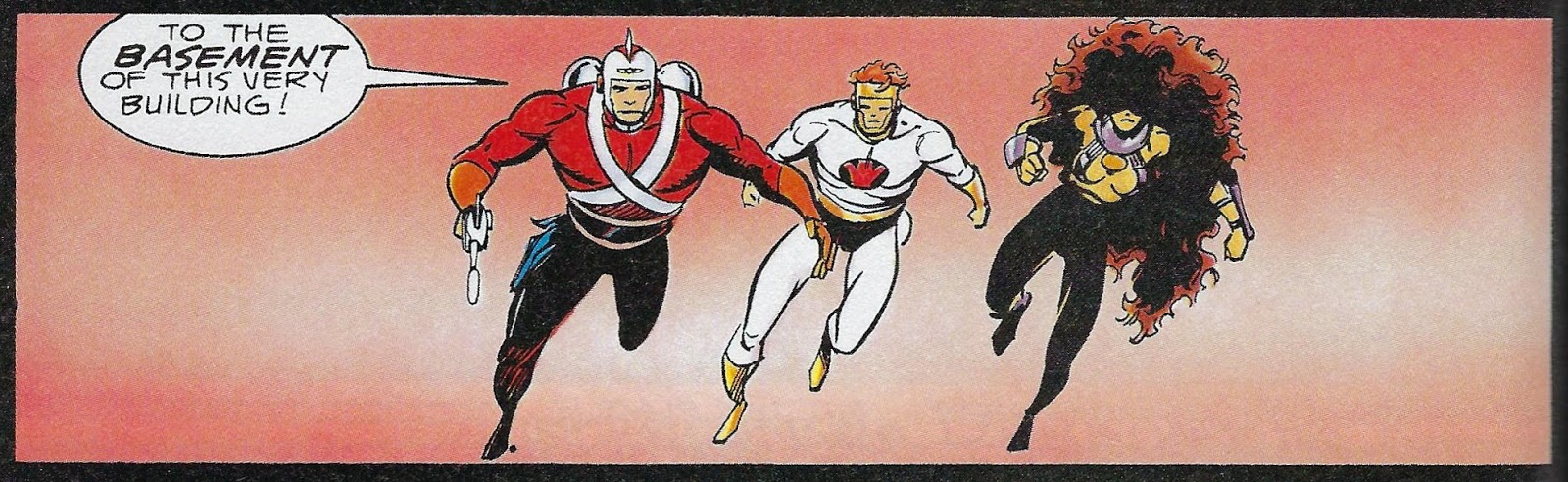
Adam Strange, you deserved better. Should have stayed out of sight like the Hawks apparently did on Thanagar.
from Cosmic Odyssey #2

Well, I don't know what any of those people were thinking, because Cosmic Odyssey's take-- like so many other post-Kirby takes on the New Gods-- is terrible. Like in Death of the New Gods, they're not portrayed as gods here; the way Starlin writes them, they're basically just sci-fi aliens who call themselves gods. The New Gods should not be demeaned by explanations about pocket dimensions and sectors of space. They should not be engaging in technobabble. And certainly, the anti-life equation is not a thing you use to power an enormous space cannon! Like, Darkseid has not been scouring the cosmos for something as tawdry as a power source for a space cannon! The anti-life equation is the absence of free will, not a blob that flies around building bombs that blow up planets.

Gods don't originate in sectors!
from Cosmic Odyssey #1

Even outside of that, this isn't a good comic. The title implies an epic. What we get instead is one of those old 1960s Justice League of America-style stories where a big group gets together, but then everyone splits up and carries out side quests in groups of two: Superman and Orion, John Stewart and the Martian Manhunter, Batman and Forager, and Starfire and Lightray. Plus, John Stewart messes up and causes a planet's entire population to die... but only because of incredibly poor, out-of-character writing. He spends the whole book telling everyone his ring can do everything and he doesn't need their help at all. Because of this, the planet Xanshi explodes when he leaves the Martian Manhunter behind to confront the anti-life entity alone and it turns out it painted its bomb yellow. (In Green Lantern: Mosaic, John actually thinks back to this and decides he must have been crazy because there's no other explanation for his behavior.)

WHAT COULD POSSIBLY GO WRONG?
from Cosmic Odyssey #2

The end of the story descends into thaumababble when Doctor Fate turns up and saves everyone.

In panel #1, Doctor Fate says each of the five have a different source of power. Then, in panel #3, he rattles them all off... and Orion and Highfather have the same one. Do you even know what you're talking about, dude?
from Cosmic Odyssey #4

I did kind of like the idea of Metron discovering the anti-life equation and being destroyed by it just because of his insatiable idea to know things. Too bad it couldn't have been embedded in a better story.

I did like the art of Mike Mignola a lot; how could you not? Mignola and the New Gods are a great pairing; it's only a shame the real New Gods aren't actually here, just these counterfeit sci-fi aliens. Jim Starlin did a great job with DC's sci-fi comics in 1990s and 2000s, but judging by this and Death of the New Gods, the mythical aspects of DC are beyond his abilities. Based on his Thor run, I can see why Walter Simonson would be praised for his take (I haven't read Simsonson's Orion Omnibus yet), because unlike Starlin, he knows how to write gods as gods.

09 July 2018

Review: Ironwolf: Fires of the Revolution by Howard Chaykin, John Francis Moore, Michael Mignola, and P. Craig Russell

Side note: my review of the 2015 audiobook of the 1995 novel that inspired the 2007 episode, Doctor Who: Human Nature by Paul Cornell, is up at Unreality SF! Read by Lisa Bowerman, as it deserved to be.

Comic trade paperback, 96 pages
Published 1993 (originally 1992)

Acquired and read August 2017
Ironwolf: Fires of the Revolution

Writers: Howard Chaykin and John Francis Moore
Penciller: Michael Mignola
Inker: P. Craig Russell
Colorist: Richmond Lewis
Letterer: Bob Lappan

Before reading it, I had thought Ironwolf: Fires of the Revolution would be a retelling of the events of Howard Chaykin's original IronWolf* story in the new context of his Twilight story. It turns out that Fires of the Revolution is largely a sequel to the 1973-74 IronWolf, albeit one that retcons it a little bit to fit it into the future history established by Twilight. The original IronWolf concerned struggles over the "Empire Galaktika"; Fires of the Revolution quickly establishes that this is a high-faluting name for a group of three planets. The capital of the Empire Galaktika was Earth; Fires of the Revolution clarifies that early human colonists named a ton of planets "Earth." This does require us to ignore that in the original series, IronWolf visited the Grand Canyon, but it mostly all fits together (except for the Tales of the House of IronWolf back-ups, but they weren't such a big deal anyway).

Well, I say it all fits together, but Fires of the Revolution actually opens with a retelling of an event from the first issue of IronWolf, Weird Worlds #8: Lord Ironwolf's burning down of his family's ancestral forests of anti-gravity wood, to keep them out of the hands of his brother, who's working with the Empress Erika. I complained that in the original, this moment seemed underplayed; here the writers and artists turn it into the big dramatic moment it deserved to be. From there, though, Fires of the Revolution shifts into following up rather than retelling: Ironwolf and Shebaba's fledgling revolution is cut short when one of their own betrays them. The empress is willing to cut a deal with the rebels and form a parliamentary government, but only on the condition of Ironwolf's death, so one of Ironwolf's allies betrays him.


It's a slightly different world than the original IronWolf stories of two decades prior: less sword-and-planet warlord, and more courtly intrigue. Penciller Mike Mignola follows this new approach with visuals that come right out of the French Revolution: his Empress Erika is a highly refined aristocrat, not the sultry seductress of Chaykin's originals. (Though, of course, she is no less venomous underneath.) In the highly repressed world of this Empire Galakitka, Lord Ironwolf is different from the other aristocrats: something primal and barbaric, full of energy, willing to burn the world down if it means progress might result. This resonates with the larger story of Twilight, too (to which this is a sidequel; Homer Glint puts in an appearance, and everyone in this story can live forever because of what happened over there), in that Ironwolf claims that if the Empire Galakitka is integrated into humanity's galactic civilization, it can reverse some of the stagnation that has set in.


On the whole, Fires of the Revolution is kind of pulpy just like the original IronWolf, but in a different way. Lots of fights and betrayals and fires and shadow and plotting, but the universe feels darker and less swashbuckling. But I would partially attribute that to putting the fabulously gloomy Mignola on art. I enjoyed reading it on the whole, and looking at it even more. I still do have one complaint: I get what motivates Ironwolf's personal goals. He is a simple man at heart, and he wants revenge for the various ways he's been wronged. (There's a lot of them by this point-- basically everyone who ever threw in with him was killed.) But what motivates him politically? As an "aristo" what makes him want to rid the Empire Galaktika of aristocratic control and put a democracy in place? This was a weakness in the original IronWolf and continues to be one here.


(This book was originally published as a graphic novel in hardcover in 1992, and released in paperback in 1993. DC finally collected Chaykin's Twilight in 2015; it would be cool if they also released a collection of both Fires of the Revolution and the original IronWolf stories from Weird Worlds. It would make a nice little 150ish-page space epic.)

* As always, it's hard to tell how comic book character names ought to be capitalized. While the text pieces in the 1986 reprint special used "IronWolf," Walt Simonson's introduction to this volume goes with "Ironwolf," so I am capitalizing that way in the context of this volume.

30 December 2013

Review: The Starman Omnibus, Volume Four by James Robinson with Jerry Ordway

Comic hardcover, n.pag.
Published 2010 (contents: 1998-99)
Acquired February 2010
Read October 2013
The Starman Omnibus, Volume Four

Writers: James Robinson, Jerry Ordway
Pencillers: Tony Harris, Mike Mignola, Pete Krause, John Lucas, Mike Mayhew, Gary Erskine, Matt Smith, Gene Ha, Steve Sadowski, Wade von Grawbadger, Dusty Abell, Tim Burgand
Inkers: Wade von Grawbadger, Mike Mignola, Dick Giordano, Gary Erskine, Richard Case, Gene Ha, John Lucas, Mike Mayhew, Tom Nguyen, Drew Geraci, Tim Burgand, Ray Snyder
Colorists: Gregory Wright, Carla Feeny, Matt Hollingsworth, Glenn Whitmore, Pat Garrahy, Gene Ha
Letterers: Bill Oakley, Kurt Hathaway, Willie Schubert, John Costanza

Volume Four is maybe the weakest part of Starman. A lot of it feels like biding time. At the end of Volume Three, Sadie asks Jack if he will go into space to look for her brother, because (susprise!), she is secretly the brother of a previous Starman. But that doesn't happen in this book, and indeed, there's no emotional fallout from the fact that Sadie has basically been lying to/manipulating Jack their entire relationship. I get that she grew to love him, but there should be something to deal with it.

Also: the crossover with Captain Marvel doesn't quite work, though I don't have a good feeling as to why. I don't think the worlds are incommensurable, but the fight is forced, and the contrasts aren't hit quite the way one would hope.

While the book bides its time, it does have its highlights: a "Time Past" story of Ted Knight and the ever-lovable Etrigan, the cleverly constructed 80-page giant anthology (especially the appearance of "Those Li'l O'Dares (and Patrolman Clarence)"), and the story of the Mist's "team-up" with Mary Marvel, the exploration of the relationship between Ted and his cousin Sandra (the Phantom Lady) all stand out to me as some of the more memorable standalone Starman stories. Mike Mayhew's art on the latter is especially superb.

Also featuring superb artwork: issue #45, where Jack finally leaves for space. Tony Harris pulls out all the stops for his last issue on the title. The two-page spread of Jack and Mikaal boarding the rocket, saying goodbye to friends and family, is superb, and a worthy final effort from Harris, whose talents visibly grew over the course of the series. The rocket's launch is also magnificent.

Finally, I don't know why someone out there thought that Batman/Hellboy/Starman was a must-have crossover, but I could look at that beautiful Mike Mignola artwork all day. Combined with Matt Hollingsworth's colors, it's a stunning use of light and dark.

19 June 2011

Faster than a DC Bullet: The Sandman Spin-Offs, Part IV: Neil Gaiman's Midnight Days

Comic hardcover, n.pag.
Published 1999 (contents: 1989-99)

Borrowed from the library
Read June 2011
Neil Gaiman's Midnight Days

Writers: Neil Gaiman with Matt Wagner
Artists: Stephen Bissette, John Totleben, Richard Piers Rayner, Mike Hoffman, Kim DeMulder, Mike Mignola, Dave McKean, Teddy Kristiansen
Colorists: Tatjana Wood, Danny Vozzo
Letterers: John Costanza, Tim Harkins, Todd Klein

This book collects much (all?) of Gaiman's non-Sandman Vertigo work, presumably so the dedicated Gaiman-ite doesn't have to sully themselves by buying comics by other people. (Actually, most of the work here had never been collected in trade paperback before, so I'm just being mean.)

Swamp Thing: "Jack in the Green"
This story is about a Swamp Thing from the Middle Ages. It's the second comic Gaiman ever wrote. It's okay, I guess. Nothing really happens.

Swamp Thing: "Brothers"
In this story, Brother Power the Geek comes back to the Earth. He's a character who hadn't appeared for years before this and no one cared about him. I'm not sure why anyone should after reading this. I guess that's kinda the point-- he's the hippie who can't let go. I did enjoy the two side characters, though, one of which who actually was a hippie who couldn't let go. The evil government agent (who was also an ex-hippie) was a pretty cool character. The Claw or whatever his name was, not so much. Oh, and Batman is in it.

Swamp Thing: "Shaggy God Stories"
what is this I don't even

John Constantine, Hellblazer: "Hold Me"
I've never read a John Constantine story before. This was pretty good. The resolution makes little sense on a plot level, but is nice emotionally. Poor Constantine, keeps the world at bay, and even when he lets it in... it doesn't actually like him. The art is amazing. McKean and Gaiman showed they made a good team in Black Orchid, but this is even better from an artistic standpoint.

Sandman Midnight Theatre
I've read this story before, on its own, and it takes up half the book! Why not throw in the Poison Ivy story that Gaiman mentions instead; I want to read that, since he did such an intriguing Ivy in Black Orchid. Sandman Midnight Theatre belongs in a collection, sure... but in a Sandman Mystery Theatre one instead, where it's an important part of an ongoing narrative. It was nice to read it again, though, and Gaiman's introduction to the story provides some nice insight into the way it was written. (Gaiman and Wagner worked out a plot in a hotel room, Wagner wrote detailed breakdowns, Kristiansen drew the art following these, Gaiman wrote the dialogue to match the pictures.) Other than that, I have nothing to say that I didn't say last time.

The collection as a whole is a bit of a jumble, really. Nice to have it all collected, but none of it really stands out or impresses on its own, except for maybe "Hold Me."