Showing posts with label creator: ursula k. le guin. Show all posts

25 May 2026

Ursula K. Le Guin, Interfaces (anthology, 1980)

This is an anthology of original sf put together by Ursula Le Guin and her agent, Virginia Kidd, back in 1980. Between this and Le Guin's other anthology that I've read, the Norton Book of Science Fiction (1993), I think I have to conclude that while Le Guin's short fiction is very much to my taste, Le Guin's taste in short fiction is not exactly to my taste. There's a whiff of the Ellisonian form of the "New Wave" in here, stories that trade a bit too much on sex or violence or literary effect but forget to be an interesting story. I'm not enthusiastic to write up stories I dislike, though, so you'll mostly just have to infer those by omission. (The book has fifteen stories and two sets of poems.)

Interfaces
edited by Ursula K. Le Guin and Virginia Kidd

Published: 1980
Acquired: July 2023
Read: March 2026
Still, there was some good stuff. "The Reason for the Visit" by John Crowley didn't totally make sense to me, but I was fine with that, because the conceit was interesting and the way it was told was very well done. (I don't want to give away the premise, because working it out for yourself is one of the story's pleasures.) I liked the narrative voice of "The New Zombies" by Avram Davidson and Grania Davis, though otherwise found the story trite and obvious. "Earth and Stone" by Robert Holdstock was weird and I didn't exactly get what happened, but I did enjoy the ride. Gene Wolfe's "A Criminal Proceeding" was a great little piece of dystopian satire, I found it hilarious and sadly prescient. I enjoyed Edward Bryant's "Precession," though mostly for its depiction of grading student essays and dealing with student freakouts, which was apparently little better forty-five years ago. I did not totally get James Tiptree, Jr.'s "Slow Music," about those who opt not to become immortal, but I liked what I did get.

My favorite story, though was Michael Bishop's "A Short History of the Bicycle: 401 B.C. to 2677 A.D." The story does one of my favorite sfnal moves, which is to take a pretty absurd premise and extrapolate with utter seriousness; in this case, it's the idea that bicycles are a creature that independently evolved on an alien planet; the story alternates between the scientist studying the ecology of bicycles and extracts from scientific writing. It's a weird idea well told; it's also a strong metaphor for the human treatment of nature. Lots of well done little details and good jokes, a perfect little tale. From the ISFDB it seems to have only been reprinted the once, in a collection of Bishop's work from 1983, which seems a real shame, as it deserves a wider audience.

03 July 2024

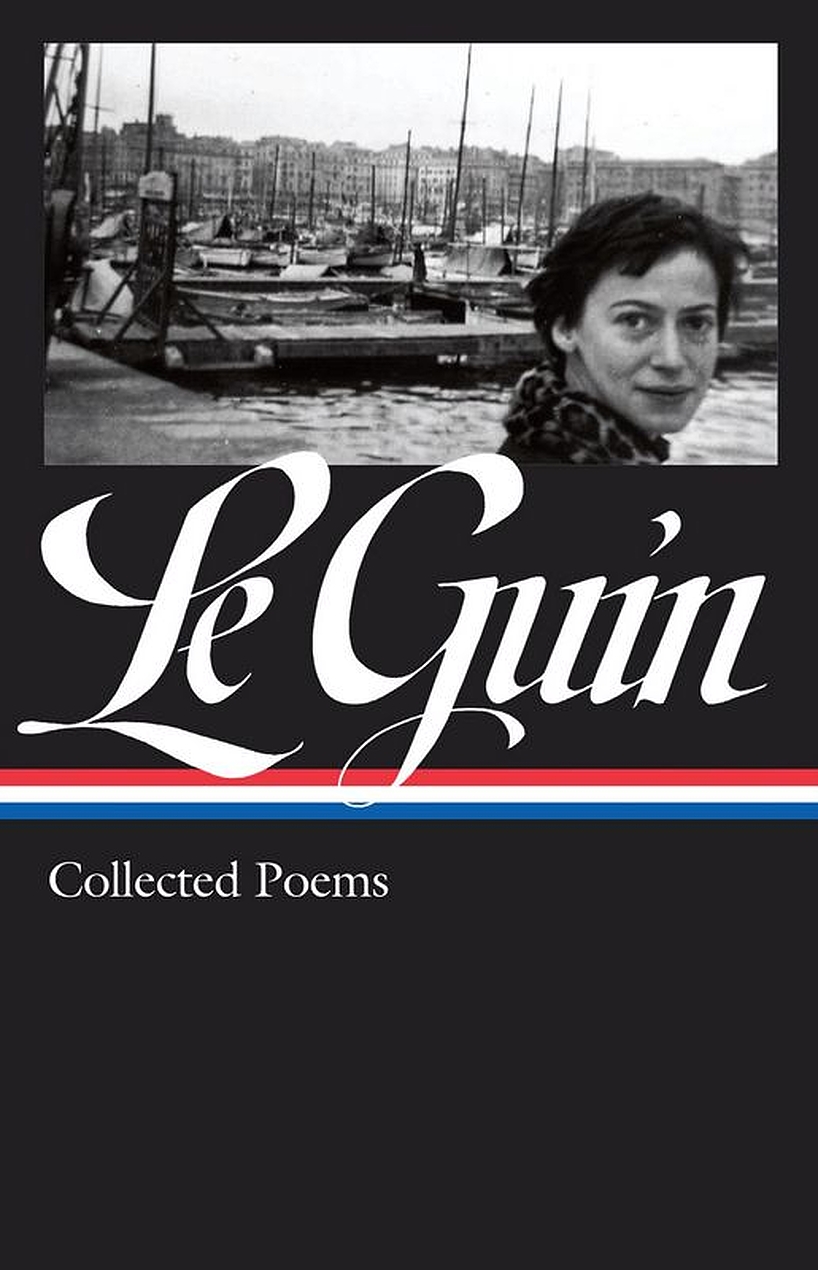
Library of America: The Collected Poems of Ursula K. Le Guin

Collected Poems by Ursula K. Le Guin
edited by Harold Bloom

It's one of my goals to own and have read everything Ursula K. Le Guin has ever written, but I have never read any of her poetry. Thus, the release of this Library of America edition was a big help; it contains all of her books of poetry, from 1975's Wild Angels to 2018's So Far So Good, as well as a number of previously uncollected poems and some prose writing about poetry (mostly her introductions to her own books, though in classic Library of America fashion, these are placed at the end for some reason, not where they ought to actually go). I don't think poetry benefits from sustainedly reading over seven hundred pages in one go, so for the past couple months I've dipped in and out of this between Hugo finalists.

Collection published: 2023
Contents originally published: 1960-2018
Acquired: December 2023
Read: May–June 2024

I would say I am largely not a poetry person, but I do have my likes, such as Anne Sexton and Christina Rossetti. Alas, Le Guin is not to my taste as much as either of them. Certainly she is not bad, but I just did not like a lot of what I read here—certainly not as much as Harold Bloom, whose praise in the introduction is enthusiastic but largely inscrutable as far as I was concerned

Still, a couple points I can make:

(Normally when reading books of poetry, I mark ones I enjoy and want to come back to later by dog-earing the page. However, I am not going to dog-ear a nice Library of America hardback! So in this case, I used my phone's camera to snap pictures of particularly enjoyable poems. The downside of this approach is that on occasions when reading without my phone nearby, I had no way to note those poems, so there are gaps in my coverage of the book. Also it's a plan that didn't occur to me until I was some way into my reading! In my comments below I will link to the poems I can find online, and excerpt in some cases, usually when I can't.)

Getting to read her poetry in order is interesting in a couple ways. One is that you see her development as a poet; she starts with largely free verse, but seems to experiment with more formal, well, forms as she goes. And maybe it's the Victorianist in me, but I found those much more to my taste.

You also get to see what an increasingly central role poetry played in her literary output. There are seven hundred pages of poems here; when you are on page 350, you might be halfway through her poetry, but she is over sixty years old. She produced more than half of her poetic output in the last two decades of her literary career. That said, this was at least partially because she couldn't write novels anymore as she got older; I remember her announcement that Lavinia (2008) would be her last because it was all she was capable of, even though she didn't die for another decade. She captured her sadness over this in her poem "The Old Novelist's Lament" (2018):

I miss the many that I was,
my lovers, my adventurers,
the women I went with to the Pole.
What was mine and what was theirs?
We were all rich. Now that I share
the cowardice of poverty,
I miss that courage of companionship.

Le Guin writes a lot about nature, which is not particularly to my taste. I get why she does this, there is a very good speech by her included here about the Anthropocene, arguing that attention to nature is a political project in an era where we largely see nature as a resource to be exploited. I agree with this in principle, but in practice, I find nature poems pretty boring. Still, not to be too much of a grump, I did like her cat poems, such as "Black Leonard in Negative Space" (1978):

All that surrounds the cat
is not the cat, is all
that is not the cast, is all,
is everything, except the animal.
It will rejoin without a seam
when he is dead. To know
that no-space is to know
what he does not, that time
is space for love and pain.
He does not need to know it.

As a parent who has read her picture book Cat Dreams aloud many times, I am not surprised she has a good grasp on cats. Though a cat poem is probably not a nature poem now that I think about it!

I was pleasantly surprised by her translation of the Tao Te Ching (1998). To be honest, I had not expected to get much out of this, expecting somewhat woo-woo life advice I guess, which seems a bit of a disservice to an important philosophical tradition now that I write this, but it was true. But there is genuinely good stuff to be found in here, stuff worth holding onto and remember. For example, take this stanza from "Proportion" (scroll down at the link to hear it read aloud):

You can't keep standing on tiptoe
or walk in leaps and bounds.
You can't shine by showing off
or get ahead by pushing.
Self-satisfied people do no good,
self-promoters never grow up.

I wouldn't claim it's groundbreaking, but it resonates. And of course as a literary studies academic, I found a lot to enjoy in Le Guin's accounting of her own method of translation and her footnotes about choices she made.

Le Guin is often at her best when she is angry. There is a lot to be angry about here; like I said above, over half the book comes from (relatively) late in her life, and it seems to me that 9/11 in particular was a key moment for her, with lots of poems from 2001 onwards about peace and war and liberty and injustice. I particularly liked "Peace Vigil, March, 2003" (2006), about a man who wanders into a peace vigil the speaker is attending:

Spring night in time of war. A big man
with a big ragged backpack
wandered into the circle and stood
looking around, till somebody
spoke to him, somebody gave him
a candle, somebody lighted the candle.
Then he sat down on the wet pavement
right in the empty center of the circle.
He sat huddled up over the candle,
holding it in one hand, and holding
the other hand over it to get warm, and then
he would change hands. . . .

Some of her translations of the Tao Te Ching capture the antiwar sentiment well, too, actually, even though they precede 9/11. Take this stanza from "Against war":

It is right that the murder of many people
is mourned and lamented.
It is right that a victor in war
be received with funeral ceremonies.

Additionally, I once read an interview with Le Guin where she said to the interviewer, "Thank you for noticing that some of my stories are funny. A great many critics never have." She can write funny poems, and those are often her best. There is a particularly goofy one, "On David Hensel's Submission to the Royal Academy of Art" (2006), about a real situation where an artist sent his sculpture of a human head and its plinth in for display separately—and the museum rejected the sculpture but mistook the plinth for a work of art and put it on display! Her "Found Poem" (1986) is funny enough that I read it aloud to my wife and she laughed too. But it's also kind of sublime and beautiful, a really clever moment captured in a few lines.

Perhaps her very best, then, are the ones where she is both funny and angry, combining absurdity and injustice into powerful statements. At its best, the book embodies Le Guin's own poem, "Read at the Award Dinner, May 1996" (1999):

Above all beware of honoring women artists.
For the housewife will fill the house with lions
and in with the grandmother
come bears, wild horses, great horned owls, coyotes.

I think if they were all like this, I would have loved this book. As it was, I liked it, but it certainly had many moment worth loving. But of course, seven hundred pages of poetry are never going to be one hundred percent to one person's taste, I imagine, least of all mine.

26 January 2024

Five Further Very Good Short Stories I've Read Lately

I've been enjoying these posts, so here's another one. This is the third in a series.

"The Prophet of Flores" by Ted Kosmatka

In school they taught him that through science you could decipher the truest meaning of God's words. God wrote the language of life in four letters—A, T, C, and G.

I read this late last year in an excellent anthology, much mentioned by me, called Twenty-First Century Science Fiction. Kosmatka was a new-to-me author. The story was originally published in Asimov's in 2007, and doesn't seem to be legally available online in text form, but it was released as an audio reading in an episode of the StarShipSofa podcast, which I've linked to above.

The story is set in a universe where science ended up showing that six-day literal creationism is true, and follows a paleontologist in that world—who ends up involved in the discovery of the very real so-called "hobbits of Flores," which threaten to upend science. The worldbuilding is incredibly well done, the story is tightly written, and it got pretty intense. Much like a similar story for Ted Chiang, it's a neat way of exploring science and technology issues in our world. It was later expended into a novel called The Prophet of Bones; this got mixed reviews but I must pick it up.

"The Silence of the Asonu" by Ursula K. Le Guin 

To perceive the Asonu thus is almost inevitably to interpret their silence as a concealment. As they grow up, it seems, they cease to speak because they are listening to something we do not hear, a secret which their silence hides.

This Le Guin story was originally published (under the title "The Asonu") in an environmental magazine called Orion in 1998; it was subsequently incorporated into her 2003 story cycle Changing Planes, which is where I read it. It has since been reprinted many times, including in Lightspeed magazine, which is what I've linked to above.

Like most of the Changing Planes stories, it takes the reader onto another "plane" and explores the people who live there. The Asonu start out capable of speech, but gradually give it up as they grow older; in one example, an Asonu elder says eleven things in the last four years of his life. The story explores the way humans want to make sense of things, want utterances to have meaning, want to ascribe wisdom to what is cryptic. Like all of Le Guin, clever and kind of funny, but also dark.

"Muallim" by Ray Nayler 

“I must go to the school, or I will be late.”
     “Are you avoiding the subject?” Irada asked.
     “The first subject is math,” Muallim said. “There is no avoiding math.”
     “Hey – that was a pretty good joke!”
     “That was not a joke,” Muallim said as it walked out of the yard. “There really is no avoiding math.”

This is a more recent story than most of what I describe in this post; it's the very first story in the most recent volume of Neil Clarke's The Best Science Fiction of the Year, and was originally published in Asimov's in 2021. It's about a UN inspector who goes to Khynalyg, a (real) remote village in Azerbaijan to evaluate the success of a program to use a robot instructor in schools. Somewhere (I forgot where now) I found a negative review dismissing it as cliché, but I actually found it a sharply observed story about how interactions between different societies can surprise us, and how often technology is put to unexpected use. Clearly written, cleverly done.

"Five Sphinxes and 56 Answers" by Kij Johnson 

And, riddles solved, Phix kills herself. She has served her purpose in advancing the hero's story, and now she is extraneous, a potential plotline complication down the road when sex with his mother, his blinding, and his ignominious death should be driving the story; and so she is hustled off-stage. She throws herself from the column and dies.
     A life depends on the answers to the Sphinx's riddles: yours, if you are wrong—but hers, if you are not.

I read a volume of Kij Johnson stories last fall and overall enjoyed them, but this was probably my favorite. (It was originally published in an online litmag called Diagram, which ISFDB does not seem to know about.) It bounces back and forth between a take of the sphinx myth, a modern girl growing up who is captivated by riddles, and embedded riddles that resonate with the events of the story. Johnson is probably one of the best writers in terms of craft in the contemporary sf&f space, and this story certainly helps show that. Like much of her work, it's a striking reflection on the stories we tell and what we think of the nonhuman.

"History Report" by Simon Rich 

My Great-Grandfather told me that all dates ended with the same custom. After the two people had finished all the alcohol they’d been served, one person would ask the other to come over to their dorm room to watch “Arrested Development.” “Arrested Development” was a non-“Spider-Man” show that you played by putting small, round disks into a machine. The reason it existed was to create a way for people on dates to gauge each other’s interest in becoming naked, without having to directly ask them. The way this worked was a little complicated, but my Great-Grandfather was able to explain all the steps. First, you asked the other person if they had seen “Arrested Development,” and they would respond, “Some, but not all of it.” This would be your prompt to ask them if they wanted to come to your dorm room to watch the episodes they’d missed. If they didn’t want to see you naked, they would say that they had to “finish a paper,” which was an expression that meant that they were not attracted to you. If they did agree to watch “Arrested Development,” it meant that they probably wanted to see you naked. But here’s where it gets complicated: sometimes it didn’t mean that. Sometimes it just meant that they wanted to watch “Arrested Development.”
Now, this story I discovered where I least expected it: driving home from dropping my family off at the airport, I didn't happen to bring my iPod and was thus forced to endure This American Life. The last segment of the episode I listened to was a reading of this, a 2022 New Yorker story about how two people fell in love, narrated by their great-grandson after everyone has left the Earth due to the climate apocalypse. (Unfortunately, Ira Glass introduces it with a joke about StoryCorps that made me confused about what it was trying to do at first.)

It's quite funny, it's nostalgic if you went to college and dated in the mid-2000s, and it's a pointed take on the things we say are important versus the things we actually act on. If you didn't go to college in the mid-2000s as I and evidently Simon Rich did, you might not find it very entertaining, but I suspect that most of the people who care about my recommendations for short fiction probably did.

02 October 2023

Changing Planes by Ursula K. Le Guin

Changing Planes by Ursula K. Le Guin

This is a collection of short pieces, not even so much stories as observations on various places, assembled by Ursula Le Guin. The premise is that people can open up their minds to "changing planes"; the method for doing so is different on every plane, but in our plane, it has to be done while literally "changing planes"—you can only do it while waiting for a connecting flight in an airport! (Incidentally, the flap writer seems to think the stories are narrated by Sita Dulip, the Cincinnati(!) woman who invented the method, but that's clearly not the case; the narrator is a friend of hers.) The opening story lays out the basics of the method and is probably the funniest thing I've ever read by Le Guin, an enjoyable satire on the indignities of air travel.

Collection published: 2003
Contents originally published: 1998-2003
Read: June 2023

The book reminds me of Italo Calvino's Invisible Cities, and that's surely on purpose; Le Guin had a fascination for that kind of fictional travelogue, as she translated a couple of them into English. The chapters are fairly different: some are full-fledged short stories about a trip taken by the narrator, some are explications of other societies and cultures, some are stories from those other planes. Most, of course, reflect back on our world, depicting other ways of being in the world and thus causing us to reflect on ours. My favorite along those lines was "Seasons of the Ansarac," about a plane where the inhabitants are migratory, and only engage in sex while in the north; in the south, they have no sex, no romance. It asks us to consider why our society is organized the way it is, and how it might be different; like many stories in the book, it also contains some brief moments of cultural imperialism. "The Royals of Hegn" is a good satire on our interest in royalty; it takes place on a plane where everyone is royalty except for a couple commoners that the royals are totally obsessed with. (Though like a couple stories in the book, it uses rape as a sort of tossed-off joke in a way that surprised me. I wonder if that would have been true if I had read it in 2003; I think our mores around this have shifted.) I also enjoyed the satire of "Great Joy," about a group of businessmen who remake another plane as a series of holiday-themed vacation sites: Christmas Island, Easter Island, Fourth (of July) Island, and so on.

Some of the sociological ones that were less satirical I found less interesting, but I did particularly like "The Building," a weird story about two societies on one plane, where the members of one continuously work on a building with no clear purpose or structure, and "The Fliers of Gy," about a plane where the occasional inhabitant is born who can fly—and is thus doomed some day to die when their wings spontaneously give out. Only one story did I not enjoy at all, "Woeful Tales from Mahigul," which relates a series of stories from one of the other planes, which I found difficult to find anything interesting in.

At her best, though, as always, Le Guin makes us imagine other worlds and reimagine ourselves. My favorite of these stories was "The Silence of the Asonu," which is about a plane where people gradually cease speaking as they grow older, and the visitors from other planes who desperately try to find meaning in the few words they do speak.

This is a Le Guin book my wife owned which I borrowed off her to finally read. I think it's probably minor Le Guin, but even minor Le Guin is always worth your time. According to David Cloyle Smith at Library of America, it will be collected in one of their volumes eventually, though it seems like not soon.

17 May 2021

Review: Annals of the Western Shore by Ursula K. Le Guin

Collection published: 2020
Contents originally published: 2004-07
Acquired: December 2020
Read: May 2021

Annals of the Western Shore: Gifts / Voices / Powers
by Ursula K. Le Guin

This Library of America edition collects three late-career YA novels from Le Guin, the loosely linked "Annals of the Western Shore." They are not very connected-- they take place in the same fantasy world, but there's no overarching plot, and each installment takes place in a very different part of that fantasy world. Each book has a different protagonist, but the previous book's protagonist makes an appearance as well, providing some continuity. Unlike most of the other Le Guin LOAs I've read, this one didn't contain any stories I've read before. (I own paperbacks of all three Annals but have never gotten around to them.) It took me a long time to get through all three stories, but I think that's the fault of me (or of the world), not of the books; once my semester I was over, I shot through the final story in just a couple days. Like, I am realizing, a lot of Le Guin's late career work, these are all bildungsroman. (Which is why they were marketed as YA; none of them feel like the kind of YA fantasy that have come to dominate in the post-Hunger Games era (thanks God), but that makes it hard for me to imagine these being published as YA novels now.)

The first, Gifts, is set in a mountain country divided up into small estates, each ruled by a man with some kind of "gift." Our main character, Orrec, comes from a family where people can unmake things and people, literally unraveling them, just by looking at them. He lives in fear of his own power, and also fear of his father, whose high expectations for him are seemingly impossible to live up to. It's an emotional, tragic story. Le Guin, of course, always gets how to do fantasy: this story expertly unfolds a different society, but also a person, and at the same time it's a metaphor for all fathers and sons. It's desperately sad in parts, in a way that's hard to talk about; some of what Orrec undergoes is awful.

It's also cleverly told; the story is narrated by Orrec, but often we are not told things in any kind of objective way; Orrec is very clear that he is telling us a story that someone else once told him. Everything is mediated through the experience of someone else. As much as anything else, the Annals are all about the power of stories, especially, the written word, to change the world, and this ranges from published books to the stories we tell ourselves, and Le Guin is always attentive to the details of how that works, and Gifts is all the better for it.

The second story, Voices, I struggled to get into. It's about a girl named Memer who might be able to hear the voice of books in a city occupied by an outside force that has banned its religion. It might not be the story's fault, but I never emotionally connected with this one. Memer's inner life and desires never came alive for me in the way Orrec or the third story's protagonist did; her goal was murkier. I'd be curious to reread this, though, at a time when I can give it more of my attention and see if I like it more.

The first two novels are each about 150 pages in my LOA edition; Powers is almost 300. Despite that, I read it the quickest of all three, and it was definitely my favorite. Powers is about a slave boy named Gavir in a place called the "City States" who is being educated so that he can educate future generations of his masters. He struggles with loving a literature that depicts ideals his actual society does not live up to-- and he might have powers he needs to keep secret. He eventually goes on a long journey, and what results is a moving story about finding and making one's place in the world; there are two different key parts where I started to tear up here. One due to relieved tension, and one where Gavir finally makes it, the power of stories having saved him in the end. I am a sucker for a good travel narrative and a good bildungsroman, and Le Guin blends both here to excellent effect. In discovering the world, Gavir discovers himself, and in discovering Gavir, we readers discover ourselves too. Shot through with tragedy, but also redemption. Stories blind us and save us, and I felt a little bit saved when I finished Powers. I look forward to reading and savoring this one again someday.

It was a bit weird reading the back matter, where it's brought out that some of the themes and ideas of the Annals are responding to things like the wars in Iraq and Afghanistan; that was just fifteen years ago, but worrying about the doings of Donald Rumsfeld feels like something from another century in the Age of Trump. We used to be so worried about what America was doing to the world, but that's almost quaint now that the country America is destroying is itself.

This is the fifth LOA edition of Le Guin, and the fourth that I have read. They have all being great opportunities to visit parts of the Le Guin canon that are new to me, and revisit ones that I already knew I loved. It's not clear to me that if a sixth is planned, but man, I really hope so. More Le Guin is always needed.

14 September 2020

Review: Library of America Hainish Novels & Stories, Volume Two by Ursula K. Le Guin

Collection published: 2017
Contents originally published: 1972-2000
Acquired: January 2019
Read: August 2020

Hainish Novels & Stories, Volume Two: The Word for World Is Forest / Stories / Five Ways to Forgiveness / The Telling
by Ursula K. Le Guin

This volume collects the last of Le Guin's "second phase" Hainish works (1969-74) and then the bulk of it is taken up by the works of her third phase, when she returned to Hain after a fifteen-year absence and with a somewhat different approach (1990-2000). As with volume one, all the novels were rereads, whereas all the short fiction was new to me.

The Word for World Is Forest
I remember liking this novella enough to do a project on it in college (I don't remember exactly what it was, but I do remember it involved me writing documents and such from the world of the novella; it was for an English education class), but on reread, it's definitely the weakest of the phase two and three Hainish books. And even though it's better from a technical standpoint than any of her phase one works, I find it hard to get into. Unusually for Le Guin, there's been no real effort to create sympathetic characters. There's no attempt to make Davidson anything other than a monster even when you're in his head. He's a monster that feels real, sure, but it's exhaustive reading. But Lyubov, who I feel like should have our sympathy, is a largely pathetic figure. Davidson despises him, he despises himself, and, I would argue, the narrative itself despises him. The sections told from the perspective of the Athsheans are hard to glom onto, too. The overall effect is something that seems like it ought to be powerful, but is actually quite clinical; it always feels like you're experiencing events at a remove because no one in the book has feelings congruent to your own.

I know the book came out of a very 1970s sense of anger over Vietnam and the environment, but I think 1990s Le Guin could have done this same material much more powerfully. (And I agree with Harlan Ellison over Le Guin: The Word for World Is Forest is a much better title than Little Green Men!)

Stories
Le Guin returned to the Hainish world in 1990, but didn't write an actual novel until 2000, easing back into the universe. This volume collects all of her third-phase short fiction except for "Coming of Age in Karhide" (collected in volume one). Three of the stories make a little sequence about "churtening," a form of FTL travel being tested by the Ekumen where spaceships, objects, and people can "move" instantaneously across rooms or star systems. (It's technically not movement, the Cetians point out, because movement takes time, and churtening does not.) I liked the idea of "The Shobies' Story" and "Dancing to Ganam" more than the actuality; the premise is that churtening disrupts our experience of reality and stories help us reclaim it. In "The Shobies' Story," the characters rebuild a mutual experience through storytelling, while in "Dancing to Ganam," one character's belief in stories warps the reality he finds. But I feel like the description of the stories I've just given you works better than the actual stories Le Guin wrote. I did like "Another Story or A Fisherman of the Inland Sea," which revisits an old Le Guin theme (the person who returns home after a long relativisitc journey, as seen in Rocannon's World and "Winter's King"), but from a more upbeat angle.

A couple of the other stories are what we might call anthropological stories, where the Ekumen explicate other societies: "The Matter of Seggri" and "Solitude." This made me realize that so many Le Guin stories are told this way-- we don't learn about another society from the inside, but the outside, through the eyes of an external interlocutor (e.g., Rocannon's World, The Left Hand of Darkness, The Word for World Is Forest, the present-day chapters of The Dispossessed, some sections of Five Ways to Forgiveness, The Telling). It might be easy to dismiss this as laziness, or (more charitably) convenience: far easier to have an Ekumenical Observer use exposition to reveal a society than have it unspooled through incluing from the inside. But I don't think that's it. I think Le Guin gets that there's no such thing as a "pure" culture: all cultures are defined by their relationships with other cultures, as she highlights in The Dispossessed, when contact with offworlders gives Urras and Anarres the identity of "Cetian" for the first time. That we can discover another society from the inside is an illusion: the Ekumenical Observers stand in for us the readers,* and it would kind of be a lie to not have them. All this is to say that I enjoyed both stories, though "Matter of Seggri" was pretty tough going at times.

Finally, there are a few stories exploring gender dynamics on O, where people marry in groups of four: "Unchosen Love" and "Mountain Ways," and "Another Story" also fits into this group. They're neat-- I think like a lot of sf, you get that doubling effect. You explore a weird world, but you are also reading a metaphor for your own. I particularly liked how Le Guin explores the way in which the system doesn't work for everyone in "Unchosen Love" and (especially) "Mountain Ways." What system does?

Story Suite: Five Ways to Forgiveness
When I read this before, there were only four ways to forgiveness. The original four stories were published individually 1994-5, and then as a single volume in September 1995. Le Guin published a fifth installment in 1999, but the Library of America publication is the first time it appears with the others. I remembered really liking this book, and thinking it underrated. The Dispossessed and The Left Hand of Darkness cast a long shadow, and justly so, but they do mean that people don't really discuss the other Hainish novels a whole lot, and Five Ways to Forgiveness is the best of the others. It offers five different stories about the decolonization of the planet Yeowe. Three of them are excellent on their own ("Forgiveness Day," "A Woman's Liberation," and "Old Music and the Slave Women"), and I think "A Man of the People" is pretty good too (I do admit "Betrayals" leaves me a little cold). But like many "story suites," the whole is greater than the parts, giving us a variety of intersecting and complementing perspectives on slavery and colonization. I think a particular strength is the exploration of the "slave mentality," that many of the former slaves cannot get rid of, and also how slavery shapes the enslaver. There is some really hard reading here, especially in "A Man of the People."

"Forgiveness Day" is my favorite; Teyeo is such an excellent character, a man whose rigidity saves him and destroys him at the same time. I also really like the perspective we get on Hain itself in "A Man of the People": most of the Hainish don't care about space anymore, and spend their time leading traditional lives in small communities. The ones who do look outward are "historians": their purpose in connecting to other planets is to chronicle history, of which Hain has so much. It's an interesting way of thinking about interactions with other societies.

Women are the (co-)protagonists of three of the five stories here; I find it fascinating that it took Le Guin almost thirty years to write a Hainish book where a woman's voice dominated. What an example of internalized patriarchy!

The Telling
I know I've read this before, but I had literally no memory of it going in. And I never had a memory of it: not a single passage or incident sparked a memory of having read the book before. I don't know why, because it's quite good. It's a pretty typical late-period Le Guin Hainish story: it's very quiet and mostly about explicating a different society. But it's also tough going in her depiction of religious fundamentalism. Sutty's past life and present day collide at the end, and it's a very devastating ending after what has been a pretty gentle book. Definitely a "lesser" Hainish work... but a lesser Le Guin still towers above the work of many others! I can't believe I forgot it.

I did find it interesting the way this lined up with "Forgiveness Day": both stories feature young woman as Ekumenical Observers who are naive but don't realize how much they don't know, and their arrogance gets themselves and others into trouble; they end up in relationships with rigid men from an oppressive society. There's something vaguely misogynistic about it, actually, which I find quite weird; if it just happened once, you'd think it was just an individual, but twice feels like a commentary.

Also both The Telling and Five Ways depict situations where the oppressive society explored by the Ekumen was actually indirectly caused by the Ekumen. The Werelians in Five Ways developed spaceflight and colonized Yeowe in response to Ekumenical contact; the dictatorship in The Telling is inspired by hearing from Terra on the ansible. It's an interesting critique of a set-up that was fairly benign in Left Hand: even a well-intentioned contact between cultures will change both sides in ways we can't imagine. The Ekumen does not always make things better. (Though, both stories argue, in the long run, things will come out all right.)

* * *

Something else that stuck out to me while reading volume two is that a lot of Le Guin's phase-three Hainish work is very bildungsromanish. The Dispossessed in volume one was arguably the start of this trend, but many of the stories in phase three start in someone's childhood and track them all the way up through adulthood: "Coming of Age in Karhide" (duh!), "Another Story," "Solitude," and three of the stories in Five Ways. Probably others I'm not thinking of. This isn't true of any of the phase-one stories, I don't think. I'm not sure what to think of it, but the bildungsroman is arguably about learning how to fit into society, which has interesting correspondence with how Le Guin's sf is about discovering societies, from without and from within.

The arrangement of these volumes is largely in publication order, except that the short fiction is grouped together in a way that reads well. But I don't get why The Dispossessed (1974) was in volume one while The Word for World Is Forest (1972) is in volume two. Especially as 1) switching the 300-page Dispossessed with the 100-page Word for World would give more even page counts (volume one is over 1,000 pages, and volume two under 800), and 2) putting them the other way around would distribute the two most famous Hainish novels across two different volumes, which is surely good from a sales standpoint.

That said, the arrangement is largely academic to me, because I read the stories in pretty strict publication order, rather than the given order. I think the order here would be fine, but I did really enjoy the publication order. For example, "Vaster Than Empires and More Slow" makes sense to read in proximity to The Word for World Is Forest, as both are about ecology and colonialism, and "Coming of Age in Karhide" feels very much of a piece with the anthropological coming-of-age stories collected in volume two.

If you want to know the publication order of the Hainish cycle, I've published a page on it here.

Because I'm me, I also spent my time making notes about the internal chronology of the stories-- no easy task, because Le Guin often didn't care! But I think she cared more than she claimed to, and a coherent timeline isn't too hard to work up with a couple exceptions. When I first read the Hainish books back in 2005-7, I did it in chronological order, but extra clues from reading the short fiction (and not just the books) led me to discover that I made an error. Contra whatever timeline I consulted at the time, I think The Telling almost certainly precedes Five Ways to Forgiveness (though this is one of the areas where the details are contradictory). Anyway, full details are at the same link above if you are interested. I think there is merit in a chronological read-through for a first-time reader, in that it front-loads The Dispossessed, one of the best Hainish novels, instead of causing you to lead off with the three original novels, which are the weakest and most generic in my opinion. But the books are all so lightly linked that order rarely matters.

* Some have criticized Left Hand, for example, for the fact that Genly sexual/gender biases are so much like those of a contemporary reader, but that's the point. To an extent, Le Guin isn't really trying to imagine someone coming from a cosmopolitan future society going to a different planet, but someone from 1970s America doing so.

02 September 2020

Review: Library of America Hainish Novels & Stories, Volume One by Ursula K. Le Guin

Hardcover, 1,095 pages
Published 2017 (contents: 1964-95)

Acquired January 2019
Read July 2020
Hainish Novels & Stories, Volume One: Rocannon's World / Planet of Exile / City of Illusions / The Left Hand of Darkness / The Dispossessed / Stories
by Ursula K. Le Guin

This beefy tome collects about half of Ursula Le Guin's so-called "Hainish cycle," less a series and more a setting that she set most, but not all, of her space-based sf in. It's one of two from Library of America, and it collects all of what I would call her "phase one" Hainish stories (1964-67), and about half of her second phase (1969-74), along with one short story from the third phase (1990-2000). Before launching into this (the first of a two-volume set), I had read all six of the Hainish books but none of the short fiction; my original read (back in 2005-07) was in internal chronological order, but I did this one in publication order (more on that in a future post). So I was coming at this material from a slightly different angle than before, with older eyes.

Rocannon's World / Planet of Exile / City of Illusions
These three novels were the first Hainish stories written, but a couple slot in earlier chronologically. That makes me glad I read them in chronological order before, actually, because they are a rough beginning. They're not bad... but they're also nothing special. Together they make up what I see as the first phase of Hainish stories, all action-adventure stories about war. It's Le Guin, so they're deeper than they need to be, but what she would accomplish later is largely nascent here. I've seen some reviewers say each book is better than the one before it, but I disagree: I find Rocannon's World the most interesting. It's a good exploration of something Le Guin was handle a lot in her writing, encounters between different cultures and worldviews. Semley goes from her society to a more advanced one on her own planet, and then to the stars; Rocannon comes from the stars to a "primitive" planet and then treks across it, encountering a number of different societies. There's some beautiful writing, especially in the prologue, where Le Guin cleverly retells an ancient myth in the trappings of sf so well you could be convinced the myth was meant to be about space travel to begin with! Rocannon is a thoughtful protagonist, one of many in the Hainish stories. But I find the end unsatisfying on a number of levels.

Planet of Exile seems to me to be doing something interesting in pairing a war narrative with a more female-focused one, and indeed, its co-lead is the only female protagonist of a Hainish book (there are some in the short fiction) until 1995! But to be honest, I find it boring. Le Guin never really makes one care about the invaders on this distant colony world. City of Illusions starts strong, with a trek across a dangerous landscape combined with a coming of age-- putting those two things together is arguably what she's best at-- but once action moves to the eponymous city, I find everything gets dull fast and there's a little too much psychobabble. I can see why the Shing were quietly written out of the Hainish continuity.

The Left Hand of Darkness
I've always loved The Left Hand of Darkness. (This was my third time.) Reading in publication order, it's even more impressive, though. It's published just two years after City of Illusions, but represents such a massive step up in Le Guin's skill as a writer in general, and a writer of science fiction in particular. Just within the first chapter, you notice a depth of character, a depth of world, and a depth of theme that were absent in the three League of Worlds novels.

Everyone always talks about the gender stuff, something Le Guin herself actually complained about ("the real subject of the book is not feminism or sex or gender or anything of the sort; as far as I can see, it is a book about betrayal and fidelity"), but what always gets me is the relationship between Genly and Estraven. Two people from vastly different world initially unable to comprehend each other who eventually-- I would argue-- fall in love. The climax gets me emotionally every time, utterly heartrending. This is full of acutely observed detail in terms of both character and culture, which would define most of Le Guin's later Hainish work.

The Dispossessed
This was also my third time reading The Dispossessed. I've always liked it, but this was my first time loving it; I think it resonates with me at age 35 in a way it did not at ages 17 and 20. Yes, it's an exploration of anarchist utopia, but it's also an excellent bildungsroman: how do you position yourself in society in a way that's ethical and consistent with your values? This is no less difficult than a utopia, and I found myself moved as I followed each stage of Shevek's journey. The structure is quite clever, too. The image of the wall is very potent.

Stories
There are four pieces of short fiction included in this volume: two sequels to The Left Hand of Darkness ("Winter's King" and "Coming of Age in Karhide"), one prequel to The Dispossessed ("The Day Before the Revolution"), and one other story that I assume is here because all the short fiction in volume two is from the 1990s, and so it would be out of place there ("Vaster Than Empires and More Slow"). I don't think any of these are Le Guin's greatest work, to be honest. "Winter's King" seemed to me to scratch the surface of its theme, one of Le Guin's favorites (the traveller who misses out on years because of NAFAL travel, depicted also in Rocannon's World and volume two's "Another Story"). "Vaster Than Empires and More Slow" was interesting and probably the best of them; its twist is an old theme but I think Le Guin handles it better than most. "The Day Before the Revolution" is a quiet meditative piece that I did really enjoy. "Coming of Age in Karhide" is typically of Le Guin's third-phase Hainish work, and it really belongs in volume two despite its links to The Left Hand of Darkness. It explores an alien biology and culture in a very straightforward coming-of-age story, giving new depth to the Gethenians (and handling their sexual ambiguity better than either Left Hand or "Winter's King" did).

Appendix
Four introduction Le Guin wrote are collected here, alongside a couple other essays and a version of "Winter's King" written before she came up with Gethenian sexuality. The best is "Is Gender Necessary? Redux"; it was an essay originally written in 1976 as a defense of Left Hand, and then rewritten in 1987 to admit she could have done it better after all. The discussion of pronouns is particularly interesting, and strengthens my belief that Ann Leckie was responding to Left Hand when she wrote Ancillary Justice (a novel where people from a gender-ambiguous culture go on a dangerous sledge trip and learn something about each other).

Notes
Overall, I think Brian Attebery's apparatus is good, the notes being minimal and unobtrusive. Two things stuck out at me. One was just amusing: there's a note that explains "Fomalhaut II" means the second planet out from the star Fomalhaut, a thing no sf fan would ever need explained. Clearly a Library of America volume has a very different audience! The other did bother me: volume two annotates "thick description" almost every time Le Guin uses it, explaining the meaning and crediting Geertz. But The Dispossessed frequently uses "mutual aid" and yet Attebery never mentions Kropotkin. (Le Guin mentions him in an essay, but if you didn't already know Kropotkin popularized the term, you wouldn't make the connection.)

* * *

This is a great volume for anyone who thinks they might like Le Guin, or thinks they would. I'll talk more about the Hainish stories overall when I get around to finishing and reviewing volume two.

18 November 2019

Review: Always Coming Home by Ursula K. Le Guin

Hardcover, 826 pages
Published 2019 (contents: 1981-2019)

Acquired July 2019
Read August 2019
Always Coming Home: Author's Expanded Edition
by Ursula K. Le Guin

Always Coming Home is a critical utopia by Le Guin from 1985, here collected in a beautiful Library of America edition with many supplemental materials (I own all four LoA Le Guins, but this is the first I've read). The book is odd and tough to get into at first: Pandora, an anthropologist from our time, is doing a study of the Kesh, a civilization in the postapocalyptic Napa Valley. What we get are a mixture of texts: notes by Pandora on Kesh culture and language, Kesh poetry and song and myth, Kesh biography and memoir, short interviews with particular Kesh, and a partial Kesh novel. At first I admired it more than I liked it, but as I went on, I got into it more and more.

I particularly liked how it was structured: most of the biographies are short, but there's one long one, "Stone Telling," that's distributed in three chunks across the whole book. The first part is tough going, because you're thrown into this alien culture with pretty much no explanation. But as you read further into the book, moving back and forth between different kinds of texts, they start to reinforce one another. The specificity of "Stone Telling" brings some of the anthropological details to life, keeps them from being abstractions, but also by the time you get to the final chunk of "Stone Telling," you understand it a lot better because of all the other material about the Kesh you've read. It help that "Stone Telling" is about a Kesh who goes outside the valley; Le Guin correctly grasps that contrast is a strong way to reveal how something is constructed. We figure out the Kesh by seeing what they are not.

There are lots of neat little details. I like the train, and the Kesh lodges and houses, and the attention to how language structures thought, and the discussion of Kesh adolescence, and the Kesh term for "pets," and how some Kesh became warriors because of outside influence. I like how at first the society seems non-technological, but as you go you realize that this seemingly "primitive" people have solar panels on every roof and a computer access terminal in every village! I liked the City of Mind (a vast computer network) and the City of Man (the way the Kesh understand our civilization). As someone who reads a lot of nineteenth-century utopian literature, I liked when Pandora gets metatextual with one of her cicerones: "This is the kind of conversation they always have in utopia. I set you up and then you give interesting, eloquent, and almost entirely convincing replies. Surely we can do better than that!" (370) I laughed out loud at that (and then struggled to explain why it was funny to my wife). H. G. Wells made a similar joke in The Time Machine, but Le Guin takes it in a much more optimistic direction.

I don't think you have to read every word to enjoy this (I skimmed some of the poetry, sorry Ursula, and occasionally some of the narratives got a little too weird to be interesting), but by the end I was really enjoying it, and I feel like I learned something about my own society, which is what any good utopia should do. I don't think I would like being Kesh, to be honest, but thank you to Pandora and Le Guin for letting me visit them.

The book also contains three other sections: "Pandora Revisits the Kesh and Come Back with New Texts," "Other Writing Related to Always Coming Home," and "Essays." The first is some extra material Le Guin finalized just before her death, published here for the first time. The most noteworthy part is that Always Coming Home features a one-chapter excerpt from the Kesh novel Dangerous People, but here we get three chapters, and extra footnotes from Pandora; when I got to where Dangerous People was incorporated in the original ACH, I jumped ahead and read the version here, before going back. There's also some more poems.

The second section is Kesh-related material published elsewhere; the standout part of it is "May's Lion," a great little short story about a dying mountain lion, in both our world and the Kesh's.

The final section is a number of essays and lectures by Le Guin that illuminate Always Coming Home in some way. They did indeed deepen my appreciation for the book, and allow me to see more of the levels on which it was operating. But also Le Guin was an accomplished essayist, so these make for thoughtful, interesting reading on their own, especially "A Non-Euclidean View of California as a Cold Place to Be" (about how to imagine utopias better), "The Carrier Bag Theory of Fiction" (fiction that moves away from conflict), and "Indian Uncles" (Le Guin's relationships with three Native men who were friends of her father, himself an anthropologist).
"Many theorizers feel that the earliest cultural invention must have been a container to hold the gathered products and some kind of sling or net carrier." So says Elizabeth Fisher in Women's Creation. But no, this cannot be. Where is that wonderful, big, long, hard thing, a bone, I believe, that the Ape Man first bashed somebody with in the movie and then, grunting with ecstasy at having achieved the first proper murder, flung up into the sky, and whirling there it became a spaceship thrusting its way into the cosmos to fertilize it and produce at the end of the movie a lovely fetus, a boy of course, drifting around the Milky Way without (oddly enough) any womb, any matrix at all? I don't know. I don't even care. I'm not telling that story. (726-7)

10 July 2019

Hugos 2019: Conversations on Writing by Ursula K. Le Guin

Hardcover, 138 pages
Published 2018

Acquired April 2019
Read May 2019
Conversations on Writing by Ursula K. Le Guin with David Naimon

This is the third year in a row with a collection of Ursula Le Guin nonfiction on the Hugo Award for Best Related Work ballot, her late-life strategy of collecting and organizing her work in action. It's a slim volume, and reads even faster than you'd think from its size; it's a set of transcripts of radio interviews she did, one on fiction, one on nonfiction, one on poetry. While I guess I'm glad it exists, and it contains a number of Le Guin's usual insights (it was nice to hear her on, for example animal poetry, or conflict in fiction, or the use of tense and voice) it all feels a bit pointless. Mostly Naimon asks Le Guin about things she'd said and done elsewhere (as one does, I suppose), and you kind of get the feeling you'd be better off reading those other things that are being discussed to get the real insights. Like, the nonfiction interview is mostly about her 2016 collection Words Are My Matter, and I felt like I didn't learn anything I didn't learn better from reading the actual book. Valuable for the Le Guin completist (and I am one!), but hard to recommend to a more casual fan.

04 March 2019

Review: The Norton Book of Science Fiction edited by Ursula K. Le Guin and Brian Attebery

Trade paperback, 869 pages
Published 1993 (contents: 1960-90)

Acquired November 2008
Read September 2018
The Norton Book of Science Fiction: North American Science Fiction, 1960-1990
edited by Ursula K. Le Guin and Brian Attebery
Karen Joy Fowler, consultant

This is an odd book; one can tell that as soon as you look at the table of contents. There are not many familiar names or familiar stories here. I think this would be okay if it were marketed as Science Fiction Stories Liked by Le Guin and Attebery, however, it's supposedly The Norton Book of Science Fiction, an overview of an entire genre. The back cover trumpets it as suitable for use in schools, but I think you'd be better off with, say, The Science Fiction Hall of Fame, Volume One if you want a chunky anthology that gives an overview of the genre. I don't think an overview has to be historically comprehensive, it just has to cover the range of subforms the genre can take, so the subtitle of "North American Science Fiction, 1960-1990" isn't necessarily limiting even if it is arbitrary. But this feels to me like a limited slice of what science fiction can do.

I guess it shouldn't surprise anyone that Le Guin's taste in sf is literary. That's perfectly fine by me, as I like literary sf, and Le Guin is my joint favorite sf writer. What does surprise me from the author of the Hainish cycle is that it's very Earthbound. Very few stories here take place in space. I think that's what makes it feel limited: sf's ability to imagine other worlds and future times is very underrepresented here. There are times this book feels very insular. It's hard to imagine handing this to a literary sf neophyte and having them come away wowed at the possibilities the genre offers.

Random thoughts on random stories:
  • "The Handler" by Damon Knight (1960): This felt very old-school to me, a short story constructed around a sort of Twilight Zone-y concept of a man who operates a human suit. But it's more than just a twist, it tells us something about ourselves in that best sfnal way, so I ended up liking it a lot despite the fact there's not a whole lot to it. (Kind of an odd choice to begin the collection, though, but I guess that's chronological order for you.)
  • "High Weir" by Samuel R. Delany (1968): I really enjoyed this, a tale of explorers on Mars where an encounter with an ancient, dead civilizations ends up unsettling the minds of one of the explorers. I am always meaning to read some Delany.
  • "Day Million" by Frederick Pohl (1969): This is one of the few stories (I think just four?) in the book that I'd read before (in this case, in Ascent of Wonder, a collection it definitely did not belong in). I enjoyed it there and enjoyed it here, a very weird story of romance.
  • "The Women Men Don't See" by James Tiptree, Jr. (1973): Justly a classic. My second time reading it, and I still quite enjoyed it. Cleverly written from the perspective of a male protagonist where you have to read against what he says to sympathize with the female characters.
  • "Schrödinger's Plague" by Greg Bear (1982): A sort of goofy sf thought experiment about a disease that may or may not exist, but clever enough and well told enough (it's a found documents story) to get away with it.
  • "Snow" by John Crowley (1985): A man accesses the life experiences of his dead wife, which had been recorded completely. There's a lot of stories here about people flitting into the lives of the dead, I think, actually, but this is one of the better ones. They didn't exactly love each other, which makes it more poignant.
  • "The Brains of Rats" by Michael Blumlein (1986): This was a dark, disturbing story, of a self-hating male feminist scientist. I wouldn't say I loved it, but I did think it was executed with great skill.
  • "We See Things Differently" by Bruce Sterling (1989): In a future where America is no longer a dominant world power, a Muslim Egyptian journalist interviews a popular rock star. This did absolutely nothing for me, and I'm not sure what the point was, even with the twist at the end.
  • "Half-Life" by Paul Preuss (1989): This is perhaps a typical weak story in some ways, one I wanted to like but couldn't never quite unlock. Something something Marie Curie, but I'd be damned if I could tell you what, and I think how the story is told gets in the way of whatever effect the writer was trying to achieve.
  • "And the Angels Sing" by Kate Wilhelm (1990): Perhaps unfairly, you could say this was like a lot of stories in the volume: something fantastic enters into the lives of humdrum people. That said, I did quite enjoy it, as Wilhelm draws character sharply and has a knack for the uncanny and the weird. A reporter who pushes everyone away suddenly finds an alien and has to figure out what to do, along with a photographer who doesn't like him very much.
There were plenty others I liked, too: "When I Was Miss Dow" by Sonya Dorman Hess, "Stable Strategies for Middle Management" by Eileen Gunn, "(Learning About) Machine Sex" by Candas Jane Dorsey, "Tauf Alef" by Phyllis Gotlieb, "Invaders" by John Kessel, and "Schwarzschild Radius" by Connie Willis. This all gives a disproportionately positive impression, though, because there are a lot of stories I just didn't even mention here, because I just couldn't latch onto them, not even enough to tell you what I don't like about them. Skipping back through the book to pick out the ones I listed above, I found there were so many I just didn't remember. There are some sixty-seven stories in the book, so even thirty standouts wouldn't be a very good rate. (The book took me seven months to read; I read a story over lunch at work one to five times most weeks.)

So, it's definitely got some interesting stuff going on, and there are stories I would revisit, but on the whole, there are definitely better entries into the genre of Honking Big SF Anthologies than this one.

18 July 2018

Hugos 2018: No Time to Spare by Ursula K. Le Guin

Hardcover, 215 pages
Published 2017 (contents: 2010-16)

Acquired April 2018
Read June 2018
No Time to Spare: Thinking about What Matters
by Ursula K. Le Guin

This was a delightful, charming book, a collection of blog posts Ursula Le Guin wrote from 2010 to 2016. Unlike in last year's Words Are My Matter, there's little about science fiction here; most of them concern life, especially growing old, and also Le Guin's cat. Maybe I'm just biased to like anything she writes, but there's a quiet wisdom here, about growing old, about nature, about capitalism, about storytelling, about cats. We get glimpses of her home life and glimpses of her youth and glimpses of her working process. One of my favorites was about an alumni survey Le Guin received from Harvard on the eve of her 60th reunion, and she demonstrates a sharp sense of humor when it comes to the inane assumptions the survey makes. But many others were also good, like why she doesn't interfere when her cat kills mice, and her thoughts on not receiving awards.

Like the best writers of wisdom, Le Guin is able to link small moments to big ideas. I enjoyed almost every essay in some way, and I can see myself returning to this book to savor individual pieces of it in the future. Not just the world of science fiction, but the whole world is the poorer for having lost her.

16 February 2018

Two Ways to Ursula K. Le Guin (1929–2018)

I doubt the world needs another commemoration of Ursula K. Le Guin, but I feel compelled to add my two cents for the writer who, along with Stanislaw Lem, is my joint favorite author of science fiction.

not actually the edition I read
(but it has the best cover)
I first read Le Guin in high school, when we were assigned The Dispossessed in AP Literature. I was amazed to be reading a piece of science fiction for class, but I didn't particularly love the novel, I don't think. Certainly I didn't rush out and start buying other books by Le Guin. I do still remember being impressed by my teacher's lesson on the book one day, where he demonstrated how the structure of the book reflected its themes. My embrace of Le Guin's science fiction would have to wait another year.

I roomed with the same person my entire college career, my high school friend James. James and we got along quite well, but there were times his idiosyncrasies could drive a man mad: watching Simon Schama's The History of Britain as he fell asleep every night, his belief that a grown man should neither wear shorts nor use an umbrella, the way he would tear up little pieces of paper into progressively smaller pieces, his weird dual way of wanting to be nice but also not caring if he caused offense. I kind of make him sound terrible with this list, but I really enjoyed rooming with James, and he was a great friend. (We've sort of drifted apart since; he's in Canada now and almost a Jesuit priest.)

But every now and again he would just drive me around the bend, and I don't remember what the specific cause was anymore, but he did so some weekend night in spring 2004, near the end of our freshman year. I have a vague memory he was going on about Independence Day, but who knows. I took off without even saying a word (I being as nonconfrontational as he) and wandered around Miami's campus in the middle of the night.

Miami has a gorgeous campus that enables wandering, but there's only so many times you can go by the swan pond, and so I ended up in King Library at ten at night. I wandered into the leisure reading room, where I spotted The Left Hand of Darkness. I thought, "The Dispossessed was all right," picked it up, settled down into a chair, and began reading. I was there until the library closed, which got me about halfway through the novel.

Many words have been spilt on gender in The Left Hand of Darkness, and I'm sure they're all true. (My favorite I've seen of late was on WNYC's On the Media.) But what really sticks with me is the friendship between Genly Ai (visitor to Gethen from the Ekumen) and Estraven (a native Gethenian). Genly does not understand Estraven, but the two end up thrown together by the novel's events, and by Estraven's sense of duty.

artwork from the BBC Radio 4 adaptation of Left Hand
What always sticks in my mind is their desperate eighty-day sled trip across a barren wasteland. Le Guin is a master of description, of character, and of society, and these all combine in this sequence where you feel how hard this is, both physically and emotionally. To me, it's one of the most affecting sequences in literature, up there with Hetty Sorell's own mad dash through the wilderness in Adam Bede.

I didn't finish the book that night, but I did check it out and wrap it up soon thereafter. From there I tracked down the rest of the Hainish novels, and from November 2005 to January 2007 I read the entire sequence in order of internal chronology, rereading The Dispossessed and Left Hand, and reading the rest for the first time. Aside from Left Hand, my favorite is Four Ways to Forgiveness, a moving take on discrimination and decolonization in a science-fiction told in one of my favorite formats, that of a linked story cycle. And in the long run, I went on to read Earthsea and many other books by her-- and yet I have many more to read.

(I could talk a lot about her. I did a project on The Word for World Is Forest in an English ed class in college; I read The Left Hand of Darkness again in one of my first pedagogy classes, in complicated circumstances that meant even the professor was kind of baffled; I loved Le Guin's reviews collected in Words Are My Matter; and I admire her fervent defense of the genre of science fiction. But that's enough for now.)

Le Guin's focus on what some call "anthropological sf" means she created other worlds in her writing, not just our world with advanced technology. But these other worlds still are our world; she is a master at the doubling effect that makes science fiction my favorite and the best genre.
What is the use trying to describe the flowing of a river at any one moment, and then at the next moment, and then at the next, and the next, and the next? You wear out. You say: There is a great river, and it flows through this land, and we have named it History. (Four Ways to Forgiveness, p. 108)
Ursula K. Le Guin has flowed through me, has shaped my way of thinking about the world ever since she saved me on a dark and lonely night. Just like the river History, she will keep flowing through this land.

20 June 2017

Hugos 2017: Words Are My Matter by Ursula K. Le Guin

Before we get started: I have a review up of Big Finish's most recent Torchwood special, the prequel story Torchwood One: Before the Fall, at Unreality SF.

Hardcover, 316 pages
Published 2016 (contents: 1997-2016)

Acquired and read May 2017
Words Are My Matter: Writing About Life and Books, 2000-2016
with A Journal of a Writer's Week
by Ursula K. Le Guin

This volume collects various bits and bobs of Ursula K. Le Guin's nonfiction writing from the last sixteen years, divided into four different sections: talks and essays of various sorts, introductions to republications of books, book reviews, and a journal from a week Le Guin spent at a rural writer's retreat.

The speeches and other essays are good, if an odd and inconsistent miscellany, ranging from two quick pages on Le Guin's experience getting an abortion before Roe v. Wade, to six pages about invented languages in fiction, to seven pages about genre fiction, to fifteen pages about the architect of the house she grew up in. What you get out of these will probably depend on your interest in the topics: I found that fifteen pages about an architect was more than I cared to read, for example, but loved Le Guin's various thoughts on genre. She's not a big fan of literary writers who borrow from speculative fiction at the same time they condescend about it, and this parody of their discourse was probably one of my favorite bits of the book:
my book Searoad [...] makes ironic use of some realist tropes—but of course I don't write Re-Fi [...]. Realism is for lazy-minded, semi-educated people whose atrophied imagination allows them only the most limited and conventional subject matter. Re-Fi is a repetitive genre written by unimaginative hacks who rely on mere mimesis. If they had any self-respect they'd be writing memoir, but they're too lazy to fact-check. Of course I never read Re-Fi. But the kids keep bringing home these garish realistic novels and talking about them, so I know that it's an incredibly narrow genre, completely centered on one species, full of worn-out clichés and predictable situations—the quest for the father, mother-bashing, obsessive male lust, dysfunctional suburban families, etc., etc. All it's good for is being made into mass-market movies.
The forewords, on the other hand, were tough going at times; if I've learned anything from reading this book and Neil Gaiman's The View from the Cheap Seats, it's that forewords stand on their own somewhat awkwardly, being designed to prime you to read a book you're not actually about to read. Some were interesting enough that I marked the books down to check out later, but I was relieved when I made it through them all.

The book reviews, though, made the whole book worth it. Le Guin is an incisive and intelligent reviewer, and I'd read one or two of these in The Guardian on-line, but most of them were new to me. Le Guin is skilled at identifying what kind of genre a work is operating in, and using that to say something interesting about the book. A good review should not only give you a sense of the work, but it should also say something that goes beyond the book-- without going so far beyond the book as to leave it behind-- and Le Guin achieves all that in these excellent little bits of criticism. She left me with a number of books I wanted to read because she made them sound good, ones she made me know I did not want to read, and ones I wanted to read because it sounded like they failed in interesting ways.

The journal was cute if somewhat insubstantial; despite being "of a writer's week" it's less about writing and more about bits of nature Le Guin notices at the retreat. I did like her observations about the trails at the retreat, and the behavior of rabbits.

Next Week: Relationships and drama and alien encounters on A Long Journey to a Small, Angry Planet!

15 May 2017

Review: The Ascent of Wonder: The Evolution of Hard SF edited by David G. Hartwell and Kathryn Cramer

Before we begin, I want to point out that my last-ever review of The Avengers: The Lost Episodes has gone up at Unreality SF. I've really enjoyed this series, and I will miss it. A beautifully written, performed, and produced slice of the 1960s here in the 2010s. Like I said in this review, it captured everything I enjoyed about the old black-and-white 30-minute Danger Mans back in the day.

Hardcover, 990 pages
Published 1994 (contents: 1841-1994)

Acquired March 2008
Read March 2017
The Ascent of Wonder: The Evolution of Hard SF
edited by David G. Hartwell and Kathryn Cramer

A thousand-page anthology devoted to a subgenre feels like an argument to me. A shorter book would claim to be nothing more than a sampling, while even a thousand-page book devoted to whole genre of science fiction couldn't rightly claim comprehensiveness. But with one thousand pages and over sixty stories from a single subgenre, The Ascent of Wonder can claim to be defining that subgenre's entire form and purpose. Unfortunately, it gets off to a rough start: I found the introductions (there are three!) by Gregory Benford and Kathryn Cramer more befuddling than illuminating, but I keyed in on a passage from David Hartwell's introduction: "Hard sf is about the beauty of truth. It is a metaphorical or symbolic representation of the wonder at the perception of truth that is experienced at the moment of scientific discovery" (30). I don't know that I entirely agree, but it's an intriguing formulation that explains why Hartwell and Cramer picked the stories they did for this anthology.

Judging by the stories included here, Hartwell and Cramer's definition of hard sf is a lot more capacious than my own. I love Cordwainer Smith, and "No, No, Not Rogov!" is indeed about the "perception of truth that is experienced at the moment of scientific discovery," but the inclusion of stories like this make me think that definition isn't specific enough-- I don't think Smith cares about science except as a source of beautiful imagery and fantastic ideas, and if sf is to be "hard" I feel like it needs something more than that. It's not that Nathaniel Hawthorne's "Rappaccini's Daughter" or Henry Kuttner and C. L. Moore's "Mimsy Were the Borogoves" or Isaac Asimov's "The Last Question" are bad stories, or even stories uninterested in science, but it's that they're not invested in following the implications of actual science in a way that, say, Tom Godwin's "The Cold Equations" is-- a story that despite its flaws (or maybe because of them) epitomized the hard sf ethos of logic over all else. There are times I found myself wishing Hartwell and Cramer had included some kind of counterpoint story: if "Nine Lives" by Ursula K. Le Guin (a story that has clones in it, but no science behind them) or "The Very Slow Time Machine" by Ian Watson (which has a neat concept at its heart, but not as far as I can tell, one from actual science) or "The Longest Science Fiction Story Ever Told" by Arthur C. Clarke (which is an unfunny joke about unfunny jokes) are all hard sf, then what isn't? Show me the other side of the subgenre so I can see its edges more clearly.

That said, with over 150 years of stories to pick from, Cramer and Hartwell assembled an excellent collection of stories, and despite some dubious enclosures, I do feel I understand the parameters and possibilities of hard sf more than I did before reading. Some were by authors I knew and loved already: James Blish's "Beep" has a clever and interesting conceit that would make Steven Moffat's head spin. Donald Kingsbury's "To Bring in the Steel" was a surprising tale of a Paris Hilton-esque media floozy discovering a new side of herself on an asteroid mine; after enjoying Psychohistorical Crisis so much, I ought to seek out more of his work. "Waterclap" was an interesting Isaac Asimov story I hadn't read before, but let down by the fact that Asimov can imagine a moon colony and an underwater colony, but can't imagine a woman having any role in either outside of childbearing... in 1970! Le Guin's "The Author of the Acacia Seeds" wasn't a story, but had neat enough ideas (about ant language!) to succeed regardless. And I'm always happy to reread James Blish's "Surface Tension," which is in my sci-fi top five. David Brin's "What Continues, What Fails..." shows science fiction at its best as well, combining future reproduction with black hole physics to deliver a testimony for the human need to reproduce and leave a mark on the universe. (I did appreciate that unlike most anthologists, they included the contextual material with Rudyard Kipling's "With the Night Mail," though I wish they hadn't dumped it all at the end, after the actual story.)

There was the occasional outright bad one: Rudy Rucker's "Message Found in a Copy of Flatland" was sort of a non-story, not doing anything that Flatland didn't do itself; I got the feeling that it was in the book because being a novel, Flatland itself couldn't be. And James P. Hogan's "Making Light" is an unfunny joke stretched out way too long with dubious claims to be science fiction, much less hard sf. I think it's only in here because Hogan didn't write much short fiction, so Cramer and Hartwell had limited options (his novel Inherit the Stars is probably one of the best examples of the subgenre).

I was kind of a sucker for stories involving academia, I guess for obvious reasons. "Davy Jones' Ambassador" by Raymond Z. Gallun was surprisingly interesting, a tale of a professor (who's married to a dean) chasing a giant leviathan. I particularly loved Katherine Maclean's "The Snowball Effect," a rare sociological hard sf tale about a sociology department head defending his program against budget cuts by an overeager administrator by accidentally transforming a local knitting club into a global power. Michael F. Flynn's "Mammy Morgan Played the Organ; Her Daddy Beat the Drum" was surprisingly moving tale of a physics professor hunting ghosts as he destroys his academic career.

This review just scratches the surface of the good stuff contained within. (I want to read more Bob Shaw and Gordon R. Dickson now, for example, and I was very glad to see H. G. Wells's "The Land Ironclads" in this context.) Presumably no anthology is perfect, but I suspect this one comes closer than most: it's probably a better sf anthology than any I've read outside of The Science Fiction Hall of Fame series. I discovered a lot of new stories, developed a new appreciation for a subgenre I've thought little about, and have some new authors to look up.