Showing posts with label creator: philip wylie. Show all posts

15 September 2021

Review: "Man-God!" by Roy Thomas and Tony DeZuniga

The Young All-Stars was not the first time Roy Thomas had adapted Philip Wylie's Gladiator for comics. In 1976, he scripted a 52-page adaptation of the novel that was illustrated by Tony DeZuniga in atmospheric black and white. Despite the fact that the story was published by Marvel, it's easy to imagine it fitting into the continuity Thomas established in Young All-Stars. In fact, DeZuniga draws Hugo Danner with a white streak in his hair, evidently patterned after how Joe Shuster drew "The Superman" on the cover of an otherwise lost 1933 comic book (you can see a copy of the cover here), though probably on that cover the white is just meant to indicate a glare from a light source. It's fitting: a proto-Superman drawn to resemble a proto-Superman. The artists on Young All-Stars would draw Hugo Danner and his son Arn "Iron Munroe" Munroe the same way. (DeZuniga actually drew a couple issues of YA-S, but not, I think, any that Hugo Danner actually appears in.)

Anyway, how is the actual comic? Roy Thomas is, you know, gonna Roy Thomas. Obviously the premise prevents him from packing the page with continuity, but one definitely gets the feeling that Thomas is more interested in Hugo's superpowers than he is Hugo as a character. In the novel, Hugo's college years especially are a source of deep emotion, as he struggles to find his place as a young man; here, it seems like Thomas is trying to speed through them so he can show off Hugo doing super-things during the first World War. The way Hugo left his girlfriend was sad and tragic in the novel, but she barely resonates here.

What does work is Tony DeZuniga. DeZuniga has long been a favorite of mine, since I first came across his work in DC's 1970s horror comics; his lavish work on The Secret House of Sinister Love especially impressed me. Those comics were originally color but presented in black and white in the Showcase Presents editions I read them in, and my guess was they probably looked better in moody black and white than their actual original appearances. All that is to say that though his color work is always good, black and white is definitely DeZuniga's métier, and a comic designed to be in black and white is even better than ones that only ended up that way inadvertently. He makes great use of shading, and the lack of color is especially effective in the sequences set during the Great War, lending them a grimness despite Thomas's focus on the vaguely superheroic antics.

The adaptation was, alas, incomplete; the second half of the novel was promised for a later installment of Marvel Preview but it never came to pass even though the title lasted another four years. If you have an interest in Gladiator, though, and/or if you like Tony DeZuniga as an artist, this is worth tracking down. (I got a used copy for $3.60, so it's not exactly hard to come by.)

(I could be mistaken, but I actually think that with this story, I say goodbye to Roy Thomas. As far as I know, The Young All-Stars and Secret Origins were his last JSA/Earth-Two works for DC Comics, except for All-Star Comics 80-Page Giant, which I already read out of publication order. For a decade, he shaped the JSA's role at DC, and even though he will never be in the pantheon of great writers of dialogue, and his continuity predilection sometimes annoyed me, his contribution to the idea of the JSA as a heroic legacy shaped the JSA's role in the DC universe for the next two decades, and is what made me want to undertake this whole project to begin with. He might be the man who had to kill the JSA off, but he also gave them a way to maintain their relevance even in a post-Crisis universe. Go Roy!)

"Man-God!" originally appeared in issue #9 of Marvel Preview (Dec. 1976). The story was written and edited by Roy Thomas and illustrated by Tony DeZuniga.
 
This post is a supplement to a series about the Justice Society and Earth-Two. The next installment covers volume 2 of Justice Society of America. Previous installments are listed below:
  1. All Star Comics: Only Legends Live Forever (1976-79)
  2. The Huntress: Origins (1977-82)
  3. All-Star Squadron (1981-87)
  4. Infinity, Inc.: The Generations Saga, Volume One (1983-84)
  5. Infinity, Inc.: The Generations Saga, Volume Two (1984-85)
  6. Showcase Presents... Power Girl (1978)
  7. America vs. the Justice Society (1985)
  8. Jonni Thunder, a.k.a. Thunderbolt (1985)
  9. Crisis on Multiple Earths, Volume 7 (1983-85)
  10. Infinity, Inc. #11-53 (1985-88) [reading order]
  11. Last Days of the Justice Society of America (1986-88)
  12. All-Star Comics 80-Page Giant (1999)
  13. Steel, the Indestructible Man (1978)
  14. Superman vs. Wonder Woman: An Untold Epic of World War Two (1977)
  15. Secret Origins of the Golden Age (1986-89)
  16. The Young All-Stars (1987-89)
  17. Gladiator (1930)
  18. The Crimson Avenger: The Dark Cross Conspiracy (1981-88)
  19. The Immortal Doctor Fate (1940-82)
  20. Justice Society of America: The Demise of Justice (1951-91)
  21. Armageddon: Inferno (1992)

23 August 2021

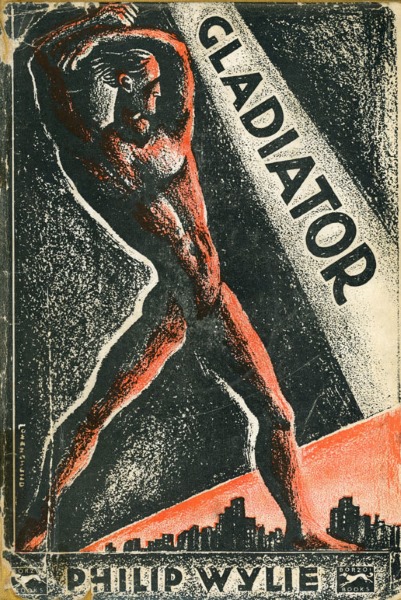
Review: Gladiator by Philip Wylie

Now I am swinging around to catching up on another set of reviews: those of my ongoing read-through of DC's post-Golden Age JSA-centric comic books. That begins with this, a story which somehow belongs in the DC universe despite predating it...

Originally published: 1930
Read: March 2021

Gladiator by Philip Wylie

In The Young All-Stars, Roy and Dann Thomas created the character of Arn "Iron Munro" Munro, who was eventually revealed to be the son of Hugo Danner. Danner is the protagonist of Philip Wylie's 1930 sf novel Gladiator, seen by some as forerunner of Superman. We don't know that Jerry Siegel and Joe Shuster read Gladiator or anything, but there are some resonances between their novel and the earlier conceptions of Superman. The Thomases literalized this possible debt in-universe by making the character of Hugo Danner a forerunner and progenitor of the superheroes of the 1930s and '40s. Gladiator is in the public domain and thus on Project Gutenberg, so I figured I would read it upon finishing Young All-Stars.

I'll be honest, though, I was curious but did not have high expectations. The Hugo Danner stuff was some of my least favorite material in Young All-Stars, and the only thing I knew Philip Wylie from was that he co-wrote the novel When Worlds Collide, which I haven't read... but I have seen the absolutely awful 1951 film.

But it was really good! Wylie charts the life of Hugo Danner in exhaustive detail, from outsider childhood to college football star to war hero and beyond. Wylie gets how to write good science fiction, which is that he simultaneously shows you something new and cool and it's a metaphor for something old. This is a pretty grounded and realistic take on what it would be like to be a "superman," I think; it almost reads like a riff on superheroes except it came before them! It reminds me of some of those 1990s/2000s comics about what it "really" be like to have superpowers, except not needlessly brutal as those sometimes were.

Yet it's also something we can all empathize with: not fitting in. Hugo struggles to find his place in the world from boyhood on, and constantly realizes that the connections he does have turn out to be more superficial than he thought. The story of his time at college, especially his summer vacation, was one of my favorite parts, and the description of his involvement in the futility of World War I is probably the book's best part. There's a lot of quiet and thoughtful characterization here in what was a quick and energetic read.

Indeed, I ended the whole experience thinking that Roy Thomas had really done Hugo Danner dirty in The Young All-Stars. The adaptation of this story in Young All-Stars #10-11 communicates none of its power. Danner deserved better than becoming a mediocre villain in a mediocre storyline.

(Thomas had actually previously adapted Gladiator in a different comic back in 1976, which I'll circle back to read now that I've finally written up Gladiator. I am curious to see what I think of that take.)

This post is seventeenth in a series about the Justice Society and Earth-Two. The next installment covers The Crimson Avenger: The Dark Cross Conspiracy. Previous installments are listed below:

  1. All Star Comics: Only Legends Live Forever (1976-79)
  2. The Huntress: Origins (1977-82)
  3. All-Star Squadron (1981-87)
  4. Infinity, Inc.: The Generations Saga, Volume One (1983-84)
  5. Infinity, Inc.: The Generations Saga, Volume Two (1984-85)
  6. Showcase Presents... Power Girl (1978)
  7. America vs. the Justice Society (1985)
  8. Jonni Thunder, a.k.a. Thunderbolt (1985)
  9. Crisis on Multiple Earths, Volume 7 (1983-85)
  10. Infinity, Inc. #11-53 (1985-88) [reading order]
  11. Last Days of the Justice Society of America (1986-88)
  12. All-Star Comics 80-Page Giant (1999)
  13. Steel, the Indestructible Man (1978)
  14. Superman vs. Wonder Woman: An Untold Epic of World War Two (1977)
  15. Secret Origins of the Golden Age (1986-89)
  16. The Young All-Stars (1987-89)