Showing posts with label series: war of the worlds. Show all posts

21 June 2018

Review: The War of the Worlds: From H. G. Wells to Orson Welles, Jeff Wayne, Steven Spielberg and Beyond by Peter Beck

Some more catching up on my reviews of audio dramas at Unreality SF: the most recent UNIT box set, Cyber-Reality, featuring Kate Stewart, Osgood, the Cybermen, and Derek Jacobi as the Master; the most recent Torchwood adventure, We Always Get Out Alive, featuring Gwen, Rhys, and a car; and the final Jago & Litefoot adventure, Jago & Litefoot Forever.

Acquired September 2017
Read May 2018
The War of the Worlds: From H. G. Wells to Orson Welles, Jeff Wayne, Steven Spielberg and Beyond
by Peter J. Beck

I should begin with some personal disclosures. As long-time readers, colleagues, and friends will know, I am low-key obsessed with H. G. Wells's The War of the Worlds. I teach it whenever I can; I published on its 1898 American rip-offs in the journal English Literature in Transition; I have presented on Marvel's Killraven, a schlocky 1970s sequel; I will argue this summer at a conference that M. T. Anderson's Landscape with Invisible Hand is an adaptation of it; and I have read and watched far, far too many versions of it. One of my dream book projects is to cover its various versions and iterations. So you can imagine my sadness and disappointment when I realized Peter J. Beck had beat me to the punch with a book from Bloomsbury Academic.

All of this is to forewarn you that when I say I don't like this book, I might just be biased because 1) I wanted to write this book, but also 2) it's not how I would have written it. Beck is a historian, and the book strongly emphasizes the history of The War of the Worlds. There's a lot of thorough, interesting background on where the book was written and when, both in terms of society/culture and in terms of Wells's personal life. About the first half of the book is given over to this. The weak part of the first half is Beck's handle on the novel itself; his interpretation of the book (in a chapter called "The War of the Worlds: Storyline and Methodology") is pretty short and pretty formulaic, to the point you wonder why he bothered. A lot of this I knew already, but then I'm pretty deep in the (red) weeds on Wells, so many readers will probably get more out of this than me. It's a lucid account of the book's writing and publication, even if it doesn't say much about the novel qua novel.

The discussion of the novel's "multimedia afterlife" covers a lot of ground very quickly, and sometimes the focus is odd. Comics and graphic novels get a mere two pages! There is a chapter on the 1898 American version, which I was happy to see draws heavily on my ELT article. (It also draws heavily on a LiveJournal post I made in 2009 during my first year of graduate school; never thought I'd see that incorporated into my citation count!)

There's a very thorough chapter on the 1938 Orson Welles version, and a much more superficial one on other radio versions of the novel. The discussions of the two major film versions (George Pal's 1953 and Steven Spielberg's 2005) are also pretty quick. The problem in these, as in much of the book, is Beck's historian mindset. He's interested in how these things got made, and somewhat interested in reactions to them, but there's not much analyses of the actual adaptations. If I were writing this book, I'd be focusing on the way the stories took Wellsian ideas and imagery and reworked them in different times and places.

Beck is really interested in Woking, the London suburb where Wells wrote the novel, and where much of the novel takes place. This helps the early parts of the novel, but diminishes its later parts, because I feel like Beck is too quick to dismiss adaptations that move the story out of Victorian Woking. The Spielberg film, for example, feels criticized for the fact that Spielberg didn't want to make a period piece. I don't like this attitude (as I've written about before), because it neglects that Wells was not writing a period piece. Wells was writing a story about aliens disrupting our complacency in the here and now. An adaptation that maintains the Victorian setting isn't doing what Wells was doing, it's doing something completely different. Now, Beck doesn't have to share this approach, but I wish he was more sympathetic to the motives of adapters that relocate the setting.

Relatedly, I also wish he was less sympathetic to Jeff Wayne's mediocre disco musical version of the novel, an adaptation whose valorization I will never understand except for reasons of kitsch. But for some reason it gets more than twice as much space as the Spielberg film despite being substantially less interesting from a literary and adaptative perspective.

There are also some oddities of structure. There are a couple chapters that lay things out in really brief detail that get covered more comprehensively later on, in a way that feels redundant. The second-last chapter for some reason includes a catalogue of the places Wells lived while writing the novel, the information from which really ought to have been folded into the first half of the book.

All that said, I'm worried that I'm biased because I'm jealous. But on the other hand, I'm kind of glad it's not the book I would have written-- because that means when I finally try to write my book, there will still be a gap in the world that it can squeeze into.

13 May 2016

Text and Paratext: Student Responses

I have ambitions for writing a larger, longer post (about a taxation metaphor in Middlemarch), but time has kind of gotten away from me, so instead I want to post a little bit about the wrapup of my teaching this semester. I taught a new-to-me course, "Honors I: Literary Study through Reading and Research," which basically is first-year writing for Honors students. It's kind of a mini-graduate seminar: we studied one topic in depth, and the students produced research projects at the end of the course on topics that they selected within the course's area of inquiry.

My section (along with two others; this course is always taught in "pods") had the theme of "book history": how are books used by readers, how do the elements that are not the text of the book (i.e., the paratext) affect the way it is received? In class, we explored this through two case studies: Elizabeth Gaskell's Cranford and H. G. Wells's The War of the Worlds. We read Cranford as a novel, but then explored its magazine serialization, its various early editions, its illustrations, its deployment as a school text in America in the early twentieth century, a stage adaptation, and its two television versions. After reading The War of the Worlds as a novel, we looked at its original magazine serialization, its unauthorized American newspaper publication, the Orson Welles radio drama, different covers, comic adaptations, and the Steven Spielberg film version. We did this to model the kind of work they could do with their final projects.

These final projects were the really impressive part of the course for me, and I felt the students did a great job producing a diverse range of approaches to a diverse range of texts. Here is the complete gamut of titles: (I've added a comment in brackets in some cases where specificity could be added)
  • 400 Years of Favor: The Origin and Sustainability of the King James Version of the Bible
  • Analysis of the Alternate Endings in A Clockwork Orange
  • The Art of Adaptation: From Coming-of-Age Story to Racial Courtroom Drama [in To Kill a Mockingbird]
  • Creating Sympathy for Criminals: Inevitable Subjectivity of a Holocaust Narrative in The Storyteller
  • Cuckoo’s Nest Book vs. Film
  • The Different Societal Notions Presented Through The Land of Oz
  • The Effect of Tyranny on an Author and the People [in 1984]
  • Examining the Author-Reader Relationship in Modern Romance: An Investigation
  • How Interactions Between Author and Reader Function as Promotion [in Maggie Stiefvater's The Raven Cycle]
  • The Impact of Society on the Conversion of Fairy Tales by the Brothers Grimm into Disney Movies
  • The Impact of the Preface in The Picture of Dorian Gray
  • “I Open at the Close”: An Evolution of Harry Potter Cover Art
  • The Influence of Race on One’s Reaction to Adventures of Huckleberry Finn
  • Liberation, Vulnerability, and Contentment in Covers of Their Eyes Were Watching God
  • The Reality of 1984 [the use of "Orwellian" as a term in contemporary journalism]
  • Research on George Orwell’s 1984 [as Prophecy]
  • Shifting Political Interpretations of Nineteen Eighty-Four
  • The Will of One: How Bill Watterson Made Calvin and Hobbes a Legend
  • The Young Adult Genre: The Power of Publicity in Bubble Gum Books
As you can see, most (though not all) even paid attention during my mini-lecture on the writing of good paper titles!

I really enjoyed teaching this class; there are things I'd do differently, but I was really impressed with the research my students did and (especially) the conclusions they drew about it. Shame they all want to be doctors, because some of them would make good humanists!

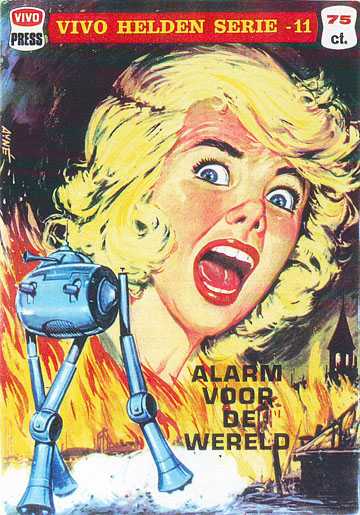
I've illustrated this entry with some of the more baffling War of the Worlds covers my students examined in class. These scans are courtesy Dr. Zeus's excellent The War of the Worlds Book Cover Collection.

28 August 2015

The War of the Worlds and Faithfulness

Martin Johnson, who's done a lot of sound design for Big Finish and Bafflegab, is producing an adaptation of H. G. Wells's The War of the Worlds that he's funding through Kickstarter. I've pledged my support, as it looks like an interesting project (and you should too).

Inside: sex tips and future-war fiction
I was happy to see Johnson correctly refer to the novel as being written in 1897; it was first published as a book in 1898, which means a lot of people refer to it as an 1898 novel, but in reality, it was serialized in 1897, in Pearson's Magazine in the UK, and in Cosmopolitan in the US (yes, Cosmo).

But as someone who occasionally dabbles in adaptation theory, there is some fascinating rhetoric used in the project description:
This groundbreaking novel became an instant success placing fear into the hearts of children and adults the world over. In the 118 years since the novel was first serialized in Pearson's Magazine there have been numerous adaptations of Wells' original story in all kinds of media. Seven films, various radio dramas, graphic novels, television series and sequels or parallel stories all derived from the original text in some form.

The only issue with all of these adaptations is one of faithfulness to Wells' original story. Changes have included the tone and feel of the story, the geographical location, the Victorian time period in which the action is set, the fighting machine design, etc.

None of these adaptations have been truly faithful to H. G. Wells' original story; This is where we come in...
Faithfulness is kind of a weird thing. What is a faithful adaptation of The War of the Worlds? Wells's original intention was to tell a story about aliens tearing up the countryside of his readers. The book was not about an alternate history, or an assault on a distant, historical landscape. The book was about what would happen if aliens attacked you the reader, about how the imperial relationships of the reader's world would be rendered if transplanted to the context of aliens from Mars. For me, that's the essence of The War of the Worlds, that's what makes the story what it is: when the narrator's hiding in a ruined house, it could be your house.

So it's natural, then, that adaptations of The War of the Worlds are set in the present day; I would argue that Steven Spielberg was being incredibly faithful in his 2005 adaptation when he transplanted the story to contemporary New Jersey. That's what The War of the Worlds is all about. There are things about that movie that do not work, but the period transformation is not one of them. And why do we want our adaptations to meticulously maintain the original, where there still is an original? If I want to experience Martians invading Victorian Britain,* I can just read the book!

Dear Warwick,
Thanks for your illustrations.
They sucked.
Love, H. G.
I do wonder about the point of emphasizing the design of the Martian fighting-machines for two reason. The first is that if they're referring to Warwick Goble's illustrations from the serial in Pearson's, Wells actually didn't like them! There's actually an explicit dissing of them in the (illustration-free) 1898 novel version:
I recall particularly the illustration of one of the first pamphlets to give a consecutive account of the war. The artist had evidently made a hasty study of one of the fighting-machines, and there his knowledge ended. He presented them as tilted, stiff tripods, without either flexibility or subtlety, and with an altogether misleading monotony of effect. The pamphlet containing these renderings had a considerable vogue, and I mention them here simply to warn the reader against the impression they may have created. They were no more like the Martians I saw in action than a Dutch doll is like a human being. To my mind, the pamphlet would have been much better without them.
The second reason is that this is an audio drama. No one will see any tripods!

But Johnson is right that original-period adaptations of The War of the Worlds are rarely undertaken (the biggest exceptions I know of are a comic by Ian Edginton and D'Israeli and a terrible movie by Pendragon), and I look forward to hearing how they handle the transformation to audio, as The War of the Worlds is a book without much dialogue and with a lot of narration. There is this real creepy feel of loneliness and desperation in the second half of the novel that I have rarely seen adapted successfully. And I have full trust in Lisa Bowerman's directing prowess, after hearing her tackle the fantastic in the Victorian era time and again in Jago & Litefoot. So I've backed it, and I look forward to hearing it.

The Coming of the Disco Beats
Also: this Kickstarter taught me that thanks to his goofy musical version of The War of the Worlds, Jeff Wayne has a trademark on the title "The War of the Worlds" in the UK, so this adaptation has to be called The Coming of the Martians. How bizarre.

* One should note, however, that the book actually takes place in the future, so if it's after January 1901, which it probably is, the book isn't Victorian, either.