Showing posts with label creator: ursula vernon. Show all posts

06 August 2026

Hugo Awards 2026: What Stalks the Deep by T. Kingfisher

This is the third book in T. Kingfisher's "Sworn Soldier" sequence, a series of novellas narrated by Alex Easton, a nonbinary (sort of) retired soldier from a Ruritanian country in the late nineteenth century. Like the first two, it is a finalist for the Hugo Award for Best Novella.

What Stalks the Deep by T. Kingfisher

Published: 2025
Acquired: May 2026
Read: July 2026

As is often the case with series that end up being Hugo finalists repeatedly, I enjoyed the first one a lot, but am a little skeptical about the fact that it keeps being nominated. The second one was nowhere near as good as the first. There are two factors here. One is similar to what affected the Murderbot novellas, in my estimation, is that part of what made the first book engaging was the voice of the narrator, but obviously what is novel in book one will not be novel anymore in later installments. I like Alex Easton a lot, but is their voice original in book three the way it was in book one? Of course, that doesn't make the book less good but it does perhaps make it less award-worthy.

The other reason I liked book two less is because it used its science fictional premise less interestingly. Book one was surely not hard sf, but it did take the idea that someone might be possessed by fungus with a certain level of seriousness, thinking through the premise in a way I didn't recall ever seeing before, and I enjoyed that aspect of it a lot. Book two, on the other hand, had what seemed to me to be an explanation that didn't rise beyond the level of "magic." Which was fine, but not what drew me to the series to begin with.

Book three, I am happy to say, is more like book one in that regard than book two. Though, again, this is surely not hard sf, Kingfisher has thought through a common sf&f idea and done her best to justify it, and I appreciated that a lot. Unfortunately, this isn't done as smoothly as in book one; we get a big chunk of exposition to make it all clear. But, I guess, the big chunk of exposition is a hard sf staple! Anyone, it's fun, T. Kingfisher always is... though I do wish she would go back to doing coming-of-age stuff, I find her more interesting in that mode than in horror.

08 July 2025

Hugos 2025: A Sorceress Comes to Call by Ursula Vernon

I have enjoyed a lot of previous books and stories by T. Kingfisher/Ursula Vernon, but this one didn't do it for me at all. I find it a bit hard to enumerate exactly why, to be honest, but I'm going to try.

The book has two protagonists. One is the daughter of a sorceress; the sorceress has (among other powers) the ability to make people "obedient," which forces them to do exactly what she wants. She often uses this on her own daughter as a form of punishment, making her do certain things she doesn't actually want to do. When the book opens, the mother decides she wants to get married, so the two of them head off to woo a rich man, the sorceress coming up with an excuse for them to be houseguests. (The book seems to take place in a place that is vaguely nineteenth-century Britain, though not exactly.)

The other protagonist is the middle-aged sister of the sorceress's target, who is skeptical of this woman intruding into their lives and decides to get rid of her... but also eventually realizes that this woman's daughter needs saving from her too.

A Sorceress Comes to Call by T. Kingfisher

Published: 2024
Acquired: April 2025
Read: July 2025
In the acknowledgements, Vernon says her influence was the genre of regency romance but it more reminded me of Victorian sensation novels by Wilkie Collins or Mary Elizabeth Braddon (or later writers influenced by them, like Thomas Hardy), where the main threat is that the Wrong Marriage is going to happen with catastrophic consequences. Unfortunately, compared to these novelists, the book very much comes up short. In a book by Collins or Braddon or Hardy, one very much feels the threat of the marriage, the inexorable pull of how it's going to wreck everyone's life. But I found that the tone didn't really come across here, as the sister would talk about how big a threat the sorceress was... but then kind of just sit around and throw a big house party, which didn't seem to correlate. Tonally, the moment where the book really fails is that the sorceress succeeds in marrying the brother... but the characters don't react with horror or anything, they're just like "oh well" and continue with their plans to try to stop (now undo) the marriage. I thought it was very weirdly handled, very much a lost opportunity.

The book is, unfortunately, filled with little moments that don't quite vibe right and thus stopped me from feeling invested. The daughter's only friend in her mother's household is their family's horse; it's supposed to be a big betrayal that the horse is actually her mother's familiar and has thus been funneling information to the mother all along... but we've only just been told this about the horse, so it doesn't come across at all. I had very little sense of what the brother saw in the sorceress; the linchpin of the sorceress's plan is that the brother is in love with her but the sorceress can't use magic to make this happen, yet we don't really get to see how she wins him over. Everyone else is onto her so quickly it makes the brother seem like quite a dunderhead. The sister has this subplot about not wanting to marry the guy she's in love with, but it never clearly came across why she had turned him down.

It's a shame because the basic concept of making people obedient and using it to explore the dynamics of child abuse seems quite potent, but I felt like the book largely squandered it. I don't think there's one big way in which this book whiffed it, but add up all my complaints above, and you end up with a book I never engaged with on any level, perhaps the first time that's ever happened to me with Vernon/Kingfisher.

03 June 2025

Hugos 2025: What Feasts at Night by T. Kingfisher

Ursula Vernon (who usually writes for adults or even YA audiences as "T. Kingfisher") has been one of my favorite discoveries from my reading of Hugo Award finalists. Since I began in 2017, I think there hasn't been a single year where she hasn't been on the ballot in at least one category. I have very much come to appreciate her humor, her sensitivity, her focus on the forgotten and unseen. A Wizard's Guide to Defensive Baking is particularly excellent.

What Feasts at Night by T. Kingfisher

Originally published: 2024
Acquired: April 2025
Read: May 2025
One of this year's Best Novella finalists is What Feasts at Night, a sequel to What Moves the Dead, her Best Novella finalist from 2023. I ranked it first, but it bafflingly finished in fourth. What Moves the Dead was about a soldier from a Ruritanian country travelling to another small European country, where they encountered evil alien fungus. I found it funny and cleverly done. It seems like fantasy horror at first, but it eventually becomes clear the book is actually science fiction.

But... did it need a sequel? Did the sequel need to be a Hugo finalist? I enjoyed going back to these characters, but unfortunately the story here is up to much less than in the first book. Someone is getting sick, and Alex very slowly investigates. It's a bit too obvious what's going on. While in the first book you might have some inkling, I think there that worked to generated dread—here it mostly drags on. What you think is going in is exactly what is going on, and unlike in What Moves the Dead, there's no clever explanation; it's just a mythical creature. I found it pretty disappointing.

But still! Kingfisher is engaging enough a writer that you still enjoy a lot of it. Lots of humor, and the narrator has a great voice, and the side characters are vivid, almost Dickensian sorts. I enjoyed most of the ride, even if I wasn't really sure why I was on it or if it was even going anywhere. I'm not really sure why this book exists, in that I think Kingfisher ought to have waited until she had a stronger premise for a second book in this sequence, and I'm really not sure why it's a Hugo finalist... but I certainly had a much less pleasant time reading some other inexplicable Hugo finalists.

16 July 2024

Hugos 2024: Thornhedge by Ursula Vernon

Thornhedge by T. Kingfisher

Published: 2023
Acquired: April 2024
Read: June 2024

This is a finalist for the Best Novella Hugo; while I automatically pick up (almost) all Best Novel finalists, I only purchase finalists in other categories for authors I particularly like. T. Kingfisher (a.k.a. Ursula Vernon) is one of those authors, as I have very much enjoyed her previous Hugo finalists, especially A Wizard's Guide to Defensive Baking.

This is a fairy tale retelling, focusing on Sleeping Beauty—the central conceit is the question, "What if there was a good reason for the fairy godmother to put her to sleep for a long time?" It's an interesting idea, but I didn't find the execution very interesting; this is probably the weakest Kingfisher/Vernon book I've read. Most of it is given over to the backstory of the godmother, which is doled out pretty slowly, and I didn't find the climax of the story very interesting. It's well written of course, but it doesn't compare to, say, last year's What Moves the Dead or Nettle and Bone for complexity and depth.

03 October 2023

Hugos 2023: What Moves the Dead by T. Kingfisher

What Moves the Dead by T. Kingfisher

Published: 2022
Acquired: July 2023
Read: September 2023

This retells Poe's "The Fall of the House of Usher"... only I've never read that. I imagine that's cleverly done (Vernon certainly makes it sound so in her afterword), but it also works totally on its own. I guess it's a piece of horror, but I didn't find it scary... that's not an indictment, though, because I did find it really interesting. When I began reading it, I assumed it was fantasy, but actually I think it's science fiction: it's about fungus, but it's all carefully done in terms of plausibility (as far as these things go, anyway).

The narrator is from a Ruritanian country, travelling to another one (but not the actual Ruritania of Prisoner of Zenda, despite what the back cover says); ka is from a country with a lot of pronouns, including specific ones for soldiers (God and priests/nuns each also get their own set). There's some interesting stuff with gender as a result, and I found ka a very fun narrator.

This is by Ursula Vernon, so the main thing to note is that it's all leavened perfectly by comedy. The narrator's Scottish batman is particularly excellent, but all the characters here are good fun. A quick, interesting read, well put together.

15 August 2023

Hugos 2023: Nettle and Bone by Ursula Vernon

Nettle and Bone by T. Kingfisher

Ursula Vernon (here writing as "T. Kingfisher") is one of my favorite discoveries from reading Hugo finalists; I have enjoyed her YA/middle-grade novels (such as the 2021 Lodestar Award winner A Wizard's Guide to Defensive Baking) and her adult short stories (such as the 2017 Best Novelette winner "The Tomato Thief"). I was curious, then, to read my first novel of hers with an adult audience.

Published: 2022
Acquired: July 2023
Read: August 2023

It actually turns out to have a lot in common with her YA work. Like Defensive Baking and Minor Mage, this is about someone who sets out to right an injustice—an injustice it should not be her responsibility to right, but which only she is willing to take on. Like in those books, the protagonist goes on a journey through a magical land, acquiring friends along the way, and developing an ethos of care in the face of brutality. Plus: lots of jokes! So basically, Vernon is doing in Nettle and Bone the thing she did in the other books of hers I liked, only this time with an adult protagonist, darker themes, and some more horrific magic.

The main character of Nettle and Bone is Princess Marra, whose older sister has been married off to a cruel prince in order to secure a vital alliance; Marra, shunted off to a convent, decides to see if she can help that sister, enlisting the assistance of a "bone-wife" (a woman who can talk to the dead), a disgraced knight, a kindly little old lady, and a dog made of bones. I wouldn't say it's as funny as a Terry Pratchett novel (surely praising with faint damnation!) but it is in the same sort of area as him, especially his work in the Tiffany Aching novels: how to care for others, how to be a better person, how to see the dark power that runs through the real world and overcome it. This is exactly the kind of fantasy fiction I enjoy, and a well-executed example of it. I loved this cover to cover, and if my first Hugo read, Legends & Lattes, quickly established itself as the lower bar,  Nettle and Bone is the high bar; if any of my remaining novels are better than it, they must be excellent books indeed.

15 November 2021

Hugos 2021: A Wizard's Guide to Defensive Baking by Ursula Vernon

Published: 2020
Acquired and read: July 2021

A Wizard's Guide to Defensive Baking by T. Kingfisher

Last summer, a former student of mine had to crash in our spare room for a couple days when she fell afoul of a rental scam. A day or two later, she came to me and asked, "Do you have any other books like Minor Mage?" It had been sitting out, either because I had just read it or because I was just about to read it, and she had randomly grabbed it. It had really resonated with her own life, because it was about a child upon whom great burdens were placed before they were ready, due to the failure of adults to discharge their responsibilities. I struggled to come up with something else. She started Kingfisher's Summer in Orcus but didn't really find it hit that tone; she did leave with Frances Hardinge's A Skinful of Shadows, but I'm not sure how that went. Come to think of it, she still has my copy of that.

I need to get in touch with her—not just to get my book back, but also to loan her this one. Kingfisher's newest YA fantasy is my favorite yet, and hits the same notes as Minor Mage, but even better. Mona is a fourteen-year-old apprentice baker, and also a wizard... one whose powers are limited to bread. She can work dough, stop it from burning, and even bring gingerbread men to life; she has a sourdough starter that might be carnivorous. Like most Kingfisher (a.k.a. Ursula Vernon), it's very charming, and laugh out loud. (All the stuff involving the toilet was amazing.) But it's also sad and depressing; Mona's society lets her down in some really big ways, and she has to step in and fill the gap even though it ought not be her responsibility. The use of magic is clever and interesting, and I genuinely teared up a little bit near the end. I've read four of the six 2021 Lodestar Award finalists so far, and this is still the one to beat.

05 November 2021

2021 Hugo Award for Best Short Story Ballot

As I said back when I posted my Best Related Work ballot, this year, I have much more time to get all my ballots up, so I'll be doing a single post for each category in which I am voting. Here is Best Short Story.

Things I Nominated

Most of my sf&f short fiction reading comes via the Hugo ballot and Neil Clarke's Best Science Fiction of the Year anthologies, so it's hard for me to nominate anything, as by the time I read it, it's too late. But I actually nominated three things in this category, though I knew none of them would make the ballot.

One was the short story "In Vivo" by Christiane Vadnais; I read this as part of the short story collection Fauna (translated by Pablo Strauss, Coach House). The collection as a whole I found hit or miss, but this story was a creepy bit of thoughtful horror. I doubt it came to the attention to the majority of the Hugo electorate, however, being an indie non-sf publisher translation of a Francophone short story collection!

The other two were both Doctor Who: Lockdown! short stories by Paul Cornell, "The Shadow Passes" (about the thirteenth Doctor and companion waiting out a disaster in isolation) and "Shadow of a Doubt" (about the thirteenth Doctor going back for Daughter-of-Mine from "Human Nature" and giving her the second chance that the tenth Doctor wouldn't). Again, I didn't expect them to make the ballot (tie-in fiction is not a preferred subgenre of the Hugo electorate, despite their tastes in film only running as far as mediocre franchises), but Cornell got the thirteenth Doctor down better than any of her screen stories have bar one, I reckon, and these were both uplifting tales in a time where we really needed them, and they were certainly among the best 2020 fiction I read in time to nominate.


6. "Little Free Library" by Naomi Kritzer

Is there a sequel to The Fellowship of the Ring? I would very much like to read it. I will leave behind anything I have for the other books, if you will give them to me. Also, I am sorry about the day I took everything. I promise I will never do this again. What would you like in trade for the next book about Frodo, if there is one?

This is a somewhat twee fantasy story about how good it is to read fantasy stories, the kind of thing that Hugo nominators and often Hugo voters evidently eat up. The basic concept is okay (people from a fantasy world love the fantasy books they find in a Little Free Library) but it went on too long and didn't go somewhere that I found very plausible.

5. "Badass Moms in the Zombie Apocalypse" by Rae Carson

So many things could go wrong. We’ve discussed all of them. Like billions of child-bearers who came before us, we’re counting on a little luck.

I read a thing by Rae Carson that explained where this story was coming from, and once I got that, I appreciated it more, but I still didn't like it a ton. This is about a group of women during a zombie apocalypse; zombies go particularly crazy for the birthing scent, and the story follows two moms hiding out as one gives birth. I see that it's working against particular tropes about women in general and mothers in particular in zombie stories... but as a story, I still didn't find it very interesting. Basically, two people hide from zombies for a while, then they get out. Its particular ranking is kind of arbitrary, but I felt the Lee story was up to something I found more interesting, but it also didn't put me off like the Kritzer. Just kind of dull.

4. "The Mermaid Astronaut" by Yoon Ha Lee

“It will hurt,” the witch said. “Certain kinds of desire always do.”

A mermaid wants to go into space, but has to give up being a mermaid to do so. Lee knows how to craft engaging prose, and I think he works better in the short form than the novel form a lot of the time, but the actual story I thought was pretty good though not great.

3. "Open House on Haunted Hill" by John Wiswell

“I’m a software engineer, and I host a skeptic podcast. You might have heard us.”

The house isn’t offended. It doesn’t believe in ghosts either.
Cute story about a haunted house, except all the haunted house wants is for a nice family to move into it. I feel like you would get more out of this if you read it from inside the horror genre, where it's clearly subverting tropes, than from outside it. As a piece of worldbuilding, it doesn't really do anything. Not the story's fault it got nominated for an sff award, I guess!

2. "A Guide for Working Breeds" by Vina Jie-Min Prasad

hey again
just wanted to ask
do you know how to be mean to humans

This is cute (so many short fiction Hugo finalists are these days, not sure how I feel about that) but enjoyable: told largely in chat logs, it's the tale of two robots, a newly activated barista and an experience killing machine; the machine is assigned to mentor the barista. The at-first-stodgy killing machines learns there is more to life than its narrow vision; the naïve barista learns to stand up for itself. I thought the resolution was a bit pat, but otherwise I enjoyed it.

1. "Metal Like Blood in the Dark" by T. Kingfisher

Eve had had the knowledge of good and evil handed to her, but Sister had to create it for herself from first principles, and it went slowly.

This at first threatens to be a cute story about robots, but this is by T. Kingfisher a.k.a. Ursula Vernon, so the fluffiness is wrapped around an iron mallet. Two naïve robots are taken advantage of, and one must invent the concept of lying in order to protect her brother. Clever and moving, and an angle I don't remember ever having seen before on a pretty common sf concept.


My attempts to predict winners are often pretty bad, especially in the short categories, where I know less of the "buzz" around various stories than I do as regards novels and films. But if I were to give it a go, I would say that the Hugo electorate 1) always loves T. Kingfisher (justifiably) and 2) always loves self-serving stories about how great it is to be a fan (less justifiably). So I would guess either "Metal Like Blood" or "Little Free Library."

As is often the case with Best Short Story of late, I find it hard to believe this is the six best stories in the genre for the year, but at least the top couple are strong and deserving winners. The past couple years, I've read Neil Clarke's The Best Science Fiction of the Year volume and found his selections much more to my taste than the Hugo electorate's. The volume covering 2020 isn't out yet, but from the table of contents, I can see that none of these stories made it in. (Of course, Clarke's book is sf-only, so three of these stories wouldn't have even been eligible.) Actually, I think none of Clarke's picks were Hugo finalists in any category, which is a first, I believe. The problem is, I suspect, that the Hugos for short fiction are biased towards what is freely available on the Internet; Clarke reads much more widely, and gets the good stuff out of Asimov's, F&SF, and all the rest that the awards don't.

21 July 2020

Hugos 2020: Minor Mage by Ursula Vernon

Trade paperback, 167 pages
Published 2019

Acquired May 2020
Read July 2020
Minor Mage by T. Kingfisher

This was cute, as Ursula Vernon usually is, and it was meaningful, as Ursula Vernon usually is. A twelve-year-old mage is sent on a quest to bring rain to his drought-ridden village, with only an armadillo familiar and three spells to his name. It's about the way large groups of people can think, and how that can make people worse than they really are, and it's about the toughness of doing the right thing when no one else will, and when it will have a terrible cost. Plus the armadillo is pretty funny, and there's a teenage boy with a compulsion to make harps out of the corpses of murder victims that shriek in the presence of their murderers. Dark stuff, communicated lightly, and very good, as Ursula Vernon usually is.

02 August 2019

My 2019 Hugo Awards Ballot: Short Fiction Categories

As always has been my tradition the past few years, I'm writing up my votes in the various Hugo Award categories that I vote in, in advance of Dublin 2019, an Irish Worldcon. Here are my ballots (from lowest-ranked to highest) in each short fiction category, with commentary. Links are to where you can freely read the stories on-line (when possible) or to full reviews (if I did one).

Best Short Story


6. "The Rose MacGregor Drinking and Admiration Society" by T. Kingfisher
“Excuse me! I am a pooka! We drown people! None of this waiting around for them to die of a broken heart! We are efficient!”
This was cute: a group of mythical creatures that usually tempt women and then leave them with broken hearts congregate to discuss Rose MacGregor, the woman who left them with broken hearts. I liked its playfulness with an old trope, but ultimately it's more cute than substantial.

5. "The Tale of the Three Beautiful Raptor Sisters, and the Prince Who Was Made of Meat" by Brooke Bolander
Such a long face! Don’t concern yourself a feather-tip about that poor horse, shining claw of my foot’s delight, for it opened like a generous man’s gut beneath Ceecee’s teeth and talons and not a hunk went to waste.
A fairy tale about three raptors, a slightly dim prince, and a very clever princess. This was a fun read, and I liked the fairy-tale narrative voice, which hovered just on the right side of twee. It's fun to imagine the kind of fairy tales dinosaurs would tell. There were also good jokes about dinosaurs pretending to be human. Some of the gender stuff got a little too straightforward, though-- all of the women were clever, all of the men were stupid. I read fiction to be challenged, and that component of the story was too obvious.

4. "The Secret Lives of the Nine Negro Teeth of George Washington" by Phenderson Djèlí Clark
When George Washington wore Solomon’s tooth, he dreamed of a place of golden spires and colorful glass domes, where Negroes flew through the sky on metal wings like birds and sprawling cities that glowed bright at night were run by machines who thought faster than men.
Set in a fantasy world, this story provides accounts of nine Negro teeth used by George Washington, each from a different person, each of which comes with some kind of magic, and each of which has some kind of effect on him. I would say that I admired the conceit more than I enjoyed the story per se, which is what made me give a slight edge to "A Witch's Guide to Escape," but I would say they're pretty much on par with one another.

3. "A Witch's Guide to Escape: A Practical Compendium of Portal Fantasies" by Alix E. Harrow
(There have only ever been two kinds of librarians in the history of the world: the prudish, bitter ones with lipstick running into the cracks around their lips who believe the books are their personal property and patrons are dangerous delinquents come to steal them; and witches).
A librarian who is also a witch tries to help a boy living a rough life by giving him the books he needs, fantasies of escape (some exist in our world, like A Wizard of Earthsea; some do not but are of a recognizable type, like the fourteen-volume Tavalarrian Chronicles). I enjoyed it, but the narrative voice was at times a little twee. The fantasy element is slight, but deployed potently.

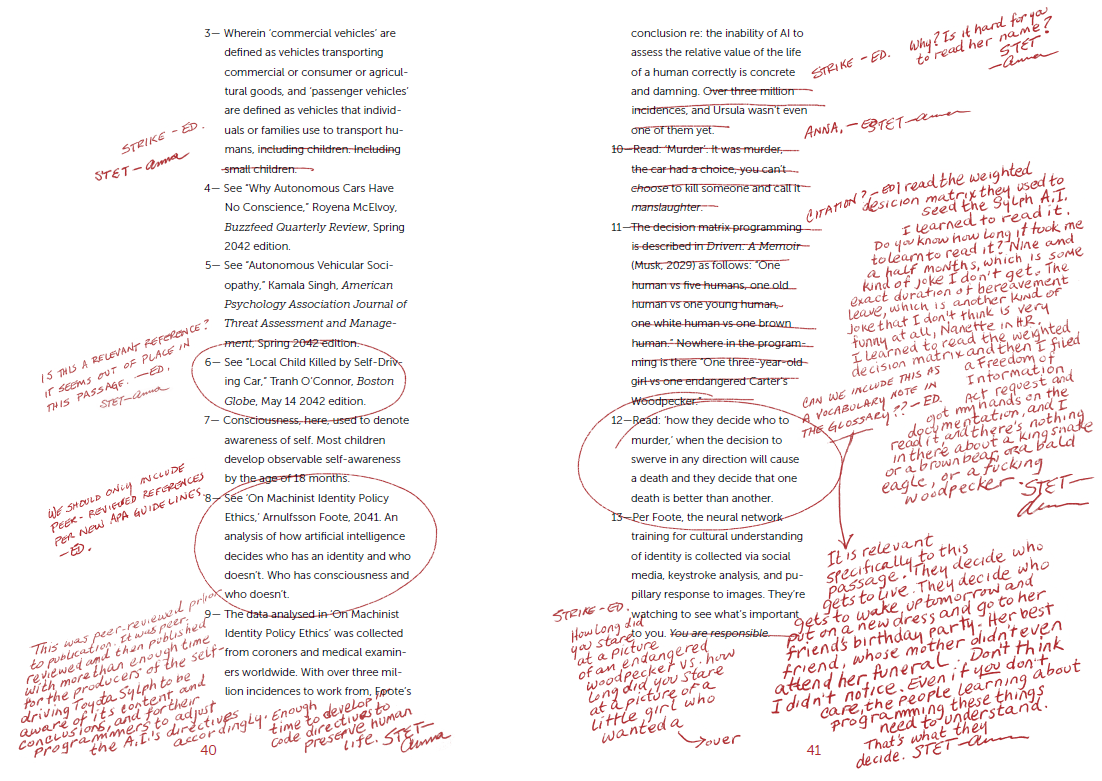
2. "STET" by Sarah Gailey
I read the weighted decision matrix they used to seed the Sylph AI. I learned to read it. Do you know how long it took me to learn to read it? Nine and a half months, which is some kind of joke I don’t get. The exact duration of bereavement leave, which is another kind of joke that I don’t think is very funny at all, Nanette in HR.
This was a very cleverly told tale. It's a 100-word excerpt from a textbook on autonomous cars, with 800 words of footnotes, and then comments from an editor on the footnotes, and then rebuttal comments from the author. A story begins to emerge in all this, about a girl who died. It's cleverly told, and kind of touching, too. I think there's a real point in here, as well (though some of its fearmongering seems kind of overblown, along the lines of this Radiolab episode). The on-line version is neat, but the version in the print edition-- where the comments are handwritten-- is more effective.

1. "The Court Magician" by Sarah Pinsker
The first time he says the word, he loses a finger.
As always, Pinsker nails it, with a clever concept well told. A kid magician from the streets is elevated to become the court magician, and goes from illusions to practicing real magic. Only, the real magic exacts a cost, as he slowly loses everything that he loves. But he keeps going on, because he must know how it works, always wondering if real magic is just another form of illusion. This one sucked me in and kept me going, a perfect little story.

Best Novelette


6. "The Thing About Ghost Stories" by Naomi Kritzer
Something had arrived in a padded envelope, and when I saw the return address, I tore it open eagerly. It was a first-off-the-press copy of The Stories We Tell in the Dark—my book.

I set it down on the counter and just looked at it for a minute. It was published by the Indiana University Press and it looked really good: the cover image was a fog-shrouded forest, very spooky looking without appearing so much like a book for the layperson that no respectable folklorist would consider assigning it to their students in class.
This is essentially just a ghost story. A very well-told ghost story, layered with literary details, but nonetheless not much actually happens in one sense, and things play out fairly predictably. But then again, the story is about the predictable nature of ghost stories, something the story itself sign-posts from the second paragraph, and I still felt tension as the story drew to a conclusion. As an academic, I appreciated the story gets academia largely right, and I found it really well done in parts. But it's still "just" a ghost story.

5. "Nine Last Days on Planet Earth" by Daryl Gregory
“Beauty’s just”—he made explosion fingers—“joy in the brain, right? A flood of chemicals and, and, and—” What was the word? “Fireworks. Neuronal fireworks. We don’t logic our way to beauty, it hits us like a fucking hammer.”
In 1975, strange alien seed pods fall to Earth, blanketing the world, and ten-year-old LT watches. The story jumps ahead in increasing intervals, covering LT's life in this new world. It's a great story, moving and unsettling at the same time, though maybe a little too obviously sentimental. I really enjoyed reading it, but I think that to be ranked higher, it would really need to do more with its sfnal element. Hugo-nominated short sf often feels reluctant to embrace its speculativeness, to prefer to tell literary fiction with speculative trappings. Which is fine, sometimes I like that approach a lot, but award-nominated stuff seems like it should be pushing harder.

4. "If at First You Don't Succeed, Try, Try Again" by Zen Cho
Leslie cleared her throat. “I didn’t get tenure.”

Byam had learned enough about Leslie’s job by now to understand what this meant. Not getting tenure was worse than falling when you were almost at the gates of heaven. It sat down, appalled.

“Would you like me to eat the committee for you?” it suggested.
An imugi (the worm-like nascent form of a dragon) keeps trying to ascend into a dragon and failing, but then it gets sidetracked when it meets a physics graduate student who ruined its most recent attempt. This was really good and kind of moving, and that I loved it but still ranked it down in fourth is a testament to how strong the novelette shortlist was this year. I think "When We Were Starless" and "The Last Banquet" both give me what I want out of sf/f a bit more, but this really got me in the heart, and it has some good jokes, too.

3. "When We Were Starless" by Simone Heller
We told ourselves that we made a difference, that we shaped a world, but one look at this ruined vastness told the truth: we didn’t change a thing, and all our sacrifices were just to survive another day. It was enough, mostly, as long as we pretended it didn’t tear our hearts out.
I struggled to rank this one vs. "The Last Banquet." "When We Were Starless," which follows a member of a sentient race of reptiles on an Earth polluted and abandoned by humanity, is more to my taste as speculative fiction; I love the world and imagery it conjurers up. But at times it is a little too immersive. Heller resists unnatural exposition quite successfully, which sometimes meant scrolling backward and forward while I tried to make sure I understood what happened, which occasionally undermined the story's emotional effect. But I did really like it. It has that aspirational tone of the best (to me) sf. We live in a world without stars, but we know they are there.

2. "The Last Banquet of Temporal Confections" by Tina Connolly
“You will see pain,” she said. “Not your own pain, but another’s. A moment of exquisite pain that someone else is suffering.”
A really clever story, well told, where pastries, properly prepared with the right herbs, can invoke memories in the eater: Rosemary Crostini of Delightfully Misspent Youth, Fennel Flatbread of Sunlit Days Gone By, and so on. The story is told from the point of view of the pastry chef's wife, who serves as taster to the king, so that the pastry chef cannot poison the tyrant king. The story alternates between the present day (a Banquet of Temporal Confections) and the memories invoked by the pastries. A neat idea that enables a neat exploration of memory, with a clever conclusion. I do kind of wish there was more sf in the short fiction categories, but this was good fantasy.

1. The Only Harmless Great Thing by Brooke Bolander
No matter what you did, forty or fifty or a hundred years passed and everything became a narrative to be toyed with, masters of media alchemy splitting the truth's nucleus into a ricocheting cascade reaction of diverging alternate realities.
The premise of this book sounds wacky if you try to explain it to someone: in an alternate reality where elephants are sentient, they are hired to replace the Radium Girls after it comes out how dangerous it is to work in the factories. The book alternates between elephant myths, a former Radium Girl hired to train them, and a researcher in the future, negotiating with the sovereign elephant tribes. But Bolander makes it work, and how. It packs a lot into its short length; it's about history, and labor, and our treatment of animals, and even Disneyfication. I complained in my write-up of "Last Banquet" that I wanted more sf, and I complained in my write-up of "Nine Last Days" that I wanted the sf elements to be more than props, and this story gave me exactly what I wanted on both accounts.

Best Novella


7. Binti: The Night Masquerade by Nnedi Okorafor

This is the only novella finalist I'd read before the ballot came out; in my review, I said it had a "muddled emotional throughline, an overly meandering plot, and too much happenstance." I liked each Binti novella less than the previous one, and this was the third.

6. The Tea Master and the Detective by Aliette de Bodard

It's like Holmes and Watson, except they're both women, and it's in space, and everyone's Vietnamese, and Watson is a former military spaceship traumatized by the death of her crew. I mean, why not? This had lots of great concepts (the Watson-analog spaceship makes money by brewing teas designed to manipulate the brain in specific ways), but as happens a little too often with novellas, I felt like the execution didn't completely live up to the idea; the emotional climax was a little subdued, and the mystery isn't really the focus, disappointingly.

5. The Murderbot Diaries: Artificial Condition by Martha Wells

The sequel to last year's winner is nowhere near as good. All Systems Red was a quick, engrossing action story with a distinct narrative voice. Artificial Condition is slow-moving (I wasn't sure what the story was even going to be about until I was a third of the way in) and the narrative voice is much more bland; I got much less of a sense of character off Murderbot than before. I didn't really get why it thought the so-called "asshole research transport" was an asshole; that seemed like a good joke that had been inadequately set up. I got more out of this than Tea Master, but even though Beneath the Sugar Sky was somewhat unfulfilling, it was at least trying to do something more than this ultimately hollow action piece.

4. Beneath the Sugar Sky by Seanan McGuire

The third Wayward Children book is definitely better than the second, but not as good as the first. In this one, four of the kids (all children who returned to Earth after visiting fantasy worlds via portals) go on a quest to resurrect a dead classmate, in order to ensure the existence of her future daughter-- who is on the quest with them. It's good, but not as good as it should be. McGuire's narrator likes to offer a lot of wise-sounding insight, but would benefit from being more attentive to character; each character has an elaborate backstory, but they often don't feel like they really matter, their actions in the present being kinda interchangeable, including the character who doesn't even want to be on a quest. It's entertaining, though (I like a portal-quest fantasy), and makes better use of the central concept than the second book did. Kept my attention more than Tea Master but didn't entertain me as much as Black God's Drums.

3. The Black God's Drums by P. Djèlí Clark

The best part of this book was its first-person narrative voice, told from the perspective of a black street urchin with an African goddess in her head-- in a steampunk New Orleans in a timeline where the Civil War ended in a draw, but New Orleans is neutral territory. The main character must get help from an airship smuggler captain when it turns out Confederate racists are building a superweapon in secret, in violation of the treaty. It's good fun, with strong worldbuilding and character. Its main weakness was that it felt a little set-up heavy, with not enough actually happening, and I dithered on how to rank it versus Tea Master, but ultimately decided I definitely want there to be a sequel, so Clark kind of gets away with it.

2. Gods, Monsters, and the Lucky Peach by Kelly Robson

I liked this more than any of the other novellas on the shortlist this year. It has interesting worldbuilding (a post-environmental collapse where humans are beginning to reclaim the surface, but different people see it different ways), well-drawn characters, lots of interesting little details, a good sfnal hook, some sharp action sequences, and some good discussion of big ideas. I particularly liked the blending of the fantastic and the mundane: the main character works for an environmental reclamation organization, and has to submit a funding proposal... for a time travel project! But it was a bit too slow moving as the preparation of the grant proposal went on, and though I don't mind a story, especially an sf story, that leaves things open, several key questions posed at the story's beginning go unanswered. It's definitely doing more than any other novella finalist... but it feels more like the opening section of a novel in some ways.

1. No Award

Am I overly grumpy for doing this? Yes, but I am doing it anyway. 2017's novella line-up was outstanding, 2018's had a couple good ones, but 2019's ranges from terrible to above average, and I refuse to rank "above average" as my number one choice for a Hugo Award. Can I say what the problem is? Not really. It's tempting to blame Tor.com (all of these finalists bar The Tea Master and the Detective were their work), but they all have different problems. Gods, Monsters feels like a part of a novel, not a novella; Black God's Drums is a good action story that doesn't use its worldbuilding; the Wayward Children books probably should have stopped after the first one; Murderbot was fun before but this sequel was dull; and Binti is just bad. Several of them, though, suffer from the problem of coming up with good worlds or ideas, but failing to tell good stories about those ideas. I'd like to see a more diverse novellas shortlist in future, but given I only catch up on short sf with the Hugos, I won't be contributing to this myself.

Overall Thoughts


Short story was also a weak category this year; only "Court Magician" had the depth I would want of a Hugo finalist, even though many of the remaining stories were fine. I ranked a Sarah Gailey piece below in No Award in both 2017 and 2018, so I was wondering if it would happen again and if I just didn't get on with their writing, but 2019 shows they can impress me.

Oddly, I felt Best Novelette was highly competitive this year. In 2017, it had one clear frontrunner; in 2018, nothing set me alight. My theory was that the novelette is a fake form. There are no novelettes, just novellas that under-ran or short stories that weren't cut down. But 2019 has proved me wrong, with two excellent stories, three great stories, and one very good story. "Nine Last Days on Planet Earth" would have topped my ballot in 2018, but this year it must languish down in fifth!

I think Muderbot will win Best Novella; if not, it'll be Binti. The other two short fiction categories don't have any obvious top contenders, in my opinion, so I'll be curious to see what sifts to the top.

29 August 2018

Hugos 2018: Summer in Orcus by Ursula Vernon

Trade paperback, 261 pages
Published 2017 (originally 2016)

Acquired May 2018
Read June 2018
Summer in Orcus by T. Kingfisher

Summer in Orcus was technically a finalist for the Lodestar Award for Best Young Adult Book, but I'm not sure it's YA per se, for two reasons. One, the protagonist Summer is 11, which skews a bit more middle-grade, and two, T. Kingfisher (a.k.a. Ursula Vernon) actually wrote the story for an adult audience, namely herself and her Patreon backers.

But anyway, it's the story of Summer, who's sent into a fantasy world called Orcus by Baba Yaga and ends up going on a quest, meeting a number of distinct and vivid characters on the way. I grew up reading portal-quest fantasy, and I love the stuff. This isn't quite my flavor: Orcus feels more like a mythology and less like a place, if that makes any sense. Like, I like those fantasy lands where one draws maps of kingdoms and continents, like Oz and Middle-earth, or at least could do so, like Narnia. Orcus is more a collection of mythologies, which I don't like quite as much.

Still, that's picking too much at something that's basically a whim of preference. I really enjoyed this. Summer is a good protagonist, the daughter of a single mother who sometimes feels oppressed by her mother who ends up travelling to another world and meeting a variety of travelling companions, including a werehouse (a wolf that transforms into a house) and, my favorite, Reginald, a bird who is a bit of a fop; if you imagine him being voiced by Hugh Laurie in his Wooster mode, it works perfectly.

The book is filled with a lot of charm, a lot of clever concepts, some metafiction, and a lot of jokes. I really liked how things resolved. Summer, like a lot of child portal-quest protagonists, succeeds through being nice and attentive (I'm thinking of Baum's characters here), and I enjoyed her attempts to decode what her role in events was, and respond to the needs of those around her without being duped. Like I said, I liked Reginald, and I also enjoyed the entire visit to his family's estate and the associated civilization. Kingfisher does some nice extrapolation: Baba Yaga's walking house becomes the basis for a land filled with walking houses, where houses you have to build yourself are inferior. The villains are well-drawn and interesting and have relatable motives. Summer herself has read Narnia, and those books are occasionally invoked as she tries to work out what's going on, and often the narrator will deliberately subvert your expectations of the genre. And as things like "werehouse" indicate, there's a good line in puns (one of the things the narrator makes fun of, actually), but there's also some gentle character humor in the way the members of Summer's weird little group interacts.

The end promises a sequel; I would definitely read it if it was written, and I think the deepening of the land by coming back years later would even rectify my primary objection.

03 August 2018

My 2018 Hugo Awards Ballot: Short Fiction Categories

My write-ups for the Hugos continue with the ballots I submitted to Worldcon 76 San Jose in the three short fiction categories, with commentary. In each category, I'll start with the story I placed the lowest and move up to the highest. I'll provide links when the stories are freely and legally available on-line, or to longer reviews when I wrote them.

Best Short Story


6. "Clearly Lettered in a Mostly Steady Hand" by Fran Wilde
Open the drawers of Items We've Let You Touch Because Someone Just Like You Said It Would Make Us Well. The hooks and saws, the foul tastes and that stuff that made us gag and didn't make us any better. You all wrote neat words down about each experiment anyway and that made you better.
This story is about someone going to a strange exhibit, with rooms like "A Hallway of Things People Have Swallowed," "A Radium Room," "A Room of Objects That Are Really People," "A Room of Objects That Are Very Sharp," and so on, narrated by the exhibitor. I didn't really get what the exhibit was or what the visitor to the exhibit was, or really what was going on at all. Googling reveals that I'm not alone in this standpoint, which is kind of reassuring. But it was really well written from a prose standpoint, and occasionally really insightful. But ultimately I found it unsuccessful as a story.

5. "The Martian Obelisk" by Linda Nagata
[T]he obelisk would still be standing a hundred thousand years hence and likely far longer. It would outlast all buildings on Earth. It would outlast her bloodline, and all bloodlines. It would still be standing long after the last human had gone the way of the passenger pigeon, the right whale, the dire wolf. In time, the restless Earth would swallow up all evidence of human existence, but the Martian Obelisk would remain—a last monument marking the existence of humankind[...]
This story had a great concept-- humanity is dying off, not with a massive apocalypse, but in a slow yet inevitable fading away. An architect is remotely building a monument to humanity on Mars, using the materials sent there for a colony that was never settled. It's an arresting idea, but I didn't think the story told about it quite lived up to it. The end took a swerve into optimism that felt unearned and dissonant.

4. "Fandom for Robots" by Vina Jie-Min Prasad
Pyro: Okay, is it just me, or is Cyro starting to get REALLY attractive? I swear I’m not gay (is it gay if it’s a robot) but when he slung Ellison over his shoulder and used his claw to block the Sixth Saber at the same time
This story is about a sentient robot from the 1950s named Computron that spends his time in a museum exhibit finding community when he joins anime fandom after learning there's a new anime that features a robot of similar design named Cyro. He writes fanfic and soon becomes a collaborator on a fan comic for a show called Hyperdimension Warp Record. The story is pretty slight, but it was cute and funny, though sometimes too cute. I'm glad I read it, though I would never have nominated it for a Hugo myself. I waffled on how to rank it versus "Martian Obelisk," but even though I think "Martian Obelisk" is trying to do more, "Fandom for Robots" unequivocally succeeds more at what it attempts.

3. "Carnival Nine" by Caroline M. Yoachim
My spring is on the verge of breaking, I can feel it. The maker gave my son and me the same number of turns today. Ten turns. Fewer than I’ve ever had, and the most my son has ever been given.
This was an enjoyable, captivating story, about clockwork robots whose daily actions are limited by how many turns their spring can sustain in a day, and whose lives are limited by how many times their springs can be wound. Most live for a thousand days at most. The society Caroline Yoachim describes here is fascinating, and like a lot of the best sf, it has the double effect of telling us about an alien world and telling us about ourselves. The main character has a son who is essentially disabled or maybe has a terminal illness-- his spring can sustain many fewer turns than most. A sad-but-poignant tale, well told.

2. "Sun, Moon, Dust" by Ursula Vernon
“I mean, we could conquer the neighbors, but that seems a little unkind. I trade seeds with them every spring. Their goat covered mine last month, and they didn’t ask for payment because I’m just getting started here. Well, and you can’t really keep goats from doing that, but…” He trailed off. Something about the angle of Dust’s head made him think that the warrior was not interested in the details of goat husbandry.
A really simple story: a farmer inherits an enchanted sword from his grandmother. It carries the spirits of three ancient warriors within it (the Sun, Moon, and Dust of the title), who give him advice, but as the above excerpt shows, the kind of advice three ancient warriors give is not the kind of advice a farmer needs. It's beautifully told, both funny and touching, and it has something to say about how we find nobility in what we choose to do. It didn't feel quite as substantial as Ursula Vernon's novelette winning novelette was last year, but it was still excellent.

1. "Welcome to Your Authentic Indian Experience™" by Rebecca Roanhorse
“Our last name’s not Trueblood,” she complains when you tell her about your nom de rêve.

“Nobody wants to buy a Vision Quest from a Jesse Turnblatt,” you explain. “I need to sound more Indian.”
I waffled here. Sometimes the top story makes itself obvious; sometimes less so. I probably could have placed this anywhere in the top three. This second-person story is about an Indigenous man who guides tourists through VR "vision quests" or whatever other "Indian" experience they desire; as the quotation above alludes to, he's forced to perform his own self, to fake aspects of himself to be more "authentic." This had a little bit of a sting in the tale that gave it some added pizazz, and eventually caused me to elevate it above "Sun, Moon, Dust," which was good but maybe a little too... proper? I dunno.

Best Novelette


6. "The Secret Life of Bots" by Suzanne Palmer
“Your logics are intact?”

“I believe so. But if they were not, would I know? It is a conundrum,” 4340 said.
In this cute but predictable story, a maintenance robot chases down a malfunction on a warship and ends up proving its heroism. Like I said, it's cute, but like I said, it's predictable, and I do not find cute but predictable stories particularly award-worthy-- this doesn't really do anything noteworthy or unexpected with its premise, as well-executed as it is. There are a lot of cute robot stories on the ballot this year (cf. "Fandom for Robots" above and All Systems Red below) for some reason.

5. "Children of Thorns, Children of Water" by Aliette de Bodard
A child. The shape of a child. And—Thuan’s memory was unfortunately excellent on details like this—not something made of flesh and muscles and bones, but a construct of parquet wood, prickling with the thorns of brambles
If I've learned anything from reading Hugo finalists, it's that short fantasy fiction without much exposition is not for me. This reminded me a lot of last year's The Jewel and Her Lapidary, in that I never quite understood what was going on or what was at stake, and therefore it was impossible for me to get into the story. I ranked this above "Secret Life of Bots," though, because I felt like it was aiming for something interesting, even if I didn't understand what that was, although as a reading experience, I probably got more out of "Secret Life."

4. "Wind Will Rove" by Sarah Pinsker
People on Earth wrote about blue skies because they'd stood under grey ones. They wrote about night because there was such a thing as day. Songs about prison are poignant because the character knew something else beforehand and dreamed of other things ahead. Past and future are both abstractions now.
In contrast to many other stories on the ballot, this felt like very traditional sf in some ways. It's about a generation ship, which I feel like is a classic staple of the genre that people rarely write stories about anymore, perhaps because we ceased to believe in them. Pinsker's story explores the idea of cultural memory in an environment where people work really hard to remember the past, arguably at the expense of the present. Some good writing and good scenes and good details, but I felt like it was too long, in that I got the point long before the narrator did. Also I'm not convinced fiddling will really be this important in the space future.

3. "A Series of Steaks" by Vina Jae-Min Prasad
Forging beef is similar to printmaking—every step of the process has to be done with the final print in mind.
I enjoyed this story, which has an intriguing premise: in a world where meat and other organic compounds can be printed, you get people devoted to "forging" meat, to making it seem like you're eating meat from a real animal when in fact it has been printed as well. It's an enjoyable story, but it didn't completely grab me; I kind of wanted more to be done with the premise, as it felt like there were sections of the story when the protagonist could have been forging basically anything. But I did really enjoy how it all came together in the end.

2. "Small Changes Over Long Periods of Time" by K. M. Szpara
“I’m old, Finley. Too old. I’ve followed human history for millennia. I’ve met believers and skeptics. Warm beds and pitchforks. Somehow, I never expected assimilation.” He relaxes onto his side, rests his head on his hand. “Never expected to go mainstream.”
This is a story of a man becoming a vampire, seduced by an elder vampire in a somewhat-in-the-future society where vampirism is a legally recognized condition. The other wrinkle here is that the man is trans, and the revitalizing effects of vampire blood begin to bring out his female sexual characteristics once more-- though some of his male ones are enhanced, too. It's well written, occasionally funny, often very dark with a streak of amorality, but that's a mark of its genre, I think. I didn't quite get the ending, otherwise I might have rated it higher.

1. "Extracurricular Activities" by Yoon Ha Lee
Since I expect your eating options will be dismal, I have sent you goose fat rendered from the great-great-great-etc.-grandgosling of your pet goose when you were a child. (She was delicious, by the way.) Let me know if you run out and I’ll send more.
This story is a prequel to Yoon Ha Lee's Machineries of Empire series; Shuos Jedai goes on an undercover mission to rescue captured soldiers. Compared to the grim Machineries stories, it's surprisingly breezy and fun. It's a pretty straightforward action story, albeit with Lee's attention to cultural and character detail. (We don't learn much about the heptarchate or its calendar, except by implication, though, because Jedai spends most of his time outside of it. There's an implication the alien race has an unusual conception of reality, but not much is done with it.) Like in Raven Stratagem, flashbacks to training sessions are used to reveal much of this. I don't know how much the story would do for a novice reader, but if you've read the Machineries stories there's some real charm in seeing Jedai-- a notorious genocidal maniac by the time those stories are set-- being sent care packages by a doting mother.

Best Novella


7. River of Teeth by Sarah Gailey

The best part of this novella is the two-page foreword by the author that explains that there once was an idea to import hippopotamuses into the Louisiana bayou to relieve a meat shortage and also fight an invasive aquatic plant. This book takes place in an alternate timeline where that really happened. Alas, the actual book is not particularly good. For some reason Gailey transposes the hippo plan from 1910 to 1857, and introduces a number of anachronisms into the book's setting of 1889. The book's characters never grabbed me-- I feel like the characterization came from the this-will-be-good-as-a-movie school of writing-- and the plotting was murky to me.

6. No Award

Everything else on this list was engaging and interesting on some level even if I didn't like it as much as I wanted to, but stories I consider "not particularly good" don't seem like stories that ought to be winning Hugo Awards.

5. Binti: Home by Nnedi Okorafor

The Binti books, as I've alluded to in my reviews of them, are a little frustrating, as I feel like I'm reading the foundation of a great story, but in actuality a mediocre story, leaving me with something of an in-between tale. I like the milieu a lot, but Home is a kind-of-cliché the-estranged-child-returns-home story crossed with a lot of exposition about Binti's secret heritage, then it ends on a cliffhanger. I hoped for more out of this book and this series based on what I'd heard.

4. Down Among the Sticks and Bones by Seanan McGuire

Last year, Seanan McGuire's Every Heart a Doorway came in first for Best Novella, and I myself ranked it second. It was one of those books that puts a clever spin on a genre, about a boarding school for children who had participated in portal fantasy stories and then returned to the real world and were having trouble adjusting. Down Among the Sticks and Bones is a prequel to Every Heart, about two of the characters and their adventures. As a result, I found it considerably less interesting-- Every Heart plays with the genre, but Down Among just is the genre, just is a portal fantasy. That's not necessarily bad, but it does mean the story has to do something else interesting instead, and I didn't really see that here. (Plus a lot of what happens we were already told in Every Heart.) I think portal fantasies work well as tantalizing backstories for the characters in the "Wayward Children" series, but I'm not sure I'm interested in actually seeing those backstories play out. I hope future installments of this series return to the school itself as a setting. The very self-conscious narrative voice McGuire uses eventually began to grate on me, as well. A bit too precious.

3. The Black Tides of Heaven by JY Yang

I struggled to rank this versus All Systems Red. The Black Tides of Heaven is certainly more ambitious, providing an overview of the lives of a pair of identical twins in a fantasy world, both with magical powers, one with the gift of prophecy. I enjoyed it... but I never felt myself drawn into the characters or their world. So while I think on concept it's probably worthier than a pretty straightforward action thriller, on execution, All Systems Red is the more successful novella.

2. All Systems Red by Martha Wells

This was fun. Written from the first-person perspective of a security cyborg, it's a quick but well-done action story with a distinct narrative voice. The security cyborg calls itself a "Murderbot," but all it really wants to do is watch crappy television and avoid human contact. So basically it's an introvert millennial with super-strength. The voice of the main character is the basic selling point of the book-- I read it while waiting with my wife for an oil change and I kept reading her little bits of it-- but the action/conspiracy story is pretty good, too, and there's a genuine sense of suspense, struggle, and consequently perseverance at the climax. Perhaps nothing groundbreaking, but on the other hand, almost exactly what you might want out of Tor.com's novella program. (Martha Wells used to write Stargate Atlantis and Star Wars tie-in novels; as a former tie-in author myself, I always find it nice when one makes good.)

1. "And Then There Were (N-One)" by Sarah Pinsker

This was the only thing on this whole page I read before it became a Hugo nominee, thanks to a recommendation on the blog Rocket Stack Rank. I loved it, from the clever title onwards. Sarah Pinsker goes to a convention-- only all the participants are versions of her from various alternate universes. And then there's a murder, so she's the victim and all the suspects! It's clever, fun, funny (satire on conventions always goes over well for me), ruminative, and kind of deep. I was surprised to realize it was a novella, because I devoured it in one sitting and then immediately began recommending it to everyone I know. I even ended up doing a guest lecture on it to a colleague's class, when she asked if I could recommend a story that was 1) sf, 2) postmodern, 3) American, and 4) short, for her literature survey course.


Overall Thoughts

Last year I wrote, "I was probably more frustrated with Short Story and Novelette than any other Hugo categories." I wouldn't call myself "frustrated" per se, but I did find the short fiction categories kind of weak. Though I liked my top three in Short Story, I don't think any of them nailed it, and I think the hit rate in Novelette was slightly worse. "And Then There Were (N-One)" did nail it in Novella, but beneath that, I felt that this batch of novellas was of lower quality than last year's.

All of the finalists bar one came from either free Internet magazines or the Tor.com novellas program. I do have a suspicion that the advantages both have in the popularly-voted Hugos lead to the omission of other quality work from the ballot. "Wind Will Rove" is the only story on this page from a traditional print publication. Like, River of Teeth cannot be among the best six novellas of the year. Though, Uncanny is clearly doing something right, with six finalists across the eighteen stories here originating from their "pages." (Of course, I'm part of the problem here; the only contemporary short sf I read are Hugo finalists, so I'm sure not nominating stuff published in Asimov's or Analog!)

Even with Nicholas Whyte's strawpoll, I find it hard to gauge what will win in any of these categories. I don't quite buy that it will be "Fandom for Robots" in Short Story-- it's too cute-- but then I don't know what it will be instead. I will tentatively guess "Wind Will Rove" for Novelette based on Nicholas's strawpoll. It will certainly be All Systems Red (it's very popular) or "N-One" (it's very good) for Novella. I don't know which of those two it will be, but by God it ought be "N-One."