Showing posts with label blog: essay. Show all posts

21 May 2020

Fiction for a Pandemic

The world doesn't need more shelter-in-place/quarantine/pandemic thinkpieces, but there are two books I keep thinking about. Lots of people have been going on about Station Eleven by Emily St. John Mandel, a book I have not actually read, but I am given to understand is about a virus that wipes out 99% of the human race in a very short span of time, like in Survivors, which doesn't really feel like the coronavirus!

No, the science fiction story I keep thinking of is Sarah Pinsker's "Our Lady of the Open Road." It's set in a near-future United States, where the lingering social effects of a pandemic mean that people are skeptical of strangers, and large social gatherings are strongly discouraged, if not outright banned. Most music acts are now holograms that can be projected into one's living room, watched safely from home; the story follows one of the last live music acts, as they travel the country, desperately trying to cobble a living together out of underground live gigs.

At the time, it felt very fanciful. Now in this time where all concerts, all sporting events, all church services, all commencements, all parades, all blueberry picking has been cancelled it feels eerily prescient. A novel, Song for a New Day, that expands on the novella came out in 2019. I haven't picked it up yet, and now I'm not sure I have the courage to do so.

There are lots of science fiction stories about plagues and pandemics and viruses, but the book I keep coming back to actually isn't science fiction, or even about a plague, pandemic, or virus. It's Mrs. Miniver by Jan Struther, a domestic novel set on the eve of World War II.

One of the weird boons of the coronavirus has been reconnecting and building new connections. Bereft of face-to-face contact except with the people who work at Publix, we've been participating in a lot of video calls. Weekly ones with grad school friends, and more with other family and friends, all people who under normal circumstances I talk to once every couple months at best. My sister and I have started doing crossword puzzles together using a site called Down for a Cross; we do at least one every day if not three or four, and it has become a daily ritual I really look forward to. I am getting to spend more time with my son, and I am more deliberate about the time I do spend with him. We go on walks through the neighborhood every day, sometimes two or three times, which means not only do we get some good family bonding, but that I have talked to my neighbors more in the past two-plus months than in the whole three-plus years I have lived in this community.

The passage I keep mentally coming back to is one near the end of the novel, where Mrs. Miniver writes a letter to her sister about all the ways the nation has come together since the war began, and how grand that is:
I can think of a hundred ways already in which the war has "brought us to our senses." But it oughtn't to need a war to make a nation paint its kerbstones white, carry rear-lamps on its bicycles, and give all its slum children a holiday in the country. And it oughtn't to need a war to make us talk to each other in buses, and invent our own amusements in the evenings, and live simply, and eat sparingly, and recover the use of our legs, and get up early enough to see the sun rise. However, it has needed one: which is about the severest criticism our civilization could have.
It oughtn't to need a pandemic to make me reach out to friends and family, and to talk to my neighbors. However, it has needed one.

01 December 2011

M. T. Anderson and Reading Widely: Half of a Manifesto, Maybe

So last night, I saw one of my favorite authors, M. T. Anderson, speak at Eastern Connecticut State University here in Willimantic.  Anderson is a children's/YA writer, but he's absolutely one of my favorites, maybe in my top five ever.  (Who else is in that top five?  Good question.)  I saw him speak at UConn back in 2008, but I couldn't pass up another opportunity, and I convinced Hayley to go along with me.  (Hayley actually really likes him too, so I just needed to tip the scales against going to her Tuesday evening class.)

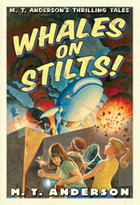
One of the things I like about him is his diversity of voice-- this is a guy who can write all sorts of things.  My introduction to him was Whales on Stilts, the first book in the Pals in Peril series, a satire on formula series fiction, aimed at 10-12 year olds.  But he's also written Feed, a gorgeous if slightly problematic dystopia aimed at teenagers, and the Octavian Nothing duology, set during the Revolutionary War and really capturing the prose style of the era (maybe too well) in what almost seems like a dark fantasy, but turns out to be something very different.  And he has other stuff I've yet to read, but even within the Pals in Peril books he shows a diversity of style.  But he's not just diverse-- he's very very good.  Feed is moving at the same time it satirizes contemporary consumer culture; it contains an extraordinary passage that recreates the drama, the facileness, and the beauty of teenage love.  (I actually taught Feed to my Freshman English class this summer, and some of them even liked it, but I completely forgot to pass on the announcement to them.  Whoops.)

He spoke for about 45 minutes and then took questions.  Some of what he said, I knew already, but that was fine.  Much of what he said was funny, and that was good.  He's also clearly very intelligent, and very imaginative, in the best of ways, able to take idle wonderings and transform them into universal sentiments.  Even Whales on Stilts, where mind-controlled whales on mechanical stilts with laser eyes invaded the continental United States, has one of my favorite statements on friendship.  He's had a good career, and he's one of those rare authors I just don't like or love; in some ways, I wish I could have written his books.  Hayley and I brought two books to be signed, and bought three more there.  While he signed all five to both of us (after a debate over whose books they were), Hayley talked with him about the beauty of Linnaeus's scientific writing while I tried to be cool and name-dropped Erasmus Darwin ineffectively.

One of the things he said that impressed me most, even though I've heard it elsewhere before, is that one of the best things an author can do is read widely.  I did like how he said it though, which was different: (paraphrasing from memory here) "Go into the bookstore and look.  Every book there is someone's favorite.  Read it and find out why.  If you don't like science fiction, read a science fiction book.  Read a romance novel.  If there's How to Play the Tuba, that's someone's favorite book.  Why is that?  What speaks to them?"

I think this is what irks me about some of the genre and tie-in fiction I read-- it reads like it's written by someone who only reads other genre and/or tie-in fiction.  (And one Shakespeare play, a Dan Brown novel, and a book of profound quotations.)  M. T. Anderson's work doesn't.  It's enmeshes in a large, complicated world, and this is shown in overt and subtle ways.  The third thrilling Pals in Peril tale, Jasper Dash and the Flame-Pits of Delaware, is not just a send-up of children's books about people on adventures in dinosaur-infested "exotic" lands in Africa/South America, but it also exposes (subtly but very effectively) the way that European travel fiction can render the "other" and make a "foreign" landscape into something to be dominated by a colonial observer.  And then it makes fun of people who know about all these problems and try to seek an "authentic" experience in foreign countries!  He's not only read his Richard Burton, Frank Reade Jr., and Edward Said, he's read his Stuff White People Like, and he's engaged with all of the above in interesting ways.  Even if you don't recognize the references, I think you still absorb something.  And even if you don't, there's still a fight scene where pacifist monks defeat an army of gangsters with haikus.

I try to read widely myself, as best I can.  I can't say I read How to Play the Tuba or Harlequin romances, but this month I read:
- a cultural criticism Doctor Who episode guide
- two YA Spider-Man novels
- two Victorian writers, George Eliot and Wilkie Collins
- a Doctor Who tie-in based in part on Beowulf (someone else has read widely)
- a 1988 sf anthology
- a critical analysis of the philosophy of a Victorian scientist
- a Rudyard Kipling collection
- a graphic novel adaptation of The Canterbury Tales

Obviously some of this reading is more wide than others, and the requirements of coursework and my fetish for Doctor Who and serialized comic books conspire to constrain me somewhat, but I try pretty hard.  When I was writing the acknowledgements page for A Choice of Catastrophes, I briefly considered listing every author whose book I had read while working on it (I thought better fairly rapidly) because I knew and could point to ways in which David N. Wilson, Barry Unsworth, Jim Starlin, Doris Lessing, Margaret Wander Bonanno, Paul Cornell, and Geoff Ryman had all influenced what I had come up, large and small, positive and negative.  (Of course, it's a book in which Captain Kirk gets into a fist fight with an octopus, and a continuity conundrum about Mister Leslie's name is resolved by referencing a 1975 Peter Pan record, so let's not get too grandiose.)

One of my friends got to chat with M. T. Anderson for ten minutes about Cotton Mather and was invited to e-mail him, of which I suspect I will be eternally jealous.  But I forgot my copies of Burger Wuss and Jasper Dash and the Flame-Pits of Delaware, so I will be seeking him down again for sure.  And you know, he might read Edward Said, but he's also the man who the Governor of Delaware called "buster" in formal correspondence.

11 January 2008

Here is a story about Christmas and its most important part, getting books.

This year, LibraryThing ran an event called SantaThing.  It was essentially a Secret Santa event-- all the participants paid $25 to LibraryThing, who then connected all of the participants to one another.  You could post comments about what you wanted, and then your SantaThinger would select books for you, which LibraryThing would order off Amazon-- so no exchanging of addresses with Internet strangers.  You were limited in your purchases to books available from the appropriate regional Amazon (US, UK, or Canada), worth less than $20 total, and numbering no more than two.

I decided to sign up because it sounded like it could be fun-- I love picking books, and I love getting books even more!  This is what I put:

The authors currently on my "target list" are (hold your breath): Edwin Abbot, Paul Auster, Beryl Bainbridge, Iain Banks, James Blish, Octavia E. Butler, Italo Calvino, Paul Cornell, Lawrence Durrell, C.S. Forester, Elizabeth George, David Gerrold, James Hamilton-Paterson, Nathaniel Hawthorne, Thomas Hardy, Ursula K. Le Guin, Stanislaw Lem, Doris Lessing, David Lodge, Scott McCloud, Walter M. Miller Jr., Alan Moore, Christopher Morley, Larry Niven, Dan Simmons, Ali Smith, E.E. "Doc" Smith, Neal Stephenson, Karen Traviss, and P.G. Wodehouse. Basically, any book I don't already own by these folks would be marvelous.  No Star Trek or Star Wars or Doctor Who or other media tie-ins. If I wanted it, I would've bought it myself.
I know, it's a lot, but I didn't want to limit anyone.  I figured that with that many, one of those authors had to be a favorite of whoever my SantaThinger was, and that there had to be a beloved book by them I didn't already own.  (The wonderful thing about LibraryThing is that you know you are not going to buy someone a book they already own.)

Meanwhile, I was selecting a book for someone else.  This is what he put:
I like urban fantasy, histories of food, surreal comedies, mysteries (if the protagonists have a sense of humor)....what I'd really like to try is some world lit. I have always read mostly American / Western European authors & there is a whole wide world out there that I'm missing.  Please, please no sports books. Or anything with World War II.
Talk about broad!  The first thing to pop into mind for "surreal comedy" was James Hamilton-Paterson's Cooking with Fernet Branca, which I read last semester in Dr. Hardesty's modern British literature class and thought vastly amusing.  Plus, the protagonist is a sports biographer and hates it, so I figured that would be appropriate.  That came up to just $10.17, so I decided to find another book-- something non-Western, to fulfill one of his other desires.

The problem is that, on a normal Amazon discount, a normal trade paperback comes to $10.17!  It was impossible to find a second book of the appropriate price!  The other problem was that I'm not very familiar with non-Western literature, so I didn't know what to suggest.  But, thanks to my Kafka class from a year ago, I had heard of the author of Kafka on the Shore, Haruki Murakami, so on a whim I decided to get one of his books.  As luck would have it, his book A Wild Sheep Chase seemed to be surreal and a detective story, fulfilling a number of my SantaThingee's desires!

But it was $10.17.  I searched for ages for something cheaper, but with no success.  Finally, I gave in and just plunked both into my request, figuring that I wasn't even fifty cents over the twenty-dollar limit, and who could get bothered about that?

Meanwhile (this was late December after all), my Aunt Janet had contacted me-- she had me in the family gift exchange this year, and were there any books I particularly wanted?  I sent her my target list, a list of authors (usually with specific books attached) that I search for every time I enter a used bookstore.  Obviously there was some overlap with my SantaThing author list, but I figured that with such large lists, the possibility of coincidence was low.

My book from SantaThing showed up a couple days before Christmas Eve-- James Blish's A Case of Conscience.  This is what my SantaThinger (LibraryThing's sysadmin, actually!) wrote me:
I have agonised over this. I'm recommending A Case of Conscience by James Blish, ISBN 0345438353.

This user lists James Blish as one of the authors they're after. They also have several of his books - star trek novelisations!! And yet they *don't* have this book, a hugo award winner and (IMHO) one of the best examples of "good" sci-fi. I had some reservations because it's not a very long book, and at $19 I've put all my bets on the one horse. As well as this, religion (specifically catholicism) is central to the plot, and so some knowledge in this area would be helpful. Still, this is all about surprises and the opportunity to read something you might otherwise not have picked up off the shelf, right? ;)

Here's a note for the recipient:

Hi! I noticed you're after more from James Blish, but don't have "A Case of Conscience". This is one of my favourite SF books so it seems like a good choice. It's unconventional sci-fi - it explores the concept of morality with a Jesuit biologist as the main character - but it's well written with believable characters, and a worthy winner of the Hugo award. I hope you enjoy it!
He needn't've worried!  I read Blish's The Devil's Day a few months back, and A Case of Conscience was one of the other two books in his loose After Such Knowledge sequence-- essentially, it or Doctor Mirabilis were the books I had meant when I put "James Blish" down on my target list!  As as for Catholic/Jesuit knowledge... well, I certainly have no shortage of that.

My selections were approved, but I don't know what my SantaThingee thought of them; he never contacted me.  In fact, they haven't even been added into his library!  But then, neither has anything else since November.

Meanwhile, on Christmas Eve, my Aunt Janet did well-- I received the next two of Elizabeth George's Inspector Lynley mysteries-- Deception on His Mind and In Pursuit of the Proper Sinner-- as well as Ursula K. Le Guin's Tales from Earthsea.  All not only books I wanted, but books I really wanted.  Aunt Janet reported that she had fun perusing the used bookstore as well, and she'd even figured out my list's organizational system.

And luckily enough there was no overlap.  I hope SantaThing is run next year as well, for I found it good, solid fun.