 |
| Comic trade paperback, 276 pages Published 2014 (contents: 1986-87) Borrowed from the library Read November 2015 |
Writers: Max Allan Collins, Jo Duffy, Jim Starlin
Pencillers: Jim Starlin, Denys B. Cowan, Chris Warner, Ross Andru, Dave Cockrum, Kieron Dwyer, Jim Aparo, Norm Breyfogle
Inkers: Jim Starlin, Greg Brooks, Mike DeCarlo, Dick Giordano, Don Heck, Norm Breyfogle
Colorists: Daina Graziunas, Adrienne Roy
Letterers: John Costanza, Todd Klein, Agustin Más, Albert DeGuzman
Year Ten, October
Out of universe it's been ten years, but in universe it's just been two since Batman moved to a downtown penthouse and Dick Grayson went off to college. Now Bruce is back in Stately Ward Manor and there's a new Robin in town. Second Chances collects twelve stories, whose unifying feature is that the majority of them are by Max Allan Collins, and all of them feature Jason Todd as the new Robin. (Unfortunately, there's almost no consistency in the artistic team.)
The book opens with a two-part tale: "There's Nothing So Savage-- As a Man Destroying Himself!"/"One Batman Too Many." Criminals are turning up violently murdered... seemingly by the Batman! Jim Starlin provides some great, dynamic layouts in the first half, which I really enjoyed; the second part, where the faux Batman escapes Arkham and Batman hunts him down, was less interesting, partly because the art of Denys Cowan and Greg Brooks was not as sharp as Starlin's. In this story, Jason is already the new Robin, and evidencing a slight bloodthirsty streak, as he wonders if Batman maybe should be employing some of the techniques of his impersonator.
The book then jumps backward to explain how Jason got to be the new Robin; "Did Robin Die Tonight?" opens with Dick Grayson still operating as Robin, receiving an injury at the hands of the Joker. Bruce fires Robin: "In what I do, there is no place for a child. [...] Son, I'm sorry. And you are a man-- man enough to accept my decision." We don't even see what happens to Dick, though; he informs Bruce that though Robin will stay "dead," he has a destiny to pursue, but as far as we see, he doesn't even leave. What's he off doing? Who knows! After operating solo for a little bit, Batman goes to visit Crime Alley on the anniversary of his parents' death, where while he's out walking (Batman strolling down the street, saying "Gentlemen" to a pair of men on the sidewalk, is a surreal sight), a juvenile delinquent steals the tires off the Batmobile.
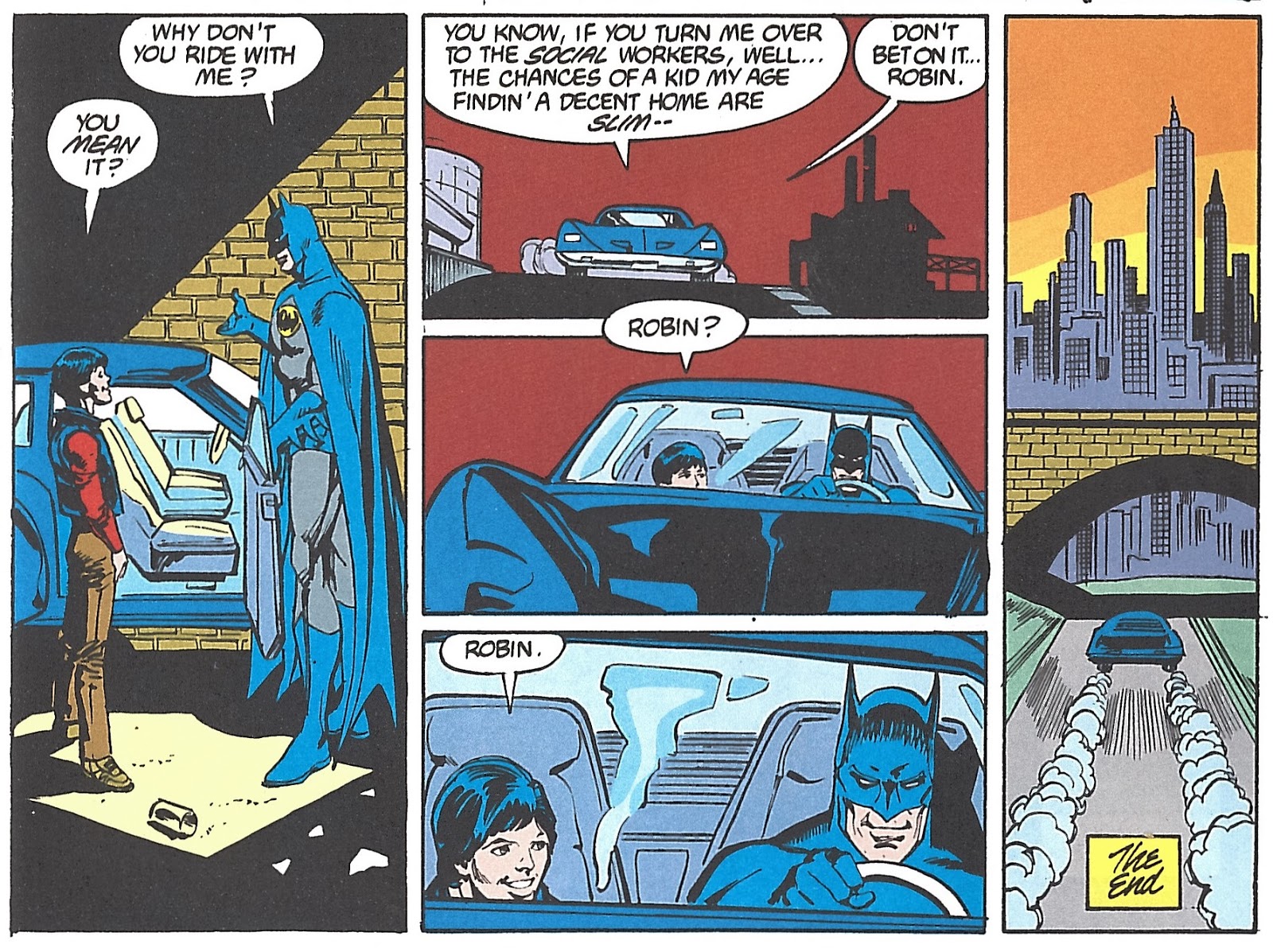
Batman enrolls Jason in a reform school, but in "Just Another Kid on Crime Alley," it's revealed the school is actually a front for a crime ring, which Jason helps Batman break up. And then, even though Batman just claimed he didn't want any kids around, he's calling Jason "Robin" just like that. If I was Dick, I'd be ticked off! I know from reading interviews with Collins was that the idea was Jason would live a life so dangerous on the streets that being Robin was actually a safer alternative, but no one in the story actually says this, and it's not convincing: surely Bruce making Jason his ward without revealing he was Batman would be safer than either crime or crime-fighting!
 |
| "Dick Grayson? Who cares about Dick Grayson? Screw that guy." from Batman vol. 1 #409 (script by Max Allan Collins, art by Ross Andru & Dick Giordano) |
The next few stories chronicle the early days of Jason Todd as Robin, as they face Two-Face, who turns out to be responsible for Jason's father's death. It's a lot of weird, Silver Age-style hijinks, with Two-Face employing the "Dopple Gang" and robbing one of Gotham's two major league baseball stadiums during the second half of the second inning when there's two strikes, two balls, and two men on base! It's not Starlin's best work on the title. I assume the intro story about the false Batman slots in here, before the next couple tales, each more weird than the last: an evil mime and a samurai ghost.
That last tale is by Jo Duffy, and then Jim Starlin takes over as writer. His first story is a sort of grim, but consequence-free story of Batman hunting a serial killer. With only 22 pages to make us care about some woman and kill her off, the story isn't big enough to succeed. Then Batman discovers Commissioner Gordon is a Manhunter in a crossover with Millennium that totally does not stand on its own, and then Dick Grayson comes back in "White Gold and Truth"-- which is dated "ONE YEAR AGO." I have no idea where that's mean to place it relative to the other stories in the volume.
This story finally fills in what Dick Grayson has been up to. In a retcon I don't think later writers abided by, allegedly all of Dick's adventures with the Teen Titans occurred after he left Batman's company. Dick's retelling of their split is also a little more acrimonious than the one we saw in "Did Robin Die Tonight?" Bruce and Dick argue, but Dick and Jason team up to beat up some criminals while Bruce smiles from the rooftop, unseen. It feels more like a patch over Collins's sparse story than a story of its own.
Collins isn't all done; the last story in the book is "Love Bird," a cute tale illustrated by Norm Breyfogle about a paroled Penguin seeking love and trying to go straight.
A common denominator between many of these stories is the presence of Vicki Vale as Bruce's girlfriend who hates the Batman and also hates Bruce's idling about all the time. Her presence is inconsistent; Collins seems to keep forgetting about her. As a result, I never really had a good feel for what she and Bruce saw in each other, so she comes across as largely superfluous.
 |
| "Batman, if you just drive a couple more miles to the other Kroger's, their bananas are two cents cheaper!" from Batman vol. 1 #402 (script by Max Allan Collins, art by Jim Starlin) |
So: historically important tales, yes, but inconsistent in quality. But I got very intrigued from this era of Batman history, and I actually added a few more 1980s/Jason Todd stories to my list after reading it, wanting to flesh him and his era out before hitting A Death in the Family. These came out after Batman: Year One, but that story didn't change the other Batman tales overnight; these later stories feel like a weird jumble of the Silver Age aesthetic and the Frank Miller one (Commissioner Gordon looks more like a jolly grandpa than a hard-hitting cop/special forces vet), and I look forward to seeing how that changes over time.
Next Week: It's Year One again as Huntress makes her debut on the Gotham stage!


