Showing posts with label creator: elliot s. maggin. Show all posts

18 June 2018

Review: Star Raiders by Elliot S! Maggin and José Luis García López

I think I've neglected to cross-post my reviews of audio dramas here for a while, so here are some recent ones: Doctor Who: Ghost Walk, Doctor Who: Serpent in the Silver Mask, Doctor Who: Short Trips: "Erasure", and ATA Girl. That last review I'm particularly proud of, so if you only read one, read it. It's a four-story set about female pilots during World War II.


Perfect-bound comic, n.pag.
Published 1983

Acquired and read August 2017
Star Raiders

Writer: Elliot S! Maggin
Artist: José Luis García López
Letterer: Orzecody

Strictly speaking this isn't a DC Comics space story-- it's a graphic novel published by DC, but it's not set in the DC universe, as it's a licensed story based on Atari videogames! As you might expect of a space adventure story from 1983, it's very Star Wars: it opens with a space battle over a desert planet, there's a hotshot pilot, a wise old man, an evil empire, a heroic resistance, and cute alien animals. The basic premise is that the insectoid Zylons control the galaxy; the pilot (Jed) and navigator (Tomorrow "Tommy" Hardtack) of a star cruiser come to a devastated planet where they find an immortal librarian (Zeke) and an old spaceship, the Star Raider. Jed and Tommy repair the Star Raider with Zeke's guidance, recruit more rebels, and have a couple run-ins with the Zylons. (There's also a bit of Battlestar Galactica in it, I guess.)


It's fun enough. Jed arguing with Zeke is a little overdone, and everyone goes off half-cocked and has to be rescued by someone else at some point. I liked Tommy (a riff in name if nothing else on the DC character Tommy Tomorrow of the Planeteers) the most; she's sublimely 1980s-- just look at those shoulderpads and that hair band-- and feels the least like a Star Wars character. The beautiful art by José Luis García López is probably the real selling point of this book; this story didn't deserve art this good, but it got it anyway! The only thing to not like about it is that Jed and Tommy's original ship has a confusingly similar design to the Star Raider. (But I would guess this has something to do with the original videogame on which the graphic novel is based.)


The set-up is good, but the ending feels rushed-- a significant connection between a minor character and the Zylon queen comes out of nowhere, allowing everything to be wrapped up easily. It felt like Maggin was setting up an ongoing series (there are a number of characters introduced who end up not doing much) and had to swerve to wrap everything up in twenty pages at the last minute. Still, if you want some 1980s spectacular space action, this is a quick, enjoyable read. Too bad there's no more adventures for these characters, because I'd read them.

02 February 2018

Through DC's Time Warp: Doomsday Tales and Other Things

Working through DC's science fiction comics of the 1970s as I've been doing, I'm starting to come away with an impression of a publisher desperately trying to cash in on a wider cultural science fiction craze with no idea how. Over the past few months I've read IronWolf (lasted three issues), DC Super-Stars of Space (four issues), Star Hunters (eight issues), and Starfire (eight issues). Now I'm on to Time Warp, an anthology title... that lasted a whole five. DC sure kept trying to make these space comics work though, and in particular, editor Joe Orlando and associate editor Jack C. Harris did: they were behind Star Hunters, Starfire, and Time Warp.

Time Warp is different from some of these other efforts: instead of an ongoing science-fiction adventure, it was an anthology book. Each double-length issue included eight tales by an array of writers and artists. The book's cover line "Doomsday Tales and Other Things" gives you some idea of the focus; there were a lot of apocalyptic and postapocalyptic stories, especially in the first couple issues.

A tragedy I've grown used to in reading these Bronze Age sci-fi comics is the oblivious letter page in the final issue: the final letter page that doesn't know it's the final letter page. Jack C. Harris natters on about the next issue in #5, but there was no next issue, as Time Warp lasted only five issues (except for a one-issue 2013 revival). Reading it, it's not hard to see why. The lettercols speak of wanting to tap into the Star Trek/Star Wars-era zeitgeist... but in execution, these stories hearken back DC's horror comics of the early 1970s like House of Mystery and House of Secrets, which Orlando himself edited if I recall correctly.

It's basically sub-Twilight Zone stuff: lots of "twist" endings, and lots of stories where people are converted into horrific monsters. You've read much better science fiction, and in prose and on tv by 1979, the genre had evolved beyond this. Time Warp feels like it comes out of the pulps of the 1950s more than anything else, and hardly any of the stories here still stick with you.

What does work is the art-- much like in those early-decade horror comics. Give Steve Ditko a race of one-eyed alien monsters, and he will draw the hell out of them. Give Dick Giordano an underground society of sexy women, and he will draw the hell out of them. Give basically anyone spaceships and space monsters, and they will draw the hell out of them. There's some real inventive, impressive work here, starting with Michael Wm. Kaluta's sort-of-techno-fetish covers, and running all the way through the interiors. So probably a misguided experiment (I just kept wishing for real science fiction stories, not horror stories with sf trappings), but one that yielded some entertainment regardless.

Time Warp vol. 1 was originally published in five issues (Oct./Nov. 1979June/July 1980). The stories were written by Denny O'Neil, Michael Fleisher, George Kashdan, Mike W. Barr, Jack C. Harris, Bob Rozakis, Paul Levitz, Wyatt Gwyon, J. M. DeMatteis, Bill Kelly, Arnold Drake, Dan Mishkin, Gary Cohn, Bob Haney, Scott Edelman, David Allikas, Paul Kupperberg, Sheldon Mayer, Mimai Kin, and Elliot S. Maggin. They were pencilled by Rich Buckler, Steve Ditko, Dick Giordano, Tom Sutton, Jerry Grandenetti, Don Newton, Jim Aparo, Howard Chaykin, Gil Kane, Joe Orlando, Romeo Tanghal, Ed Barreto, Madz Castrillo, Fred Carillo, Mike Nasser, Joel Magpayo, Ernesto Patricio, Dick Ayres, Edgar Bercasio, Vic Catan, Charles Nicholas, Trevor Von Eeden, and Jerry Bingham, and they were inked by Dick Giordano, Steve Ditko, Tom Sutton, Jerry Grandenetti, Dan Adkins, Jim Aparo, Howard Chaykin, Gil Kane, Joe Orlando, John Celardo, Dave Simons, Madz Castrillo, Steve Mitchell, Fred Carillo, Mike Nasser, Joel Magpayo, Ernesto Patricio, Jimmy Janes, Edgar Bercasio, Vic Catan, Armondo Gil, Carl Potts, and John Celardo. Colors were provided by Gene D'Angelo, Adrienne Roy, Jerry Serpe, Tatjana Wood, and Bob Le Rose, and the issues were lettered by Ben Oda, Milton Snapinn, Todd Klein, Shelly Leferman, Esphidy Mahilum, and Albert De Guzman. The series was edited by Joe Orlando; his managing editor was Jack C. Harris.

19 January 2018

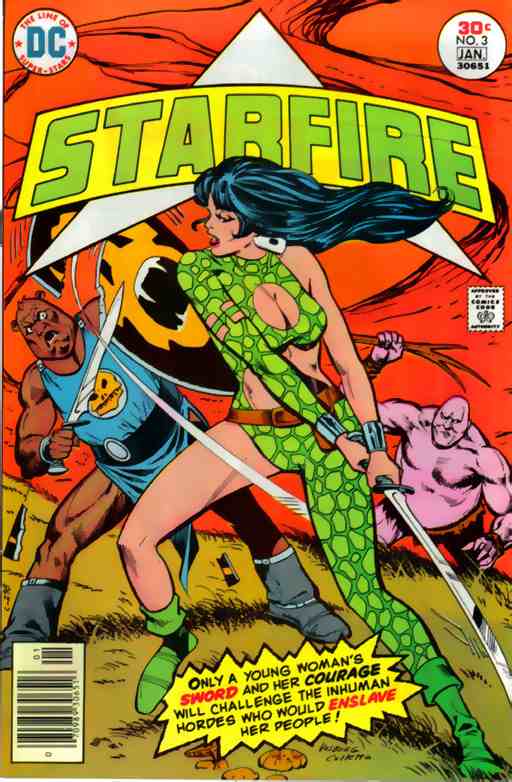
Review: Starfire by Mike Vosburg, Vince Colletta, Elliot S! Maggin, et al.

Four years before the Teen Titan Starfire debuted, and almost forty years before she got her own series, there was a very different DC series called Starfire. A take on the sword-and-sorcery comics then popular, it billed itself as "sword-and-science": it was set on another planet, and in a world not with magic, but one that had been conquered by aliens and partially regressed into barbarism after an era of great scientific achievement.

In this era, humans are the subjects of the Mygorg, a brutish alien race; the main character, Starfire, began her life as a human slave of the Mygorg, but when she's about to turn eighteen, she realizes she's going to become their sex slave! She runs away, and is rescued by a priest who helps train her in the ways of combat. They fall in love, he dies, and she vows to destroy the Mygorg forever. So she sets off with a band of adventurers seeking the people and resources to do exactly that.

Starfire was one of very few female-led DC superhero-adjacent titles in the 1970s (were the other just Wonder Woman, Lois Lane, and Supergirl?), but more importantly it was probably the first comic to feature an Asian protagonist.* Well, sort of-- since Starfire is set on an alien planet nothing to do with Earth, she can't be from China or Cambodia, but we are told, "her mother was white, and the father yellow," artist Mike Vosburg draws her with East Asian facial features, and the colorists depict her skin tone as slightly different from all the white characters (though she has blue eyes). Though I suspect it was done to make her a little more "exotic" and thus sexy, it was a surprising moment of diversity for the comics of the 1970s.

If you look at the credits at the bottom of this entry, you'll see that even though Starfire had a consistent penciller, the series accrued four writers and three editors in eight issues. The series is kind of jerked around and never really takes off as a result. David Michelinie creates the baseline in his original two issues: the first gives Starfire's backstory, climaxing in a surprisingly brutal scene where she beheads the Mygorg who killed her lover and would have taken her as a "bride." Then in #2, he establishes the formula: Starfire and her band (the only named member of which is Thrumdahg) come to a place, fight some Mygorg, and advance onwards. In this story, they acquire a map with the location of the fabled "Lightning Lords" on it, humans with advanced weapons that will help Starfire's band win their battles, thus setting up a quest behind the formula.

Michelinie stops it from being too straightforward, though; Starfire's eagerness for a fight in #2 disrupts a manor whose human lord has an uneasy truce with the Mygorg, for example, culminating in the accidental death of the manor lord's young son. So Starfire's quest will be tinged with a need for understanding complexity, and an undercurrent of tragedy.

The next three issues are the work of Elliot Maggin, who basically reproduces Michelinie's issue #2 formula. He keeps adding new members to Starfire's band, including the mute Thump and the poet Moonwatcher. Beginning with Thrumdahg back in #2, though, there's this consistent thing that the members of Starfire's band all think she really needs some loving, and so she's always fending off unwanted advances. Thump is the only exception to this. It's a weird, unpleasant choice, even in the context of a comic that began with its protagonist almost being forced into a life of sexual slavery. Like, why do I want to read about a band of would-be rapists? Still, Maggin's first two issues are solid adventure tales, each setting up its own interesting situation and then resolving it in the course of a single issue.

In issue #5, though, things begin to change, as Starfire meets the Lightning Lords at last in what's the first part of a three-part story by two different writers. The premise of the series begins to warp: while in the first five issues, it was sword-and-science, no sorcery needed, #6 introduces an out-and-out sorceress with magical powers!

The attempts to retool the series also become pretty brazen. In #6, while camping outside the lair of the Lightning Lords, who live in the middle of a mountainous wilderness, Starfire runs off in the middle of the night and comes back in a new costume. Which she allegedly picked up at a marketplace? Like why is there a human marketplace in the middle of nowhere selling sexy costumes for adventuresses?

This new costume lasts one whole issue, as in #7, Starfire is charging through a doorway and her costume gets caught on a nail and falls off, meaning she has to run around in a bra and short pants. I shit you not. Vosburg doesn't even draw the nail; in one panel, Starfire's shirt is ripping, and in the next she observes, "Looks like I lost my modesty to a rusty nail! Nothing ever comes free in this world!" Like, what does that even mean? And then she never mentions it again, apparently content to wear what is essentially a chainmail bikini. (I actually did like her original outfit, a sort of asymmetrical Seven of Nine-esque jumpsuit.)

Also, in #7, new new writer Steve Englehart must have also disliked the fact that the majority of Starfire's band were rapists, because he kills off all the supporting characters except for Thump and Moonwatcher in a teleporter accident! Like, a supercomputer tries to beam a group of them out of danger, but it doesn't know human biology, and they all die except Moonwatcher (the least rapey of the ones who weren't Thump; he seemed to want to charm Starfire into sleeping with him). Starfire also becomes a bystander in her own story in this storyline, as it turns out Thump is a genius computer programmer, and he makes a lot of decisions while Starfire just yells and fights a lot.

#8 introduces a new new direction, bringing back the order of priests Starfire's lover from #1 belonged to. The book promises there are more issues to come, but they never happened; I'm not sure why. The DC Implosion that killed Star Hunters was over a year away. Well, I mean I guess I know why, because this book's writer and premise were constantly shifting, and each change made it worse, not better. (Creator David Michelinie did slip Starfire into a one-panel cameo in Star Hunters #7 as another avatar of the same multiversal force as Star Hunters's lead character. But that was Star Hunters's last issue too!)

The one consistently good part of the book was the artwork of Mike Vosburg and Vince Colletta. They do great fantasy stuff, especially with Starfire herself: thick lines that really show off her beauty and her power. Too bad the writing couldn't consistently match what they were capable of.

Starfire vol. 1 was originally published in eight issues (Aug./Sept. 1976–Oct./Nov. 1977). The series was written by David Michelinie (#1-2), Elliot S! Maggin (#3-5), Steve Englehart (#6-7), and Tom DeFalco (#8); pencilled by Mike Vosburg; inked by Robert Smith (#1) and Vince Colletta (#2-8); colored by Liz Berube (#2); and edited by Joe Orlando (#1-4), Jack C. Harris (#5-7), and Denny O'Neil (#8).

* Karate Kid received an ongoing series in Mar./Apr. 1976, and he's half-Japanese, but that's a retcon, and I'm not sure when it was established.

12 July 2013

Faster than a DC Bullet: Project Crisis!, Part VI: Crisis on Multiple Earths, Volume 4

Comic trade paperback, 165 pages
Published 2005 (contents: 1975-77)
Borrowed from the library
Read June 2013
Crisis on Multiple Earths, Volume 4

Writers: Cary Bates and Elliot S! Maggin, E. Nelson Bridwell, Martin Pasko, Paul Levitz
Artists: Dick Dillin, Frank McLaughlin

The first story in here is one of the weirdest crossovers yet: "Where on Earth am I?" starts on Earth-Prime, which is our Earth, where DC Comics is based. Cary Bates and Elliot S! Maggin, at a loss for a Justice League plot, are sucked into Earth-Two, where Cary Bates promptly (for some reason) becomes a supervillain. Whoops. It's a bit by-the-numbers, despite the premise, but fun enough. The best part is probably the way they write their cranky old editor, Julius Schwartz.

The last two tales are co-written by Martin Pasko (the first with E. Nelson Bridwell, the second with Paul Levitz), and boy are they dull. Lots of fighting to no clear purpose, lots of mind-control so that heroes fight other heroes. Who knew that Superman finally meeting Captain Marvel could be so uninteresting? Worse, who knew that the freakin' Legion of Super-Heroes turning up could be very uninteresting!? And overcomplicated. I don't know if I'm running out of interest in these kind of stories, or if the writers are. Well, just two more volumes of this series to go.

It's worth noting that the last story shows Power Girl flirting with the Earth-One Superman. I guess that if you're gonna try to make out with your cousin, restricting it to his parallel self is a sensible option...

20 May 2013

Faster than a DC Bullet: Prose Fiction #5: Superman: Miracle Monday

Mass market paperback, 205 pages
Published 1981
Borrowed from the library
Read May 2013
Superman: Miracle Monday
by Elliot S. Maggin

I really enjoyed Maggin's first Superman book, Last Son of Krypton, and his second is not quite as good, but it is still very good. If there's anything I didn't like, it's just that the plot takes its time getting off the ground; we're over halfway into the book before Superman even finds out that there's a problem he needs to be solving.

But aside from that, this is essential Superman. Maggin has a way with all the characters, one that makes me regret the fact that I don't think I've ever read a Maggin comic book. I'll have to get on that! He gets them all perfectly, but especially Superman and Lex Luthor.

Though I might disagree with the way Maggin phrases it, that Clark Kent is just a pretense for Superman, the way it plays out in practice is great. I haven't read any of the comics from the era where Clark is a newsanchor for WGBS Metropolis, but the way that Maggin shows him juggling his Clark and Superman roles is perfect. As a big Lex Luthor fan, I also love the way that Maggin writes Luthor: the smartest man in the room, at all times, just never quite grasping an essential moral truth. He's funny, in the sense that the Master on Doctor Who is funny: his plans stagger the mind, but have a certain twisted logic to them.

Also, here's a bit from a description of the prison where Lex Luthor is incarcerated: "Haskell was the ninth warden at this prison in eight years. Four had been fired; two had had nervous breakdowns; one had had a heart seizure after seven months here [...]; and one had turned out to be one of Luthor's many fictional alter egos" (49). That's my Lex!

Lois isn't a big figure in this book, but the scene between Lois and Superman after the Superman/Clark duality has been revealed to the world is the best summation of Lois's character I've ever seen. Even Jimmy Olsen gets his bit!

The triumph of the book is of course in the ending. I don't know if Maggin actually grew up reading Superman comics, but I suspect he did. This book is the work of a man who grew up believing that Superman is the essential, archetypal hero, and that is absolutely right.

Happy Miracle Monday!

14 January 2013

Faster than a DC Bullet: Prose Fiction #4: Superman: Last Son of Krypton

Mass market paperback, 238 pages
Published 1978
Borrowed from the library
Read December 2012
Superman: Last Son of Krpyton
by Elliot S. Maggin

It was this novel's good reputation that prompted me to begin my entire sub-undertaking of journeying through prose fiction based on superhero comics. Well, I'm happy to report that it's as every bit as good as everyone says, and definitely up there with the best Superman stories in any medium. Elliot Maggin just gets Superman and everything about him.

I was a bit skeptical about the book's opening, which begins with the destruction of Krypton and prophecies of doom from Jor-El-- we've seen all that a million times by now, not the least in the only previous Superman novel. Thankfully, this is only a small part of the novel, and it turns out to be necessary, because then we get three chapters of Clark's life in Smallville being set up by a very unlikely person. I thought it was goofy when I first figured it out, but I soon came to love the idea. And that person's influence turns out to be key to the plot of the second half of the novel.

The plot actually takes its time showing up, but that's okay, because I was having such a good time in the interim. Superman is portrayed how I love him best: a really good guy trying to do his best because he believe the best of everyone, bothered but not overly so by his inability to do everything for everybody. Clark is a bit of a wimp, but not overly so, and the interactions with Steve Lombard show how to carry that kind of thing out perfectly: you'd like Clark even if you didn't sympathize with him because Steve Lombard is such a jock.

Though everyone, down to Jimmy Olsen (as goofy as ever) and Lois Lane, gets their moment, Lex Luthor is the other standout character here. There is a lot of interspersed backstory here about Clark and Lex growing up together in Smallville, which is something I normally dislike because it turns Superman into someone whose presence is harmful and Lex into someone too obsessed with a single vendetta to be interesting. But Maggin does a great job with here, all because his character-work is very fine: the presence of Superboy is just one of many incidents working on Lex's mind, and though Lex might not have become a supervillain without Superboy, he didn't become one only because of Superboy, either.

What really makes it work, though, is all the stuff Luthor gets up to in the present. He's still in his Silver Age "mad scientist" phase here, but he's verging into being the corporate mogul: he has quite the criminal empire here. Maggin's Luthor is usually the smartest man in the room, but he also always knows what to do when he's not. My favorite passage is definitely this one, about when Luthor is in prison, allowed only a ballpoint pen and pad of legal paper:
One night, in a loose moment, Luthor figured out how to melt the plastic cap of the pen, let a certain amount drip into the ink refill, extract a substance from the glue that bound the legal pad, wrap it all in half a sheet of yellow paper and make an explosive powerful enough to blast out a wall of his cell. Luthor would never do that, of course. If he did, the next time he was in jail the warden wouldn't give him his pen and pad. (138-39)
Hilarious and genius. Perfect Lex.

It's not all about Luthor, though, as Superman just manages to keep his counterpart from stealing the show. There are some fantastic depictions of Superman's powers in action; sometimes you might think he's got too many of them, but as in All-Star Superman, who cares? What keeps Superman grounded isn't his powers (or lack thereof), it's his ethos. (The epilogue is particularly good in this regard.) My favorite moment is a late one in the book, so I won't spoil it, but suffice it to say that while Superman is trusting and always willing to give a second chance, he's nobody's chump... and he knows how to scheme with the best of them.

I can't wait to read Maggin's other Superman novel, Miracle Monday; this was a book of sheer joy.

11 December 2009

Faster than a DC Bullet: Project Star City, Part XI: Green Arrow / Black Canary: For Better or For Worse

Comic trade paperback, 199 pages
Published 2007 (contents: 1969-2003)

Borrowed from the library
Read November 2009
Green Arrow / Black Canary: For Better or For Worse

Writers: Denny O'Neil, Elliot S! Maggin, Alan Moore, Mike Grell, Chuck Dixon, Kevin Smith, Brad Meltzer
Pencillers: Dick Dillin, Dick Giordano, José Luis García-López, Klaus Janson, Mike Grell, Lurine Haines, Rick Hoberg, Rodolfo Damaggio, Phil Hester
Inkers: Dick Giordano, Klaus Janson, Rick Hoberg, Joe Giella, Frank McLaughlin, Vince Colletta, Terry Austin, Robert Campanella, Ande Parks
Colorists: Julia Lacquemont, Lee Loughridge, Guy Major, James Sinclair
Letterers: Todd Klein, Ken Bruzenak, Steve Haynie, John Costanza, Sean Konot

At the time that Green Arrow and Black Canary were getting married, DC released this anthology, collecting the highlights of Oliver and Dinah's relationship over nearly forty years of comics. It has a rather nice introduction by Denny O'Neill, where he explains the genesis of their relationship and its appeal to him.

The book falls into two distinct halves, though more through accident than design. The first half is stories from the 1960s and 1970s. These stories are typically short and fun, and feature both Green Arrow and Black Canary... but not exactly their relationship, as they're more just stories both characters happen to be in. For example, "In Each Man There is a Demon!" (written by Denny O'Neil, art by Dick Dillin & Joe Giella) is simply narrated by the two of them (though it is important to their characters for other reasons). "The Plot to Kill Black Canary!" (written by Elliot Maggin, art by Dick Giordano) has Black Canary confess her love, but it's a one-page coda to an unrelated adventure. Most of the stories in this section do short shrift to Black Canary, too: despite her own status as a superhero, Green Arrow is always rescuing her. I don't understand why in "A Gold Star for the Joker" (written by Elliot S! Maggin, art by J. L. Garcia Lopez and V. Colletta) she simply stands around and does nothing while the Joker wreaks havoc: she's a judo expert and possesses a canary cry, for goodness sake! The two-part "Lure for an Assassin!"/"Terminal for a Tragedy" (written by Denny O'Neil, art by Mike Grell & Vince Colletta) has Black Canary trying to rescue Green Arrow for a change... but two minutes later she's captured by the villains and held hostage to make Green Arrow co-operate, so she sits out the rest of the story. Surely the Black Canary ought to be written differently than Lois Lane, yet she's just a damsel is distress. If you ignore that component, they're decent stories in the goofy way comics were in the period, and the art is usually strong. The Joker one was probably my favorite.

The second half of the book is stories from the 1980s through the 2000s. The tend to take a different tack, focusing more directly on the relationship between the two characters and treating them both like competent superheroes. The first of these is "The Hunters" (written by Mike Grell, art by Mike Grell and Lurine Haines), which shows us the moment that Dinah reveal to Oliver she doesn't want to have a child with him. But it's only part of "The Hunters", showing us the flaw of the second half of the book: there's not a single whole story or even issue in it. In some cases this makes sense, even when it's irritating to have some text filling the gaps for you: most of "Membership Has Its Privileges" (written by Kevin Smith, art by Phil Hester and Ande Parks) actually has nothing to do with the relationship. But in other cases it's annoying: "Auld Acquaintance" (written by Mike Grell, art by Rick Hoberg) does seem to be about their relationship, and it looks like Black Canary even saves Green Arrow from danger for once, but who knows, as half the story has been replaced with a two-paragraph synopsis. But even when you know it's justifiable, it's still annoying to read. I think my favorite in this half of the book was either "The Hunters" (wish we'd had more of it, though) or what we get of "Run of the Arrow" (written by Chuck Dixon, art by Rodolfo Damaggio and Robert Campanella), which has a great scene where Connor Hawke goes to tell Dinah about Oliver's death.

The relationship between the two characters is one I didn't know a lot about (Black Canary appeared very seldomly in the 2000s Green Arrow series), and I was glad this book existed to fill me in. But it didn't do so in an entirely satisfying fashion.