Showing posts with label creator: geoff senior. Show all posts

11 August 2026

Marvel's The Transformers Year Three, Part III: Ancient Relics! (US #28-30 / UK #119-27 & 130-3)

I'm not jumping between different volumes of the Til All Are One compendia anymore, but as always I have my own opinion about how to sequence the stories. (Though I should note I find all of Skybound's decisions here perfectly rational.) My first change is that the compendium places the Action Force crossover Ancient Relics! between "Crater Critters" (UK #123-4) and "The Cure!" (#126-7), which is where part one was released. (Parts two through five didn't appear in The Transformers, but in the UK Action Force comic.) But even though Ancient Relics! doesn't connect to it and so certainly could be taking place simultaneously, "Crater Critters"/"The Cure!" is a single two-part story and it reads weird to have this whole other story in the middle of it, so I bumped it to after "The Cure!"

On the other hand, the compendium places all four parts of the Headmasters miniseries after US #37, which makes sense, as the Earth Autobots send a signal in US #37 that is picked up by the Headmasters in Headmasters #4. But Headmasters was released bi-monthly across late 1987, and I decided I wanted my experience to replicate that—sort of like every now and then you cut to what's going on in space. Headmasters #1 came out between "Crater Critters" and "The Cure!", so I read it after "The Cure!" This does mean my installments of Headmasters will be spread out across several weeks' worth of posts.

Fire on High! / "Vicious Circle!" / "Mechanical Difficulties!" / "Crater Critters" / "The Cure!" / "Ring of Hate!" / Ancient Relics!, from The Transformers US #28-30 (May-July 1987) & The Transformers: Headmasters #1 (July 1987) / The Transformers UK #119-27 & 130-3 (27 June–22 Aug. & 12 Sept.–3 Oct. 1987), The Transformers Annual [1987], and Action Force #24-27 (15 Aug.–5 Sept. 1987); reprinted in The Transformers: Til All Are One Compendium Two (2025)
written by Simon Furman and Bob Budiansky; pencils by Dan Reed, Geoff Senior, Anderson, Don Perlin, and Frank Springer; inks by Dan Reed, Geoff Senior, Dave Harwood, and Ian Akin & Brian Garvey; letters by Mike Scott, Starkings, Janice Chiang, Diana Albers, and Annie Halfacree; colour by Steve White and Nel Yomtov

from The Transformers UK #120
Fire on High! and "Vicious Circle!" wrap up the ongoing story about Galvatron, Rodimus, Ultra Magnus, Goldbug, and Death's Head. It's totally fine—nothing too clever, but I did enjoy, of course, getting to see a Galvatron/Ultra Magnus throwdown once again drawn by Geoff Senior. It's too bad he didn't get to draw the story's final installment too!
 
From there, we go into a run of US stories detailing how Grimlock's leadership is shaking out, and focusing a bit on new-ish Autobots like Blaster and Goldbug. The first of these, "Mechanical Difficulties!", inexplicably brings back "the Mechanic," the human villain from just a couple issues ago who made off with some of the Autobots' equipment... when they were all being very dumb. This guy did not need to come back; this story about him is also not very good either. Things improve with "Crater Critters" and "The Cure!", a two-part story where Goldbug and Blaster—having gone rogue due to their dislike of Grimlock's leadership—discover some Decepticons newly arrived on Earth bring with them an infection of metal-eating "scraplets." Some decent character dynamics... plus I always love any Transformers story featuring my favorite Decepticon fuel auditor, Ratbat!
 
from The Transformers: Headmasters #1
Then I jumped to the first issue of Headmasters. As noted above, I'm reading this (roughly) in publication sequence. But also, the IDW reprints of the Marvel US comic (inexplicably) placed this in the final volume... which I never got, so I've never actually read this story before. I found it interesting and kind of odd. I like the idea of a bunch of Autobots growing weary of war and deciding to leave Cybertron, though it seems a bit mean of them to go to an inhabited planet and potentially bring the war there! Like a lot of Transformers stories of this era, it suffers from needing to introduce lots of toys and thus lots of characters, no one's personality really pops. The present-day versions of a lot of characters introduced in the movie appear here for the first time: Kup, Hot Rod, Blurr. This answers my question from last post of "Kup is always portrayed as one of the longest-serving Autobots... yet whenever 2007 Kup travels back in time to 1987, none of the 1987 Autobots know who he is. So where did he serve and who with?" But on the other hand, I feel like Uncle Bob is barely trying when it comes to conveying personality: Kup, Hot Rod, and Blurr all have very distinctive even if simple personalities, and you get absolutely no hint of them here! They're just generic Autobot filler.
 
from Action Force #24
Lastly, we get Ancient Relics! Since G.I.Joe and the Transformers (see items #10 and 11 in the list below) couldn't be run in the UK, this was its equivalent there, with the UK's G.I.Joe adaptation, Action Force. (Though, this reprinting changes all instances of "Action Force" to "G.I.Joe." I am not sure if that was done for this volume or some previous reprint.) The first part ran in the Transformers comic and the other four in Action Force, I'm guessing to convince loyal TF readers to check out the other mag.
 
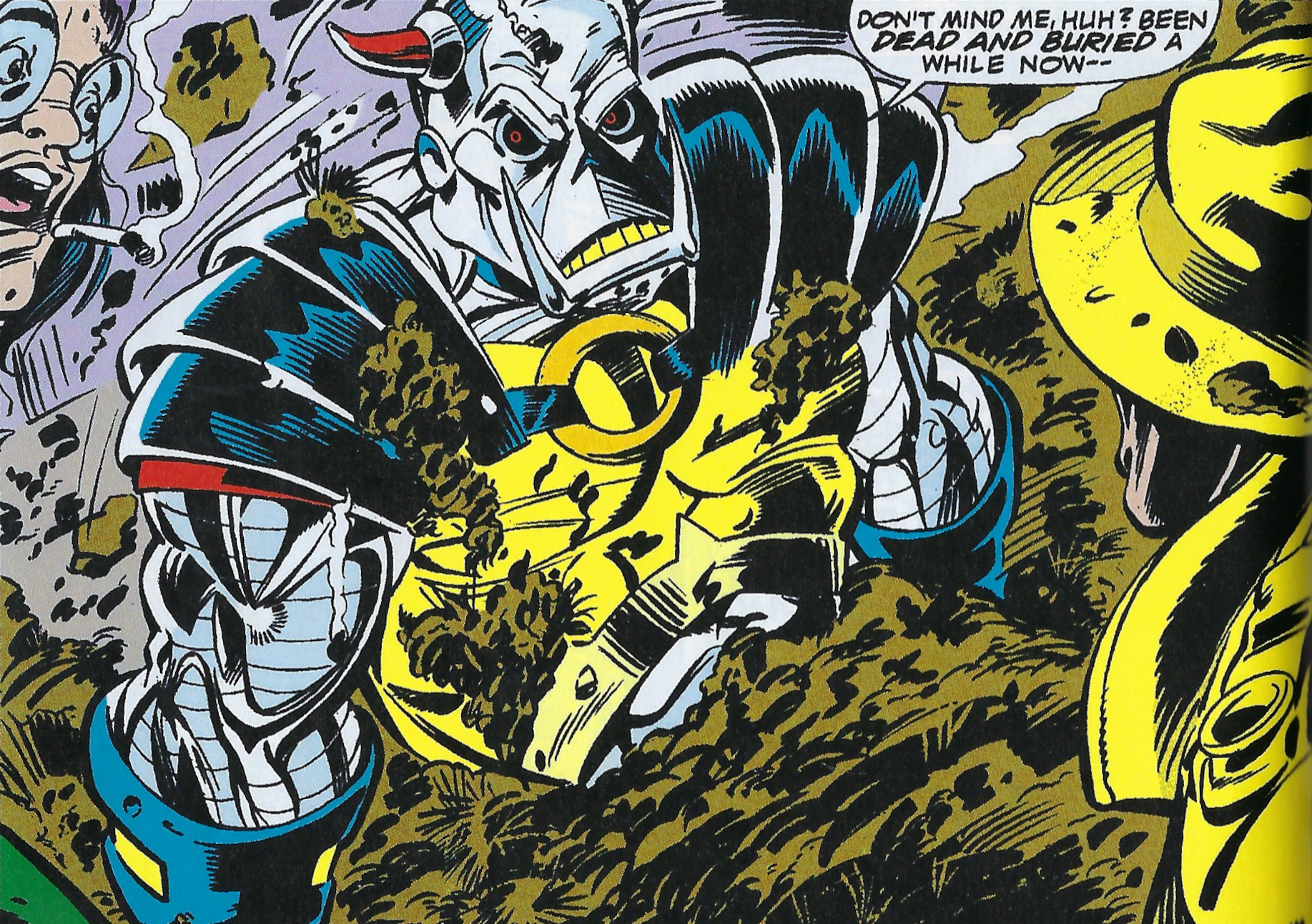
I really don't care about G.I.Joe, but I found this pretty enjoyable. Trying to find the missing Goldbug and Blaster, Blades instead finds Megatron—damaged and deranged after blowing himself up on the space bridge (see #10 below)—in the sewers of London. Blades, Grimlock, and Centurion must try to bring him down with the help of G.I.Joe, who are totally outclassed. It's a pretty simple story, elevated like a lot of Simon Furman's work by using punchy first-person narration from a variety of different characters. And, of course, five whole installments of Geoff Senior art! (But who else could ever be given the assignment of drawing Megatron vs. Grimlock?) One problem: in previous stories, Centurion was a human-built robot remote-controlled by a human being, but here is clearly a reasoning being on his own! Whoops.
 
This is the twelfth in a series of posts about Marvel's The Transformers. The next covers US issues #31-32 and UK issues #128-9 & 132-7. Previous installments are listed below:

12 May 2026

Marvel's The Transformers Year Two, Part IV: Target: 2006 Part One (UK #75-84)

So here we hit the tie-ins to The Transformers: The Movie. In the US, this was a three-issue adaptation of the movie, which I haven't actually read before, as IDW's Transformers Classics reprints included it in volume 7, not in the volume it would have fit in by publication order, and I only read the first four volumes. In the UK, this was the storyline Target: 2006, where a set of film characters travelled back in time to the present during the events of the film.

I certainly wouldn't recommend this for a new-to-this-material reader, but I decided to read chronologically. Which is to say, for the film characters, Target: 2006 probably takes place after Galvatron says, "Decepticons, to Earth" on p. 5 of issue #2 of the film adaption, so I read the film adaptation up to that panel, then jumped to the beginning of Target: 2006, read all of it, then returned to p. 5 of issue #2 of the film. The Til All Are One compendium, much more sensibly, places the film adaptation in its entirerty after the last part of Target: 2006.

I also read a story from the 1986 annual here, which would have been released around this time, though the compendium places it much earlier. "State Games" is a text story that serves as a prequel to "A There Shall Come... a Leader!" from the 1985 annual, but I like reading it here because it includes Emirate Xaaron, who appears in the present day in Target: 2006, nicely setting up our return to Cybertron in that story arc. (The very short text feature "Cybertron: The Middle Years!", included in UK issue #83, bridges the gap between the long-ago Cybertron of "State Games" and "There Shall Come..." and the present-day Cybertron of Return to Cybertron and Target: 2006.)

That makes this my first batch of Marvel Transformers stories to include no regular issues of the US comic. 

In the National Interest, Parts 2–4 / "State Games: A Tale from Cybertron" / "The Planet-Eater!" / "Judgment Day!" (part 1) / Target: 2006, Prologue & Parts 1–6, from The Transformers UK #75-84 (23 Aug.–25 Oct. 1986), The Transformers Annual [1986], and The Transformers: The Movie #1-2 (Dec. 1986–Jan. 1987); reprinted in The Transformers: Til All Are One Compendium One (2025)
stories by Simon Furman, James Hill, and Ralph Macchio; pencils by Will Simpson, Johns Stokes, Don Perlin, Jeff Anderson, Ron Smith, and Geoff Senior; inks by Dave Hine, Tim Perkins (with Andrew Leary), Will Simpson, Ian Akin & Brian Garvey, Jeff Anderson, Ron Smith, and Geoff Senior; letters by Annie Halfacree, Janice Chiang, and Starkings; colours by John Burns, Gina Hart, Tony Jozwiak, Nel Yomtov, and John Burns

from The Transformers UK #74*
In the National Interest is fine. It has to balance out one thing that I enjoy and one thing I don't, in that I do like the Dinobots, especially the ongoing subplot about Sludge's crush on human reporter Joy Meadows, but on the other hand, the convoluted clandestine machinations of the Intelligence and Information Institute (Triple-I!) rapidly get tedious. Whenever secret organizations get involved in Transformers stories, I tune out; they really shift things away from the core appeal of Budianskian storytelling, I think. Still, good showing for the Dinobots.
 
"State Games" is a decent text story, showing how the war between the Autobots and Decepticons came about. It packs in a lot of exposition and thus gets a bit overwhelming, but it has some interesting ideas; the kernel of the idea that was explored in great detail in the IDW continuity, that Megatron and his comrades had legitimate grievances, comes from this story. It's not as nuanced as it would be later on... but it is pretty nuanced for a 1980s kids comic! Note that in this story, "Optimus Prime" is just a guy's name, not some kind of title, even though it came out a month after The Transformers: The Movie, where we learned there was a mythical significance to "Prime." Not a criticism of the story, but it shows you how much the Transformers mythos was being made up as it went along.
 
from The Transformers: The Movie #1
The first half of the comics adaptation of the movie is fine; it's a bit jumpy and narration heavy, and I wonder how much it would make sense to someone who hadn't actually seen the film. The death of Optimus Prime seems kind of crammed in... on the other hand, the capture of Megatron by Unicron and subsequent transformation into Galvatron is very well done. Mostly reading it made me aware of how much work the film's soundtrack and editing did in making the events seem grandiose.
 
As mentioned above, I directly segued from page 5 of issue #2 of the comic into Target: 2006. In this story, Galvatron attempts to escape Unicron's control by travelling back in time to 1986. (The actual movie was set in 2005, as was the comic adaptation; in the UK comic, the movie's events were set in 2006, and the UK printing of the comic adaptation edited it to be consistent with that, but the compendium doesn't include those edits.) However, this isn't very clear at first: Target: 2006 is designed to be someone's introduction to the movie mythos, and so these things are very gradually revealed to the 1986 characters (and thus the reader) across the course of the story's first seven parts. 
 
Thus, reading it with the added context of already having read/seen the movie undermines it a bit... but to be honest, is probably also helpful, because there is a lot going on here. When Galvatron and his minions come back in time, three Autobots including Optimus Prime disappear, so they are disarray; this means that back on Cybetron, the Autobot resistance becomes aware that something has snuffed out the Creation Matrix, and so Ultra Magnus travels to Earth to find out what, even though he's a key part of a planned attack by the Wreckers on the Decepticon elite that can't be adjusted. So we're not just following Galvatron's machinations but also Ultra Magnus's adventures and what's going on back on Cybertron! Plus, Furman jumps around a lot chronologically; each installment almost always begins a bit after the previous one ended and then fills in some, if not all, of its events retrospectively. I admire his structural ambition, but I very often got lost and some key details of the story eluded me (I was very surprised when Starscream woke up in the Ark... totally missed where he was brought back to it).
 
from The Transformers UK #82
Still, the ambition of the story is admirable. This is surely Furman's first go at what we would now recognize as "Furmanist" storytelling: using the mythos of Transformers to its own end, rather than tying it into human characters, extrapolating from the much more "space opera" mode of the movie. I always like Ultra Magnus, and this is a good showing for him. I do think one of the story's big weaknesses is that not every comic book artist is cut out for drawing Transformers; you can probably get away with this in a story with a lot of human characters, but in a Furmanist story with only robots, you have to be good at drawing robots. Unfortunately, Will Simpson is not. It's a breath of fresh air when Geoff Senior turns up to do the last two installments reviewed here.
 
The other weird thing about reading in this sequence is that Kup and Blurr were pretty much completely cut out of the comics adaptation of the film, despite being prominent in the actual film, so when they appear with Hot Rod at the end of part six, you're very much like, "Who are those guys?" It's also jarring to have Target: 2006 heavily revolve around the comics version of the Matrix, where it's the "Creation Matrix," a computer program in Optimus's mind (than can be mentally transferred between people, even into a human being), when the story it ties into has the very different "Matrix of Leadership," a physical object in Optimus's chest.
 
This is the seventh in a series of posts about Marvel's The Transformers. The next covers US issues #21-22 and UK issues #85-92. (See also a side post analyzing the "Budianskian"/"Furmanist" framing.) Previous installments are listed below:
  1. US #1-3 & 33-34 / UK #1-6 & 9-17 (1984-85)
  2. US #4-8 / UK #7-8 & 18-30 (1984-85) 
  3. US #9-12 / UK #31-41 (1985-86) 
  4. US #13-14 / UK #42-54 (1985-86) 
  5. US #15-16 / UK #54-63 (1985-86)
  6. US #17-20 / UK #64-74 (1986) 

* Yes, I know this scan comes from an issue not reviewed in this post... but I like it too much to omit! 

14 April 2026

Marvel's The Transformers Year Two, Part I: Dinobot Hunt! (US #13-14 / UK #42-54)

This set of stories is mostly UK stories, with a couple US ones at the end. In the early years of the book, at least, there's pattern of four US issues and then a set of UK stories and so on; in this case, though the four US stories span two of my posts, so I'll cover the other two US ones from this sequence next week. It also incorporates two "special" stories: one from the 1986 UK annual (I haven't even gotten through all the stories from the 1985 annual yet, but this one fits best here) and one from... Woman's Day!?

Crisis of Command! / The Icarus Theory / Dinobot Hunt! / "Victory!" / "Shooting Star!" / "Rock and Roll-Out!" / "The Night the Transformers Saved Christmas", from The Transformers US #13-14 (Feb.-Mar. 1986) / The Transformers UK #42-54 (4 Jan.–29 Mar. 1986), The Transformers Annual [1986], and Woman's Day 26 Dec. 1985; reprinted in The Transformers: Til All Are One Compendium One (2025)
scripts by Mike Collins, James Hill, Simon Furman, and Bob Budiansky; pencils by Geoff Senior, John Stokes, Barry Kitson, Will Simpson, and Don Perlin [with Herb Trimpe]; inks by Geoff Senior, John Stokes, Barry Kitson, Will Simpson, Marc Griffiths, Tim Perkins, and Al Gordon; colours by Steve Whitaker, Gina Hart, Stuart Place, Jeff Anderson, and Nel Yomtov; letters by Mike Scott, Starkings, Annie Halfacree, and Janice Chiang

from The Transformers UK #44
Crisis of Command! picks up on a detail seeded in the previous UK story about how Optimus is feeling a lack of confidence in his abilities following how Shockwave removed his head and almost made off with the Creation Matrix. In later years, Optimus's crises of confidence would go so frequent one wondered how he ever rose to a position of leadership at all, but this one is decently done; he waffles a bit, and then realizes he is awesome, crisis over. This is nicely paralleled to the various Decepticons jockeying for authority in the absence of Shockwave.

Then we have two Dinobot-focused stories. In the first, The Icarus Theory, a human scientist dredges up the body of Swoop and figures out how to remote control it. This was, like most Furman stories, interestingly told, though I found the climax a bit rushed and underbaked. It leads into the next; Ratchet realizes Swoop was rendered mindless by his millennia of submersion in the Savage Lands and that the other Dinobots (who departed for parts unknown) would have suffered the same, so the Autobots must hunt them down... only there are Decepticons on their tail. I found Dinobot Hunt! confusing and jumpy, a rare total misfire from Furman. Partially the issue is too many characters; I usually struggle to keep track of the largely indistinguishable G1 characters. I did like the epilogue story, "Victory!", about what the Dinobots dream as they await repair and revival. You can't go wrong with Geoff Senior drawing the Dinobots!

from The Transformers US #13
One thing that has surprised me about this project is that I did not have very good memories of Bob Budiansky's stories... but his stories from issues #5 to 12 have been quite good. Not high art, but solid kids' comics; the way he has kept the sf elements grounded in the real world through Buster has been quite effective. But in the two stories here, I feel like Budiansky has completely lost, almost overnight, what made the early stories work. (In his history of the comic, Stuart Webb speculates Budiansky thought he would be off the book at issue #12.) 

In the first, we finally learn what happened to Megatron, trapped in gun mode when last seen. A cowardly hood finds him, using him to strike at his enemies. I feel like this had real potential, but there's barely any Megatron in the story. Aside from a brief conversation, Megatron is mostly trapped in gun mode, so he's just a nice weapon for the protagonist to yield. Imagine if the emphasis of the story wasn't on Megatron-as-tool, but Megatron-as-advisor, if he'd helped this guy by encouraging his ruthless side. So much better!

The other story is the first of many dumb Decepticon plans we'll be subjected to. In this one... they are stealing music from rock concerts? Okay sure. Both are drawn by Don Perlin; his work isn't great but I seem to recall he comes to grips with Transformers better as he goes.

from Woman's Day 26 Dec. 1985
Lastly, there's a very short story (just four pages) originally published in Women's Day, I guess so moms could share it with their kids. It's a Christmas tale, so the compendium puts it later, with the 1986 UK Christmas strip, but in terms of narrative and character status, it fits in nicely after US #14. Just ignore the fact that it was Christmas only a few strips ago! It's fine, you know.

This is the fourth in a series of posts about Marvel's The Transformers. The next covers US issues #15-16 and UK issues #54-63. Previous installments are listed below:

20 October 2021

Death's Head: Freelance Peacekeeping Agent in the Marvel Universe (From Stockbridge to Segonus: A Doctor Who Magazine Comics Marathon, Part 15)

Collection published: 2019
Acquired: March 2020
Second half read: July 2021

Death's Head: Freelance Peacekeeping Agent
stories from Death's Head vol. 1 #9-10 (Aug.-Sept. 1989), Strip #13-20 (Aug.-Nov. 1990), Fantastic Four vol. 1 #338 (Mar. 1990), The Sensational She-Hulk #24 (Feb. 1991), Marvel Heroes #33 (Mar. 2011), and What If... vol. 2 #54 (Oct. 1993)

Writers: Simon Furman & Walter Simonson with Ferg Handley
Pencilers: Geoff Senior, Bryan Hitch & Walter Simonson with John Ross & Simon Williams
Inkers: Geoff Senior, Bryan Hitch, Walter Simonson & John Beatty with John Ross & Simon Willams
Colorists: Louise Cassell, Euan Peters, Geoff Senior, Christie Scheele, Glynis Oliver & Sarra Mossoff with John Charles, Jason Cardy & Kat Nicholson
Letterers: Annie Halfacree, Helen Stone, Todd Klein, Jim Novak & Janice Chiang with Tim Warran-Smith

Issue #8 brought a big change of direction for Death's Head... but due to rights issues, it can't be printed in this collection! Suffice it to say that the Doctor takes Death's Head out of the Doctor Who universe in 8162 and plops him in the Marvel universe in the present day; I will eventually read it when I pick up The Incomplete Death's Head. So now Death's Head is in his third universe thus far!

So #9 picks up with Death's Head on the roof of Four Freedoms Plaza, where the Fantastic Four live. At first they fight, of course, but then they must team up the Fantastic Four's security system goes haywire. At the end of this issue, the Fantastic Four try to send Death's Head back to 8162 (I guess no one knows he's in the wrong universe), but when Reed Richards realizes he's a paid killer, he switches it off, which ejects Death's Head in the far-off year of, um, 2020. (Iron Man 2020 had been a feature of some Marvel comics, so this was an established setting.) The set-up is a bit confusing, as Death's Head is already established, and trying to find money to fix up his spaceship... which didn't come with him... and which doesn't appear in 2020 until the issue's end! 

Even Death's Head can't resist a baby.
from Death's Head vol. 1 #9 (script by Simon Furman, art by Geoff Senior)

These two issues are basically fine. There's some fun interplay between Death's Head and the FF, and the Iron Man 2020 has some great Death's Head moments, but on the other hand falls foul of the dull convolutions that bedevilled a number of the pre-time-jump stories. Overall though, one can sense a comic frantically searching for a new direction... and getting cancelled abruptly, as an obviously hastily final two pages in #10 sum up a lot.

After this, Death's Head doesn't have a status quo. The graphic novel The Body in Question (which has three parts; book one is set between the antepenultimate and penultimate pages of #10, and then books two and three after #10) makes the mistake of delving into the history of Death's Head, though it does reunite him with his supporting cast from his ongoing. No one cares about where Death's Head came from; what makes him interesting is what he does. Unfortunately this story gives us very little of that, instead spending time on a lot of cod mysticism. There is one good joke, though.

Actually, the issue number below is an educated guess. I can find very little information out there about the original appearance of this story.
from Strip #17 (script by Simon Furman, art by Geoff Senior)

I don't know why Furman bothered bringing the supporting cast back, because they never appear again. We next follow Death's Head into Fantastic Four #338, when he's starting freelancing for the Time Variance Authority. This is not much of a Death's Head story; it's just a Fantastic Four one he happens to be in. Better use is made of him in Sensational She-Hulk #24; he's back in New York 2020... but in a grave for some reason. (He still has his TVA time-bike, though, because he never returned it.) The story is goofy, but enjoyable, and actually makes good use of the 2020 setting in that something She-Hulk does in 1991 has repercussions thirty years later... and vice versa. Then in 2011, he's being hired by aliens to fight on their behalf (against the Hulk, as Earth's champion). (I assume because of time travel again, but I don't think anyone says.) Each of these is probably fine as a guest appearance, but it is a pretty disappointing way for the character to go out. He's brought into the Marvel universe... and promptly amounts to nothing!

Only thing that comes close to Geoff Senior drawing Death's Head is Walt Simonson doing it, complete with those amazing Simonson sound effects.
from Fantastic Four vol. 1 #338 (script & art by Walter Simonson)

Part of the reason was that in 1992, he was killed off and replaced by Death's Head II, an "extreme" 1990s character. So Death's Head makes it into a new universe, and is killed off for his troubles. Simon Furman got the opportunity to kind of undo this in an issue of What If..., which has him uniting a team of 1992 superheroes to take down a villain in 2020. It probably would have been much more interesting if I was familiar with the story it was rewriting... but I also can't imagine I would enjoy reading that story either! Geoff Senior's usually solid art seems compromised in pursuit of the mediocre 1990s aesthetic, to boot.

Is he in a grave because the character was "dead," as in no longer published? Is that the joke? If so, he'd only been last published three months prior!
from The Sensational She-Hulk #24 (script by Simon Furman, art by Bryan Hitch & John Beatty)

So, I wish Furman had left Death's Head in Los Angeles 8162 and perfected that set-up instead. This was a pretty dismal way for a once-great character to go out. (Though, in my marathon at least, there is more Death's Head to come.)

(Also it seems like a bummer that this doesn't contain the 2011 Revolutionary War: Death's Head one-shot... I haven't read it, though, so maybe there's a good reason for that.)

This post is the fifteenth in a series about the Doctor Who Magazine comic strip and Marvel UK. The next installment covers The Good Soldier. Previous installments are listed below:

  1. The Iron Legion
  2. Dragon's Claw 
  3. The Transformers Classics UK, Volume One
  4. The Tides of Time
  5. The Transformers Classics UK, Volume Two
  6. Voyager
  7. The Transformers Classics UK, Volume Three
  8. The World Shapers
  9. The Transformers Classics UK, Volume Four
  10. The Age of Chaos
  11. The Transformers Classics UK, Volume Five
  12. A Cold Day in Hell!
  13. Death's Head: Freelance Peacekeeping Agent (part 1)
  14. Nemesis of the Daleks

11 October 2021

Death's Head: Freelance Peacekeeping Agent in the Doctor Who Universe (From Stockbridge to Segonus: A Doctor Who Magazine Comics Marathon, Part 13)

Collection published: 2019
Acquired: March 2020
First half read: June 2021

Death's Head: Freelance Peacekeeping Agent
stories from Dragon's Claws #5 (Nov. 1988), Death's Head vol. 1 #1-7 (Dec. 1988–June 1989), and Marvel Comics Presents vol. 1 #76 (May 1991)

Writer: Simon Furman
Pencilers: Geoff Senior, Bryan Hitch, Lee Sullivan, John Higgins & Liam Sharp
Inkers: Geoff Senior, Mark Farmer, David Hine, Lee Sullivan, John Higgins, Paul Marshall & Jeff Anderson
Colorists: Steve White, Nick Abadzis, Louise Cassell & Stuart Place with Joe Rosas
Letterers: Annie Halfacree with Richard Starkings

I had always intended to follow Death's Head out of A Cold Day in Hell! and into his solo series. If I had been smart, though, I would have picked up Panini's two-volume collection of his adventures; since Panini has (had?) the UK reprint rights to both Marvel and Doctor Who, they could include both Death's Head stories with Doctor Who elements and ones with Marvel elements. Alas, I did not, and that collection is now prohibitively expensive and/or just unavailable. Instead, I picked up this Marvel collection, which has to skip over, for example, Death's Head #8 because both the Doctor and Josiah W. Dogbolter appear in it.

So: in the Transformers storyline "The Legacy of Unicron!", Death's Head was lost in a time portal; in the Doctor Who Magazine story The Crossroads of Time, he emerged in the Doctor Who universe. At the end of that story, the Doctor sent him to Earth in the year 8162, setting up his appearances here. That means all the stories in the first half (which are the ones I'm discussing here) take place in the Doctor Who universe, and thus also Marvel UK's Dragon's Claws series must take place in the Who universe, though neither Lars Pearson's Ahistory nor the Tardis wiki seem to buy this argument. As I discussed in my review of A Cold Day in Hell!, the fact that Dragon's Claws is set in the 82nd century is actually what allows us to date a significant number of DWM stories: Dreamers of Death, The Free-Fall Warriors, The Moderator, The Shape Shifter, Polly the Glot, War-Game, the Kane's Story sequence, A Cold Day in Hell!, Redemption!, and many I haven't gotten to yet must take place in the 82nd century because Death's Head #8 established that Dogbolter was from the same era as Dragon's Claws. Yet, as far as I know, we never see Earth in DWM during what Lars Pearson calls "the Mazuma Era"; the status of humanity's homeworld in this time is only fleshed out in Dragon's Claws and in Death's Head #1-8. (I think? It may have appeared in passing in the Kane's Story sequence now that I think about it.)

Earth in the 82nd century isn't up to much... maybe that's why the Doctor didn't care if he unleashed Death's Head there.
from Death's Head vol. 1 #3 (art by Bryan Hitch & David Hine)
 
Okay, okay, enough context, what about the stories? Reading this, at first I wondered if Death's Head could actually work as a solo character. What made him fun in The Transformers was the way he was above it all-- or rather, beneath it all. Here's this vast cosmic war happening, and especially in the 2006-set stories he originated in, it features titans of the universe. But Death's Head doesn't give a crap: he just cares about money, and if someone is going to call him a "bounty hunter" instead of a "freelance peacekeeping agent." The fun derives from the fact that Death's Head is basically operating in a totally different story to that of our usual protagonists and antagonists. But can that be maintained when he becomes the star of the show?

Most of the time, Simon Furman seemingly can't figure out how to do it. At first, this title really struggles because of Dragon's Claws. The first issue collected here is Dragon's Claws #5, and the story drops you right in, with no context for who these people are or why you should care about them. Which, okay, to be fair, it was their series and Death's Head was a guest star. Why should they be explained? But Death's Head was the breakout star of Marvel UK, and surely Death's Head fans followed him from The Transformers into this without picking up issues #1-4? Yet no concession is made for them. This is also true of some of the individual issues of the actual solo series once it gets started, especially #2, which really strongly assumes I understand who all these characters are and what they are doing when I just don't.

Just try to care about these guys... it can't be done!
from Dragon's Claws #5 (art by Geoff Senior)

In issues #3-7, the series moves into its short-lived status quo, where Death's Head with his assistant Spratt set up a business in the Los Angeles Resettlement. There are two I particularly liked, two that make the format work. The first is #5, which brings back self-interested space trash Keepsake from the Doctor Who Magazine story Keepsake. Now, when I saw this, my reaction was, "uh, really?" because Keepsake wasn't exactly a noteworthy story where I was thinking, "let's bring back that guy." But when I read it, I finally saw what this series was doing and could do. In this one, Keepsake returns to L.A. to meet up with an old partner; between the two of them, they have a complete map to a buried treasure. Only Keepsake-- who now has a new girlfriend in tow-- ran out on his wife so that she wouldn't get part of his half, and so the wife hires Death's Head to get Keepsake. The result of this is a confusing panoply of Keepsake vs. ex-partner and Keepsake vs. ex-wife. But just like the Autobot/Decepticon war, Death's Head doesn't give a hoot, he just wants a payday. It's dumb, and it's fun because Death's Head agrees with us that it's dumb, and doesn't give the interpersonal dynamics any real thought if he gets his money.

Don't annoy Death's Head, lady.
from Death's Head vol. 1 #5 (art by John Higgins)

Similarly, #7 is about Death's Head and Spratt chasing a mark-- but what they don't know is that two different bounty hunters are chasing down Death's Head. So these two bounty hunters are trying to kill him, which he doesn't know, and also trying to kill each other so that the other one doesn't get the credit. Again, this sense that Death's Head attitude means that he's just above it all is where these stories are the most fun.

They've won, and they don't even know why.
from Death's Head vol. 1 #7 (art by Bryan Hitch & Jeff Anderson)

But when they expect you to take these things seriously, they don't work, because much of the time, they are impossible to: a lot of macho early 1990s stuff, even though it's still the late 1980s. Too many stories are dependent on action, which I don't care about, or keeping track of a bunch of interchangeable nobodies. There are occasional flashes of wit and color, but overall the effect is drab.

(I did also like #1, where we get a series of flashbacks each of which ends with Death's Head laying down one of his principles of being a freelance peacekeeping agent.)

Still, I think the comic was getting somewhere and figuring itself out, which is why it's a bummer that #8 totally shifted the direction of the comic, though I'm sure there were good sales-related reasons for this. Well, at least I think it'll be a bummer; I'll see when I get there.

This post is the thirteenth in a series about the Doctor Who Magazine comic strip and Marvel UK. The next installment covers Nemesis of the Daleks. Previous installments are listed below:

  1. The Iron Legion
  2. Dragon's Claw 
  3. The Transformers Classics UK, Volume One
  4. The Tides of Time
  5. The Transformers Classics UK, Volume Two
  6. Voyager
  7. The Transformers Classics UK, Volume Three
  8. The World Shapers
  9. The Transformers Classics UK, Volume Four
  10. The Age of Chaos
  11. The Transformers Classics UK, Volume Five
  12. A Cold Day in Hell!