Showing posts with label creator: marco castiello. Show all posts

01 June 2026

Star Wars: Knight Errant by John Jackson Miller, Books 3 & 4

Star Wars: Knight Errant, Volume Two: Deluge

Collection published: 2012
Contents originally published: 2011-12
Acquired: January 2013
Read: December 2025
Scripts: John Jackson Miller
Pencils: Ivan Rodriguez, Iban Coello, David Daza, Marco Castiello
Pencil Assists: Andrea Chella
Inks: I
van Rodriguez, Sergio Abad, Vincenzo Acunzo
Colors: Michael Atiyeh
Letters: Michael Heisler

Knight Errant lasted two more story arcs after its novel installment: thus, volumes two and three make up books three and four of the series. I feel like these deliberately tried to remedy some of the faults of the first comic arc and the novel, in that both delve into Kerra Holt's backstory more and thus her characterization. In volume two, Deluge, Kerra returns to her home planet for the first time since her childhood, alongside a squadron of Republic starfighters who actually dare to fight the Sith. The story delves into her childhood friendships, her guilt, and her expectations for the actions of others.

This was certainly my favorite Knight Errant story, though it still has its weaknesses. While some other Knight Errant arcs feel a bit stretched, this one actually feels compressed: the idea that Kerra had a positive relationship with the squadron, and then they kind of betray her, and then she redeems them, is a good one, but her relationship with them feels squeezed in amongst everything else the story is doing. I think this needed more time to breathe in order to be effective. 

Additionally, the story suffers from the same thing as the rest of the Knight Errant comics, which is inconsistent and low-quality artwork. The art is fine enough I suppose, but struggles to communicate action—in a very action-focused series—and doesn't do a lot with faces—in a series with few supporting characters, there's not much character-revealing dialogue, which means we need to learn character from art.

Still, I enjoyed it well enough, and if the series had gone on like this (or gone on at all), it would have been solid enough even if it never hit the heights of writer John Jackson Miller's Knights of the Old Republic

Star Wars: Knight Errant, Volume Three: Escape

Collection published: 2013
Contents originally published: 2012-13
Acquired: May 2013
Read: January 2026

Unfortunately the last installment, Escape, is probably the weakest Knight Errant story yet. In a very big way, this is down to the art: we still don't have one artist who can make it all the way through a storyline, and Marco Castiello's Kerra becomes a generic big-breasted female comic book character. (I note that back in the novel, Kerra specifically noted she was not well-endowed!) On top of that, Castiello shows little visual imagination: the hardware and soldiers he draws are largely straight out of the Clone Wars even though this story takes place a thousand years prior! (Colorist Michael Atiyeh does his best to disguise this, God bless him.)

I didn't find the story here very interesting, either; the idea of Kerra hunting down her missing family had merit, but it felt like there were too many coincidences and the story's optimism often felt unearned given some of the horrific events it depicts. I also feel like two arcs in a row delving into Kerra's backstory is too much: backstory is not character.

Overall, I would argue that Knight Errant was a victim of the release pattern Dark Horse adopted for its ongoings during the late EU. Though I'm sure there were good sales-related reasons for it, instead of releasing traditional monthly ongoings (as they had with KOTOR and Legacy), they instead alternated between different miniseries. Knight Errant isn't made up of fifteen issues, but rather Knight Errant  #1-5, Knight Errant: Deluge #1-5, and Knight Errant: Escape #1-5, with a six-month break in between each arc. (This model was also used for Dark TimesInvasion, and Agent of the Empire.) At the time I'm sure that resulted in a loss of storytelling momentum; that doesn't matter so much in retrospect, but I think the way it constrains the shape of the stories does. Miller's KOTOR had stories of one, two, three, four, six, and even twelve issues. This kind of flexibility, being able to move between intimate one-offs and massive epics, while incrementally moving forward all the time, is the real strength of the medium of the ongoing comic, and Knight Errant's straitjacket of five-issue stories keeps it from living up to the potential of its premise. Miller created a compelling world, but the series as published doesn't get to explore it enough.

30 January 2019

Review: Star Wars: Purge by John Ostrander, Alexander Freed, et al.

Comic trade paperback, 124 pages
Published 2013 (contents: 2005-13)
Acquired August 2014 

Read December 2018
Star Wars: Purge

Script: John Ostrander, Haden Blackman, Alexander Freed
Art: Douglas Wheatley, Jim Hall and Alex Lei & Mark McKenna, Chris Scalf, Marco Castiello & Andrea Chella
Colors: Ronda Pattison, Michael Atiyeh
Lettering: Michael David Thomas, Michael Heisler

The contents of this collection-- five issues published across seven years-- overlap chronologically with that of Dark Times, so I read it alongside it. It's okay, but not great, but I doubt it could be great: a series of one-shots about Darth Vader hunting down Jedi after Revenge of the Sith can pretty much only go one way again and again. In each story, some minor Jedi character challenges Vader. Usually, the character has appeared in two previous issues since 1999, or perhaps they've never appeared anywhere before at all. Guess what? They go down. Hard.

Obviously most of the stories are trying to give us emotional insight into Vader after his fall, but there's not a lot to give: Vader is angry, even more so than Palpatine wants. Well, sure. The best story in this regard is the third, "The Hidden Blade" by Haden Blackman and Chris Scalf, where Vader's anger actually causes some conflict, getting in the way of his mission. I also liked the final story, "The Tyrant's Fist" by Alexander Freed, Marco Castiello, and Andrea Chella, because a lot of it was told from the perspective of a young Imperial officer, using her to show how the galaxy is adapting to the lack of the Jedi, as they have to be eradicated not just physically, but from the hearts and minds of the people. So a couple decent stories, a couple okay ones. You could do worse, but most of the people involved in this have done better.

04 January 2017

Faster than a DC Bullet: Project Crisis!, Part LVIII: The World of Flashpoint featuring Green Lantern

Comic trade paperback, n.pag.
Published 2012 (contents: 2011)
Borrowed from the library
Read August 2016
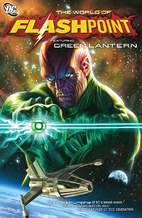
The World of Flashpoint featuring Green Lantern

Writers: Adam Schlagman, Jeff Lemire, Pornsak Pichetshote
Artists: Felipe Massafera, Robson Rocha, Joe Prado, Ibraim Roberson, Alex Massacci, Andy Smith, Keith Champagne, Ig Guara, Marco Castiello, Ruy José, Vincenzo Acunzo, Cliff Richards, Ben Oliver
Colorists: Rod Reis, Pete Pantazis, Stefani Rennee, Allen Passalaqua
Letterers: Dave Sharpe, Pat Brosseau, Travis Lanham, Carlos M. Mangual, Wes Abbott

Like I said when talking about the Batman World of Flashpoint volume, despite thinking these books were kind of dumb at first, I'm coming to enjoy them. The World of Flashpoint featuring Green Lantern is another solidly enjoyable volume-- I liked all four stories here. The key ones are definitely the first and last stories, both written by Adam Schlagman: "Abin Sur: The Green Lantern" and "Hal Jordan." These stories essentially run in parallel, depicting the lives of their two main characters. In this timeline, Abin Sur still crashlands on Earth and is found by hotshot test pilot Hal Jordan, but Abin doesn't die, meaning he doesn't pass his Green Lantern ring on to Hal.

Why are the Guardians of the Universe jerks in every timeline?
from Flashpoint: Abin Sur: The Green Lantern #1 (script by Adam Schlagman, art by Felipe Massafera)

Abin's story is about him holding onto the Green Lantern determination to protect life in a universe increasingly hostile to it. We see his youth, we see his friendship with fellow Green Lantern Thaal Sinestro (I had no idea Sinestro had a first name), we see Sinestro's turn to evil when he's told their timeline is an aberration and can be rewritten, and we see Abin sent on a mission to Earth by the Guardians of Oa, who want him to recover the White Entity, the essence of life, from its hiding place. Only once Abin finds out about the Amazon-Atlantis war consuming Earth, he wants to stop that instead. This isn't anything deep, but it is a solid, enjoyable tale, with larger-than-life characters doing big things and making tough choices. The art of Felipe Massafera and his collaborators (Robson Rocha and Joe Prado) is some of the best art on a World of Flashpoint story I've seen yet, communicating character and strength. There's some real tragedy, and real emotion here. As always, I'm curious to see if these events will play into the main Flashpoint title. It seems like they ought to, but Flashpoint is only five issues long and so many things have been set up in The World of Flashpoint by this point!