Earlier this year I read all the collected editions of DC's Manhunter ongoing (2004-09). Though all of the ongoing was collected, one more Manhunter collection was solicited but never published: Face Off* which would have collected the thirteen nine-page Manhunter backup strips that ran in Batman: Streets of Gotham for a year. I liked Manhunter enough, and wanted more closure than I got from the last volume of the ongoing, so I tracked down the issues of Streets of Gotham and read them.
It begins with Kate Spencer starting her third job: she's the new district attorney for Gotham City, an unthankful job if there ever was one, only it seems perfectly suited for the way Kate/Manhunter works as a character. Justice fails so much in Gotham that there will be plenty for her to do. She doesn't want to endanger Ramsey, though, so he stays back in L.A. with his father. The main thrust of this storyline is Kate's attempt to prosecute Two-Face for the murder of her predecessor (and, I guess, his successor) as D.A., which was carried out by "Jane Doe," a woman who can wear other people's skins, at his instigation. I think. There were definitely some jumps. I wasn't even sure when and how Kate figured out Two-Face was responsible for the murder, and the trial starts for some reason even though she actually has almost no evidence.
Clearly the story cuts off before Andreyko imagined it would, as his Manhunter stories always seemed to; Face Off ends without a resolution to the Two-Face trial, though there has been a mini-resolution when Jane Doe assaults Kate's family and is defeated. Still, I enjoyed returning to these characters-- moving the story to Gotham even allows Andreyko to tie up what happened to Dylan Battles, who went to Gotham in the aborted penultimate storyline from the ongoing. We also get Ramsey's discovery of his superpowers, setting the stage for him becoming a superhero in the "Some Years Later" epilogue.
Like I said, Gotham is a good fit for this series's sensibilities, and Andreyko gets some of his better artistic collaborators. Though there is a lot of switching off over the story's 117 pages (see below), I thought Jeremy Haun, who pencils a majority of it, was suited to the gritty tone of Manhunter and Gotham. I even liked the work of Georges Jeanty, whose poor childlike faces always threw me in Buffy the Vampire Slayer: Season Eight-- whatever he did in those stories that I didn't like, he tones down here.
This is a decent, if incomplete, story, and I enjoyed reading it more than the last few "actual" Manhunter storylines. It deserved to be collected, so I'm glad I tracked it down. Kate only appeared on the cover once (issue #7, pictured above; the cover is by Dustin Nguyen, who drew the lead Batman feature in Streets of Gotham), and I'd guess the cover was commissioned so it could be used for the never-published collected edition. I assume the moment for any kind of Face Off collected edition has long passed, but maybe someday there will be a Kate Spencer, Manhunter Omnibus, where this would make a perfect inclusion between issues #36 and 37.
Manhunter: Face Off originally appeared in issues #1-13 of Batman: Streets of Gotham (Aug. 2009–Aug. 2010). The story was written by Marc Andreyko; pencilled by Georges Jeanty (#1-3), Jeremy Haun (#4-6, 8-11), Cliff Richards (#7), and Szymon Kudranski (#12-13); inked by Karl Story (#1, 3), Dexter Vines (#2), Jack Purcell (#3), Jeremy Haun (#4-5, 9), John Lucas (#6, 8, 10-11), Art Thibert (#7), and Szymon Kudranski (#12-13); colored by Nick Filardi; lettered by Sal Cipriano (#1-6, 8-13) and John J. Hill (#7); and edited by Janelle Siegel.
* Or Faceoff or Face-off: I saw all three versions on-line. I went with "Face Off" because that's the actual title of the story in issue #7.
Steve[n] Mollmann's blog: it only knows that it needs, but like so many of us, it does not know what
Showing posts with label creator: cliff richards. Show all posts
24 November 2017
Review: Manhunter: Face Off by Marc Andreyko, Jeremy Haun, John Lucas, et al.
09 August 2017
Faster than a DC Bullet: Project Crisis!, Part LXXI: Convergence: Zero Hour, Book 2
![]() |
| Comic trade paperback, n.pag. Published 2015 (contents: 2015) Borrowed from the library Read July 2017 |
Writers: Tony Bedard, Larry Hama, Keith Giffen, and Louise Simonson
Artists: Cliff Richards, Philip Tan & Jason Paz/Rob Hunter, Rick Leonardi & Dan Green, Ron Wagner & Bill Reinhold, Timothy Green II & Joseph Silver, June Brigman & Roy Richardson
Color: John Rauch, Elmer Santos, and Paul Mounts
Letterers: Dave Sharpe, Steve Wands, and Corey Breen
Color: John Rauch, Elmer Santos, and Paul Mounts
Letterers: Dave Sharpe, Steve Wands, and Corey Breen
This volume collects the Convergence adventures of five more sets of 1990s heroes, hailing from September 1994 or thereabouts. There's the hook-handed Aquaman (he lost the real hand in September 1994's Aquaman #2); Batman is joined by Azrael, who substituted for him during the Knightfall storyline (February 1993 through August 1994); Kyle Rayner is Green Lantern (he took over in March 1994's Green Lantern #50), and Hal Jordan has become Parallax; Supergirl is a protoplasmic blob from a pocket universe (she adopted the role in February 1992), working for Lex Luthor, who's transferred his brain into a younger, sexier, Australianer, hairier clone body (he first appeared in October 1990; the two dated until Supergirl #4 in May 1994, so there's some timeline wonkiness here); and John Henry Irons, who substituted for Superman while he was dead, is the superhero-in-his-own-right Steel (he got his own series in February 1994).
Maybe I lack nostalgia for these 1990s set-ups (I've read very little of any of them, except clone Luthor and protoplasmic Supergirl both feature in the Death of/World Without a/Return of Superman trilogy). Like all of these Convergence stories, it has to contrive to get the heroes all in the same city; apparently that was because everyone turned up in Metropolis to fight Parallax. Does this mean the city was domed during the events of Zero Hour? I don't remember the events of Zero Hour well enough to say; it seems a pretty tepid explanation that Azrael came to Metropolis because couldn't "miss a gathering of heroes like that." Additionally, the stories are inconsistent as to whether Superman was in the dome or not. He doesn't actually appear, but Kyle includes him among those who forgave Hal for his actions as Parallax, while on the other hand, both Steel and Lex mention that he's absent.
Whatever. Probably none of this really matters, what matters is the story... but I didn't really care about the stories here. It's impossible to care about Aquaman, the Azrael story was pretty uninteresting, and I don't know what planet Keith Giffen was on when he wrote the Supergirl tale, but it is bonkers, and sometimes in a good way, sometimes in a bad way, most often in a what is this i don't even way. I did like that Parallax isn't evil per se (remember Hal's actions were all in aid of trying to bring back the destroyed Coast City), so he ruthlessly fights on behalf of the city against its enemies, and Kyle has to try to stop him from going overboard. But even though in theory I do like the character of Steel, his story still didn't do much for me, even if it did reunite the actual creative team the character had back in the 1990s.
Probably part of the problem is that in three of these stories, the opponents are from the Wildstorm universe. This is definitely thematically appropriate, as Wildstorm is the most 1990s thing of them all, and thank God that Grifter doesn't turn up, but seriously, who gives a shit about Wildstorm? And these folks are like the Wildstorm also-rans; I could tolerate the Authority or maybe even Stormwatch, but Gen¹³ and Wetworks? In two of the stories, it's the denizens of Earth-6, which is kind of random, but thankfully Giffen makes a joke at the expense of that randomness. Earth-6's Lady Quark was a member of L.E.G.I.O.N., which Giffen wrote, and he has a joke about that, though it's anachronistic to say the least.
Anyway, whatever. All the 1990s stuff I cared about was frontloaded in the first Convergence: Zero Hour volume, which didn't leave me with much to enjoy here.
Next Week: Superman, the Question, the Justice League of America, Stephanie Brown, and Nightwing and Oracle battle for their lives in Convergence: Flashpoint, Book 1!
10 March 2017
Review: Nemesis: The Impostors by Ivan Brandon and Cliff Richards
When I read the various Final Crisis Aftermath titles a couple years ago, my favorite was Escape, which had the character of Tom "Nemesis" Tresser trying to escape Brother Eye and the Electric City, home of the new Checkmate Global Peace Agency. I said that it was the only one FCA story "that doesn't feel like the writer is trying to make something out of Grant Morrison's leftovers, that feels like its writer actually has his own story to tell" and though I found it confusing (it has conspiracies and duplicates and time travel), "just enough explanations were provided to make me feel like there was a logic to this, and to intrigue me to read on. There was a purpose to everything that happened, one that stems from the events of Final Crisis and has repercussions for the future."
Even though one of Grant Morrison's purposes in Final Crisis was setting up new concepts for other writers to play with them, and DC's purpose in the FCA tales was apparently to do that playing, none of them really took off. There were no more Human Flame stories after Run!, no Super Young Team stories after Dance, and almost no more Tattooed Man stories after Ink. Escape did, however, receive a follow-up, in the form of a four-issue Nemesis miniseries called The Impostors. Having escaped from the Electric City, Tom Tresser tries to take down the Council (apparently his recurring nemesis from his original 1980s appearances in The Brave and the Bold), but has to tackle with Batman and possibly the Joker in the process. It was never collected, so I couldn't get it from the library, but I liked Escape enough to buy the single issues off eBay.
As I quoted myself above, I enjoyed Escape and liked the future it implied. Only now, eighteen months after I wrote that, I have no idea what I was talking about. The Impostors did nothing to remind me what I was talking about back then. I was so confused reading this book, and not in a good way. Why exactly did Tom suddenly want to take down his old enemies? Why did he keep seeing Brother Eye and the Electric City? What did the stuff I did dimly remember from Escape actually have to do with anything? And what the heck was up with the ending?Frustratingly, the story ends in such a way that indicates more is to come-- and that more needs to come, because The Impostors makes so little sense on its own. However, The Impostors was Tom Tresser's last appearance, and then the universe was rebooted. I bounced off this story completely, which is a shame because of how much I liked Escape. I would read more in the vain hope that something might make sense again, but I don't even have that option.
One thing I did like: Tom is pretty paranoid in this story, and justifiably so, and his paranoia is amped up because he doesn't believe the guy claiming to be Batman is actually Batman because his body language is wrong. This is because The Impostors takes place after Final Crisis-- so Bruce Wayne is unstuck in time, and Dick Grayson is the new Batman. It's a nice little touch.Nemesis: The Impostors was originally published in four issues (May-Aug. 2010). The story was written by Ivan Brandon; illustrated by Cliff Richards; colored by Matthew Wilson; lettered by Steve Wands (#1), Sal Cipriano (#2-3), and Travis Lanham (#4); and edited by Ian Sattler (#1-4) and Rex Ogle (#2-4).
15 February 2017
Faster than a DC Bullet: Project Crisis!, Part LXIII: The New 52 Villains Omnibus
![]() |
| Comic hardcover, 1168 pages Published 2013 (contents: 2013) Borrowed from the library Read November 2016 |
by Greg Pak, Paulo Siquiera, Netho Diaz, Marguerite Bennett, Ben Oliver, Cliff Richards, China Miéville, Mateus Santolauco, Carla Berrocal, Riccardo Burchielli, Liam Sharp, Jock, Tula Lotay, Marley Zarcone, Brendan McCarthy, Emma Rids, Emi Lenox, Jeff Lemire, Frazier Irving, David Lapham, Carmen Carnero, Sloane Leong, Kelsey Wroten, Michelle Faran, Annie Wu, Zak Smith, Alberto Ponticelli, Dan Green, Geoff Johns, Sterling Gates, Manuel Garcia, Rob Hunter, Matt Kindt, Sam Basri, Keith Champagne, Bit, Derlis Santacruz, Tom DeFalco, Chad Hardin, Edgar Salazar, Ann Nocenti, Dan DiDio, Fabrizio Fiorentino, Tom Derenick, Philip Tan, Jason Paz, Tony Bedard, Geraldo Borges, Ruy José, Paul Levitz, Yildiray Cinar, Aaron Lopresti, Art Thibert, Brian Buccellato, Chris Batista, Tom Nguyen, Francis Manapul, Scott Hepburn, Andrea Sorrentino, Charles Soule, Jesús Saiz, Marv Wolfman, Cafu, Corey May, Dooma Wendschuh, Moritat, Angel Unzueta, Robson Rocha, John Ostrander, Victor Ibañez, Brian Azzarello, Michael Alan Nelson, Mike Hawthorne, Ken Lashley, Raymund Bermudez, Sholly Fisch, Jeff Johnson, Andy Smith, Steve Pugh, Pascal Alixe, Scott Lobdell, Dan Jurgens, Ray McCarthy, Aaron Kuder, Brett Booth, Norm Rapmund, Robert Venditti, Rags Morales, Cam Smith, Jim Starlin, Howard Porter, Stefano Landini, Dale Eaglesham, Andy Kubert, Andy Clarke, Scott Snyder, Ray Fawkes, Jeremy Haun, Frank Tieri, Christian Duce, Peter J. Tomasi, Graham Nolan, Guillem March, James Tynion IV, Jorge Lucas, Tim Seeley, Francis Portela, Gail Simone, Justin Gray, Jimmy Palmiotti, Jason Masters, John Layman, Georges Jeanty, Derek Fridolfs, Javier Pina, Neil Googe, Szymon Kudranski, Scot Eaton & Jaime Mendoza
The Book as a Whole
This book ties into Forever Evil, an event where the Crime Syndicate (i.e., the Evil Justice League) temporarily took over the Earth. As a result, most of DC's monthly titles were "taken over" by supervillains-- like, Action Comics #23.2 featured General Zod. Yes, there were decimals in the numbering. Some series were taken over four times, some just once. One presumes this was in proportion to popularity; it's easier to get someone to buy four extra issues of Action Comics than of Swamp Thing. These vary in type: some show what the villain in question was doing during Forever Evil, some show random other adventures of the villain, some show the origin story of the villain, some do more than one. I'd guess that more than half aren't even stories, but just set-up: leading into Forever Evil itself, or a Forever Evil spin-off, or just leading into a forthcoming issue of an ongoing where said villain is going to turn up. Like when I reviewed The New 52 omnibus, I'm going to tackle each individual grouping of issues, since there are too many to look at each on its own.
![]() |
| That's the kind of casual, fun attitude I like my international spies to have. from Justice League of America vol. 3 #7.3 (script by Tom DeFalco, art by Chad Hardin) |
Justice League (Darkseid, Lobo, Dial E, Secret Society, Deadshot, Killer Frost, Shadow Thief, Black Adam, the Creeper, Eclipso, Black Manta, Ocean Master, Desaad, Solomon Grundy, Grodd, Reverse-Flash, the Rogues, Count Vertigo, Arcane, Trigon, Deathstroke, the Cheetah, First Born)
If I learned anything from this section, it's how few people should be allowed to touch the New Gods: to stories featuring Darkseid and Desaad are so mundane as to completely miss the point of the characters. Darkseid doesn't need an origin story, he's "the Tiger-Force at the core of all things! When you cry out in your dreams-- it is Darkseid that you see!" How can such a character have a youth and a backstory? It makes him mundane to give him a motivation, and Darkseid should never be mundane.04 January 2017
Faster than a DC Bullet: Project Crisis!, Part LVIII: The World of Flashpoint featuring Green Lantern
![]() |
| Comic trade paperback, n.pag. Published 2012 (contents: 2011) Borrowed from the library Read August 2016 |
Writers: Adam Schlagman, Jeff Lemire, Pornsak Pichetshote
Artists: Felipe Massafera, Robson Rocha, Joe Prado, Ibraim Roberson, Alex Massacci, Andy Smith, Keith Champagne, Ig Guara, Marco Castiello, Ruy José, Vincenzo Acunzo, Cliff Richards, Ben Oliver
Colorists: Rod Reis, Pete Pantazis, Stefani Rennee, Allen Passalaqua
Letterers: Dave Sharpe, Pat Brosseau, Travis Lanham, Carlos M. Mangual, Wes Abbott
Colorists: Rod Reis, Pete Pantazis, Stefani Rennee, Allen Passalaqua
Letterers: Dave Sharpe, Pat Brosseau, Travis Lanham, Carlos M. Mangual, Wes Abbott
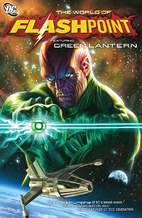
Like I said when talking about the Batman World of Flashpoint volume, despite thinking these books were kind of dumb at first, I'm coming to enjoy them. The World of Flashpoint featuring Green Lantern is another solidly enjoyable volume-- I liked all four stories here. The key ones are definitely the first and last stories, both written by Adam Schlagman: "Abin Sur: The Green Lantern" and "Hal Jordan." These stories essentially run in parallel, depicting the lives of their two main characters. In this timeline, Abin Sur still crashlands on Earth and is found by hotshot test pilot Hal Jordan, but Abin doesn't die, meaning he doesn't pass his Green Lantern ring on to Hal.
![]() |
| Why are the Guardians of the Universe jerks in every timeline? from Flashpoint: Abin Sur: The Green Lantern #1 (script by Adam Schlagman, art by Felipe Massafera) |
Abin's story is about him holding onto the Green Lantern determination to protect life in a universe increasingly hostile to it. We see his youth, we see his friendship with fellow Green Lantern Thaal Sinestro (I had no idea Sinestro had a first name), we see Sinestro's turn to evil when he's told their timeline is an aberration and can be rewritten, and we see Abin sent on a mission to Earth by the Guardians of Oa, who want him to recover the White Entity, the essence of life, from its hiding place. Only once Abin finds out about the Amazon-Atlantis war consuming Earth, he wants to stop that instead. This isn't anything deep, but it is a solid, enjoyable tale, with larger-than-life characters doing big things and making tough choices. The art of Felipe Massafera and his collaborators (Robson Rocha and Joe Prado) is some of the best art on a World of Flashpoint story I've seen yet, communicating character and strength. There's some real tragedy, and real emotion here. As always, I'm curious to see if these events will play into the main Flashpoint title. It seems like they ought to, but Flashpoint is only five issues long and so many things have been set up in The World of Flashpoint by this point!
02 November 2016
Faster than a DC Bullet: Birds of Prey, Part XIX: Your Kiss Might Kill
![]() |
| Comic trade paperback, n.pag. Published 2013 (contents: 2012) Borrowed from the library Read May 2016 |
Writer: Duane Swierczynski
Artists: Travel Foreman, Jesus Saiz, Javier Pina, Jeff Huet, Timothy Green II, Joseph Silver, Cliff Richards, Romano Molenaar, Vicente Cifuentes
Colorists: June Chung, Gabe Eltaeb, Chris Sotomayor
Letterers: Carlos M. Mangual, Dave Sharpe
I just reread my review of Duane Swierczynski's previous volume of Birds of Prey, which indicates I enjoyed it quite a bit. I'm sad to say that the same cannot be said of this muddled, unfocused volume. The book begins by tying up the story begun in the previous volume. I think so, anyway, as it's been three years since I read it, and Swierczynski does little to reorient the reader. It's pretty unsatisfying. I thought Black Canary formed the Birds of Prey to take down some bigger threat, but here the bad guys are just after her-- for murder! (Of her husband, no less.) Which hardly makes them "bad," though their methods are pretty over the top. But one giant fire/explosion, and this plot line is completely over, which seems a little easy.
![]() |
| Good guys without superpowers can jump out of exploding buildings and be unharmed. from Birds of Prey vol. 3 #8 (art by Jesus Saiz & Javier Pina) |
The book then becomes a series of weird detours, made worse by the fact that regular artist Jesus Saiz departs and is replaced by Travel Foreman, who is just... not great. His action is blocky and without energy, and his characters start out looking a little too posed and get worse and worse across the course of the volume. His first story is about a "Talon" of the "Court of Owls": all derived from an exciting Batman crossover, I'm sure, but it comes out of total left field within this book. It hooks into the ongoing narrative of Birds of Prey, though, as it ends with Poison Ivy being grievously injured taking out the Talon, and Black Canary fulfills a promise she made to her ("months ago," apparently, even though I think this team could only have possibly been together a couple weeks by internal chronology) to take her to the jungle. Batgirl comes along too-- I guess she's joined the Birds?
22 June 2016
Faster than a DC Bullet: Project Gotham, Part XXVII: Huntress: Year One
![]() |
| Comic trade paperback, 143 pages Published 2009 (contents: 2008) Borrowed from the library Read December 2015 |
Writer: Ivory Madison
Penciller: Cliff Richards
Inkers: Art Thibert, Norm Rapmund, Rebecca Buchman
Colorist: Jason Wright
Letterer: Sal Cipriano
Year Eleven, February
Retcons are a weird thing, but they're a constant of the superhero comic book world. Helena Bertinelli was introduced as the Huntress in the 1989-90 ongoing series The Huntress, a dark, sort of moody noir series that stood on its own, though she did meet Batman once and was also a member of the Justice League International's American branch (since she lived in New York City). She faded away, but in 1992, Chuck Dixon brought her back for a two-issue story in Detective Comics, and then a key role in Robin III: Cry of the Huntress (1992-93), and finally her own miniseries (1994). Each of these tweaked her origin a little bit: soon she was from Gotham, not New York, and the exact details of how her family had been murdered fluctuated with each new story. Her origin got a wholesale retelling in 2000 with Batman/Huntress: Cry for Blood (the only one of these I haven't actually read), and then another one in 2008 with this series, Huntress: Year One.
As you read new versions, it's sometimes hard to judge them on their own merits. The original Huntress series by Joey Cavalieri and Joe Staton isn't perfect, but it is distinctive, with dark, moody artwork and a heroine who's not always attractive, physically or elsewise. Though later takes on the Huntress would be darker and more violent, and though the plots of the ongoing sometimes got silly, there's a real sense of the series trying something not because it's tried and true, but because it's new and distinctive. The 1990s would take "dark and gritty" in bad directions sometimes, but I enjoyed what The Huntress seemed to be striving towards, even if it didn't always hit it.
![]() |
| I guess this explains why Batman doesn't like the Huntress. from Huntress: Year One #5 (art by Cliff Richards and Norm Rapmund & Rebecca Buchman) |
So, my problems with Huntress: Year One aren't really its own fault. Its Huntress is a different character than the one created by Cavalieri and Staton, and she has a somewhat different history. I'm not sure what I think of her being raised in Sicily, or having a lost love: I liked the damaged, lonely warrior of the original series that didn't have anyone to support her. But the story Madison Ivory and Cliff Richards tell here is not bad, just different, and on its own merits, it's pretty good-- if nothing exceptional.
Instead of the gritty urban vigilante aspects of the character, this really focuses on mafia princess components, as Helena untangles a conspiracy to deprive her of her inheritance, and much worse, that runs from Sicily to the Vatican to Gotham, and leads to her meeting Batman, Batgirl, Barbara Gordon, Bruce Wayne, and Catwoman, among others. Like a lot of conspiracy stories, some of it went over my head, and there's a lot of characters to keep track of, but Ivory keeps things pretty interesting, and I enjoyed the clean linework of Cliff Richards, Art Thibert, and Norm Rapmund, especially their regal, statuesque Helena.
But I just couldn't shake the versions I'd read before from my head. Usually, I feel like I'm better at this. Oh, well.
Next Week: It's Year One again again as Nightwing makes his debut on the Gotham stage!
13 April 2016
Faster than a DC Bullet: Project Crisis!, Part LI: Final Crisis Aftermath: Escape
![]() |
| Comic trade paperback, n.pag. Published 2010 (contents: 2009) Borrowed from the library Read August 2015 |
Writer: Ivan Brandon
Pencillers: Marco Rudy, Cliff Richards, Neil EdwardsInkers: Mick Gray, Jack Purcell, JP Mayer, Prentis Rollins
Colorists: The Hories
Letterer: Sal Cipriano
I don't know why all the Final Crisis Aftermath books have verbs for subtitles, but I kind of like it. It would have been even better if they'd all used exclamation marks like Run!, though. Isn't Escape! a much better title than Escape?
In my review of Ink, I said it was my favorite FCA tale, but this one has supplanted it. This is the first of them that doesn't feel like the writer is trying to make something out of Grant Morrison's leftovers, that feels like its writer actually has his own story to tell. Ivan Brandon and Marco Rudy pick up some time after the end of Final Crisis, with its hints about Brother Eye and a Global Peace Agency. In Escape, Tom Tresser-- apparently a master of disguise called "Nemesis," but a new character to me-- wakes up in the Electric City, a sort of prison, a weird surreal prison whose wardens insist it's not a prison, and where his fellow inmates who know him refuse to talk to him. Many of the other prisoners seem to be characters who also worked for the government: Amanda Waller, Rick Flag, Blackhawk (I'm not sure which one-- Janos Prohaska?), Atomic Knight, Cameron Chase, the Spy Smasher.
The writing and the art are both deliberately disorienting, with Brandon providing little in the way of answers and Rudy embedding panels within panels to put the reader off from following the story. The characters don't know who to trust, they don't know who put them where they are or why, and imprisonment might not even be the purpose of their jailers. I was often confused by this story, but always intrigued, as the answers always felt just outside of my grasp. It reminded me-- quite deliberately, I suspect-- of The Prisoner, and that's almost always a good thing. The wheel with the options of DEATH, FREE, PEACE, VIOLENCE, ESCAPE, PANIC, RESET was a great surreal touch, and the seeming time travel elements were perfect icing on the cake of confusion.
I expected the end to be one of those endings that explains nothing, but to my surprise just enough explanations were provided to make me feel like there was a logic to this, and to intrigue me to read on. There was a purpose to everything that happened, one that stems from the events of Final Crisis and has repercussions for the future. I do want to know how the Buddy Blank and Brother Eye we see here relate to the ones from Countdown to Final Crisis and Final Crisis itself, though; that wasn't terribly clear.
Overall, I really enjoyed this. It was bold, it was different, and despite its obvious debts to both The Prisoner and Jack Kirby, I didn't feel like I'd ever encountered anything quite like it. I look forward to seeing what happens to Tom next, and unlike with most of these Final Crisis Aftermath tales, I actually can; Ivan Brandon apparently wrote a followup miniseries called Nemesis: The Impostors. Sadly, it's uncollected, so I'll have to find the floppies somewhere.
Next Week: That's it for Final Crisis and its tie-ins, so I jump backwards slightly to continue my superhero prose fiction reading project with the novelization of Countdown!
18 April 2014
Faster than a DC Bullet: Project Crisis!, Part XVIII: The OMAC Project
![]() |
| Comic trade paperback, n.pag. Published 2005 Borrowed from the library Read March 2014 |
Writers: Geoff Johns, Greg Rucka, Judd Winick
Artists: Rags Morales & Michael Bair, Ed Benes, Jesus Saiz & Jimmy Palmiotti, Ivan Reis & Marc Campos, Phil Jimenez & Andy Lanning, Cliff Richards & Bob Wiacek, David Lopez, Tom Derenick, Georges Jeanty, Karl Kerschl, Mark Propst, Bit, Dexter Vines, Rob Petrecca, Nelson DeCastroColorists: Moose Baumann, Paul Mounts, Guy Major, Steve Firchlow, Richard & Tanya Horie
Letterers: Nick J. Napolitano, Phil Balsman, Todd Klein
First off, let's look at those credits: twenty artists worked on the eight issues collected here. Twenty. I guess superhero comics are not an auteur medium.
Secondly, let's reminisce. Though I didn't read a whole lot of superhero comics back in 2005, I was becoming aware of them, and I remember the first time I saw the title "Countdown to Infinite Crisis." I thought it was a parody comic. Then I realized-- the title was real. Which was horrifying.
That said, the story of that title collected here turns out to be rather good. Nine years later I think it's okay to say that this is the story where Blue Beetle dies. Now, as a big fan of the Justice League International days, I really like Blue Beetle. I like to think he's what I'd be if I became a superhero: chubby, well-meaning, a little bit insecure, trying his best every day. "Countdown to Infinite Crisis" shows him off at his best, tracing a mystery no one else can be bothered with (except for the ever-loyal Booster Gold) across the Earth. All things said, it's a good mystery story, and despite being a fan of the JLI days, I even think the twist about the villain works. When Blue Beetle is shot in the head, you feel it in the gut.
"Countdown to Infinite Crisis" is followed by three chapters of "The OMAC Project," which runs two parallel stories: while Batman, Wonder Woman, and Booster Gold try to figure out who killed Blue Beetle (and what was worth killing him over), Sasha Bordeaux starts to fret about her role in the mysterious "Checkmate" organization. I guess Sasha was in some Batman stories I haven't read, but you actually don't need to know that for this story to work; Greg Rucka is skilled enough a writer to make her plight instantly sympathetic. Her attempt to get to Batman and let the truth out is a great thriller story, the kind of stuff Rucka is really adept at. I also like how this story spins out of Identity Crisis, showing a more-- and justly-- paranoid Batman. There are real repercussions for that story, which stops it from being the shilling shocker it's sometimes characterized as.
Something I particularly liked about "The OMAC Project" is the way that Rucka and letterer Phil Balsman use the computer lettering of the Brother Mk. I satellite, sometimes on the edge of the narrative, sometimes on top of it, sometimes interrupting speech bubbles. It's used to clever and sometimes chilling effect, and the way it can run in parallel to the main story on the page is the kind of thing I'd assert you can only do in comics. The repeated motif of the satellite's eye logo is also well used: an all-seeing eye, a Panopticon for the postmodern age.
"The OMAC Project" is interrupted halfway through by "Sacrifice, Part 4 of 4." Bizarrely, parts 1-3 are synopsized and you can go read them in another book-- after you've read the end here, I guess. The book actually gets away with it, though; the synopsis proves enough to get you through this story: famously, the one where Wonder Woman kills Maxwell Lord. I have to say, it's built up to pretty compellingly; this is no callous murder, but a genuine life-or-death situation that there is truthfully no other way out of. Of course, both Rucka and Lord contorted to make that the case, but it promises some interesting repercussions, which I guess will be in some other book. I only wish it had better art: ten of the book's twenty artists are used on this one 22-page story, and it is not to the tale's benefit.
The last three parts of "The OMAC Project" shift the focus from the now-dead Maxwell Lord to the supercomputer he stole from Batman, Brother Mk. I, which has now rebranded itself "Brother Eye" and elected to purge the Earth of superhumans. Since Batman lost control of it, it's gained the ability to turn any human who's taken a certain nanite-infused vaccine into a One-Many Army Corps (of old Jack Kirby fame). An army of OMACs comes at the Earth, which makes for a couple great splash pages from Jesus Saiz. (Indeed, I liked his art throughout the book; he does great facial expressions and body language, though it's baffling that he draws a second Checkmate agent who looks almost exactly like Sasha.)
Though I think the OMAC army's defeat comes a little too cursorily, there are a lot of great moments along the way, especially when Booster Gold leads his old JLI teammates (Guy Gardner, Fire, Mary Marvel, Metamorpho, Martian Manhunter, and Rocket Red) into battle to avenge Blue Beetle. This era may have been pilfered for shock value and retconned to death by this whole story, but the old team is still being treated with respect, thankfully.
Like Day of Vengeance, I'm left with little idea of where this is all going as it counts down to the Infinite Crisis, but I'm interested and ready to find out, and even if this goes nowhere, Greg Rucka and Jesus Saiz constructed a really enjoyable and thrilling ride.
Subscribe to:
Posts (Atom)