Showing posts with label topic: hugos 2019. Show all posts

16 February 2024

How Often Do I Agree with the Hugo Electorate?

In my recent post comparing my final ballot to the winners of the 2023 Hugo Awards, I noted that my first place choice and the actual final winner were the same in four of the nine categories in which I vote. I then speculated, "I think this is a record."

But was it a record? Good question! I trawled backward through my old posts to see how often the broader Hugo electorate had made the right choice (i.e., my choice).

Here's how many categories my first-place choice and the voters' has coincided in each year:

  • 2017: 4 (Novelette / Short Story / Related Work / Dramatic Long)
  • 2018: 1 (Short Story)
  • 2019: 1 (Dramatic Long)
  • 2020: 1 (Novel)
  • 2021: 4 (Short Story / Related Work / Dramatic Short / Lodestar)
  • 2022: 1 (Lodestar)
  • 2023: 4 (Novel / Short Story / Related Work / Dramatic Long)

Far from being a record, four matches is my second most common result! I had not realized that my distribution was so sharply bimodal; either I agree in one category or four. Never zero, two, or three!

I then wondered how I did more broadly. To figure this out, I looked at whatever I ranked first and then averaged where it ranked in the final results. That is to say, if my picks for first came in fifth, sixth, first, first, sixth, first, first, and second, that would average out to 2.9. A lower score is better; thus on this graph, I've flipped things around.


You'll see that 2023 actually is a record at 2.3; I've never been so consistently in agreement with the other voters. My low point was 2019; I don't know what was wrong with everyone else. 

I am not sure what we can infer from this: it may be that in years where I match up well, there's a weak finalist pool and thus only one obvious winner for me and everyone else.

Having compiled this data, it was then easy to also figure out what was the category where my tastes are most often aligned with the broader electorate's:

I didn't find anything too surprising here. Dramatic Long usually has one very good choice and a bunch of Marvel movies, so I am not surprised to see I usually line up well here. I have picked the eventual first-place winner three out of seven times.

Two categories do much worse on a regular basis. I have never picked a first-place winner in Graphic Story; indeed, one time my first-place pick finished in second, and all other times fourth or sixth. But it is a category usually made up of a bad set of finalists (in my opinion), and one where my tastes clearly do not line up with others' at all. Novella fares even worse, with my first-place pick coming in fifth on average. I have never picked the winner, and my pick for the winner has come in sixth three times and in seventh once! (In 2019, I liked the set of finalists so little that I voted No Award in first.) Though apparently me and the voters do pretty well for Short Story,* when it comes to novella-length fiction, we just do not get on.

Which is to say, the electorate loves Tordotcom novellas and I do not.

* My first-place choice has come in first four out of seven times, actually, which is my best result for any category, but this is counterbalanced by my first-place choices coming in fourth, seventh, and fifth in the three other years.

23 August 2019

The 2019 Hugo Awards: Results and Final Thoughts

I watched the livestream go out again this year, which really is the way to do it. This year's ceremony was a little longer than last year's, which I liked, as last year's felt a little rushed at times. Both co-hosts-- Irish author Michael Scott and American artist Afua Richardson-- were fantastic. Richardson's mid-show tribute to Nichelle Nichols, complete with an amazing rendition of "Stand by Me," was a real highlight of the whole evening, and made my eyes mist up slightly. The use of live music for when winners walked up to the stage was also a nice touch. (And whenever my twelve-month-old son heard it, he started dancing.)

Once again, it was great to be able to see all these writers go up to the mic and receive their awards, even people who I myself did not vote for or even particularly want to win!

Say what you will about The Good Place, it was super-cool that actress D'Arcy Carden and the writer (I think? I didn't quite catch her introduction) sent a video message accepting the award; last year I complained at how the Best Dramatic Presentation finalists are unrepresented. Also I felt Professor Ada Palmer gave a great speech as she presented the Campbell Award for Best New Writer.

People really need to learn to not depend on their phones for acceptance speeches... and really not depend on logging into their e-mail!

So what did I think of the results? Just some brief thoughts here:

Category What Won Where I Ranked It What I Ranked #1 Where It Placed
Lodestar Award for Best Young Adult Book Children of Blood and Bone
6th Tess of the Road 3rd
I knew this would win, even though I found little of interest in it myself. I thought Tess of the Road would do worse, though, so I was happy for a third-place showing. Dread Nation, which I rated second, finished second, so that was nice. The category was pretty evenly split in first-round votes among four different titles; CBB, Dread Nation, Tess, and Invasion each had around 200. I'm not very surprised to see that Cruel Prince and The Belles weren't to the taste of the Hugo electorate, though Cruel Prince did edge past Invasion to take fourth.

Best Dramatic Presentation (Short Form) The Good Place: "Janet(s)" 3rd Dirty Computer 6th
Dirty Computer was a finalist that was really liked by those who liked it... but not liked by enough people in the end. It had the second most first-round votes: more than "Janet(s)," actually, as The Expanse: "Abbadon's Gate" got the most. But once the other Good Place episode, "Jeremy Bearimy," was eliminated from contention, most of its votes unsurprisingly transferred to "Janet(s)." The two Doctor Who episodes up this year (which I ranked second and fourth) finished in third and fourth.

The long list has some interesting stuff bubbling under with not quite enough nominations to make the ballot: episodes of the new She-Ra in 8th and 13th, an ep of Steven Universe in 10th, and a Star Trek: Discovery episode down in 14th.

Best Dramatic Presentation (Long Form) Spider-Man: Into the Spider-Verse 1st Spider-Man: Into the Spider-Verse 1st
This was the only category where I voted for the first-place winner! I was delighted, as it was a very worthy winner. I feel almost embarrassed to see, though, that Infinity War in third somehow beat out Annihilation, A Quiet Place, and Sorry to Bother You. C'mon, people!

Best Graphic Story Monstress: Haven
7th On a Sunbeam
6th
My tastes in comics and those of Hugo voters at large are clearly wildly divergent. The two works I placed below No Award (Monstress and Black Panther: Long Live the King) ranked first and second! On the other hand, On a Sunbeam lands in last, which is just grossly unfair. Why do the Hugo voters love Monstress so much? Can one of them please explain what is actually happening in that series to me? It has now won three years in a row!

The longlist shows some interesting stuff bubbling under, some of which I suspect would have been more to my taste: The Wicked + the Divine (7th), Ms. Marvel: Teenage Wasteland, which I nominated (9th), Mister Miracle, which I read but after nominations closed (14th). I also nominated Transformers: Lost Light, but it didn't place in the top 15.

Best Related Work Archive of Our Own 7th Astounding 6th
Wow, yikes, me totally off based yet again. Great speech by the victors, though, and I like that they're actually leaving the rocket with WSFS because it belongs to fandom, not them. I am really, well, astounded at the poor showing for Astounding. It did not deserve to be beaten by a mediocre Le Guin interview, for sure. It actually got the most nominations, so I'm not sure what happened there. Also bummed that the The Hobbit video essay landed in fifth.

Looking at the longlist, I am pretty relieved I didn't have to read George R.R. Martin's Westeros history, as it missed the ballot by less than half a point.

Best Short Story "A Witch's Guide to Escape" 3rd "The Court Magician" 5th
Hard for me to complain, when I felt this category was kind of mediocre this year. All of the finalists were pretty good, but few were great, so eh. Am kind of sad that Sarah Pinsker keeps getting Hugo nominations but no wins (she's definitely the best short fiction writer I've discovered by getting involved in the Hugos), but I feel like she'll make it someday.

Best Novelette "If at First You Don't Succeed, Try, Try Again" 4th The Only Harmless Great Thing 5th
On the other hand, this is hard for me to complain about because the category was so strong! "If at First You Don't Succeed" is an amazing little story, and only ended up in fourth on my ballot because the competition was so strong. I'm not surprised Only Harmless wasn't quite to the taste of the average Hugo voter.

Best Novella Artificial Condition 5th No Award 7th
Okay, I'm not surprised No Award didn't win this category, or even place, and I'm also not surprised that Murderbot won, and I'm also also not surprised that the actual story I ranked second landed down in sixth, Gods, Monsters, and the Lucky Peach. I hope next year is better.

Best Novel The Calculating Stars 2nd Spinning Silver 2nd
Not surprised at this, and pretty happy about it, too; it's the one category where I was roughly in accord all the way down (I placed Space Opera last; it finished in last). Mary Robinette Kowal gave a fantastic acceptance speech, too.

I actually No Awarded Best Series because I don't believe in the category, and I don't rate the Wayfarers books very highly... but I was glad to see Becky Chambers win it. First, because it's the kind of series the category was ostensibly created to honor, one where the constituent parts haven't won, but the whole does. Second, because Chambers gave a great acceptance speech about how Worldcon itself transformed her from a self-published author to one with a book deal! She was quite clearly emotional as she gave her speech, wishing her wife was there to share in the moment instead of back home.

As always, I enjoyed the experience, though I think I didn't enjoy more of the finalists this year than in previous years. Hopefully next year is a return to form. On the other hand, this year's actual process of voting and reading was way better than 2018's.

Now that I've done it three times, it's a thing, so I'll def be back for more!

16 August 2019

My 2019 Hugo Awards Ballot: Book(ish) Categories

This final post covers my votes in the three of the Hugo categories for book-length works: novels, YA fiction, and nonfiction. (Though, as we'll see, "book" isn't entirely accurate when it comes to half of the Best Related Work finalists.) If I did a full review of a work, I'll link to that here. I only did that if I owned the book: I didn't do it for anything I read an e-version of from the Hugo voters packet, or borrowed from the library. I will also link if the work is available on-line.

Best Novel 


7. Space Opera by Catherynne Valente

I just totally and completely bounced off this book, taking what felt like weeks to crawl through its low page count; I felt it squandered a great premise, though as I said in my review, I suspect it was a premise for a short story, not a novel.

6. Record of a Spaceborn Few by Becky Chambers

I read the first two Galactic Commons novels for the 2017 Hugo Awards; the first left me largely cold, but the second brought tears to my eyes, so I bought the third right when it came out (making it one of two novels on the shortlist I'd read before it was announced). But this was more like the unfocused, low-stakes storytelling of the first novel, and it did little for me. I've seen a lot of praise for these books for how they eschew the usual trappings of space opera for personal stories-- and I'm all for that, I read contemporary literary fiction! But something needs to be at stake for that approach to work, and outside of A Closed and Common Orbit, I never feel like it is in Chambers's work.

5. No Award

I have a couple different personal "No Award" tests. One is: do I understand why someone else likes something, even if I myself do not? Versus, do I find it inexplicable that someone else would like a thing, even if intellectually I know it must be the case? I have no idea what people see in Space Opera and Record of a Spaceborn Few (outside of the premises themselves), and so I have no desire to see them win a Hugo Award. On the other hand, even though I wasn't much into it myself, I can see why someone would like Trail of Lightning.

4. Trail of Lightning by Rebecca Roanhorse

This was fine. As essentially urban fantasy, very much Not My Thing, but I suspect a well-executed example of Not My Thing. I wouldn't be embarrassed if it won, but I wouldn't exactly be excited either, so here it sits.

3. Revenant Gun by Yoon Ha Lee

Revenant Gun is the other Best Novel finalist I'd read in advance, and with a similar reason for Record: it's the third book in a series where I largely bounced off the first installment, but then enjoyed the second enough to pick up the third. I definitely liked it more than Record or Trail, but I don't think it quite delivered on its own potential. A version of this book with more energy could have easily blew me away; as it was, the book kind of fizzles instead of climaxing, and I wouldn't be super-excited if it won. (I suspect it won't, though; the previous two Machineries of Empire books finished in third and fifth.)

2. The Calculating Stars by Mary Robinette Kowal

This is the second-last novel finalist I read, and thank God for it, because after my first four books, I was wondering if this was really the best we could do. But Calculating Stars nailed it-- a great alternate history story with some intense writing and emotional scenes. One of the best of these finalists.

1. Spinning Silver by Naomi Novik

Even though I liked Calculating Stars a lot, I wasn't entirely satisfied with the idea of it as a Best Novel winner; I think I probably would have ranked it fourth or fifth in 2017 if it had been on the ballot then, which was a much stronger year for Best Novel. It does what it want to do very well, but I feel like a winner of the Hugo Award needs to do more than be very good. Spinning Silver is more than very good; it manages to be unique, and timeless, and of its moment all at once. I like Calculating Stars, but it feels very 2018, and I wonder how much people will care about what it's trying to do in 2083 except as an historical document. Spinning Silver also feels very 2018, but I can imagine someone reading it in 2083 and learning something about their own time. This is a great book. It's the clear best on this weak shortlist, but it would be a contender in any year (I'd've ranked it second in 2017, or above any of 2018's finalists.)

Best Related Work


7. Archive of Our Own by the Organization for Transformative Works

I could be mistaken, but I don't think a website has ever been a Hugo finalist before, at least not as a website. The WSFS Constiution specifies that finalists for Related Work must be "either non-fiction or, if fictional, [...] noteworthy primarily for aspects other than the fictional text." So, despite containing 4.7 million fanfictions, Archive of Our Own isn't nominated for them per se, but for the project of archiving and maintaining them. This, I think, is an astoundingly good project, and AO3 is a really well put together website, but I feel like Hugos are for works, not projects, and I find it hard to justify rating a project particularly high in a category with "work" in the title. AO3 deserves all the awards it can get, but this particular one doesn't feel like a good fit.

6. The Mexicanx Initiative Experience at Worldcon 76, founded by John Picacio

This website chronicles the Mexicanx Initiative, where people could pledge money to fund Mexicanx creators to attend Worldcon 76; it funded 50 people, 42 of which ultimately attended. The site contains interviews with key participants, a photo gallery, and A Larger Reality, an anthology of Mexicanx speculative fiction. (Note that I didn't read the anthology because of the stipulation about non-fiction quoted above.) It's a really cool project, decently chronicled (though one kind of wishes for more participant narratives, and the photo gallery is poorly designed) and you can tell how much it meant to its participants but...

5. No Award

...but one of my Hugo Award pet peeves is when they get too self-referential. Is one of the best sf-related things from 2018 that WSFS can find something that WSFS itself did? This isn't as bad as when one of the 2012 Dramatic Presentation finalists was the acceptance speech a Hugo Award winner gave at the 2011 ceremony, but it still smacks of fannishness, and so I am compelled to rank both websites beneath No Award for various reasons.

4. Conversations on Writing by Ursula K. Le Guin

Ultimately, I just felt like there wasn't much to this book; it doesn't compare favorably to Le Guin's Best Related Work finalists from 2017 or 2018, both of which were much more interesting and insightful collections of writing, but I would feel okay about it if it won.

3. An Informal History of the Hugos: A Personal Look Back at the Hugo Awards, 1953-2000 by Jo Walton

Walton's book collects a series of blog posts she made on Tor.com from 2010 to 2011, where in each post she examines what the short list of Hugo Award finalists was for that year, and considers how well the award did at picking out the "best" books, through some combination of 1) has she read them, 2) did she like them, 3) and do they represent the state of sf at that time. I had read some of the blogs, though not systematically; usually, I have just dipped in to get a take on a year I am interested in. Walton's thoughts are interesting, but the book is somewhat overrun by lists: lists of finalists, many of which she doesn't say much about (she mostly comments on Best Novel, with a little commentary on the short fiction categories), as well as lists of books that did not make the finalists, usually culled from other award nominees. I like her comments, and thus I wanted more of them. Thank goodness the book has some extra essays stuck in where she rereads and reviews finalists in depth. I'm currently reading all the Best Novel winners, but she's made me want to read the other finalists, too. (I'll keep my undertaking to a manageable size, though.) The book also includes some of the comments from the blog posts, usually those by Rich Horton and the late Gardner Dozois. Dozois's are insightful, particularly once the book gets to the point where he is editing Asimov's. Horton's started out as more lists (of eligible short fiction), but as the book goes on, he gets better about providing commentary, which is usually interesting. Sometimes Dozois and Horton get more interesting than Walton. Anyway, I liked it well enough, but 500+ pages when so much of it is lists you can get on the Internet is too much, and I got to read it for free in the Hugo voter packet; I probably would have been less into it if I'd shelled out the inane $32 list price for a collection of free-to-read blog posts where much of the best content isn't always by the author.

2. The Hobbit: A Long-Expected Autopsy / The Battle of the Five Studios / The Desolation of Warners, written and edited by Lindsay Ellis and Angelina M

Best Related Work is always hard to make apples-to-apples comparisons in, as nonfiction books alone can be very different to each other; this year is worse than normal because I am meant to compare websites to books to... a YouTube video. But Lindsay Ellis's critique of The Hobbit has a depth to it that's missing from both Conversations on Writing and An Informal History of the Hugos. Running over ninety minutes, it explores the narrative and artistic choices that all too often just do not work, as well as delving into the backstory of how the films came to exist as they are. Ellis even travels to New Zealand and talks to one of the dwarf actors, which turned out to be kind of touching; as he and she both point out, the dwarves are the core of the film at the beginning, but not by the end. She also delves into the labor dispute that rose up around the films' production in New Zealand, which was resolved by the New Zealand government passing a law to restrict labor rights in order to ensure that production remained in the country, which continues to affect it today. Essentially it's a documentary that delves into the transformation between something we loved in childhood but cannot love as adults. Not as impressive an achievement as Astounding, but imagine a big gap between it and everything below it.

1. Astounding: John W. Campbell, Isaac Asimov, Robert Heinlein, L. Ron Hubbard, and the Golden Age of Science Fiction by Alec Nevala-Lee

This is essentially a biography of John W. Campbell, who as editor of Astounding/Analog from 1937 to 1971 reshaped the genre of science fiction, cultivating many great talents, and publishing many classics of the genre. But because editors do their work through their authors, it also weaves into Campbell's story the stories of three key writers, as indicated in the subtitle. It's a great, fascinating book; I knew a little about Campbell from reading Asimov's autobiographies, but Nevala-Lee dives deeps, showing his transformation to mediocre writer to sterling editor to hateful crackpot across the course of a long life. I didn't know that, for example, he helped Hubbard write Dianetics, or that it was first published in the pages of Astounding (because, surprise, no medical journal would take it). It's well-researched, well-written, and the kind of thing I would expect this category to be rewarding.

Lodestar Award for Best Young Adult Book


6. Children of Blood and Bone by Tomi Adeyemi

If you read my review of this one, you'll know I largely bounced off it, for being derivative and poorly written. Only partway through, and I was already certain it would be near the bottom of my ballot, if not at it.

5. The Cruel Prince by Holly Black

This book was weirdly similar to Tess of the Road (see below): in both, the main character, who shares her name with the protagonist of a famous Thomas Hardy novel, is one of a pair of twin sisters, and the one more prone to acting out, while her twin does everything right. While they are human, they have an older half-sibling who is half magic, from the previous marriage of one of their parents. That all seems very specific, but they're very different books. Jude of The Cruel Prince was abducted from the human world along with her siblings and raised in Faerie by her older sister's father, a warrior fairy. She struggles to fit in, since her fairy classmates taunt her, and eventually finds herself roped into politics of the fairy courts, serving as spy for one of the princes. It's all fine, I'm sure but it's Very Much Not For Me. Ever since The Sandman, I've struggled to care about fairies, and this book did not change my mind. Parts of the book are very obvious and cliched, even though it has some effective twists as well. I didn't care for the narrative voice, which was a bit too much like Children of Blood and Bone's, though not as bad; is that how YA is written now? I did like that I actually kept on forgetting the narrator was a girl at first; Black writes her a plot and a characterization that I feel would usually be the province of a male character (except for the romances, which were the weakest parts anyway). On the other hand, that Jude and her twin wouldn't just move back to Earth didn't seem believable given how awful Faerie is for them, so I don't get why Black established that they could have if they wanted to. So yeah, fine enough, but it doesn't strike me as award-winning.

4. The Belles by Dhonielle Clayton

At about page 200, I would have told you I was ranking this at the bottom. This novel is set in a fantasy world where most people are born ugly; special people called "Belles" have the magical power to reshape the body to make people beautiful. The narrator (first-person present tense again; I guess this is the way YA is written now, and I hate it) wants to be "the favorite," the Belle at the Royal Court, but is passed over... then ends up with a second chance. I just did not care about her or her tribulations; the world here seems like it could be interesting, but never clicked for me either. But I did get interested as the plot finally emerged and events accelerated, and I'd say by the end I was more into it than I had been Cruel Prince. Another thing unites CBB, Cruel Prince, and this book, though, and it's that they all lack real resolution because they're all set ups for trilogies. I don't mind trilogies per se but these opening installments just don't stand alone in the way that the trilogy-derived Best Novel finalists of the past couple years have (e.g., Ninefox Gambit, Fifth Season), and I find that hard to reward.

3. The Invasion by Peadar O'Guilin

I really liked the premise of this book. Ireland has been cut off from the outside world for a generation, a generation where every child is called by the Sidhe to the Grey Land during their teen years. At first, only three in a thousand survived, but now kids are enrolled in survival colleges to enable them to last the twenty-four hours you need to last to return to the real world. This book mostly follows two kids who survived such an ordeal in the previous book. I liked the sense of a changed world, but got bored by the actual story told, and neither of the main characters ever grabbed me (though I admit that may have been different if I'd read the first book). Plus, the ending wrapped a lot of stuff up out of basically nowhere, though it does seemingly leave room for a book 3. I'd say pretty comparable to Belles, but better worldbuilding and more interesting premise, and more self-containedness give it the edge. It doesn't really set me alight as a potential winner, though.

2. Dread Nation by Justina Ireland

Beginning this book, I was worried; it was my fourth present-tense first-person YA narrative, and I was already sick of the style. But I soon warmed to it, because Dread Nation has a distinct narrative voice, and actually makes good use of its tense, shifting between present and past as it shifts back and forth in time. Dread Nation is an alternate history zombie novel, where after the Battle of Gettysburg, the dead ("shamblers") began to walk. The Civil War thus became a zombie war, and American society has restructured around defending against the undead, including taking African-Americans and training them to defend whites from attack. Our narrator is one of those, the daughter of a plantation owner's wife and a slave, who is good at killing shamblers but not good at taking direction. I enjoyed it a lot; Ireland packs in a lot of interesting ideas, and uses the zombie conceit to make some commentary to make some commentary on our own world. (Though it raises some issues I wish it had actually dealt with, like the role of Native Americans in all this.) The dialogue is good, the characters are interesting, and the plot goes in a lot of unexpected but interesting directions. I did have some quibbles with internal chronology, though, and the ending packs in one too many surprise reveals. There is a sequel forthcoming, which I would read, but it works as a standalone.

1. Tess of the Road by Rachel Hartman

At first, I found this book plodding and a little obvious, but once Tess actually goes on the road, it steadily gets better and better until you're reading something quite special. It's kind of a fantasy riff on Tess of the D'Urbervilles, in big ways and small was, from the double standard of premarital sex for men and women to the solace of physical labor. Seventeen-year-old Tess, always the "bad twin," finally runs away from home shortly after her "good" sister gets married, escaping a negligent father and stringent mother. She teams up with a lizard creature, pretends to be a man, learns the joys of construction work, seeks out the Serpent that birthed the world, learns that sex can be more than she thought, and learns something about herself and the world. With the exception of one bit in the middle where I found the logistics wonky (how did she find time to work on farms while trailing the two ne'er-do-wells, and why did they tolerate her?), I really enjoyed Tess's trek; it's the best sort of travel narrative. My main reservation would be that I feel like it's the kind of YA novel that's not actually for young adults, but for the adults who read YA.

Overall Thoughts


Last year, I was grumpy at the Best Novel finalists. This year, I am slightly less grumpy, in that I think Spinning Silver is clearly better than any of last year's finalists, and is 100% a worthy winner that presents me with what I want in a Hugo finalist. But I found the ranking really easy to do, and I feel like the ideal set of finalists is the one you find difficult to rank. The YA Award, which last year I called a "smashing success"... well, you can see what a struggle it was for me this year. Again, I mourn the lack of any real sf in this category (though the only book I nominated myself, M. T. Anderson's The Assassination of Brangwain Spurge, was fantasy). There are clearly a set of trends in YA fiction that are completely incompatible with my tastes.

Based on buzz and other awards, I reckon The Calculating Stars will win Best Novel. If not that, I could imagine Spinning Silver (Novik came in second with her previous fairy tale novel, Uprooted, in 2015); I don't think any of the other four have broad enough appeal to win it. I also reckon very strongly that Children of Blood and Bone will win the Lodestar, though I would love to read a convincing positive review of this book, as I just don't get it. I also suspect Dread Nation has a good shot. I doubt it will be Tess.

Related Work was just an odd duck. I don't think AO3 will get it; there were too many people grumbling about the weirdness of nominating a web site of fiction for not its fiction. Astounding is the most traditional finalist in this category, so I hope that's it, and I feel like it has the broadest appeal. Maybe Walton will appeal to Hugo voters' interest in themselves, though, or maybe the Le Guin streak will go on for a third year. (I miss her, too, but I really don't think she deserves to win it for this.) I've seen some grumbling about the oddness of Related Work, and some wondering if it should go back to "Related Book," but I like it, even AO3. Fandom is a broad church, and a reward like this lets us reward the interesting stuff about sf that is not itself sf. My life would be poorer for not having seen Lindsay Ellis's The Hobbit duology.

09 August 2019

My 2019 Hugo Awards Ballot: Visual Categories

These are my ballots for Dublin 2019: An Irish Worldcon, with commentary, in the two Hugo categories for "Dramatic Presentations" and the "Best Graphic Story" category (i.e., comic books). I'll start with the story I ranked the lowest and move upwards. Links are to longer reviews when I have written such a thing, or where the story is freely and legally available on the Internet.

Best Dramatic Presentation (Long Form)


6. Avengers: Infinity War, written by Christopher Markus & Stephen McFeeley, directed by Anthony Russo & Joe Russo

Going into this film, I was convinced it was going to be terrible and there was no way they were going to pull it off. That they did pull it off is a testament to the skill of everyone involved, but I still don't think it's particularly great. Parts of it are clever and exceptional, but parts of it are bloated with spectacle. Characters have to make dumb choices a little too often to make the story work.

5. A Quiet Place, screenplay by Bryan Woods & Scott Beck and John Krasinski, directed by John Krasinski

A postapocalyptic horror thriller where people must make as little sound as possible: this was intense and well constructed. I think probably it was a better film than Sorry to Bother You or Black Panther. That I don't want to rank it higher than them reveals, I think, how voting in the Hugos is not just about quality, but about the best in a genre. It might be a better film than Sorry to Bother You but I don't think it's a better sf/f film. I told this to Hayley and she objected it was totally an sf premise, and she's right... but the movie isn't interested in doing sf things with that premise, it's interested in doing horror things. (I thought there were some pretty implausible parts of the premise, actually.) Those aren't mutually exclusive, of course, but the film definitely emphasize scares over, say, worldbuilding, and it's hard for me to point at A Quiet Place and say it's the best that sf on film has to offer even if it is very good.

4. Sorry to Bother You, written and directed by Boots Riley

If this whole film had been like its first two thirds, this would be hovering a little higher, probably just below Annihilation. It starts out a funny, dark comedy about a black guy trying to make it as telemarketer; once he learns how to adopt a "white voice" he's suddenly the superstar, right as his telemarketing workplace is unionizing. The scenes especially where he is initiated as a "power caller" are amazing. But if it had all been like its first two thirds, it wouldn't have been sfnal, not really, even if it does seem to take place about five minutes into the future. The last third gets strange, partially in ways that I liked, and that continue the satire of the beginning, but partially in ways that kind of make it feel like the film is floundering and doesn't know how to resolve. Great acting, great music, great visual gimmicks. Definitely more ambitious than Black Panther, but not as consistent in realizing its ambitions.

3. Black Panther, written by Ryan Coogler & Joe Robert Cole, directed by Ryan Coogler

I admired this film more than I loved it. Great cast, good worldbuilding, but ultimately it's a Marvel superhero film by the numbers. Which is an achievement in its own way, but I felt that like many Marvel movies, it tries to raise issues of complexity without dealing with their complexity. No one in Wakanda actually seems tempted by Killmonger's plan, which makes it all a little too easy for Black Panther to win everybody back; he himself doesn't feel like he quite goes low enough to ultimately be reborn.

2. Annihilation, written and directed by Alex Garland

This film was really captivating, making you feel strange and tense. Like Arrival on the 2017 ballot, this seems like the kind of thing the Hugos should be rewarding. Great music, great direction, one of Natalie Portman's greatest performances, astounding visuals, great sfnal ideas. I like stories that point at how big the universe is, and how unfriendly it is, and this definitely does that. Every time you think you have the lay of the land, the movie changes tack, up to the strangely beautiful ending. I feel sad this had to come out the same year as Into the Spider-Verse, as I would have ranked it #1 on, say, 2018's ballot.

1. Spider-Man: Into the Spider-Verse; screenplay by Phil Lord & Rodney Rothman; directed by Bob Persichetti, Peter Ramsey, & Rodney Rothman

I expected that I would like this; I did not expect that I would rank it so high. Funny, moving, clever, dramatic, it plays with superhero spectacle and interpersonal drama with equal astuteness, knowing how to mix them. Definitely the best Spider-Man film since Spider-Man 2; probably the best Spider-Man film of them all. If every superhero film was this good, the saturation of the genre would be worth it. Some Marvel movies feel manufactured (I enjoyed Captain Marvel, for example, but it's very Marvelly), but this one feels real. Plus it's just gorgeous, using the animation medium to its utmost, especially during the final battle. And the jokes. Oh the jokes! Honestly this is better than a Spider-Man cartoon movie had any right to be.

Best Dramatic Presentation (Short Form)


6. The Good Place, Chapter 31: "Jeremy Bearimy," written by Megan Amram, directed by Trent O'Donnell

Sometimes you can drop into a serialized show and figure out why you should care, and you do care. Sometimes you drop into a serialized show, however, and bunch of characters who were dead last time you saw them now live in Australia, and you spend the whole episode wondering what's going on. Lots of people go around doing things I didn't care about; the title of the episode comes from a joke I thought was vaguely amusing, but has nothing to do with anything.

5. Doctor Who 11x03: "Rosa," written by Malorie Blackman & Chris Chibnall, directed by Mark Tonderai

This episode-- Doctor Who Discovers Rosa Parks-- had its good and even great moments, but didn't come together. Like too many episodes of series 11, there are weird jumps in the story, bits that seem important but ultimately fizzle out. The Doctor feels curiously impotent, and there are spots where that's a feature, but too often it's a bug. I'm not surprised this was a finalist, though; it feels like the Doctor Who equivalent of Oscar-bait. (I nominated "It Takes You Away" personally, but I'm not surprised that didn't make the finalists list.)

4. The Expanse 3x13: "Abbadon's Gate," written by Daniel Abraham & Ty Franck and Naren Shankar, directed by Simon Cellan Jones

I was an avid viewer of The Expanse, but not long after I started watching season 3, I got busy somehow and fell away after just one episode, so I had to skip over eleven episodes to watch this and vote! But I figured it would be okay because between then and now, I'd read the book this season was based on. It kind of was. There are a number of characters in the show who are not in this particular book, and as a season finale of a serialized show, its pay-offs are mostly action/plot, and not emotional, which was the strength of book three. Plus, some aspects seemed overly compressed, especially the fall-out after the climax (book one got fifteen episodes, but book three only seven!). I enjoyed it fine, and could imagine myself enjoying it more if I rewatched it in context, though, and there were no glaring incompetencies as there sometimes were in "Rosa," so I gave it the edge.

3. The Good Place, Chapter 36: "Janet(s)," written by Josh Siegal & Dylan Morgan, directed by Morgan Sackett

This is the best episode of The Good Place of the four I've seen. I laughed at multiple jokes (I think for the first time), and it has an inventive premise: because the four main human characters have all been hidden inside the artificial construct Janet, the actress who plays Janet must play all four of them. (Most of the regular cast is barely in the episode.) She completely nails it, capturing their mannerisms and ways of speaking (without doing impressions) so well you kind of forget they're not being played by their normal actors. All that, plus a genuinely fun visit by Janet and Michael to Accounting, where the morality points people earn during their lives are reckoned. This is the first Good Place ep I've seen to actually make me want to watch the show. Thus, I could imagine myself wanting to rewatch it in a way that's not true of "Rosa," so I ranked it higher.

2. Doctor Who 11x06: "Demons of the Punjab," written by Vinay Patel, directed by Jamie Childs

I enjoyed this more than "Rosa": it's another "worthy" Doctor Who episode, this one is Doctor Who Discovers the Partition of India. It has nice human moments, and its lack of a real villain saves it from some of the problems that plagued a lot of other series 11 episodes. The thirteenth Doctor is at her best when being empathetic and enthusiastic, and this one did a great job with that.

1. Dirty Computer: An Emotion Picture by Janelle Monáe, directed by Andrew Donoho & Chuck Lightning, written by Chuck Lightning

I actually nominated this; it's a series of music videos from a concept album packaged into an overall narrative. Set in a dystopian future, Jane 57821 is captured by the government for being "dirty" (i.e., noncompliant), and we see her memories as they are "cleansed." It's visually amazing and inventive, and resonates with the contemporary moment metaphorically. It's unlike anything else on this shortlist, or unlike anything else I can remember, and that seems like the kind of thing worth awarding. (Incidentally, fact fans, this is one of three Dramatic Presentation finalists this year to star Tessa Thompson. She plays a very different character each time!)

Best Graphic Story


7. Monstress: Haven, script by Marjorie M. Liu, art by Sana Takeda

I liked the first volume of this series a lot, but with each successive volume, I enjoy it less. I'm happy other people are into it, and it seems a worthy finalist (and of course it's won the last two years), but it's hard for me to rank it remotely high.

6. Black Panther: Long Live the King; scripts by Nnedi Okorafor & Aaron Covington; art by André Lima Araújo, Mario Del Pennino, and Tana Ford, Terry Pallot, & Scott Hanna

Three standalone stories in the world of Black Panther: a three-issue one where he investigates the cause of an earthquake/blackout and runs into an old childhood friend, a two-issue one where he seeks out the leader of a dangerous cult and runs into an old childhood friend, and and one-issue one about a Venomized Black Panther who chases down robbers and runs into an old childhood friend. Apparently there is only one way to generate character drama. The first two stories are okay but unremarkable superhero adventures. Good concepts, but largely nothing is done with them except for fight sequences, and the art looks good but struggles to communicate action. The third I had to stop reading halfway through because I didn't understand where an interim Black Panther who was a wheelchair-using Nigerian girl carrying the Venom symbiote fit into things; I googled and discovered the whole story takes place in an alternate universe, which the comic book collection itself completely fails to mention. Anyway, last story aside, I understood what was happening so I ranked it above Monstress.

5. No Award

I don't feel like the Hugo Award for Best Graphic Story is for merely competent superhero comics (even within the superhero genre, there is definitely better than Black Panther), so this seems like the kind of circumstance in which one ought to deploy No Award.

4. Abbott, script by Saldin Ahmed, art by Sami Kivelä

This was a fun comic book: a black journalist in Detroit in 1972 discovers that dark occult forces are at work, and only she can put the pieces together to stop them. It was fun, but not great, I think because honestly the supernatural stuff feels like a distraction because it's all kind of generic. I'd rather be reading a comic about a hard-nosed bisexual reporter investigating police corruption in Detroit, which seems much more unique than a comic about a woman encountering dark supernatural forces. Though of course then it couldn't be a Hugo finalist. Anyway, great art, strong dialogue and sense of character. Ahmed is clearly a rising star in comics.

3. Paper Girls 4, script by Brian K. Vaughan, art by Cliff Chiang

I felt this volume of Paper Girls was weaker than the volumes of Paper Girls on either side of it, but a weak volume of Paper Girls is still a comic book worth awarding. Vaughan and Chiang consistently do some of their best work here, month in, month out.

2. Saga, Volume 9, art by Fiona Staples, script by Brian K. Vaughan

Saga is always quality, and though I found aspects of volume 8 on the weaker side, volume 9 bounced back nicely, with some good character and thematic resolution. For me, Saga is slightly better than Paper Girls-- I think Vaughan has more to say in Saga-- so an above-average Saga wins out over a below-average Paper Girls even though they're both great comics.

1. On a Sunbeam by Tillie Walden 

Even though I really like both Paper Girls and Saga, I can't say I was excited to have them ranked up top. I feel like awards, especially genre awards, need to recognize works that are pushing forward. But Saga already won in 2013 for volume 1, and was a finalist in 2014, 2015, 2017, and 2018, while Paper Girls hasn't won yet but was a finalist in 2017 and 2018 already. All of my lower ranked placings also feel kind of recycled (Monstress already won in 2017 and 2018, even). But On a Sunbeam, which I read last, delighted and moved me. Walden takes the boarding-school story and the group-of-disparate-people-have-to-work-as-a-team-in-space story and makes something new in putting them together. Add a beautiful romance and even more beautiful art, and you have something quite amazing, something that even though it has many familiar elements, feels utterly unlike anything else I've read (except for maybe Moto Hagio). Great stuff, and quite obviously the most deserving of the award by far.

Overall Thoughts


Long-Form Dramatic Presentation was probably the strongest of these three categories, where I'd be reasonably happy if anything in my top five won. I appreciate how the Hugos always cause me to seek out a few non-franchise films I might not have gotten around to in a long time, if ever, otherwise. I don't think the eventual winner is as clear-cut as in some other years: Annihilation is my guess, but on the other hand, I feel like everyone who sees Into the Spider-Verse is taken by it. Short Form was kind of a muddle, but then it always is; even the stronger stuff here didn't blow me away. My guess is that the inexplicable and inscrutable love of the Hugo electorate for The Good Place causes "Janet(s)" to win. I really wish there was a more diverse pool of tv finalists, though; we supposedly live in the Golden Age of it after all!

Similarly, I wish Graphic Story was more diverse; as my comments on On a Sunbeam point to, there's been a lot of repetition in this category in just the three years I've been voting. I kind of have a feeling Monstress will threepeat, but I have no idea why people keep voting for it. I guess at least Schlock Mercenary no longer makes the ballot.

07 August 2019

Hugos 2019: Spinning Silver by Naomi Novik

Trade paperback, 474 pages
Published 2019 (originally 2018)

Acquired May 2019
Read July 2019
Spinning Silver by Naomi Novik

This was the last Best Novel finalist that I read for the 2019 Hugo Awards. It's a loose fairy tale retelling, and I was kind of dreading it because that kind of thing doesn't interest me, but I was soon sucked into it. Naomi Novik has constructed a fascinating world filled with a number of fully realized characters; I appreciated her ability to give us multiple protagonists whose goals are at odds with one another in pretty dramatic ways without compromising our empathy with any of them. I've never read anything by her before, but she writes really compellingly-- there were a couple sequences where I was utterly enthralled, on the edge of my seat with suspense. It helps that it's a very unpredictable novel (in a good way); it's not regurgitating some kind of stock plot you've seen a million times.

One of its most noteworthy features is that it has multiple first person narrators. Surprisingly, it rotates narrators even within chapters, and there are no obvious indicators of the switches; you have to pick up on who the "I" of each section is, though Novik is good about putting some kind of giveaway detail within the first couple sentences of each section. Even more surprisingly, it constantly adds on narrators, even hundreds of pages in, so you never know who you'll be hearing from next. Why do this, I wondered? One is, I think, that this is a book about spinning, about twisting fibers together to form yarn. The yarn is made up of individual strands-- just as stories are. The structure of the novel reminds us how there is no such thing as a standalone story, each person's story is made up of other stories in ways both small and big.

This is reinforced in a scene where one character's mother tells another character that the most one can do is help others, and do so cheerfully. Wanda was hired as a servant by Miryem, but Wanda's aid to Miryem's family went beyond what was required. The best people do good in the world where they can, and expect nothing in return, because you don't know how your story might affect someone else's. We see this quite literally in the novel in a scene where two groups of characters are staying in the same house, but in two different worlds, and each group of characters unwittingly helps the other group through their generosity. Like the best novels, Spinning Silver encourages an ethical orientation toward the world with its form and with its plot.
There are men who are wolves inside, and want to eat up other people to fill their bellies. That is what was in your house with you, all your life. But here you are with your brothers, and you are not eaten up, and there is not a wolf inside you. You have fed each other, and you kept the wolf away. That is all we can do for each other in the world, to keep the wolf away. (308)

02 August 2019

My 2019 Hugo Awards Ballot: Short Fiction Categories

As always has been my tradition the past few years, I'm writing up my votes in the various Hugo Award categories that I vote in, in advance of Dublin 2019, an Irish Worldcon. Here are my ballots (from lowest-ranked to highest) in each short fiction category, with commentary. Links are to where you can freely read the stories on-line (when possible) or to full reviews (if I did one).

Best Short Story


6. "The Rose MacGregor Drinking and Admiration Society" by T. Kingfisher
“Excuse me! I am a pooka! We drown people! None of this waiting around for them to die of a broken heart! We are efficient!”
This was cute: a group of mythical creatures that usually tempt women and then leave them with broken hearts congregate to discuss Rose MacGregor, the woman who left them with broken hearts. I liked its playfulness with an old trope, but ultimately it's more cute than substantial.

5. "The Tale of the Three Beautiful Raptor Sisters, and the Prince Who Was Made of Meat" by Brooke Bolander
Such a long face! Don’t concern yourself a feather-tip about that poor horse, shining claw of my foot’s delight, for it opened like a generous man’s gut beneath Ceecee’s teeth and talons and not a hunk went to waste.
A fairy tale about three raptors, a slightly dim prince, and a very clever princess. This was a fun read, and I liked the fairy-tale narrative voice, which hovered just on the right side of twee. It's fun to imagine the kind of fairy tales dinosaurs would tell. There were also good jokes about dinosaurs pretending to be human. Some of the gender stuff got a little too straightforward, though-- all of the women were clever, all of the men were stupid. I read fiction to be challenged, and that component of the story was too obvious.

4. "The Secret Lives of the Nine Negro Teeth of George Washington" by Phenderson Djèlí Clark
When George Washington wore Solomon’s tooth, he dreamed of a place of golden spires and colorful glass domes, where Negroes flew through the sky on metal wings like birds and sprawling cities that glowed bright at night were run by machines who thought faster than men.
Set in a fantasy world, this story provides accounts of nine Negro teeth used by George Washington, each from a different person, each of which comes with some kind of magic, and each of which has some kind of effect on him. I would say that I admired the conceit more than I enjoyed the story per se, which is what made me give a slight edge to "A Witch's Guide to Escape," but I would say they're pretty much on par with one another.

3. "A Witch's Guide to Escape: A Practical Compendium of Portal Fantasies" by Alix E. Harrow
(There have only ever been two kinds of librarians in the history of the world: the prudish, bitter ones with lipstick running into the cracks around their lips who believe the books are their personal property and patrons are dangerous delinquents come to steal them; and witches).
A librarian who is also a witch tries to help a boy living a rough life by giving him the books he needs, fantasies of escape (some exist in our world, like A Wizard of Earthsea; some do not but are of a recognizable type, like the fourteen-volume Tavalarrian Chronicles). I enjoyed it, but the narrative voice was at times a little twee. The fantasy element is slight, but deployed potently.

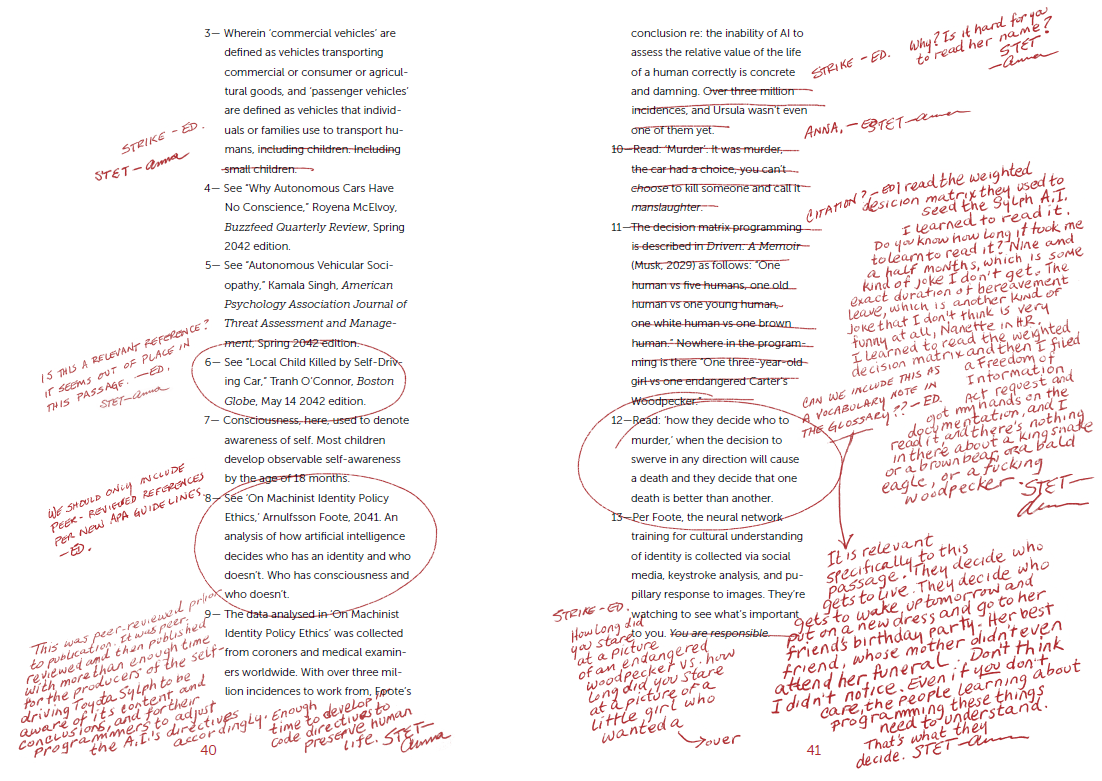
2. "STET" by Sarah Gailey
I read the weighted decision matrix they used to seed the Sylph AI. I learned to read it. Do you know how long it took me to learn to read it? Nine and a half months, which is some kind of joke I don’t get. The exact duration of bereavement leave, which is another kind of joke that I don’t think is very funny at all, Nanette in HR.
This was a very cleverly told tale. It's a 100-word excerpt from a textbook on autonomous cars, with 800 words of footnotes, and then comments from an editor on the footnotes, and then rebuttal comments from the author. A story begins to emerge in all this, about a girl who died. It's cleverly told, and kind of touching, too. I think there's a real point in here, as well (though some of its fearmongering seems kind of overblown, along the lines of this Radiolab episode). The on-line version is neat, but the version in the print edition-- where the comments are handwritten-- is more effective.

1. "The Court Magician" by Sarah Pinsker
The first time he says the word, he loses a finger.
As always, Pinsker nails it, with a clever concept well told. A kid magician from the streets is elevated to become the court magician, and goes from illusions to practicing real magic. Only, the real magic exacts a cost, as he slowly loses everything that he loves. But he keeps going on, because he must know how it works, always wondering if real magic is just another form of illusion. This one sucked me in and kept me going, a perfect little story.

Best Novelette


6. "The Thing About Ghost Stories" by Naomi Kritzer
Something had arrived in a padded envelope, and when I saw the return address, I tore it open eagerly. It was a first-off-the-press copy of The Stories We Tell in the Dark—my book.

I set it down on the counter and just looked at it for a minute. It was published by the Indiana University Press and it looked really good: the cover image was a fog-shrouded forest, very spooky looking without appearing so much like a book for the layperson that no respectable folklorist would consider assigning it to their students in class.
This is essentially just a ghost story. A very well-told ghost story, layered with literary details, but nonetheless not much actually happens in one sense, and things play out fairly predictably. But then again, the story is about the predictable nature of ghost stories, something the story itself sign-posts from the second paragraph, and I still felt tension as the story drew to a conclusion. As an academic, I appreciated the story gets academia largely right, and I found it really well done in parts. But it's still "just" a ghost story.

5. "Nine Last Days on Planet Earth" by Daryl Gregory
“Beauty’s just”—he made explosion fingers—“joy in the brain, right? A flood of chemicals and, and, and—” What was the word? “Fireworks. Neuronal fireworks. We don’t logic our way to beauty, it hits us like a fucking hammer.”
In 1975, strange alien seed pods fall to Earth, blanketing the world, and ten-year-old LT watches. The story jumps ahead in increasing intervals, covering LT's life in this new world. It's a great story, moving and unsettling at the same time, though maybe a little too obviously sentimental. I really enjoyed reading it, but I think that to be ranked higher, it would really need to do more with its sfnal element. Hugo-nominated short sf often feels reluctant to embrace its speculativeness, to prefer to tell literary fiction with speculative trappings. Which is fine, sometimes I like that approach a lot, but award-nominated stuff seems like it should be pushing harder.

4. "If at First You Don't Succeed, Try, Try Again" by Zen Cho
Leslie cleared her throat. “I didn’t get tenure.”

Byam had learned enough about Leslie’s job by now to understand what this meant. Not getting tenure was worse than falling when you were almost at the gates of heaven. It sat down, appalled.

“Would you like me to eat the committee for you?” it suggested.
An imugi (the worm-like nascent form of a dragon) keeps trying to ascend into a dragon and failing, but then it gets sidetracked when it meets a physics graduate student who ruined its most recent attempt. This was really good and kind of moving, and that I loved it but still ranked it down in fourth is a testament to how strong the novelette shortlist was this year. I think "When We Were Starless" and "The Last Banquet" both give me what I want out of sf/f a bit more, but this really got me in the heart, and it has some good jokes, too.

3. "When We Were Starless" by Simone Heller
We told ourselves that we made a difference, that we shaped a world, but one look at this ruined vastness told the truth: we didn’t change a thing, and all our sacrifices were just to survive another day. It was enough, mostly, as long as we pretended it didn’t tear our hearts out.
I struggled to rank this one vs. "The Last Banquet." "When We Were Starless," which follows a member of a sentient race of reptiles on an Earth polluted and abandoned by humanity, is more to my taste as speculative fiction; I love the world and imagery it conjurers up. But at times it is a little too immersive. Heller resists unnatural exposition quite successfully, which sometimes meant scrolling backward and forward while I tried to make sure I understood what happened, which occasionally undermined the story's emotional effect. But I did really like it. It has that aspirational tone of the best (to me) sf. We live in a world without stars, but we know they are there.

2. "The Last Banquet of Temporal Confections" by Tina Connolly
“You will see pain,” she said. “Not your own pain, but another’s. A moment of exquisite pain that someone else is suffering.”
A really clever story, well told, where pastries, properly prepared with the right herbs, can invoke memories in the eater: Rosemary Crostini of Delightfully Misspent Youth, Fennel Flatbread of Sunlit Days Gone By, and so on. The story is told from the point of view of the pastry chef's wife, who serves as taster to the king, so that the pastry chef cannot poison the tyrant king. The story alternates between the present day (a Banquet of Temporal Confections) and the memories invoked by the pastries. A neat idea that enables a neat exploration of memory, with a clever conclusion. I do kind of wish there was more sf in the short fiction categories, but this was good fantasy.

1. The Only Harmless Great Thing by Brooke Bolander
No matter what you did, forty or fifty or a hundred years passed and everything became a narrative to be toyed with, masters of media alchemy splitting the truth's nucleus into a ricocheting cascade reaction of diverging alternate realities.
The premise of this book sounds wacky if you try to explain it to someone: in an alternate reality where elephants are sentient, they are hired to replace the Radium Girls after it comes out how dangerous it is to work in the factories. The book alternates between elephant myths, a former Radium Girl hired to train them, and a researcher in the future, negotiating with the sovereign elephant tribes. But Bolander makes it work, and how. It packs a lot into its short length; it's about history, and labor, and our treatment of animals, and even Disneyfication. I complained in my write-up of "Last Banquet" that I wanted more sf, and I complained in my write-up of "Nine Last Days" that I wanted the sf elements to be more than props, and this story gave me exactly what I wanted on both accounts.

Best Novella


7. Binti: The Night Masquerade by Nnedi Okorafor

This is the only novella finalist I'd read before the ballot came out; in my review, I said it had a "muddled emotional throughline, an overly meandering plot, and too much happenstance." I liked each Binti novella less than the previous one, and this was the third.

6. The Tea Master and the Detective by Aliette de Bodard

It's like Holmes and Watson, except they're both women, and it's in space, and everyone's Vietnamese, and Watson is a former military spaceship traumatized by the death of her crew. I mean, why not? This had lots of great concepts (the Watson-analog spaceship makes money by brewing teas designed to manipulate the brain in specific ways), but as happens a little too often with novellas, I felt like the execution didn't completely live up to the idea; the emotional climax was a little subdued, and the mystery isn't really the focus, disappointingly.

5. The Murderbot Diaries: Artificial Condition by Martha Wells

The sequel to last year's winner is nowhere near as good. All Systems Red was a quick, engrossing action story with a distinct narrative voice. Artificial Condition is slow-moving (I wasn't sure what the story was even going to be about until I was a third of the way in) and the narrative voice is much more bland; I got much less of a sense of character off Murderbot than before. I didn't really get why it thought the so-called "asshole research transport" was an asshole; that seemed like a good joke that had been inadequately set up. I got more out of this than Tea Master, but even though Beneath the Sugar Sky was somewhat unfulfilling, it was at least trying to do something more than this ultimately hollow action piece.

4. Beneath the Sugar Sky by Seanan McGuire

The third Wayward Children book is definitely better than the second, but not as good as the first. In this one, four of the kids (all children who returned to Earth after visiting fantasy worlds via portals) go on a quest to resurrect a dead classmate, in order to ensure the existence of her future daughter-- who is on the quest with them. It's good, but not as good as it should be. McGuire's narrator likes to offer a lot of wise-sounding insight, but would benefit from being more attentive to character; each character has an elaborate backstory, but they often don't feel like they really matter, their actions in the present being kinda interchangeable, including the character who doesn't even want to be on a quest. It's entertaining, though (I like a portal-quest fantasy), and makes better use of the central concept than the second book did. Kept my attention more than Tea Master but didn't entertain me as much as Black God's Drums.

3. The Black God's Drums by P. Djèlí Clark

The best part of this book was its first-person narrative voice, told from the perspective of a black street urchin with an African goddess in her head-- in a steampunk New Orleans in a timeline where the Civil War ended in a draw, but New Orleans is neutral territory. The main character must get help from an airship smuggler captain when it turns out Confederate racists are building a superweapon in secret, in violation of the treaty. It's good fun, with strong worldbuilding and character. Its main weakness was that it felt a little set-up heavy, with not enough actually happening, and I dithered on how to rank it versus Tea Master, but ultimately decided I definitely want there to be a sequel, so Clark kind of gets away with it.

2. Gods, Monsters, and the Lucky Peach by Kelly Robson

I liked this more than any of the other novellas on the shortlist this year. It has interesting worldbuilding (a post-environmental collapse where humans are beginning to reclaim the surface, but different people see it different ways), well-drawn characters, lots of interesting little details, a good sfnal hook, some sharp action sequences, and some good discussion of big ideas. I particularly liked the blending of the fantastic and the mundane: the main character works for an environmental reclamation organization, and has to submit a funding proposal... for a time travel project! But it was a bit too slow moving as the preparation of the grant proposal went on, and though I don't mind a story, especially an sf story, that leaves things open, several key questions posed at the story's beginning go unanswered. It's definitely doing more than any other novella finalist... but it feels more like the opening section of a novel in some ways.

1. No Award

Am I overly grumpy for doing this? Yes, but I am doing it anyway. 2017's novella line-up was outstanding, 2018's had a couple good ones, but 2019's ranges from terrible to above average, and I refuse to rank "above average" as my number one choice for a Hugo Award. Can I say what the problem is? Not really. It's tempting to blame Tor.com (all of these finalists bar The Tea Master and the Detective were their work), but they all have different problems. Gods, Monsters feels like a part of a novel, not a novella; Black God's Drums is a good action story that doesn't use its worldbuilding; the Wayward Children books probably should have stopped after the first one; Murderbot was fun before but this sequel was dull; and Binti is just bad. Several of them, though, suffer from the problem of coming up with good worlds or ideas, but failing to tell good stories about those ideas. I'd like to see a more diverse novellas shortlist in future, but given I only catch up on short sf with the Hugos, I won't be contributing to this myself.

Overall Thoughts


Short story was also a weak category this year; only "Court Magician" had the depth I would want of a Hugo finalist, even though many of the remaining stories were fine. I ranked a Sarah Gailey piece below in No Award in both 2017 and 2018, so I was wondering if it would happen again and if I just didn't get on with their writing, but 2019 shows they can impress me.

Oddly, I felt Best Novelette was highly competitive this year. In 2017, it had one clear frontrunner; in 2018, nothing set me alight. My theory was that the novelette is a fake form. There are no novelettes, just novellas that under-ran or short stories that weren't cut down. But 2019 has proved me wrong, with two excellent stories, three great stories, and one very good story. "Nine Last Days on Planet Earth" would have topped my ballot in 2018, but this year it must languish down in fifth!

I think Muderbot will win Best Novella; if not, it'll be Binti. The other two short fiction categories don't have any obvious top contenders, in my opinion, so I'll be curious to see what sifts to the top.