Showing posts with label creator: jim starlin. Show all posts

07 October 2020

Review: Superboy and the Legion of Super-Heroes, Volume Two by Paul Levitz, Gerry Conway, Joe Staton, et al.

Comic hardcover, 463 pages
Published 2018 (contents: 1978-80)
Acquired July 2018
Read July 2020
Superboy and the Legion of Super-Heroes, Volume Two

Writers: Paul Levitz, Paul Kupperberg, Len Wein, Gerry Conway, Steve Apollo 
Pencillers: James Sherman, Arvell Jones, Joe Staton, Steve Apollo, Dick Dillin, Steve Ditko
Inkers: Bob McLeod, Danny Bulanadi, Jack Abel, Joe Giella, Murphy Anderson, Dick Giordano, Dave Hunt, Joe Staton, Frank Chiaramonte, Vince Colletta, Dan Adkins
Colorists: Cory Adams, Gene D'Angelo, Glynis Wein, Adrienne Roy, Jerry Serpe
Letterers: Ben Oda, Shelly Leferman, Jean Simek, Todd Klein, Mike Stevens, Milt Snapinn

DC inches ever closer to plugging the gap between the last Legion of Super-Heroes Archive and The Great Darkness Saga with this, the second and final volume of Superboy and the Legion of Super-Heroes. (The just-annonced Before the Darkness series will continue from where this collection leaves off.) I'm glad this collection exists, but it's not the Legion's best material.

I don't know much behind-the-scenes information for this era, but the book gives every indication of being jerked around. First we have the five-part Earthwar saga scripted by Paul Levitz, where Earth is invaded by Khunds working for Mordru (to be honest, I don't remember who Mordru is). This is okay: it does nicely subvert your expectations at points, and the events are big... but they never feel big. When Levitz came back to the book for The Great Darkness Saga, he would do much better and more epic work than he did here, and it would feel meaningful to the characters in a way this sorely does not.

James Sherman, why couldn't you have stuck around for more than two issues?
from Superboy and the Legion of Super-Heroes #241 (script by Paul Levitz, art by James Sherman & Bob McLeod)

Then we get a couple issues written or co-written by Len Wein that read like inventory stories to me, with small references to the recent big events shoehorned in. I did kind of like the idea of "Savage Sanctuary!", where the Fatal Five kind of go legit, though the actual story got a bit stupid. The rule forbidding married couples to be in the Legion is rescinded, and thus Saturn Girl and Lightning Lad rejoin, and Lightning Lad is elected to leadership in short order, replacing Wildfire.

Poor Emerald Empress.
from Superboy and the Legion of Super-Heroes #247 (script by Len Wein, art by Joe Staton & Jack Abel)

Then we have a couple stories by Gerry Conway that more directly deal with the aftermath of Earthwar-- suddenly Earth is a wreck in need of repair. These are okay, nothing special. (Brainiac is extra jerk-like, which I assume is to set up the next story, though.)

That's uh, quite an outfit. (How does Reep having the hots for humanoid women fit with Invasion!'s revelation that the actual form of Durlans is a weird squid monster?)
from Superboy and the Legion of Super-Heroes #249 (script by Paul Kupperberg, art by Joe Staton)

Then we have a couple stories by Steve Apollo (better known as Jim Starlin) that were clearly orignally written to slot in around the time of Earthwar, with some last-minute dialogue tweaks: lip service is given to the fact that Lightning Lad is leader, but he and Saturn Girl aren't in the story even though it supposedly features all active Legionnaires (even Tyroc turns up!); Wildfire is clearly in charge. In this story, Brainiac is revealed to be a murderer, having gone insane, and Matter-Eater Lad goes insane, too. Not a lot of it makes sense. I didn't really buy any of this, and why do we need another giant attack on Earth when we just had one?

Tall panel!
from Superboy and the Legion of Super-Heroes #250 (plot & layouts by Steve Apollo, script by Paul Levitz, art by Dave Hunt)

Then Gerry Conway takes over permanently, dealing with the fallout of Apollo's story... but his stories are repetitive (three different ones are about people coming to take revenge on the Legion for slights, real or imagined) and contrived (the one where Superboy makes people think Legionnaires are dead by activating a latent chemical in their bloodstreams is particularly bad). Brainiac is healed in an entirely unconvincing way, and the Legion undertakes bizarre lengths to do it. The only thing I liked was the subplot about how R. J. Brande went bankrupt... but then realized he was a hoarder and gave away all his money.

If my dreams were like this, I wouldn't want to leave them, either.
from Superboy and the Legion of Super-Heroes #252 (script by Gerry Conway, art by Joe Staton & Dave Hunt)

(There's also a couple issues of DC Comics Presents by Levitz included, where Superman gets told by the Legion that he has to let Pete Ross's son be kidnapped by aliens to preserve future history. I found this kind of gross.)

Shouldn't Saturn Girl know that Pete Ross knows Superboy's secret identity, because Pete was a Legionnaire himself?
from DC Comics Presents #13 (script by Paul Levitz, art by Dick Dillin & Dick Giordano)

Finally, the last issue writes out Superboy from the comic that used to bear his name (Superboy vol. 1 became Superboy and the Legion of Super-Heroes became Legion of Super-Heroes vol. 2). I liked how this was done, actually: Superboy finds out how his parents will die. The problem is that when he travels back to the 1950s, he loses his knowledge of future history only to regain it up returning to the 2970s. This means that every time he travels to the future from now on, he will be newly hit with the knowldge of how his parents die. Ouch! He promises to keep up his visits, but the Legion (okay, this part I like less) plant a telepathic block to stop him from doing so, so he flies off to the past for the last time.

Poor Clark.
from Legion of Super-Heroes vol. 2 #259 (script by Gerry Conway, art by Joe Staton & Dick Dillin)

Conway is often not a great writer (I found his run on All Star Comics around this same time pretty bleh), and Legion feels typical of his lesser output. Lots of bombast, not a lot of sense. Which you can kind of get away with in other comics, but Legion is trying to have an ongoing story with ongoing consequences, and those just don't play to Conway's strengths. There are some good artists on the book (e.g., Joe Staton, Jim Starlin), but it's no one's best work. James Sherman, who I really like, does the first couple issues but that's it. His characterful work could have kept this all a bit more grounded, I reckon.

I read a Legion of Super-Heroes collection every six months. Next up in sequence: Five Years Later Omnibus, Volume 1

25 February 2019

Review: Cosmic Odyssey by Jim Starlin, Mike Mignola, and Carlos Garzon

Comic hardcover, n. pag.
Published 2017 (contents: 1988)

Acquired and read September 2018
Cosmic Odyssey: The Deluxe Edition

Writer: Jim Starlin
Penciller: Mike Mignola
Inker: Carlos Garzon
Colorist: Steve Oliff

Letterer: John Workman

I picked this up for three reasons. The first is that I knew Green Lantern: Mosaic continued some of its threads, and I wanted to read that, so reading this first seemed helpful. Additionally, I knew it at least partially took place in space, and I have been trying to read all of DC's space-based comics. (It does have scenes set on both Thanagar and Rann, and Adam Strange is a minor character, but that's about it.) Lastly, I knew it was supposed to be good. When Jim Starlin's The Death of the New Gods came out, a lot of the reviews basically expressed surprise that man who had handled the New Gods so well in Cosmic Odyssey did so poorly in Death of the New Gods.

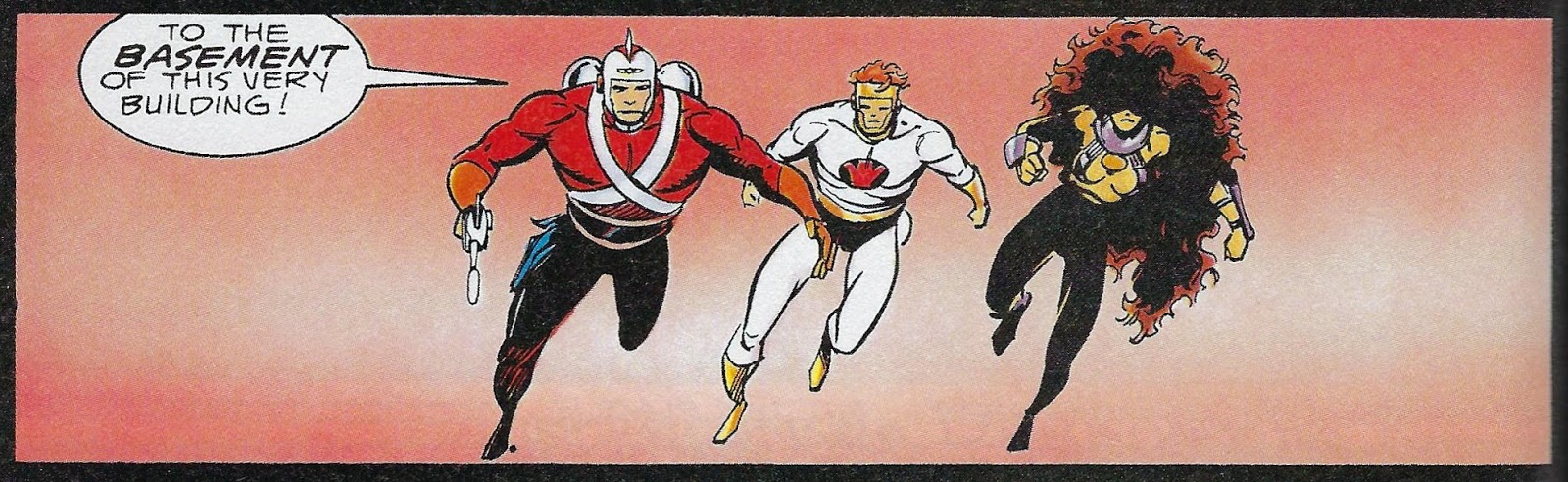
Adam Strange, you deserved better. Should have stayed out of sight like the Hawks apparently did on Thanagar.
from Cosmic Odyssey #2

Well, I don't know what any of those people were thinking, because Cosmic Odyssey's take-- like so many other post-Kirby takes on the New Gods-- is terrible. Like in Death of the New Gods, they're not portrayed as gods here; the way Starlin writes them, they're basically just sci-fi aliens who call themselves gods. The New Gods should not be demeaned by explanations about pocket dimensions and sectors of space. They should not be engaging in technobabble. And certainly, the anti-life equation is not a thing you use to power an enormous space cannon! Like, Darkseid has not been scouring the cosmos for something as tawdry as a power source for a space cannon! The anti-life equation is the absence of free will, not a blob that flies around building bombs that blow up planets.

Gods don't originate in sectors!
from Cosmic Odyssey #1

Even outside of that, this isn't a good comic. The title implies an epic. What we get instead is one of those old 1960s Justice League of America-style stories where a big group gets together, but then everyone splits up and carries out side quests in groups of two: Superman and Orion, John Stewart and the Martian Manhunter, Batman and Forager, and Starfire and Lightray. Plus, John Stewart messes up and causes a planet's entire population to die... but only because of incredibly poor, out-of-character writing. He spends the whole book telling everyone his ring can do everything and he doesn't need their help at all. Because of this, the planet Xanshi explodes when he leaves the Martian Manhunter behind to confront the anti-life entity alone and it turns out it painted its bomb yellow. (In Green Lantern: Mosaic, John actually thinks back to this and decides he must have been crazy because there's no other explanation for his behavior.)

WHAT COULD POSSIBLY GO WRONG?
from Cosmic Odyssey #2

The end of the story descends into thaumababble when Doctor Fate turns up and saves everyone.

In panel #1, Doctor Fate says each of the five have a different source of power. Then, in panel #3, he rattles them all off... and Orion and Highfather have the same one. Do you even know what you're talking about, dude?
from Cosmic Odyssey #4

I did kind of like the idea of Metron discovering the anti-life equation and being destroyed by it just because of his insatiable idea to know things. Too bad it couldn't have been embedded in a better story.

I did like the art of Mike Mignola a lot; how could you not? Mignola and the New Gods are a great pairing; it's only a shame the real New Gods aren't actually here, just these counterfeit sci-fi aliens. Jim Starlin did a great job with DC's sci-fi comics in 1990s and 2000s, but judging by this and Death of the New Gods, the mythical aspects of DC are beyond his abilities. Based on his Thor run, I can see why Walter Simonson would be praised for his take (I haven't read Simsonson's Orion Omnibus yet), because unlike Starlin, he knows how to write gods as gods.

27 July 2016

Faster than a DC Bullet: Project Gotham, Part XXXII: DC Comics Classics Library: Batman: A Death in the Family

Comic hardcover, 271 pages
Published 2009 (contents: 1988-89)

Borrowed from the library
Read January 2016
DC Comics Classics Library: Batman: A Death in the Family

Writers: Jim Starlin, Marv Wolfman
Layouts and Co-Plotter: George Pérez
Pencillers: Jim Aparo, Tom Grummett
Inkers: Mike DeCarlo, Bob McLeod

Year Twelve, November - Year Thirteen, June
One of the results of the continuity-driven nature of superhero comics is that there are a number of comics known better for what happened in them than how it happened. A Death in the Family is one of those stories. Chronicling the death of the second Robin, Jason Todd (who's only been in the role for two years, poor fellow), A Death in the Family is just not a good story. It lurches along weirdly and depends on coincidence way too much, and even for a superhero comic, it's contrived: the idea that Iran would appoint the Joker its UN ambassador is untenable, a completely bizarre merging of comic goofiness with real-world politics that is tonally misjudged.

But let's start at the beginning with this one. A Death in the Family seems to have been originally designed as a six-issue story but released as a four-part one, as its first and second issues both consist of two 22-page chapters. The first has Jason acting particularly like a jerk, and Batman benching him as a result. Their relationship hasn't particularly been consistent in the Jason stories I've read: Jason is very bloodthirsty in the the beginning of Second Chances, pretty chummy with Batman later on in the same book (except for learning that Batman hid who killed his father from him), and they got along perfectly in Ten Nights of the Beast and The Cult. But now Jason is a jerk again, and Batman doesn't handle it well at all.

Your hero, ladies and gentlemen!; or, Don't you think kids who are little bit snotty deserve to be brutally murdered?
from Batman vol. 1 #426 (script by Jim Starlin, art by Jim Aparo & Mike DeCarlo)

I really don't get why this approach was taken. A character's last story should show them at their best, to make you really regret it when they're gone; for all their flaws, later DC shock killings like Identity Crisis and Countdown to Infinite Crisis got this exactly right, sending Sue Dibny and Blue Beetle out on career highs. This story should show Jason Todd as his heroic best as Robin. But A Death in the Family, bizarrely, wants to make you glad he's dead.

Batman discovers that the Joker is trying to sell a cruise missile to terrorists in Lebanon at the exact same time Jason realizes that the woman he thought was his mother actually isn't, and that a woman who might be his birth mother is-- completely coincidentally-- also in Lebanon. So while Batman shuns his runaway sidekick to chase the Joker (apparently there's no one Batman can ask for help; if only he wasn't always such a jerk to Nightwing), the two end up in the same place anyway and team up.

20 July 2016

Faster than a DC Bullet: Project Gotham, Part XXXI: Batman: The Cult

Comic trade paperback, n.pag.
Published 1991 (contents: 1988)

Borrowed from the library
Read January 2016
Batman: The Cult

Writer: Jim Starlin
Illustrator: Bernie Wrightson
Color Artist: Bill Wray
Letterer: John Costanza

Year Twelve, September
This is my last Jason Todd story prior to his death. The Cult concerns the rise of a charismatic speaker in Gotham City, who organizes the underclass and seals the city off from the outside world; large parts of this plot were adapted for the film The Dark Knight Rises, though instead of Batman being gone while this happens, Batman is being broken. Not physically, but emotionally. The book opens with Batman already captured by Deacon Blackfire and his cult, and the brainwashing well underway.

The comics equivalent of rapid crosscutting here is a really interesting technique, and one I don't think I've seen before. It's confusing when you first transition (the Batman on the left is from a dream he's having where he's committed murder; the one on the right is the actual Batman, hanging in Deacon Blackfire's lair), but that's the point.
from Batman: The Cult #1

What makes this book works so well is Bernie Wrightson. I primarily know Wrightson from his contributions to DC horror comics like The House of Mystery, The House of Secrets, and The Witching Hour!, and The Cult puts him to good use depicting the existential horror that is Batman's mental breakdown, as well as the collapse of all Gotham society. His Batman is a devastated man, and despite the fact that a cowl covers half his face, his Batman communicates the anguish he is experiencing quite well. Panel transitions are used quite well, too, to show how Batman is flickering back and forth between different mental states: we'll jump between the world-as-it-is and the world-as-Batman-sees-it quite rapidly, showing his struggle. Wrightson's art (especially aided by colorist Bill Wray) is grotesque when it needs to be. I hate to complain about someone with the skills of Jim Aparo, but Wrightson is clearly a much better match for Jim Starlin's Batman sensibilities, and it's a shame there's not much more Batman work from him.

13 July 2016

Faster than a DC Bullet: Project Gotham, Part XXX: Batman: Ten Nights of the Beast

Comic trade paperback, 96 pages
Published 1994 (contents: 1988)

Borrowed from the library
Read January 2016
Batman: Ten Nights of the Beast

Writer: Jim Starlin
Penciller: Jim Aparo
Inker: Mike DeCarlo
Colorist: Adrienne Roy
Letterers: John Costanza, Agustin Mas

Year Twelve, June
I'm sort of pushing the definition of Batman's "early years" at this point, but I wanted to maximize my Jason Todd stories before seeing him get killed off in A Death in the Family. He actually doesn't play a very big role in Ten Nights of the Beast, which pits Batman against the KGBeast, the trained Soviet assassin. I'd first encountered him in the uncollected miniseries Robin III: Cry of the Huntress, but this was his first appearance. Here he goes rogue and travels to Gotham City to disrupt the Star Wars missile defense program, and Batman must team up with the Gotham PD, the FBI, the CIA, and the KGB to stop him. The KGBeast has a list of ten key Star Wars personnel (conveniently, they're all residents of Gotham or will visit it during the same week) that he's working his way through, but despite acquiring his list early in the book, the KGBeast is so strong and powerful there's not a whole lot Batman can do to stop him: Batman gets pushed to his limit as the KGBeast kills person after person on the list, plus anyone who gets in his way. (Or gets his Iranian Shi'ite terrorist friend to do it for him.)

One of my favorite things in comics is people who have to wear hats to disguise the masks they're wearing as a disguise.
from Batman vol. 1 #419

The problem is that the KGBeast is so good that the story becomes implausible. There is an early effort to move one of the people on the list out of town, but other than that, Batman and company take little preventative action. The last person on the list is President Reagan,* who for some reason still comes to Gotham for a fundraising dinner! It really pushes my credulity that in a circumstance where the KGBeast has caused deaths in the triple digits in pursuit of his goal that anyone would think it appropriate to bring the President of the United States into the city where's he operating. Also, given Batman only saves the lives of about three of the people on the KGBeast's list, I don't see how the Star Wars program isn't permanently crippled. It's a very small victory, I guess.

Greatest double-take in the history of comics?
from Batman vol. 1 #420

Jim Starlin seems to really like stories where Batman is pushed to his limit-- it's something we'll see again in The Cult and A Death in the Family-- but this one doesn't really work for me; you don't feel the desperation to the extent the story needs you to. I'll expand on this in my writeups of both those collections, but I think the problem is Jim Aparo. Or rather, the Starlin/Aparo collaboration. Aparo is a great artist and supposedly a great Batman artist, but I think he's more remembered for his ten-year run on The Brave and the Bold than his late 1980s Batman stint, where I don't think he's a good tonal match for Starlin's dark and brutal scripts. But like I said, more on that next week.

* Previous appearances of Ronald Regan include Legends, Millennium, and the Deadman storyline in Action Comics Weekly. There's probably more I'm forgetting. Invasion!, maybe? DC Comics really loved this guy, I guess.

Next Week: Batman faces a Dark Knight of the Soul when he comes up against The Cult!

15 June 2016

Faster than a DC Bullet: Project Gotham, Part XXVI: Batman: Second Chances

Comic trade paperback, 276 pages
Published 2014 (contents: 1986-87)

Borrowed from the library
Read November 2015
Batman: Second Chances

Writers: Max Allan Collins, Jo Duffy, Jim Starlin
Pencillers: Jim Starlin, Denys B. Cowan, Chris Warner, Ross Andru, Dave Cockrum, Kieron Dwyer, Jim Aparo, Norm Breyfogle
Inkers: Jim Starlin, Greg Brooks, Mike DeCarlo, Dick Giordano, Don Heck, Norm Breyfogle
Colorists: Daina Graziunas, Adrienne Roy
Letterers: John Costanza, Todd Klein, Agustin Más, Albert DeGuzman

Year Ten, October
Out of universe it's been ten years, but in universe it's just been two since Batman moved to a downtown penthouse and Dick Grayson went off to college. Now Bruce is back in Stately Ward Manor and there's a new Robin in town. Second Chances collects twelve stories, whose unifying feature is that the majority of them are by Max Allan Collins, and all of them feature Jason Todd as the new Robin. (Unfortunately, there's almost no consistency in the artistic team.)

The book opens with a two-part tale: "There's Nothing So Savage-- As a Man Destroying Himself!"/"One Batman Too Many." Criminals are turning up violently murdered... seemingly by the Batman! Jim Starlin provides some great, dynamic layouts in the first half, which I really enjoyed; the second part, where the faux Batman escapes Arkham and Batman hunts him down, was less interesting, partly because the art of Denys Cowan and Greg Brooks was not as sharp as Starlin's. In this story, Jason is already the new Robin, and evidencing a slight bloodthirsty streak, as he wonders if Batman maybe should be employing some of the techniques of his impersonator.

The book then jumps backward to explain how Jason got to be the new Robin; "Did Robin Die Tonight?" opens with Dick Grayson still operating as Robin, receiving an injury at the hands of the Joker. Bruce fires Robin: "In what I do, there is no place for a child. [...] Son, I'm sorry. And you are a man-- man enough to accept my decision." We don't even see what happens to Dick, though; he informs Bruce that though Robin will stay "dead," he has a destiny to pursue, but as far as we see, he doesn't even leave. What's he off doing? Who knows! After operating solo for a little bit, Batman goes to visit Crime Alley on the anniversary of his parents' death, where while he's out walking (Batman strolling down the street, saying "Gentlemen" to a pair of men on the sidewalk, is a surreal sight), a juvenile delinquent steals the tires off the Batmobile.

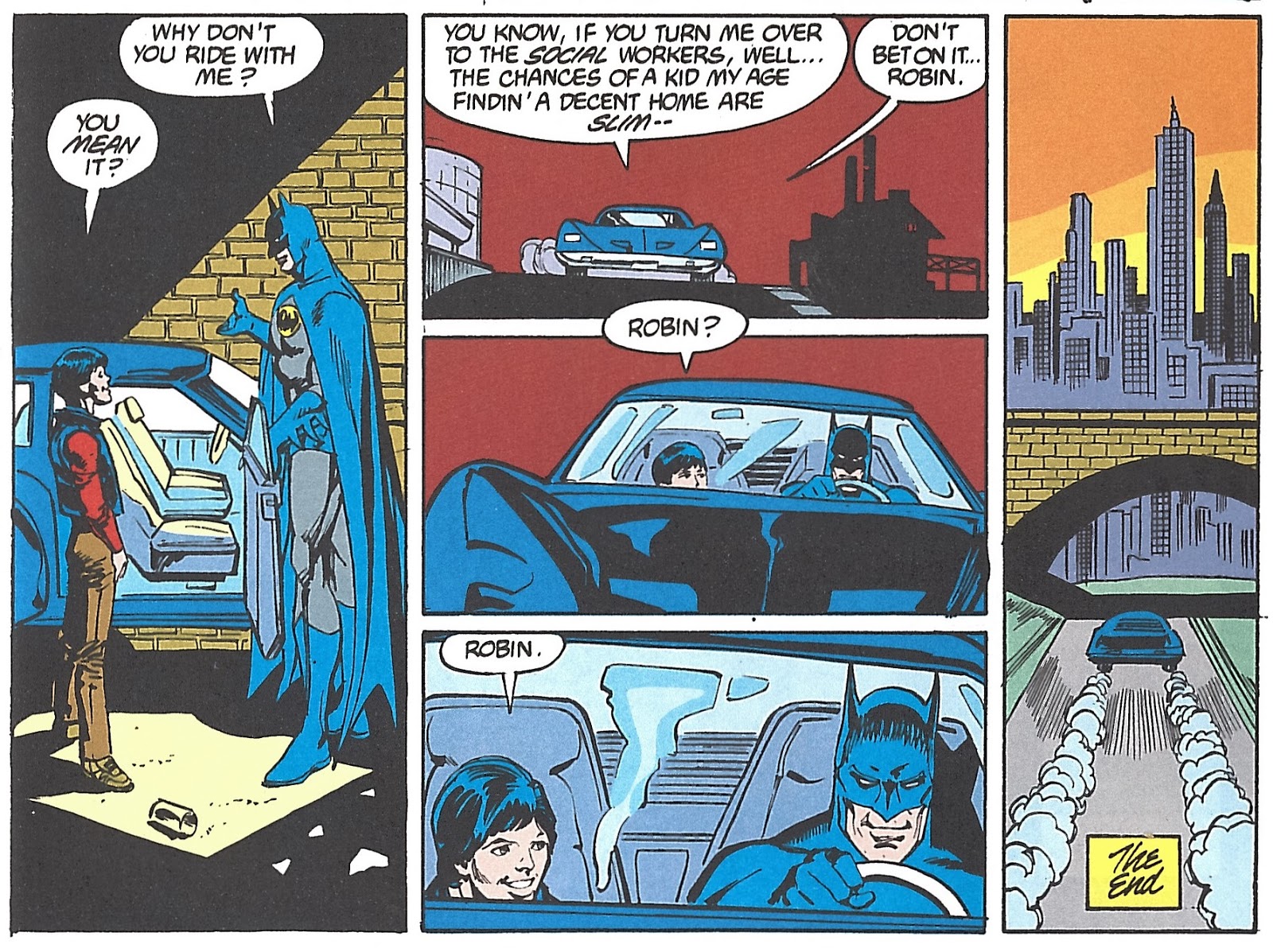
Batman enrolls Jason in a reform school, but in "Just Another Kid on Crime Alley," it's revealed the school is actually a front for a crime ring, which Jason helps Batman break up. And then, even though Batman just claimed he didn't want any kids around, he's calling Jason "Robin" just like that. If I was Dick, I'd be ticked off! I know from reading interviews with Collins was that the idea was Jason would live a life so dangerous on the streets that being Robin was actually a safer alternative, but no one in the story actually says this, and it's not convincing: surely Bruce making Jason his ward without revealing he was Batman would be safer than either crime or crime-fighting!

"Dick Grayson? Who cares about Dick Grayson? Screw that guy."
from Batman vol. 1 #409 (script by Max Allan Collins, art by Ross Andru & Dick Giordano)

The next few stories chronicle the early days of Jason Todd as Robin, as they face Two-Face, who turns out to be responsible for Jason's father's death. It's a lot of weird, Silver Age-style hijinks, with Two-Face employing the "Dopple Gang" and robbing one of Gotham's two major league baseball stadiums during the second half of the second inning when there's two strikes, two balls, and two men on base! It's not Starlin's best work on the title. I assume the intro story about the false Batman slots in here, before the next couple tales, each more weird than the last: an evil mime and a samurai ghost.

That last tale is by Jo Duffy, and then Jim Starlin takes over as writer. His first story is a sort of grim, but consequence-free story of Batman hunting a serial killer. With only 22 pages to make us care about some woman and kill her off, the story isn't big enough to succeed. Then Batman discovers Commissioner Gordon is a Manhunter in a crossover with Millennium that totally does not stand on its own, and then Dick Grayson comes back in "White Gold and Truth"-- which is dated "ONE YEAR AGO." I have no idea where that's mean to place it relative to the other stories in the volume.

This story finally fills in what Dick Grayson has been up to. In a retcon I don't think later writers abided by, allegedly all of Dick's adventures with the Teen Titans occurred after he left Batman's company. Dick's retelling of their split is also a little more acrimonious than the one we saw in "Did Robin Die Tonight?" Bruce and Dick argue, but Dick and Jason team up to beat up some criminals while Bruce smiles from the rooftop, unseen. It feels more like a patch over Collins's sparse story than a story of its own.

Collins isn't all done; the last story in the book is "Love Bird," a cute tale illustrated by Norm Breyfogle about a paroled Penguin seeking love and trying to go straight.

A common denominator between many of these stories is the presence of Vicki Vale as Bruce's girlfriend who hates the Batman and also hates Bruce's idling about all the time. Her presence is inconsistent; Collins seems to keep forgetting about her. As a result, I never really had a good feel for what she and Bruce saw in each other, so she comes across as largely superfluous.

"Batman, if you just drive a couple more miles to the other Kroger's, their bananas are two cents cheaper!"
from Batman vol. 1 #402 (script by Max Allan Collins, art by Jim Starlin)

So: historically important tales, yes, but inconsistent in quality. But I got very intrigued from this era of Batman history, and I actually added a few more 1980s/Jason Todd stories to my list after reading it, wanting to flesh him and his era out before hitting A Death in the Family. These came out after Batman: Year One, but that story didn't change the other Batman tales overnight; these later stories feel like a weird jumble of the Silver Age aesthetic and the Frank Miller one (Commissioner Gordon looks more like a jolly grandpa than a hard-hitting cop/special forces vet), and I look forward to seeing how that changes over time.

Next Week: It's Year One again as Huntress makes her debut on the Gotham stage!

27 January 2016

Faster than a DC Bullet: Project Crisis!, Part XL: The Death of the New Gods

Comic trade paperback, 246 pages
Published 2008 (contents: 2007-08) 

Borrowed from the library
Read May 2015
The Death of the New Gods
​
Writer and penciller: Jim Starlin 
Inkers: Matt Banning, Art Thibert, Mark McKenna
Colorist: Jeromy Cox
Letterers: Jared K. Fletcher, Travis Lanham, Randy Gentile, Steve Wands

Whether this book should even exist is pretty debatable: it's supposed to tie into Final Crisis, but like most Final Crisis tie-ins, it would ultimately do so in a way not very consistent with that book. To wit: all the New Gods die here, in front of Superman, but no one seems to know about this when Final Crisis rolls around.

The book has bigger crimes, though, and those are that it takes Jack Kirby's amazing cosmic epic and crams it into a procedural. The Death of the New Gods should be an operatic tragedy... instead it's a murder mystery? It's a weird misjudging of genre that transforms something mythic into something ordinary. These characters don't feel like gods, but squabbling aliens from any number of mid-range science fiction television shows. Plus, it's not even a good mystery; ten minutes after reading it, and I couldn't have explained to you what had happened exactly, and the revelation of the "villain" is beyond silly. Jack Kirby knew characters had to be reinvented to keep them vital, but this was not the way to reinvent the New Gods-- and I'm surprised that after his runs on cosmic titles for both Marvel and DC, Jim Starlin couldn't do better than this.

Next Week: We reach zero, both issue-wise and quality-wise, in the final volume of Countdown to Final Crisis!

03 November 2007

Archival Review: Mystery in Space with Captain Comet, Volume One by Jim Starlin

Mystery in Space with Captain Comet, Volume One

Writer: Jim Starlin
Pencillers: Shane Davis, Jim Starlin
Inkers: Matt "Batt" Banning, Al Milgrom
Colorists: Jeromy Cox, Jim Starlin
Additional Colors: Guy Major
Letterers: Phil Balsman, Rob Leigh, Jared K. Fletcher


Once I was in the comic book store, and I saw this series called Mystery in Space.  No 2007 book can normally have such an awesome title, and it was all I could do to stop myself from buying the whole series on the spot.  I succeeded in self-control by going home and putting the trade paperback collection on preorder. 

Fortunately, the book did indeed turn out to be quite good-- it's exactly what it says on the tin, a mystery story set in space.  Captain Comet is an instantly likeable protagonist (now I am very tempted to seek out his previous adventures) and Hardcore Station is a good setting (good enough that I immediately tracked down the 1998 miniseries of that title and read it too).  The standout character is Tyrone, Comet's bulldog that has been genetically engineered to be sentient-- artist Shane Davis manages the extraordinary feat of giving him discernible facial expressions.  Looking forward to Volume Two.