Showing posts with label creator: carlos garzon. Show all posts

27 December 2021

Review: Justice Society of America: Home Again! by Len Strazewski, Mike Parobeck, Mike Machlan, et al.

I guess The Demise of Justice (or Vengeance from the Stars!, as it was known back then) must have done well, because in short order, a few members of its creative team were reunited to put together the first-ever self-titled ongoing series for the JSA. Len Strazweski, writer, and Mike Parobeck, penciller on issues #3 and 5, were joined by Mike Machlan, who had JSA experience as an inker on All-Star Squadron and Infinity, Inc. Alas, this "ongoing" lasted a mere two issues longer than the "mini" that birthed it!

It's not intuitive to me that because Len Strazewski had been a good writer of a retro-set JSA story that he would be the man to bring them back in the present day. It's a very different idea! But man, he sure was.

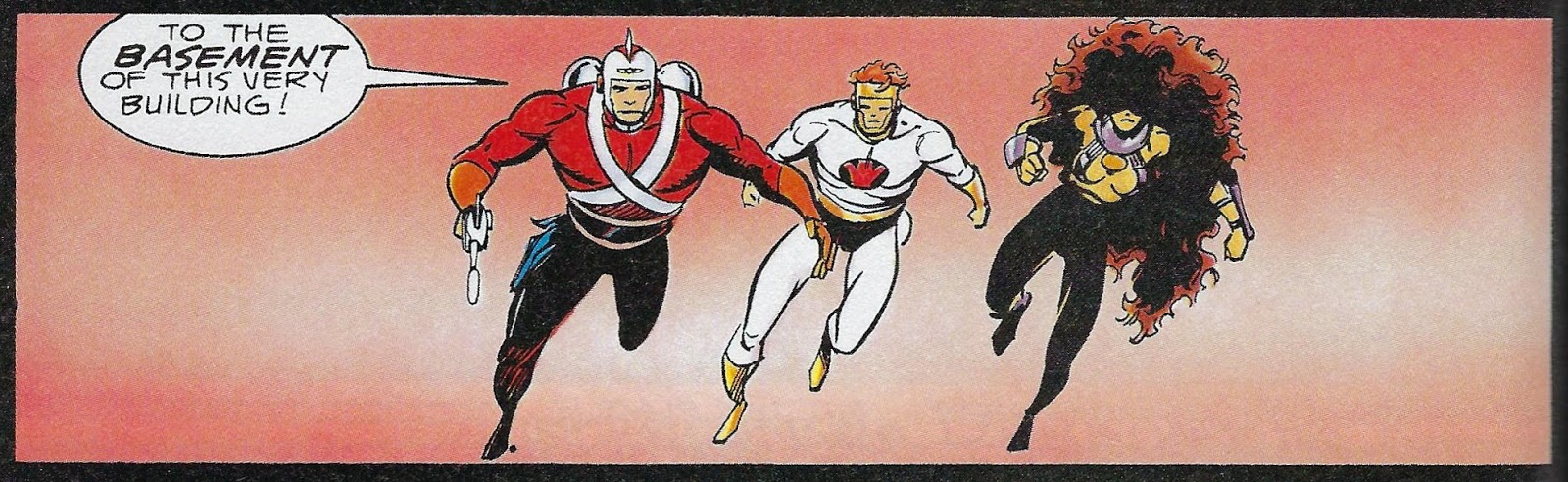
The series begins with a prologue set shortly after Armageddon: Inferno, with the JSA being heralded at a big event to welcome them home after their years fighting in the simulation of Ragnarok. (In a nice touch, Clark Kent is in the audience, and he is a total fanboy at getting to see the JSA again.) The series then jumps forward a couple months to let the JSA members settle into their lives again and pick up with what they're doing now. As the first present-day post-Crisis JSA ongoing, Justice Society vol. 2 can make use of a lot of the ideas Roy and Dann Thomas introduced in All-Star Squadron and Infinity, Inc. for the first time. For example, A-SS's Johnny Quick reappears, and we learn that since we last saw him way back in 1942, he and Liberty Belle had a daughter and got divorced. This daughter, Jesse, is writing a dissertation on superheroes, and has inherited her father's super-speed (now revealed to be a consequence of Invasion!'s metagene); she quickly (ha!) becomes involved with the JSA as superheroine "Jesse Quick." (Plus Gernsback the robot is even installed in the JSA's new headquarters!) Infinc's Rick "Hourman II" Tyler reappears, now succumbing to Miraclo-induced cancer. The Hawks don't want to join a new JSA at first, being in mourning over the death of their son Hector in The Sandman. (On the other hand, it's a bit odd to read about this series's Wes "Sandman" Dodds, a rare appearance of his post-Crisis but pre-Sandman Mystery Theatre incarnation. This version of the character was being wiped out right as JSA vol. 2 drew to a close.)

from Justice Society of America vol. 2 #2
(art by Mike Parobeck & Mike Machlan)
The strengths of this series are many, but one of them is in carving out a place for the JSA in the present-day DC universe, the first time this had really been done post-Crisis. They fit into a heroic lineage now, in a way that Roy Thomas was beginning to exploit in Infinc but really comes into its own here. Bit by bit, we are seeing the way that the JSA was largely depicted in the 1990s and 2000s come into being. Wally West shows up for a bit, and is wowed by Jay Garrick; Guy Gardner has a showdown with Alan Scott while under the influence of an ancient Egyptian god's hate spell. But Strazewksi also has a light touch when it comes to continuity. Though some Infinc characters reappear, the series isn't bogged down in revisiting, say, Doctor Mid-Nite II, or in spending lots of time explaining what's up with Wildcat's legs.

Another of the series's strengths is its characterization. Strazewksi hits exactly the balance I like to see in a superhero comic. No issue ever lacks for a fight scene-- but each issue usually also finds time for an extended conversation. Strazewksi's writing is heart-warming without being saccharine, and he has a great handle on the present-day JSA members. My favorite touch is that of all the JSA, Al "the Atom" Pratt is the most like a grumpy old man. It's like, of course he is, because he had a chip on his shoulder since his college days... but he was also the youngest of the original JSA by far, so it's ironic, too! The interplay between him and Wildcat was especially great, but I loved seeing all of them in action: Alan Scott, Jay Garrick, Charles McNider, Johnny Thunder, and so on.

In the lettercol to issue #10, Strazewski says he was inspired by seeing Buckminster Fuller and pre-WWII woman union members: "the senior heroes of my experience, folks [...] who had been making their statements and bucking conventional wisdom for decades[,] seemed to me, for want of a better word, secure." There's no angst here, just pleasure in a job they've always loved doing.

On top of that we have fun stories and good art. Mike Parobeck has a clean, heroic, retro style, perfectly suited to the world's first superhero team. You can tell all his characters apart even as civilians (not every superhero artist can do this); they have distinct builds and faces and hairstyles. The action is usually clear and clean. The plots are solid: the JSA battles evil experimenters (surprise, it's Ultra-Humanite), goes back to Badhnesia (where Johnny's powers come from) to find out what happened to its people, and stops a deadly hate plague spread by Spectre foe Kulak. I had a blast reading every single issue.

It's a shame, of course, that the series ended so soon; one senses that they were just getting started. Jesse Quick does a little, but not a lot; Kiku, the new ward for Johnny Thunder who gains some power over the Thunderbolt, hardly does anything. Future writers would pick up on Jesse, but I am pretty sure Kiku is forgotten. At the end of issue #10, Starman and the Sandman have only just got back into action. (Starman, by the way, clearly has one son, not two.) But even still, Strazewski, Parobeck, and Machlan carved out a way for the JSA to remain relevant in the 1990s and beyond; I think there's a direct line from what they did here to how David Goyer and James Robinson ultimately brought the JSA back in 1999. (But more on that later! Much later at the rate I am going.)

Justice Society of America vol. 2 was originally published in ten issues (Aug. 1992–May 1993). The series was written by Len Strazewski; pencilled by Mike Parobeck; inked by Mike Machlan (#1-10), Matt Banning (#5), Jeff Albrecht (#5), and Carlos Garzon (#6); lettered by Bob Pinaha; colored by Glenn Whitmore; and edited by Brian Augustyn.
 
This post is twenty-second in a series about the Justice Society and Earth-Two. The next installment covers the Alan Scott stories in Green Lantern Corps Quarterly. Previous installments are listed below:
  1. All Star Comics: Only Legends Live Forever (1976-79)
  2. The Huntress: Origins (1977-82)
  3. All-Star Squadron (1981-87)
  4. Infinity, Inc.: The Generations Saga, Volume One (1983-84)
  5. Infinity, Inc.: The Generations Saga, Volume Two (1984-85)
  6. Showcase Presents... Power Girl (1978)
  7. America vs. the Justice Society (1985)
  8. Jonni Thunder, a.k.a. Thunderbolt (1985)
  9. Crisis on Multiple Earths, Volume 7 (1983-85)
  10. Infinity, Inc. #11-53 (1985-88) [reading order]
  11. Last Days of the Justice Society of America (1986-88)
  12. All-Star Comics 80-Page Giant (1999)
  13. Steel, the Indestructible Man (1978)
  14. Superman vs. Wonder Woman: An Untold Epic of World War Two (1977)
  15. Secret Origins of the Golden Age (1986-89)
  16. The Young All-Stars (1987-89)
  17. Gladiator (1930) ["Man-God!" (1976)]
  18. The Crimson Avenger: The Dark Cross Conspiracy (1981-88)
  19. The Immortal Doctor Fate (1940-82)
  20. Justice Society of America: The Demise of Justice (1951-91)
  21. Armageddon: Inferno (1992)

25 February 2019

Review: Cosmic Odyssey by Jim Starlin, Mike Mignola, and Carlos Garzon

Comic hardcover, n. pag.
Published 2017 (contents: 1988)

Acquired and read September 2018
Cosmic Odyssey: The Deluxe Edition

Writer: Jim Starlin
Penciller: Mike Mignola
Inker: Carlos Garzon
Colorist: Steve Oliff

Letterer: John Workman

I picked this up for three reasons. The first is that I knew Green Lantern: Mosaic continued some of its threads, and I wanted to read that, so reading this first seemed helpful. Additionally, I knew it at least partially took place in space, and I have been trying to read all of DC's space-based comics. (It does have scenes set on both Thanagar and Rann, and Adam Strange is a minor character, but that's about it.) Lastly, I knew it was supposed to be good. When Jim Starlin's The Death of the New Gods came out, a lot of the reviews basically expressed surprise that man who had handled the New Gods so well in Cosmic Odyssey did so poorly in Death of the New Gods.

Adam Strange, you deserved better. Should have stayed out of sight like the Hawks apparently did on Thanagar.
from Cosmic Odyssey #2

Well, I don't know what any of those people were thinking, because Cosmic Odyssey's take-- like so many other post-Kirby takes on the New Gods-- is terrible. Like in Death of the New Gods, they're not portrayed as gods here; the way Starlin writes them, they're basically just sci-fi aliens who call themselves gods. The New Gods should not be demeaned by explanations about pocket dimensions and sectors of space. They should not be engaging in technobabble. And certainly, the anti-life equation is not a thing you use to power an enormous space cannon! Like, Darkseid has not been scouring the cosmos for something as tawdry as a power source for a space cannon! The anti-life equation is the absence of free will, not a blob that flies around building bombs that blow up planets.

Gods don't originate in sectors!
from Cosmic Odyssey #1

Even outside of that, this isn't a good comic. The title implies an epic. What we get instead is one of those old 1960s Justice League of America-style stories where a big group gets together, but then everyone splits up and carries out side quests in groups of two: Superman and Orion, John Stewart and the Martian Manhunter, Batman and Forager, and Starfire and Lightray. Plus, John Stewart messes up and causes a planet's entire population to die... but only because of incredibly poor, out-of-character writing. He spends the whole book telling everyone his ring can do everything and he doesn't need their help at all. Because of this, the planet Xanshi explodes when he leaves the Martian Manhunter behind to confront the anti-life entity alone and it turns out it painted its bomb yellow. (In Green Lantern: Mosaic, John actually thinks back to this and decides he must have been crazy because there's no other explanation for his behavior.)

WHAT COULD POSSIBLY GO WRONG?
from Cosmic Odyssey #2

The end of the story descends into thaumababble when Doctor Fate turns up and saves everyone.

In panel #1, Doctor Fate says each of the five have a different source of power. Then, in panel #3, he rattles them all off... and Orion and Highfather have the same one. Do you even know what you're talking about, dude?
from Cosmic Odyssey #4

I did kind of like the idea of Metron discovering the anti-life equation and being destroyed by it just because of his insatiable idea to know things. Too bad it couldn't have been embedded in a better story.

I did like the art of Mike Mignola a lot; how could you not? Mignola and the New Gods are a great pairing; it's only a shame the real New Gods aren't actually here, just these counterfeit sci-fi aliens. Jim Starlin did a great job with DC's sci-fi comics in 1990s and 2000s, but judging by this and Death of the New Gods, the mythical aspects of DC are beyond his abilities. Based on his Thor run, I can see why Walter Simonson would be praised for his take (I haven't read Simsonson's Orion Omnibus yet), because unlike Starlin, he knows how to write gods as gods.