Showing posts with label creator: gerry conway. Show all posts

03 January 2024

Legion of Super-Heroes: Before the Darkness, Volume Two by Gerry Conway, Roy Thomas, Paul Levitz, Steve Ditko, Frank Chiaramonte, Bruce Patterson, Carmine Infantino, et al.

Legion of Super-Heroes: Before the Darkness, Volume Two

Collection published: 2022
Contents originally published: 1980-82
Acquired: February 2022
Read: October 2023

Writers: Gerry Conway, Roy Thomas, Paul Levitz
Artists: Jim Janes, Steve Ditko, Frank Chiaramonte, Bruce Patterson, Carmine Infantino, José Luis García-López, Dick Giordano, Howard Bender, Rodin Rodriguez

Containing Legion of Super-Heroes vol. 2 #272-83, this collection fills in the last part of the gap between the last of the Legion of Super-Heroes Archives and The Great Darkness Saga deluxe edition, meaning that DC has collected a full run of the Legion from 1958's Adventure Comics #247 to 1984's Legion of Super-Heroes #313, which is quite frankly astounding. (Now all I have to do is track down the last four archives I need...) As a friend of mine has pointed out, there's no series other than the Legion where DC kept going once the archives sputtered out.

What is less astounding is the actual stories collected here. While volume one had a certain madcap old-school sci-fi charm, thanks to that volume's main scripter Gerry Conway, this one was much more the typical pedestrian Legion of the 1970s. Don't get me wrong, there's a lot of the typical Legion melodramatics here, including an extended storyline where Ultra Boy seemingly dies but actually loses his memory and becomes a space pirate. But I found it hard to care, you know? The characters seemed to lack the solid grounding that makes the best Legion stories sing. I found it really hard to care about Reflecto or the Time Trapper here. Perhaps part of the issue is that none of the regular artists are among the Legion greats, even when they've done good work elsewhere.

I always enjoy some Blok.
from Legion of Super-Heroes vol. 2 #272 (script by Gerry Conway, art by Steve Ditko & Frank Chiaramonte)

The one thing you can say in favor of this saga is that it does also explain away Brainiac 5's turn into villainy and murder way back in Superboy and the Legion volume two. Perhaps we'd have been better off ignoring that, to be honest, but I guess it's good for one of our heroes to not be murdering women in squalid apartments, even when insane. This volume has a lot of the slow-simmering background plotlines that would be perfected during the Levitz and Giffen era, but they aren't so effective here; eventually I started to wonder if there would ever be any movement on the "Colossal Boy's mother is president of Earth" and "maybe Timber Wolf is going to leave the team" threads that never seemed to go anywhere.

It works well to find out Wildfire's bluster is balanced out by deep-set self-loathing.
from Legion of Super-Heroes vol. 2 #283 (script by Roy Thomas, art by Howard Bender & Bruce Patterson)

My favorite story was a small one, and surprisingly the work of Roy Thomas. I mean, I enjoyed Roy's work on DC's Earth-Two stuff, but I don't feel like he has a particular aptitude for the Legion. But he gives a solid and keen look into the origin of Wildfire, showing the insecurities of the Legion's most blustering member. Nice stuff.

I read a Legion of Super-Heroes collection every six months. Next up in sequence: Five Years Later Omnibus, Volume 2

03 April 2023

Legion of Super-Heroes: Before the Darkness, Volume One by Gerry Conway, Paul Kupperberg, E. Nelson Bridwell, J. M. DeMatteis, Jim Janes, Steve Ditko, Jim Sherman, Frank Chiaramonte, Dave Hunt, et al.

Legion of Super-Heroes: Before the Darkness, Volume One

Collection published: 2020
Contents originally published: 1979-81
Acquired: February 2021
Read: March 2023

Writers: Gerry Conway, Paul Kupperberg, E. Nelson Bridwell, J. M. DeMatteis
Artists: Jim Janes, Steve Ditko, Jim Sherman, Joe Staton, Ric Estrada, Frank Chiaramonte, Dave Hunt, John Calnan, Bob Wiacek

Before the Darkness is DC's most recent reprint series for Legion of Super-Heroes, the one that finally totally seals the gap before The Great Darkness Saga, thus giving us a complete collection of the Legion from 1958 to 1984! I feel like this era is often spoken of in pretty disparaging terms, the consensus being that when Levitz and Giffen took over, they saved the book. Even in this very volume, the introduction comes across as an apology for what you are about to read, explaining that Gerry Conway—who writes most of the stories collected here—did not really like the Legion. Conway's run actually began with issues collected in the previous collection, Superboy and the Legion, Volume Two, and I didn't like much of what I read there.

So... I was pleasantly surprised by this run! I don't think Conway is among the great Legion writers, but this volume shows him to be among the solid ones. He provides more character focus than I remember from some previous Legion volumes, particularly on lesser-used, often-forgotten characters like Timber Wolf and Light Lass. Timber Wolf had largely faded into the background since he joined the Legion, but Conway gives him lots to do; Light Lass I don't remember doing anything at all ever, but here she's a versatile, integral member of the team. He shows off the powers of some other Legionnaires to good effect; Princess Projectra, always one of my favorites, got a couple excellent moments across these stories. We get a nice return to what Bouncing Boy and Duo Damsel are up to, for example. Maybe Conway didn't love the Legion, but he clearly threw himself into its history and characters with a gusto that he probably could have got away with not having.

A bit of futurism where Gerry Conway totally whiffed it: the continued relevance of circuses. They didn't make it into the twenty-first century, much less the thirtieth.
from Legion of Super-Heroes vol. 2 #260 (script by Gerry Conway, art by Joe Staton & John Calnan)

Conway is also, I think, more of a science fiction fan than most comics writers: you can tell he was probably reading actual prose sf, not just reading other comics and watching bad films. He uses stuff like tachyons and explores how the President of Earth might be elected. Genuinely interesting worldbuilding, which is something that usually happens in Legion by accident... if at all. I particularly liked the climax of one story: the Legion, in space suits, grabs onto a spaceship when it enters hyperspace. Without a hull between hyperspace and them, their perceptions of its strange dimensions threaten to drive them mad, but Brainiac 5 has the bright idea that Projectra should cast an illusion of reality, so they all perceive themselves in a beautiful meadow. This includes the villain, who's there with them... and he, not understanding the illusion, runs away from them, thus letting go of the ship and losing himself in the depths of hyperspace.

Jim Sherman can balance the human and the cosmic alike.
from Legion of Super-Heroes vol. 2 #262 (script by Gerry Conway, art by Jim Sherman)

A lot of them are goofy, of course. Not sure what was up with the one about the guy who attacked the Legion with fake pirates! But every story by Conway has at least one solid moment of characterization, one clever twist. I particularly liked the saga of the "Dark Man."

How can you know enough about the Legion to know who Shadow Lass is, what planet she's from, and what powers people have there, but not know that all the Legionnaires can fly?
from Legion of Super-Heroes vol. 2 #267 (script by Paul Kupperberg, art by Steve Ditko & Dave Hunt)

Conway also writes out Tyroc but tries to smooth out his history in the process. When originally introduced, it seemed as though Tyroc came from an island where all humans of African descent were segregated to—and ignored. This story establishes something very different, that it's a Brigadoonesque place that only appears every two centuries, and that it was settled by escaped slaves from the 1800s. I guess this is better? Unfortunately, it writes Tyroc out, so he never gets a chance to make much of an impact as a character. 

In the future, no one will wear pants.
from Legion of Super-Heroes vol. 2 #265 (plot by Gerry Conway, script by J. M. DeMatteis, art by Jim Janes & Dave Hunt)

Outside of Conway's stuff, there's a pretty bad fill-in by J. M. DeMatteis, which spends more time on overcomplicated exposition of the villain's backstory than the actual story, and three issues of Secrets of the Legion of Super-Heroes. This miniseries, written by Paul Kupperberg from a plot by E. Nelson Bridwell, with art by Jim Janes and Frank Chiaramonte, was I believe the first official attempt to put this history of the Legion into some kind of detailed order. With the way I dance around Legion history out of sequence, it's hard for me to know for certain, but I think this story is the source of many retcons we now take for granted.

...and she went on to be the best member that wasn't Saturn Girl.
from Secrets of the Legion of Super-Heroes #2 (plot by E. Nelson Bridwell, script by Paul Kupperberg, art by Jim Janes & Frank Chiaramonte)

The plot is thin: R. J. Brande is dying and his assistant Marla Latham sneaks into Legion H.Q. to steal files on the Legionnaires because he thinks one might secretly be related to him and thus be able to provide a blood transfusion. Like, why not just ask? But it's an excuse to watch some history tapes and for the Legion to reexplain their own backstories, and I appreciated that more than the mediocre attempt at drama. It's also the story that reveals Brande is secretly a Durlan and the father of Chameleon Boy.

Not really clear to me why the villain changed Dreamy into this outfit to murder her, to be honest.
from Legion of Super-Heroes vol. 2 #268 (script by J. M. DeMatteis, art by Steve Ditko & Bob Wiacek)

The art in this volume is generally quite solid, too. One story by Jim Sherman, which is always nice, but most of it is by the new-to-me Jim Janes, who I would say is above-average for the era is terms of doing character work with the art. I see he continues on into the next volume, but apparently has not done much other comics work, alas. I feel like he could have blossomed into quite a talent given time. Steve Ditko does one issue, and unlike most Legion artists, he gives the Legionnaires spacesuits, not just bubble helmets. But the spacesuits are colored to look like their costumes, which means any Legionnaire with bare arms or legs (which is most of the women and many of the men) has a spacesuit that is mostly flesh-colored. (I guess this could be the colorist's fault. On the other hand, the colorist was clearly told during some issues to make the outfits more modest, as parts of characters like Shadow Lass and Princess Projectra that are usually colored like skin are made to be part of their outfits.)

I read a Legion of Super-Heroes collection every six months. Next up in sequence: Before the Darkness, Volume Two

22 January 2021

Wonder Woman: Earth-Two

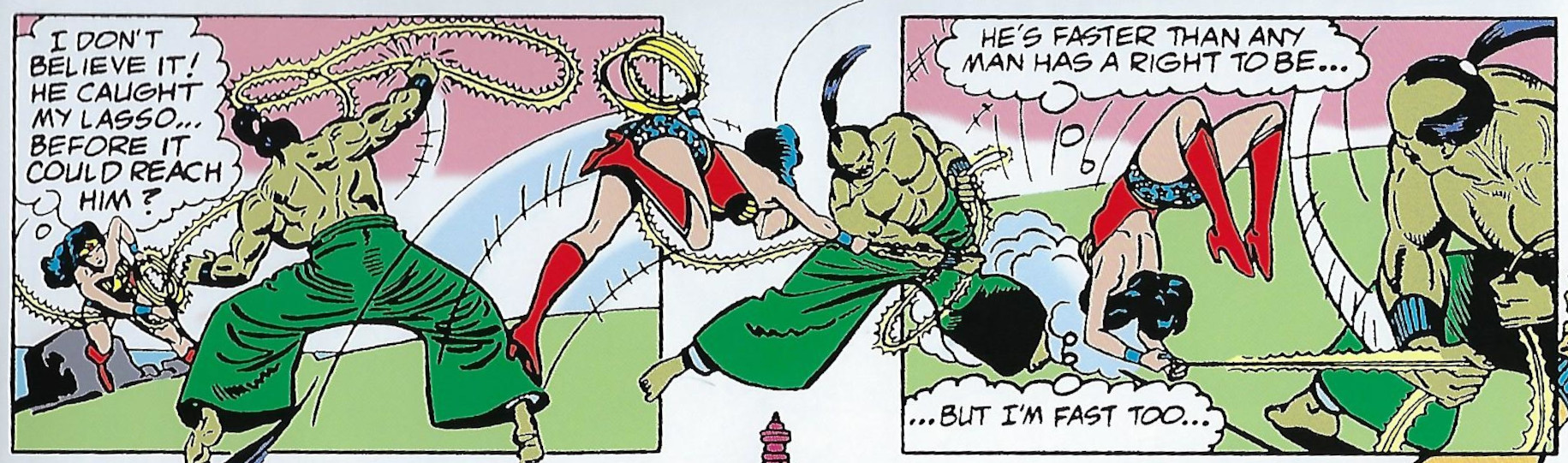
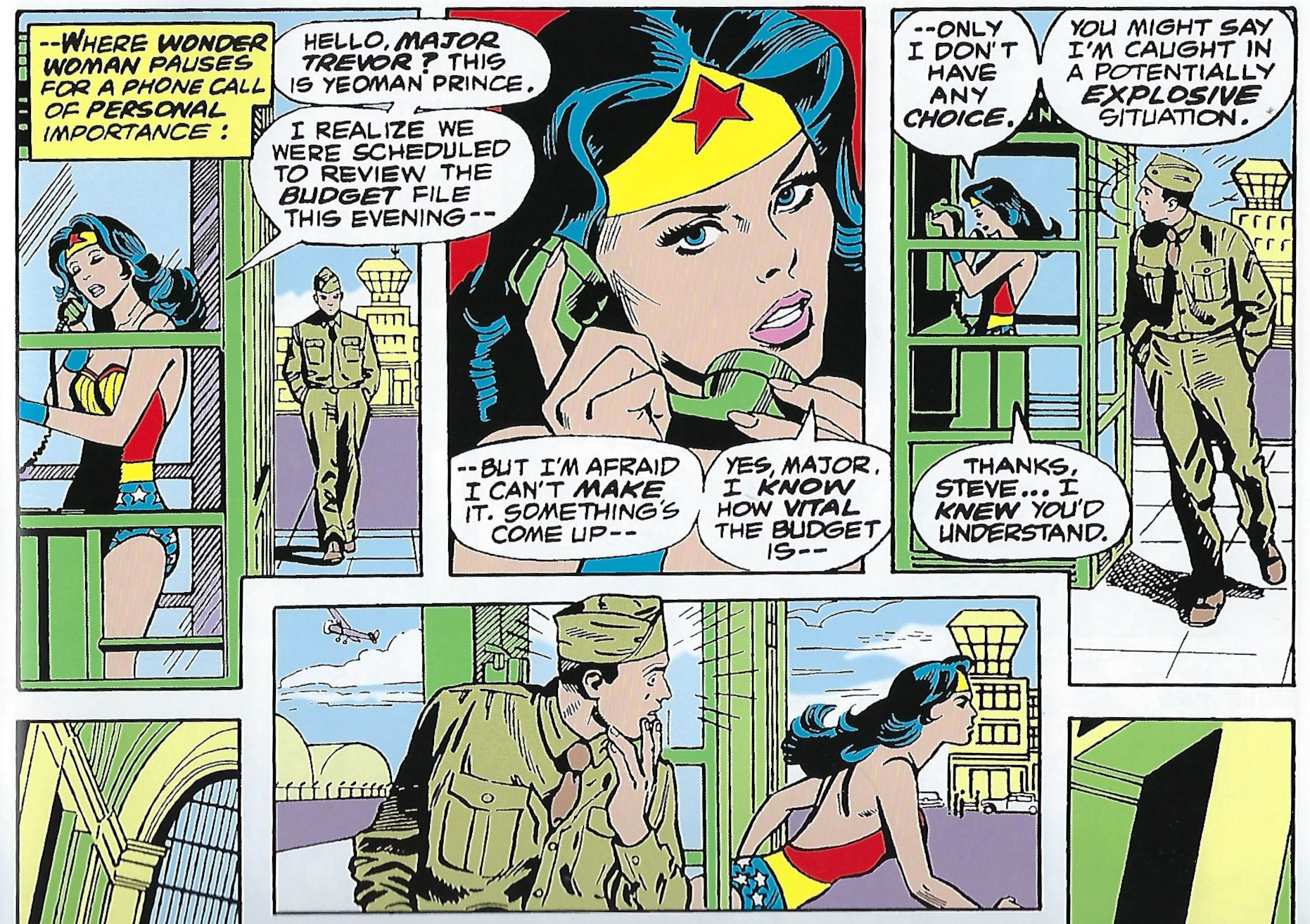
There's one last 1970s Earth-Two comic set retroactively during World War II that I didn't discover until reading All-Star Squadron, following Steel and Superman vs. Wonder Woman. In November 1975, the tv movie The New Original Wonder Woman aired on ABC, adapting the Golden Age comic book by setting Wonder Woman's adventures in World War II; this lead to a tv show from April 1976 to February 1977, similarly set during World War II.* These days, comics readers often complain when comics contort to be more like their television or film counterparts, but it's nothing unique to this moment: the Wonder Woman comic switched to a World War II setting to tie in to the tv show.

I don't know how they might have handled it without the multiple Earths set-up, but DC already had a method of depicting WWII-set adventures of Wonder Woman. In Wonder Woman vol. 1 #228 (cover-dated Feb. 1977, but actually released Nov. 1976), the Earth-One Wonder Woman encounters a villain who has traveled across time and dimensions from Earth-Two in 1943. She fights him, and ends up pulled back to his home dimension and time, and teams up with her Earth-Two counterpart to defeat him. Wonder Woman returns to 1970s Earth-One at the end of the issue-- but from that point onwards, Wonder Woman vol. 1 continues to follow the 1940s adventures of the Earth-Two Wonder Woman, not following its star back home.

The Earth-Two Wonder Woman would star in Wonder Woman for the next year in a series of adventures by a variety of writers and artists, and often guest-starring various members of the Justice Society; many were written by the ubiquitous Gerry Conway. My understanding is that these stories often owed more to the tv show than to the Golden Age comics they were supposedly set between; I think in the original Golden Age comics, Diana Prince was a nurse, but in these stories, she's in Army Intelligence, for example. Roy Thomas would of course pick up some details of these comics for All-Star Squadron, pitting some of the original Axis villains devised by Conway against the Squadron.

During this time, the Earth-Two Wonder Woman also had a feature in World's Finest vol. 1 that ran from issue #244 (Apr./May 1977) to #249 (Feb./Mar. 1978), and she played a role in "The Reality War!", a celebratory story in issue #250 (Apr./May 1978) that featured a whole mess of DC characters; she also had an epic 64-page story in DC Special vol. 2 #9 (1978).

But as you can tell if you pay attention to the dates, DC's tie-in had been a bit belated, and thus it didn't last long. In issue #243 of Wonder Woman vol. 1 (May 1978), released over six months after the tv Wonder Woman had switched to a contemporary setting, the Earth-One Wonder Woman was again pulled through time by a villain to Earth-Two (this time to 1945). The two Wonder Women teamed up again, and before returning to the future, the Earth-One Wonder Woman erased the Earth-Two Wonder Woman's memory of her, thus neatly explaining why the Earth-Two Wonder Woman hadn't known of Earth-One in any of the set-later-but-published-earlier JLA/JSA team-ups! Then, from #244 onwards, Wonder Woman vol. 1 again focused on the adventures of the Earth-One Wonder Woman.

So, are they any good? I don't know. I had intended to read all of these stories and review them... but I couldn't! Most go for silly money on the secondary market, if they're available at all, and few have even been digitized, so you can't read them on comiXology or DC Universe Infinite. My write-up here is just based on what I've read about these comics, not actually reading them myself. 

DC has done some good collections of older Wonder Woman comics the past few years, including collecting the "Diana Prince, Secret Agent" era (1968-73), and the "Twelve Labors" storyline (1974-76). It would be nice to see those continue into a reprint of this material; Wonder Woman #228-43, DC Special #9, and the Wonder Woman stories from World's Finest #244-50 would make a great, if a little chunky, collected edition. Maybe DC could toss in Superman vs. Wonder Woman and/or Wonder Woman vol. 1 #300 if they were feeling generous. The former I've already covered; the latter is a 1983 story where the Earth-One Wonder Woman visits her Earth-Two counterpart in the present, and establishes that Diana Prince married Steve Trevor and has a daughter, Lyta (later, of course, Fury of Infinity, Inc. fame). I would buy it! Below I'll list what chronologically such a collection would include, and what its credits would be. (Thanks to the Grand Comics database for the covers used in this essay and for credits information.)


Wonder Woman: Earth-Two

Writers: Gerry Conway, Martin Pasko, Jack C. Harris, Alan Brennert, Denny O'Neil, Roy & Dann Thomas
Pencillers: Jose Delbo
, Don Heck, Mike Vosburg, Bob Brown, Jim Sherman, Mike Nasser, Jose Luis Garcia Lopez, Russ Heath, Steve Ditko, Dick Ayres, Joe Staton, George Tuska, Ross Andru
Inkers: Vince Colletta, Joe Giella, Dick Giordano, Bob Wiacek, Bob Smith, Dan Adkins, Steve Ditko, Frank Chiaramonte
Colorists: Liz Berube, Jerry Serpe, Adrienne Roy, Carl Gafford, D. R. Martin
Letterers: Milt Snapinn, Joe Letterese, John Workman, Ben Oda, Bill Morse, Gaspar Saladino, Clem Robins, John Constanza

  • Wonder Woman vol. 1 #228-29
  • World's Finest vol. 1 #244
  • Wonder Woman vol. 1 #230-31
  • World's Finest vol. 1 #245
  • Wonder Woman vol. 1 #232-33
  • World's Finest vol. 1 #246
  • Wonder Woman vol. 1 #234-35
  • World's Finest vol. 1 #247
  • Wonder Woman vol. 1 #236-37
  • World's Finest vol. 1 #248
  • Wonder Woman vol. 1 #238-39
  • World's Finest vol. 1 #249
  • Wonder Woman vol. 1 #240
  • All-New Collectors' Edition #C-54
  • DC Special vol. 2 #9
  • Wonder Woman vol. 1 #241
  • World's Finest vol. 1 #250
  • Wonder Woman vol. 1 #242-43, 300

* The show continued after that, but switched to a contemporary setting for seasons 2 through 4.

This post is a supplement in a series about the Justice Society and Earth-Two. The next installment covers Secret Origins of the Golden Age. Previous installments are listed below:

  1. All Star Comics: Only Legends Live Forever (1976-79)
  2. The Huntress: Origins (1977-82)
  3. All-Star Squadron (1981-87)
  4. Infinity, Inc.: The Generations Saga, Volume One (1983-84)
  5. Infinity, Inc.: The Generations Saga, Volume Two (1984-85)
  6. Showcase Presents... Power Girl (1978)
  7. America vs. the Justice Society (1985)
  8. Jonni Thunder, a.k.a. Thunderbolt (1985)
  9. Crisis on Multiple Earths, Volume 7 (1983-85)
  10. Infinity, Inc. #11-53 (1985-88) [reading order]
  11. Last Days of the Justice Society of America (1986-88)
  12. All-Star Comics 80-Page Giant (1999)
  13. Steel, the Indestructible Man (1978)
  14. Superman vs. Wonder Woman: An Untold Epic of World War Two (1977)

18 January 2021

Review: Superman vs. Wonder Woman by Gerry Conway, José Luis García-López, and Dan Adkins

Collection published: 2020
Contents originally published: 1977
Acquired and read: December 2020

Superman vs. Wonder Woman: An Untold Epic of World War Two

Writer: Gerry Conway
Artists: Jose Luis Garcia Lopez and Dan Adkins
Letterer: Gaspar Saladino
Colorist: Jerry Serpe
 
My journey through the comics of Earth-Two is always revealing things I missed and have to go back for; when looking up the history of Baron Blitzkrieg while reading All-Star Squadron, I discovered that he was the villain of issue #C-54 of All-New Collectors' Edition in 1977, a giant "tabloid-size" comic set during World War Two. I decided I would go back and read it before returning to WWII in The Young All-Stars, but quickly realized that doing so would be prohibitively expensive: the original issue goes for $50+ on-line, and while it was reprinted in Adventures of Superman: José Luis García-López, Volume 1, that collection is out of print and goes for $200! But in a total coincidence, right at the moment I had given up reading the story, DC announced a facsimile-sized reprint, and in another coincidence, that reprint was released the month I was due to start reading The Young All-Stars!
 
That dude is my favorite.
 
The story is set in June 1942, and involves Superman and Wonder Woman independently discovering the existence of the Manhattan Project, as well as an effort by the Axis powers to steal its secrets. Though both don't want the bomb in Nazi hands, Wonder Woman doesn't want it in any human hands, while Superman has greater faith in America to do the right thing, and in the end, the two come to blows over it all-- though of course, they set their differences aside to punch some Nazis.
 
Wonder Woman!

The story, to be honest, is not the point. The point of this is to see Superman and Wonder Woman battling rendered in the beautiful art of José Luis García-López at an enormous size. In this regard, the book utterly delivers. Superman fights robot planes; Wonder Woman throws cars at Nazis; Diana Prince sneaks into military file rooms; Superman and Wonder Woman fight each other in Chicago and then on the moon. It all looks great.
 
You might notice a bias toward cool Wonder Woman moments in my scans-- that's because the story itself seems to be biased toward Wonder Woman over Superman, perhaps because Conway was at the time a regular writer of Wonder Woman?

Perhaps for this reason, the book fudges some Earth-Two details. Superman and Wonder Woman are drawn how their Earth-One versions looked in the 1970s, not how their Earth-Two versions looked in the 1940s. But given García-López created the style guide all DC merchandise was beholden to in the 1980s, why would you have him draw anything other than these characters' most iconic forms? The book also has things like Clark Kent working for Perry White at the Daily Planet, not-- as would be the case on Earth-Two-- him working for George Taylor at the Daily Star. On the other hand, it features Earth-Two villain Baron Blitzkrieg, and even includes a footnote referencing the Earth-Two-set World's Finest vol. 1 #246 for those who want to know his origin. So I think writer Gerry Conway is trying to have his Earth-Two cake and eat it too; use the iconic Earth-One versions of the characters because this is a story with broad appeal, but slip in some Earth-Two references for the dedicated comics nerds who worry about how such a story can exist in continuity. (Conway was at the time the writer of the adventures of the Earth-Two Wonder Woman in her self-titled comic and in World's Finest.) As far as weird continuity details go, we also learn that the moon of Earth-Two is home to the ruins of an extinct civilization, one that destroyed itself with the atomic bomb. Did any other comics writers pick up that weird nugget?

Roy Thomas would also go on to use Sumo in the Commander Steel storyline in All-Star Squadron.

While the story doesn't need to be very good, it actually has some nice touches that elevate it. It's framed as a series of declassified reports, the moral conflict is a good one, the appearance by Albert Einstein is fun, the way Diana Prince infiltrates military records is a great sequences, and the ending has a sharp piece of irony with President Roosevelt declaring to both superheroes, "As long as I am president... America will never use the bomb to kill. Never." Ouch. I understand that Roy Thomas depicted a post-Crisis version of these events in the Young All-Stars storyline Atom and Evil (as of this writing, I am on YA-S #14, and Atom and Evil begins in issue #21), but I would have liked to have seen him weave the pre-Crisis version of All-Star Squadron into these events, which I'm sure was his long-term plan.
 
The idea that Conway and his artists are reconstructing a story from declassified documents doesn't make a ton of sense, but it is cute.

Anyway, if you are at all interested in this story, this oversized reprint is a gorgeous way to experience it, and I highly recommend it. (Unfortunately, my scans here can't do justice to the best of its art, because its full-page panels are too big for my scanner!)

28 December 2020

Review: Steel, the Indestructible Man by Gerry Conway, Don Heck, et al.

The nature of shared universe comics is that when reading them, they lead you to discover more comics that you also want to read. This is their curse and their blessing all at once. Hence, it was while reading All-Star Squadron that I discovered the existence of Steel, the Indestructible Man, a comic set on Earth-Two during World War II, and so I decided to catch up on it before wrapping up my WWII-set comics with The Young All-Stars.
 
Steel was created by Gerry Conway, a mainstay of DC in the 1970s and 1980s; around the time he wrote this, he was also working on Superboy and the Legion of Super-Heroes, All Star Comics, and Justice League of America, among many others. I haven't found Conway's work on team books to be very interesting most of the time,* but Steel reads differently than the others. I don't want to falsely attribute motives to him, but Steel reads like something he wrote because he was in love with the idea, rather than because he'd been assigned to and was capable of putting out serviceable work at great volume. The lettercol of issue #2 indicates that he was inspired by the research he did while writing the WWII-era adventures of the Earth-Two Wonder Woman to come up with his own WWII hero.
 
Steel is set about a year before America entered the war, when many Americans believed we shouldn't be involved at all. Steel is Hank Heywood, a promising medical student who gave up his career after a trip to Poland where he saw Nazi brutality firsthand, and enlisted in the Marines. Injured while taking down a saboteur, he survived only because of an experimental surgery by his old mentor, who use "bio-retardant" to heal his wound and enable his body to accept steel beams and motors in place of damaged bones and muscle. But after his surgery, he realizes he can use his newfound strength and durability to fight for the cause in a more direct way.
 
from Steel, the Indestructible Man #1 (art by Don Heck & Joe Giella)
The actual superhero plots are often pretty banal; Steel fights mediocre enemies like the Mineral Master and the Gadgeteer. Like Roy Thomas's later All-Star Squadron, though, what elevates the material is a sense of history, the way it weaves Steel into the real social concerns of the 1940s. Every mediocre supervillain here is somehow tied to the concerns of the war; Heywood himself is torn between using his abilities to push America into war and the dreams of his peace of his fiancée; on a practical basis, he has to work his superheroing in and around his responsibilities as a Marine private. Like the best superhero premises, it feels like a strong "storytelling engine," one that could have generated ideas and conflicts for years to come.
 
Additionally, Conway does some of his finest scripting here; much of the series is narrated in the first person by excerpts from Heywood's journal, which gives the whole series a strong sense of personality. Don Heck is an artist I can't claim to have thought much about (my notes tell me I have reviewed seven  previous comics he's worked on, but in none of those reviews did I ever mention his work aside from All-Star Squadron), but here he does great work. Like the best superhero comics artists, he draws cleanly and clearly, and is also good at communicating character. Steel's costume might be over-the-top, but it's also entirely appropriate, and presents a strong image. And some of the stories have some good zip to them, like the one where Steel confronts a newspaper mogul over his complicity in a friend's betrayal.

from Steel, the Indestructible Man #5 (art by Don Heck & Frank Chiaramonte)
The only thing I didn't like was issue #5, which for some reason takes a swerve into the Gothic, with a tale of twin brothers and deformed creatures in a spooky house in the middle of a dark forest. It's no coincidence this story is totally detached from the concerns of World War II!

Interestingly, nothing in the first five issues definitively places it on Earth-Two; though Superman, the Sandman, the Flash, and Hawkman would have been active by this point (among others), no one ever mentions them or calls Steel a superhero. If #6 had been published, however, it would have featured the origin of Baron Blitzkrieg, a character Conway and Heck created for the Earth-Two Wonder Woman comics... but there never was an issue #6. Steel was a victim of the so-called "DC Implosion," one of seventeen comics cancelled overnight. Issue #5 previews a #6 that never appeared, and Conway and Heck had even written and pencilled the issue.

That wasn't the end of Steel, though; Roy Thomas brought the character into the All-Star Squadron, a natural fit if there ever was one, given the common vibe of both series. Thomas even took the completed issue #6 and worked it into All-Star Squadron, using it as flashbacks in A-SS #8-9 to explain how Steel came to be involved in that adventure of the Squadron. I reread #8-9 to cap off Steel, and found them more interesting with the context of knowing who Steel was and wanting to see his adventures continue. Steel would continue as an A-SS member up through the Crisis, and his grandson would also star in Justice League in the 1980s, which I look forward to reading someday.

Steel, the Indestructible Man was originally published in five issues (Mar.-Nov. 1978). The series was created and written by Gerry Conway; designed by Don Heck; pencilled by Don Heck (#1-5) and Juan Ortiz (#3-4); inked by Joe Giella (#1, 3-4), Vince Colletta (#2), Bruce Patterson (#3-4), and Frank Chiaramonte (#5); lettered by Ben Oda (#1-3), Todd Klein (#3), Clem Robins (#4), and Karin (#5); colored by A. Tollin (#1), Adrienne Roy (#2), Bob LeRose (#3-4), and Jerry Serpe (#5); and edited by Allen Milgrom.
 
* Lest it sound like I hate all Gerry Conway work, I actually really enjoyed some of his Crisis crossovers, especially the "Crisis on New Genesis" one. Plus I liked Sun Devils, but that came later.
 

07 October 2020

Review: Superboy and the Legion of Super-Heroes, Volume Two by Paul Levitz, Gerry Conway, Joe Staton, et al.

Comic hardcover, 463 pages
Published 2018 (contents: 1978-80)
Acquired July 2018
Read July 2020
Superboy and the Legion of Super-Heroes, Volume Two

Writers: Paul Levitz, Paul Kupperberg, Len Wein, Gerry Conway, Steve Apollo 
Pencillers: James Sherman, Arvell Jones, Joe Staton, Steve Apollo, Dick Dillin, Steve Ditko
Inkers: Bob McLeod, Danny Bulanadi, Jack Abel, Joe Giella, Murphy Anderson, Dick Giordano, Dave Hunt, Joe Staton, Frank Chiaramonte, Vince Colletta, Dan Adkins
Colorists: Cory Adams, Gene D'Angelo, Glynis Wein, Adrienne Roy, Jerry Serpe
Letterers: Ben Oda, Shelly Leferman, Jean Simek, Todd Klein, Mike Stevens, Milt Snapinn

DC inches ever closer to plugging the gap between the last Legion of Super-Heroes Archive and The Great Darkness Saga with this, the second and final volume of Superboy and the Legion of Super-Heroes. (The just-annonced Before the Darkness series will continue from where this collection leaves off.) I'm glad this collection exists, but it's not the Legion's best material.

I don't know much behind-the-scenes information for this era, but the book gives every indication of being jerked around. First we have the five-part Earthwar saga scripted by Paul Levitz, where Earth is invaded by Khunds working for Mordru (to be honest, I don't remember who Mordru is). This is okay: it does nicely subvert your expectations at points, and the events are big... but they never feel big. When Levitz came back to the book for The Great Darkness Saga, he would do much better and more epic work than he did here, and it would feel meaningful to the characters in a way this sorely does not.

James Sherman, why couldn't you have stuck around for more than two issues?
from Superboy and the Legion of Super-Heroes #241 (script by Paul Levitz, art by James Sherman & Bob McLeod)

Then we get a couple issues written or co-written by Len Wein that read like inventory stories to me, with small references to the recent big events shoehorned in. I did kind of like the idea of "Savage Sanctuary!", where the Fatal Five kind of go legit, though the actual story got a bit stupid. The rule forbidding married couples to be in the Legion is rescinded, and thus Saturn Girl and Lightning Lad rejoin, and Lightning Lad is elected to leadership in short order, replacing Wildfire.

Poor Emerald Empress.
from Superboy and the Legion of Super-Heroes #247 (script by Len Wein, art by Joe Staton & Jack Abel)

Then we have a couple stories by Gerry Conway that more directly deal with the aftermath of Earthwar-- suddenly Earth is a wreck in need of repair. These are okay, nothing special. (Brainiac is extra jerk-like, which I assume is to set up the next story, though.)

That's uh, quite an outfit. (How does Reep having the hots for humanoid women fit with Invasion!'s revelation that the actual form of Durlans is a weird squid monster?)
from Superboy and the Legion of Super-Heroes #249 (script by Paul Kupperberg, art by Joe Staton)

Then we have a couple stories by Steve Apollo (better known as Jim Starlin) that were clearly orignally written to slot in around the time of Earthwar, with some last-minute dialogue tweaks: lip service is given to the fact that Lightning Lad is leader, but he and Saturn Girl aren't in the story even though it supposedly features all active Legionnaires (even Tyroc turns up!); Wildfire is clearly in charge. In this story, Brainiac is revealed to be a murderer, having gone insane, and Matter-Eater Lad goes insane, too. Not a lot of it makes sense. I didn't really buy any of this, and why do we need another giant attack on Earth when we just had one?

Tall panel!
from Superboy and the Legion of Super-Heroes #250 (plot & layouts by Steve Apollo, script by Paul Levitz, art by Dave Hunt)

Then Gerry Conway takes over permanently, dealing with the fallout of Apollo's story... but his stories are repetitive (three different ones are about people coming to take revenge on the Legion for slights, real or imagined) and contrived (the one where Superboy makes people think Legionnaires are dead by activating a latent chemical in their bloodstreams is particularly bad). Brainiac is healed in an entirely unconvincing way, and the Legion undertakes bizarre lengths to do it. The only thing I liked was the subplot about how R. J. Brande went bankrupt... but then realized he was a hoarder and gave away all his money.

If my dreams were like this, I wouldn't want to leave them, either.
from Superboy and the Legion of Super-Heroes #252 (script by Gerry Conway, art by Joe Staton & Dave Hunt)

(There's also a couple issues of DC Comics Presents by Levitz included, where Superman gets told by the Legion that he has to let Pete Ross's son be kidnapped by aliens to preserve future history. I found this kind of gross.)

Shouldn't Saturn Girl know that Pete Ross knows Superboy's secret identity, because Pete was a Legionnaire himself?
from DC Comics Presents #13 (script by Paul Levitz, art by Dick Dillin & Dick Giordano)

Finally, the last issue writes out Superboy from the comic that used to bear his name (Superboy vol. 1 became Superboy and the Legion of Super-Heroes became Legion of Super-Heroes vol. 2). I liked how this was done, actually: Superboy finds out how his parents will die. The problem is that when he travels back to the 1950s, he loses his knowledge of future history only to regain it up returning to the 2970s. This means that every time he travels to the future from now on, he will be newly hit with the knowldge of how his parents die. Ouch! He promises to keep up his visits, but the Legion (okay, this part I like less) plant a telepathic block to stop him from doing so, so he flies off to the past for the last time.

Poor Clark.
from Legion of Super-Heroes vol. 2 #259 (script by Gerry Conway, art by Joe Staton & Dick Dillin)

Conway is often not a great writer (I found his run on All Star Comics around this same time pretty bleh), and Legion feels typical of his lesser output. Lots of bombast, not a lot of sense. Which you can kind of get away with in other comics, but Legion is trying to have an ongoing story with ongoing consequences, and those just don't play to Conway's strengths. There are some good artists on the book (e.g., Joe Staton, Jim Starlin), but it's no one's best work. James Sherman, who I really like, does the first couple issues but that's it. His characterful work could have kept this all a bit more grounded, I reckon.

I read a Legion of Super-Heroes collection every six months. Next up in sequence: Five Years Later Omnibus, Volume 1

24 August 2020

Review: Crisis on Multiple Earths, Volume 7 by Roy Thomas et al.

DC's JLA/JSA / Earth-One/Earth-Two crossovers were an annual tradition from 1963 to 1985; several years ago, I read the Crisis on Multiple Earths trade paperbacks which collect them in their entirety... except that in classic DC fashion, they stopped publishing them when just one volume more would have collected them all! As I neared the 1985 crossover in my reading of Infinity, Inc., I realized that I ought to bung in the two before it and thus get the experience of what that nonexistent volume 7 would have been like...

Unfortunately, they're not the series's best work, even allowing for the fact that I was never particularly wowed by most JLA/JSA crossovers to begin with. Each one has the germ of a good idea, but it isn't really realized. I really enjoyed reading part one of Crisis in the Thunderbolt Dimension!, where Johnny Thunder's Thunderbolt goes berserk and begins attacking the heroes of Earth-One in the midst of the annual JLA/JSA team-up. The writers do a pretty fun pastiche of how these things usually go; as it often is, the best part is when the members of the two super-teams are just chilling on the JLA satellite before things begin to go south, as we get to see (for example) Firestorm moon over Power Girl. Part one is credited to both Roy Thomas and Gerry Conway, but I would guess that they plotted it together and Conway wrote the actual script; Conway was responsible for what were in my opinion the best of these crossovers (see volumes 5 and 6).

You wouldn't need the credits, however, to know that part two is entirely the work of Roy Thomas, because everyone immediately begins speaking in continuity and exact dates, telling each other things they already know and/or don't need to know.
  • "It's Sargon the Sorcerer-- another who was born on our Earth and later migrated to this one."
  • "I left the world of my birth for this one, in 1950."
  • "Before you wandered onto the scene in 1947, Black Canary."
  • "And who took his place in spring of '48? A certain wig-wearing wonder we all know-- called the Black Canary!"
  • "The Wizard's idea, I'd guess. He's the one who dreamed up that 'patriotic crimes' caper in the late 40's, remember." "I don't-- because I was retired back then."

from Justice League of America vol. 1 #219
(script by Roy Thomas & Gerry Conway, art by Chuck Patton & Romeo Tanghal)
It's not just the dialogue, though; the entire story is constructed around explaining how Black Canary could have debuted in the 1940s but still be young enough in the 1980s to date Green Arrow (and was still drawn the same) while most of the other JSA members had aged. This is an okay thing to explain, but the actual explanation is so convoluted it beggars belief. Apparently, Dinah (Black Canary) and her husband Larry had a daughter also named Dinah, but she was cursed with a sonic scream, so she was transported into the thunderbolt dimension, where she aged normally but was comatose, and Dinah and Larry had their memories wiped of her! Like, what!? But wait, there's more when Larry died and Dinah moved from Earth-Two to Earth-One, Dinah began to die of radiation poisoning, so Superman detoured into the thunderbolt dimension and switched the consciousnesses of the mother and the daughter, so the mother has actually been in her daughter's body since 1969, as the daughter remains trapped, comatose, in her mother's radiation-ravaged body in another dimension! Only Dinah had no idea this happened to her. So much for informed consent! What is all this? It's terrible. Like, c'mon Roy, just say she got zapped with a youth spell. (Indeed, during his run on All-Star Squadron, Thomas would establish that many JSA members had had their aging slowed.) It's a terrible idea, and it makes for a terrible story. There may have been some JSA-related downsides to the Crisis on Infinite Earths, but one of its upsides was the new generational history for Black Canary that was developed.

from Justice League of America vol. 1 #232
(script by Kurt Busiek, art by Alan Kupperberg)
I felt that Family Crisis! started strong, with narration from an unknown narrator testing some of the heroes of Earths-One and -Two during their annual team-up. The whole thing is about a scientist whose mind gets taken over by an alien conqueror, but also his family was involved. Part two devolves into a pretty generic punch-up, though, and the family thread never really takes off, unfortunately.

The last JLA-JSA team-up actually took place during Crisis on Infinite Earths. As JLA-JSA crossovers go, there's not much to it; the JSA barely features in favor of Infinity, Inc., but Infinity, Inc. barely matter to the story: it clearly slots into and partially resolves an ongoing story in Justice League of America. There's not much to it outside of that. In the first part, some aspects of Infinity, Inc.'s recent "Helix" three-parter (#16-18) are tied up, and then Commander Steel (also a star of All-Star Squadron, just forty years younger) comes to ask Infinity, Inc.'s help against what he claims is a bunch of renegades using the name of the JLA. They travel to Earth-One and fight the JLA (now in its "Detroit" phase). Then in part two, the JLA goes to the wrecked satellite to use its transmatter to get help from the JSA, and everyone whales on Commander Steel-- who doesn't like how his grandson Steel or the new JLA have turned out-- together. (Commander Steel is aided by Mekanique, the robot from the future who would also bedevil the All-Star Squadron.)

It's mostly a couple fights. The most effective part is the segment where the JLA drift through the wreckage of their old satellite headquarters, which is atmospherically written by Conway and atmospherically pencilled by the ever dependable Joe Staton.

I look forward to reading this story in its JLA context when I get around to reading my Justice League: The Detroit Era Omnibus in its entirety, but as the final JLA/JSA team-up, it's a whimper. The JSA are barely in it, and I feel like there was some mileage in teaming the upstarts in Infinity, Inc. up with the upstart new version of the Justice League, but Thomas and Conway get nothing out of it; they barely interact meaningfully. How would these two group of youngsters remake an old tradition?

I'm glad I read these, but I feel like the last few JLA/JSA team-ups were victims of the concept's success. Because the concept had been so popular, it had spawned ongoing Earth-Two stories in All-Star and Infinity, Inc.-- but that meant those series were carrying the weight of Earth-Two, resulting in the last few crossovers being largely inconsequential side shows that couldn't do much of note.

Crisis in the Thunderbolt Dimension! originally appeared in issues #219-20 of Justice League of America vol. 1 (Oct.-Nov. 1983). The story was written by Roy Thomas (#219-20) & Gerry Conway (#219), pencilled by Chuck Patton, inked by Romeo Tanghal (#219-20) & Pablo Marcos (#220), lettered by John Costanza (#219) and Cody (#220), colored by Gene D'Angelo, and edited by Len Wein.

Family Crisis! originally appeared in issues #231-32 of Justice League of America vol. 1 (Oct.-Nov. 1984). The story was written by Kurt Busiek, illustrated by Alan Kupperberg, lettered by Ben Oda, colored by Gene D'Angelo, and edited by Alan Gold.

The Last JLA–Justice Society Team-Up! originally appeared in Infinity, Inc. vol. 1 #19 (Oct. 1985) and Justice League of America vol. 1 #244 (Nov. 1985). The story was written by Roy Thomas (#19) and Gerry Conway (#244), pencilled by Todd McFarlane (#19) and Joe Staton (#244), inked by Steve Montana (#19) and Mike Machlan (#244), co-plotted by Dann Thomas (#19), colored by Anthony Tollin (#19) & Adrienne Roy (#19) and Gene D'Angelo (#244), lettered by Cody (#19) and Albert De Guzman (#244), and edited by Roy Thomas (#19) and Alan Gold (#244).

This post is the ninth in a series about the Justice Society and Earth-Two. The next installment covers issues #11-53 of Infinity, Inc. Previous installments are listed below:
  1. All Star Comics: Only Legends Live Forever (1976-79)
  2. The Huntress: Origins (1977-82)
  3. All-Star Squadron (1981-87)
  4. Infinity, Inc.: The Generations Saga, Volume One (1983-84)
  5. Infinity, Inc.: The Generations Saga, Volume Two (1984-85)
  6. Showcase Presents... Power Girl (1978)
  7. America vs. the Justice Society (1985)
  8. Jonni Thunder, a.k.a. Thunderbolt (1985)

12 August 2020

Review: Jonni Thunder, a.k.a. Thunderbolt by Roy & Dann Thomas, Dick Giordano, et al.

Jonni Thunder, a.k.a. Thunderbolt reinvents the character of Johnny Thunder for the 1980s, though really it takes the name of the character and basically nothing else. Jonni is a private investigator, formerly in partnership with her father until he recently died; a man dies in her office, thrusting her into the middle of a complex situation with multiple participants jockeying for possession of a small statuette she's had since she was a child... only she's somehow gained possession of superpowers?

I read Jonni Thunder because I believed it took place on Earth-Two (and I understand that Jonni ends up appearing in Infinity, Inc. during Crisis on Infinite Earths), but within this four-issue miniseries, it's not really connected at all. When Jonni gains superpowers, her referents are tv shows, not real superheroes buzzing around, and the one reference to Wonder Woman could easily be construed to WW as a fictional character. Though it has some of the trappings of it, it's not really a superhero story, but something else entirely.

This is very much the hard-boiled detective genre, one I don't have a ton of experience with, but I have enough to identify how it slots in. It's kind of like Chinatown, if Jack Nicholson suddenly manifested the ability to mentally fuse with a thunderbolt and leave his body behind. Jonni has to figure out who she can trust (no one) and has to compromise her morality in order to accomplish her goal of solving the murder. Things richochet back and forth between Los Angeles and San Francisco as she fights gangsters, movie stars, technical geniuses, good cops, lazy cops, sleazy P.I.s, and the starter on her 1957 Thunderbird.

from Jonni Thunder #3
(plot & script by Roy & Dann Thomas, art by Dick Giordano)
I enjoyed it. Like I said, I don't know hard-boiled well, but I'm always up for a good pastiche, and this is a great one. Roy and Dann Thomas have a good knack for the genre, and the supernatural elements don't feel too grafted on. Jonni is a great protagonist, in slightly over her head, but quick-witted and always planning her next move. Dick Giordano is one of comics's most reliable artists, and he does good work here, though I found myself wishing it had been printed on nicer, Baxter paper-- the inks would have held up better, but also more interesting things could have been done with the coloring. Ernie Colón (originally slated to be the artist but it didn't work out) gives Jonni great style, men's suits in black and white, but they don't really pop with the primitive coloring technology of the mid-1980s. Imagine a moodier, atmospheric version of this comic!

I've read a lot of Roy Thomas comics by now (all of All-Star Squadron, America vs. the Justice Society, and the first seventeen issues of Infinity, Inc.), and this is the first one where his wife Dann gets a full co-writer credit, not just co-plot. Surely not coincidentally, it has the best dialogue and other prose of any Roy Thomas comic I've read. The banter is fun, and first-person narration is characterful and insightful. Apparently the plotted the issues together, than Dann wrote the scripts, then Roy did a little polish-- but, he says in the lettercol, not much was needed. On the strength of this, I look forward to reading the Infinity, Inc. issues where she graduates to full co-writer.

Jonni Thunder is in some ways a simple comic, but simple pleasures are still pleasures. This is a delightful mash-up of superhero and P.I., and I wish there had been more of it. In the lettercols, Roy suggests that thought he and Giordano didn't have time to write an ongoing, they could do a succession of miniseries and/or graphic novels. Alas, they never came to pass. But I am curious to see how Jonni will integrate into the very different style of full-color superheroics in Infinity, Inc.!

Jonni Thunder, a.k.a. Thunderbolt originally appeared in issues #1-4 of Jonni Thunder (Feb.-Aug. 1985). The series was created by Roy & Dann Thomas, Dick Giordano, and Gerry Conway, with special thanks to Ernie Colón; scripted by Roy & Dann Thomas; illustrated by Dick Giordano (#1-4), with an assist by Mike Esposito (#2); co-plotted by Gerry Conway (#1); colored by A. Tollin (#1) and Adrienne Roy (#2-4); and lettered by L. Lois Buhalis & Orzechowski.

This post is the eighth in a series about the Justice Society and Earth-Two. The next installment covers Crisis on Multiple Earths, Volume 7. Previous installments are listed below:
  1. All Star Comics: Only Legends Live Forever (1976-79)
  2. The Huntress: Origins (1977-82)
  3. All-Star Squadron (1981-87)
  4. Infinity, Inc.: The Generations Saga, Volume One (1983-84)
  5. Infinity, Inc.: The Generations Saga, Volume Two (1984-85)
  6. Showcase Presents... Power Girl (1978)
  7. America vs. the Justice Society (1985)