Showing posts with label series: inspector lynley. Show all posts

04 August 2014

The Inspector Lynley Mysteries, Book 18

Acquired June 2014
Read July 2014
Just One Evil Act
by Elizabeth George

For three years now, I've read an Inspector Lynley novel every four months... finally I've caught up! Sometimes I wonder if it's really been worth it-- there have been some awful ones-- but Just One Evil Act is somewhere in the middle. It has a number of distinct phases: 1) Barbara Havers's neighbor Hadiyyah is "kidnapped" by her mother, 2) Hadiyyah is actually kidnapped and Lynley is sent to Italy to investigate, and 3) Havers crosses the line helping Hadiyyah's dad and Lynley debates intervention. Part 1 is a necessary prologue, but part 2 is just dead boring. As far as I can tell, Lynley never even actually investigates anything, he just talks to Italian policeman and magistrates while Havers tries to help from the UK. There are also long scenes where all of the dialogue is in Italian. How is that even narratively justifiable? Oh God, it was painful. It's George's wheel-spinning narratives at their worst, and it all could have been handled much more quickly because it's not the actual point of the novel.

It's all really there for part 3, the real meat of the book-- how far will Havers go? She makes choices that make you yell at the book, but George knows her character: they're all perfectly plausible ones. It's well written, and a great mystery even pops up. But man.. why's it got to take so long to get to the point of the great mystery? The thing about George is that even if you only get half of a good book, her books are so long that that's still more good writing than you might get out of a complete novel by another writer.

(Also, seriously, George needs to stop talking about computers, because no matter how much research she does, she just comes across like my grandmother trying to use facebook.)

05 March 2014

The Inspector Lynley Mysteries, Book 17

Hardcover, 610 pages
Published 2012

Acquired September 2012
Read February 2014
Believing the Lie
by Elizabeth George

George's Inspector Lynley novels seem to alternate between great and terrible, so it seems inevitable that after enjoying This Body of Death, I'd really struggle with Believing the Line. Like the worst Lynley novels, it just takes forever-- there's a lot of perspectives outside of Lynley (and sometimes Havers), and since each character is given equal time, that means Lynley pops up very rarely and thus does very little investigating. Indeed, I can barely remember him talking to anyone; Sergeant Havers and Deborah St. James (gah) doing most of the actual legwork here. It's also really hard to care, because it's not very certain that a murder even happened, and that uncertainty never goes away.

I get it, Elizabeth George, you're trying to upend the mystery genre... but you're not good enough to get away with it. Leave it to Paul Auster and Julian Barnes. Also, I refuse to believe this book was actually written and set in 2012; a key plot point is that Barbara can't perform even rudimentary translation of Spanish-language web pages on her own, because she's working on the case outside of the Met and its resources. Resources like Google Translate, I guess?

That said: Barbara Havers is always awesome, and there's a decent sideplot about a divorced couple trying to care for an orphaned kid. And the last 100 pages or so are pretty good, as everything comes into focus. But man, a lot more sure needed to happen in the rest of the book.

14 October 2013

The Inspector Lynley Mysteries, Book 16

Hardcover, 692 pages
Published 2010

Acquired August 2013
Read  September 2013
This Body of Death
by Elizabeth George

Woah, what happened here? It's an Inspector Lynley mystery that I had almost no reservations about. This is George on the absolute top of her game, a level of skill we haven't seen from her since, like, book 8. Lynley is awesome, the death of his wife being used to good effect; Havers is awesome, her understanding of Lynley being tested, but she's still utterly tenacious. I even liked Isabelle Ardery, the new boss of Lynley's unit-- not as a person, but as a character she's quite interesting. (Shame about her getting together with Lynley, though; I feel like it really undercuts the potential of their relationship in favor of something more formulaic.) The mystery unravels quite well, with complications galore and a keen sense of character. And even though it's over 600 pages long, I never felt it dragged. Why can't she always write like this?

05 September 2013

The Inspector Lynley Mysteries, Book 15

Mass market paperback, 725 pages
Published 2009 (originally 2008)
Acquired March 2013
Read April 2013
Careless in Red
by Elizabeth George

I was initially excited by this Lynley novel, because the dead body is actually discovered in the prologue-- and even discovered by our detective, so unlike many of the latter novels, we don't have to wait hundreds of pages for the detective to get to the detecting. George, however, proves she can slow down a plot regardless of how quickly it starts; a couple hundred pages later, and it just feels like we're watching unpleasant people talk to other unpleasant people, and not unraveling a mystery. Eventually someone solves the crime, I guess. Havers is in this one a little, which is always nice.

04 September 2013

The Inspector Lynley Mysteries, Book 14

Mass market paperback, 722 pages
Published 2007 (originally 2006)
Acquired September 2012
Read November 2012
What Came Before He Shot Her
by Elizabeth George

Like many of the latter "Inspector Lynley Mysteries," What Came Before He Shot Her demonstrates George's desire to expand the series beyond being a series of mysteries solved by an English peer and his lower-class sidekick. In this case, the novel fills in the life of the young kid who killed Lynley's wife at the climax of With No One As Witness. It's okay. Like a lot of the latter Lynley novels, it's about 200 pages too long; I get that you're supposed to think this kid has no options in life, but there comes a point where the repeated horribleness of his life becomes monotonous to the reader. It also seems a bit contrived; one would hope that the world isn't as horrible as George paints it here, and the ways in which people fail to help our protagonist go a little too far at some points.

Also of note: there's lot of characters in this book who have failed to reach their potential and become criminals or dropouts... and they're all men. We're told all these seemingly thuggish men read philosophy or are great poets or whatever. They have potential they've failed to realize, and we're meant to feel sorry as a result. The criminal/thuggish women, though... they're just that way, sexual creatures apparently without even unrealized intellectual potential. It's very weird.

11 June 2012

The Inspector Lynley Mysteries, Book 13

Mass market paperback, 774 pages
Published 2006 (originally 2005)
Acquired and read May 2012
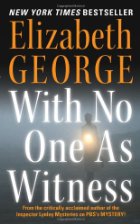
With No One As Witness
by Elizabeth George

I've struggled with the last few Lynley/Havers stories, but somehow Elizabeth George is right back on track with this one.  The characters are actually working together, the mystery actually starts right at the beginning, and I actually never had to force myself to keep on reading.  It's not the very traditional mystery structure of most of her other novels, as in this case Lynley is put in charge of a big Scotland Yard effort to stop a serial killer at work in London.  But it works despite that; indeed, the parts of the novel that work least well are the most traditional, as Havers talks to person after person in a youth outreach program.  It takes a better writer than most to make the internal politics of a youth outreach program interesting.  But the rest-- the methodical, slow hunt for evidence, often grasping at straws, as the killer operates with impunity-- makes for good reading.  It's horrifying at times, but that's George at her best for you.  Havers gets a chance to shine here, more than she has in any of these novels for what feel like a long time.

I still wonder why she hates Havers so much.  I mean, Lynley has his faults, but they're the kind of faults that aren't really faults: he's too forthright, he cares too much, he's too responsible.  Oh, how dreadful for him.  On the other hand, Havers's inability to dress herself reaches new heights of absurdity in this installment.  Cut the poor woman a break and let her wear a nice pair of pants without a ketchup stain on them, okay?

There's a big "shock" at the end, or rather there would be if I cared about any of the characters who weren't Lynley, Havers, Taymullah, Hadiyyah, and Nkata.  Okay, that's more than I thought, but why is the rest of the supporting cast so... insipid?

16 January 2012

The Inspector Lynley Mysteries, Book 12

After my marathon readthrough of three Inspector Lynley books this summer, which were my first entries in the series for five years, I decided that I was going to finish the series off.  So every four months I'll be picking up another one and giving it a go...

A Place of Hiding
by Elizabeth George


I'm rapidly coming to the conclusion that Elizabeth George does not understand what I like about the Inspector Lynley mysteries.  The thing that makes the series shine is Lynley and Havers.  In the past three books we've had Havers on her own, Lynley and Havers on different cases, and Lynley and Havers working together but barely in the book.  Why did she come up with two characters who go great together and then either not put them together, or minimize their appearances?  A Place of Hiding contributes to this problem by having no Havers and barely any Lynley; the detective for this story is Simon St. James, Lynley's good friend.  George overestimates the extent to which I am interested in St. James.  In theory, he's a different character (and certainly people in the story keep on saying he is), but I would be hard-pressed to name a difference between how St. James and Lynley conduct their investigations.

All that grumbling aside, this is a pretty good mystery on its own merits.  It's really slow to get started (also par for the course for the last few books), but around halfway through, it began to accelerate, and at the three-quarter mark, it was rocketing.  The last quarter was excellent: great stuff.  George knows how to assemble a puzzle, and how to make not one, but many revelations that shock you as things come to a climax.  Once again, though, I completely failed to guess the culprit.  I think I will have to admit that I am just rubbish at mysteries, even though I enjoy them.