Showing posts with label creator: james roberts. Show all posts

10 May 2021

The Transformers Classics UK, Volume Four (From Stockbridge to Segonus: A Doctor Who Magazine Comics Marathon, Part 9)

Collection published: 2013
Contents originally published: 1987
Read: February 2021

The Transformers Classics UK, Volume Four
editorial notes and assistance by James Roberts

Written by Simon Furman, Ian Rimmer, and Lew Stringer
Pencils by Geoff Senior, Will Simpson, Dan Reed, Jeff Anderson, and Lew Stringer
Inks by Geoff Senior, Tim Perkins, Dan Reed, Stephen Baskerville, Dave Harwood, David Elliot, and Lew Stringer
Colors by Steve White, Euan Peters, and Abadzis
Letters by
Annie Halfacree, Richard Starkings, and Mike Scott

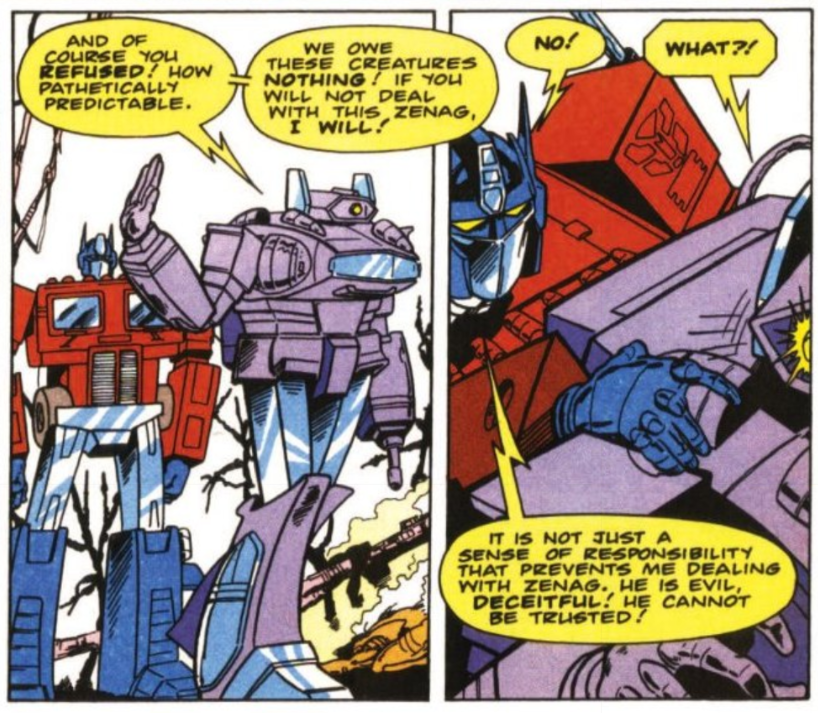
So far, Marvel UK's The Transformers has been on a nice upward trajectory: that comes to an end with this volume. It does get off to a nice start with the sequence of stories about Rodimus Prime of 2007 hiring a bounty hunter to kill Galvatron, who ends up tracking him to Earth of 1987 ("Wanted: Galvatron, Dead or Alive!"/"Burning Sky!"/"Hunters!"/"Fire on High!"/"Vicious Circle!"). The bounty hunter is Death's Head, who will be the character who connects Transformers to Doctor Who Magazine in the long run. You can see why Death's Head went on to get his own spin-off: he's a fun, expressive, dynamic character, and the four-way collision we get here between Death's Head, Galvatron, the Autobots of 1987, and the Autobots of 2007 is kind of explosive stuff Furman excels at. Big, fast-paced action, with enjoyable characters. I liked the IDW Ultra Magnus, and I am quickly coming to appreciate the Marvel UK Ultra Magnus as well, even though he's a very different character. (I am not sure why it is taking him months to locate the Ark, though!)

Kind of awkward to have your hand shot off, yes?
from The Transformers #120 (script by Simon Furman, art by Geoff Senior)

After that, though, it's a bit of a mix. There's "Ancient Relics!", a crossover with Action Force (the UK equivalent of G. I. Joe) that is mostly just tedious, uninteresting action sequences, with none of Furman's character flare. There's "Worlds Apart!", a really uninteresting tale of some Headmasters on Nebulos, apparently slotting in during an issue of the US Headmasters miniseries that hadn't even been reprinted in the UK mag yet at the time it came out.* And there's the UK retelling of the Headmasters series, and what can I say about the Headmaster concept except that I just really really hate it, because it overloads an already overloaded series with uninteresting characters.

Apparently the UK version of "The Headmaster Saga" presents a whole different reason the Headmasters traveled to Earth than the one the US stories gave, yes?
from The Transformers Annual 1987 (art by unknown)

But there is some decent stuff here, even if it doesn't rise to the high points of volume three. "Kup's Story" (a flashback of how Kup met Rodimus) is fun, as is "Ark Duty" (a flashback of Kup and Rodimus in the period leading up to Transformers: The Movie). The return of the Dinobots in "Grudge Match" was kind of silly (I liked the Dinobots throwing down the Predacons, but I didn't buy that they would let them off so easy), though I did like the "What's in a Name?" lead-in story that revealed Swoop's secret shame over "losing" his name. The "Ladies' Night" story, uniting three female characters from across the UK run, might have been more successful if the artists here were more skilled at drawing humans, not robots, but it was fine.

So that's what Rodimus Prime's alt mode looks like, yes?
from The Transformers #118 (script by Simon Furman, art by Jeff Anderson & Stephen Baskerville)

I did have to love "Stargazing," where a human boy teaches Starscream-- Starscream!-- the true meaning of Christmas. He thinks he's succeeded, but Starscream just wants to get one up on an Autobot.

This kid is Starscream's most compelling nemesis, yes?
from The Transformers #145 (plot by Simon Furman, script by Ian Rimmer, art by Jeff Anderson & Stephen Baskerville)

And Death's Head reappears in "Headhunt," which gives us our first glimpse of a 21st-century storyline not tied to the 20th-century one. I am curious to see how that is going forward, and how Furman pulls all the strands-- of which there are a lot at this point-- together. But this volume itself felt more like a chore than any previous one.

* The chronology gets a bit complicated here. The UK stories collected here (#113-45) overlap with the US stories collected in The Transformers Classics, Vol. 3, but those stories also overlap with the Headmasters miniseries, which wasn't collected until the US Classics, Vol. 7. And some of these UK stories fit in during Headmasters, and others are set purely in the future, and one ongoing plot from the UK strip is only tied up in the annual. And then also some of the US issues during this time reprinted UK strips! I suggest something like this, but your mileage may vary, and this also means you need to save some of the UK strips from this volume until you get to UK volume five: US #26-27; UK #113-20; "Vicious Circle!" (from UK Annual 1987); US #28; UK #125; US #29-30; UK #132; "Ark Duty" (from UK Annual 1987); UK #133-34; Headmasters #1; US #31; "What's in a Name?" (from UK Annual 1987); UK #135-38; US #32; Headmasters #2; "Doomsday for Nebulos"/"Stylor's Story" (from UK Annual 1987); Headmasters #3; US #35-36; UK #145-53; US #37; Headmasters #4; UK #130-31; "The Final Conflict" (from UK Annual 1987); US #38. This does rather stretch out Headmasters, so it functions as a sort of "meanwhile... in space" in advance of their appearance in #38. Okay wow that is messy... I should just do a Transformers reading order post at some point.

This post is the ninth in a series about the Doctor Who Magazine comic strip and Marvel UK. The next installment covers The Age of Chaos. Previous installments are listed below:

  1. The Iron Legion
  2. Dragon's Claw 
  3. The Transformers Classics UK, Volume One
  4. The Tides of Time
  5. The Transformers Classics UK, Volume Two
  6. Voyager
  7. The Transformers Classics UK, Volume Three
  8. The World Shapers

19 April 2021

The Transformers Classics UK, Volume Three (From Stockbridge to Segonus: A Doctor Who Magazine Comics Marathon, Part 7)

Collection published: 2012
Contents originally published: 1986-87
Read: January 2021

The Transformers Classics UK, Volume Three
editorial notes and assistance by James Roberts

Written by Simon Furman, James Hill, and Lew Stringer
Pencils by Jeff Anderson, Will Simpson, Ron Smith, Geoff Senior, Martin Griffiths, and Lew Stringer
Inks by Jeff Anderson, Will Simpson, Ron Smith, Geoff Senior, Tim Perkins, and Lew Stringer
Colors by Tony Jozwiak, John Burns, Gina Hart, and Steve White
Letters by Richard Starkings, Annie Halfacree, and Robin Riggs

Each volume of Transformers Classics UK is more confident and more distinct than the last; it's hard to believe that these stories overlap with what I think was one of the less interesting periods of the US title.* Imagine going from battling Galvatron to save the timeline in "Target: 2006" to the Bob Budiansky story where the Decepticons' big threat is painting graffiti on the Washington Monument.

Mostly this volume contains two big epics. The first is "Target: 2006," where Galvatron and his minions travel back in time from 2006, during the events of The Transformers: The Movie. Galvatron, feeling stymied by Unicron's control, plans to build a giant gun and bury it, so that he can return to the future and defeat Unicron. Because of that, Optimus Prime vanishes (if you jump back in time, you dimensionally displace an equivalent amount of mass) and so Ultra Magnus makes a risky spacebridge jump from Cybertron to Earth to find out what happened to him. And because of that, a mission Magnus is supposed to go on with the Wreckers to unite the Autobot resistance on Cybertron is put in danger. So we follow these three parallel threads of Galvatron, Ultra Magnus, and the Wreckers. Furman has continued to grow as a writer, and here he weaves it all together expertly. The time travel stuff is kind of nonsense (like, wouldn't the Autobots have two decades to disable Galvatron's cannon once he returns to 2006?) but it's glorious all the same. I enjoyed this now, but I wish I'd read it back in high school when I was eating up Transformers temporal machinations on Beast Wars and Beast Machines; this is more of the same, and back then I would have found it the pinnacle of epic storytelling. The way Galvatron is portrayed as a fundamentally unbeatable bad guy is neat, and the way the Autobots ultimately foil his plan is a clever one.

If you haven't grabbed some hapless local and demanded, WHAT YEAR IS THIS!?, have you really had the full time travel experience?
from The Transformers #78 (script by Simon Furman, art by Jeff Anderson)

Furman does have this one storytelling tic that is clever but I don't like. Each issue usually incorporates some recap of the previous, which makes sense, but reading them back to back, I usually skim those a little bit... except that so these recaps aren't pointless, he usually folds in new information, bridging the gap between the previous installment and the current one. So, if you are skimming the recaps, you quickly get confused when you miss the new information! No matter how often it happens, I keep skimming and having to jump back and reread the recap once I get confused about something.

I think Skids is still gone by the end of this volume. Does he come back...?
from The Transformers #101 (script by Simon Furman, art by Geoff Senior)

I also really enjoyed the sequence of linked stories that finishes out the volume: "Prey!", "...The Harder They Die!", "Under Fire!", "Distant Thunder!", "Fallen Angel," and "Resurrection!" Through a series of convoluted machinations, Optimus and Megatron end up on Cybertron. Megatron has to answer to Lord Straxus, who has taken over the Decepticons in his long absence; Optimus has to go on the run from his own people when a Decepticon misinformation campaign convinces the Autobots he's an impostor. Seeing the two match wits is fun, and Optimus gets some of his best material of the whole UK run, as he teams up with Outback, the only Autobot who believes him, a pessimist who believes he's doomed. I really liked this guy, and am disappointed I haven't seen him elsewhere that I remember. The way Optimus ultimately proves himself to the Autobots is great, too.

Megatron's body is invaded by Lord Straxus's mind. It's interesting how this (I suspect) recontexualizes things Bob Budiansky wrote in the surrounding US issues; I'll be curious to see what is done with this in the next volume.
from The Transformers #103 (script by Simon Furman, art by Will Simpson)

Both of these stories have a broader canvas, with bigger gaps between US tales than earlier in the run, and they really use that to their advantage, weaving together a number of subplots into a coherent whole. They also pop a bit because they introduce original characters not being used in the US stories, such as Ultra Magnus and the Wreckers, which allows them to not be constrained in character development. I always liked Magnus in More than Meets the Eye and Lost Light, and his first comics incarnation here is almost as good, a determined but overly single-minded warrior; the Wreckers are always good fun.

I didn't mention this in my body text, but I did find the celebratory 100th issue a bit weird in its choice of topic. It's a good story, just not the one I'd've done here!
from The Transformers #100 (script by Simon Furman, art by Will Simpson & Tim Perkins)

The James Hill story might be out of order, but I did like the existential angst of Jetfire, who feels out of place as the first Earth-born Autobot.

Plus some comedy strips from Lew Stringer, who thirty-five years later is still working for Marvel UK's successor Panini, drawing strips for Doctor Who Magazine! What's not to love?

What joke can I make about this that it didn't make itself? Stringer was (and is) a pun king.
from The Transformers #97 (script & art by Lew Stringer)

It's interesting, reading these in parallel with DWM prior to when they will converge in the seventh Doctor era. (I'm not reading them in publication sequence; I thought about it, but since Transformers UK put out so much content so quickly, I would have been reading two or three Transformers volumes in a row between Doctor Who ones, which didn't appeal.) There's not really a distinctive style: the approach of Voyager and "Target: 2006" is nothing alike. But what does shine through is that in both cases, the Marvel UK comics chart their own course, taking the ingredients of the parent series but remixing them to do something all their own. Voyager is nothing like Colin Baker's tv adventures; "Target: 2006" is nothing like Bob Budiansky's Transformers. But that's what makes these series sing.

* The stories in this volume still overlap with those contained in volume two of the US reprints. I suggest the following order: UK #78-88, US #21-22, UK #93, US #23, UK #96-104, US #24-25. It's one of the easiest periods to follow, except that for some reason this volume reprints UK #93 between UK #100 and 101, where it absolutely does not go.

This post is the seventh in a series about the Doctor Who Magazine comic strip and Marvel UK. The next installment covers The World Shapers. Previous installments are listed below:

  1. The Iron Legion
  2. Dragon's Claw 
  3. The Transformers Classics UK, Volume One
  4. The Tides of Time
  5. The Transformers Classics UK, Volume Two
  6. Voyager

24 March 2021

The Transformers Classics UK, Volume Two (From Stockbridge to Segonus: A Doctor Who Magazine Comics Marathon, Part 5)

Collection published: 2012
Contents originally published: 1986
Acquired: December 2020
Read: January 2021

The Transformers Classics UK, Volume Two
editorial notes and assistance by James Roberts

Written by Simon Furman (with Barry Kitson), Ian Mennell & Wilf Prigmore, James Hill, and Jamie Delano
Art by
Barry Kitson, Will Simpson, Geoff Senior, John Stokes, Tim Perkins, and Jeff Anderson
Additional Inks by Marc Griffiths
Colors by Gina Hart, Stuart Place, Jeff Anderson, Jose Firmin, John Burns, and Tony Jozwiak
Letters by Richard Starkings, Annie Halfacree, and Mike Scott

I continue to alternate volumes of Panini's DWM reprints with volumes of IDW's Transformers UK reprints, and the Transformers UK comics continue to weave in and out of the American stories I read a few years back.* This is kind of a lot to wrap my head around at times, to be honest (my memories of the fine details of Bob Budiansky's Transformers run are foggy at best), but I am enjoying the experience. James Roberts argues in his editorial commentary that this is where Simon Furman's writing on Transformers begins to come into its own, and I agree.

Dinobot pathos.
from The Transformers #50 (script by Simon Furman, art by Barry Kitson)

Like with volume one, what makes this work is the more character-based focused on the UK comic, which I think it kind of had to have, given the big plot events could only transpire in the US comic. In this volume, the big thread is the Dinobots, who come into the spotlight in "The Icarus Theory," "Dinobot Hunt!", "Victory!" and "In the National Interest." We see their hidden desires in "Victory!", we see them break out and undertake action in "In the National Interest." This latter story was probably my favorite in the volume, as it effectively draws together threads from a number of recent US and UK stories in a way that makes it serve as an effective "season finale" for the volume. The Dinobots frustration meets Robot Master meets Triple I meets tv reporter Joy Anderson meets frustrated scientist Professor Morris. A lovestruck Dinobot is a fun concept.

I would not have dreamed she would become a recurring character!
from The Transformers #48 (script by Simon Furman, art by Barry Kitson)

We also get a little plotline involving Buster, the Autobots' human friend, across "Robot Buster!", "Devastation Derby!", and "Second Generation!" Thanks to his time hosting the Creation Matrix, he begins having visions of the future, foreseeing the coming of the Special Teams, those Transformers who can combine into gestalts. Buster, alas, has never done much for me; give me more Sparkplug and Jesse. These stories are no exception, but I did like the way Furman reconciles a plot point Budiansky dropped from the US comic, explaining how Megatron and Shockwave came to share Decepticon leadership. (Continuity-gap plugging becomes a bit of a theme; James Hills's "The Return of the Transformers" indicates why in volume one, Optimus Prime was opposed to creating new, more powerful Transformers while here he initiates development of the Special Teams.)

UK comics Soundwave is pretty awesome, too. (Much better than cartoon-aping Soundwave of late IDW.)
from The Transformers #62 (script by Simon Furman, art by Will Simpson)

The lowlight is definitely "To a Power Unknown!", a daft story of a morality-reversing energy pulse that feels more like the mediocre cartoon than something from the more grounded(!) comic, but the other highlights are two text stories from the 1986 Annual. "State Games" by James Hill is okay as written, but once I read it, I realized how hugely influential it was: this is the origin of the IDW version of Megatron, for example, and many incarnations as well. "The Mission" (by future Hellblazer scribe Jamie Delano) is a neat little standalone tale about Jazz and Hoist on a desperate Arctic mission.

* The stories in this volume mostly overlap with those contained in volume two of the US reprints. I suggest the following order: UK #45-50; US #13-16; UK #59-63, 54, 64-65; US #17-20; UK #74-77. The annual stories, as ever, make things complicated, but "Victory!" works well after UK #50.

This post is the fifth in a series about the Doctor Who Magazine comic strip and Marvel UK. The next installment covers Voyager. Previous installments are listed below:

  1. The Iron Legion
  2. Dragon's Claw 
  3. The Transformers Classics UK, Volume One
  4. The Tides of Time

13 August 2019

Review: Transformers: The Wreckers Saga by Nick Roche, et al.

Comic trade paperback, n.pag.
Published 2018 (contents: 2010-18)
Acquired May 2019

Read July 2019
Transformers: The Wreckers Saga

Story: Nick Roche & James Roberts
Art: Nick Roche, Guido Guidi, John Wycough, Andrew Griffith, Geoff Senior, and Brendan Cahill
Colors: Josh Burcham, Joana Lafuente, and Josh Perez
Letters: Neil Uyetake, Chris Mowry, Tom B. Long, and Shawn Lee

Having enjoyed IDW's first two Wreckers comics, somehow I still missed the existence of a third, Requiem of the Wreckers until it was too late: the one-shot wasn't at my local comics shop, and wasn't even available at my usual aftermarket web site. It was collected in this trade paperback, but this trade paperback also collected the first two Wreckers miniseries, which I already owned, and I wasn't about to pay $20 for a collection of eleven issues that I already owned ten of. But then the collection appeared in my LCS's $5 discount pile on Free Comic Book Day, so of course I went for it.

The first time I read this comic, I kept forgetting who Impactor was. I'm so bad at robots.
from The Transformers: Last Stand of the Wreckers #2 (script by Nick Roche & James Roberts, art by Nick Roche & John Wycough)

I'm actually really glad I did. I liked Last Stand of the Wreckers and Sins of the Wreckers the first time around, and I'm not going to re-review them here, but I liked them even more a second time around, with a firmer grounding in Transformers lore, and knowledge of where the stories were ultimately going. Small details became significant with foreknowledge in mind, and reading Last Stand and Sins (and Requiem) back to back made how it's all one big story much more apparent. (Poor Guzzle.)

As you do.
from Transformers: Sins of the Wreckers #1 (script & art by Nick Roche)

Requiem is a fitting end for the whole saga, bringing together the villains of the first two stories, and tying off a lot of emotional and character threads, especially for Impactor and Springer, whose relationship is one of the backbones of the series. Kup is dead, so he can't feature like he did in the first two, but Roche turns that into a virtue.

Nooo, Ironfist/Fistiron!
from Transformers: Sins of the Wreckers #5 (script & art by Nick Roche)

I also appreciated the presence of Verity Carlo throughout. Verity was there when IDW's continuity began, so I'm glad Nick Roche kept her character going once Simon Furman left, and gave her an ending as IDW's entire universe drew to an end.

Hopefully if you lived through what Verity did, you'd gain some wisdom, too. I hope.
from Transformers: Requiem of the Wreckers Annual 2018 (script by Nick Roche, art by Brendan Cahill)

Roche is oft-praised by Transformers fans, I think, but probably still not praised enough. Of course he knows his continuity and stuff, and we like him for it, but even better, he understands character and theme. This is a saga about the damage war does, and how we need friendship to overcome it, and what the appropriate bounds of friendship allow for and what they do not. How do you forge an identity that meets the expectations your friends place upon you when the entire universe seems to be conspiring against you? This informs every character arc, every story beat. He also has a way with big crazy ideas, and his art is incredible stuff. James Roberts (co-writer on some of Last Stand) justly gets a lot of praise, but Roche is surely the talent of the IDW era. I hope IDW keep him involved in their new era, or that he goes on to do his own incredible stuff. Or you know, both.

Well, that's one kind of personal growth, I guess.
from Transformers: Requiem of the Wreckers Annual 2018 (script & art by Nick Roche)

Wreck and rule!

Next Week: Meanwhile, on Elonia... the universe is about to be devoured by Unicron!

30 November 2018

Review: Transformers: Lost Light: Crucible by James Roberts, Jack Lawrence, Brendan Cahill, et al.

The Lost Light might have accomplished the goal of their quest (kind of) in The Everlasting Voices, but that doesn't mean the story was over. There's still the mysterious Grand Architect out there, and what were Drift's visions of, and hey, doesn't Getaway still control the Lost Light? All that and more needs to be reckoned with in Crucible, which at six parts is I think the longest story in the history of More than Meets the Eye/Lost Light.

It's one of those stories that at times becomes too epic for its own good. The best MtMtE storylines turned on the characters: okay, so Overlord was in the basement and wasn't that neat, but what really made his attack noteworthy was the way all the characters reacted to it, and the emotions that engendered in the reader. Crucible is pretty epic, and it has a lot of answers to provide, but the questions weren't ones I was particularly burning to know. Like who is the Grand Architect? It turns out I didn't particularly care; the characters are what carried me through all these issues, not the mythology.

So the best moments of Crucible are those based on character. Rodimus finally getting his showdown with Getaway, but then stepping into the flames to rescue him and being restored to his original paintjob in the process was an awesome moment. Megatron making his comeback from the Functionist universe, having spent centuries trying to redeem himself but still feeling unredeemed was a perfect use of the character, especially when he reconciles with Rodimus and Ultra Magnus (who previously thought Megatron bailed on them).

The second-best moment of the whole story was probably when the crew splits up, and a whole group of different characters each have to open the Matrix of Leadership, which is morality locked. The group of characters selected to do this is great (Swerve, Tailgate, Ratchet, Nautica with Brainstorm, and so on), and the speech Rodimus gives to enable them to make the final pulls is heartwarming. I've grown to love these characters, and this was an excellent way for James Roberts to highlight that.

The best moment is the true revelation of what's the deal with Rung, but I won't spoil that for you here.

So those character moments are great, and there are some epic sequences, but I found the explanations behind the Grand Architect, the Warren, and all that jazz much less compelling than the character stuff it enabled. But compare this to some of the classic MtMtE stories, and I think the ratio of character-to-plot was better in those, probably because Roberts just had to get through so much plot in six issues. (I think Lost Light was originally supposed to last twice as long?)

There's also the final Lost Light story, "How To Say Goodbye and Mean It: Part 2." This is hard to talk about without spoiling, but I thought it was mostly spectacular. The story is set many years after Crucible, with the Lost Light crew reunited for the funeral of a friend. In dialogue and flashbacks, we learn what all the main characters have been up to in the intervening time: Rodimus and Minimus Ambus and Megatron and Brainwave and Nautica and Whirl and so on.

I'm a sucker for this kind of thing, and James Roberts does it very well, giving a mix of happy and tragic afterlives for these characters. This has been, after all, a series about damaged people, and "How To Say Goodbye" doesn't shy away from that. Some of these people never did get over the psychological effects of the war. There are tons of "awwwww....." moments here.

At the same time, I'm a sucker for those kind of endings that don't end, the kind of endings that just tell us "and the adventure continues!" The best part of this issue is that James Roberts comes up with a way to do that too. The story ends, but the story never ends.

On the day Lost Light #25 finally came out, I told my class I couldn't hang around after class because I had to get to the comic book store. "What are you going to do there?" one asked. "Buy comic books!" I answered. "So you don't have to get there," one said. I explained that I did because the final issue of a comic book series I really liked was coming out. They asked what it was, and I replied that it was a Transformers comic... and that I seriously, without sarcasm, believed it was one of the best comic books ever written.

I stand by that. Between them, More than Meets the Eye and Lost Light provided (arguably) one hundred issues of entertainment. In terms of building characters, creating tragedies, and telling jokes, I have never read a comic book series this good. It made me cry more than once, and made me laugh an absurd amount, too. It wasn't perfect, but I loved almost every issue of it. The whole reason I started reading IDW's Transformers comics was to get to More than Meets the Eye, because everything I had read about it told me I would like it. I did like it, and it was work well worth out.

This was a fitting ending, and I look forward to rereading the series at some point; I suspect it will be even better now that I'm better at reading Transformers comics, and now that I can understand all the hints about where it will go.

Next Week: Nothing! Be back whenever I get around to reviewing the digital collection of Unicron, which isn't out until March.

Crucible originally appeared in issues #19-24 of Transformers: Lost Light (June-Sept. 2018). The story was written by James Roberts; illustrated by E. J. Su (#19), Casey W. Coller (#20), Jack Lawrence (#21, 23), and Brendan Cahill (#22, 24); colored by Joana Lafuente; lettered by Tom B. Long; and edited by David Mariotte.

"How To Say Goodbye and Mean It: Part 2" originally appeared in issue #25 of Transformers: Lost Light (Oct. 2018). The story was written by James Roberts, illustrated by Jack Lawrence, colored by Joana Lafuente, lettered by Tom B. Long, and edited by David Mariotte.

23 November 2018

Review: Transformers: Lost Light: The Everlasting Voices by James Roberts and Jack Lawrence

The quest of the Lost Light is at an end! Not because they've finally found what they're looking for... but because they're all dead. In The Everlasting Voices, Team Rodimus wakes up in the Afterspark, having died in compressed space when attempting to find medical assistance for a dying Ratchet. They're in a transitory phase, ready to join the Matrix once they accept their fates.

Or are they?

Of course they're not, but the story explores their different reactions to death. Rodimus is angry because he'll never confront Getaway; Ratchet the atheist doesn't believe they can be dead; Swerve is actually earnest for once in his life; Whirl is bored.

There are lots of great moments building on the characters James Roberts has established across umpteen previous issues. We have the mixed emotions of a Cyclonus/Tailgate reunion (sure, they're back together... but that means Tailgate died!), we have Whirl increasing signs of a conscience. Probably my favorite part is when Rodimus decides to confront God by whistling and shouting, "YO! Primus! Rodimus here. Long time face, first time caller." As Ultra Magnus moans, "if Rodimus was ever going to engage in a theological conversation, this is exactly how it would play out."

Yet, things have an undercurrent of seriousness; I liked that Rodimus summons Drift, Ratchet, and Ultra Magnus as his counsel before the Guiding Hand to have "[e]very base covered: faith, science, law." And then Rodimus actually grows up a little bit, the Guiding Hand getting him to admit recovering the Lost Light isn't about Getaway at all, but about the fact that it's "where [he's] happiest.... Because that's where everyone is happiest."

Similarly, Nightbeat is initially depressed he's never solved any of the universe's greatest mysteries. But then he does solve one of them, and ascends into the afterlife out of joy. Only once you learn what's really going on-- surprise, it's not the afterlife-- that means was initially was this joyous moment is actually a tragedy in disguise. It's a clever moment, not to mention good foreshadowing for the Crucible to come.

In the final issue, things come together extraordinarily. The Scavengers turn up, finally meeting Team Rodimus. Nautica figures out what's wrong with the afterlife. And then Rodimus figures out what's wrong with Cyberutopia. In a move that probably surprises no one, the quest of the Lost Light can never be accomplished, but the specific reason is pretty clever and unexpected. There's enough time for a few more nice character moments before the shit hits the fan in preparation for Crucible.

Quest stories often end with the realization that the journey itself was what mattered, more than the destination. It's a cliché, but that doesn't make it untrue, and The Everlasting Voices shows how true it is.

Next Week: Meanwhile, in the Benzene Cluster... it all comes to an end in a Crucible!

The Everlasting Voices originally appeared in issues #16-18 of Transformers: Lost Light (Mar.-May 2018). The story was written by James Roberts, illustrated by Jack Lawrence, colored by Joana Lafuente, lettered by Tom B. Long, and edited by David Mariotte.

16 November 2018

Review: Transformers: Lost Light: The Scavengers In: MacGuffin Quest! by James Roberts, Sara Pitre-Durocher, Brendan Cahill, et al.

Lost Light is back! Well, it never went away in the world, but it did go away from my reading habits; when I hit issue #12, I decided to save the remaining issues for the point where I could read one per day and end with #25, the final issue, on the day it came out. This didn't quite work out, though, because #25 was delayed repeatedly, but I came pretty close. Issues #13-18 make up the third trade paperback, but those six issues contain three stories, so I'll be doing the first half of that set this week, and the second half next week.

After The Plotters' Club showed us what was happening on the Lost Light, "Sardines" brings its attention back to "Team Rodimus." Rodimus and company are chasing down Getaway and the Lost Light, using the corpse of a Decepticon who transforms into a spaceship, which they've enlarged via mass displacement. Only, the effects of that are starting to wear off, and it's not a very big space considering it contains Velocity, Anode, Lug, Swerve, Chromedome, Rewind, Nautica, Brainstorm, Ratchet, Drift, Ten, Ultra Magnus, Cyclonus, Nightbeat, Whirl, and Rung. Wow!

It's a fun story. It's been a while since we've seen the whole Lost Light main cast, and this is a fun return to them, as everyone gets their little moments, funny or tragic or both. Velocity helps Swerve with a prank; Anode and Lug try to outprank the prankster; Ultra Magnus reveals that he thinks utopia will be full of paperwork; Cyclonus wonders if he made a mistake leaving Tailgate behind; Swerve is discovered to have a bomb that counts down with each word he says; Whirl shows some psychological insight; and Rung stays out of the way. There are some good jokes, and the whole thing builds to a climax of chaos and an amazing final panel. We're clearly moving into the endgame of Lost Light, and I look forward to seeing how it all wraps up.

MacGuffin Quest! returns us to the Scavengers, the team of Decepticons who have periodically been focal characters. I never can remember which is which, but I still delight in their adventures, a bunch of losers who just want to stay out of the way, but can't. Here, they get caught up in the plot of Scorponok and the Grand Architect to make use of an ancient Cybertronian artifact, the Magnificence.

Though I got a little lost (not sure why the Decepticon Justice Division backstory was needed), I enjoyed it. It's especially nice to see what happens between Grimlock, the deranged Autobot the Scavengers have been toting around, and the rest of the team. It's also nice to see the Scavengers affirm their own unity-- they were pretty dysfunctional when introduced. Here, though, Scorponok offers them a place in his new Decepticon order, and there's a great bit where they're not even tempted by it:
"Scorponok. Mate. It's like this..."
"If there's one thing we learned over the last few years, it's that--"
"We've glad the war's over."
"Yeah, the war sucked."
"Don't get us wrong, being a Decepticon's great... so long as you don't have to fight anyone."
"Hm. If I'm honest, I thought I'd crafted more of a dilemma. Oh well..."
They save the galaxy through their insistence on still being losers-- and are rewarded for their efforts with another great cliffhanger. If this was their final end, it would be a fitting one, but I already know it's not...

Next Week: Meanwhile, on Mederi... the Lost Light crew hear some Everlasting Voices!

"Sardines" originally appeared in issue #13 of Transformers: Lost Light (Dec. 2017). The story was written by James Roberts, illustrated by Alex Milne, colored by Joana Lafuente, lettered by Tom B. Long, and edited by David Mariotte with Carlos Guzman.

The Scavengers In: MacGuffin Quest! originally appeared in issues #14-15 of Transformers: Lost Light (Jan.-Feb. 2018). The story was written by James Roberts, illustrated by Sara Pitre-Durocher and Brendan Cahill, colored by Joana Lafuente, lettered by Tom B. Long, and edited by David Mariotte.

24 August 2018

Review: Transformers: Lost Light: The Plotters' Club by James Roberts, Jack Lawrence, Priscilla Tramontano, et al.

Issues #8-12 of Transformers: Lost Light (which roughly correspond to volume 2 of the collected editions) contain two stories, both kind of side stories but clearly also contributing to the long game of this comic book: a two-parter without an overarching title and a three-parter with two different ones.

"An Axe to Break the Ice" and "Chasing the Infinite" is about Nautica and Velocity going to a market planet, ostensibly for information, but actually because Nautica wants to bring Skids back to life; they're accompanied by new characters Anode and Lug, who get into hijinks of their own, before it all comes together. I wanted to like this more than I did. The problem is that the Nautica/Skids friendship and/or romance was never really at the forefront of More than Meets the Eye, so the depth of Nautica's grief never quite comes off. What does work, though, is the Nautica/Velocity friendship, which has been a strongly consistent element of these characters since they were introduced back in Dark Cybertron. The bigger plot elements here a little confusing, but I assume they'll become clear in time and/or the Transformers wiki will explain them to me.

The Plotters' Club takes us back to the Lost Light for the first time since Getaway stole it from Rodimus at the beginning of volume 10 of More than Meets the Eye; First Aid and the "Protectobots," who left the ship during Combiner Wars, finally make it back, only to discover there's been a change in management since they left. At first, things seem pretty chill-- under Getaway's leadership, the Lost Light is actually making progress-- but the longer they stay on board, the more suspicious things turn out...

This is another strong installment of MtMtE/Lost Light, undermined only by the fact that it focuses on some of the lesser characters, and I still find it difficult to distinguish unfamiliar robots from each other even after three years of reading Transformers comics. Like, when Ambulon came back, I wouldn't have known who he was without the TFWiki. But this is one of those James Roberts stories that blends interesting concepts, crazy antics, and chilling darkness into a coherent whole. The descent of Getaway into madness is fascinating, and I like seeing First Aid-- a guy I'd never given much thought to-- start to stand up to him. There are a lot of callbacks to earlier issues (Froid and Star Saber both return), and by and large they tend to work. It's another dozen-or-so issues before this series comes to an end, but things are clearly accelerating into the endgame at this point.

Also there are some good Thunderclash jokes, which I always appreciate.

Next Tuesday: Meanwhile, on Cybertron... the Dinobots are once again searching, this time for Salvation!

"An Axe to Break the Ice" and "Chasing the Infinite" originally appeared in issues #8-9 of Transformers: Lost Light (July-Aug. 2017). The story was written by James Roberts, illustrated by Priscilla Tramontano, colored by Joana Lafuente, lettered by Tom B. Long, and edited by Carlos Guzman.

The Plotters' Club (also known as The Mutineers Trilogy) originally appeared in issues #10-12 of Transformers: Lost Light (Sept.-Nov. 2017). The story was written by James Roberts; illustrated by Jack Lawrence (#10-12), Alex Milne (#11), and Andrew Griffith (#12); colored by Joana Lafuente (#10-12), Priscilla Tramontano (#11-12), and John-Paul Bove (#12); lettered by Tom B. Long; and edited by Carlos Guzman.

17 August 2018

Review: Transformers: Lost Light: Dissolution by James Roberts, Jack Lawrence, et al.

As I worked my way through my digital More than Meets the Eye trades (mostly from Humble Bundle), I began to be convinced that 1) this was the best ongoing comic book there was, and 2) I didn't want it to be my fault if it was cancelled. Well, in a sense it already was cancelled, because after Revolution, it was relaunched as Lost Light, but the point stands. So I started subscribing to it in floppy format with August 2017's issue #9, hunting down the first eight issues as well. If it was cancelled, it wasn't going to be my fault. (As it turns out, by the point I finally got to reading Lost Light #1 in April 2018, it was announced that the series would be cancelled with September 2018's issue #25. Oh well.)

Lost Light picks up shortly after volume 10 of More than Meets the Eye, where various members of the Lost Light crew were stranded on the Necroworld after a ferocious battle with the Decepticon Justice Division... and then the planet exploded. Well, it turns out that the planet did not explode, but was instead shunted into an alternate universe, one created during the time travel shenanigans of volume 7. In this timeline, there is no Megatron, meaning that the Great War never happened... but instead the totalitarian Functionist Council eventually overthrew the Senate, turning Cybertron into an isolationist dystopia. "Team Rodimus" teleports to Cybertron only to find they're in this alternate world, and of course things go south quickly once they arrive.

A big part of the story resolves around Rung's apparent uselessness. Because no one know what Rung's alternate mode is for, he's an ideological thorn in the side of Functionists, who preach that every Cybertronian has one purpose and one purpose only. When Team Rodimus arrives on Cybertron, the Functionist Council claims they've finally figured out what Rung is for. To be honest, I didn't always follow this stuff, but the whole thing climaxes with a giant-sized Rung battling a moon, so I think it's pretty valid to say it worked for the awesomeness, and that's all I really require.

The real heart of the story in the Functionist universe is Megatron, still attempting to live up to his vow of pacifism, but now trapped in the horrors of a universe where he didn't start a war. At the end of the story, Megatron stays behind to lead the resistance against the Functionists. Megatron doesn't want to, though, showing the extent to which his time on the Lost Light really has changed him. He tells his friend Terminus, "If I stayed behind-- if I went back on my word-- I wouldn't be the person you think I am. And the person you think I am... that's the person I want to be." Terminus is someone Megatron hasn't seen since before the war, someone who never knew Megatron the monster. Terminus tricks Megatron into staying behind on the Functionist Cybertron; when Terminus claims Team Rodimus purposefully left Megatron behind, saying "They've given you a second chance," Megatron replies, "They'd already done that."

I was a Megatron-skeptic when he was introduced to More than Meets the Eye back in volume 6, but Dissolution shows how well he'd integrated himself into the series. I got chills with the line above, and in an earlier sequence, where Megatron expounds his new Autobot philosophy: "The opposite of Functionism isn't lack of Functionism. The opposite of Functionism is choice. It's about doing what you want-- regardless of what you were born to do, or what you're told to do, or what society expects you to do. No one can decide how to live your life except you." The second-last page, with Megatron lecturing to his new followers, is charming ("Peace through empathy."); the final page, where it seems like this might be the one reality where Megatron and Orion Pax can be friends, is heart-warming.

This was a satisfying end to the Megatron story. If he had ended up acquitted for his crimes because of a technicality like he'd originally planned, that would have beggared belief. But as told here, he genuinely comes around to the Autobot philosophy, and then is given an opportunity to put it into action. But I also like the tragedy that several of the Lost Light crew, in particular Rodimus and Ultra Magnus, end the storyline convinced Megatron never really did change, and was playing them the entire time. (Rodimus because of his own ego; Ultra Magnus because he can't stand ambiguity.) What was done with Megatron in season 2 of More than Meets the Eye and Dissolution shows the validity of IDW's approach to the Transformers universe. These are the stories you could only tell outside of the usual straightjacket of Autobots-versus-Decepticons, and they're all the better for it.

There's also a couple side plots about what's happening on Necroworld, which is mostly 1) the introduction of a new character, Anode, on whom I am currently agnostic, and 2) the deteriorating relationship Cyclonus and Tailgate. All the feels about the latter, of course; I look forward to seeing where both storylines go, as they're clearly more about setting up concepts for the run of Lost Light now that it's tied off some of the biggest plots of season 2 of More than Meets the Eye.

Next Tuesday: Meanwhile, on Cybertron... Windblade must fight evil giant robot zombies Till All Are One!

Dissolution originally appeared in issues #1-7 of Transformers: Lost Light (Dec. 2016–June 2017). The story was written by James Roberts, illustrated by Jack Lawrence, inked by John Wycough (#7), colored by Joana Lafuente (#1-7) and John-Paul Bove (#1), lettered by Tom B. Long, and edited by Carlos Guzman.

14 August 2018

Review: Revolution: Transformers by John Barber, Mairghread Scott, James Roberts, et al.

Comic PDF eBook, n. pag.
Published 2017 (contents: 2015-16)
Acquired January 2018

Read April 2018
Revolution: Transformers

Written by John Barber, Mairghread Scott, Nick Roche and James Roberts
Art by Andrew Griffith, Naoto Tsushima, Alex Milne, Corin Howell, Kotteri, Josh Burcham
Colors by Thomas Deer, Joana Lafuente
Letters by Gilberto Lazcano, Tom B. Long, Chris Mowry

This volume collects three Transformers-focused Revolution tie-ins, as well as the Transformers Holiday Special. Since I already reviewed the latter on its own (wish I'd known it was collected here before buying it!), I'll just be reviewing the Revolution tie-ins.

Basically, each of the Transformers ongoings gets a story that takes place during Revolution, expanding on some story details and crossing over with one of the non-Transformers titles. The subtitle-less series formerly known as Robots in Disguise tells a story about Tundercracker and Marissa Faireborn battling Dire Wraiths (from Rom); Till All Are One features Windblade on a journey to the Microverse (from Micronauts); and More than Meets the Eye has the Scavengers teaming up with a G.I. Joe member and encountering a lone Dire Wraith.

Has any IDW artist outside of E. J. Su been good at both humans and robots?
from Revolution: Transformers #1 (script by John Barber, art by Andrew Griffith)

They're, uh, they're okay, I guess. The Transformers one confirmed that I am tired of John Barber's take on Thundercracker, the Decepticon-gone-native-who-has-a-dog-and-wants-to-write-screenplays-and-apparently-is-crushing-on-Marissa-Faireborn. What could have been an interesting character has Flanderized into a one-note joke.

The Till All Are One one is pretty flimsy. Windblade is summoned to Earth to communicate with Metroplex (explaining why she's there in the main Revolution story), she does so, she journeys into Microspace where she meets some people, she goes home. I think this set up something about the Micronauts or Rom in the main Revolution story, but by the time I read this, I'd forgotten most of what happened when I read Revolution. The story is pretty detached from the setting and ideas that actually drive Till All Are One, aside from Windblade herself. I guess it does point toward some growing discontent from Windblade with Optimus's leadership.

I'm down with anything that makes fun of M.A.S.K. Like, why are they even called that? They don't wear masks, or anything, their power is driving cars.
from Revolution: Transformers: More than Meets the Eye #1 (script by Nick Roche & James Roberts, art by Alex Milne)

Finally, the More than Meets the Eye one doesn't have any of the Lost Light crew (how could it, they died six months ago when their planet blew up?), instead focusing on the Scavengers who come to Earth so one of their members can go on an Internet date. It's a pisstake of the whole concept of Revolution (one of the characters keeps chanting about "the Brand"); the best bits are MP3, the world's worst G.I. Joe member, and the two Scavengers pretending to be members of M.A.S.K. It's not James Roberts and Nick Roche's best work, but I enjoyed it well enough and laughed several times. Which makes it the best part of Revolution. (Which is damning with faint praise.)

Crankcase accurately summarizes the plot of Revolution.
from Revolution: Transformers: More than Meets the Eye #1 (script by Nick Roche & James Roberts, art by Alex Milne)
This Friday: Meanwhile, in space... we return to the Lost Light!